Tech Industry Adds Nearly 119,000 Jobs in 1st Half of 2014 
Growth Driven by IT Services and R&D, Testing, and Engineering Services 
+108,400 jobs 
+1.8% 
6.09 6.10 6.10 
6.12 
6.15 
6.19 
+231,000 jobs 
6.22 6.23 
+3.8% 
6.18 
6.21 6.22 6.23 
6.4 
6.2 
6 
Copyright (c) 2014 CompTIA Properties, LLC. All Rights Reserved. | TechAmericaFoundation.org 
+118,800 jobs 
+1.9% 
6.20 6.21 6.22 
6.25 
6.28 
6.32 
5.8 
JAN 
2013 
FEB 
2013 
MAR 
2013 
APR 
2013 
MAY 
2013 
JUN 
2013 
JUL 
2013 
AUG 
2013 
SEP 
2013 
OCT 
2013 
NOV 
2013 
DEC 
2013 
JAN 
2014 
FEB 
2014 
MAR 
2014 
APR 
2014 
MAY 
2014 
JUN 
2014 
TECH EMPLOYMENT TRENDS* 
JANUARY 2013 – JUNE 2014 
* Not adjusted for seasonal variances Source: U.S. Bureau of Labor Statistics 
(IN MILLIONS) 
Analysis 
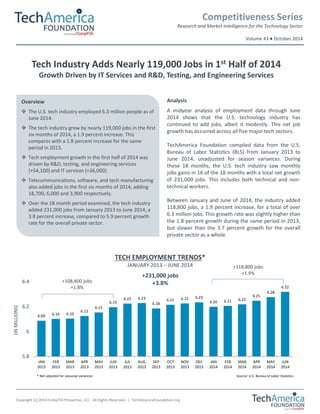
A midyear analysis of employment data through June 
2014 shows that the U.S. technology industry has 
continued to add jobs, albeit it modestly. This net job 
growth has occurred across all five major tech sectors. 
TechAmerica Foundation compiled data from the U.S. 
Bureau of Labor Statistics (BLS) from January 2013 to 
June 2014, unadjusted for season variances. During 
these 18 months, the U.S. tech industry saw monthly 
jobs gains in 16 of the 18 months with a total net growth 
of 231,000 jobs. This includes both technical and non-technical 
workers. 
Between January and June of 2014, the industry added 
118,800 jobs, a 1.9 percent increase, for a total of over 
6.3 million jobs. This growth rate was slightly higher than 
the 1.8 percent growth during the same period in 2013, 
but slower than the 3.7 percent growth for the overall 
private sector as a whole. 
Overview 
 The U.S. tech industry employed 6.3 million people as of 
June 2014. 
 The tech industry grew by nearly 119,000 jobs in the first 
six months of 2014, a 1.9 percent increase. This 
compares with a 1.8 percent increase for the same 
period in 2013. 
 Tech employment growth in the first half of 2014 was 
driven by R&D, testing, and engineering services 
(+54,100) and IT services (+36,000). 
 Telecommunications, software, and tech manufacturing 
also added jobs in the first six months of 2014, adding 
18,700, 6,000 and 3,900 respectively. 
 Over the 18 month period examined, the tech industry 
added 231,000 jobs from January 2013 to June 2014, a 
3.8 percent increase, compared to 5.9 percent growth 
rate for the overall private sector. 
Competitiveness Series 
Research and Market Intelligence for the Technology Sector 
Volume 43 ♦ October 2014
14,500 
2,500 
21,100 
28,500 
41,900 
29,400 
3,800 
-43,100 
29,300 
10,700 8,900 
60,000 
40,000 
20,000 
0 
-20,000 
-40,000 
TECH EMPLOYMENT GROWTH* 
AT 6, 12, AND 18 MONTHS 
+118,800 jobs +122,600 JOBS +231,000 JOBS 
6,317 6,317 6,317 
6,400 
6,300 
6,200 
6,100 
6,000 
Copyright (c) 2014 CompTIA Properties, LLC. All Rights Reserved. | TechAmericaFoundation.org 
-35,200 
6,700 
12,700 
28,900 28,200 
42,200 
-60,000 
FEB 
2013 
MAR 
2013 
APR 
2013 
MAY 
2013 
JUN 
2013 
JUL 
2013 
AUG 
2013 
SEP 
2013 
OCT 
2013 
NOV 
2013 
DEC 
2013 
JAN 
2014 
FEB 
2014 
MAR 
2014 
APR 
2014 
MAY 
2014 
JUN 
2014 
CHANGES IN TECH EMPLOYMENT FROM PREVIOUS MONTH* 
JANUARY 2013 – JUNE 2014 
* Not adjusted for seasonal variances Source: U.S. Bureau of Labor Statistics 
TechManufacturing 
Tech manufacturing employment in the United States 
increased in the first six months of 2014, adding a net 
3,900 jobs or 0.3 percent growth for a total of 1.1 
million workers. 
When examining tech employment over the past 12 
months, from June 2013 to June 2014, tech 
manufacturing experienced a net decrease of some 
17,200, a drop of 1.5 percent. 
Over the 18 month period, tech manufacturing 
declined by 14,400 or 1.3 percent. 
Telecommunications 
The telecommunications sector comprises traditional 
wired and wireless carriers and their associated 
services, as well as Internet service providers (ISPs), 
web search portals, hosting and related data services. 
The telecommunications sector experienced job growth 
of 1.5 percent during the first six months of 2014. 
Tech Services 
One of the most significant macro trends in the tech 
space is the on-going shift to an on-demand, agile 
services model. Software-as-a-service (SaaS), IT 
infrastructure-as-a-service (IaaS), and managed IT 
services, to name just a few. As a result, the sub-category 
computer system design and related services, 
which supports many of the aforementioned services, 
generated 35,100 new jobs during the first half of the 
year, representing a 2.0 percent growth. 
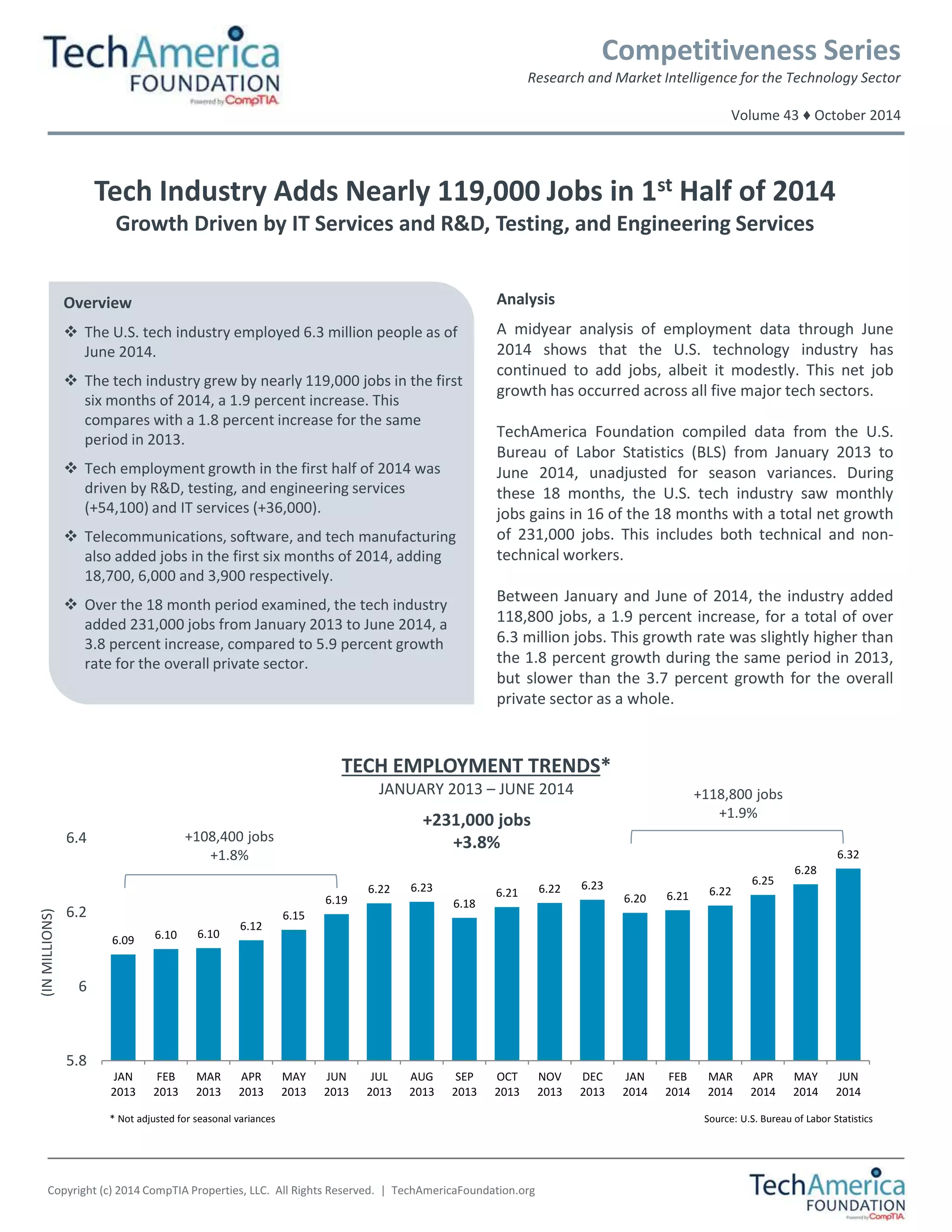
On a year-to-year basis, from June 2013 to June 2014, 
the tech industry added 122,600 jobs, a 2.0 percent 
increase. 
These BLS figures are not adjusted for season variations 
and include fluctuations that are only seen at certain 
times of the year. Seasonally adjusted data are not 
available for the entire tech industry. 
6,199 6,195 
6,086 
5,900 
6 Months 12 Months 18 Months 
(IN THOUSANDS) 
* Not adjusted for seasonal variances 
Source: U.S. Bureau of Labor Statistics
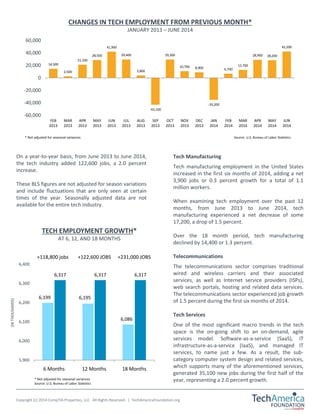
Software publishing continued its trend of employment 
growth in the first half of 2014, adding 6,000 jobs, a 2.0 
percent growth rate. IT services industry employment 
grew by 36,000 in the first 6 months of 2014 and grew by 
63,100 from June 2013 to June 2014, for a total of nearly 
1.9 million jobs. Over these same 12 months, IT services 
employment grew by 3.5 percent, compared to a private 
sector growth rate of 2.2 percent. 
The R&D, testing, and engineering services industry had 
the fastest employment growth rate of the all the tech 
sectors in the first half of 2014, growing by 3.2 percent 
and adding some 54,100 jobs. During the 18 month 
period of January 2013 to June 2014, this sector grew by 
96,800, a 6 percent increase. 
Tech Employment Compared to Private Sector 
While the tech industry has added jobs over the past 6, 
12, and 18 months, its job growth is slower than that of 
the overall private sector. 
From January to June 2014, the tech industry overall grew 
by 1.9 percent, compared to 3.7 percent growth for the 
private sector. Over the 12 month period of June 2013 to 
June 2014 tech grew by 2.0 percent compared with 2.2 
percent growth for the private sector. 
The most recent tech wage data from TechAmerica 
Foundation reveals that the tech industry pays on average 
98 percent more than the average private sector worker, 
$93,800 compared to $47,400. This represents a 
continuation of the long-term trend of tech wages 
growing faster than the overall private sector. Over five 
years tech wages increased by 5.6 percent, adjusted for 
inflation, compared with private sector wages dropping 
by 0.6 percent. More details about wages will be available 
in the upcoming Cyberstates report. 
1.20 
1.10 
TECH EMPLOYMENT MANUFACTURING* 
Copyright (c) 2014 CompTIA Properties, LLC. All Rights Reserved. | TechAmericaFoundation.org 
TECH EMPLOYMENT BY SECTOR* 
(JANUARY 2014 vs. JUNE 2014) 
1,665,300 
1,719,400 
1,876,200 
1,126,600 
1,130,500 
1,286,900 
304,400 
1,840,200 
1,268,200 
298,400 
JAN 2014 JUN 2014 
SOFTWARE PUBLISHING 
TECHNOLOGY MANUFACTURING 
TELECOMMUNICATIONS 
R&D, TESTING, & ENGINEERING SERVICES 
IT SERVICES 
* Not adjusted for seasonal variances 
Source: U.S. Bureau of Labor Statistics 
1.145 1.148 
1.127 1.131 
1.00 
JAN 
2013 
JUN 
2013 
JAN 
2014 
JUN 
2014 
(JANUARY 2013 – JUNE 2014) 
* Not adjusted for seasonal variances 
Source: U.S. Bureau of Labor Statistics 
(IN MILLIONS) 
Tech Sector Hiring Environment 
According to CompTIA’s Q2 IT Industry Business 
Confidence, 6 in 10 industry executives indicate it is 
challenging or very challenging to fill openings for 
technical positions. Additionally, 33 percent report 
being understaffed, while 42 percent are fully staffed 
by want to hire workers in order to expand. 
Data from the analytics firm, Burning Glass 
Technologies Labor Insights, suggests more than 
450,000 job postings were made by tech industry 
companies during the first half of 2014. This includes 
hiring for both technical and non-technical positions. 
Across all segments of the tech sector, demand is 
highest for software talent. This reflects the 
increasingly role software plays across every functional 
area of every business. 
Note: not all job postings lead to new hires. Conversely, 
companies may use a single job posting to fill multiple 
positions. As such, job posting data should be viewed as 
a guide for hiring intent in an industry, but not a 
definitive measure of job gains.
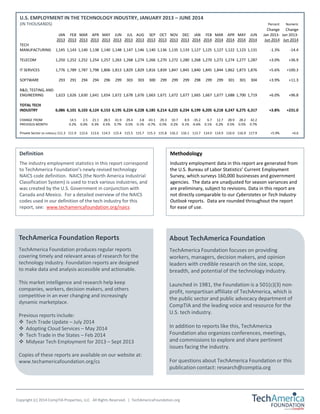
U.S. EMPLOYMENT IN THE TECHNOLOGY INDUSTRY, JANUARY 2013 – JUNE 2014 
(IN THOUSANDS) Percent Numeric 
Copyright (c) 2014 CompTIA Properties, LLC. All Rights Reserved. | TechAmericaFoundation.org 
Change Change 
JAN FEB MAR APR MAY JUN JUL AUG SEP OCT NOV DEC JAN FEB MAR APR MAY JUN Jan 2013- Jan 2013- 
2013 2013 2013 2013 2013 2013 2013 2013 2013 2013 2013 2013 2014 2014 2014 2014 2014 2014 Jun 2014 Jun 2014 
TECH 
MANUFACTURING 1,145 1,143 1,140 1,138 1,140 1,148 1,147 1,146 1,140 1,136 1,135 1,133 1,127 1,125 1,127 1,122 1,123 1,131 -1.3% -14.4 
TELECOM 1,250 1,252 1,252 1,254 1,257 1,263 1,268 1,274 1,266 1,270 1,272 1,280 1,268 1,270 1,272 1,274 1,277 1,287 +3.0% +36.9 
IT SERVICES 1,776 1,789 1,787 1,798 1,806 1,813 1,829 1,829 1,816 1,839 1,847 1,845 1,840 1,845 1,844 1,862 1,873 1,876 +5.6% +100.3 
SOFTWARE 293 291 294 294 296 299 303 303 300 299 299 299 298 299 299 301 301 304 +3.9% +11.3 
R&D, TESTING, AND 
ENGINEERING 1,623 1,626 1,630 1,641 1,654 1,672 1,678 1,676 1,663 1,671 1,672 1,677 1,665 1,667 1,677 1,688 1,700 1,719 +6.0% +96.8 
TOTAL TECH 
INDUSTRY 6,086 6,101 6,103 6,124 6,153 6,195 6,224 6,228 6,185 6,214 6,225 6,234 6,199 6,205 6,218 6,247 6,275 6,317 +3.8% +231.0 
CHANGE FROM 14.5 2.5 21.1 28.5 41.9 29.4 3.8 -43.1 29.3 10.7 8.9 -35.2 6.7 12.7 28.9 28.2 42.2 
PREVIOUS MONTH 0.2% 0.0% 0.3% 0.5% 0.7% 0.5% 0.1% -0.7% 0.5% 0.2% 0.1% -0.6% 0.1% 0.2% 0.5% 0.5% 0.7% 
Private Sector (in millions) 111.3 111.9 112.6 113.6 114.5 115.4 115.5 115.7 115.3 115.8 116.2 116.1 113.7 114.0 114.9 116.0 116.9 117.9 +5.9% +6.6 
Definition 
The industry employment statistics in this report correspond 
to TechAmerica Foundation’s newly revised technology 
NAICS code definition. NAICS (the North America Industrial 
Classification System) is used to track various industries, and 
was created by the U.S. Government in conjunction with 
Canada and Mexico. For a detailed overview of the NAICS 
codes used in our definition of the tech industry for this 
report, see: www.techamericafoundation.org/naics 
Methodology 
Industry employment data in this report are generated from 
the U.S. Bureau of Labor Statistics’ Current Employment 
Survey, which surveys 160,000 businesses and government 
agencies. The data are unadjusted for season variances and 
are preliminary, subject to revisions. Data in this report are 
not directly comparable to our Cyberstates or Tech Industry 
Outlook reports. Data are rounded throughout the report 
for ease of use. 
TechAmerica Foundation Reports 
TechAmerica Foundation produces regular reports 
covering timely and relevant areas of research for the 
technology industry. Foundation reports are designed 
to make data and analysis accessible and actionable. 
This market intelligence and research help keep 
companies, workers, decision makers, and others 
competitive in an ever changing and increasingly 
dynamic marketplace. 
Previous reports include: 
 Tech Trade Update – July 2014 
 Adopting Cloud Services – May 2014 
 Tech Trade in the States – Feb 2014 
 Midyear Tech Employment for 2013 – Sept 2013 
Copies of these reports are available on our website at: 
www.techamericafoundation.org/cs 
About TechAmerica Foundation 
TechAmerica Foundation focuses on providing 
workers, managers, decision makers, and opinion 
leaders with credible research on the size, scope, 
breadth, and potential of the technology industry. 
Launched in 1981, the Foundation is a 501(c)(3) non-profit, 
nonpartisan affiliate of TechAmerica, which is 
the public sector and public advocacy department of 
CompTIA and the leading voice and resource for the 
U.S. tech industry. 
In addition to reports like this, TechAmerica 
Foundation also organizes conferences, meetings, 
and commissions to explore and share pertinent 
issues facing the industry. 
For questions about TechAmerica Foundation or this 
publication contact: research@comptia.org

TechAmerica Mid-year Tech Employment Update

  • 1.
    Tech Industry AddsNearly 119,000 Jobs in 1st Half of 2014 Growth Driven by IT Services and R&D, Testing, and Engineering Services +108,400 jobs +1.8% 6.09 6.10 6.10 6.12 6.15 6.19 +231,000 jobs 6.22 6.23 +3.8% 6.18 6.21 6.22 6.23 6.4 6.2 6 Copyright (c) 2014 CompTIA Properties, LLC. All Rights Reserved. | TechAmericaFoundation.org +118,800 jobs +1.9% 6.20 6.21 6.22 6.25 6.28 6.32 5.8 JAN 2013 FEB 2013 MAR 2013 APR 2013 MAY 2013 JUN 2013 JUL 2013 AUG 2013 SEP 2013 OCT 2013 NOV 2013 DEC 2013 JAN 2014 FEB 2014 MAR 2014 APR 2014 MAY 2014 JUN 2014 TECH EMPLOYMENT TRENDS* JANUARY 2013 – JUNE 2014 * Not adjusted for seasonal variances Source: U.S. Bureau of Labor Statistics (IN MILLIONS) Analysis A midyear analysis of employment data through June 2014 shows that the U.S. technology industry has continued to add jobs, albeit it modestly. This net job growth has occurred across all five major tech sectors. TechAmerica Foundation compiled data from the U.S. Bureau of Labor Statistics (BLS) from January 2013 to June 2014, unadjusted for season variances. During these 18 months, the U.S. tech industry saw monthly jobs gains in 16 of the 18 months with a total net growth of 231,000 jobs. This includes both technical and non-technical workers. Between January and June of 2014, the industry added 118,800 jobs, a 1.9 percent increase, for a total of over 6.3 million jobs. This growth rate was slightly higher than the 1.8 percent growth during the same period in 2013, but slower than the 3.7 percent growth for the overall private sector as a whole. Overview  The U.S. tech industry employed 6.3 million people as of June 2014.  The tech industry grew by nearly 119,000 jobs in the first six months of 2014, a 1.9 percent increase. This compares with a 1.8 percent increase for the same period in 2013.  Tech employment growth in the first half of 2014 was driven by R&D, testing, and engineering services (+54,100) and IT services (+36,000).  Telecommunications, software, and tech manufacturing also added jobs in the first six months of 2014, adding 18,700, 6,000 and 3,900 respectively.  Over the 18 month period examined, the tech industry added 231,000 jobs from January 2013 to June 2014, a 3.8 percent increase, compared to 5.9 percent growth rate for the overall private sector. Competitiveness Series Research and Market Intelligence for the Technology Sector Volume 43 ♦ October 2014
  • 2.
    14,500 2,500 21,100 28,500 41,900 29,400 3,800 -43,100 29,300 10,700 8,900 60,000 40,000 20,000 0 -20,000 -40,000 TECH EMPLOYMENT GROWTH* AT 6, 12, AND 18 MONTHS +118,800 jobs +122,600 JOBS +231,000 JOBS 6,317 6,317 6,317 6,400 6,300 6,200 6,100 6,000 Copyright (c) 2014 CompTIA Properties, LLC. All Rights Reserved. | TechAmericaFoundation.org -35,200 6,700 12,700 28,900 28,200 42,200 -60,000 FEB 2013 MAR 2013 APR 2013 MAY 2013 JUN 2013 JUL 2013 AUG 2013 SEP 2013 OCT 2013 NOV 2013 DEC 2013 JAN 2014 FEB 2014 MAR 2014 APR 2014 MAY 2014 JUN 2014 CHANGES IN TECH EMPLOYMENT FROM PREVIOUS MONTH* JANUARY 2013 – JUNE 2014 * Not adjusted for seasonal variances Source: U.S. Bureau of Labor Statistics TechManufacturing Tech manufacturing employment in the United States increased in the first six months of 2014, adding a net 3,900 jobs or 0.3 percent growth for a total of 1.1 million workers. When examining tech employment over the past 12 months, from June 2013 to June 2014, tech manufacturing experienced a net decrease of some 17,200, a drop of 1.5 percent. Over the 18 month period, tech manufacturing declined by 14,400 or 1.3 percent. Telecommunications The telecommunications sector comprises traditional wired and wireless carriers and their associated services, as well as Internet service providers (ISPs), web search portals, hosting and related data services. The telecommunications sector experienced job growth of 1.5 percent during the first six months of 2014. Tech Services One of the most significant macro trends in the tech space is the on-going shift to an on-demand, agile services model. Software-as-a-service (SaaS), IT infrastructure-as-a-service (IaaS), and managed IT services, to name just a few. As a result, the sub-category computer system design and related services, which supports many of the aforementioned services, generated 35,100 new jobs during the first half of the year, representing a 2.0 percent growth. On a year-to-year basis, from June 2013 to June 2014, the tech industry added 122,600 jobs, a 2.0 percent increase. These BLS figures are not adjusted for season variations and include fluctuations that are only seen at certain times of the year. Seasonally adjusted data are not available for the entire tech industry. 6,199 6,195 6,086 5,900 6 Months 12 Months 18 Months (IN THOUSANDS) * Not adjusted for seasonal variances Source: U.S. Bureau of Labor Statistics
  • 3.
    Software publishing continuedits trend of employment growth in the first half of 2014, adding 6,000 jobs, a 2.0 percent growth rate. IT services industry employment grew by 36,000 in the first 6 months of 2014 and grew by 63,100 from June 2013 to June 2014, for a total of nearly 1.9 million jobs. Over these same 12 months, IT services employment grew by 3.5 percent, compared to a private sector growth rate of 2.2 percent. The R&D, testing, and engineering services industry had the fastest employment growth rate of the all the tech sectors in the first half of 2014, growing by 3.2 percent and adding some 54,100 jobs. During the 18 month period of January 2013 to June 2014, this sector grew by 96,800, a 6 percent increase. Tech Employment Compared to Private Sector While the tech industry has added jobs over the past 6, 12, and 18 months, its job growth is slower than that of the overall private sector. From January to June 2014, the tech industry overall grew by 1.9 percent, compared to 3.7 percent growth for the private sector. Over the 12 month period of June 2013 to June 2014 tech grew by 2.0 percent compared with 2.2 percent growth for the private sector. The most recent tech wage data from TechAmerica Foundation reveals that the tech industry pays on average 98 percent more than the average private sector worker, $93,800 compared to $47,400. This represents a continuation of the long-term trend of tech wages growing faster than the overall private sector. Over five years tech wages increased by 5.6 percent, adjusted for inflation, compared with private sector wages dropping by 0.6 percent. More details about wages will be available in the upcoming Cyberstates report. 1.20 1.10 TECH EMPLOYMENT MANUFACTURING* Copyright (c) 2014 CompTIA Properties, LLC. All Rights Reserved. | TechAmericaFoundation.org TECH EMPLOYMENT BY SECTOR* (JANUARY 2014 vs. JUNE 2014) 1,665,300 1,719,400 1,876,200 1,126,600 1,130,500 1,286,900 304,400 1,840,200 1,268,200 298,400 JAN 2014 JUN 2014 SOFTWARE PUBLISHING TECHNOLOGY MANUFACTURING TELECOMMUNICATIONS R&D, TESTING, & ENGINEERING SERVICES IT SERVICES * Not adjusted for seasonal variances Source: U.S. Bureau of Labor Statistics 1.145 1.148 1.127 1.131 1.00 JAN 2013 JUN 2013 JAN 2014 JUN 2014 (JANUARY 2013 – JUNE 2014) * Not adjusted for seasonal variances Source: U.S. Bureau of Labor Statistics (IN MILLIONS) Tech Sector Hiring Environment According to CompTIA’s Q2 IT Industry Business Confidence, 6 in 10 industry executives indicate it is challenging or very challenging to fill openings for technical positions. Additionally, 33 percent report being understaffed, while 42 percent are fully staffed by want to hire workers in order to expand. Data from the analytics firm, Burning Glass Technologies Labor Insights, suggests more than 450,000 job postings were made by tech industry companies during the first half of 2014. This includes hiring for both technical and non-technical positions. Across all segments of the tech sector, demand is highest for software talent. This reflects the increasingly role software plays across every functional area of every business. Note: not all job postings lead to new hires. Conversely, companies may use a single job posting to fill multiple positions. As such, job posting data should be viewed as a guide for hiring intent in an industry, but not a definitive measure of job gains.
  • 4.
    U.S. EMPLOYMENT INTHE TECHNOLOGY INDUSTRY, JANUARY 2013 – JUNE 2014 (IN THOUSANDS) Percent Numeric Copyright (c) 2014 CompTIA Properties, LLC. All Rights Reserved. | TechAmericaFoundation.org Change Change JAN FEB MAR APR MAY JUN JUL AUG SEP OCT NOV DEC JAN FEB MAR APR MAY JUN Jan 2013- Jan 2013- 2013 2013 2013 2013 2013 2013 2013 2013 2013 2013 2013 2013 2014 2014 2014 2014 2014 2014 Jun 2014 Jun 2014 TECH MANUFACTURING 1,145 1,143 1,140 1,138 1,140 1,148 1,147 1,146 1,140 1,136 1,135 1,133 1,127 1,125 1,127 1,122 1,123 1,131 -1.3% -14.4 TELECOM 1,250 1,252 1,252 1,254 1,257 1,263 1,268 1,274 1,266 1,270 1,272 1,280 1,268 1,270 1,272 1,274 1,277 1,287 +3.0% +36.9 IT SERVICES 1,776 1,789 1,787 1,798 1,806 1,813 1,829 1,829 1,816 1,839 1,847 1,845 1,840 1,845 1,844 1,862 1,873 1,876 +5.6% +100.3 SOFTWARE 293 291 294 294 296 299 303 303 300 299 299 299 298 299 299 301 301 304 +3.9% +11.3 R&D, TESTING, AND ENGINEERING 1,623 1,626 1,630 1,641 1,654 1,672 1,678 1,676 1,663 1,671 1,672 1,677 1,665 1,667 1,677 1,688 1,700 1,719 +6.0% +96.8 TOTAL TECH INDUSTRY 6,086 6,101 6,103 6,124 6,153 6,195 6,224 6,228 6,185 6,214 6,225 6,234 6,199 6,205 6,218 6,247 6,275 6,317 +3.8% +231.0 CHANGE FROM 14.5 2.5 21.1 28.5 41.9 29.4 3.8 -43.1 29.3 10.7 8.9 -35.2 6.7 12.7 28.9 28.2 42.2 PREVIOUS MONTH 0.2% 0.0% 0.3% 0.5% 0.7% 0.5% 0.1% -0.7% 0.5% 0.2% 0.1% -0.6% 0.1% 0.2% 0.5% 0.5% 0.7% Private Sector (in millions) 111.3 111.9 112.6 113.6 114.5 115.4 115.5 115.7 115.3 115.8 116.2 116.1 113.7 114.0 114.9 116.0 116.9 117.9 +5.9% +6.6 Definition The industry employment statistics in this report correspond to TechAmerica Foundation’s newly revised technology NAICS code definition. NAICS (the North America Industrial Classification System) is used to track various industries, and was created by the U.S. Government in conjunction with Canada and Mexico. For a detailed overview of the NAICS codes used in our definition of the tech industry for this report, see: www.techamericafoundation.org/naics Methodology Industry employment data in this report are generated from the U.S. Bureau of Labor Statistics’ Current Employment Survey, which surveys 160,000 businesses and government agencies. The data are unadjusted for season variances and are preliminary, subject to revisions. Data in this report are not directly comparable to our Cyberstates or Tech Industry Outlook reports. Data are rounded throughout the report for ease of use. TechAmerica Foundation Reports TechAmerica Foundation produces regular reports covering timely and relevant areas of research for the technology industry. Foundation reports are designed to make data and analysis accessible and actionable. This market intelligence and research help keep companies, workers, decision makers, and others competitive in an ever changing and increasingly dynamic marketplace. Previous reports include:  Tech Trade Update – July 2014  Adopting Cloud Services – May 2014  Tech Trade in the States – Feb 2014  Midyear Tech Employment for 2013 – Sept 2013 Copies of these reports are available on our website at: www.techamericafoundation.org/cs About TechAmerica Foundation TechAmerica Foundation focuses on providing workers, managers, decision makers, and opinion leaders with credible research on the size, scope, breadth, and potential of the technology industry. Launched in 1981, the Foundation is a 501(c)(3) non-profit, nonpartisan affiliate of TechAmerica, which is the public sector and public advocacy department of CompTIA and the leading voice and resource for the U.S. tech industry. In addition to reports like this, TechAmerica Foundation also organizes conferences, meetings, and commissions to explore and share pertinent issues facing the industry. For questions about TechAmerica Foundation or this publication contact: research@comptia.org