© 2017 The design of this presentation is the copyright of the author & was created explicitly for academic purposes only.
This work is licensed under a Creative Commons Attribution-NonCommercial-ShareAlike 4.0 International License.
Theme of cases &
Team-Based Project
that can be given to junior high schools
projects
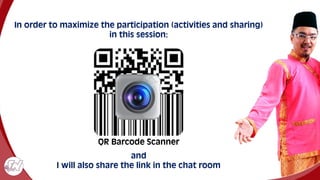
In order to maximize the participation (activities and sharing)
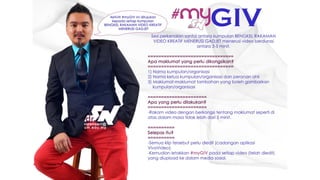
in this session:
QR Barcode Scanner
and
I will also share the link in the chat room
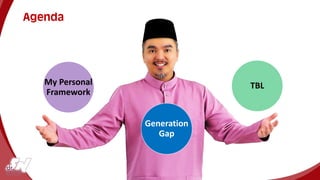
Agenda
Generation
Gap
My Personal
Framework
TBL
https://www.facebook.com/drsnpro
#drSNpro
ROUND
15-30
min
My Personal
Framework
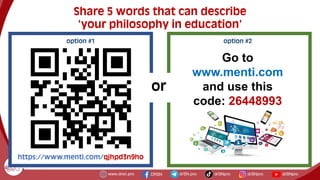
option #1
https://www.menti.com/qjhpd3n9ho
Share 5 words that can describe
‘your philosophy in education’
Go to
www.menti.com
and use this
code: 26448993
option #2
or
NEEDED
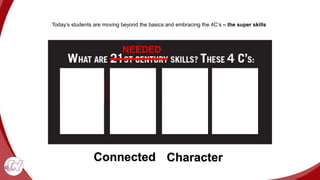
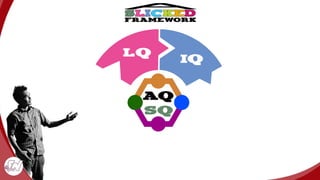
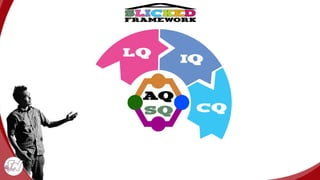
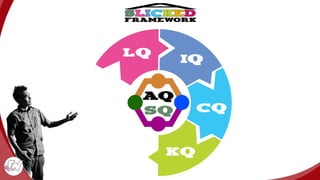
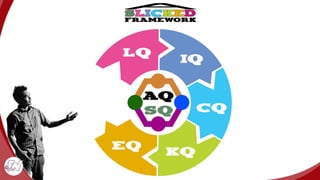
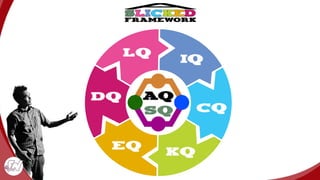
Today’s students are moving beyond the basics and embracing the 4C’s – the super skills
Connected Character
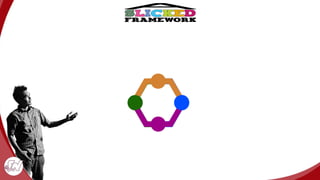
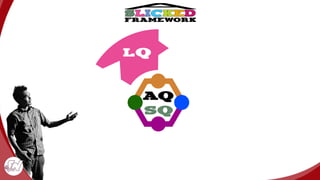
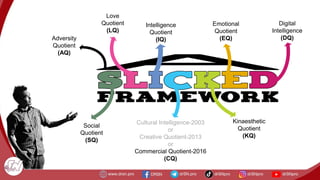
Love
Quotient
(LQ)
Intelligence
Quotient
(IQ)
Cultural Intelligence-2003
or
Creative Quotient-2013
or
Commercial Quotient-2016
(CQ)
Kinaesthetic
Quotient
(KQ)
Emotional
Quotient
(EQ)
Digital
Intelligence
(DQ)
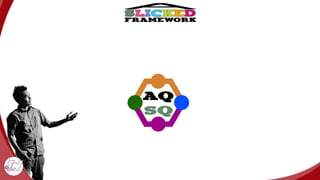
Social
Quotient
(SQ)
Adversity
Quotient
(AQ)
ROUND
15-30
min
Generation
Gap
option #1
https://www.menti.com/5k48nrxczh
Let's share our thought:
What can we describe about 'Generation Gap’?
Go to
www.menti.com
and use this
code: 28274807
option #2
or
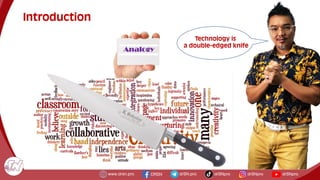
Introduction
Technology is
a double-edged knife
Introduction
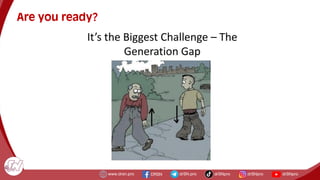
Are you ready?
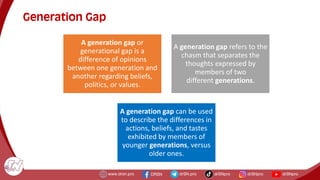
Generation Gap
A generation gap or
generational gap is a
difference of opinions
between one generation and
another regarding beliefs,
politics, or values.
A generation gap refers to the
chasm that separates the
thoughts expressed by
members of two
different generations.
A generation gap can be used
to describe the differences in
actions, beliefs, and tastes
exhibited by members of
younger generations, versus
older ones.
Generation Gap
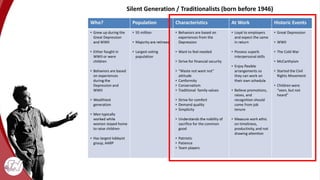
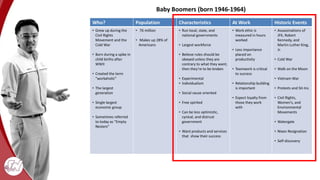
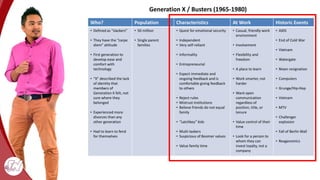
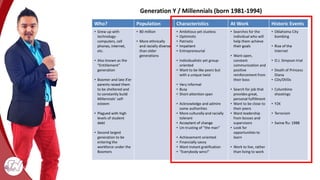
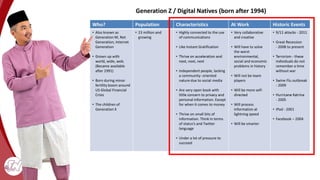
before 1900
Great Generation
Silent/Traditionalist
Baby Boomers
Generation X
Gen Y/Millennials
Generation Z
before 1900–1945
before 1946–1964
before 1965–1980
before 1981–1995
before 1995–2010
(oldest are 26 years old)
Experienced World War II
Civil Rights Movement, Cold War
Space Exploration, Civil Rights, Women's
Movement and the Environment
Computer, MTV, Vietnam, Berlin Wall Fall,
AIDS
Internet Rise, CD / DVD, Y2K, Terrorism
iPod, Facebook, web 2.0
Historical Events
Born
Sumber rujukan [Meet-the-generations]
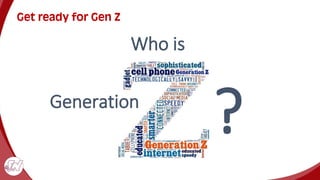
Get ready for Gen Z
Who is
?
Generation
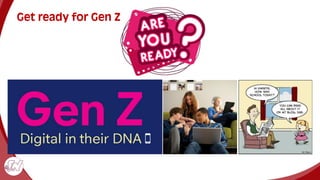
Get ready for Gen Z
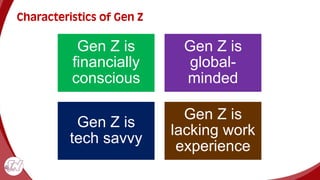
Characteristics of Gen Z
Gen Z is
financially
conscious
Gen Z is
global-
minded
Gen Z is
tech savvy
Gen Z is
lacking work
experience
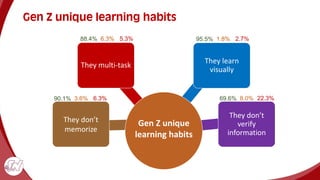
Gen Z unique learning habits
They don’t
memorize
They multi-task
They learn
visually
They don’t
verify
information
Gen Z unique
learning habits
88.4% 6.3% 5.3%
90.1% 3.6% 6.3%
95.5% 1.8% 2.7%
69.6% 8.0% 22.3%
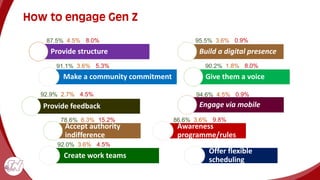
How to engage Gen Z
Provide structure
Accept authority
indifference
Create work teams
Make a community commitment
87.5% 4.5% 8.0%
91.1% 3.6% 5.3%
92.9% 2.7% 4.5%
Build a digital presence
Give them a voice
Engage via mobile
Provide feedback
Awareness
programme/rules
78.6% 6.3% 15.2%
92.0% 3.6% 4.5%
86.6% 3.6% 9.8%
94.6% 4.5% 0.9%
95.5% 3.6% 0.9%
90.2% 1.8% 8.0%
Offer flexible
scheduling
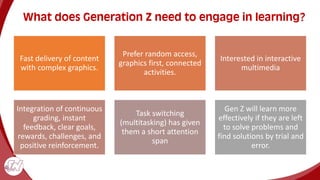
What does Generation Z need to engage in learning?
Fast delivery of content
with complex graphics.
Prefer random access,
graphics first, connected
activities.
Interested in interactive
multimedia
Integration of continuous
grading, instant
feedback, clear goals,
rewards, challenges, and
positive reinforcement.
Task switching
(multitasking) has given
them a short attention
span
Gen Z will learn more
effectively if they are left
to solve problems and
find solutions by trial and
error.
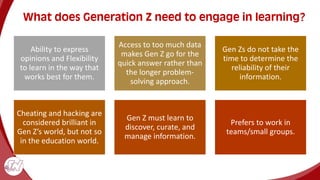
What does Generation Z need to engage in learning?
Ability to express
opinions and Flexibility
to learn in the way that
works best for them.
Access to too much data
makes Gen Z go for the
quick answer rather than
the longer problem-
solving approach.
Gen Zs do not take the
time to determine the
reliability of their
information.
Cheating and hacking are
considered brilliant in
Gen Z’s world, but not so
in the education world.
Gen Z must learn to
discover, curate, and
manage information.
Prefers to work in
teams/small groups.
“Didiklah anak-anakmu sesuai dengan
zamannya, karena mereka akan
hidup pada zaman yang berbeza
dengan zamanmu,”
-Saidina Umar-
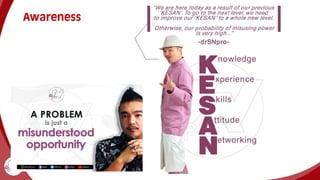
Generation Gap Awareness
Presentation in 2014
ROUND
45-60
min
TBL
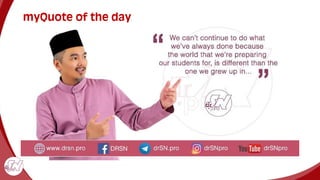
myQuote of the day
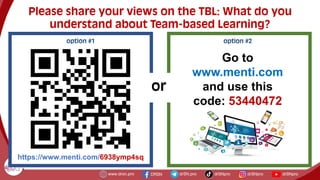
option #1
https://www.menti.com/6938ymp4sq
Please share your views on the TBL: What do you
understand about Team-based Learning?
Go to
www.menti.com
and use this
code: 53440472
option #2
or
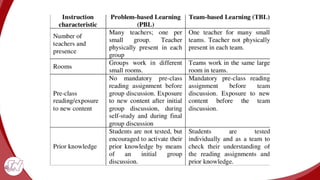
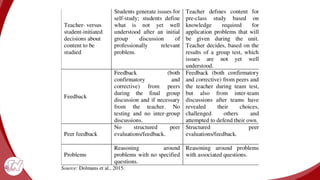
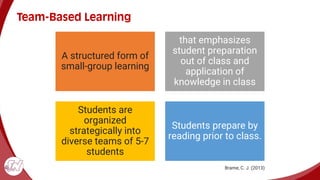
Team-Based Learning
A structured form of
small-group learning
that emphasizes
student preparation
out of class and
application of
knowledge in class
Students are
organized
strategically into
diverse teams of 5-7
students
Students prepare by
reading prior to class.
Brame, C. J. (2013)
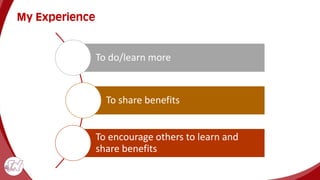
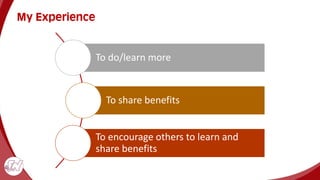
My Experience
To do/learn more
To share benefits
To encourage others to learn and
share benefits
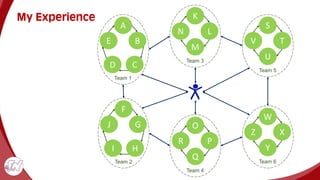
My Experience
To do/learn more
To share benefits
To encourage others to learn and
share benefits
K
N L
M
Team 3
O
R P
Q
Team 4
A
E B
C
Team 1
D
F
J G
H
Team 2
I
S
V T
U
Team 5
W
Z X
Y
Team 6
My Experience
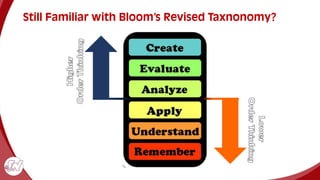
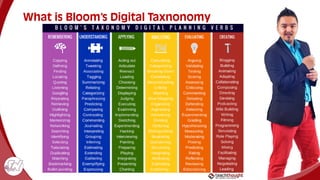
Still Familiar with Bloom’s Revised Taxnonomy?
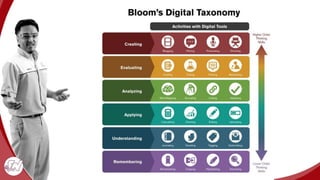
What is Bloom’s Digital Taxnonomy
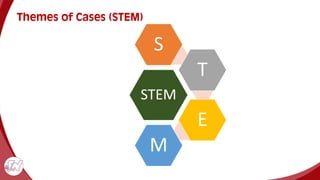
Themes of Cases (STEM)
STEM
S
T
E
M
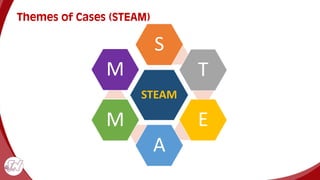
Themes of Cases (STEAM)
STREAM
S
T
R
E
A
M
STEAM
S
T
E
A
M
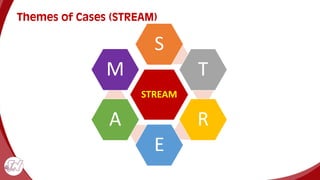
Themes of Cases (STREAM)
STREAM
S
T
R
E
A
M
Projects
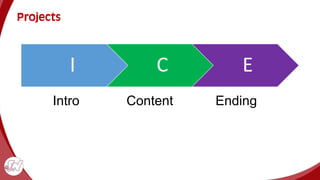
Projects
I C E
Intro Content Ending
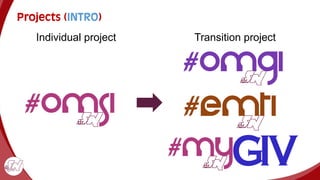
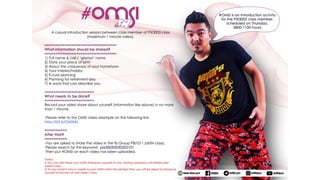
Projects (INTRO)
Individual project Transition project
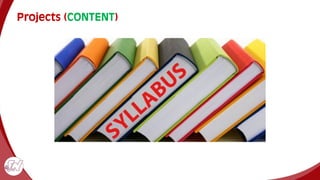
Projects (CONTENT)
Projects (ENDING)
reflection in group work
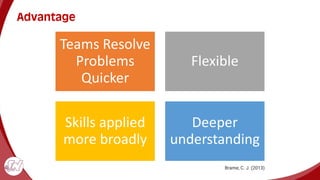
Advantage
Teams Resolve
Problems
Quicker
Flexible
Skills applied
more broadly
Deeper
understanding
Brame, C. J. (2013)
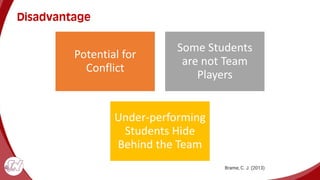
Disadvantage
Potential for
Conflict
Some Students
are not Team
Players
Under-performing
Students Hide
Behind the Team
Brame, C. J. (2013)
https://www.facebook.com/drsnpro
#drSNpro
Awareness
Conclusion
Team-Based Learning
Team-Based Learning

Team-Based Learning