2
TEACHING FISHING
FOR MANAGERS
‘Leadership Transformation’
By Doug Booker
Originally Co-authored by:
Charlene Dunfee, Ph.D.
& Rev. Jack Blansit
Original Copyright 2009 by Doug Booker
Revised & Republished 2014
3
All rights reserved.
ISBN-13: 978-1495964411
ISBN-10: 1495964418
(Available on KINDLE)
Kansas City
913.232.0244
www.bookertraining.com
Published by
Drambert Publishing Company
4
Table of Contents
Dedication p. 5
Purpose & Introduction p. 8
Leadership Conversation, Part I p. 13
Author’s Assumptions p. 26
Our Story, Part II p. 33
The Author’s Wrap-up p. 94
Connecting Concepts, Part III p. 96
Final Note / Conclusion p. 110
Your Author / Co-authors p. 113
Qs 4 U: Practical Application p. 118
5
“This book is dedicated to those who have
helped me learn, grow and laugh”
People & organizations who allowed me in their worlds to
help…
Gregg, Mark, Ed, & other clients and friends with
whom I have learned…
My perfect parents (great leaders and models)…
Graduate / Undergraduate students I’ve taught and who
taught me…
Ron Black, who led me to the Lord; Sydney who has led me
closer…
The U.S. Army and military leadership experiences…
Kansas State University ROTC cadets who allowed me to
teach them…
My two great kids who suffered my learning of leadership
in parenting…
6
INTRODUCTORY THOUGHTS
“Everything
Is about Relationships”
I hope you will find this book and those that follow to be
hugely beneficial in numerous ways. Much time, effort and
heart was put into this to be a practical and applicable
learning tool for you and/or your organization. For sure,
this book and the others to follow are about how leaders
grow individuals, teams and organizations. Our book
cover depicts a leader walking a tightrope all alone, so
There are biblical and spiritual thoughts and ideas
throughout that will be potentially bonus stuff for the
Christian and Believer. However, for any open-minded
thinker and learner, there is plenty of substance that will
help those who have any or no religious affiliation.
A good leader must listen to those who work for him and
bring out their best qualities. Some of Jesus’ disciples were
fishermen. He did provide fish and sustenance at times,
but also Jesus taught them to become fishers of men as
well. They had to follow Him; He was their Leader and
Guide, He was in charge, and He had power and influence.
Leaders must lead by example so that those who follow will
become an imitator of the leader and accept their
guidance, while emulating and acting in agreement with
his/her example. This is how organizations become full of
leaders and real organizational leadership develops from
top to bottom.
7
A good leader will not think of himself as more highly than
others, and he will not tolerate disrespect or lazy work
habits. He knows who he is and the position he is filling.
Jesus embodies the concept of good leadership, using
parables to instruct the people. The effective leader also
uses stories; we have provided a story here for you. A good
leader knows how to guide the action or opinion of those
who work for him or under him.
Matthew 5:16 says, “Let your light so shine before men,
that they may see your good works….”
My work here is intended to be about learning by first
creating an interest followed by an awareness of need
(motivation), a story, application and finally some tools to
make it stick. From start to finish, this short book and those
to follow will accomplish all this effectively in hopes of
making this a valuable resource for you.
If I am successful, hopefully, you will tell and share it with
others who are interested in learning about leadership and
people. This will make you a teacher of fishing as well!
8
PURPOSE & INTRODUCTION
“Without Direction, We Wander”
LEADERSHIP CONVERSATIONS: Teaching Fishin’ is the first
of a series of books to help all those who lead people. Each
of our books will begin with a discussion (or conversation)
about leadership, and each book will include a story that
offers skill development and practical learning (Part II).
This book and the entire series is applicable to leadership
development at work, church, school, parenting, teaching,
coaching—virtually any role that requires leadership.
Concepts, terminology and topics addressed within
include:
 Servant Leadership
 Teaching and Facilitating
 People-systems describes of a system of leadership,
teamwork, culture, relationship-building and
interaction.
9
 TEAMership represents the intricate dynamics of
working as a team and how these dynamics play out
from the executive level all the way across to the
entry level.
 Growing people includes developing their ability to
think and problem solve as well as increasing their
involvement in the organization. Ultimately this
positively impacts the individual’s self-worth and
overall value to the company.
 Personal Mastery
 Buy-in and Consensus building
 Mentoring
 Organizational Development
 Critical Thinking
I will mention this again, but let me emphasize that none of
this discussion is intended to suggest management or
managers are bad people. Sometimes people initially
believe I am targeting or attacking managers. This could
be no further from the truth. By the end of this book, I am
sure you will realize this. I sincerely love people. I find us
hugely amazing. I also have a lot of compassion for the
challenges managers face and the hopeless position most
are placed in with little to no training or preparation.
10
However, I also have a lot of compassion and empathy for
the zillions of people who have to be led by untrained and
therefore ineffective leadership. To that end, the purpose
of this book is to challenge the current thinking of people
responsible for developing leadership and essentially
organizations as a whole. For those not yet achieving
leadership positions, this could and should be a great
resource for not only understanding your management,
but to prepare you for your day in the sun! As I will get
into shortly, the fundamental premise of this book series is
to depict how our society leaves sound leadership up to
chance.
Once again, Part One of each book in our series provides a
leadership conversation surrounding the challenges that
individual leaders and organizations face. Part Two of each
book includes a story that takes place in a workplace
setting. In each case, the story is intended to serve as a
leadership lesson that enables anyone to become a better
leader. The lessons provide actual steps and approaches to
improve leadership. It’s my hope that these improvements
will happen instantly, especially if the lessons offered are
truly understood and consistently practiced.
Part Three of each book concludes with some author’s
notes that focus on practical application. The purpose of
11
these exercises is to make the connection between this
story, its applications and the leadership traits and qualities
covered in Part Two.
One important note before we move on to Part One: If you
are anything like me, you may like to skip around while you
read. Take my advice; this is not one of those books where
you can do that. This book is written in such a way that
one idea builds upon another. As for Part II, it simply
requires that you read it straight through.
You will also notice that there are several boxes sprinkled
throughout this book. In some cases, we have included a
question or statement to challenge your thinking. These
spaces are intended to provide you time to pause and
think, react, capture ideas, add reminders, or perhaps jot
down some action items.
Additionally, my style of writing is intended as a
comfortable, easy-to-read, conversational tone. My hope is
that you will feel you are a part of a dialogue with a trusted
friend and mentor. As with any good mentor, I will try to
challenge you, provide you food for thought and prod you
to think. Hopefully, this will enable you to become more
capable and skillful as a leader.
12
“Managers maintain current
processes and
The current relationships;
Leaders grow and improve
The processes, relationships and
their people.”
13
Part I
LEADERSHIP
CONVERSATION
“Leadership Conversations” is the first of a series of
thoughts and short stories about leadership that stem from
over 20 years as a leadership development consultant and
professor. The books and I are here to serve as your
personal leadership mentor and coach. This book and
subsequent ones are resources to keep nearby in your daily
work as a manager. They will also serve as books to help
you mentor others as you grow and become a leader and
teacher.
My hope is that with a bit of persistence and effort, you
may actually view this leadership thing as fun vs. work.
This series very easily could be used by organizational
management as a resource for developing leadership. I
hope that this can and will be used as a supplement to real
leadership coaching and mentoring by you and by those
who may be above you. It can be used for organizational
14
learning, mentoring, teaching, team meetings, reading
programs, workshops, discussions, training sessions, lunch
n’ learns, etc. Leaders in business, non-profits,
communities, churches, and wherever we find people
trying to work together to accomplish something will
hopefully benefit.
Let’s jump right in with a thought-provoking question:
Have you considered where you will receive leadership
training?
Consider the following possibilities:
Your boss. Nice try, but you and I both know that it’s very
likely your boss doesn’t possess much more skills or
learning about leadership than you do! Perhaps this
person has less expertise than you or has less tenure. Or
conversely, this person has much more tenure than you.
It’s still very likely that tenure won’t make much of a
difference. Think about it, where did he or she get their
leadership skills and wisdom? What developmental
process did he or she undertake? Right you are, who
15
knows! The reality is that your boss may have stumbled
around trying to do his or her best just as you are. As you
read this book, consider the possibilities if your past and
present superiors had read this and practiced the
concepts…
Human Resources. Well this may be a resource for
uncovering some workshops or resources that could be
interesting. However, even if you find time to go, who is
going to hold you accountable to develop those leadership
behaviors and skills discussed in the training? Learning
doesn’t work that way. Years of behaving don’t just
suddenly change because you heard that you should
participate in a management workshop! I have been on
the training end of this concept, and can tell you that if
there is no follow-up mentoring, reinforcement, or
coaching back at the office, this training makes no
significant difference.
Laments (bellyaching) from those you manage. Your staff
is very capable of pointing out your flaws and all the stuff
you aren’t doing well from their perspective. This may
indeed provide some insight, but I am not convinced that
this is about real development and behavioral change to
become a more effective leader. Actually, since most
managers experience this kind of input, and continue
remaining ineffective, I am positive that this isn’t how we
16
learn and change. Likely, your reactions to them are just
about altering some behaviors at that moment in time to
make this individual happy.
Advice from friends and family. Good luck with this
approach. These individuals may indeed be a decent
source of input, but again I would encourage you to
consider how they know anything about it? How much of
what you are hearing is truly valuable and useful? This
reminds me of Dave Ramsey (Christian financial speaker,
radio & TV host), who makes the point about how illogical
it is to get financial advice from people who are up to their
ears in debt!
17
LEADERSHIP & MANAGEMENT
(The Dilemma)
“When all other efforts fail,
Try developing your Leadership”
The dilemma here is that we all know when our leader is
not being a leader. However, when we are the leader, how
do we know how to practice sound leadership? I cannot
begin to tell you how many individuals and groups I have
spoken with over the years that believe they will be a good
manager just because…! This because is tied to a notion
that leadership is just “stuff” we all possess. And, if we are
nice, honest, good listeners, fair and treat people right,
then we inherently possess leadership skills—or something
like that.
I can assure you that the vast majority of those managers
that everyone complains about thought this very same way
before their management days. “When I get there, I will
ask people their opinion, listen, and help them,” they say.
Most of us honestly believe (or believed) that would be the
case. This is part of the dilemma, it doesn’t work that way.
18
There is more to leading folks than just being a good
person, trust me.
I will have to admit that the previously listed traits would
indeed make a nice start for effective leadership. To that
point, some of you may be thinking, “Yeah, I would take
just those things in my boss and be happy.” I hear you, feel
and understand your pain.
However, these few qualities just aren’t enough when the
pressures of management land on this previously awesome
employee! For the first time, you (the new manager or
supervisor) have just moved into a brand new skill set
which has to be learned from the ground up, for the most
part. And oh yeah, with no training! The reality is, again,
that this new manager is the least developed individual on
his or her team at that moment in time! Worse yet, this
weakest link on the team is the one looked to for all the
decisions--and he or she has a false sense of security in
making them!
So just how do organizations and our society allow
someone to end up in a supervisory or management role
without having the knowledge or skills to lead? Think
about it for a moment here….
Well... Can you relate to this dilemma?!
19
Where did the managers around you get their training and
leadership development? If you are a manager now, where
did you get your training?
Many of you received your training from what we will call
“The Land of Assumptions” (a place where people assume
that leadership comes along with the development of
technical, business, or operational experience).
*Sorry but this gets just a tad bleaker before it gets
better. Hang in there, there is hope. 
20
What does all of this have to do with your current position
in life and work? Are you a manager now or planning to
become one soon?
WHAT ARE YOU THINKING RIGHT NOW?
This is the essence of what this book is about, a focus on
what leading people is all about, and why we all struggle
with and maybe even hate managing people. For current
managers, supervisors and yes, even the executives out
there, the answer is very simple--you never learned how.
21
Think about this for a moment. Pick something in your life
that you enjoy doing and have become skilled at doing. Do
you have something in mind? Would you or could you
have ever learned to do it (much less enjoy it) if you hadn’t
first learned how? Would we just throw a welder into a
critical welding job without teaching him or her how to
weld? Would we place someone in a financial consultant
job without training them how to do it?
Yes, there is the argument that some people are natural
born leaders. For now let’s just accept that just as there are
not many piano aficionados, there are also not many
managers just born with natural leadership ability. This is
why we don’t see many of either one!
And yet, we take this awesome, respected and productive
welder, and give him a few years to gain some seniority
and expertise, and then declare him to be the new welder
supervisor. It’s as if the company says, “Here ol’ great
welder, you are now in charge. Here are your 10 people.
Now go screw them up!”
In my teaching and consulting profession, I frequently
explain this dynamic to people with a simple discussion
that goes like this:
22
In organization after organization that I consult and assist
with developing and improving their “people-system,” I
discover the same common approach to leadership. The
company is attempting to improve productivity, solve
quality issues, resolve conflict and/or increase profitability
with untrained leadership and management. These people
know their stuff when it comes to technical and business
issues, but have never been trained for leadership roles.
This scenario is perpetuated through the years. It’s no
wonder so many people become frustrated with
management!
Repeatedly, the same ol’ story plays out: An individual is
there for a long time, has done a great job, learned all the
technical aspects, the operational processes and services -
so surely this person will be an effective manager.
SURPRISE! It rarely works out that way, now does it?
Here’s a more typical outcome: This new leader suddenly
discovers that being a supervisor is not so easy after all.
“My technical know-how doesn’t seem to get me anywhere
with these people. They don’t seem to appreciate me
being in their face telling them how to do their job. Not
only that, I seem to now have a lot more people problems
and no one cares about mine! What’s going on? Nothing
23
seems to work with this unappreciative and unmotivated
bunch!” Sound familiar?
Before long, this previously cooperative, dependable and
knowledgeable employee (now supervisor) becomes public
enemy number one, as threatening, intimidating and
hollering become the preferred communication technique.
“Why don’t they just do what I say and respect me? After
all, I am their boss!” There is a lot of mumbling and
grumbling about how this person has forgotten where he
came from, and who his friends are. “I am not a bad
person, why isn’t this working?”
Consider this quote as part of the solution:
“People don’t care how much you know until they first
know how much you care!”
In many ways, this dilemma is the same one that challenges
small businesses (and by the way, all big ones started out
as a small business). Think about it, once again people are
attempting to lead with a skill set that is all about the
technical and operational knowledge of the service or
product. However, management has little regard for the
importance and relevance of leadership and management
concepts. This brings us back to the point that leadership,
24
people skills and managerial concepts are the assumed
skills and qualities that are only considered well after-the-
fact, when things begin to go badly. More than likely,
these issues come to light after the company’s initial burst
of success, growth, and increased earnings. However,
when the dust settles, the powers that be realize that there
is more to running a business than producing a product or
providing a service! Usually, this realization happens way
too late in the game. What results are damaged
relationships, blurred roles, conflict, apathy, distrust,
unhappy customers and people who just don’t want to
come to work—much less work for the unskilled manager.
This is why I feel compelled to push the following quote on
managers:
“People don’t care how much you know until they first
know how much you care!”
Think about it! What got you here, what you know
technically or operationally, is not what will take you into
the future as a successful leader. That’s why the purpose of
this book series is to offer mentoring tools and
development strategies for both the organization and the
individual manager.
25
Are you thinking? (Consider capturing what is on your
mind at this moment!)
26
ASSUMPTIONS:
My thinking & beliefs:
Before we continue any further, you should know what
assumptions are being made as I put myself out here to
serve as your mentor. Since we haven’t met and maybe
won’t anytime soon, we definitely need to clarify a couple
of things. Without this mutual understanding, your
acceptance of what is provided here will be limited and you
will find little value in what I have presented. I assure you
that these assumptions are valid, 99% accurate, indicative
to your organization’s culture and pertinent to our
conversations. So here are the assumptions for your
consideration. Please read these and see if we are indeed
on the same page.
This book and the subsequent books are based upon these
assumptions about leadership, culture, teams, individuals
and organizations. I provide no research or references for
validation. I also reference these assumptions as if they are
facts.
These assumptions are not presented in any particular
priority or order of importance. The concepts in this book,
along with these assumptions are completely relevant to
any and all aspects of our society. I also acknowledge that
there are many exceptions out there.
27
1. Ineffective organizational management impacts
culture, productivity, morale, and the bottom line to
the tune of about 15%-25%. This means that if the
organization truly developed leadership in its
management personnel, the organization would see
an increase of 15%-25% in these crucial areas. FYI: I
think this number is actually more like 40%, but let’s
just say this number is just15%. What would this
mean to your bottom line?
2. The organizational leader at the top, (CEO, President,
GM, Plant Manager, etc.) has everything to do with
the effectiveness, climate and productivity of the
organization (or team). Leadership is a top-down
concept. The way we are lead determines and
influences how we will behave. If the leader at the
top is not a leader, very little effective leadership is
happening. This is true for the entire organization or
small business.
3. Management is not about bad people, but bad
management is about counterproductive practices
95% of the time! A good person doesn’t necessarily
make for a good manager. I will acknowledge it is a
good foundation, but we still need the rest of the
house.
4. Management and managers are bad or marginally
effective at getting productivity and results from their
people. Effectively developed leadership makes a
difference. This is not only a matter of low
productivity, but also the primary cause for high
organizational turnover.
5. Flattening of organizations (which companies
attempt periodically during their existence) makes
total sense with the way organizations approach
leadership. Since management is typically the least
effective category of people in the workplace, who
28
else would we eliminate? After all, we can’t wipe out
a layer of folks that are actually adding value can we?
6. Most people believe that leadership, relationship
building and teamwork are simple concepts and
common sense stuff. Most of us are never really
taught these dynamics. The workplace expects
people to practice them effectively regardless. It
makes no sense to expect people to perform without
training first.
7. Increasingly, workplace leadership worsens as the
family deteriorates. In today’s culture, fewer people
grow up with strong leaders in the home. Couple that
with a deteriorating educational system and you have
a culture of broken individuals who lack the people
skills to manage effectively.
8. Most people exist within a work environment that
they do not appreciate, enjoy or care about. The
result is less than stellar productivity on their part.
Most folks complain about their job and their boss
more than any other relationship.
9. Both leaders and followers in the workplace and in
society have become accepting and numb to
ineffective leadership. Most of us have accepted how
non-productive, unenthusiastic, and ineffective we
and those around us really are! We accept this
insanity as just the way it is and has to be (poor
relationships between individuals and departments,
conflicts and bottlenecks, poor attitudes, bad apples
and bad management).
10. The vast majority of managers have not considered
these assumptions. Management and HR
departments are for the most part ineffective and
incapable of identifying, hiring, growing, mentoring
and practicing leadership. This is logical, since they
29
came from this same ineffective model (set of
assumptions). If they don’t know it themselves, how
can they fix it?
11. Identifying and resolving conflict, dealing with the
problem folks and addressing bad relationships on the
team is the manager’s job. However, many managers
don’t get this and simply maintain the status quo.
12. Effective communication is what most organizations
focus on as their number one issue. In fact, ineffective
relationships are actually their biggest obstacle. Think
about this one for a moment.
13. Most organizations, if they do anything, will hire
people from the outside (consultants like me) to train
supervisors and managers in leadership. This is not
sustainable, since this learning is not reinforced back
at the ranch.
14. Culture is changed when leadership is changed.
Attitude, climate, environment, values and morale are
influenced and determined by those leading the
organization. Contrary to common belief, attitude is
not completely a matter of choice. This is a copout
used by managers with no leadership understanding
and capability. The leader is capable of ruining
someone’s attitude. Conversely, a leader can vastly
improve someone’s attitude given the skills and
training on how to do so. But, oh yeah, we didn’t
train the leaders to do this, did we?
15. Organizations periodically address these flaws of
leadership by trying every trick in the book, including
fad programs, things like throwing FISH, having MICE
MOVE CHEESE, PENGUINS falling off ICEBERGS,
motivational speakers, pizza n’ picnics, team building
workshops and every other imaginable gimmick to
raise morale and productivity. Nearly everything is
tried except the one thing that will truly cause
30
sustainable change--organizational leadership
development.
16. Companies go through quality programs as frequently
as they try new branding gimmicks in an effort to
make things better. The most important factor that
remains unaddressed is organizational leadership.
TQM, Six Sigma, Lean, and the other ones come and
go, most with minimal success because we skip or
gloss over the leadership factor which is the crucial
ingredient.
17. People do not naturally resist change as there is
nothing natural about an acquired immunity to
change. Past ineffective leadership (work, bosses,
school teachers, church, parents, etc.) has influenced
this resistance. With no knowledge of change
management, leaders just cram change down folks’
throats.
….and lastly,
18. Managers are charged with the thinking and decision
making, while those whom they supervise are
charged with the doing. If managers continued to be
hired based solely on what they know (about
operations, business or service), this dichotomy will
persist.
31
SO WHAT DO YOU THINK?
Seem kind of bleak? Now don’t go and get all depressed.
After all, if we have created awareness here, that’s a
positive. In learning and changing, we have to first
recognize the problem.
If we accept these assumptions to be generally true, isn’t it
amazing how teams, groups and organizations get
anything done? Once again, I remind you that as negative
as this sounds, this is not about bad people. It is about bad
stuff we are practicing in our workplaces and organizations
(of all types). Most managers are doing their best with very
little preparation.
I totally believe that most managers are good people trying
to do good things.
The first step in addressing leadership issues is addressing
these assumptions. Consider this for a moment: When
someone takes on a supervisory or management role, who
on that team now has become the most junior, untrained,
inexperienced individual on the team? It’s the new
supervisor who is in a brand new role, with no training,
development, experience or expertise in leading people.
As we wrap up Part I, The Conversation for this initial book,
32
let me leave you with this reality--entire organizations are
consumed with this leadership dilemma! How many
people are in leadership roles in your organization? Would
you agree that that accounts for a lot of untrained and
ineffective managers?
THOUGHTS ON THESE ASSUMPTIONS?
So that’s it for our first Leadership Conversation and
discussion. That’s plenty to soak up, ponder, digest and
maybe even act upon. Future books will also lead with a
discussion about leadership, prior to the short story which
follows next.
Hope you enjoy it!
33
Part II
‘‘TTEEAACCHHIINNGG FFIISSHHIINNGG’’
“Give a man a fish and
He eats for today;
Teach a man to fish and
He eats for a Lifetime!”
34
(BACKGROUND FOR OUR STORY)
Booker (known simply as “Book” to some) is a relatively
new senior executive at a company called, Tool Box Inc,
(TBI). He recently joined the organization after the
company spearheaded a lengthy search. Booker was
brought on board to take TBI to new levels, fix culture and
create leaders. In short, he would serve as a mentor to
senior-level managers.
DO YOU HAVE ANY MENTORS IN YOUR LIFE?
WHO IS HELPING YOU GROW IN YOUR
LEADERSHIP ROLE? ARE YOU MENTORING
ANYONE?
35
TBI manufactures toolboxes — the kind that you see on the
bed of pickup trucks. The company has been located in a
small community just outside of Kansas City, Missouri, for
nearly 50 years. Over the past decade or so, it has
employed between 850-1,000 folks.
Layoffs occur every few years and turnover has been an
issue for the last decade.
TBI began in J.C. Fisher’s garage 53 years ago. Fisher
started the organization from nothing. By the 1970s, TBI
had become very profitable. During this time, Fisher was
still president and pretty much the plant everything. He
epitomized how someone with ability discovered a niche,
began a company and grew it into a powerhouse.
However, poor leadership and management dynamics can
drastically wound any organization. This was the case with
TBI and J.C. as well.
36
THE NEW CLO
Hired as the CLO (Chief Leadership & Learning Officer)
about five months ago, Booker deemed TBI to be a fairly
normal organization. For Booker, normalcy meant
management was broken, as is the case in most
organizations. The management was untrained,
ineffective, disrespected, talked about, dictatorial and
lacked productivity on all levels! He realized that most
people considered this “broken-ness” as business as usual.
For Booker, that was unacceptable. So his role was to
begin a developmental process for organizational
leadership.
Booker understood that dysfunctional leadership,
departmental relationships, culture and teamwork do not
get fixed overnight. There was much work to do.
Fortunately, Booker had seen it and done it before with
other organizations. Prior to TBI, he had worked with
manufacturers, banks, churches, service-providers, utility
companies and government entities to bring about
organizational leadership.
37
His expertise and passion was to transform people into
leaders. If the organization was willing to commit from the
top, things could change. That’s why TBI was so exciting.
WHAT DO YOU THINK ABOUT TRANSFORMING
PEOPLE INTO LEADERS?
38
THE OTHER TBI PLAYERS
Booker is responsible for developing 12 managers:
 Phyllis is in charge of Training and Education for
TBI, with a staff of four.
 Rodney is the Quality Manager and supervises 10
coordinators.
 Ed serves as Booker’s understudy. This allows for
some redundancy in leadership development, a
move Booker thought would buffer the extreme
changes TBI would undergo.
 Jim is the Plant Engineer for Designs & New
Projects. He leads a group of engineers and design
specialists who focus on new initiatives, new
product, etc.
 Eight other managers report to Booker.
The only member of this cast of characters not yet
mentioned, is an old friend and professional associate of
Booker’s, known here simply as the “Professor.”
On some occasions, Booker invites the Professor to
mentoring sessions, crediting her leadership research and
theory (what Booker calls academia) with adding validity to
the lessons he teaches managers and supervisors.
39
One of these mentoring sessions is included a little later in
this book. For now we refer to this lesson as, “TEACHING
FISHING”. Teaching Fishin’ is teaching a method that
Booker believes in wholeheartedly. He claims it to be a
tremendous key to his own personal leadership success.
He believes this concept can cause any supervisor,
manager or executive to transform his or her management
style into leadership success.
JUST A BIT MORE ABOUT TBI & ITS LEADERSHIP
TBI is a very typical and traditional blue-collar company. Its
workforce, like most, is made up of pretty good people.
Supervisors and managers typically achieve their positions
because of their experience, seniority and expertise — like
95% of all organizations. Likely, this includes your
organization, right?
Throughout the years, there were also a few supervisors
and managers who had landed their positions because of
whom they knew, if you know what I mean. This hasn’t
been the case for a while now and likely won’t be an issue
with Mr. Gregg and Booker in place. However, there are a
few still around.
40
AUTHOR’S NOTE: For further clarification and to
ensure that we are on the same page here, the
expertise referenced here is the knowledge associated
with the technical, business, and operational aspects
of their jobs. The expertise they deal with, in this case,
is how to make toolboxes.
THOUGHTS?
41
Where our story begins…
Jim supervises four managers who oversee several
engineers, a variety of technical folks and design
specialists.
He deems himself as pretty successful, having achieved a
senior manager role, a nice title and good salary — all in a
10-year period. While he feels pretty good about these
accomplishments, managing people frustrates him deep
down and tries his patience. Jim’s conversations with
Booker about management revealed some pretty negative
feelings.
“Managing people is clearly not what I thought it would be,
and leading people is completely frustrating at times,” Jim
said. “They are so unappreciative. All I ever do is work on
their problems. I spend most of my days solving their
issues, not to mention their relationships and personal
conflicts. Why can’t they just do what we pay them to do?
Very few think for themselves and won’t make the smallest
decision without me.”
Booker was not surprised by what he was hearing as he
had heard it all before from other managers. This was the
exact sentiment he was trying to change.
42
Although Jim felt especially inept at fostering leadership
development among his four managers, he did his best to
provide whatever guidance he could, which meant
handing out fish on a regular basis.
To brush-up on leadership training, he read some books on
management and attended some training workshops
when the budget allowed, and if it was convenient, which
was hardly ever. He also encouraged his team to do the
same.
In today’s workforce, Jim is a pretty typical manager — as is
his ascent into management. He initially came on board as
a Fabrication Machine Operator. Afterwards, he spent
about five years working in several areas of the plant
before landing his first managerial role, which happened
after his own boss got canned for some “indiscretions.”
Jim is clearly one of the most respected and trusted guys at
the plant and continues to climb the ladder. Credited for
his creativity, work ethic, knowledge and openness to new
ideas, most everyone assumes he will become the next
plant manager.
In comparison to other managers around the company, Jim
is pretty good…again, in comparison. Booker’s goal is to
raise the bar, manager by manager.
43
ANY THOUGHTS ABOUT YOUR ORGANIZATION’S
LEADERSHIP EFFECTIVENESS………………………..OR
YOURS?
44
JIM’S WEEKLY MENTORING
SESSION & HIS BIG PROBLEM
One October Tuesday, Jim was attending his weekly
mentoring session with Booker. He couldn’t help but
wonder if these sessions were simply some new
management fad, or if they were here to stay.
Consequently, five months had passed and Booker’s
commitment to these leadership mentoring sessions was
obvious as he accepted very few excuses for non
attendance. Nevertheless, a few of Jim’s peers considered
it a waste of time and tried to avoid meeting. After word
got around that a few managers were chewed out for not
showing up, it became apparent that these sessions were
not to be blown-off.
The session begins… “Merry Christmas, Jim,” Booker said.
“Merry Christmas, Booker,” Jim echoed not quite sure why
they were having this particular exchange in mid-October.
Christmas is Booker’s favorite holiday. Every year, he beats
the major retail and big box chains in ringing in the
Christmas cheer. Conversely, he never acknowledges
Halloween or what that particular day represents. This has
raised a few eyebrows around the plant.
45
As for the leadership mentoring session that was taking
place, Jim was anxious to cut to the chase because he was
struggling with a problem in the paint department — a
problem that had been lingering for a couple of weeks.
The problem was impacting productivity, quality, and
internal dynamics as well as normal daily operations.
After the session ended, Jim was headed to another
meeting. Still recovering from hip replacement surgery he
had a few years back, he limped down the hall and played
back the morning’s session.
Among several things, Booker talked about his interest in
implementing lean manufacturing and asked Jim to attend
an upcoming seminar in December at the Kansas City
Sprint Center. Jim was looking forward to this as he had
heard much about this new entertainment and sports
arena.
However, something slowly began to bug him. It was
something that had struck him a few weeks back, and this
time it was eating at him a bit more than usual. Once
again, Booker had done something that most of Jim’s
buddies griped about behind Booker’s back. He never
seemed to help them solve problems. Instead, he always
answered a question with a question! This was the same
46
approach he used in response to Jim’s paint department
problem that morning.
“Why does Booker rarely give a straight answer?” Jim said
aloud to himself. “What’s up with that!?”
Many speculated that Booker’s questioning style was
because he was new to TBI and just didn’t know much. At
the same time, if he was insecure about his knowledge, or
ignorant in this new role, it certainly was not apparent.
Booker seemed very confident. People genuinely liked him.
Quite frankly, when it came to confidence, self-esteem,
security, and just working well with others, Booker was at
the top of his game.
DO YOU OR MANAGERS IN GENERAL COMMIT
THIS KIND OF TIME TO TALK TO TEAM
MEMBERS? CAN YOU, OR THEY, AFFORD NOT TO?
47
…and when should you begin the process of building
bridges and developing relationships when you’ve
started a new job or new position?
On the other hand, some questioned why the organization
hired an outsider to manage them anyway. After all, what
did he know about making toolboxes and how things
worked at TBI?
This seemed to be a pretty good question to Jim as well,
although he kept it quiet, intending to give Booker a
chance. Jim was careful to never reveal that he basically
shared the same sentiment about why an outsider was
needed. Nothing personal, he just wondered, why?
48
Still pondering the earlier dialogue and conversation with
Booker, Jim was confident that he clearly described the
situation, covered resource issues and bottlenecks,
pertinent dynamics, resulting conflicts, and other obstacles
related to this problem. He wanted Booker’s thinking and
input!
HE’S LOOKING FOR A FISH. I KNOW YOU MAY
NOT KNOW WHAT THAT MEANS, BUT WE’RE
GETTING TO IT. MAYBE YOU DO KNOW? 
Instead he heard, “I’m not sure what I would do Jim, what
do you think?”
Even more irritated with Booker’s response, or lack thereof,
he decided to go back and confront Booker. The meeting
he was supposed to be heading to would simply have to
wait. On a positive note, Jim was glad he had established a
comfort zone with Booker that allowed him to speak freely.
49
Despite his frustrations, Jim couldn’t help but feel that
these sessions could be doing some good.
As Jim headed to Booker’s office, he realized that he had
an inkling about how to solve the paint department issue.
“I think it will work…,” he mumbled to himself. “A little
affirmation from Book would be nice, though.”
Jim smiled politely as he passed Mildred, Booker’s office
assistant, and asked if Booker was in. Mildred pointed to
the door which suggested he could go in. As he lightly
tapped on the door, Jim spotted Booker on the phone so
he backed away and waited. After he heard Booker hang
up, he stuck his head in and said, “I need a couple minutes,
if you’ve got time.”
Booker motioned for him to come in, “Sure, what’s up? By
the way, did I wish you Merry Christmas, today?” pushing
candy Jim’s way.
“Yes, I believe you expressed your wishes once already,
today.” After an awkward silence, Jim said, “Book here’s
the deal…” Jim went through everything, including his
frustrations and as well as the others.’
He continued, “As I walked away, I replayed our discussion
and got pretty flustered. What really bugs me is why you
50
always give questions back instead of answers? You rarely
provide an answer or any kind of solution! Quite honestly,
I’ve heard others say the same things I’ve said — that it’s
pretty frustrating. Most of the time, you never seem to
have an answer. Instead, you just answer questions with
questions. It seems to me, if I did that with my four
managers, they would assume I didn’t know anything.
That’s supposed to be my job isn’t it, to know stuff and help
them solve problems? Shouldn’t I have the answers?”
Booker listened intently with a bit half grin, recognizing
this very discussion he had in past years with plenty of
other managers in leadership roles. He responded with,
“Jim, I’m kind of new, so it is a fact that I don’t know a
whole lot yet, but that’s not why I do it. Let me ask you,”
the smirk grows even wider, “Why do you think I do this?”
Jim shook his head and exclaimed, “See, that’s what I
mean. You didn’t answer my question!”
“Jim, relax. I was just kidding…Okay perhaps my timing
was a little off. Sorry.” Booker continued to smile as he
examined Jim’s disposition. “There is a viable purpose for
doing things the way I do, Jim. Asking questions is what
some people may consider as ignorance on my part.
However, I view this questioning technique as one of the
51
absolute greatest keys to whatever leadership success I
have had.” After a brief pause, he added with a big smile
on his face, “And since it’s the Season of Giving, I‘m going
to give you this key as a gift?”
Ignoring Booker’s humor, Jim said, “Not giving people
answers and helping them with their problems is leading?”
That’s leadership?”
“Yep,” Booker said as he reached over the top of his desk
and grabbed a file folder, slid back into his chair, leafed
through the papers and pulled one out.
“Jim, first of all, I’m really glad you felt comfortable enough
to come tell me about this. One of my goals with these
weekly mentoring sessions is to develop this kind of
comfort level with everyone.
“Although I’m dying to share everything with you right
now, it will have to wait until our leadership roundtable on
Friday, when we’ll have ample time to go through it all. As
for now, I’ve got to get to that Employee of the Month deal.
“
Booker handed Jim the piece of paper he had taken from
the folder, “Take this and read it between now and then.
The others will get a copy of this, too. Can you live with
that for now?” Jim nodded, as they headed out.
52
”By the way, make certain you find some quiet time to read
this article — and I mean really read it. Then, see if you can
figure out why it’s significant. Consider what it means and
how it connects to why you’ve been frustrated with me.
We’ll see what you and the others think on Friday!” Jim
nodded again.
As they both headed down the hallway, Booker said, “Jim, I
remember being exactly where you are right now. Believe
me, I do understand. Please realize and trust that there is a
method to my madness.”
Still irritated, Jim said, “If people would just do what they
are supposed to do, do a little thinking on their own and
quit expecting me to fix every dang thing…”
“Well first of all, if people just did that, what they were
supposed to do and were no trouble, then we’d be out of a
job,” Booker interjected. “It sounds like you just routinely
hand out fish…” Jim went on, not really paying attention to
the fish comment, “Managing isn’t very fun…it’s always
been a pretty thankless job around here. To tell you the
truth, there are days that I’m not sure why I’ve stayed in
management. I definitely understand why some people
don’t take supervisory positions when they are offered!”
53
“Everyone hits this phase and some never escape it! Once I
discovered the teaching fishin’ concept, everything I
thought about leadership changed,” Booker said as he
observed Jim’s reaction.
Confused, Jim said, “Teaching people, what?” We’ll talk on
Friday my friend,” Booker said.
WHAT DO YOU THINK TEACHING FISHIN’
MEANS?
54
BOOKER RECRUITS THE
PROFESSOR
Booker was chuckling a bit about Jim’s curiosity and
frustration. After the Employee of the Month presentation,
he plopped in his chair and pushed speed dial for the
Professor.
After just a couple of rings, the Professor answered,
“Booker, what’s up in your world and who have you been
harassing today? Or did you just call to harass me?”
“First and foremost, Merry Christmas!” laughing as he
spoke.
“Booker, it’s not even Halloween yet,” the Professor said.
Booker went on without any pause, “Yeah, so I’ve heard.
Hey, I’ve got a few managers frustrated with the fishin’
thing. Remember Jim, whom you met a couple months
back? I got him nibbling big time…I may need some help,
though.”
The Professor, who also loved teaching leadership and
developing people, took off rambling even before the last
word left Booker’s mouth. “Well you know I always have
something to say on the topic, but I’m a bit late for a
55
meeting. Worse yet, I’m supposed to be leading the
meeting!”
“Well, I will keep it brief,” Booker said. “If you can, plan to
attend Friday’s leadership roundtable ‘round 8:30.”
“I’ll be there,” the Professor said.
JIM READS THE ARTICLE
THURSDAY NIGHT
By close of business on Thursday, Jim had nearly
implemented the solution to his department’s big problem.
It appeared to be a real fix that could put operations back
to normal within a week. He felt pretty good about what
he had solved. After he made his rounds to let the night
shift people know he was heading home for the day, he
ducked into his office to grab his jacket. That’s when he
noticed the piece of paper Booker had given him.
He pondered whether to leave it or take it home to read
after dinner. Worn out from the late hours, he fell into his
chair. Tired yet curious about the fishing thing, he grabbed
his bifocals and read…
56
LEADER MOMENT #12 Feb, 1999
(An article on growing people, teams and organizations.)
This is a quote that may or may not be familiar to you, but
regardless, don’t discount it too quickly as just another quote. It
has extremely deep roots toward your success as a LEADER!
Give a man a fish
And he eats today.
Teach a man to fish and
He eats for a lifetime
I often find myself on this following topic of conversation with
leaders and managers (interestingly, it is normally the upper-
level leaders at the top of organizations, for some reason---but
applies to all of us as leaders). The conversation goes
something like this:
“Day after day, I have people lined up at my door
wanting to know this or that? What to do about this? How
to handle that? And on and on it goes…”
Now go back, read the quote above, and see if you see a
connection yet? The trap we fall into as leaders is attempting
to handle this and handle that, answer this, solve that, provide
a solution here and tell them how we should deal with this or
that. Is the picture getting more and more familiar to you? Do
you recognize this trap?
There is another real-life issue that causes us to fall into this
trap. TIME! It’s very efficient to just give answers rather than
to get our people to think. We say to ourselves, “The quicker
that I give him an answer, the quicker I can GIVE THE NEXT
GUY HIS or HER FISH. AND besides, isn’t that my job as the
leader-to do the THINKING?”
57
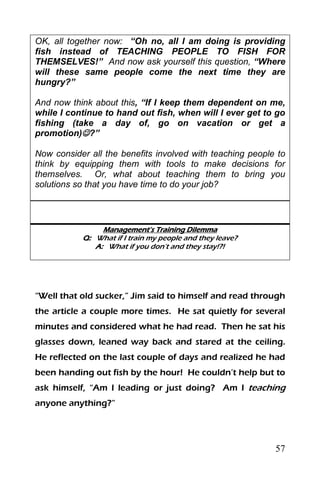
OK, all together now: “Oh no, all I am doing is providing
fish instead of TEACHING PEOPLE TO FISH FOR
THEMSELVES!” And now ask yourself this question, “Where
will these same people come the next time they are
hungry?”
And now think about this, “If I keep them dependent on me,
while I continue to hand out fish, when will I ever get to go
fishing (take a day of, go on vacation or get a
promotion)?”
Now consider all the benefits involved with teaching people to
think by equipping them with tools to make decisions for
themselves. Or, what about teaching them to bring you
solutions so that you have time to do your job?
Management’s Training Dilemma
Q: What if I train my people and they leave?
A: What if you don’t and they stay!?!
“Well that old sucker,” Jim said to himself and read through
the article a couple more times. He sat quietly for several
minutes and considered what he had read. Then he sat his
glasses down, leaned way back and stared at the ceiling.
He reflected on the last couple of days and realized he had
been handing out fish by the hour! He couldn’t help but to
ask himself, “Am I leading or just doing? Am I teaching
anyone anything?”
58
Talking to himself audibly, he continued, “I thought I had
solved the problem all by myself! Well, I guess I did, but
Booker forced me to solve it on my own by asking all those
WHAT IF, WHY and HOW questions…pretending he didn’t
have a clue. All the while, I’ve worked like a madman the
last 48 hours making sure this solution worked, because it’s
my butt on the ringer if it doesn’t. I should have read this
on Tuesday!” Jim wadded the article and aimed for the
waste basket. Missing his target made him think about
how he had been missing out on a lot lately, especially
when it came to managing people. It also occurred to him
why he was forced to cancel his last two vacations. Jim hit
speed dial #6 on his phone. Booker had insisted that his
personal code be the number six. It was something
connected to a command position code number used in his
Infantry Officer days.
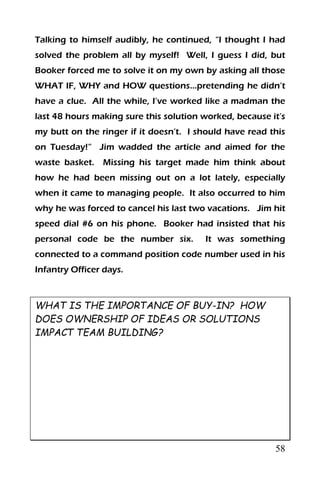
WHAT IS THE IMPORTANCE OF BUY-IN? HOW
DOES OWNERSHIP OF IDEAS OR SOLUTIONS
IMPACT TEAM BUILDING?
59
As Jim waited for the voicemail prompt, he realized that
Booker always managed to leave the office at a decent
hour. “I guess he can leave at a decent hour because he’s
taught people how to fish.”
After the voicemail prompt, Jim blurted, “You turkey! Why
didn’t you teach me this before? I realize you aren’t there,
but I just finished the article you gave me and I wanted to
say, ‘thanks.’ I get it now, I think. See you in the morning!”
60
TEACHING FISHING TEACHING:
(FRIDAY’S ROUNDTABLE)
On the way to Booker’s office the next morning, Jim’s cap
staging coordinator stopped him for help with an issue. As
with all dilemmas, Jim was expected to solve the problem —
or dole out more fish.
He had never taught the staging coordinator how to fish,
so the usual bucket-load of questions hit Jim no sooner
than he walked through the door. He even attempted to
use some teaching fishin’ techniques. Short on time, Jim
caved and simply handed out another fish.
As he continued to Booker’s, he put his cell phone on
vibrate and said, “It may take a bit, a few months or so, but
my people will learn how to fish for themselves.”
When Jim arrived, the Professor was there along with the
other 11 managers. The Christmas music that played
lightened the mood and made for a festive gathering.
“Jim, good to see you again,” the Professor said before
addressing the rest of the group. “You all have my
condolences for having to work with this guy,” she said,
61
gesturing in Booker’s direction. “Oh, and Merry Christmas
everybody! Now Booker, can you turn that down?”
pointing to the boom-box.
The Professor said that later she’d approach the teaching
fishin’ concept from an academic standpoint and then gave
the floor to Booker.
“Let’s get right into the real issue for today! To some
degree, all of you have been dealing with my ‘never giving
an answer’ thing. I trust everyone got the article I sent on
Tuesday? I had planned something a bit different for our
first leadership roundtable, but Jim dumped on all of
you…He said you were a little frustrated with me.” Booker
paused and waited for the group to confirm what Jim had
shared. Most everyone shook their head in agreement.
“The intent today is to cover this teaching fishin’ article
and concept,” Booker explained. “It’s something I learned
from my teacher and mentor a while back. I can’t take
credit for its origin, as it stems from a Chinese proverb,
‘Give a man a fish and he eats for a day; teach a man to fish
and he eats for a lifetime.’” Booker couldn’t help but
wonder if this Chinese proverb was inspired by teachings
from the Bible…
“I realize a couple of you have until 11:30, so let’s get to it.
Professor, would you like to kick things off?”
62
As she began to talk, Booker handed everyone another
copy of the article.
The Professor stood up without any delay, “I love the
theory, research, and the academic side of leadership and
management. Booker and I talk a lot about it. Now, before
Booker launches into this discussion, please take a moment
to re-read the article.” After a few moments, the Professor
asked, “So, what do you think?” Before she finished the
question, everyone was laughing.
Phyllis jumped in first, “Booker and I had a brief talk about
this yesterday. I have a couple of issues with this whole
practice of asking people what they think. This fishing
concept is reminiscent of various Bible teachings, but I
guess I’ve never really applied it to managing people. Most
of the time, I pretty much hand out fish. I think most of us
managers and supervisors do. But, if I change this all of a
sudden, I can literally see a mini-revolt happening. I
foresee attitudes from some, some really bad ideas coming
from others, and a couple of folks not having any thought
at all. I can also say there are a couple of guys who will
latch onto this. They want to make decisions and take on
more responsibility. Anyway, I’m not sure how to handle
this, or if I’m even ready to.”
“I’m with you, Phyllis,” Jim said.
63
“First off, let me assure you that by committing to teaching
fishin’, leadership dynamics will improve individual by
individual. At the same time, to learn this skill, we have to
be realistic about what you’ve expressed. There are some
definite realities that will play out with your people,”
Booker warned. “Ed, let’s say Joe comes to you, asking for
fish, because he has a problem. If you are practicing this
concept, your reply would be what?”
Ed thought for a moment and took a shot, saying, “I might
say, ‘Joe, I’m not really sure either, what do you think?’”
The Professor, Booker and a few others in the room agreed.
Booker continued, “It’s important that we understand some
of the ramifications with this approach. Let’s consider a
few of them:
“Time will definitely be your biggest challenge. It’s much
more efficient, on the front end anyway, to simply hand
out answers, or fish!” Booker paused briefly to allow the
group time to think before he continued.
“One possibility is that you’ll get some negative attitudes,
much like you’ve already expressed.
64
“A second possibility is that you’ll get a really dingdong
answer that you know won’t work. The third possibility is
that you’ll get a great response or idea that can work.
Maybe this great response or idea is one that you thought
about yourself.
SO HOW WOULD YOU RESPOND?
1. Negative Attitude:
2. A solution that you know for fact won’t work:
3. A solution that seems good and should work:
65
“Well, I can see all of these possibilities playing out and can
even picture which of my people would answer in these
different ways,” Rodney interjected. “Like Phyllis
mentioned, I can guess who will have the attitude, who will
struggle with good ideas, etc. But how do you handle the
bad attitudes? Take Jean for instance. You know she can
be a royal pain. She’s definitely going to be a problem.”
The group concurred.
Booker smiled, “She can be difficult. But you’ve also heard
me say that most people have attitudes for valid reasons.
Most of the time that attitude has been well earned
through ineffective, past leadership of one sort or
another…past managers, parents, teachers, etc. This is not
about you. Somewhere along the way, these people —
who we view as pains — were ineffectively led. Anyway,
back to the question you’ve posed. The art, skill and
practice of Teaching Fishin’ is not a short-term gig. After
all, how many of you bellyached to your buddies about me
over the last few months?” Convicted and embarrassed by
the question because it was certainly the truth, everyone
tried their best to avoid eye contact with Booker. “That’s
okay, trust me. But now that you’re wearing your
leadership hats, do you get the method behind my
madness?” The group agreed.
66
Booker continued, “Jim, the frustration and patience we
spoke about the other day will remain important qualities
and traits for you or any leader to employ on a consistent
basis,” Booker said as he looked at Jim and the others
around the room.
Then he turned his attention to Phyllis and Rodney, “I
suspect you’re right. Jean is a tough customer. But also
realize that everyone won’t be like Jean. Some will learn
and work with you rather easily — just as some of you will
buy into this concept quicker than others.
“So let’s continue with handling people with attitudes.
Let’s say you ask Jean the magic question and she comes
back with, ‘That’s your job to do the thinking. What are
you asking me for?’ This is where you must step up and not
respond emotionally. Remain level-headed. Then facilitate
the discussion until you get her to play along.” Booker
paused to glean the group’s reaction.
“Let me assure you, sooner or later Jean and those like her,
will play along because she wants to be involved. She and
others with similar tendencies don’t want to be left out.
They want to be a part of the solution. Just maybe Jean’s
personality type describes a couple of you right now sitting
around this table,” Booker said lightheartedly.
67
“Seriously, you can persist with a level-head when you get
attitude. It’s very critical that you don’t feed their
aggression and instigate an argument. Be a leader, teacher
and facilitator! Consider this: If you get into a fight and
end up making the decision anyway, you might as well go
back to handing out fish. Make sense?”
Booker allowed everyone a moment to think about what
was just said.
“It won’t be easy, that’s for sure,” Jim said. “I have at least
one Jean myself, but I’m with you so far. It’s do-able. So
we, speaking for the 12 of us, should work through their
attitude by engaging them in a conversation?”
The Professor responded immediately, “Absolutely. Now
let’s move onto the other two possibilities. This is where
your teaching, facilitating and coaching skills are needed
even more.” The Professor sat down, sipped her coffee and
allowed Booker to continue the discussion.
“So let’s go to the dingdong idea, the one you know won’t
work. When someone responds with a bad idea that can’t
work, what do you do? First, let me give you a clue: Your
response shouldn’t be, ‘That won’t work’. You want them
to figure out, through your facilitation and questioning,
68
why it won’t work. Your ability to decipher what works
and doesn’t work allows you to continue the facilitating
process. Let me add here, that once you begin using this
technique, you may not always know the answer…But,
being the teacher and facilitator you will know how to
navigate through the issue with your team until a solution
is uncovered.
So you respond with a question or a series of questions
which will lead the person to finally realize why their
suggestion won’t work. For example, Betty Sue might say
something like, ‘Wait a minute Jim, that won’t work,
because…” and she explains her reasoning.
“You must stay the course until, when?” Booker asked.
“Until she keeps eliminating alternatives that won’t work
and gets to the third option we discussed—a solution that
will work!” Jim said. “And we can manipulate or work the
dialogue by asking questions and navigating through
wrong answers until they arrive at something that will
work, right?” (Jim’s long-winded answer leaves him out of
breath.)
“Wait a minute, manipulation? Is that what we want to be
doing here?” Phyllis asked.
69
“Well, let me ask you this: Who says manipulation is a bad
thing?” the Professor added.
Most of the managers looked around at each other as Jim
said, “Well, it‘s a word we tend to think of in a negative
sense, but I guess…”
“It really isn’t,” Phyllis said abruptly. “It’s manipulation for a
positive outcome.”
“A loose paraphrase of Webster’s definition of
manipulation is managing or utilizing skillfully; to control
or play upon by insidious means especially to one’s own
advantage,” the Professor explained. “It may indeed have
roots in the negative, but can be used to accomplish what
we are doing here. I like to think of Teaching Fishin’ as
leading a person in a direction of understanding and
learning.”
Booker jumped in, “That’s a big part of why I like
processing stuff like this with the good doctor here. Gang,
don’t get wrapped up in the word ‘manipulation.’ For now,
let’s focus on the intended action or behavior. To state it
simply, we are asking leading questions to get to a
solution. In the process, we cause them to think and grow
70
along the way! Any time you teach a person to think, it’s a
good thing.”
Adding to the exchange, Rodney said, “So once they get to
the workable idea, we’re in a position to finally say, ‘Yes, I
think you’re right Betty Sue. That can work. Let’s do it.
Nice job.’ And guess who solved the problem? She did.
And that’s the point, right?” Rodney said.
The Professor and Booker agreed.
“When they do get it, let me point out something you don’t
throw into the mix,” Booker said, as he noticed the
intensity of the managers. “Many leaders, not fully
comprehending all this, might come back with, ‘Great, I
think you have something that will work. I was thinking of
something just like that, let’s do it.’ This is the one thing
you don’t want to do.”
DO YOU KNOW WHY?
71
Booker continued, “Many of us will want to add this little
bit at the end, indicating that we were also thinking of this
answer. Don’t go there! It needs to be all their idea or
solution. Out of insecurity, some leaders want to be part of
the solution. But why is this the wrong approach?”
“Ownership, bottom line,” Jim said. “It’s because we work
on our ideas harder than someone else’s, right? So let it be
theirs, all theirs. They’ll make it work, because if it doesn’t,
who bears the brunt of the responsibility? “
72
Before continuing, Booker made a quiet assessment of the
group. “Now think what this means to you as managers.
Think what it implies about being persistent and realizing
you are up against past management and managers
who’ve never asked people to think for themselves. You
will have to be committed to Teaching Fishin’ or it just
won’t happen. There will be too much resistance if you’re
not absolutely on board and committed to teaching all the
time.”
IT’S IRONIC HOW PEOPLE BELLYACHE ABOUT NOT
BEING INVOLVED UNTIL YOU ASK THEM TO
THINK AND THEN…?
(Your observations or thoughts!)
73
The Professor added, “If you think about it, this concept
speaks to the ineffectiveness of parents, teachers,
preachers and all people who have authority in our lives.
As Booker always says, this is not about labeling someone
as a bad person because they hand out fish. What it is
about is becoming a more effective leader.
When Book discovered this and began sharing it with me a
few years back, I actually adopted it in my classes at the
college. I can honestly say it has paid huge dividends in my
ability to educate my students and watch them learn and
grow. I facilitate and teach Fishin’ much more and lecture
a whole lot less, which makes teaching so much more
enjoyable. I guess I have Booker to thank for this,” she
said.
74
“Let me challenge your thinking a bit more. Consider what
I just said about facilitating vs. lecturing and how that
equates to your facilitating vs. dictating those whom you
manage. Chew on that for a minute. The parallels
between teaching and managing are amazingly similar,”
she concluded.
WELL, ARE YOU CHEWING?
Looking at Booker, Jim said, “I get all this and it seems like a
great difference-maker and practice, really, but…isn’t this
75
going to take a lot of our time? Time seems like a huge
factor in all of this.”
“I’ll take this one, Booker,” the Professor said. “Consider for
a moment if you leave things as they are and don’t employ
this practice?” After an intentional pause to allow
everyone time to think, a few of the managers looked up
and nodded. They understood where she was headed.
“Sure, it’s time consuming when you teach, but the results
are clearly measurable. Yes, time is one challenge. But an
accountable, thinking workforce creates consensus, a
positive work environment and individual fulfillment — not
to mention a more profitable company. However, your
level of commitment to this will determine your degree of
reward, as well as those whom you manage.”
Jim jumps in and adds, “Yeah and I wouldn’t have had to
cancel my last two vacations if I had taken the time earlier!”
76
SO WHAT ARE THE BENEFITS TO TEACHING vs.
GIVING FISH TO YOU? IS IT WORTH YOUR
TIME?
77
RELATING TEACHING FISHIN’
TO LEADERSHIP
“I have an idea. Let’s continue with a quick exercise,” the
Professor said. “Booker, what are those 15 traits and
qualities you always tell people that everyone says they
want in a leader?”
Booker headed to his desk and grabbed the list. He
handed one to the Professor and gave one to Mildred who
made copies for the group. “Thanks Mildred,” he said.
78
BEFORE CONTINUING ON AND SEEING BOOKER’S LIST…. HOW
ABOUT MAKING A LIST OF ‘WHAT YOU WANT IN A LEADER?
(Make a list of 10-15 traits/qualities, to YOU!)
1.______________________________________
2.______________________________________
3.______________________________________
4. ______________________________________
5._______________________________________
6. _______________________________________
7._______________________________________
8. _______________________________________
9.________________________________________
10._______________________________________
…Now don’t cheat! Jot down your own list
BEFORE turning the page. 
79
Three of the managers had to get to other obligations. Everyone
agreed that this would be a dialogue to continue and they could
be brought up to speed later. To the ones left, Booker continued,
“How about we process this over an early lunch?” Booker
suggested adding, “I’ll buy. We can fit into my car, and maybe one
other. John, you have that big van, can you drive?” John gladly
obliged.
The local café bar was a popular lunch spot for TBI personnel. The
group found a large table near the back and placed their drink
orders. While looking at the menus, Booker shared the
significance of the list. It was his intent, along with the CEO, to
create a set of leadership competencies to use as criteria at TBI. It
would become a standardized set of competencies used for hiring,
training, mentoring, performance evaluation, promotion, etc.
“This list is hugely important for your future development,” Booker
said. “These are the most common attributes associated with
leaders:”
80
What they all say!
A top 20 listing of what hundreds of groups of supervisors,
managers and executives have identified as the traits they want in
leaders; what the last 2500 people have said!
Look kind of familiar?
Involves
Cares
Understands
Open-minded
Honest
Fair / Consistent
Friendly
Listens
Respects
Clear Expectations
Asks Opinion
Supportive
Helpful
Works with Me
Coach / Teacher
Motivator
Firm
Decisive
Problem-Solver
Dependable
“Leadership is a trained individual and organizational skill, just like
any other technical skill, but maybe much more difficult to learn!”
“It’s not just common sense stuff that everyone possesses
naturally.”
“These traits, qualities and behaviors should become
Our agenda for hiring, training and development.”
81
After a bit more discussion about the list and its significance,
Booker pressed on, sensing they really had little time left to talk.
“Let’s start with an easy one: Teaching and Coaching. Obviously
this fishing deal is all about teaching and coaching people to fish
for themselves. It requires an understanding of facilitation, how
people learn, human behavior and how people think in order to
be a successful leadership trait.” Moving right along, he asked for
a volunteer to pick up with another trait.
Jim jumped right in, “How about Involvement and Caring.
Obviously by asking people what they think, you are involving
them at that moment. You are also creating a culture of individual
mindsets that think and act as a team. And I must care if I ask your
opinion and involve you in problem solving and decision making.
It says that I care about what you think and that your opinion is
important to me. Ultimately, they will realize that I cared about
them enough to help them develop and evolve.”
Changing directions a bit, Phyllis said, “Professor, I can’t help but
to assume how connected these traits must be to your world. Just
as this is key to leadership, managing, and facilitating in the
workplace, it also applies to teachers doesn’t it?
Both Booker and the Professor chuckled at the question, as they
had discussed this very point on numerous occasions.
82
Phyllis continued, “Well, I’ll jump to the bottom of the list and take
RESPECT. Respect plays out in a number of directions, like how I
respect your opinion and thinking when I ask you what you think.
Respect also becomes a part of our team and culture when we
listen and respect each other’s opinions. Respect plays out in how
I am perceived by my superiors and peers when they see what I
have created by growing people and teams.”
Another manager quickly filled in the blank, “We will have created
a team of fishermen or fisher-people to be politically correct. This
means we as a team will be better in all kinds of ways… I was
pretty skeptical about all of this, Booker, and haven’t said much
until now. This concept touches on productivity, continuous
improvement, job satisfaction and morale. It also has implications
for the group right here around this table. Just maybe, we’ll
become a TEAM for once.”
“Didn’t I tell you guys this fishing thing could be the key to your
future leadership success?” Booker said.
“What I’d like to know is what are you teaching over at the
college, Professor?” Phyllis inquired. “Tell us what the academic
world says about our role as a leader and about this fishing
concept?”
83
How do you think teaching in the workplace correlates to
teaching in the classroom?
84
THEORIES FROM THE PROFESSOR
Phyllis was barely finished with her question, when the Professor
said, “Well, since you asked…Research and theory happen to be
one of my passions. Feel free to stop me if you have any questions
or if I’m going too fast.
“I teach that values-based leadership is demonstrated when a
leader conveys their vision to the follower with integrity, trust,
open communication, and respect to the extent that the leader’s
vision becomes the follower’s. To some degree, I believe this is
what we are attempting to do with TBI.
“With me so far?” the Professor asked before she continued.
“Biographers described the Rushmoreans’ (Washington, Jefferson,
Lincoln, and Teddy Roosevelt) leadership characteristics as
courage, authenticity, integrity, vision, passion, conviction, and
persistence. They listened to others, encouraged dissenting
opinion among their closest advisers, granted ample authority to
their subordinates, and led by example rather than by power,
manipulation or coercion.
“However, courage was the most misleading of the virtues. Their
courage was not on the battlefield, but their real courage was
85
their moral fortitude. They were human in their behavior and
emotions, with weakness, foibles, vulnerable egos and even
embarrassing incidents in their pasts. They were not saints.
However, during periods of upheaval they never lost sight of their
goals or compromised their principles (O’Toole, 1996).
“Integrity for the Rushmoreans was simultaneously pragmatic and
principled as was the Declaration of Independence — specifically,
the unalienable right to the pursuit of happiness. This notion was
borrowed from Aristotle, who noted that all people have the right
for self development by virtue of their humanity. This value of
integrity has stood for over two centuries (O’Toole, 1996).
“An example of this was the heavy political price Jefferson and
Lincoln both paid for their opposition to slavery. In TBI’s case,
Booker will need to be a strong force and continue to be hugely
committed to deal with implementing a new set of leadership
competencies. People will resist when it is no longer just about
one’s technical expertise about toolboxes and operational
knowledge.”
After a brief pause, the Professor continued, “The Rushmoreans
trimmed and changed programs but never lost sight of their goals
or compromised their principles. Their integrity was evident. It
was based on the arduous course they sojourned, a course that
depicted what was morally right. I have yet to read anything
86
about Lincoln or Jefferson that indicted either one had wavered
from his convictions about the immorality of slavery. The
institution was wrong and they never lost sight of that overriding
moral principle.
“When leading people, trust is securing faith in the masses and
the masses with the leader. Booker is attempting to do that with
you. And you will have to do the same with your people.
“Back to the Rushmoreans: Washington wanted to bring
legitimacy to the presidency and wanted to be a servant of the
people. Leadership meant responsibilities not privileges. Most
people lead to meet their own needs, however, Washington led to
meet the needs of the people, proving people could rule without a
dictator or king (O’Toole, 1996).
“Roosevelt also had the right idea when he stated the best leader
is the one who has sense enough to pick good men or women to
do what he or she wants done, and the self restraint to keep from
meddling with them while they do what they do best (O’Toole,
1996).
“Well, any thoughts gang?” the Professor asked grabbing her iced
tea.
87
Jim jumped in with a question that pretty much amazed the
others. “How does this fishing concept relate to servant
leadership?”
“Servant Leadership is a concept I really relate to and focus on in
my studies,” the Professor said. “It has been described as requiring
the leader to provide the tools so that the follower may learn
leadership and thus become a leader.”
Booker added, “Let me point out that leadership and theory is the
Professor’s world. I just wanted her to give us some research to
help gain your buy-in about implementing this Teaching Fishin’
concept.
Booker, hoping the flow would continue, said, “Professor, tell
them what you know about the stewardship theory you often talk
about. Listen to this, you guys. I think this will help you connect
how all of this grows individuals and builds teams.”
The Professor was fully ready to continue on, especially with
another topic she researched routinely. “Nice lead-in Booker.
Acclaimed author and consultant Peter Block believed that
stewardship and partnership go hand-in-hand. Stewardship is
manifested by the accountability of people, while partnership is
demonstrated by taking responsibility of the process, which is the
journey.
88
Rodney, a bit perplexed asked, “Is the destination about the end
result of teaching others to fish and the journey about the process
we go through in doing the teaching?”
“I think you’re all over it Rodney,” the Professor confirmed. “Does
that make sense to all of you?” Everyone agreed, so the Professor
continued.
ANY THOUGHTS?
“Before we stop, let me add one more piece to this. Peter Senge
(American scientist and director of The Center for Organizational
Learning at MIT) stated that personal mastery was ‘the discipline
of continually clarifying and deepening our personal vision,
89
focusing our energies, developing patience, and seeing reality
objectively’” (Senge, 1990).
Phyllis asked, “Sorry to interrupt, do you mean personal mastery as
it relates to Jim, me and the others mastering how to teach this?”
“Precisely,” the Professor answered. “When personal mastery
becomes a discipline, two things happen. First, individuals
continue to define what is important to them. The path or vision
is redefined and the focus is on the path and not the problems
that occur along the journey. This means we must focus on the
process and be committed to people learning to fish, and not to
get bogged down by the obstacles along the way like people’s
attitudes. Yes, there will be hiccups and problems, but we must
persist in the teaching process. And it will definitely be a journey.
“The second thing that happens is that learning becomes a
current reality. People who have mastered their vision and the
current reality of the big picture have developed a clear ‘sense of
purpose that lies behind their visions and goals’ (p. 142). They
have learned to work within the system and deal with the
resisting forces. People who develop this discipline ‘live in a
continual learning mode’ (p. 142).
“Gang, I think we better leave it at that for now,” Booker said.
This has been an outstanding initial leadership roundtable.”
90
“I guess now it’s time for all of us to pull out our proverbial tackle
boxes, grab some of these tools and get ready to start teaching,”
Phyllis said. “Professor, thanks a lot for all of your input. I have
never been much into college, theory and all that school stuff, but
what you added was great.”
“I agree,” Jim said. “This has truly been an amazing morning.”
Clearly pleased with the outcome, Booker reminded everyone that
the next leadership roundtable would continue the second
Monday in November. After dropping off everyone at the plant,
he lingered a bit in the parking lot and phoned his pastor. Booker
knew Pastor Jack, whom he referred to as his spiritual touchstone,
would give him something to think about from a biblical
perspective.
After only a few rings the pastor answered. “Pastor, it’s your loyal
servant, Booker. Do you have a minute to talk?” As always, Pastor
Jack welcomed the call.
“Pastor, today was one of those breakthrough days…” Booker said
with exhilaration.
“Yeah? How so?” Pastor Jack asked.
“Well, the Professor and I shared the Teaching Fishin’ concept in
great detail with a handful of managers. And they were all over
91
it! It felt so good to introduce this principle to them, something
you know I feel very passionate about.”
“Book, I am glad that day one went so well.” The Pastor paused to
see if Booker caught his reference to day one. After a somewhat
lengthy silence, Booker sensed there was a point the Pastor was
intending to make.
“Day one, Pastor?” Booker repeated. “Remember when Peter
fished all night and caught nothing and Jesus admonished him to
cast his net into deeper waters? That was the last thing Peter
wanted to do because he was exhausted, frustrated, spent and
had given up. But he did as Jesus asked and caught so many fish
that the net nearly broke (paraphrase Luke 5:4-5).
“There will be days that you will have to encourage your team to
cast their nets into deeper waters because they, too, will be
exhausted, frustrated, spent and inclined to simply give up.
Perhaps the powers that be at TBI will also grow weary of this
concept and not quite understand your methods…”
“Pastor, I think I know where you are going with this. Today was
simply day one, albeit a great day one. And there will be days that
the managers may resist because of the challenges they face. But
it’s my responsibility to encourage them and the powers that be to
92
go deeper and dig their heels in when they feel like they’ve given
it all they’ve got,” Booker said.
“Exactly. Today was a good start. But it’s only the beginning. Be
prepared to cast your net into deeper waters, too. Remember, we
are all called to be fishers of men. Stay encouraged and let me
know how things are going.”
Booker replied, “Pastor Jack, I knew I could count on you to give
me more to consider. So glad I caught you and thanks for your
time. See you at church on Sunday.”
Inspired and wired after the group’s first leadership session,
Booker decided to take the rest of the afternoon off. There was
nothing that couldn’t wait until Monday. Plus, there was so much
to think about and pray about. And quite frankly, after all the
Teaching Fishin’ he had been doing over these past months, his
support staff wouldn’t miss him. They were fully capable of
thinking and making decisions for themselves. He made a quick
call to his boss to inform him and headed away from the plant.
Booker decided the perfect ending to this day would be to grab
his tackle box, head to the lake and just go fishin’.
93
Been fishin’ lately?
94
A WRAP UP FROM YOUR MENTOR,
I want to thank you for taking this journey and experiencing
this story with all of us. I hope you enjoyed the story and
appreciate you allowing us to share what we believe is truly an
absolute key to leadership success. I really do believe this is
applicable whether you are a CEO, mid-level manager, a church
leader or minister, a teacher or coach, or just assuming your first
supervisory role. Indeed, this is a skill, practice and habit that all
leaders should consider adding to their leadership tackle box!
I also hope that you will take a moment to envision this
Teaching Fishin’ concept as something that could even be bigger
than an individual leadership skill. Consider the magnitude of
both organizational and cultural changes if this practice was
consistently employed. Now consider that culture compared to
yours? What do you think?
I am sure that plenty of learning has just happened! Trust me,
it will take hold quickly, if and only if, you begin now to develop
this habit and practice the art of asking questions with those you
lead. Start right now. Stop answering and start asking!
INVOLVEMENT = COMMITMENT
This story and lesson is actually something I have shared with
hundreds and maybe thousands of people during my consulting
95
years. Dr. Charlene, Pastor Jack Blansit and I are indeed real
people and the authors of this book. I hope to see you in our
future stories (and mentoring) about lessons I have learned about
leadership. I wish you the best in your leadership pursuit, and
would welcome any and all input that you may have. Please feel
free to contact me anytime.
God bless you and those you lead!
Doug Booker
913.232.0244
doug@bookertraining.com
“The wind blows wherever it pleases. You
Hear its sound, but you cannot tell where it comes from or
where it is going. So it is with everyone born of the Spirit.”
JOHN 3:8
96
Part III:
Connecting to Management Stuff!
Within our story just completed, ‘Teaching Fishing’, we looked at a
listing of Leader Qualities/Traits that people want in their leaders.
This actually comes from thousands of people’s inputs during my
leadership training, consulting and/or academic classroom
environments. These are in fact the top 15 or so top ones that
made most everyone’s list. That tells me that these are indeed
what people want in you their leader!
In our story, we demonstrated how closely connected Teaching
Fishin’ supports the qualities of a leader list, and how practicing
Teaching Fishin’ will indeed develop anyone’s leadership skill set,
performance and behaviors. Here in Part III, we are presenting
you with further evidence regarding how the concept (Teaching
Fishin’) connects to accepted management concepts, beliefs, ideas
and programs.
If you are not already convinced, we feel certain this will
encourage you to employ Teaching Fishin’ strategies. We are
positive that you will discover that Teaching Fishin’ is a practice
97
that could improve any individual manager, community or church
leader; organizational management overall and/or an entire
culture!
So here are some of these popular management concepts,
programs, valid leadership principles, as well as recent
management-world fads. Hopefully you will see how these
further validate the book, story and mentoring you have just
experienced in reading this book!
These are in no particular order, and are just intended to be just
more food for thought, to add to the learning value here. We
think each of these brief synopses OF CURRENT MANAGEMENT
THINKING, PROGRAMS, ATTEMPTS, FADS, CONCEPTS,
ACTIVITIES, ETC will help tie into some of these activities or efforts
you and/or your organization have attempted in the past. It is
even possible you might be attempting some of these now or
pondering them for the future.
98
EMPOWERMENT
An overly used, seldom practiced term, which emerged about 20
years ago. Empowerment is still a term thrown around by
managers, trainers and consultants to motivate people. Take a
moment and just think how empowered your team or entire
workforce would be if you or your team taught FISHIN’ on a
regular basis?
YOUR THOUGHTS?
MOVING CHEESE
You are likely familiar with this book and change management
program brought into hundreds of organizations over the past
several years. It spoke of a couple of mice dealing with change
dynamics. This was one of those ever popular books that
organizations and managers connected with and brought to their
team or organization. It’s an enjoyable read with thought
99
provoking ideas, however books like this one come and go—and
we still have leaders not facilitating change effectively. We are
just saying here that TEACHING FISHIN’ is a behavioral practice
that will work and not merely be a concept. It is something that
doesn’t go away, but truly impacts positive change in a
sustainable way.
FOUND ANY CHEESE?
THROWING FISH AROUND
Oh yeah, while we are on popular books, here we go again with
another one of those fads that emerged several years back. It also
had a good message and intent, and still gets mentioned now and
then as a culture to try to emulate. Once again, good stuff, no
doubt. However it is likely to be one of those books, sets of
workshop materials or even a stuffed fish on shelves collecting
dust. When FISHIN’ is used and practiced, it fosters permanent
growth, behavioral change, enthusiasm, improvement, and a
more productive workplace.
100
DID YOU TRY THROWING FISH?
CONSENSUS
Consensus is indeed an awesome leadership practice. It is another
management belief which most leaders have heard about
somewhere along the line, but few ever really practice or come
close to mastering. For now, let’s just say that when TEACHING
FISHIN’ is practiced, we will have people involved and thinking.
Picture your team or organization, as thinkers and capable of
reaching decisions collectively. How would that impact decision
making?
101
YOUR THOUGHTS?
CRITICAL THINKING
Critical thinking is now a regular part of curriculum for Business
Management in many colleges and universities. Critical thinking is
identified by organizations as a skill all managers need in today’s
workplace and in these current challenging times. Think of what
it would mean to a team, company or organization to have people
who truly thought critically in problem solving? In most cases, it is
only the manager’s thinking that is really used. Little effort is put
into the development of thinking among their employees!
102
Think about that for just a moment and I believe you will see how
TEACHING FISHIN’ is exactly what this is about, teaching people
to think critically.
WHAT DO YOU THINK?
SUGGESTION BOXES
Suggestion boxes are those mostly ignored boxes on your walls
that someone believed to be a good idea. You and I know
however that they are simply symbols of distrust and
communication issues. Think about it, why do organizations put
these boxes on the walls anyway? Uh huh, that’s right, because
people can’t trust or feel comfortable talking to their boss, so
there is this anonymous place to deposit one’s ideas, complaints or
other communication. Why can’t people just talk to their leader?
The point is that if every leader was TEACHING FISHIN’ routinely,
we wouldn’t need these boxes on our walls, would we? Actually, I
hear they are pretty useful as ashtrays and litter collectors, so
don’t necessarily yank them down too quickly.
103
Trust, openness, creative discussions, and respect are all going to
be by products of this TEACHING FISHIN’ practice. Not only will
an organization have better ideas, but more ideas that have been
carefully considered. You will have ideas and solutions that move
productively through management that are actually implemented.
ANY SUGGESTIONS, without using a box on the wall?
WHY CAN’T WE COMMUNICATE?
Easily the biggest concern expressed by people, teams and
organizations overall. Anywhere I go to assist in organizational
leadership development, this is the very first issue identified. Let’s
just suffice it to say that if leaders are TEACHING FISHIN’, then
communication is going to happen everywhere, all the time, and
productively. As a side note, I have come to strongly believe that
COMMUNICATING is not really the issue, RELATIONSHIPS are!
Think about it, and then think how both (relationships and
communicating) are going to be drastically improved by the
practice of TEACHING FISHIN’.
104
HOW ARE YOUR RELATIONSHIPS ANYWAY?
TRANSFORMATIONAL LEADERSHIP
What is transforming anyway? Most of our thoughts about
transformation are about change, improving and getting to the
next level. So if that’s what transforming is, we are all over this
concept as we TEACH FISHIN’ and subsequently transform,
change and grow people, teams & organizations.
DONE ANY TRANSFORMING LATELY?
105
SIX SIGMA, LEAN & QUALITY PROGRAMS
All good stuff no doubt, focused on improving quality in our team
or organization. The common fundamental for successfully
implementing any of these includes the involvement and
development of people. Of course, most organizations skip this
step, more or less assume, “That’s a nice idea.” My guess is they
subconsciously assume this piece is in place. Yeah right!
Buy in by leadership, as well as employees, in general is part of
any successful implementation (which rarely happens, by the
way). You know this if you have suffered through any of these
types of initiatives (or maybe you are enduring one right now).
Regardless, if we have people and a workforce in place that is
accustomed to TEACHING (and learning) FISHIN’, and leaders
who know how to facilitate that teaching, these attempts will be
significantly easier to implement.
Work on all of that for a moment. Picture your workforce where
TEACHING FISHIN’ happens everywhere. Talk about QUALITY!
You and the organization may not even need to invest in some
quality program. Maybe it is already happening on every team, by
every leader, everywhere!
106
ANY QUALITY THOUGHTS HERE?
TWO HEADS ARE BETTER THAN ONE?!?
Organizations, managers and management don’t really get the
concept here. If they did, would we routinely make decisions
without involving others? I don’t think so…
DO YOU?
107
MANAGING vs. LEADING
This might be an easy, short one to deal with also. Let’s see, if
managers simply maintain what’s there, there’s no need to ask
people what they think, to improve things, or grow people and
teams. Leaders, on the other hand, are the ones that grow
people, teams, and organizations and achieve higher expectations
and visions. One huge way they do this is by TEACHING FISHIN’
on a regular basis!
ARE YOU LEADING OR MANAGING (maintaining)? HOW
ABOUT YOUR BOSS?
CHANGE MANAGEMENT
Everything we hear about change suggests we are to believe it is
just natural that people resist change. I don’t buy this, unless we
are saying, “In the absence of effective leadership, people will
naturally resist…” You see, at least for me, the resistance is the
108
result of past and current ineffective leadership. Now once again,
if our practice of TEACHING FISHIN’ is in place, this natural
tendency to resist simply wouldn’t be a factor as it is now. We
resist because we are not involved from the beginning. So yeah, I
will likely resist what you are cramming down my throat. If we
TEACH FISHIN’ routinely, change management happens routinely!
THINK ABOUT IT, IF I AM PART OF IT, I DON’T RESIST!
LEARNING ORGANIZATIONS
Learning organizations (and teams) will be what we are if we are
TEACHING (and learning) FISHIN’. Well, if you are struggling with
connecting here, I am just going to have to ask you to go back
and read this all over again. Obviously (well I hope it is by now
anyway), if we constantly, routinely, and always TEACH people to
FISH, we are constantly, routinely and always LEARNING. If this
happens, we are indeed a Learning Organization (or team, or
individual).
109
ARE YOU WORKING IN A LEARNING SITUATION?
And how about that classic line on most HR walls:
‘PEOPLE, OUR MOST VALUABLE RESOURCE…’
When we as the art of TEACHING FISHIN’ is mastered, you will
have what most organizations and teams do not possess - PEOPLE
AS YOUR MOST VALUABLE RESOURCE. Those others will have
the nice posters that mean little and are joked about. And you
will have the workplace where people enjoy coming to work and
contributing, while they grow and feel valued!
ARE YOU and THOSE YOU LEAD FEELING VALUED?
110
CONCLUSION
Well, that about wraps it up for our first edition of our book series.
If you are a leader, I hope you are now ready, willing and
committed to TEACHING FISHIN’. As your mentor and servant, I
will be available anytime you want to discuss TEACHING FISHIN’.
That’s a totally sincere invitation for you to contact me if you
would like to explore this further.
This series is here to make organizations and individuals realize
how much of a void we have when it comes to understanding and
developing leaders. This first story was offered as an initial step to
grow, learn and evolve as a leader, while motivating those of
whom you steward. We hope you feel equipped to move forward.
Until we meet again, I will leave you with my favorite quote and a
question:
OK, so here’s the quote:
111
“People don’t care how much you
know, until they first know how
much you care.”
…and now here’s the question:
112
What
Do
You
Think
?????????????????????????????????????????????????
113
YOUR MENTOR & STORY-TELLER
As President and Founder of Booker Training Associates, Doug is a
Professional Trainer, Facilitator, Management Coach and
Organizational Developer. Booker Training Associates is a business
that Doug began after a successful military career, retiring as a
Major from the Army in 1992. The idea for this endeavor came to
Doug after realizing the challenge of organizational leadership and
acquiring a passion for leadership, training, as well as helping
people and organizations improve!
A strong believer in the need for continued learning, he has
attended numerous professional development courses and schools
and has earned a Masters degree in Management. Doug preaches
to NEVER STOP LEARNING, witnessed by his continued efforts in
completing an Executive MBA program, as well as a Lean
Business/Manufacturing certification. He considers his strengths
to be his understanding of leadership, training development,
challenging human relations, causing individuals to think creatively,
along with a natural sense of humor. He possesses a unique ability
to relate and challenge people’s thinking, causing behavioral change.
Doug possesses a vast amount of leadership, resource management,
facilitation and coaching experience. He has worked with
industries in the Midwest, helping to improve individual and
organizational leadership, and what he refers to as organizational
‘people-systems.’ He provides honest consultation and advice to
clients along with specific Executive Leadership Coaching. He also
114
writes and distributes a series of leadership articles and briefs
(Leadership Moments) and is authoring his first book.
Doug regards his wife, two children, family and ‘helping people’ as
the best aspects of his life, along with being able to work in a field
that he loves and considers his passion. His recognition as the U.S.
Army’s Officer Leadership Developer of the Year in 1990 was the
result of one of the most rewarding positions of his career--
developing and mentoring hundreds of future leaders as an ROTC
Mentor and Faculty member. Along with growing from one of the
great learning experiences of his life, Doug was recognized by the
Secretary of Defense in Washington D.C., after being selected as
the sole Army designee from over 350 nominees nationwide.
He continues this love of learning, facilitation and the study of
leadership through his involvement with three Adult Learning
universities, classrooms and online modalities. For the last seven
years he has taught management courses at the undergraduate and
graduate levels. He currently resides outside of the Kansas City
area with his wife, assisting communities and churches in
leadership as well.
115
Co-authors
Rev. Jack Blansit was raised in Nixa, MO. He married the love
of his life, Nancy, in 1973. The Blansits have been married for 36
years. They have four children, and six grandchildren.
Rev. Blansit has been a full time senior pastor for 35 years. He
loves being in the ministry and seeing lives changed through the
power of God. He surrounds himself with good staff and involved
lay people as he genuinely loves people and looks for their
strengths.
He also knows that to be a good leader he must keep God first in
his life, therefore, he begins each work day with prayer from 6:00
a.m. – 8:00 a.m. and he knows the importance of spending time in
God’s Word. As a senior pastor, he leads by example. He believes
in missions and he desires the churches that he pastors to be
involved in missions.
The reverend is an outstanding motivational speaker. He has
creative leadership abilities and ideas. Whenever he speaks,
whether in a Sunday school class, from the pulpit, or in other
venues, he ministers God’s Word through encouragement and
humor—relating to the everyday needs of his listeners. He
preaches solid, biblical messages.
Rev. Blansit is a man of faith and he has a determination to see the
lost saved, the sick healed, and those with various needs met
through the power of God. He is a godly man, full of energy, who
116
loves the Lord and enjoys sharing his thoughts and ideas with
others. His favorite quote is: GOD IS UP TO SOMETHING and he
wants to be on the cutting edge of God’s moving.
117
Dr. Charlene Dunfee is the CFO for Com-Tech Systems, Inc.,
where she manages the corporate financial division of the company.
Married to husband and best friend for 41 years, the highlight of
her life is her family, which includes her daughter, wonderful
grandsons, and great son-in-law.
She received an undergraduate degree in computer science from
William Jewell College in Liberty, MO and received her MBA from
Baker University in Baldwin, KS. Dr. Dunfee completed her Doctor
of Management in Organization Leadership at the University of
Phoenix, which she said “electrified” her quest for knowledge, and
thus pursued another doctoral degree (Ph.D.) in leadership to
continue research in leadership and systems theory. She has also
recently taken on the position of Campus College Chair with the
Univ of Phoenix in Kansas City.
Dr. Dunfee enjoys boating, traveling, oil painting, and holds an
instrument rating as a private pilot, owning and flying a Cessna 172.
118
Some Practical Application
These practices are intended to challenge you to leverage
Teaching Fishin’ methods to grow as a leader and teacher. We
encourage you to start a leadership journal as a way to chart your
course as well as teach others what you have learned. We also
hope that you will share your journey with us.
1. Using your leadership journal, think about the last problem
someone you manage brought to your attention. How did
you resolve the issue? In looking back, how would you
have used the Teaching Fishin’ methods to resolve the
issue?
2. The next time someone brings you an issue to resolve,
employ the Teaching Fishin’ method. Journal the process
and outcomes.
119
3. Jot down 10 leadership traits you’d like to assume and
prioritize them. What methods will you use to develop
these traits? Journal your journey.
4. How do you deal with negative attitudes? Consider five
methods from Teaching Fishin’ to defuse a person with a
negative attitude. Journal the process.
5. How cohesive is your team? Consider any silos, apathy,
poor work ethics or other issues and consider one Teaching
Fishin’ strategy you can employ to make a difference.
6. Using your leadership journal and personal notes and this
book, share what you have learned with a co-worker or
friend.
120
7. Mentor this person and journal their progress.
8. Once the person you’ve been mentoring has grasped the
Teaching Fishin’ concept, encourage this person to share
the book, their leadership journal and personal notes with
someone else.
9. Find a second person to mentor. Journal the process.
10. Contact me and share your journey, sincerely!
Doug Booker - 913.232.0244
doug@bookertraining.com
121
NOTE TO SELF!
Any last ideas, plans, actions or intentions to capture here before
we finish…..go and begin TEACHING FISHING?
122
Scripture Appendix
The following is intended to be a brief listing of scriptures that
tie to our lessons here of Leadership, Relationships, Learning,
Teaching and Growing.
Deuteronomy 4:6 (NI) Observe them carefully, for this will show your wisdom and
understanding to the nations, who will hear about all these decrees and say, "Surely
this great nation is a wise and understanding people."
Proverbs
1:5 (KJ) …a wise [man] will hear, and will increase learning; and a man of
understanding shall attain unto wise counsels:
9:9 (KJ) Instruct a wise man and he will be wiser still; teach a righteous man
and he will add to his learning.
4:1(KJ) Hear, ye children, the instruction of a father, and attend to know
understanding. I give you sound learning, so do not forsake my teaching.
3:13 (KJ) Happy [is] the man [that] findeth wisdom, and the man [that] getteth
understanding.
17:22 (NI) A cheerful heart is good medicine, but a crushed spirit dries up the
bones.
123
27:10 (NI) …do not forsake your friend and the friend of your father, and do
not go to your brother's house when disaster strikes you-- better a neighbor
nearby than a brother far away.
Philippians 4:9 (NI) Whatever you have learned or received or heard from me, or seen
in me-put it into practice. And the God of peace will be with you.
Mark
1:17 (NI) “Come, follow me," Jesus said, "and I will make you fishers of men."
1:22 (NI) …the people were amazed at his teaching, because he taught them
as one who had authority, not as the teachers of the law.
Job 34:2 (NI) "Hear my words, you wise men; listen to me, you men of learning”
I Thessalonians
5:11 (AMP) …therefore encourage one another and build each other up, just
as in fact you are doing.
2:6 (NI) …we were not looking for praise from men, not from you or anyone
else. As apostles of Christ we could have been a burden to you,
John 21:6 (NI) He said, "Throw your net on the right side of the boat and you will find
some." When they did, they were unable to haul the net in because of the large
number of fish.
Ezra 8:16 (NI) …so I summoned Eliezer, Ariel, Shemaiah, Elnathan, Jarib, Elnathan,
Nathan, Zechariah and Meshullam, who were leaders, and Joiarib and Elnathan, who
were men of learning,
124
2 Chronicles 1:10 (NI) …give me wisdom and knowledge, that I may lead this people,
for who is able to govern this great people of yours?"
1 Kings
4:29 (NI) God gave Solomon wisdom and very great insight, and a breadth of
understanding as measureless as the sand on the seashore.
10:8 (NI) How happy your men must be! How happy your officials, who
continually stand before you and hear your wisdom!
Romans 2:21 (NI) …you, then, who teach others, do you not teach yourself? You who
preach against stealing, do you steal?
Isaiah 49:10 (NI) …they will neither hunger nor thirst, nor will the desert heat or the
sun beat upon them. He who has compassion on them will guide them and lead them
beside springs of water.
Matthew 10:24 (NI) "A student is not above his teacher, nor a servant above his
master.”
15:32 (NI) Jesus called his disciples to him and said, "I have compassion for
these people; they have already been with me three days and have nothing
to eat. I do not want to send them away hungry, or they may collapse on the
way."
125
Ultimately this book
And everything
I do in this amazing world and life,
Is dedicated to
My Savior,
Jesus Christ.
For those who may not be familiar with it, our
TEACHING FISHIN’ concept comes from none other
than Jesus’ teachings.
*******************
Thank you, Lord
For all my blessings, and
Bless leaders and
Those they lead, everywhere.
126
If you enjoyed and found this first book in our series to be a ‘good
thing’, please let us know! If you know of others who might find it
useful or maybe you just know they ‘should’ read it! Let us know &
we will contact them (if you don’t wanna’).
Our second book, titled ‘REBUILDING on ROCK’ continues the
‘conversation’ and sees Booker and TBI taking the message to the
whole company’s leadership. LEADERSHIP, RELATIONSHIPS,
TEAMERSHIP and FAITH to be the keys to this rebuilding
process.
For more information:
www.bookertraining.com
…you will also find us on
FACEBOOK, TWITTER & LINKED IN...
“Never stop learning”

teachingfishing Mar 2014 revision2pdf

  • 2.
    2 TEACHING FISHING FOR MANAGERS ‘LeadershipTransformation’ By Doug Booker Originally Co-authored by: Charlene Dunfee, Ph.D. & Rev. Jack Blansit Original Copyright 2009 by Doug Booker Revised & Republished 2014
  • 3.
    3 All rights reserved. ISBN-13:978-1495964411 ISBN-10: 1495964418 (Available on KINDLE) Kansas City 913.232.0244 www.bookertraining.com Published by Drambert Publishing Company
  • 4.
    4 Table of Contents Dedicationp. 5 Purpose & Introduction p. 8 Leadership Conversation, Part I p. 13 Author’s Assumptions p. 26 Our Story, Part II p. 33 The Author’s Wrap-up p. 94 Connecting Concepts, Part III p. 96 Final Note / Conclusion p. 110 Your Author / Co-authors p. 113 Qs 4 U: Practical Application p. 118
  • 5.
    5 “This book isdedicated to those who have helped me learn, grow and laugh” People & organizations who allowed me in their worlds to help… Gregg, Mark, Ed, & other clients and friends with whom I have learned… My perfect parents (great leaders and models)… Graduate / Undergraduate students I’ve taught and who taught me… Ron Black, who led me to the Lord; Sydney who has led me closer… The U.S. Army and military leadership experiences… Kansas State University ROTC cadets who allowed me to teach them… My two great kids who suffered my learning of leadership in parenting…
  • 6.
    6 INTRODUCTORY THOUGHTS “Everything Is aboutRelationships” I hope you will find this book and those that follow to be hugely beneficial in numerous ways. Much time, effort and heart was put into this to be a practical and applicable learning tool for you and/or your organization. For sure, this book and the others to follow are about how leaders grow individuals, teams and organizations. Our book cover depicts a leader walking a tightrope all alone, so There are biblical and spiritual thoughts and ideas throughout that will be potentially bonus stuff for the Christian and Believer. However, for any open-minded thinker and learner, there is plenty of substance that will help those who have any or no religious affiliation. A good leader must listen to those who work for him and bring out their best qualities. Some of Jesus’ disciples were fishermen. He did provide fish and sustenance at times, but also Jesus taught them to become fishers of men as well. They had to follow Him; He was their Leader and Guide, He was in charge, and He had power and influence. Leaders must lead by example so that those who follow will become an imitator of the leader and accept their guidance, while emulating and acting in agreement with his/her example. This is how organizations become full of leaders and real organizational leadership develops from top to bottom.
  • 7.
    7 A good leaderwill not think of himself as more highly than others, and he will not tolerate disrespect or lazy work habits. He knows who he is and the position he is filling. Jesus embodies the concept of good leadership, using parables to instruct the people. The effective leader also uses stories; we have provided a story here for you. A good leader knows how to guide the action or opinion of those who work for him or under him. Matthew 5:16 says, “Let your light so shine before men, that they may see your good works….” My work here is intended to be about learning by first creating an interest followed by an awareness of need (motivation), a story, application and finally some tools to make it stick. From start to finish, this short book and those to follow will accomplish all this effectively in hopes of making this a valuable resource for you. If I am successful, hopefully, you will tell and share it with others who are interested in learning about leadership and people. This will make you a teacher of fishing as well!
  • 8.
    8 PURPOSE & INTRODUCTION “WithoutDirection, We Wander” LEADERSHIP CONVERSATIONS: Teaching Fishin’ is the first of a series of books to help all those who lead people. Each of our books will begin with a discussion (or conversation) about leadership, and each book will include a story that offers skill development and practical learning (Part II). This book and the entire series is applicable to leadership development at work, church, school, parenting, teaching, coaching—virtually any role that requires leadership. Concepts, terminology and topics addressed within include:  Servant Leadership  Teaching and Facilitating  People-systems describes of a system of leadership, teamwork, culture, relationship-building and interaction.
  • 9.
    9  TEAMership representsthe intricate dynamics of working as a team and how these dynamics play out from the executive level all the way across to the entry level.  Growing people includes developing their ability to think and problem solve as well as increasing their involvement in the organization. Ultimately this positively impacts the individual’s self-worth and overall value to the company.  Personal Mastery  Buy-in and Consensus building  Mentoring  Organizational Development  Critical Thinking I will mention this again, but let me emphasize that none of this discussion is intended to suggest management or managers are bad people. Sometimes people initially believe I am targeting or attacking managers. This could be no further from the truth. By the end of this book, I am sure you will realize this. I sincerely love people. I find us hugely amazing. I also have a lot of compassion for the challenges managers face and the hopeless position most are placed in with little to no training or preparation.
  • 10.
    10 However, I alsohave a lot of compassion and empathy for the zillions of people who have to be led by untrained and therefore ineffective leadership. To that end, the purpose of this book is to challenge the current thinking of people responsible for developing leadership and essentially organizations as a whole. For those not yet achieving leadership positions, this could and should be a great resource for not only understanding your management, but to prepare you for your day in the sun! As I will get into shortly, the fundamental premise of this book series is to depict how our society leaves sound leadership up to chance. Once again, Part One of each book in our series provides a leadership conversation surrounding the challenges that individual leaders and organizations face. Part Two of each book includes a story that takes place in a workplace setting. In each case, the story is intended to serve as a leadership lesson that enables anyone to become a better leader. The lessons provide actual steps and approaches to improve leadership. It’s my hope that these improvements will happen instantly, especially if the lessons offered are truly understood and consistently practiced. Part Three of each book concludes with some author’s notes that focus on practical application. The purpose of
  • 11.
    11 these exercises isto make the connection between this story, its applications and the leadership traits and qualities covered in Part Two. One important note before we move on to Part One: If you are anything like me, you may like to skip around while you read. Take my advice; this is not one of those books where you can do that. This book is written in such a way that one idea builds upon another. As for Part II, it simply requires that you read it straight through. You will also notice that there are several boxes sprinkled throughout this book. In some cases, we have included a question or statement to challenge your thinking. These spaces are intended to provide you time to pause and think, react, capture ideas, add reminders, or perhaps jot down some action items. Additionally, my style of writing is intended as a comfortable, easy-to-read, conversational tone. My hope is that you will feel you are a part of a dialogue with a trusted friend and mentor. As with any good mentor, I will try to challenge you, provide you food for thought and prod you to think. Hopefully, this will enable you to become more capable and skillful as a leader.
  • 12.
    12 “Managers maintain current processesand The current relationships; Leaders grow and improve The processes, relationships and their people.”
  • 13.
    13 Part I LEADERSHIP CONVERSATION “Leadership Conversations”is the first of a series of thoughts and short stories about leadership that stem from over 20 years as a leadership development consultant and professor. The books and I are here to serve as your personal leadership mentor and coach. This book and subsequent ones are resources to keep nearby in your daily work as a manager. They will also serve as books to help you mentor others as you grow and become a leader and teacher. My hope is that with a bit of persistence and effort, you may actually view this leadership thing as fun vs. work. This series very easily could be used by organizational management as a resource for developing leadership. I hope that this can and will be used as a supplement to real leadership coaching and mentoring by you and by those who may be above you. It can be used for organizational
  • 14.
    14 learning, mentoring, teaching,team meetings, reading programs, workshops, discussions, training sessions, lunch n’ learns, etc. Leaders in business, non-profits, communities, churches, and wherever we find people trying to work together to accomplish something will hopefully benefit. Let’s jump right in with a thought-provoking question: Have you considered where you will receive leadership training? Consider the following possibilities: Your boss. Nice try, but you and I both know that it’s very likely your boss doesn’t possess much more skills or learning about leadership than you do! Perhaps this person has less expertise than you or has less tenure. Or conversely, this person has much more tenure than you. It’s still very likely that tenure won’t make much of a difference. Think about it, where did he or she get their leadership skills and wisdom? What developmental process did he or she undertake? Right you are, who
  • 15.
    15 knows! The realityis that your boss may have stumbled around trying to do his or her best just as you are. As you read this book, consider the possibilities if your past and present superiors had read this and practiced the concepts… Human Resources. Well this may be a resource for uncovering some workshops or resources that could be interesting. However, even if you find time to go, who is going to hold you accountable to develop those leadership behaviors and skills discussed in the training? Learning doesn’t work that way. Years of behaving don’t just suddenly change because you heard that you should participate in a management workshop! I have been on the training end of this concept, and can tell you that if there is no follow-up mentoring, reinforcement, or coaching back at the office, this training makes no significant difference. Laments (bellyaching) from those you manage. Your staff is very capable of pointing out your flaws and all the stuff you aren’t doing well from their perspective. This may indeed provide some insight, but I am not convinced that this is about real development and behavioral change to become a more effective leader. Actually, since most managers experience this kind of input, and continue remaining ineffective, I am positive that this isn’t how we
  • 16.
    16 learn and change.Likely, your reactions to them are just about altering some behaviors at that moment in time to make this individual happy. Advice from friends and family. Good luck with this approach. These individuals may indeed be a decent source of input, but again I would encourage you to consider how they know anything about it? How much of what you are hearing is truly valuable and useful? This reminds me of Dave Ramsey (Christian financial speaker, radio & TV host), who makes the point about how illogical it is to get financial advice from people who are up to their ears in debt!
  • 17.
    17 LEADERSHIP & MANAGEMENT (TheDilemma) “When all other efforts fail, Try developing your Leadership” The dilemma here is that we all know when our leader is not being a leader. However, when we are the leader, how do we know how to practice sound leadership? I cannot begin to tell you how many individuals and groups I have spoken with over the years that believe they will be a good manager just because…! This because is tied to a notion that leadership is just “stuff” we all possess. And, if we are nice, honest, good listeners, fair and treat people right, then we inherently possess leadership skills—or something like that. I can assure you that the vast majority of those managers that everyone complains about thought this very same way before their management days. “When I get there, I will ask people their opinion, listen, and help them,” they say. Most of us honestly believe (or believed) that would be the case. This is part of the dilemma, it doesn’t work that way.
  • 18.
    18 There is moreto leading folks than just being a good person, trust me. I will have to admit that the previously listed traits would indeed make a nice start for effective leadership. To that point, some of you may be thinking, “Yeah, I would take just those things in my boss and be happy.” I hear you, feel and understand your pain. However, these few qualities just aren’t enough when the pressures of management land on this previously awesome employee! For the first time, you (the new manager or supervisor) have just moved into a brand new skill set which has to be learned from the ground up, for the most part. And oh yeah, with no training! The reality is, again, that this new manager is the least developed individual on his or her team at that moment in time! Worse yet, this weakest link on the team is the one looked to for all the decisions--and he or she has a false sense of security in making them! So just how do organizations and our society allow someone to end up in a supervisory or management role without having the knowledge or skills to lead? Think about it for a moment here…. Well... Can you relate to this dilemma?!
  • 19.
    19 Where did themanagers around you get their training and leadership development? If you are a manager now, where did you get your training? Many of you received your training from what we will call “The Land of Assumptions” (a place where people assume that leadership comes along with the development of technical, business, or operational experience). *Sorry but this gets just a tad bleaker before it gets better. Hang in there, there is hope. 
  • 20.
    20 What does allof this have to do with your current position in life and work? Are you a manager now or planning to become one soon? WHAT ARE YOU THINKING RIGHT NOW? This is the essence of what this book is about, a focus on what leading people is all about, and why we all struggle with and maybe even hate managing people. For current managers, supervisors and yes, even the executives out there, the answer is very simple--you never learned how.
  • 21.
    21 Think about thisfor a moment. Pick something in your life that you enjoy doing and have become skilled at doing. Do you have something in mind? Would you or could you have ever learned to do it (much less enjoy it) if you hadn’t first learned how? Would we just throw a welder into a critical welding job without teaching him or her how to weld? Would we place someone in a financial consultant job without training them how to do it? Yes, there is the argument that some people are natural born leaders. For now let’s just accept that just as there are not many piano aficionados, there are also not many managers just born with natural leadership ability. This is why we don’t see many of either one! And yet, we take this awesome, respected and productive welder, and give him a few years to gain some seniority and expertise, and then declare him to be the new welder supervisor. It’s as if the company says, “Here ol’ great welder, you are now in charge. Here are your 10 people. Now go screw them up!” In my teaching and consulting profession, I frequently explain this dynamic to people with a simple discussion that goes like this:
  • 22.
    22 In organization afterorganization that I consult and assist with developing and improving their “people-system,” I discover the same common approach to leadership. The company is attempting to improve productivity, solve quality issues, resolve conflict and/or increase profitability with untrained leadership and management. These people know their stuff when it comes to technical and business issues, but have never been trained for leadership roles. This scenario is perpetuated through the years. It’s no wonder so many people become frustrated with management! Repeatedly, the same ol’ story plays out: An individual is there for a long time, has done a great job, learned all the technical aspects, the operational processes and services - so surely this person will be an effective manager. SURPRISE! It rarely works out that way, now does it? Here’s a more typical outcome: This new leader suddenly discovers that being a supervisor is not so easy after all. “My technical know-how doesn’t seem to get me anywhere with these people. They don’t seem to appreciate me being in their face telling them how to do their job. Not only that, I seem to now have a lot more people problems and no one cares about mine! What’s going on? Nothing
  • 23.
    23 seems to workwith this unappreciative and unmotivated bunch!” Sound familiar? Before long, this previously cooperative, dependable and knowledgeable employee (now supervisor) becomes public enemy number one, as threatening, intimidating and hollering become the preferred communication technique. “Why don’t they just do what I say and respect me? After all, I am their boss!” There is a lot of mumbling and grumbling about how this person has forgotten where he came from, and who his friends are. “I am not a bad person, why isn’t this working?” Consider this quote as part of the solution: “People don’t care how much you know until they first know how much you care!” In many ways, this dilemma is the same one that challenges small businesses (and by the way, all big ones started out as a small business). Think about it, once again people are attempting to lead with a skill set that is all about the technical and operational knowledge of the service or product. However, management has little regard for the importance and relevance of leadership and management concepts. This brings us back to the point that leadership,
  • 24.
    24 people skills andmanagerial concepts are the assumed skills and qualities that are only considered well after-the- fact, when things begin to go badly. More than likely, these issues come to light after the company’s initial burst of success, growth, and increased earnings. However, when the dust settles, the powers that be realize that there is more to running a business than producing a product or providing a service! Usually, this realization happens way too late in the game. What results are damaged relationships, blurred roles, conflict, apathy, distrust, unhappy customers and people who just don’t want to come to work—much less work for the unskilled manager. This is why I feel compelled to push the following quote on managers: “People don’t care how much you know until they first know how much you care!” Think about it! What got you here, what you know technically or operationally, is not what will take you into the future as a successful leader. That’s why the purpose of this book series is to offer mentoring tools and development strategies for both the organization and the individual manager.
  • 25.
    25 Are you thinking?(Consider capturing what is on your mind at this moment!)
  • 26.
    26 ASSUMPTIONS: My thinking &beliefs: Before we continue any further, you should know what assumptions are being made as I put myself out here to serve as your mentor. Since we haven’t met and maybe won’t anytime soon, we definitely need to clarify a couple of things. Without this mutual understanding, your acceptance of what is provided here will be limited and you will find little value in what I have presented. I assure you that these assumptions are valid, 99% accurate, indicative to your organization’s culture and pertinent to our conversations. So here are the assumptions for your consideration. Please read these and see if we are indeed on the same page. This book and the subsequent books are based upon these assumptions about leadership, culture, teams, individuals and organizations. I provide no research or references for validation. I also reference these assumptions as if they are facts. These assumptions are not presented in any particular priority or order of importance. The concepts in this book, along with these assumptions are completely relevant to any and all aspects of our society. I also acknowledge that there are many exceptions out there.
  • 27.
    27 1. Ineffective organizationalmanagement impacts culture, productivity, morale, and the bottom line to the tune of about 15%-25%. This means that if the organization truly developed leadership in its management personnel, the organization would see an increase of 15%-25% in these crucial areas. FYI: I think this number is actually more like 40%, but let’s just say this number is just15%. What would this mean to your bottom line? 2. The organizational leader at the top, (CEO, President, GM, Plant Manager, etc.) has everything to do with the effectiveness, climate and productivity of the organization (or team). Leadership is a top-down concept. The way we are lead determines and influences how we will behave. If the leader at the top is not a leader, very little effective leadership is happening. This is true for the entire organization or small business. 3. Management is not about bad people, but bad management is about counterproductive practices 95% of the time! A good person doesn’t necessarily make for a good manager. I will acknowledge it is a good foundation, but we still need the rest of the house. 4. Management and managers are bad or marginally effective at getting productivity and results from their people. Effectively developed leadership makes a difference. This is not only a matter of low productivity, but also the primary cause for high organizational turnover. 5. Flattening of organizations (which companies attempt periodically during their existence) makes total sense with the way organizations approach leadership. Since management is typically the least effective category of people in the workplace, who
  • 28.
    28 else would weeliminate? After all, we can’t wipe out a layer of folks that are actually adding value can we? 6. Most people believe that leadership, relationship building and teamwork are simple concepts and common sense stuff. Most of us are never really taught these dynamics. The workplace expects people to practice them effectively regardless. It makes no sense to expect people to perform without training first. 7. Increasingly, workplace leadership worsens as the family deteriorates. In today’s culture, fewer people grow up with strong leaders in the home. Couple that with a deteriorating educational system and you have a culture of broken individuals who lack the people skills to manage effectively. 8. Most people exist within a work environment that they do not appreciate, enjoy or care about. The result is less than stellar productivity on their part. Most folks complain about their job and their boss more than any other relationship. 9. Both leaders and followers in the workplace and in society have become accepting and numb to ineffective leadership. Most of us have accepted how non-productive, unenthusiastic, and ineffective we and those around us really are! We accept this insanity as just the way it is and has to be (poor relationships between individuals and departments, conflicts and bottlenecks, poor attitudes, bad apples and bad management). 10. The vast majority of managers have not considered these assumptions. Management and HR departments are for the most part ineffective and incapable of identifying, hiring, growing, mentoring and practicing leadership. This is logical, since they
  • 29.
    29 came from thissame ineffective model (set of assumptions). If they don’t know it themselves, how can they fix it? 11. Identifying and resolving conflict, dealing with the problem folks and addressing bad relationships on the team is the manager’s job. However, many managers don’t get this and simply maintain the status quo. 12. Effective communication is what most organizations focus on as their number one issue. In fact, ineffective relationships are actually their biggest obstacle. Think about this one for a moment. 13. Most organizations, if they do anything, will hire people from the outside (consultants like me) to train supervisors and managers in leadership. This is not sustainable, since this learning is not reinforced back at the ranch. 14. Culture is changed when leadership is changed. Attitude, climate, environment, values and morale are influenced and determined by those leading the organization. Contrary to common belief, attitude is not completely a matter of choice. This is a copout used by managers with no leadership understanding and capability. The leader is capable of ruining someone’s attitude. Conversely, a leader can vastly improve someone’s attitude given the skills and training on how to do so. But, oh yeah, we didn’t train the leaders to do this, did we? 15. Organizations periodically address these flaws of leadership by trying every trick in the book, including fad programs, things like throwing FISH, having MICE MOVE CHEESE, PENGUINS falling off ICEBERGS, motivational speakers, pizza n’ picnics, team building workshops and every other imaginable gimmick to raise morale and productivity. Nearly everything is tried except the one thing that will truly cause
  • 30.
    30 sustainable change--organizational leadership development. 16.Companies go through quality programs as frequently as they try new branding gimmicks in an effort to make things better. The most important factor that remains unaddressed is organizational leadership. TQM, Six Sigma, Lean, and the other ones come and go, most with minimal success because we skip or gloss over the leadership factor which is the crucial ingredient. 17. People do not naturally resist change as there is nothing natural about an acquired immunity to change. Past ineffective leadership (work, bosses, school teachers, church, parents, etc.) has influenced this resistance. With no knowledge of change management, leaders just cram change down folks’ throats. ….and lastly, 18. Managers are charged with the thinking and decision making, while those whom they supervise are charged with the doing. If managers continued to be hired based solely on what they know (about operations, business or service), this dichotomy will persist.
  • 31.
    31 SO WHAT DOYOU THINK? Seem kind of bleak? Now don’t go and get all depressed. After all, if we have created awareness here, that’s a positive. In learning and changing, we have to first recognize the problem. If we accept these assumptions to be generally true, isn’t it amazing how teams, groups and organizations get anything done? Once again, I remind you that as negative as this sounds, this is not about bad people. It is about bad stuff we are practicing in our workplaces and organizations (of all types). Most managers are doing their best with very little preparation. I totally believe that most managers are good people trying to do good things. The first step in addressing leadership issues is addressing these assumptions. Consider this for a moment: When someone takes on a supervisory or management role, who on that team now has become the most junior, untrained, inexperienced individual on the team? It’s the new supervisor who is in a brand new role, with no training, development, experience or expertise in leading people. As we wrap up Part I, The Conversation for this initial book,
  • 32.
    32 let me leaveyou with this reality--entire organizations are consumed with this leadership dilemma! How many people are in leadership roles in your organization? Would you agree that that accounts for a lot of untrained and ineffective managers? THOUGHTS ON THESE ASSUMPTIONS? So that’s it for our first Leadership Conversation and discussion. That’s plenty to soak up, ponder, digest and maybe even act upon. Future books will also lead with a discussion about leadership, prior to the short story which follows next. Hope you enjoy it!
  • 33.
    33 Part II ‘‘TTEEAACCHHIINNGG FFIISSHHIINNGG’’ “Givea man a fish and He eats for today; Teach a man to fish and He eats for a Lifetime!”
  • 34.
    34 (BACKGROUND FOR OURSTORY) Booker (known simply as “Book” to some) is a relatively new senior executive at a company called, Tool Box Inc, (TBI). He recently joined the organization after the company spearheaded a lengthy search. Booker was brought on board to take TBI to new levels, fix culture and create leaders. In short, he would serve as a mentor to senior-level managers. DO YOU HAVE ANY MENTORS IN YOUR LIFE? WHO IS HELPING YOU GROW IN YOUR LEADERSHIP ROLE? ARE YOU MENTORING ANYONE?
  • 35.
    35 TBI manufactures toolboxes— the kind that you see on the bed of pickup trucks. The company has been located in a small community just outside of Kansas City, Missouri, for nearly 50 years. Over the past decade or so, it has employed between 850-1,000 folks. Layoffs occur every few years and turnover has been an issue for the last decade. TBI began in J.C. Fisher’s garage 53 years ago. Fisher started the organization from nothing. By the 1970s, TBI had become very profitable. During this time, Fisher was still president and pretty much the plant everything. He epitomized how someone with ability discovered a niche, began a company and grew it into a powerhouse. However, poor leadership and management dynamics can drastically wound any organization. This was the case with TBI and J.C. as well.
  • 36.
    36 THE NEW CLO Hiredas the CLO (Chief Leadership & Learning Officer) about five months ago, Booker deemed TBI to be a fairly normal organization. For Booker, normalcy meant management was broken, as is the case in most organizations. The management was untrained, ineffective, disrespected, talked about, dictatorial and lacked productivity on all levels! He realized that most people considered this “broken-ness” as business as usual. For Booker, that was unacceptable. So his role was to begin a developmental process for organizational leadership. Booker understood that dysfunctional leadership, departmental relationships, culture and teamwork do not get fixed overnight. There was much work to do. Fortunately, Booker had seen it and done it before with other organizations. Prior to TBI, he had worked with manufacturers, banks, churches, service-providers, utility companies and government entities to bring about organizational leadership.
  • 37.
    37 His expertise andpassion was to transform people into leaders. If the organization was willing to commit from the top, things could change. That’s why TBI was so exciting. WHAT DO YOU THINK ABOUT TRANSFORMING PEOPLE INTO LEADERS?
  • 38.
    38 THE OTHER TBIPLAYERS Booker is responsible for developing 12 managers:  Phyllis is in charge of Training and Education for TBI, with a staff of four.  Rodney is the Quality Manager and supervises 10 coordinators.  Ed serves as Booker’s understudy. This allows for some redundancy in leadership development, a move Booker thought would buffer the extreme changes TBI would undergo.  Jim is the Plant Engineer for Designs & New Projects. He leads a group of engineers and design specialists who focus on new initiatives, new product, etc.  Eight other managers report to Booker. The only member of this cast of characters not yet mentioned, is an old friend and professional associate of Booker’s, known here simply as the “Professor.” On some occasions, Booker invites the Professor to mentoring sessions, crediting her leadership research and theory (what Booker calls academia) with adding validity to the lessons he teaches managers and supervisors.
  • 39.
    39 One of thesementoring sessions is included a little later in this book. For now we refer to this lesson as, “TEACHING FISHING”. Teaching Fishin’ is teaching a method that Booker believes in wholeheartedly. He claims it to be a tremendous key to his own personal leadership success. He believes this concept can cause any supervisor, manager or executive to transform his or her management style into leadership success. JUST A BIT MORE ABOUT TBI & ITS LEADERSHIP TBI is a very typical and traditional blue-collar company. Its workforce, like most, is made up of pretty good people. Supervisors and managers typically achieve their positions because of their experience, seniority and expertise — like 95% of all organizations. Likely, this includes your organization, right? Throughout the years, there were also a few supervisors and managers who had landed their positions because of whom they knew, if you know what I mean. This hasn’t been the case for a while now and likely won’t be an issue with Mr. Gregg and Booker in place. However, there are a few still around.
  • 40.
    40 AUTHOR’S NOTE: Forfurther clarification and to ensure that we are on the same page here, the expertise referenced here is the knowledge associated with the technical, business, and operational aspects of their jobs. The expertise they deal with, in this case, is how to make toolboxes. THOUGHTS?
  • 41.
    41 Where our storybegins… Jim supervises four managers who oversee several engineers, a variety of technical folks and design specialists. He deems himself as pretty successful, having achieved a senior manager role, a nice title and good salary — all in a 10-year period. While he feels pretty good about these accomplishments, managing people frustrates him deep down and tries his patience. Jim’s conversations with Booker about management revealed some pretty negative feelings. “Managing people is clearly not what I thought it would be, and leading people is completely frustrating at times,” Jim said. “They are so unappreciative. All I ever do is work on their problems. I spend most of my days solving their issues, not to mention their relationships and personal conflicts. Why can’t they just do what we pay them to do? Very few think for themselves and won’t make the smallest decision without me.” Booker was not surprised by what he was hearing as he had heard it all before from other managers. This was the exact sentiment he was trying to change.
  • 42.
    42 Although Jim feltespecially inept at fostering leadership development among his four managers, he did his best to provide whatever guidance he could, which meant handing out fish on a regular basis. To brush-up on leadership training, he read some books on management and attended some training workshops when the budget allowed, and if it was convenient, which was hardly ever. He also encouraged his team to do the same. In today’s workforce, Jim is a pretty typical manager — as is his ascent into management. He initially came on board as a Fabrication Machine Operator. Afterwards, he spent about five years working in several areas of the plant before landing his first managerial role, which happened after his own boss got canned for some “indiscretions.” Jim is clearly one of the most respected and trusted guys at the plant and continues to climb the ladder. Credited for his creativity, work ethic, knowledge and openness to new ideas, most everyone assumes he will become the next plant manager. In comparison to other managers around the company, Jim is pretty good…again, in comparison. Booker’s goal is to raise the bar, manager by manager.
  • 43.
    43 ANY THOUGHTS ABOUTYOUR ORGANIZATION’S LEADERSHIP EFFECTIVENESS………………………..OR YOURS?
  • 44.
    44 JIM’S WEEKLY MENTORING SESSION& HIS BIG PROBLEM One October Tuesday, Jim was attending his weekly mentoring session with Booker. He couldn’t help but wonder if these sessions were simply some new management fad, or if they were here to stay. Consequently, five months had passed and Booker’s commitment to these leadership mentoring sessions was obvious as he accepted very few excuses for non attendance. Nevertheless, a few of Jim’s peers considered it a waste of time and tried to avoid meeting. After word got around that a few managers were chewed out for not showing up, it became apparent that these sessions were not to be blown-off. The session begins… “Merry Christmas, Jim,” Booker said. “Merry Christmas, Booker,” Jim echoed not quite sure why they were having this particular exchange in mid-October. Christmas is Booker’s favorite holiday. Every year, he beats the major retail and big box chains in ringing in the Christmas cheer. Conversely, he never acknowledges Halloween or what that particular day represents. This has raised a few eyebrows around the plant.
  • 45.
    45 As for theleadership mentoring session that was taking place, Jim was anxious to cut to the chase because he was struggling with a problem in the paint department — a problem that had been lingering for a couple of weeks. The problem was impacting productivity, quality, and internal dynamics as well as normal daily operations. After the session ended, Jim was headed to another meeting. Still recovering from hip replacement surgery he had a few years back, he limped down the hall and played back the morning’s session. Among several things, Booker talked about his interest in implementing lean manufacturing and asked Jim to attend an upcoming seminar in December at the Kansas City Sprint Center. Jim was looking forward to this as he had heard much about this new entertainment and sports arena. However, something slowly began to bug him. It was something that had struck him a few weeks back, and this time it was eating at him a bit more than usual. Once again, Booker had done something that most of Jim’s buddies griped about behind Booker’s back. He never seemed to help them solve problems. Instead, he always answered a question with a question! This was the same
  • 46.
    46 approach he usedin response to Jim’s paint department problem that morning. “Why does Booker rarely give a straight answer?” Jim said aloud to himself. “What’s up with that!?” Many speculated that Booker’s questioning style was because he was new to TBI and just didn’t know much. At the same time, if he was insecure about his knowledge, or ignorant in this new role, it certainly was not apparent. Booker seemed very confident. People genuinely liked him. Quite frankly, when it came to confidence, self-esteem, security, and just working well with others, Booker was at the top of his game. DO YOU OR MANAGERS IN GENERAL COMMIT THIS KIND OF TIME TO TALK TO TEAM MEMBERS? CAN YOU, OR THEY, AFFORD NOT TO?
  • 47.
    47 …and when shouldyou begin the process of building bridges and developing relationships when you’ve started a new job or new position? On the other hand, some questioned why the organization hired an outsider to manage them anyway. After all, what did he know about making toolboxes and how things worked at TBI? This seemed to be a pretty good question to Jim as well, although he kept it quiet, intending to give Booker a chance. Jim was careful to never reveal that he basically shared the same sentiment about why an outsider was needed. Nothing personal, he just wondered, why?
  • 48.
    48 Still pondering theearlier dialogue and conversation with Booker, Jim was confident that he clearly described the situation, covered resource issues and bottlenecks, pertinent dynamics, resulting conflicts, and other obstacles related to this problem. He wanted Booker’s thinking and input! HE’S LOOKING FOR A FISH. I KNOW YOU MAY NOT KNOW WHAT THAT MEANS, BUT WE’RE GETTING TO IT. MAYBE YOU DO KNOW?  Instead he heard, “I’m not sure what I would do Jim, what do you think?” Even more irritated with Booker’s response, or lack thereof, he decided to go back and confront Booker. The meeting he was supposed to be heading to would simply have to wait. On a positive note, Jim was glad he had established a comfort zone with Booker that allowed him to speak freely.
  • 49.
    49 Despite his frustrations,Jim couldn’t help but feel that these sessions could be doing some good. As Jim headed to Booker’s office, he realized that he had an inkling about how to solve the paint department issue. “I think it will work…,” he mumbled to himself. “A little affirmation from Book would be nice, though.” Jim smiled politely as he passed Mildred, Booker’s office assistant, and asked if Booker was in. Mildred pointed to the door which suggested he could go in. As he lightly tapped on the door, Jim spotted Booker on the phone so he backed away and waited. After he heard Booker hang up, he stuck his head in and said, “I need a couple minutes, if you’ve got time.” Booker motioned for him to come in, “Sure, what’s up? By the way, did I wish you Merry Christmas, today?” pushing candy Jim’s way. “Yes, I believe you expressed your wishes once already, today.” After an awkward silence, Jim said, “Book here’s the deal…” Jim went through everything, including his frustrations and as well as the others.’ He continued, “As I walked away, I replayed our discussion and got pretty flustered. What really bugs me is why you
  • 50.
    50 always give questionsback instead of answers? You rarely provide an answer or any kind of solution! Quite honestly, I’ve heard others say the same things I’ve said — that it’s pretty frustrating. Most of the time, you never seem to have an answer. Instead, you just answer questions with questions. It seems to me, if I did that with my four managers, they would assume I didn’t know anything. That’s supposed to be my job isn’t it, to know stuff and help them solve problems? Shouldn’t I have the answers?” Booker listened intently with a bit half grin, recognizing this very discussion he had in past years with plenty of other managers in leadership roles. He responded with, “Jim, I’m kind of new, so it is a fact that I don’t know a whole lot yet, but that’s not why I do it. Let me ask you,” the smirk grows even wider, “Why do you think I do this?” Jim shook his head and exclaimed, “See, that’s what I mean. You didn’t answer my question!” “Jim, relax. I was just kidding…Okay perhaps my timing was a little off. Sorry.” Booker continued to smile as he examined Jim’s disposition. “There is a viable purpose for doing things the way I do, Jim. Asking questions is what some people may consider as ignorance on my part. However, I view this questioning technique as one of the
  • 51.
    51 absolute greatest keysto whatever leadership success I have had.” After a brief pause, he added with a big smile on his face, “And since it’s the Season of Giving, I‘m going to give you this key as a gift?” Ignoring Booker’s humor, Jim said, “Not giving people answers and helping them with their problems is leading?” That’s leadership?” “Yep,” Booker said as he reached over the top of his desk and grabbed a file folder, slid back into his chair, leafed through the papers and pulled one out. “Jim, first of all, I’m really glad you felt comfortable enough to come tell me about this. One of my goals with these weekly mentoring sessions is to develop this kind of comfort level with everyone. “Although I’m dying to share everything with you right now, it will have to wait until our leadership roundtable on Friday, when we’ll have ample time to go through it all. As for now, I’ve got to get to that Employee of the Month deal. “ Booker handed Jim the piece of paper he had taken from the folder, “Take this and read it between now and then. The others will get a copy of this, too. Can you live with that for now?” Jim nodded, as they headed out.
  • 52.
    52 ”By the way,make certain you find some quiet time to read this article — and I mean really read it. Then, see if you can figure out why it’s significant. Consider what it means and how it connects to why you’ve been frustrated with me. We’ll see what you and the others think on Friday!” Jim nodded again. As they both headed down the hallway, Booker said, “Jim, I remember being exactly where you are right now. Believe me, I do understand. Please realize and trust that there is a method to my madness.” Still irritated, Jim said, “If people would just do what they are supposed to do, do a little thinking on their own and quit expecting me to fix every dang thing…” “Well first of all, if people just did that, what they were supposed to do and were no trouble, then we’d be out of a job,” Booker interjected. “It sounds like you just routinely hand out fish…” Jim went on, not really paying attention to the fish comment, “Managing isn’t very fun…it’s always been a pretty thankless job around here. To tell you the truth, there are days that I’m not sure why I’ve stayed in management. I definitely understand why some people don’t take supervisory positions when they are offered!”
  • 53.
    53 “Everyone hits thisphase and some never escape it! Once I discovered the teaching fishin’ concept, everything I thought about leadership changed,” Booker said as he observed Jim’s reaction. Confused, Jim said, “Teaching people, what?” We’ll talk on Friday my friend,” Booker said. WHAT DO YOU THINK TEACHING FISHIN’ MEANS?
  • 54.
    54 BOOKER RECRUITS THE PROFESSOR Bookerwas chuckling a bit about Jim’s curiosity and frustration. After the Employee of the Month presentation, he plopped in his chair and pushed speed dial for the Professor. After just a couple of rings, the Professor answered, “Booker, what’s up in your world and who have you been harassing today? Or did you just call to harass me?” “First and foremost, Merry Christmas!” laughing as he spoke. “Booker, it’s not even Halloween yet,” the Professor said. Booker went on without any pause, “Yeah, so I’ve heard. Hey, I’ve got a few managers frustrated with the fishin’ thing. Remember Jim, whom you met a couple months back? I got him nibbling big time…I may need some help, though.” The Professor, who also loved teaching leadership and developing people, took off rambling even before the last word left Booker’s mouth. “Well you know I always have something to say on the topic, but I’m a bit late for a
  • 55.
    55 meeting. Worse yet,I’m supposed to be leading the meeting!” “Well, I will keep it brief,” Booker said. “If you can, plan to attend Friday’s leadership roundtable ‘round 8:30.” “I’ll be there,” the Professor said. JIM READS THE ARTICLE THURSDAY NIGHT By close of business on Thursday, Jim had nearly implemented the solution to his department’s big problem. It appeared to be a real fix that could put operations back to normal within a week. He felt pretty good about what he had solved. After he made his rounds to let the night shift people know he was heading home for the day, he ducked into his office to grab his jacket. That’s when he noticed the piece of paper Booker had given him. He pondered whether to leave it or take it home to read after dinner. Worn out from the late hours, he fell into his chair. Tired yet curious about the fishing thing, he grabbed his bifocals and read…
  • 56.
    56 LEADER MOMENT #12Feb, 1999 (An article on growing people, teams and organizations.) This is a quote that may or may not be familiar to you, but regardless, don’t discount it too quickly as just another quote. It has extremely deep roots toward your success as a LEADER! Give a man a fish And he eats today. Teach a man to fish and He eats for a lifetime I often find myself on this following topic of conversation with leaders and managers (interestingly, it is normally the upper- level leaders at the top of organizations, for some reason---but applies to all of us as leaders). The conversation goes something like this: “Day after day, I have people lined up at my door wanting to know this or that? What to do about this? How to handle that? And on and on it goes…” Now go back, read the quote above, and see if you see a connection yet? The trap we fall into as leaders is attempting to handle this and handle that, answer this, solve that, provide a solution here and tell them how we should deal with this or that. Is the picture getting more and more familiar to you? Do you recognize this trap? There is another real-life issue that causes us to fall into this trap. TIME! It’s very efficient to just give answers rather than to get our people to think. We say to ourselves, “The quicker that I give him an answer, the quicker I can GIVE THE NEXT GUY HIS or HER FISH. AND besides, isn’t that my job as the leader-to do the THINKING?”
  • 57.
    57 OK, all togethernow: “Oh no, all I am doing is providing fish instead of TEACHING PEOPLE TO FISH FOR THEMSELVES!” And now ask yourself this question, “Where will these same people come the next time they are hungry?” And now think about this, “If I keep them dependent on me, while I continue to hand out fish, when will I ever get to go fishing (take a day of, go on vacation or get a promotion)?” Now consider all the benefits involved with teaching people to think by equipping them with tools to make decisions for themselves. Or, what about teaching them to bring you solutions so that you have time to do your job? Management’s Training Dilemma Q: What if I train my people and they leave? A: What if you don’t and they stay!?! “Well that old sucker,” Jim said to himself and read through the article a couple more times. He sat quietly for several minutes and considered what he had read. Then he sat his glasses down, leaned way back and stared at the ceiling. He reflected on the last couple of days and realized he had been handing out fish by the hour! He couldn’t help but to ask himself, “Am I leading or just doing? Am I teaching anyone anything?”
  • 58.
    58 Talking to himselfaudibly, he continued, “I thought I had solved the problem all by myself! Well, I guess I did, but Booker forced me to solve it on my own by asking all those WHAT IF, WHY and HOW questions…pretending he didn’t have a clue. All the while, I’ve worked like a madman the last 48 hours making sure this solution worked, because it’s my butt on the ringer if it doesn’t. I should have read this on Tuesday!” Jim wadded the article and aimed for the waste basket. Missing his target made him think about how he had been missing out on a lot lately, especially when it came to managing people. It also occurred to him why he was forced to cancel his last two vacations. Jim hit speed dial #6 on his phone. Booker had insisted that his personal code be the number six. It was something connected to a command position code number used in his Infantry Officer days. WHAT IS THE IMPORTANCE OF BUY-IN? HOW DOES OWNERSHIP OF IDEAS OR SOLUTIONS IMPACT TEAM BUILDING?
  • 59.
    59 As Jim waitedfor the voicemail prompt, he realized that Booker always managed to leave the office at a decent hour. “I guess he can leave at a decent hour because he’s taught people how to fish.” After the voicemail prompt, Jim blurted, “You turkey! Why didn’t you teach me this before? I realize you aren’t there, but I just finished the article you gave me and I wanted to say, ‘thanks.’ I get it now, I think. See you in the morning!”
  • 60.
    60 TEACHING FISHING TEACHING: (FRIDAY’SROUNDTABLE) On the way to Booker’s office the next morning, Jim’s cap staging coordinator stopped him for help with an issue. As with all dilemmas, Jim was expected to solve the problem — or dole out more fish. He had never taught the staging coordinator how to fish, so the usual bucket-load of questions hit Jim no sooner than he walked through the door. He even attempted to use some teaching fishin’ techniques. Short on time, Jim caved and simply handed out another fish. As he continued to Booker’s, he put his cell phone on vibrate and said, “It may take a bit, a few months or so, but my people will learn how to fish for themselves.” When Jim arrived, the Professor was there along with the other 11 managers. The Christmas music that played lightened the mood and made for a festive gathering. “Jim, good to see you again,” the Professor said before addressing the rest of the group. “You all have my condolences for having to work with this guy,” she said,
  • 61.
    61 gesturing in Booker’sdirection. “Oh, and Merry Christmas everybody! Now Booker, can you turn that down?” pointing to the boom-box. The Professor said that later she’d approach the teaching fishin’ concept from an academic standpoint and then gave the floor to Booker. “Let’s get right into the real issue for today! To some degree, all of you have been dealing with my ‘never giving an answer’ thing. I trust everyone got the article I sent on Tuesday? I had planned something a bit different for our first leadership roundtable, but Jim dumped on all of you…He said you were a little frustrated with me.” Booker paused and waited for the group to confirm what Jim had shared. Most everyone shook their head in agreement. “The intent today is to cover this teaching fishin’ article and concept,” Booker explained. “It’s something I learned from my teacher and mentor a while back. I can’t take credit for its origin, as it stems from a Chinese proverb, ‘Give a man a fish and he eats for a day; teach a man to fish and he eats for a lifetime.’” Booker couldn’t help but wonder if this Chinese proverb was inspired by teachings from the Bible… “I realize a couple of you have until 11:30, so let’s get to it. Professor, would you like to kick things off?”
  • 62.
    62 As she beganto talk, Booker handed everyone another copy of the article. The Professor stood up without any delay, “I love the theory, research, and the academic side of leadership and management. Booker and I talk a lot about it. Now, before Booker launches into this discussion, please take a moment to re-read the article.” After a few moments, the Professor asked, “So, what do you think?” Before she finished the question, everyone was laughing. Phyllis jumped in first, “Booker and I had a brief talk about this yesterday. I have a couple of issues with this whole practice of asking people what they think. This fishing concept is reminiscent of various Bible teachings, but I guess I’ve never really applied it to managing people. Most of the time, I pretty much hand out fish. I think most of us managers and supervisors do. But, if I change this all of a sudden, I can literally see a mini-revolt happening. I foresee attitudes from some, some really bad ideas coming from others, and a couple of folks not having any thought at all. I can also say there are a couple of guys who will latch onto this. They want to make decisions and take on more responsibility. Anyway, I’m not sure how to handle this, or if I’m even ready to.” “I’m with you, Phyllis,” Jim said.
  • 63.
    63 “First off, letme assure you that by committing to teaching fishin’, leadership dynamics will improve individual by individual. At the same time, to learn this skill, we have to be realistic about what you’ve expressed. There are some definite realities that will play out with your people,” Booker warned. “Ed, let’s say Joe comes to you, asking for fish, because he has a problem. If you are practicing this concept, your reply would be what?” Ed thought for a moment and took a shot, saying, “I might say, ‘Joe, I’m not really sure either, what do you think?’” The Professor, Booker and a few others in the room agreed. Booker continued, “It’s important that we understand some of the ramifications with this approach. Let’s consider a few of them: “Time will definitely be your biggest challenge. It’s much more efficient, on the front end anyway, to simply hand out answers, or fish!” Booker paused briefly to allow the group time to think before he continued. “One possibility is that you’ll get some negative attitudes, much like you’ve already expressed.
  • 64.
    64 “A second possibilityis that you’ll get a really dingdong answer that you know won’t work. The third possibility is that you’ll get a great response or idea that can work. Maybe this great response or idea is one that you thought about yourself. SO HOW WOULD YOU RESPOND? 1. Negative Attitude: 2. A solution that you know for fact won’t work: 3. A solution that seems good and should work:
  • 65.
    65 “Well, I cansee all of these possibilities playing out and can even picture which of my people would answer in these different ways,” Rodney interjected. “Like Phyllis mentioned, I can guess who will have the attitude, who will struggle with good ideas, etc. But how do you handle the bad attitudes? Take Jean for instance. You know she can be a royal pain. She’s definitely going to be a problem.” The group concurred. Booker smiled, “She can be difficult. But you’ve also heard me say that most people have attitudes for valid reasons. Most of the time that attitude has been well earned through ineffective, past leadership of one sort or another…past managers, parents, teachers, etc. This is not about you. Somewhere along the way, these people — who we view as pains — were ineffectively led. Anyway, back to the question you’ve posed. The art, skill and practice of Teaching Fishin’ is not a short-term gig. After all, how many of you bellyached to your buddies about me over the last few months?” Convicted and embarrassed by the question because it was certainly the truth, everyone tried their best to avoid eye contact with Booker. “That’s okay, trust me. But now that you’re wearing your leadership hats, do you get the method behind my madness?” The group agreed.
  • 66.
    66 Booker continued, “Jim,the frustration and patience we spoke about the other day will remain important qualities and traits for you or any leader to employ on a consistent basis,” Booker said as he looked at Jim and the others around the room. Then he turned his attention to Phyllis and Rodney, “I suspect you’re right. Jean is a tough customer. But also realize that everyone won’t be like Jean. Some will learn and work with you rather easily — just as some of you will buy into this concept quicker than others. “So let’s continue with handling people with attitudes. Let’s say you ask Jean the magic question and she comes back with, ‘That’s your job to do the thinking. What are you asking me for?’ This is where you must step up and not respond emotionally. Remain level-headed. Then facilitate the discussion until you get her to play along.” Booker paused to glean the group’s reaction. “Let me assure you, sooner or later Jean and those like her, will play along because she wants to be involved. She and others with similar tendencies don’t want to be left out. They want to be a part of the solution. Just maybe Jean’s personality type describes a couple of you right now sitting around this table,” Booker said lightheartedly.
  • 67.
    67 “Seriously, you canpersist with a level-head when you get attitude. It’s very critical that you don’t feed their aggression and instigate an argument. Be a leader, teacher and facilitator! Consider this: If you get into a fight and end up making the decision anyway, you might as well go back to handing out fish. Make sense?” Booker allowed everyone a moment to think about what was just said. “It won’t be easy, that’s for sure,” Jim said. “I have at least one Jean myself, but I’m with you so far. It’s do-able. So we, speaking for the 12 of us, should work through their attitude by engaging them in a conversation?” The Professor responded immediately, “Absolutely. Now let’s move onto the other two possibilities. This is where your teaching, facilitating and coaching skills are needed even more.” The Professor sat down, sipped her coffee and allowed Booker to continue the discussion. “So let’s go to the dingdong idea, the one you know won’t work. When someone responds with a bad idea that can’t work, what do you do? First, let me give you a clue: Your response shouldn’t be, ‘That won’t work’. You want them to figure out, through your facilitation and questioning,
  • 68.
    68 why it won’twork. Your ability to decipher what works and doesn’t work allows you to continue the facilitating process. Let me add here, that once you begin using this technique, you may not always know the answer…But, being the teacher and facilitator you will know how to navigate through the issue with your team until a solution is uncovered. So you respond with a question or a series of questions which will lead the person to finally realize why their suggestion won’t work. For example, Betty Sue might say something like, ‘Wait a minute Jim, that won’t work, because…” and she explains her reasoning. “You must stay the course until, when?” Booker asked. “Until she keeps eliminating alternatives that won’t work and gets to the third option we discussed—a solution that will work!” Jim said. “And we can manipulate or work the dialogue by asking questions and navigating through wrong answers until they arrive at something that will work, right?” (Jim’s long-winded answer leaves him out of breath.) “Wait a minute, manipulation? Is that what we want to be doing here?” Phyllis asked.
  • 69.
    69 “Well, let meask you this: Who says manipulation is a bad thing?” the Professor added. Most of the managers looked around at each other as Jim said, “Well, it‘s a word we tend to think of in a negative sense, but I guess…” “It really isn’t,” Phyllis said abruptly. “It’s manipulation for a positive outcome.” “A loose paraphrase of Webster’s definition of manipulation is managing or utilizing skillfully; to control or play upon by insidious means especially to one’s own advantage,” the Professor explained. “It may indeed have roots in the negative, but can be used to accomplish what we are doing here. I like to think of Teaching Fishin’ as leading a person in a direction of understanding and learning.” Booker jumped in, “That’s a big part of why I like processing stuff like this with the good doctor here. Gang, don’t get wrapped up in the word ‘manipulation.’ For now, let’s focus on the intended action or behavior. To state it simply, we are asking leading questions to get to a solution. In the process, we cause them to think and grow
  • 70.
    70 along the way!Any time you teach a person to think, it’s a good thing.” Adding to the exchange, Rodney said, “So once they get to the workable idea, we’re in a position to finally say, ‘Yes, I think you’re right Betty Sue. That can work. Let’s do it. Nice job.’ And guess who solved the problem? She did. And that’s the point, right?” Rodney said. The Professor and Booker agreed. “When they do get it, let me point out something you don’t throw into the mix,” Booker said, as he noticed the intensity of the managers. “Many leaders, not fully comprehending all this, might come back with, ‘Great, I think you have something that will work. I was thinking of something just like that, let’s do it.’ This is the one thing you don’t want to do.” DO YOU KNOW WHY?
  • 71.
    71 Booker continued, “Manyof us will want to add this little bit at the end, indicating that we were also thinking of this answer. Don’t go there! It needs to be all their idea or solution. Out of insecurity, some leaders want to be part of the solution. But why is this the wrong approach?” “Ownership, bottom line,” Jim said. “It’s because we work on our ideas harder than someone else’s, right? So let it be theirs, all theirs. They’ll make it work, because if it doesn’t, who bears the brunt of the responsibility? “
  • 72.
    72 Before continuing, Bookermade a quiet assessment of the group. “Now think what this means to you as managers. Think what it implies about being persistent and realizing you are up against past management and managers who’ve never asked people to think for themselves. You will have to be committed to Teaching Fishin’ or it just won’t happen. There will be too much resistance if you’re not absolutely on board and committed to teaching all the time.” IT’S IRONIC HOW PEOPLE BELLYACHE ABOUT NOT BEING INVOLVED UNTIL YOU ASK THEM TO THINK AND THEN…? (Your observations or thoughts!)
  • 73.
    73 The Professor added,“If you think about it, this concept speaks to the ineffectiveness of parents, teachers, preachers and all people who have authority in our lives. As Booker always says, this is not about labeling someone as a bad person because they hand out fish. What it is about is becoming a more effective leader. When Book discovered this and began sharing it with me a few years back, I actually adopted it in my classes at the college. I can honestly say it has paid huge dividends in my ability to educate my students and watch them learn and grow. I facilitate and teach Fishin’ much more and lecture a whole lot less, which makes teaching so much more enjoyable. I guess I have Booker to thank for this,” she said.
  • 74.
    74 “Let me challengeyour thinking a bit more. Consider what I just said about facilitating vs. lecturing and how that equates to your facilitating vs. dictating those whom you manage. Chew on that for a minute. The parallels between teaching and managing are amazingly similar,” she concluded. WELL, ARE YOU CHEWING? Looking at Booker, Jim said, “I get all this and it seems like a great difference-maker and practice, really, but…isn’t this
  • 75.
    75 going to takea lot of our time? Time seems like a huge factor in all of this.” “I’ll take this one, Booker,” the Professor said. “Consider for a moment if you leave things as they are and don’t employ this practice?” After an intentional pause to allow everyone time to think, a few of the managers looked up and nodded. They understood where she was headed. “Sure, it’s time consuming when you teach, but the results are clearly measurable. Yes, time is one challenge. But an accountable, thinking workforce creates consensus, a positive work environment and individual fulfillment — not to mention a more profitable company. However, your level of commitment to this will determine your degree of reward, as well as those whom you manage.” Jim jumps in and adds, “Yeah and I wouldn’t have had to cancel my last two vacations if I had taken the time earlier!”
  • 76.
    76 SO WHAT ARETHE BENEFITS TO TEACHING vs. GIVING FISH TO YOU? IS IT WORTH YOUR TIME?
  • 77.
    77 RELATING TEACHING FISHIN’ TOLEADERSHIP “I have an idea. Let’s continue with a quick exercise,” the Professor said. “Booker, what are those 15 traits and qualities you always tell people that everyone says they want in a leader?” Booker headed to his desk and grabbed the list. He handed one to the Professor and gave one to Mildred who made copies for the group. “Thanks Mildred,” he said.
  • 78.
    78 BEFORE CONTINUING ONAND SEEING BOOKER’S LIST…. HOW ABOUT MAKING A LIST OF ‘WHAT YOU WANT IN A LEADER? (Make a list of 10-15 traits/qualities, to YOU!) 1.______________________________________ 2.______________________________________ 3.______________________________________ 4. ______________________________________ 5._______________________________________ 6. _______________________________________ 7._______________________________________ 8. _______________________________________ 9.________________________________________ 10._______________________________________ …Now don’t cheat! Jot down your own list BEFORE turning the page. 
  • 79.
    79 Three of themanagers had to get to other obligations. Everyone agreed that this would be a dialogue to continue and they could be brought up to speed later. To the ones left, Booker continued, “How about we process this over an early lunch?” Booker suggested adding, “I’ll buy. We can fit into my car, and maybe one other. John, you have that big van, can you drive?” John gladly obliged. The local café bar was a popular lunch spot for TBI personnel. The group found a large table near the back and placed their drink orders. While looking at the menus, Booker shared the significance of the list. It was his intent, along with the CEO, to create a set of leadership competencies to use as criteria at TBI. It would become a standardized set of competencies used for hiring, training, mentoring, performance evaluation, promotion, etc. “This list is hugely important for your future development,” Booker said. “These are the most common attributes associated with leaders:”
  • 80.
    80 What they allsay! A top 20 listing of what hundreds of groups of supervisors, managers and executives have identified as the traits they want in leaders; what the last 2500 people have said! Look kind of familiar? Involves Cares Understands Open-minded Honest Fair / Consistent Friendly Listens Respects Clear Expectations Asks Opinion Supportive Helpful Works with Me Coach / Teacher Motivator Firm Decisive Problem-Solver Dependable “Leadership is a trained individual and organizational skill, just like any other technical skill, but maybe much more difficult to learn!” “It’s not just common sense stuff that everyone possesses naturally.” “These traits, qualities and behaviors should become Our agenda for hiring, training and development.”
  • 81.
    81 After a bitmore discussion about the list and its significance, Booker pressed on, sensing they really had little time left to talk. “Let’s start with an easy one: Teaching and Coaching. Obviously this fishing deal is all about teaching and coaching people to fish for themselves. It requires an understanding of facilitation, how people learn, human behavior and how people think in order to be a successful leadership trait.” Moving right along, he asked for a volunteer to pick up with another trait. Jim jumped right in, “How about Involvement and Caring. Obviously by asking people what they think, you are involving them at that moment. You are also creating a culture of individual mindsets that think and act as a team. And I must care if I ask your opinion and involve you in problem solving and decision making. It says that I care about what you think and that your opinion is important to me. Ultimately, they will realize that I cared about them enough to help them develop and evolve.” Changing directions a bit, Phyllis said, “Professor, I can’t help but to assume how connected these traits must be to your world. Just as this is key to leadership, managing, and facilitating in the workplace, it also applies to teachers doesn’t it? Both Booker and the Professor chuckled at the question, as they had discussed this very point on numerous occasions.
  • 82.
    82 Phyllis continued, “Well,I’ll jump to the bottom of the list and take RESPECT. Respect plays out in a number of directions, like how I respect your opinion and thinking when I ask you what you think. Respect also becomes a part of our team and culture when we listen and respect each other’s opinions. Respect plays out in how I am perceived by my superiors and peers when they see what I have created by growing people and teams.” Another manager quickly filled in the blank, “We will have created a team of fishermen or fisher-people to be politically correct. This means we as a team will be better in all kinds of ways… I was pretty skeptical about all of this, Booker, and haven’t said much until now. This concept touches on productivity, continuous improvement, job satisfaction and morale. It also has implications for the group right here around this table. Just maybe, we’ll become a TEAM for once.” “Didn’t I tell you guys this fishing thing could be the key to your future leadership success?” Booker said. “What I’d like to know is what are you teaching over at the college, Professor?” Phyllis inquired. “Tell us what the academic world says about our role as a leader and about this fishing concept?”
  • 83.
    83 How do youthink teaching in the workplace correlates to teaching in the classroom?
  • 84.
    84 THEORIES FROM THEPROFESSOR Phyllis was barely finished with her question, when the Professor said, “Well, since you asked…Research and theory happen to be one of my passions. Feel free to stop me if you have any questions or if I’m going too fast. “I teach that values-based leadership is demonstrated when a leader conveys their vision to the follower with integrity, trust, open communication, and respect to the extent that the leader’s vision becomes the follower’s. To some degree, I believe this is what we are attempting to do with TBI. “With me so far?” the Professor asked before she continued. “Biographers described the Rushmoreans’ (Washington, Jefferson, Lincoln, and Teddy Roosevelt) leadership characteristics as courage, authenticity, integrity, vision, passion, conviction, and persistence. They listened to others, encouraged dissenting opinion among their closest advisers, granted ample authority to their subordinates, and led by example rather than by power, manipulation or coercion. “However, courage was the most misleading of the virtues. Their courage was not on the battlefield, but their real courage was
  • 85.
    85 their moral fortitude.They were human in their behavior and emotions, with weakness, foibles, vulnerable egos and even embarrassing incidents in their pasts. They were not saints. However, during periods of upheaval they never lost sight of their goals or compromised their principles (O’Toole, 1996). “Integrity for the Rushmoreans was simultaneously pragmatic and principled as was the Declaration of Independence — specifically, the unalienable right to the pursuit of happiness. This notion was borrowed from Aristotle, who noted that all people have the right for self development by virtue of their humanity. This value of integrity has stood for over two centuries (O’Toole, 1996). “An example of this was the heavy political price Jefferson and Lincoln both paid for their opposition to slavery. In TBI’s case, Booker will need to be a strong force and continue to be hugely committed to deal with implementing a new set of leadership competencies. People will resist when it is no longer just about one’s technical expertise about toolboxes and operational knowledge.” After a brief pause, the Professor continued, “The Rushmoreans trimmed and changed programs but never lost sight of their goals or compromised their principles. Their integrity was evident. It was based on the arduous course they sojourned, a course that depicted what was morally right. I have yet to read anything
  • 86.
    86 about Lincoln orJefferson that indicted either one had wavered from his convictions about the immorality of slavery. The institution was wrong and they never lost sight of that overriding moral principle. “When leading people, trust is securing faith in the masses and the masses with the leader. Booker is attempting to do that with you. And you will have to do the same with your people. “Back to the Rushmoreans: Washington wanted to bring legitimacy to the presidency and wanted to be a servant of the people. Leadership meant responsibilities not privileges. Most people lead to meet their own needs, however, Washington led to meet the needs of the people, proving people could rule without a dictator or king (O’Toole, 1996). “Roosevelt also had the right idea when he stated the best leader is the one who has sense enough to pick good men or women to do what he or she wants done, and the self restraint to keep from meddling with them while they do what they do best (O’Toole, 1996). “Well, any thoughts gang?” the Professor asked grabbing her iced tea.
  • 87.
    87 Jim jumped inwith a question that pretty much amazed the others. “How does this fishing concept relate to servant leadership?” “Servant Leadership is a concept I really relate to and focus on in my studies,” the Professor said. “It has been described as requiring the leader to provide the tools so that the follower may learn leadership and thus become a leader.” Booker added, “Let me point out that leadership and theory is the Professor’s world. I just wanted her to give us some research to help gain your buy-in about implementing this Teaching Fishin’ concept. Booker, hoping the flow would continue, said, “Professor, tell them what you know about the stewardship theory you often talk about. Listen to this, you guys. I think this will help you connect how all of this grows individuals and builds teams.” The Professor was fully ready to continue on, especially with another topic she researched routinely. “Nice lead-in Booker. Acclaimed author and consultant Peter Block believed that stewardship and partnership go hand-in-hand. Stewardship is manifested by the accountability of people, while partnership is demonstrated by taking responsibility of the process, which is the journey.
  • 88.
    88 Rodney, a bitperplexed asked, “Is the destination about the end result of teaching others to fish and the journey about the process we go through in doing the teaching?” “I think you’re all over it Rodney,” the Professor confirmed. “Does that make sense to all of you?” Everyone agreed, so the Professor continued. ANY THOUGHTS? “Before we stop, let me add one more piece to this. Peter Senge (American scientist and director of The Center for Organizational Learning at MIT) stated that personal mastery was ‘the discipline of continually clarifying and deepening our personal vision,
  • 89.
    89 focusing our energies,developing patience, and seeing reality objectively’” (Senge, 1990). Phyllis asked, “Sorry to interrupt, do you mean personal mastery as it relates to Jim, me and the others mastering how to teach this?” “Precisely,” the Professor answered. “When personal mastery becomes a discipline, two things happen. First, individuals continue to define what is important to them. The path or vision is redefined and the focus is on the path and not the problems that occur along the journey. This means we must focus on the process and be committed to people learning to fish, and not to get bogged down by the obstacles along the way like people’s attitudes. Yes, there will be hiccups and problems, but we must persist in the teaching process. And it will definitely be a journey. “The second thing that happens is that learning becomes a current reality. People who have mastered their vision and the current reality of the big picture have developed a clear ‘sense of purpose that lies behind their visions and goals’ (p. 142). They have learned to work within the system and deal with the resisting forces. People who develop this discipline ‘live in a continual learning mode’ (p. 142). “Gang, I think we better leave it at that for now,” Booker said. This has been an outstanding initial leadership roundtable.”
  • 90.
    90 “I guess nowit’s time for all of us to pull out our proverbial tackle boxes, grab some of these tools and get ready to start teaching,” Phyllis said. “Professor, thanks a lot for all of your input. I have never been much into college, theory and all that school stuff, but what you added was great.” “I agree,” Jim said. “This has truly been an amazing morning.” Clearly pleased with the outcome, Booker reminded everyone that the next leadership roundtable would continue the second Monday in November. After dropping off everyone at the plant, he lingered a bit in the parking lot and phoned his pastor. Booker knew Pastor Jack, whom he referred to as his spiritual touchstone, would give him something to think about from a biblical perspective. After only a few rings the pastor answered. “Pastor, it’s your loyal servant, Booker. Do you have a minute to talk?” As always, Pastor Jack welcomed the call. “Pastor, today was one of those breakthrough days…” Booker said with exhilaration. “Yeah? How so?” Pastor Jack asked. “Well, the Professor and I shared the Teaching Fishin’ concept in great detail with a handful of managers. And they were all over
  • 91.
    91 it! It feltso good to introduce this principle to them, something you know I feel very passionate about.” “Book, I am glad that day one went so well.” The Pastor paused to see if Booker caught his reference to day one. After a somewhat lengthy silence, Booker sensed there was a point the Pastor was intending to make. “Day one, Pastor?” Booker repeated. “Remember when Peter fished all night and caught nothing and Jesus admonished him to cast his net into deeper waters? That was the last thing Peter wanted to do because he was exhausted, frustrated, spent and had given up. But he did as Jesus asked and caught so many fish that the net nearly broke (paraphrase Luke 5:4-5). “There will be days that you will have to encourage your team to cast their nets into deeper waters because they, too, will be exhausted, frustrated, spent and inclined to simply give up. Perhaps the powers that be at TBI will also grow weary of this concept and not quite understand your methods…” “Pastor, I think I know where you are going with this. Today was simply day one, albeit a great day one. And there will be days that the managers may resist because of the challenges they face. But it’s my responsibility to encourage them and the powers that be to
  • 92.
    92 go deeper anddig their heels in when they feel like they’ve given it all they’ve got,” Booker said. “Exactly. Today was a good start. But it’s only the beginning. Be prepared to cast your net into deeper waters, too. Remember, we are all called to be fishers of men. Stay encouraged and let me know how things are going.” Booker replied, “Pastor Jack, I knew I could count on you to give me more to consider. So glad I caught you and thanks for your time. See you at church on Sunday.” Inspired and wired after the group’s first leadership session, Booker decided to take the rest of the afternoon off. There was nothing that couldn’t wait until Monday. Plus, there was so much to think about and pray about. And quite frankly, after all the Teaching Fishin’ he had been doing over these past months, his support staff wouldn’t miss him. They were fully capable of thinking and making decisions for themselves. He made a quick call to his boss to inform him and headed away from the plant. Booker decided the perfect ending to this day would be to grab his tackle box, head to the lake and just go fishin’.
  • 93.
  • 94.
    94 A WRAP UPFROM YOUR MENTOR, I want to thank you for taking this journey and experiencing this story with all of us. I hope you enjoyed the story and appreciate you allowing us to share what we believe is truly an absolute key to leadership success. I really do believe this is applicable whether you are a CEO, mid-level manager, a church leader or minister, a teacher or coach, or just assuming your first supervisory role. Indeed, this is a skill, practice and habit that all leaders should consider adding to their leadership tackle box! I also hope that you will take a moment to envision this Teaching Fishin’ concept as something that could even be bigger than an individual leadership skill. Consider the magnitude of both organizational and cultural changes if this practice was consistently employed. Now consider that culture compared to yours? What do you think? I am sure that plenty of learning has just happened! Trust me, it will take hold quickly, if and only if, you begin now to develop this habit and practice the art of asking questions with those you lead. Start right now. Stop answering and start asking! INVOLVEMENT = COMMITMENT This story and lesson is actually something I have shared with hundreds and maybe thousands of people during my consulting
  • 95.
    95 years. Dr. Charlene,Pastor Jack Blansit and I are indeed real people and the authors of this book. I hope to see you in our future stories (and mentoring) about lessons I have learned about leadership. I wish you the best in your leadership pursuit, and would welcome any and all input that you may have. Please feel free to contact me anytime. God bless you and those you lead! Doug Booker 913.232.0244 doug@bookertraining.com “The wind blows wherever it pleases. You Hear its sound, but you cannot tell where it comes from or where it is going. So it is with everyone born of the Spirit.” JOHN 3:8
  • 96.
    96 Part III: Connecting toManagement Stuff! Within our story just completed, ‘Teaching Fishing’, we looked at a listing of Leader Qualities/Traits that people want in their leaders. This actually comes from thousands of people’s inputs during my leadership training, consulting and/or academic classroom environments. These are in fact the top 15 or so top ones that made most everyone’s list. That tells me that these are indeed what people want in you their leader! In our story, we demonstrated how closely connected Teaching Fishin’ supports the qualities of a leader list, and how practicing Teaching Fishin’ will indeed develop anyone’s leadership skill set, performance and behaviors. Here in Part III, we are presenting you with further evidence regarding how the concept (Teaching Fishin’) connects to accepted management concepts, beliefs, ideas and programs. If you are not already convinced, we feel certain this will encourage you to employ Teaching Fishin’ strategies. We are positive that you will discover that Teaching Fishin’ is a practice
  • 97.
    97 that could improveany individual manager, community or church leader; organizational management overall and/or an entire culture! So here are some of these popular management concepts, programs, valid leadership principles, as well as recent management-world fads. Hopefully you will see how these further validate the book, story and mentoring you have just experienced in reading this book! These are in no particular order, and are just intended to be just more food for thought, to add to the learning value here. We think each of these brief synopses OF CURRENT MANAGEMENT THINKING, PROGRAMS, ATTEMPTS, FADS, CONCEPTS, ACTIVITIES, ETC will help tie into some of these activities or efforts you and/or your organization have attempted in the past. It is even possible you might be attempting some of these now or pondering them for the future.
  • 98.
    98 EMPOWERMENT An overly used,seldom practiced term, which emerged about 20 years ago. Empowerment is still a term thrown around by managers, trainers and consultants to motivate people. Take a moment and just think how empowered your team or entire workforce would be if you or your team taught FISHIN’ on a regular basis? YOUR THOUGHTS? MOVING CHEESE You are likely familiar with this book and change management program brought into hundreds of organizations over the past several years. It spoke of a couple of mice dealing with change dynamics. This was one of those ever popular books that organizations and managers connected with and brought to their team or organization. It’s an enjoyable read with thought
  • 99.
    99 provoking ideas, howeverbooks like this one come and go—and we still have leaders not facilitating change effectively. We are just saying here that TEACHING FISHIN’ is a behavioral practice that will work and not merely be a concept. It is something that doesn’t go away, but truly impacts positive change in a sustainable way. FOUND ANY CHEESE? THROWING FISH AROUND Oh yeah, while we are on popular books, here we go again with another one of those fads that emerged several years back. It also had a good message and intent, and still gets mentioned now and then as a culture to try to emulate. Once again, good stuff, no doubt. However it is likely to be one of those books, sets of workshop materials or even a stuffed fish on shelves collecting dust. When FISHIN’ is used and practiced, it fosters permanent growth, behavioral change, enthusiasm, improvement, and a more productive workplace.
  • 100.
    100 DID YOU TRYTHROWING FISH? CONSENSUS Consensus is indeed an awesome leadership practice. It is another management belief which most leaders have heard about somewhere along the line, but few ever really practice or come close to mastering. For now, let’s just say that when TEACHING FISHIN’ is practiced, we will have people involved and thinking. Picture your team or organization, as thinkers and capable of reaching decisions collectively. How would that impact decision making?
  • 101.
    101 YOUR THOUGHTS? CRITICAL THINKING Criticalthinking is now a regular part of curriculum for Business Management in many colleges and universities. Critical thinking is identified by organizations as a skill all managers need in today’s workplace and in these current challenging times. Think of what it would mean to a team, company or organization to have people who truly thought critically in problem solving? In most cases, it is only the manager’s thinking that is really used. Little effort is put into the development of thinking among their employees!
  • 102.
    102 Think about thatfor just a moment and I believe you will see how TEACHING FISHIN’ is exactly what this is about, teaching people to think critically. WHAT DO YOU THINK? SUGGESTION BOXES Suggestion boxes are those mostly ignored boxes on your walls that someone believed to be a good idea. You and I know however that they are simply symbols of distrust and communication issues. Think about it, why do organizations put these boxes on the walls anyway? Uh huh, that’s right, because people can’t trust or feel comfortable talking to their boss, so there is this anonymous place to deposit one’s ideas, complaints or other communication. Why can’t people just talk to their leader? The point is that if every leader was TEACHING FISHIN’ routinely, we wouldn’t need these boxes on our walls, would we? Actually, I hear they are pretty useful as ashtrays and litter collectors, so don’t necessarily yank them down too quickly.
  • 103.
    103 Trust, openness, creativediscussions, and respect are all going to be by products of this TEACHING FISHIN’ practice. Not only will an organization have better ideas, but more ideas that have been carefully considered. You will have ideas and solutions that move productively through management that are actually implemented. ANY SUGGESTIONS, without using a box on the wall? WHY CAN’T WE COMMUNICATE? Easily the biggest concern expressed by people, teams and organizations overall. Anywhere I go to assist in organizational leadership development, this is the very first issue identified. Let’s just suffice it to say that if leaders are TEACHING FISHIN’, then communication is going to happen everywhere, all the time, and productively. As a side note, I have come to strongly believe that COMMUNICATING is not really the issue, RELATIONSHIPS are! Think about it, and then think how both (relationships and communicating) are going to be drastically improved by the practice of TEACHING FISHIN’.
  • 104.
    104 HOW ARE YOURRELATIONSHIPS ANYWAY? TRANSFORMATIONAL LEADERSHIP What is transforming anyway? Most of our thoughts about transformation are about change, improving and getting to the next level. So if that’s what transforming is, we are all over this concept as we TEACH FISHIN’ and subsequently transform, change and grow people, teams & organizations. DONE ANY TRANSFORMING LATELY?
  • 105.
    105 SIX SIGMA, LEAN& QUALITY PROGRAMS All good stuff no doubt, focused on improving quality in our team or organization. The common fundamental for successfully implementing any of these includes the involvement and development of people. Of course, most organizations skip this step, more or less assume, “That’s a nice idea.” My guess is they subconsciously assume this piece is in place. Yeah right! Buy in by leadership, as well as employees, in general is part of any successful implementation (which rarely happens, by the way). You know this if you have suffered through any of these types of initiatives (or maybe you are enduring one right now). Regardless, if we have people and a workforce in place that is accustomed to TEACHING (and learning) FISHIN’, and leaders who know how to facilitate that teaching, these attempts will be significantly easier to implement. Work on all of that for a moment. Picture your workforce where TEACHING FISHIN’ happens everywhere. Talk about QUALITY! You and the organization may not even need to invest in some quality program. Maybe it is already happening on every team, by every leader, everywhere!
  • 106.
    106 ANY QUALITY THOUGHTSHERE? TWO HEADS ARE BETTER THAN ONE?!? Organizations, managers and management don’t really get the concept here. If they did, would we routinely make decisions without involving others? I don’t think so… DO YOU?
  • 107.
    107 MANAGING vs. LEADING Thismight be an easy, short one to deal with also. Let’s see, if managers simply maintain what’s there, there’s no need to ask people what they think, to improve things, or grow people and teams. Leaders, on the other hand, are the ones that grow people, teams, and organizations and achieve higher expectations and visions. One huge way they do this is by TEACHING FISHIN’ on a regular basis! ARE YOU LEADING OR MANAGING (maintaining)? HOW ABOUT YOUR BOSS? CHANGE MANAGEMENT Everything we hear about change suggests we are to believe it is just natural that people resist change. I don’t buy this, unless we are saying, “In the absence of effective leadership, people will naturally resist…” You see, at least for me, the resistance is the
  • 108.
    108 result of pastand current ineffective leadership. Now once again, if our practice of TEACHING FISHIN’ is in place, this natural tendency to resist simply wouldn’t be a factor as it is now. We resist because we are not involved from the beginning. So yeah, I will likely resist what you are cramming down my throat. If we TEACH FISHIN’ routinely, change management happens routinely! THINK ABOUT IT, IF I AM PART OF IT, I DON’T RESIST! LEARNING ORGANIZATIONS Learning organizations (and teams) will be what we are if we are TEACHING (and learning) FISHIN’. Well, if you are struggling with connecting here, I am just going to have to ask you to go back and read this all over again. Obviously (well I hope it is by now anyway), if we constantly, routinely, and always TEACH people to FISH, we are constantly, routinely and always LEARNING. If this happens, we are indeed a Learning Organization (or team, or individual).
  • 109.
    109 ARE YOU WORKINGIN A LEARNING SITUATION? And how about that classic line on most HR walls: ‘PEOPLE, OUR MOST VALUABLE RESOURCE…’ When we as the art of TEACHING FISHIN’ is mastered, you will have what most organizations and teams do not possess - PEOPLE AS YOUR MOST VALUABLE RESOURCE. Those others will have the nice posters that mean little and are joked about. And you will have the workplace where people enjoy coming to work and contributing, while they grow and feel valued! ARE YOU and THOSE YOU LEAD FEELING VALUED?
  • 110.
    110 CONCLUSION Well, that aboutwraps it up for our first edition of our book series. If you are a leader, I hope you are now ready, willing and committed to TEACHING FISHIN’. As your mentor and servant, I will be available anytime you want to discuss TEACHING FISHIN’. That’s a totally sincere invitation for you to contact me if you would like to explore this further. This series is here to make organizations and individuals realize how much of a void we have when it comes to understanding and developing leaders. This first story was offered as an initial step to grow, learn and evolve as a leader, while motivating those of whom you steward. We hope you feel equipped to move forward. Until we meet again, I will leave you with my favorite quote and a question: OK, so here’s the quote:
  • 111.
    111 “People don’t carehow much you know, until they first know how much you care.” …and now here’s the question:
  • 112.
  • 113.
    113 YOUR MENTOR &STORY-TELLER As President and Founder of Booker Training Associates, Doug is a Professional Trainer, Facilitator, Management Coach and Organizational Developer. Booker Training Associates is a business that Doug began after a successful military career, retiring as a Major from the Army in 1992. The idea for this endeavor came to Doug after realizing the challenge of organizational leadership and acquiring a passion for leadership, training, as well as helping people and organizations improve! A strong believer in the need for continued learning, he has attended numerous professional development courses and schools and has earned a Masters degree in Management. Doug preaches to NEVER STOP LEARNING, witnessed by his continued efforts in completing an Executive MBA program, as well as a Lean Business/Manufacturing certification. He considers his strengths to be his understanding of leadership, training development, challenging human relations, causing individuals to think creatively, along with a natural sense of humor. He possesses a unique ability to relate and challenge people’s thinking, causing behavioral change. Doug possesses a vast amount of leadership, resource management, facilitation and coaching experience. He has worked with industries in the Midwest, helping to improve individual and organizational leadership, and what he refers to as organizational ‘people-systems.’ He provides honest consultation and advice to clients along with specific Executive Leadership Coaching. He also
  • 114.
    114 writes and distributesa series of leadership articles and briefs (Leadership Moments) and is authoring his first book. Doug regards his wife, two children, family and ‘helping people’ as the best aspects of his life, along with being able to work in a field that he loves and considers his passion. His recognition as the U.S. Army’s Officer Leadership Developer of the Year in 1990 was the result of one of the most rewarding positions of his career-- developing and mentoring hundreds of future leaders as an ROTC Mentor and Faculty member. Along with growing from one of the great learning experiences of his life, Doug was recognized by the Secretary of Defense in Washington D.C., after being selected as the sole Army designee from over 350 nominees nationwide. He continues this love of learning, facilitation and the study of leadership through his involvement with three Adult Learning universities, classrooms and online modalities. For the last seven years he has taught management courses at the undergraduate and graduate levels. He currently resides outside of the Kansas City area with his wife, assisting communities and churches in leadership as well.
  • 115.
    115 Co-authors Rev. Jack Blansitwas raised in Nixa, MO. He married the love of his life, Nancy, in 1973. The Blansits have been married for 36 years. They have four children, and six grandchildren. Rev. Blansit has been a full time senior pastor for 35 years. He loves being in the ministry and seeing lives changed through the power of God. He surrounds himself with good staff and involved lay people as he genuinely loves people and looks for their strengths. He also knows that to be a good leader he must keep God first in his life, therefore, he begins each work day with prayer from 6:00 a.m. – 8:00 a.m. and he knows the importance of spending time in God’s Word. As a senior pastor, he leads by example. He believes in missions and he desires the churches that he pastors to be involved in missions. The reverend is an outstanding motivational speaker. He has creative leadership abilities and ideas. Whenever he speaks, whether in a Sunday school class, from the pulpit, or in other venues, he ministers God’s Word through encouragement and humor—relating to the everyday needs of his listeners. He preaches solid, biblical messages. Rev. Blansit is a man of faith and he has a determination to see the lost saved, the sick healed, and those with various needs met through the power of God. He is a godly man, full of energy, who

  • 116.
    116 loves the Lordand enjoys sharing his thoughts and ideas with others. His favorite quote is: GOD IS UP TO SOMETHING and he wants to be on the cutting edge of God’s moving.
  • 117.
    117 Dr. Charlene Dunfeeis the CFO for Com-Tech Systems, Inc., where she manages the corporate financial division of the company. Married to husband and best friend for 41 years, the highlight of her life is her family, which includes her daughter, wonderful grandsons, and great son-in-law. She received an undergraduate degree in computer science from William Jewell College in Liberty, MO and received her MBA from Baker University in Baldwin, KS. Dr. Dunfee completed her Doctor of Management in Organization Leadership at the University of Phoenix, which she said “electrified” her quest for knowledge, and thus pursued another doctoral degree (Ph.D.) in leadership to continue research in leadership and systems theory. She has also recently taken on the position of Campus College Chair with the Univ of Phoenix in Kansas City. Dr. Dunfee enjoys boating, traveling, oil painting, and holds an instrument rating as a private pilot, owning and flying a Cessna 172.
  • 118.
    118 Some Practical Application Thesepractices are intended to challenge you to leverage Teaching Fishin’ methods to grow as a leader and teacher. We encourage you to start a leadership journal as a way to chart your course as well as teach others what you have learned. We also hope that you will share your journey with us. 1. Using your leadership journal, think about the last problem someone you manage brought to your attention. How did you resolve the issue? In looking back, how would you have used the Teaching Fishin’ methods to resolve the issue? 2. The next time someone brings you an issue to resolve, employ the Teaching Fishin’ method. Journal the process and outcomes.
  • 119.
    119 3. Jot down10 leadership traits you’d like to assume and prioritize them. What methods will you use to develop these traits? Journal your journey. 4. How do you deal with negative attitudes? Consider five methods from Teaching Fishin’ to defuse a person with a negative attitude. Journal the process. 5. How cohesive is your team? Consider any silos, apathy, poor work ethics or other issues and consider one Teaching Fishin’ strategy you can employ to make a difference. 6. Using your leadership journal and personal notes and this book, share what you have learned with a co-worker or friend.
  • 120.
    120 7. Mentor thisperson and journal their progress. 8. Once the person you’ve been mentoring has grasped the Teaching Fishin’ concept, encourage this person to share the book, their leadership journal and personal notes with someone else. 9. Find a second person to mentor. Journal the process. 10. Contact me and share your journey, sincerely! Doug Booker - 913.232.0244 doug@bookertraining.com
  • 121.
    121 NOTE TO SELF! Anylast ideas, plans, actions or intentions to capture here before we finish…..go and begin TEACHING FISHING?
  • 122.
    122 Scripture Appendix The followingis intended to be a brief listing of scriptures that tie to our lessons here of Leadership, Relationships, Learning, Teaching and Growing. Deuteronomy 4:6 (NI) Observe them carefully, for this will show your wisdom and understanding to the nations, who will hear about all these decrees and say, "Surely this great nation is a wise and understanding people." Proverbs 1:5 (KJ) …a wise [man] will hear, and will increase learning; and a man of understanding shall attain unto wise counsels: 9:9 (KJ) Instruct a wise man and he will be wiser still; teach a righteous man and he will add to his learning. 4:1(KJ) Hear, ye children, the instruction of a father, and attend to know understanding. I give you sound learning, so do not forsake my teaching. 3:13 (KJ) Happy [is] the man [that] findeth wisdom, and the man [that] getteth understanding. 17:22 (NI) A cheerful heart is good medicine, but a crushed spirit dries up the bones.
  • 123.
    123 27:10 (NI) …donot forsake your friend and the friend of your father, and do not go to your brother's house when disaster strikes you-- better a neighbor nearby than a brother far away. Philippians 4:9 (NI) Whatever you have learned or received or heard from me, or seen in me-put it into practice. And the God of peace will be with you. Mark 1:17 (NI) “Come, follow me," Jesus said, "and I will make you fishers of men." 1:22 (NI) …the people were amazed at his teaching, because he taught them as one who had authority, not as the teachers of the law. Job 34:2 (NI) "Hear my words, you wise men; listen to me, you men of learning” I Thessalonians 5:11 (AMP) …therefore encourage one another and build each other up, just as in fact you are doing. 2:6 (NI) …we were not looking for praise from men, not from you or anyone else. As apostles of Christ we could have been a burden to you, John 21:6 (NI) He said, "Throw your net on the right side of the boat and you will find some." When they did, they were unable to haul the net in because of the large number of fish. Ezra 8:16 (NI) …so I summoned Eliezer, Ariel, Shemaiah, Elnathan, Jarib, Elnathan, Nathan, Zechariah and Meshullam, who were leaders, and Joiarib and Elnathan, who were men of learning,
  • 124.
    124 2 Chronicles 1:10(NI) …give me wisdom and knowledge, that I may lead this people, for who is able to govern this great people of yours?" 1 Kings 4:29 (NI) God gave Solomon wisdom and very great insight, and a breadth of understanding as measureless as the sand on the seashore. 10:8 (NI) How happy your men must be! How happy your officials, who continually stand before you and hear your wisdom! Romans 2:21 (NI) …you, then, who teach others, do you not teach yourself? You who preach against stealing, do you steal? Isaiah 49:10 (NI) …they will neither hunger nor thirst, nor will the desert heat or the sun beat upon them. He who has compassion on them will guide them and lead them beside springs of water. Matthew 10:24 (NI) "A student is not above his teacher, nor a servant above his master.” 15:32 (NI) Jesus called his disciples to him and said, "I have compassion for these people; they have already been with me three days and have nothing to eat. I do not want to send them away hungry, or they may collapse on the way."
  • 125.
    125 Ultimately this book Andeverything I do in this amazing world and life, Is dedicated to My Savior, Jesus Christ. For those who may not be familiar with it, our TEACHING FISHIN’ concept comes from none other than Jesus’ teachings. ******************* Thank you, Lord For all my blessings, and Bless leaders and Those they lead, everywhere.
  • 126.
    126 If you enjoyedand found this first book in our series to be a ‘good thing’, please let us know! If you know of others who might find it useful or maybe you just know they ‘should’ read it! Let us know & we will contact them (if you don’t wanna’). Our second book, titled ‘REBUILDING on ROCK’ continues the ‘conversation’ and sees Booker and TBI taking the message to the whole company’s leadership. LEADERSHIP, RELATIONSHIPS, TEAMERSHIP and FAITH to be the keys to this rebuilding process. For more information: www.bookertraining.com …you will also find us on FACEBOOK, TWITTER & LINKED IN... “Never stop learning”