“In the past,a traditional classroom, with its
emphasis on grammatical competence and
explicit knowledge of language rules, did not
provide occasions for learners to
communicate…”
-Adair-Hauck & Donato, 2002
4.
“Unfortunately, many studentswho spent
years learning only the formal properties
of the language (sound system, verb
conjugations, rules of syntax, vocabulary
lists) could not, in the end, exchange
information, express ideas or feelings,
construct and control problem solving, or
develop and nurture a social relationship
in a second language.”
-Adair-Hauck & Donato, 2002
5.
It is throughcommunication that we are able
to improve our world, to prosper, and to
enjoy it.
-Cooper (1993)
Communicative competence stresses the need
to know how, when, and why to say what to
whom.
-Standards of FL Learning, 1996
6.
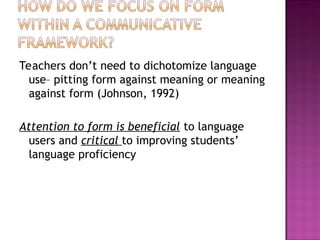
Teachers don’t needto dichotomize language
use– pitting form against meaning or meaning
against form (Johnson, 1992)
Attention to form is beneficial to language
users and critical to improving students’
language proficiency
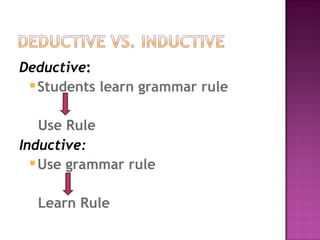
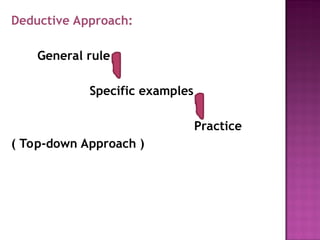
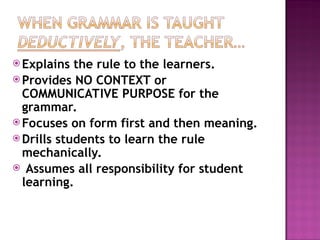
Explains therule to the learners.
Provides NO CONTEXT or
COMMUNICATIVE PURPOSE for the
grammar.
Focuses on form first and then meaning.
Drills students to learn the rule
mechanically.
Assumes all responsibility for student
learning.
11.
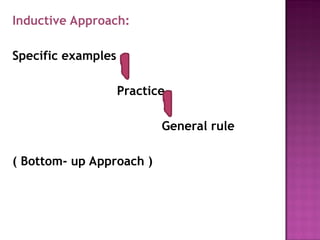
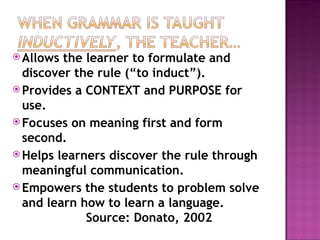
Allows thelearner to formulate and
discover the rule (“to induct”).
Provides a CONTEXT and PURPOSE for
use.
Focuses on meaning first and form
second.
Helps learners discover the rule through
meaningful communication.
Empowers the students to problem solve
and learn how to learn a language.
Source: Donato, 2002
12.
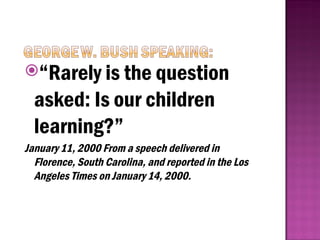
“Rarely is thequestion
asked: Is our children
learning?”
January 11, 2000 From a speech delivered in
Florence, South Carolina, and reported in the Los
Angeles Times on January 14, 2000.
13.
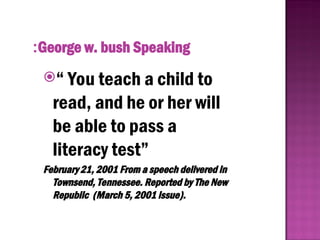
“ You teacha child to
read, and he or her will
be able to pass a
literacy test”
February 21, 2001 From a speech delivered in
Townsend, Tennessee. Reported by The New
Republic (March 5, 2001 issue).
George w. bush Speaking
:
14.
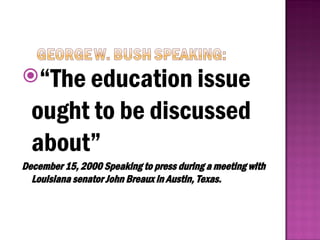
“The education issue
oughtto be discussed
about”
December 15, 2000 Speaking to press during a meeting with
Louisiana senator John Breaux in Austin, Texas.
15.
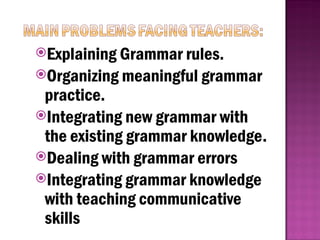
Explaining Grammar rules.
Organizingmeaningful grammar
practice.
Integrating new grammar with
the existing grammar knowledge.
Dealing with grammar errors
Integrating grammar knowledge
with teaching communicative
skills
16.
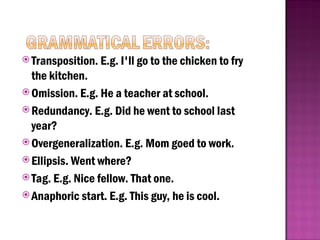
Transposition. E.g.I'll go to the chicken to fry
the kitchen.
Omission. E.g. He a teacher at school.
Redundancy. E.g. Did he went to school last
year?
Overgeneralization. E.g. Mom goed to work.
Ellipsis. Went where?
Tag. E.g. Nice fellow. That one.
Anaphoric start. E.g. This guy, he is cool.
the art ofarranging a sequence
of teaching actions to take the
learners from the state of
grammatical ignorance to the
state of grammatical knowledge.
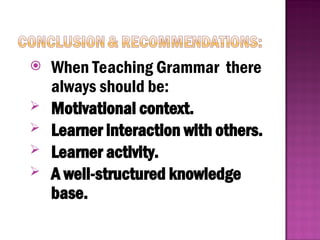
When TeachingGrammar there
always should be:
Motivational context.
Learner interaction with others.
Learner activity.
A well-structured knowledge
base.
27.
Gradual introductionwith careful
steps and plenty of modelling.
Personalise the lesson/grammar
point.
Create a meaningful context for
language use.