Caption
Instagram
CAPTIONCAPTION
Captions
 A caption is a mini-story that answers all
questions about a photo.
 Requires time, thought, research, variety and
consistency to write.
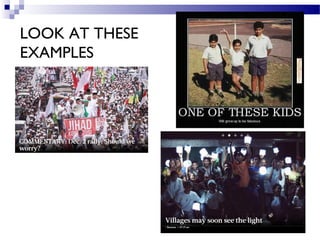
LOOK AT THESE
EXAMPLES
Captions
 Also referred to cutlines
 Every photo should have a caption for adequate identification
of its contents and to insure its historical value.
 Be certain that you write cutlines NOT cutelines.
 Captions that talk to the photo or make insinuations
and those that take liberties with the feelings of the
person(s) in the photo are not only unjournalistic
and in poor taste, they are also downright illegal.
 Any staff that uses gag cutlines is opening itself up
to problems ranging from black eyes to lawsuits.
Elements of a Caption
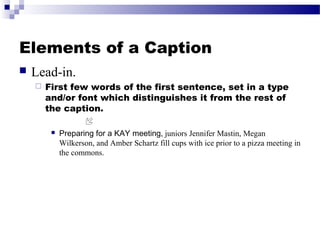
 Lead-in.
 First few words of the first sentence, set in a type
and/or font which distinguishes it from the rest of
the caption.

 Preparing for a KAY meeting, juniors Jennifer Mastin, Megan
Wilkerson, and Amber Schartz fill cups with ice prior to a pizza meeting in
the commons.
Elements of a Caption
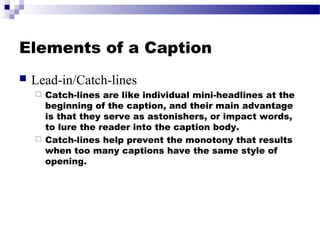
 Lead-in/Catch-lines
 Catch-lines are like individual mini-headlines at the
beginning of the caption, and their main advantage
is that they serve as astonishers, or impact words,
to lure the reader into the caption body.
 Catch-lines help prevent the monotony that results
when too many captions have the same style of
opening.
Elements of a Caption
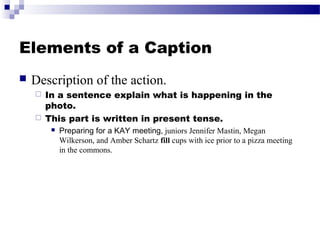
 Description of the action.
 In a sentence explain what is happening in the
photo.
 This part is written in present tense.
 Preparing for a KAY meeting, juniors Jennifer Mastin, Megan
Wilkerson, and Amber Schartz fill cups with ice prior to a pizza meeting
in the commons.
Elements of a Caption
 Description of the action
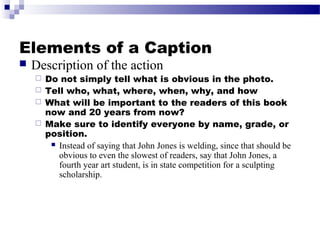
 Do not simply tell what is obvious in the photo.
 Tell who, what, where, when, why, and how
 What will be important to the readers of this book
now and 20 years from now?
 Make sure to identify everyone by name, grade, or
position.
 Instead of saying that John Jones is welding, since that should be
obvious to even the slowest of readers, say that John Jones, a
fourth year art student, is in state competition for a sculpting
scholarship.
Elements of a Caption
 A Little Something Extra.
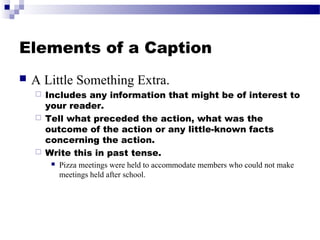
 Includes any information that might be of interest to
your reader.
 Tell what preceded the action, what was the
outcome of the action or any little-known facts
concerning the action.
 Write this in past tense.
 Pizza meetings were held to accommodate members who could not make
meetings held after school.
Elements of a Caption
 Direct Quotation.
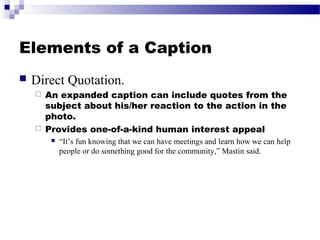
 An expanded caption can include quotes from the
subject about his/her reaction to the action in the
photo.
 Provides one-of-a-kind human interest appeal
 “It’s fun knowing that we can have meetings and learn how we can help
people or do something good for the community,” Mastin said.
Elements of a Caption
 Photo Credit
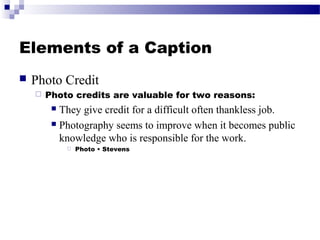
 Photo credits are valuable for two reasons:
 They give credit for a difficult often thankless job.
 Photography seems to improve when it becomes public
knowledge who is responsible for the work.
 Photo • Stevens
Putting it all together
Preparing for a KAY meeting, juniors Jennifer Mastin, Megan Wilkerson,
and Amber Schartz fill cups with ice prior to a pizza meeting in the
commons. Pizza meetings were help to accommodate members who could
not make meetings held after school. “It’s fun knowing that we can have
meetings and learn how we can help people or do something good for the
community,” Mastin said. Photo • Stevens
Expanded Caption
 Expanded captions should range from 3-4 sentences.
 Answer the 5W’s and H in every caption.
 Interview those involved in the photo as well as those
associated with the event or activity.
 Direct quotes make the caption come alive to create a “you are
there” effect.
 LAST TO LEAVE. In a deserted hallway, freshman twins Chance and Bill Terry
wait for the 5:45 p.m. bus to pick them up and take them home three hours
after the final bell. Because the brothers live next door to the bus driver,
and 15 miles in the opposite direction of the driver’s route, they hang out
until the bus swings back past the school. “I would much rather goof off at
school than ride the route with 35 screaming first graders,” Chance said.
Photo • Stevens
Variations on a Caption…
 Summary Caption
 Includes these caption elements:
 Lead-in, description of action, and photo credit.
 LAST TO LEAVE. In a deserted hallway, freshman twins
Chance and Bill Terry wait for the 5:45 p.m. bus to pick them up
and take them home after school. Photo • Stevens
Variations on a Caption…
 Candid Identification.
 Name individuals and add a brief insight.
 Freshman twins Chance and Bill Terry take a 5:45 p.m.
bus home.
Sports captions…
 An effective sports caption:
 Identifies all players in the picture by name and
jersey number. If possible, identify key athletes on
the opposing team as well.
 States the position of the player and adds depth to
the description.
 Includes the results of the action in the photo as
well as the final score and who won.
 Did the player make the basket? Did the action have a key impact
on the score? Did the player or team win any special recognition?
Caption formula…
 Lead-in
 Description of the Action
 Something Extra
 Direct Quote
 Photo Credit
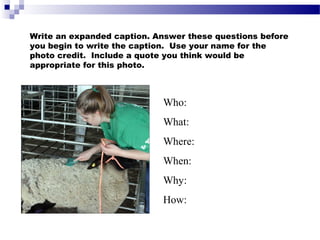
Write an expanded caption. Answer these questions before
you begin to write the caption. Use your name for the
photo credit. Include a quote you think would be
appropriate for this photo.
Who:
What:
Where:
When:
Why:
How:

Teaching caption text

  • 1.
  • 2.
  • 3.
  • 4.
    Captions  A captionis a mini-story that answers all questions about a photo.  Requires time, thought, research, variety and consistency to write.
  • 5.
  • 6.
    Captions  Also referredto cutlines  Every photo should have a caption for adequate identification of its contents and to insure its historical value.  Be certain that you write cutlines NOT cutelines.  Captions that talk to the photo or make insinuations and those that take liberties with the feelings of the person(s) in the photo are not only unjournalistic and in poor taste, they are also downright illegal.  Any staff that uses gag cutlines is opening itself up to problems ranging from black eyes to lawsuits.
  • 7.
    Elements of aCaption  Lead-in.  First few words of the first sentence, set in a type and/or font which distinguishes it from the rest of the caption.   Preparing for a KAY meeting, juniors Jennifer Mastin, Megan Wilkerson, and Amber Schartz fill cups with ice prior to a pizza meeting in the commons.
  • 8.
    Elements of aCaption  Lead-in/Catch-lines  Catch-lines are like individual mini-headlines at the beginning of the caption, and their main advantage is that they serve as astonishers, or impact words, to lure the reader into the caption body.  Catch-lines help prevent the monotony that results when too many captions have the same style of opening.
  • 9.
    Elements of aCaption  Description of the action.  In a sentence explain what is happening in the photo.  This part is written in present tense.  Preparing for a KAY meeting, juniors Jennifer Mastin, Megan Wilkerson, and Amber Schartz fill cups with ice prior to a pizza meeting in the commons.
  • 10.
    Elements of aCaption  Description of the action  Do not simply tell what is obvious in the photo.  Tell who, what, where, when, why, and how  What will be important to the readers of this book now and 20 years from now?  Make sure to identify everyone by name, grade, or position.  Instead of saying that John Jones is welding, since that should be obvious to even the slowest of readers, say that John Jones, a fourth year art student, is in state competition for a sculpting scholarship.
  • 11.
    Elements of aCaption  A Little Something Extra.  Includes any information that might be of interest to your reader.  Tell what preceded the action, what was the outcome of the action or any little-known facts concerning the action.  Write this in past tense.  Pizza meetings were held to accommodate members who could not make meetings held after school.
  • 12.
    Elements of aCaption  Direct Quotation.  An expanded caption can include quotes from the subject about his/her reaction to the action in the photo.  Provides one-of-a-kind human interest appeal  “It’s fun knowing that we can have meetings and learn how we can help people or do something good for the community,” Mastin said.
  • 13.
    Elements of aCaption  Photo Credit  Photo credits are valuable for two reasons:  They give credit for a difficult often thankless job.  Photography seems to improve when it becomes public knowledge who is responsible for the work.  Photo • Stevens
  • 14.
    Putting it alltogether Preparing for a KAY meeting, juniors Jennifer Mastin, Megan Wilkerson, and Amber Schartz fill cups with ice prior to a pizza meeting in the commons. Pizza meetings were help to accommodate members who could not make meetings held after school. “It’s fun knowing that we can have meetings and learn how we can help people or do something good for the community,” Mastin said. Photo • Stevens
  • 15.
    Expanded Caption  Expandedcaptions should range from 3-4 sentences.  Answer the 5W’s and H in every caption.  Interview those involved in the photo as well as those associated with the event or activity.  Direct quotes make the caption come alive to create a “you are there” effect.  LAST TO LEAVE. In a deserted hallway, freshman twins Chance and Bill Terry wait for the 5:45 p.m. bus to pick them up and take them home three hours after the final bell. Because the brothers live next door to the bus driver, and 15 miles in the opposite direction of the driver’s route, they hang out until the bus swings back past the school. “I would much rather goof off at school than ride the route with 35 screaming first graders,” Chance said. Photo • Stevens
  • 16.
    Variations on aCaption…  Summary Caption  Includes these caption elements:  Lead-in, description of action, and photo credit.  LAST TO LEAVE. In a deserted hallway, freshman twins Chance and Bill Terry wait for the 5:45 p.m. bus to pick them up and take them home after school. Photo • Stevens
  • 17.
    Variations on aCaption…  Candid Identification.  Name individuals and add a brief insight.  Freshman twins Chance and Bill Terry take a 5:45 p.m. bus home.
  • 18.
    Sports captions…  Aneffective sports caption:  Identifies all players in the picture by name and jersey number. If possible, identify key athletes on the opposing team as well.  States the position of the player and adds depth to the description.  Includes the results of the action in the photo as well as the final score and who won.  Did the player make the basket? Did the action have a key impact on the score? Did the player or team win any special recognition?
  • 19.
    Caption formula…  Lead-in Description of the Action  Something Extra  Direct Quote  Photo Credit
  • 20.
    Write an expandedcaption. Answer these questions before you begin to write the caption. Use your name for the photo credit. Include a quote you think would be appropriate for this photo. Who: What: Where: When: Why: How: