1
Food
The topic of this month’s activities is healthy and sustainable food. Our B2 First and C1
Advanced students will have the opportunity to read about food waste in Europe and discuss
the role that we all may have in reducing it. A2 Key and B1 Preliminary students will learn
about the impact of food waste and the ways we can help tackle this problem. Finally, our
younger learners can have some fun while learning about food and health. Happy teaching!
1. How to tackle food waste................................................................................................ 2
2. Stop food waste!............................................................................................................. 7
3. Healthy food..................................................................................................................12
4. References....................................................................................................................14
2
1. How to tackle food waste
Level: B2 First / C1 Advanced
Skills: speaking, reading
Modes of communication: mediation, interaction,
production, reception
Interaction: in groups
Time: 60 minutes
Warm up (10’) – in groups of 3
• Do you usually finish up all your food / drink? Why (not)?
• Do you usually throw away food? Why (not)?
• Have you ever seen rubbish bags with food in them outside shops / supermarkets?
Why do you think food is thrown away in these places?
• Do you usually ask restaurants to put your leftovers in a box to take away? Why (not)?
• How much do you think food waste costs?
• Do you think food waste is a problem? Why (not)?
• Some supermarkets are scrapping ‘best before’ dates. Why do you think that is?
What’s your view on this?
Reading (15’) – in groups
Divide your students into four groups (A, B, C, D). Each group is going to read a different text
about food waste.
Group A, your school / university has organised a day to raise awareness of the importance
of reducing food waste. Representatives of the city council, scientists, and members of
associations in favour of protecting the environment were invited to explain some key data
about food consumption and environment. You attended a presentation on why it is important
to reduce food waste. Look at the presentation abstract and discuss it with your group.
• Talk about the key figuresand factsin the text. Are you surprised byany of them? Why
(not)? Discuss your ideas with the rest of your group.
• Take some notes about aspects in the text that you think are relevant to you and to the
people around you. Use your own words when possible.
3
Why is it important to reduce food waste?
According to the most recent estimate, nearly 57 million tonnes of food waste (127
kg/inhabitant) are generated in the EU each year with associated market value estimated at
€130 billion. Eurostat roughly estimates that around 10% of food made available to EU
consumers (at retail, food services and households) may be wasted. At the same time, every
second day some 36.2 million people cannot afford a quality meal (including meat, chicken,
fish or vegetarian equivalent). Food waste has a huge environmental impact, accounting for
about 5% of totalEU Greenhouse Gasemissions(associated to the EU’soverallconsumption
footprint) and puts unnecessary burden on limited natural resources, such as land and water
use. Reducing food waste has enormous potential for reducing the resources we use to
produce the food we eat. Fighting food waste is a triple win: it saves food for human
consumption; helps farmers, companies and consumers to save money; and lowers the
environmental impact of food production and consumption.
Source: European Commission (2022).
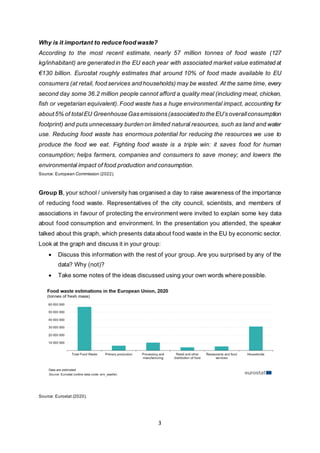
Group B, your school / university has organised a day to raise awareness of the importance
of reducing food waste. Representatives of the city council, scientists, and members of
associations in favour of protecting the environment were invited to explain some key data
about food consumption and environment. In the presentation you attended, the speaker
talked about this graph, which presents data about food waste in the EU by economic sector.
Look at the graph and discuss it in your group:
• Discuss this information with the rest of your group. Are you surprised by any of the
data? Why (not)?
• Take some notes of the ideas discussed using your own words where possible.
Source: Eurostat (2020).
4
Group C, your school / university has organised a day to raise awareness of the importance
of reducing food waste. Representatives of the city council, scientists, and members of
associations in favour of protecting the environment were invited to explain some key data
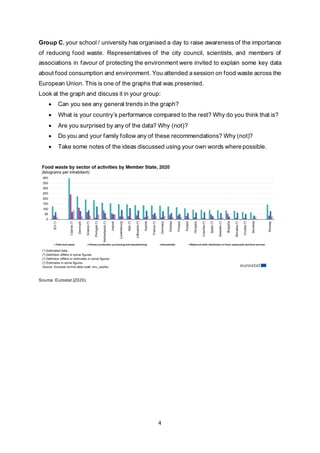
about food consumption and environment. You attended a session on food waste across the
European Union. This is one of the graphs that was presented.
Look at the graph and discuss it in your group:
• Can you see any general trends in the graph?
• What is your country’s performance compared to the rest? Why do you think that is?
• Are you surprised by any of the data? Why (not)?
• Do you and your family follow any of these recommendations? Why (not)?
• Take some notes of the ideas discussed using your own words where possible.
Source: Eurostat (2020).
5
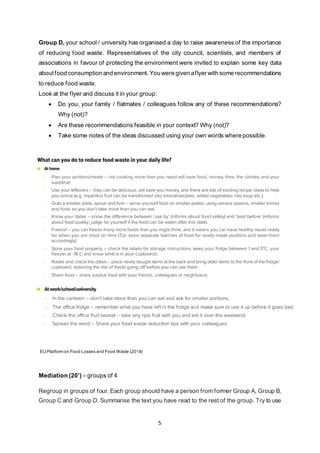
Group D, your school / university has organised a day to raise awareness of the importance
of reducing food waste. Representatives of the city council, scientists, and members of
associations in favour of protecting the environment were invited to explain some key data
about food consumption and environment. You were given aflyer with some recommendations
to reduce food waste.
Look at the flyer and discuss it in your group:
• Do you, your family / flatmates / colleagues follow any of these recommendations?
Why (not)?
• Are these recommendations feasible in your context? Why (not)?
• Take some notes of the ideas discussed using your own words where possible.
EU Platform on Food Losses and Food Waste (2019)
Mediation (20’) – groups of 4
Regroup in groups of four. Each group should have a person from former Group A, Group B,
Group C and Group D. Summarise the text you have read to the rest of the group. Try to use
6
your own words as much as possible but if there is some vocabulary your classmates don’t
know, feel free to explain it using your own words.
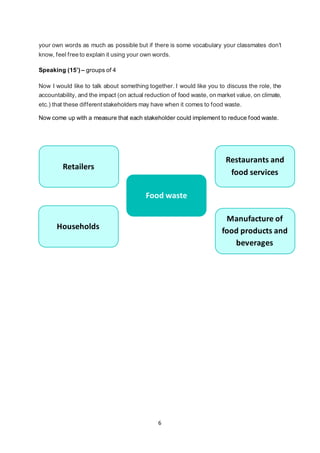
Speaking (15’) – groups of 4
Now I would like to talk about something together. I would like you to discuss the role, the
accountability, and the impact (on actual reduction of food waste, on market value, on climate,
etc.) that these different stakeholders may have when it comes to food waste.
Now come up with a measure that each stakeholder could implement to reduce food waste.
.
Food waste
Retailers
Households
Restaurants and
food services
Manufacture of
food products and
beverages
7
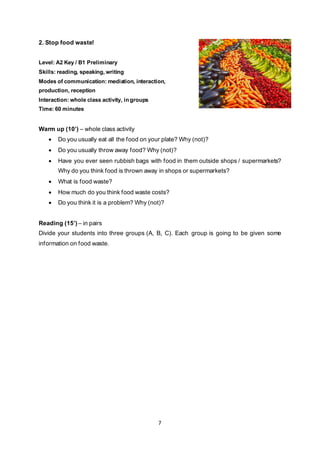
2. Stop food waste!
Level: A2 Key / B1 Preliminary
Skills: reading, speaking, writing
Modes of communication: mediation, interaction,
production, reception
Interaction: whole class activity, in groups
Time: 60 minutes
Warm up (10’) – whole class activity
• Do you usually eat all the food on your plate? Why (not)?
• Do you usually throw away food? Why (not)?
• Have you ever seen rubbish bags with food in them outside shops / supermarkets?
Why do you think food is thrown away in shops or supermarkets?
• What is food waste?
• How much do you think food waste costs?
• Do you think it is a problem? Why (not)?
Reading (15’) – in pairs
Divide your students into three groups (A, B, C). Each group is going to be given some
information on food waste.
8
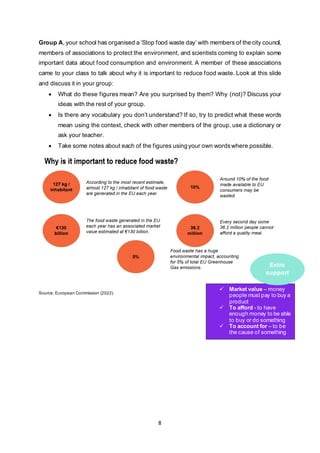
Group A, your school has organised a ‘Stop food waste day’ with members of the city council,
members of associations to protect the environment, and scientists coming to explain some
important data about food consumption and environment. A member of these associations
came to your class to talk about why it is important to reduce food waste. Look at this slide
and discuss it in your group:
• What do these figures mean? Are you surprised by them? Why (not)? Discuss your
ideas with the rest of your group.
• Is there any vocabulary you don’t understand? If so, try to predict what these words
mean using the context, check with other members of the group, use a dictionary or
ask your teacher.
• Take some notes about each of the figures using your own wordswhere possible.
Source: European Commission (2022)
 Market value – money
people must pay to buy a
product
 To afford - to have
enough money to be able
to buy or do something
 To account for – to be
the cause of something
Extra
support
9
Group B, your school has organised a ‘Stop food waste day’ with members of the city council,
members of associations to protect the environment, and scientists coming to explain some
important data about food consumption and environment. A member of the city council came
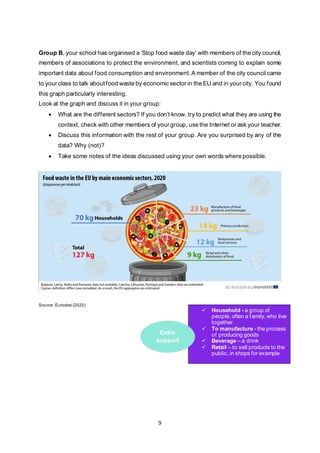
to your class to talk about food waste by economicsector in the EU and in your city. You found
this graph particularly interesting.
Look at the graph and discuss it in your group:
• What are the different sectors? If you don’t know, try to predict what they are using the
context, check with other members of your group, use the Internet or ask your teacher.
• Discuss this information with the rest of your group. Are you surprised by any of the
data? Why (not)?
• Take some notes of the ideas discussed using your own words where possible.
Source: Eurostat (2020)
 Household - a group of
people, often a family, who live
together
 To manufacture - the process
of producing goods
 Beverage – a drink
 Retail – to sell products to the
public, in shops for example
Extra
support
10
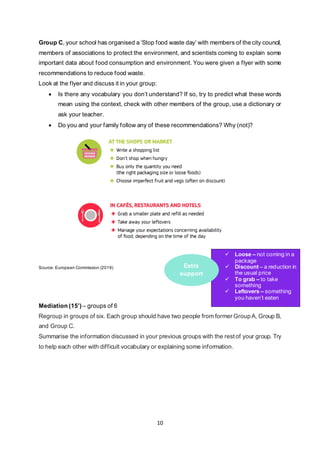
Group C, your school has organised a ‘Stop food waste day’ with members of the city council,
members of associations to protect the environment, and scientists coming to explain some
important data about food consumption and environment. You were given a flyer with some
recommendations to reduce food waste.
Look at the flyer and discuss it in your group:
• Is there any vocabulary you don’t understand? If so, try to predict what these words
mean using the context, check with other members of the group, use a dictionary or
ask your teacher.
• Do you and your family follow any of these recommendations? Why (not)?
Source: European Commission (2019)
Mediation (15’) – groups of 6
Regroup in groups of six. Each group should have two people from former Group A, Group B,
and Group C.
Summarise the information discussed in your previous groups with the rest of your group. Try
to help each other with difficult vocabulary or explaining some information.
 Loose – not coming in a
package
 Discount – a reduction in
the usual price
 To grab – to take
something
 Leftovers – something
you haven’t eaten
Extra
support
11
Speaking and writing (20’) – groups of 6 (Presentations done by A2 Key students should be
about 2 / 3 minutes long. Presentations done by B1 Preliminary should be about 5 / 6 minutes
long)
(A2 Key) Prepare a short presentation and a poster. In your presentation and poster, you
should include:
1. Something you found out today about the topic.
2. Something you found surprising. Explain why.
3. Something you will do with your family to try to reduce food waste. You don’t need to
agree on this. Each person can decide on something different to do.
4. Something you can do at school to reduce food waste. Each person can decide on
something different to do.
(B1 Preliminary) Prepare a short presentation using Powerpoint or other software. In your
presentation, you should include:
1. A way in which food waste is harmful for the environment.
2. A way in which food waste is negative for society.
3. Something you will do with your family to try to reduce food waste. Each person can
decide on something different to do.
4. Something you can do as a class / group to reduce food waste. You should tryto agree
on this.
12
3. Healthy food
Level: A1 Movers / A2 Flyers
Skills: speaking and reading
Interaction: individual, in pairs and whole class activity
Time: 30 minutes
Warm up (10’) – whole class activity
 What’s your favourite food? Why?
 When you choose some food, do you think about if it’s healthy or not?
 Can you tell me food that is yellow?
 Can you tell me food that is sweet?
 Can you tell me food that is round?
 Can you tell me food that is grown in summer?
 Can you tell me food that is produced in Spain?
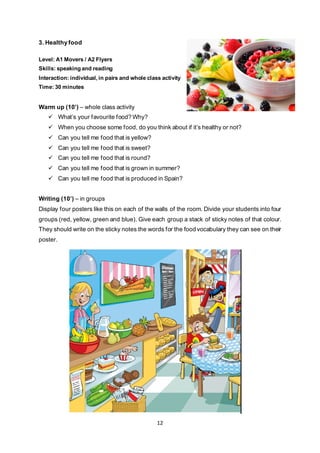
Writing (10’) – in groups
Display four posters like this on each of the walls of the room. Divide your students into four
groups (red, yellow, green and blue). Give each group a stack of sticky notes of that colour.
They should write on the sticky notes the words for the food vocabulary they can see on their
poster.
13
Groups should then swap posters and check if the vocabulary and spelling is correct. They
should award one mark for every word that is correct but has problems with spelling. They
should award two marks for everyword that iscorrect and isspelt correctly. Who isthe winner?
Writing and Speaking (10’)
Can you put the words for the food you saw on the poster in the box that you think is correct?
Why do you think this food is healthy / unhealthy?
HEALTHY UNHEALTHY
14
4. References
Doan, J. (2017). Fruit Salad In White Ceramic Bowl. [image / jpeg]. Available at:
https://www.pexels.com/photo/fruit-salad-in-white-ceramic-bowl-1105166/ [30th
November 2022].
EU Platform on Food Losses and Food Waste (2019). Recommendations for Action in Food
Waste Prevention. Available at: https://food.ec.europa.eu/system/files/2021-05/fs_eu-
actions_action_platform_key-rcmnd_en.pdf [30th November 2022].
European Commission (2019). How to reduce food waste in your daily life. Available at
https://food.ec.europa.eu/system/files/2020-06/fw_lib_poster_reduce-food-waste-
daily_en.pdf [30th November 2022].
European Commission (2022). FrequentlyAsked Questions: Reducing food waste in the EU.
Available at: https://food.ec.europa.eu/system/files/2022-10/fw_lib_reduce-food-
waste-eu_faqs.pdf [30th November 2022].
Eurostat (2020). Food waste by sector of activities by Member State, 2020 [image / png].
Available at: https://ec.europa.eu/eurostat/statistics-
explained/index.php?title=Food_waste_and_food_waste_prevention_-
_estimates&stable=0&redirect=no [30th November 2022].
Eurostat (2020). Food waste estimations in the European Union [image / png]. Available at:
https://ec.europa.eu/eurostat/statistics-
explained/index.php?title=File:FigureEUAGG_FW_KGHAB_2020.PNG [30th
November 2022].
Grey, A. (2018). Tilt Shift Lens Photography of Five Assorted Vegetables. [image / jpeg].
Available at: https://www.pexels.com/photo/tilt-shift-lens-photography-of-five-
assorted-vegetables-1196516/ [30th November 2022].
Pixabay (2017). Variety of Fruits and Vegetables. [image / jpeg]. Available at:
https://www.pexels.com/photo/variety-of-fruits-and-vegetables-264537/ [30th
November 2022].
Saglambilek, T. (2016). Man Wearing Black Apron Near Two Silver Metal Cooking Pots.
[image / jpeg]. Available at: https://www.pexels.com/photo/man-wearing-black-apron-
near-two-silver-metal-cooking-pot-66639/ [30th November 2022].
UCLES (2018). Pre A1 Starters Word list picture book for exams from 2018. Available at:
https://www.cambridgeenglish.org/images/starters-word-list-picture-book.pdf [30th
November 2022].

Teaching Activities: Food

  • 1.
    1 Food The topic ofthis month’s activities is healthy and sustainable food. Our B2 First and C1 Advanced students will have the opportunity to read about food waste in Europe and discuss the role that we all may have in reducing it. A2 Key and B1 Preliminary students will learn about the impact of food waste and the ways we can help tackle this problem. Finally, our younger learners can have some fun while learning about food and health. Happy teaching! 1. How to tackle food waste................................................................................................ 2 2. Stop food waste!............................................................................................................. 7 3. Healthy food..................................................................................................................12 4. References....................................................................................................................14
  • 2.
    2 1. How totackle food waste Level: B2 First / C1 Advanced Skills: speaking, reading Modes of communication: mediation, interaction, production, reception Interaction: in groups Time: 60 minutes Warm up (10’) – in groups of 3 • Do you usually finish up all your food / drink? Why (not)? • Do you usually throw away food? Why (not)? • Have you ever seen rubbish bags with food in them outside shops / supermarkets? Why do you think food is thrown away in these places? • Do you usually ask restaurants to put your leftovers in a box to take away? Why (not)? • How much do you think food waste costs? • Do you think food waste is a problem? Why (not)? • Some supermarkets are scrapping ‘best before’ dates. Why do you think that is? What’s your view on this? Reading (15’) – in groups Divide your students into four groups (A, B, C, D). Each group is going to read a different text about food waste. Group A, your school / university has organised a day to raise awareness of the importance of reducing food waste. Representatives of the city council, scientists, and members of associations in favour of protecting the environment were invited to explain some key data about food consumption and environment. You attended a presentation on why it is important to reduce food waste. Look at the presentation abstract and discuss it with your group. • Talk about the key figuresand factsin the text. Are you surprised byany of them? Why (not)? Discuss your ideas with the rest of your group. • Take some notes about aspects in the text that you think are relevant to you and to the people around you. Use your own words when possible.
  • 3.
    3 Why is itimportant to reduce food waste? According to the most recent estimate, nearly 57 million tonnes of food waste (127 kg/inhabitant) are generated in the EU each year with associated market value estimated at €130 billion. Eurostat roughly estimates that around 10% of food made available to EU consumers (at retail, food services and households) may be wasted. At the same time, every second day some 36.2 million people cannot afford a quality meal (including meat, chicken, fish or vegetarian equivalent). Food waste has a huge environmental impact, accounting for about 5% of totalEU Greenhouse Gasemissions(associated to the EU’soverallconsumption footprint) and puts unnecessary burden on limited natural resources, such as land and water use. Reducing food waste has enormous potential for reducing the resources we use to produce the food we eat. Fighting food waste is a triple win: it saves food for human consumption; helps farmers, companies and consumers to save money; and lowers the environmental impact of food production and consumption. Source: European Commission (2022). Group B, your school / university has organised a day to raise awareness of the importance of reducing food waste. Representatives of the city council, scientists, and members of associations in favour of protecting the environment were invited to explain some key data about food consumption and environment. In the presentation you attended, the speaker talked about this graph, which presents data about food waste in the EU by economic sector. Look at the graph and discuss it in your group: • Discuss this information with the rest of your group. Are you surprised by any of the data? Why (not)? • Take some notes of the ideas discussed using your own words where possible. Source: Eurostat (2020).
  • 4.
    4 Group C, yourschool / university has organised a day to raise awareness of the importance of reducing food waste. Representatives of the city council, scientists, and members of associations in favour of protecting the environment were invited to explain some key data about food consumption and environment. You attended a session on food waste across the European Union. This is one of the graphs that was presented. Look at the graph and discuss it in your group: • Can you see any general trends in the graph? • What is your country’s performance compared to the rest? Why do you think that is? • Are you surprised by any of the data? Why (not)? • Do you and your family follow any of these recommendations? Why (not)? • Take some notes of the ideas discussed using your own words where possible. Source: Eurostat (2020).
  • 5.
    5 Group D, yourschool / university has organised a day to raise awareness of the importance of reducing food waste. Representatives of the city council, scientists, and members of associations in favour of protecting the environment were invited to explain some key data about food consumption and environment. You were given aflyer with some recommendations to reduce food waste. Look at the flyer and discuss it in your group: • Do you, your family / flatmates / colleagues follow any of these recommendations? Why (not)? • Are these recommendations feasible in your context? Why (not)? • Take some notes of the ideas discussed using your own words where possible. EU Platform on Food Losses and Food Waste (2019) Mediation (20’) – groups of 4 Regroup in groups of four. Each group should have a person from former Group A, Group B, Group C and Group D. Summarise the text you have read to the rest of the group. Try to use
  • 6.
    6 your own wordsas much as possible but if there is some vocabulary your classmates don’t know, feel free to explain it using your own words. Speaking (15’) – groups of 4 Now I would like to talk about something together. I would like you to discuss the role, the accountability, and the impact (on actual reduction of food waste, on market value, on climate, etc.) that these different stakeholders may have when it comes to food waste. Now come up with a measure that each stakeholder could implement to reduce food waste. . Food waste Retailers Households Restaurants and food services Manufacture of food products and beverages
  • 7.
    7 2. Stop foodwaste! Level: A2 Key / B1 Preliminary Skills: reading, speaking, writing Modes of communication: mediation, interaction, production, reception Interaction: whole class activity, in groups Time: 60 minutes Warm up (10’) – whole class activity • Do you usually eat all the food on your plate? Why (not)? • Do you usually throw away food? Why (not)? • Have you ever seen rubbish bags with food in them outside shops / supermarkets? Why do you think food is thrown away in shops or supermarkets? • What is food waste? • How much do you think food waste costs? • Do you think it is a problem? Why (not)? Reading (15’) – in pairs Divide your students into three groups (A, B, C). Each group is going to be given some information on food waste.
  • 8.
    8 Group A, yourschool has organised a ‘Stop food waste day’ with members of the city council, members of associations to protect the environment, and scientists coming to explain some important data about food consumption and environment. A member of these associations came to your class to talk about why it is important to reduce food waste. Look at this slide and discuss it in your group: • What do these figures mean? Are you surprised by them? Why (not)? Discuss your ideas with the rest of your group. • Is there any vocabulary you don’t understand? If so, try to predict what these words mean using the context, check with other members of the group, use a dictionary or ask your teacher. • Take some notes about each of the figures using your own wordswhere possible. Source: European Commission (2022)  Market value – money people must pay to buy a product  To afford - to have enough money to be able to buy or do something  To account for – to be the cause of something Extra support
  • 9.
    9 Group B, yourschool has organised a ‘Stop food waste day’ with members of the city council, members of associations to protect the environment, and scientists coming to explain some important data about food consumption and environment. A member of the city council came to your class to talk about food waste by economicsector in the EU and in your city. You found this graph particularly interesting. Look at the graph and discuss it in your group: • What are the different sectors? If you don’t know, try to predict what they are using the context, check with other members of your group, use the Internet or ask your teacher. • Discuss this information with the rest of your group. Are you surprised by any of the data? Why (not)? • Take some notes of the ideas discussed using your own words where possible. Source: Eurostat (2020)  Household - a group of people, often a family, who live together  To manufacture - the process of producing goods  Beverage – a drink  Retail – to sell products to the public, in shops for example Extra support
  • 10.
    10 Group C, yourschool has organised a ‘Stop food waste day’ with members of the city council, members of associations to protect the environment, and scientists coming to explain some important data about food consumption and environment. You were given a flyer with some recommendations to reduce food waste. Look at the flyer and discuss it in your group: • Is there any vocabulary you don’t understand? If so, try to predict what these words mean using the context, check with other members of the group, use a dictionary or ask your teacher. • Do you and your family follow any of these recommendations? Why (not)? Source: European Commission (2019) Mediation (15’) – groups of 6 Regroup in groups of six. Each group should have two people from former Group A, Group B, and Group C. Summarise the information discussed in your previous groups with the rest of your group. Try to help each other with difficult vocabulary or explaining some information.  Loose – not coming in a package  Discount – a reduction in the usual price  To grab – to take something  Leftovers – something you haven’t eaten Extra support
  • 11.
    11 Speaking and writing(20’) – groups of 6 (Presentations done by A2 Key students should be about 2 / 3 minutes long. Presentations done by B1 Preliminary should be about 5 / 6 minutes long) (A2 Key) Prepare a short presentation and a poster. In your presentation and poster, you should include: 1. Something you found out today about the topic. 2. Something you found surprising. Explain why. 3. Something you will do with your family to try to reduce food waste. You don’t need to agree on this. Each person can decide on something different to do. 4. Something you can do at school to reduce food waste. Each person can decide on something different to do. (B1 Preliminary) Prepare a short presentation using Powerpoint or other software. In your presentation, you should include: 1. A way in which food waste is harmful for the environment. 2. A way in which food waste is negative for society. 3. Something you will do with your family to try to reduce food waste. Each person can decide on something different to do. 4. Something you can do as a class / group to reduce food waste. You should tryto agree on this.
  • 12.
    12 3. Healthy food Level:A1 Movers / A2 Flyers Skills: speaking and reading Interaction: individual, in pairs and whole class activity Time: 30 minutes Warm up (10’) – whole class activity  What’s your favourite food? Why?  When you choose some food, do you think about if it’s healthy or not?  Can you tell me food that is yellow?  Can you tell me food that is sweet?  Can you tell me food that is round?  Can you tell me food that is grown in summer?  Can you tell me food that is produced in Spain? Writing (10’) – in groups Display four posters like this on each of the walls of the room. Divide your students into four groups (red, yellow, green and blue). Give each group a stack of sticky notes of that colour. They should write on the sticky notes the words for the food vocabulary they can see on their poster.
  • 13.
    13 Groups should thenswap posters and check if the vocabulary and spelling is correct. They should award one mark for every word that is correct but has problems with spelling. They should award two marks for everyword that iscorrect and isspelt correctly. Who isthe winner? Writing and Speaking (10’) Can you put the words for the food you saw on the poster in the box that you think is correct? Why do you think this food is healthy / unhealthy? HEALTHY UNHEALTHY
  • 14.
    14 4. References Doan, J.(2017). Fruit Salad In White Ceramic Bowl. [image / jpeg]. Available at: https://www.pexels.com/photo/fruit-salad-in-white-ceramic-bowl-1105166/ [30th November 2022]. EU Platform on Food Losses and Food Waste (2019). Recommendations for Action in Food Waste Prevention. Available at: https://food.ec.europa.eu/system/files/2021-05/fs_eu- actions_action_platform_key-rcmnd_en.pdf [30th November 2022]. European Commission (2019). How to reduce food waste in your daily life. Available at https://food.ec.europa.eu/system/files/2020-06/fw_lib_poster_reduce-food-waste- daily_en.pdf [30th November 2022]. European Commission (2022). FrequentlyAsked Questions: Reducing food waste in the EU. Available at: https://food.ec.europa.eu/system/files/2022-10/fw_lib_reduce-food- waste-eu_faqs.pdf [30th November 2022]. Eurostat (2020). Food waste by sector of activities by Member State, 2020 [image / png]. Available at: https://ec.europa.eu/eurostat/statistics- explained/index.php?title=Food_waste_and_food_waste_prevention_- _estimates&stable=0&redirect=no [30th November 2022]. Eurostat (2020). Food waste estimations in the European Union [image / png]. Available at: https://ec.europa.eu/eurostat/statistics- explained/index.php?title=File:FigureEUAGG_FW_KGHAB_2020.PNG [30th November 2022]. Grey, A. (2018). Tilt Shift Lens Photography of Five Assorted Vegetables. [image / jpeg]. Available at: https://www.pexels.com/photo/tilt-shift-lens-photography-of-five- assorted-vegetables-1196516/ [30th November 2022]. Pixabay (2017). Variety of Fruits and Vegetables. [image / jpeg]. Available at: https://www.pexels.com/photo/variety-of-fruits-and-vegetables-264537/ [30th November 2022]. Saglambilek, T. (2016). Man Wearing Black Apron Near Two Silver Metal Cooking Pots. [image / jpeg]. Available at: https://www.pexels.com/photo/man-wearing-black-apron- near-two-silver-metal-cooking-pot-66639/ [30th November 2022]. UCLES (2018). Pre A1 Starters Word list picture book for exams from 2018. Available at: https://www.cambridgeenglish.org/images/starters-word-list-picture-book.pdf [30th November 2022].