Teacher Freedoms
Deidra Gorman, Darci
Jarstad, Emily Kreger
Freedom of Expression
 Provided teachers words do not
create “material disruption” to the
district, school or employees, they
are afforded the same rights as
every other citizen.

Connick v Meyers – School district employees
circulated a petition regarding the function of the
office. This was not upheld as freedom of
expression due to the nature of the petition, its
circulation at school, and the lack of regard of
proper channels of dealing with sub par behavior.
Speech Outside the School
Environment
 Pickering – Teachers are afforded
the same rights out of school as any
other citizen. Pickering’s letter to
the editor about the school district
was deemed within his rights even
though it misrepresented facts.
Academic Freedom
 Teachers in the public schools must
teach the curriculum in a way that
is appropriate for the students’ age,
maturity and intellectual level.
Inappropriate and controversial
material is generally not supported
by courts.
 Fowler – A tenured teacher was
discharged for showing Pink Floyd’s
The Wall because the teacher
disregarded the district’s no rated R
rule.
Freedom of Association
 Teachers have the rights of every
citizen which allows them to
associate with other people of their
choice without threat of
punishment.
 Supreme Court states “a teacher
serves as a role model for his
students, exerting a subtle but an
important influence over their
perceptions and values.”
Membership in Subversive
Organizations
 Elfbrandt v Russel – “Those who
join an organization but do not
share its unlawful purposes and who
do not participate in its unlawful
activities surely pose no threat,
either as a citizen or as a public
employee”
Political Rights
 Teachers have the same rights and
freedoms enjoyed by all citizens.
 Teachers must limit their political
activities away from the classroom
and outside of the school day.
Right to Hold Office
 Teachers can legally hold public
office. Some school board policy
dictates that teachers running
for/holding office must take a leave
of absence to do so.
 In no circumstance, can the
teacher’s contract be cancelled due
to running for/holding office.
Participation in Political
Campaigns
 Teachers have the right to
participate in political campaigns
provided it does not interfere with
the school.
 District cannot prevent, threaten,
harass or discriminate teachers
based on their participation in
political campaigns.
Dress and Grooming
 There is a long record of general
disagreement in the courts about
school districts trying to regulate
teacher appearance.
 East Hartford Education Association
v Board of Education of Town of
East Hartford – Court upheld the
dress code of wearing a tie.
Unwed Pregnant Teachers
 Courts tend to vary in rulings regarding
unwed pregnant teachers
 1960s and 1970s – courts were more
inclined to rule against single teachers
who were dismissed by school boards
when they reported their pregnancy
 Mid 1970s and early 1980s – Courts
became less inclined to rule against unwed
pregnant teachers without carefully
weighing all aspects of each case
Unwed Pregnant Teachers Cont.
 Courts considered teacher’s overall
performance record, the impact of the
teacher’s actions on students, and, more
important, the extent to which the
teacher’s actions adversely affect their
effectiveness as a teacher
 Courts may also consider community
standards and the extent to which the
teacher’s conduct violates the ethics of the
community
 Overall, large variance among courts in
addressing pregnancy among unwed
teachers
Right to Privacy
 Right to privacy of teachers and administrators
should be respected to the extent that they do
not violate the integrity of the community or
render the teacher/administrator ineffective in
performing professional duties
 Burden of proof lies with school boards to
demonstrate that lifestyle choice adversely
affects the integrity of the district or that the
conduct of the teacher/administrator has a
detrimental effect on his/her relations with
students or parents
Religious Discrimination in Public
Schools
 Title VII addresses any forms of religious
discrimination regarding employment.
 Religion is defined under Title VII to
include “all aspects of religious
observances, practices, and beliefs.”
 Employer, including school board, must
make reasonable accommodations to the
employee’s religion, unless the employer
can demonstrate the inability to do so
based on undue hardship.
Religious Discrimination in Public
Schools
 School officials must make
allowances for teachers’ religious
observances if such observances do
not create substantial disruption to
the educational process
 Examples: personal leave to attend
a religious convention or to observe
a religious holiday
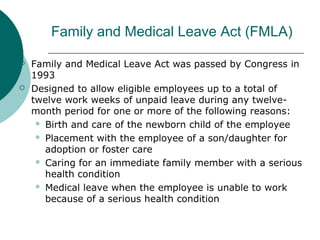
Family and Medical Leave Act (FMLA)
 Family and Medical Leave Act was passed by Congress in
1993
 Designed to allow eligible employees up to a total of
twelve work weeks of unpaid leave during any twelve-
month period for one or more of the following reasons:
 Birth and care of the newborn child of the employee
 Placement with the employee of a son/daughter for
adoption or foster care
 Caring for an immediate family member with a serious
health condition
 Medical leave when the employee is unable to work
because of a serious health condition
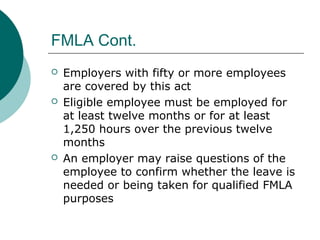
FMLA Cont.
 Employers with fifty or more employees
are covered by this act
 Eligible employee must be employed for
at least twelve months or for at least
1,250 hours over the previous twelve
months
 An employer may raise questions of the
employee to confirm whether the leave is
needed or being taken for qualified FMLA
purposes

Teacher freedoms 2013

  • 1.
    Teacher Freedoms Deidra Gorman,Darci Jarstad, Emily Kreger
  • 2.
    Freedom of Expression Provided teachers words do not create “material disruption” to the district, school or employees, they are afforded the same rights as every other citizen.  Connick v Meyers – School district employees circulated a petition regarding the function of the office. This was not upheld as freedom of expression due to the nature of the petition, its circulation at school, and the lack of regard of proper channels of dealing with sub par behavior.
  • 3.
    Speech Outside theSchool Environment  Pickering – Teachers are afforded the same rights out of school as any other citizen. Pickering’s letter to the editor about the school district was deemed within his rights even though it misrepresented facts.
  • 4.
    Academic Freedom  Teachersin the public schools must teach the curriculum in a way that is appropriate for the students’ age, maturity and intellectual level. Inappropriate and controversial material is generally not supported by courts.  Fowler – A tenured teacher was discharged for showing Pink Floyd’s The Wall because the teacher disregarded the district’s no rated R rule.
  • 5.
    Freedom of Association Teachers have the rights of every citizen which allows them to associate with other people of their choice without threat of punishment.  Supreme Court states “a teacher serves as a role model for his students, exerting a subtle but an important influence over their perceptions and values.”
  • 6.
    Membership in Subversive Organizations Elfbrandt v Russel – “Those who join an organization but do not share its unlawful purposes and who do not participate in its unlawful activities surely pose no threat, either as a citizen or as a public employee”
  • 7.
    Political Rights  Teachershave the same rights and freedoms enjoyed by all citizens.  Teachers must limit their political activities away from the classroom and outside of the school day.
  • 8.
    Right to HoldOffice  Teachers can legally hold public office. Some school board policy dictates that teachers running for/holding office must take a leave of absence to do so.  In no circumstance, can the teacher’s contract be cancelled due to running for/holding office.
  • 9.
    Participation in Political Campaigns Teachers have the right to participate in political campaigns provided it does not interfere with the school.  District cannot prevent, threaten, harass or discriminate teachers based on their participation in political campaigns.
  • 10.
    Dress and Grooming There is a long record of general disagreement in the courts about school districts trying to regulate teacher appearance.  East Hartford Education Association v Board of Education of Town of East Hartford – Court upheld the dress code of wearing a tie.
  • 11.
    Unwed Pregnant Teachers Courts tend to vary in rulings regarding unwed pregnant teachers  1960s and 1970s – courts were more inclined to rule against single teachers who were dismissed by school boards when they reported their pregnancy  Mid 1970s and early 1980s – Courts became less inclined to rule against unwed pregnant teachers without carefully weighing all aspects of each case
  • 12.
    Unwed Pregnant TeachersCont.  Courts considered teacher’s overall performance record, the impact of the teacher’s actions on students, and, more important, the extent to which the teacher’s actions adversely affect their effectiveness as a teacher  Courts may also consider community standards and the extent to which the teacher’s conduct violates the ethics of the community  Overall, large variance among courts in addressing pregnancy among unwed teachers
  • 13.
    Right to Privacy Right to privacy of teachers and administrators should be respected to the extent that they do not violate the integrity of the community or render the teacher/administrator ineffective in performing professional duties  Burden of proof lies with school boards to demonstrate that lifestyle choice adversely affects the integrity of the district or that the conduct of the teacher/administrator has a detrimental effect on his/her relations with students or parents
  • 14.
    Religious Discrimination inPublic Schools  Title VII addresses any forms of religious discrimination regarding employment.  Religion is defined under Title VII to include “all aspects of religious observances, practices, and beliefs.”  Employer, including school board, must make reasonable accommodations to the employee’s religion, unless the employer can demonstrate the inability to do so based on undue hardship.
  • 15.
    Religious Discrimination inPublic Schools  School officials must make allowances for teachers’ religious observances if such observances do not create substantial disruption to the educational process  Examples: personal leave to attend a religious convention or to observe a religious holiday
  • 16.
    Family and MedicalLeave Act (FMLA)  Family and Medical Leave Act was passed by Congress in 1993  Designed to allow eligible employees up to a total of twelve work weeks of unpaid leave during any twelve- month period for one or more of the following reasons:  Birth and care of the newborn child of the employee  Placement with the employee of a son/daughter for adoption or foster care  Caring for an immediate family member with a serious health condition  Medical leave when the employee is unable to work because of a serious health condition
  • 17.
    FMLA Cont.  Employerswith fifty or more employees are covered by this act  Eligible employee must be employed for at least twelve months or for at least 1,250 hours over the previous twelve months  An employer may raise questions of the employee to confirm whether the leave is needed or being taken for qualified FMLA purposes