Bailey Mohr
Sources
Essex, N. L. (2015). A teacher's pocket guide to school law (3rd ed.). Boston: Pearson
Education.
Module One Powerpoint Presentations
 Public schools are state controlled according to
theTenth Amendment to the U.S. Constitution
 Federal Government enacts statutes to improve
education – Federal Government cannot create
policy, but can enact statutes connected to
funding
 States have police power and plenary power
over public education
 State Departments of Education set curriculum
standards – South Dakota has adopted Common
Core State Standards
 School boards have specific or implied
powers, but answer to the state
 Local school board is policy-making entity
 The local school board has the authority to
hire or fire school employees
 School board meetings are public, as are the
minutes and recordings
 School boards set their own procedures
 Executive sessions of the school board are
called when subject is personal in nature
 Candidates for school board must be voting
members of the district who file a petition
and get community member signatures
 Teachers are public employees
 Teachers are in a contractual relationship
with the school board, which is an extension
of the state
 Teachers must know and follow school board,
state, and national policies or they may be
dismissed from their position
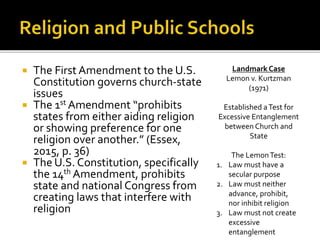
 The First Amendment to the U.S.
Constitution governs church-state
issues
 The 1st Amendment “prohibits
states from either aiding religion
or showing preference for one
religion over another.” (Essex,
2015, p. 36)
 The U.S. Constitution, specifically
the 14th Amendment, prohibits
state and national Congress from
creating laws that interfere with
religion
Landmark Case
Lemon v. Kurtzman
(1971)
Established aTest for
Excessive Entanglement
between Church and
State
The LemonTest:
1. Law must have a
secular purpose
2. Law must neither
advance, prohibit,
nor inhibit religion
3. Law must not create
excessive
entanglement
 Prayer at school is not permissible when it
is school sponsored or led by a staff
member because it violates the
establishment clause
 School staff members may use the Bible
as it pertains to historical or educational
purposes, but if it used as a religious
document, it violates the establishment
clause
 Religious worship, services, pageants, or
plays at school are unconstitutional,
unless they have a secular purpose
 Students are not required to recite the
Pledge of Allegiance if it would violate
their religious beliefs
Landmark Case
WestVirginia State
Board of Education v.
Barnette
(2002)
School officials cannot
require students to recite
the Pledge of Allegiance
because it would violate
their religious freedoms.
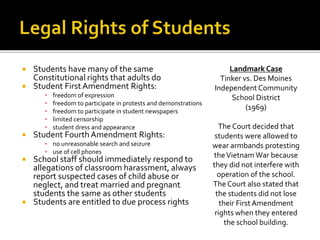
 Students have many of the same
Constitutional rights that adults do
 Student First Amendment Rights:
▪ freedom of expression
▪ freedom to participate in protests and demonstrations
▪ freedom to participate in student newspapers
▪ limited censorship
▪ student dress and appearance
 Student FourthAmendment Rights:
▪ no unreasonable search and seizure
▪ use of cell phones
 School staff should immediately respond to
allegations of classroom harassment, always
report suspected cases of child abuse or
neglect, and treat married and pregnant
students the same as other students
 Students are entitled to due process rights
Landmark Case
Tinker vs. Des Moines
Independent Community
School District
(1969)
The Court decided that
students were allowed to
wear armbands protesting
theVietnam War because
they did not interfere with
operation of the school.
The Court also stated that
the students did not lose
their FirstAmendment
rights when they entered
the school building.
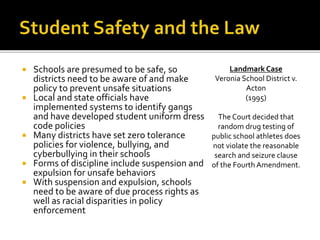
 Schools are presumed to be safe, so
districts need to be aware of and make
policy to prevent unsafe situations
 Local and state officials have
implemented systems to identify gangs
and have developed student uniform dress
code policies
 Many districts have set zero tolerance
policies for violence, bullying, and
cyberbullying in their schools
 Forms of discipline include suspension and
expulsion for unsafe behaviors
 With suspension and expulsion, schools
need to be aware of due process rights as
well as racial disparities in policy
enforcement
Landmark Case
Veronia School District v.
Acton
(1995)
The Court decided that
random drug testing of
public school athletes does
not violate the reasonable
search and seizure clause
of the Fourth Amendment.
 The BuckleyAmendment guarantees parents
and students confidentiality and fairness in
dealing with educational record
 Parents or legal guardians have the right to see
their child’s educational records
 Students over the age of 18 and some non-
custodial parents also have the right to see
educational records
 Teachers, counselors, administrators and
Federal and state officials may see educational
records if needed

School Law One

  • 1.
    Bailey Mohr Sources Essex, N.L. (2015). A teacher's pocket guide to school law (3rd ed.). Boston: Pearson Education. Module One Powerpoint Presentations
  • 2.
     Public schoolsare state controlled according to theTenth Amendment to the U.S. Constitution  Federal Government enacts statutes to improve education – Federal Government cannot create policy, but can enact statutes connected to funding  States have police power and plenary power over public education  State Departments of Education set curriculum standards – South Dakota has adopted Common Core State Standards
  • 3.
     School boardshave specific or implied powers, but answer to the state  Local school board is policy-making entity  The local school board has the authority to hire or fire school employees
  • 4.
     School boardmeetings are public, as are the minutes and recordings  School boards set their own procedures  Executive sessions of the school board are called when subject is personal in nature  Candidates for school board must be voting members of the district who file a petition and get community member signatures
  • 5.
     Teachers arepublic employees  Teachers are in a contractual relationship with the school board, which is an extension of the state  Teachers must know and follow school board, state, and national policies or they may be dismissed from their position
  • 6.
     The FirstAmendment to the U.S. Constitution governs church-state issues  The 1st Amendment “prohibits states from either aiding religion or showing preference for one religion over another.” (Essex, 2015, p. 36)  The U.S. Constitution, specifically the 14th Amendment, prohibits state and national Congress from creating laws that interfere with religion Landmark Case Lemon v. Kurtzman (1971) Established aTest for Excessive Entanglement between Church and State The LemonTest: 1. Law must have a secular purpose 2. Law must neither advance, prohibit, nor inhibit religion 3. Law must not create excessive entanglement
  • 7.
     Prayer atschool is not permissible when it is school sponsored or led by a staff member because it violates the establishment clause  School staff members may use the Bible as it pertains to historical or educational purposes, but if it used as a religious document, it violates the establishment clause  Religious worship, services, pageants, or plays at school are unconstitutional, unless they have a secular purpose  Students are not required to recite the Pledge of Allegiance if it would violate their religious beliefs Landmark Case WestVirginia State Board of Education v. Barnette (2002) School officials cannot require students to recite the Pledge of Allegiance because it would violate their religious freedoms.
  • 8.
     Students havemany of the same Constitutional rights that adults do  Student First Amendment Rights: ▪ freedom of expression ▪ freedom to participate in protests and demonstrations ▪ freedom to participate in student newspapers ▪ limited censorship ▪ student dress and appearance  Student FourthAmendment Rights: ▪ no unreasonable search and seizure ▪ use of cell phones  School staff should immediately respond to allegations of classroom harassment, always report suspected cases of child abuse or neglect, and treat married and pregnant students the same as other students  Students are entitled to due process rights Landmark Case Tinker vs. Des Moines Independent Community School District (1969) The Court decided that students were allowed to wear armbands protesting theVietnam War because they did not interfere with operation of the school. The Court also stated that the students did not lose their FirstAmendment rights when they entered the school building.
  • 9.
     Schools arepresumed to be safe, so districts need to be aware of and make policy to prevent unsafe situations  Local and state officials have implemented systems to identify gangs and have developed student uniform dress code policies  Many districts have set zero tolerance policies for violence, bullying, and cyberbullying in their schools  Forms of discipline include suspension and expulsion for unsafe behaviors  With suspension and expulsion, schools need to be aware of due process rights as well as racial disparities in policy enforcement Landmark Case Veronia School District v. Acton (1995) The Court decided that random drug testing of public school athletes does not violate the reasonable search and seizure clause of the Fourth Amendment.
  • 10.
     The BuckleyAmendmentguarantees parents and students confidentiality and fairness in dealing with educational record  Parents or legal guardians have the right to see their child’s educational records  Students over the age of 18 and some non- custodial parents also have the right to see educational records  Teachers, counselors, administrators and Federal and state officials may see educational records if needed