TEST-DRIVEN DEVELOPMENT
BEHAVIOR-DRIVEN DEVELOPMENT
            Brandon Byars
       bbyars@thoughtworks.com
As a software development organization,
I want to have more predictability and adaptability
So that I can respond to change


Given a new requirement
When I write the code for it
Then I want to know whether I did the right thing
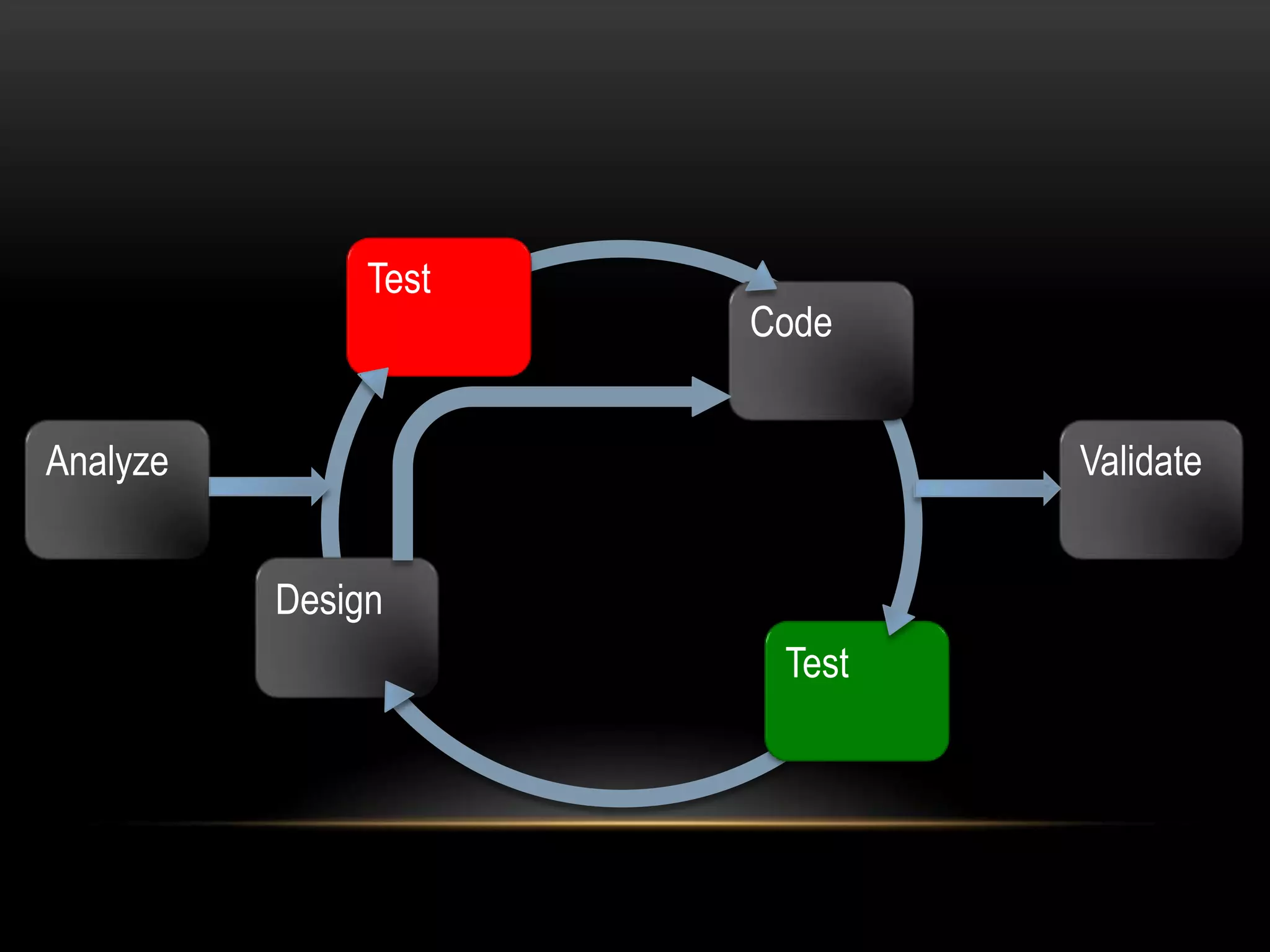
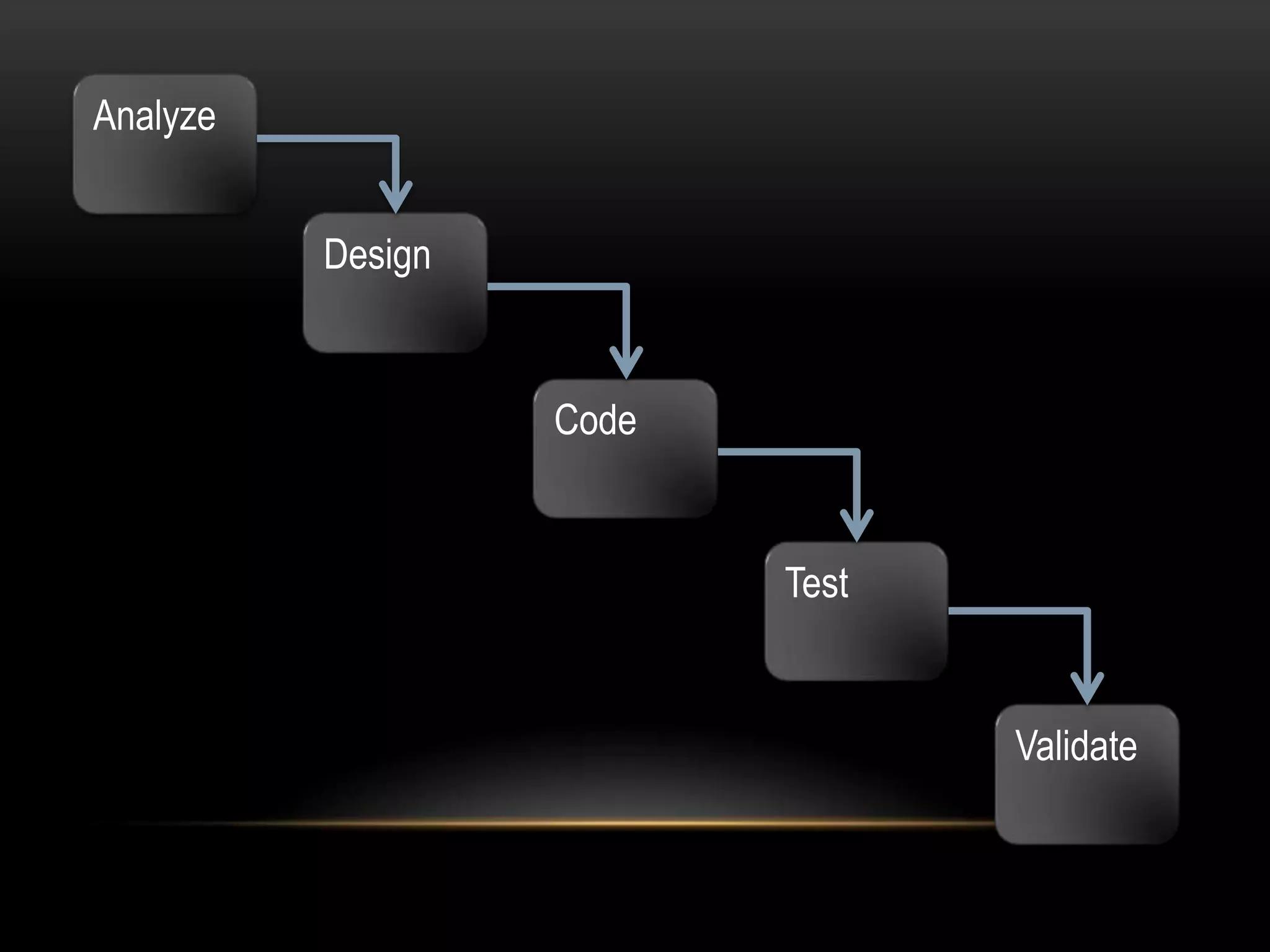
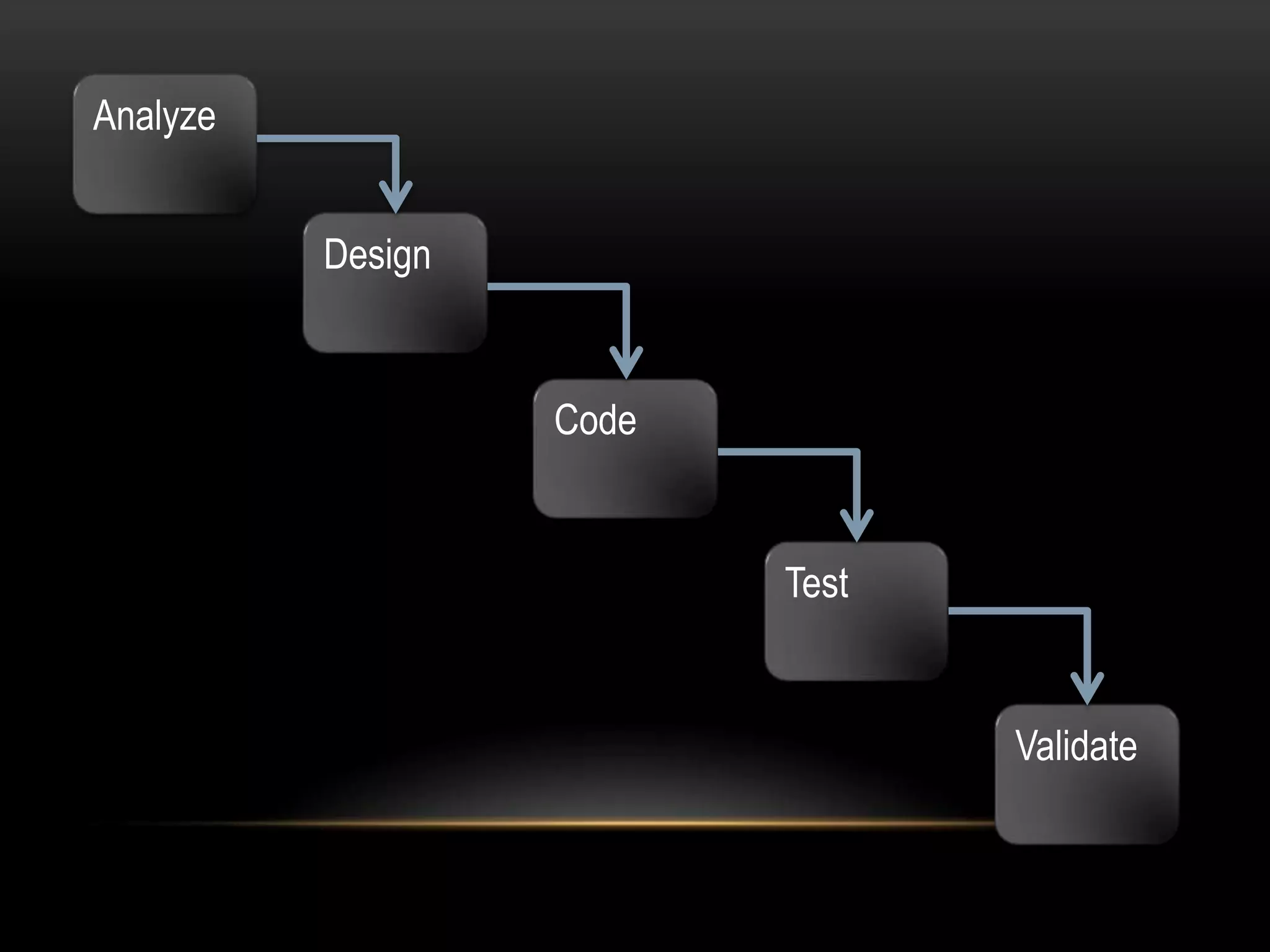
Analyze


          Design


                   Code


                          Test


                                 Validate
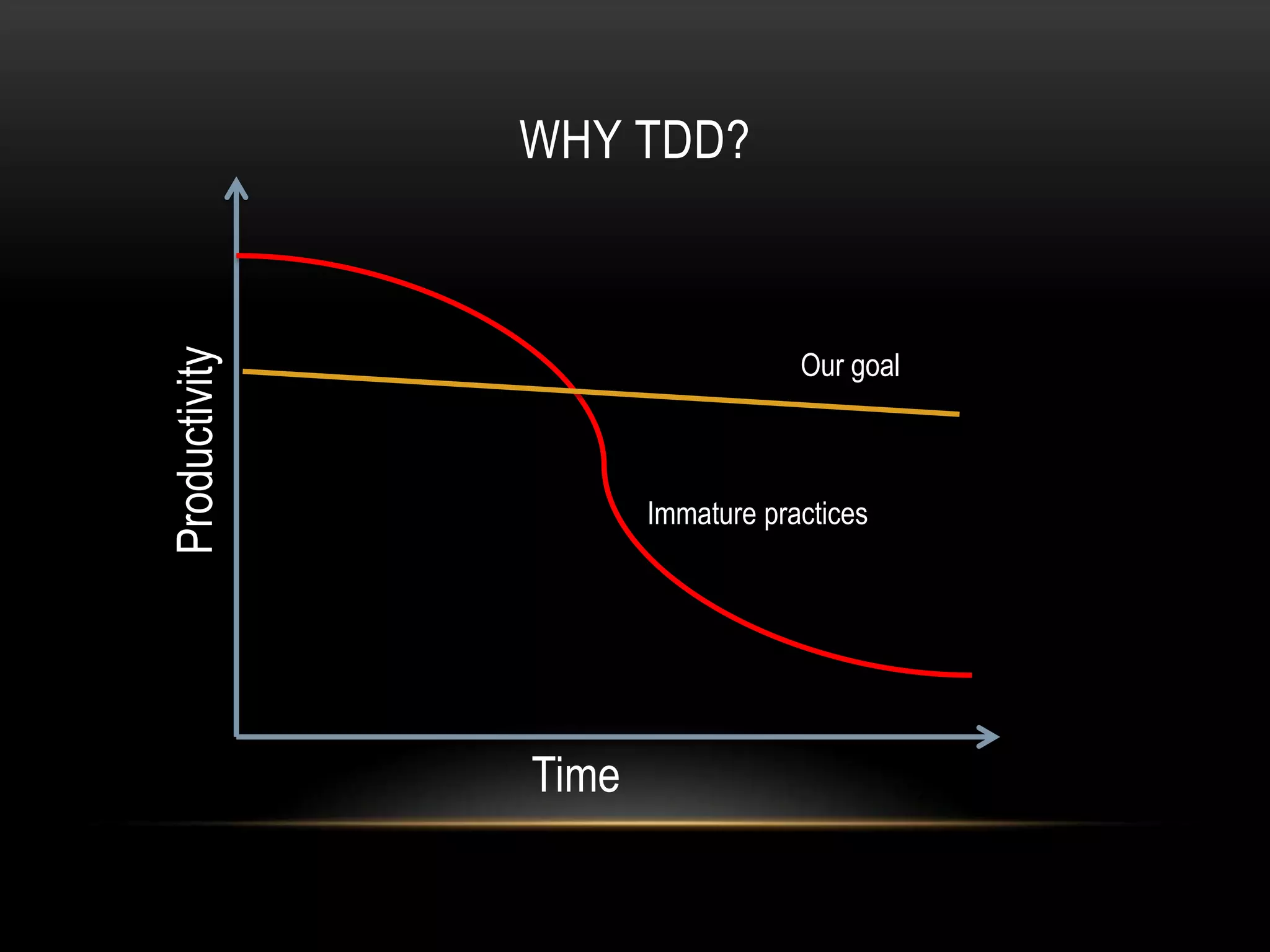
WHY TDD?
Productivity


                                  Our goal


                      Immature practices


               Time
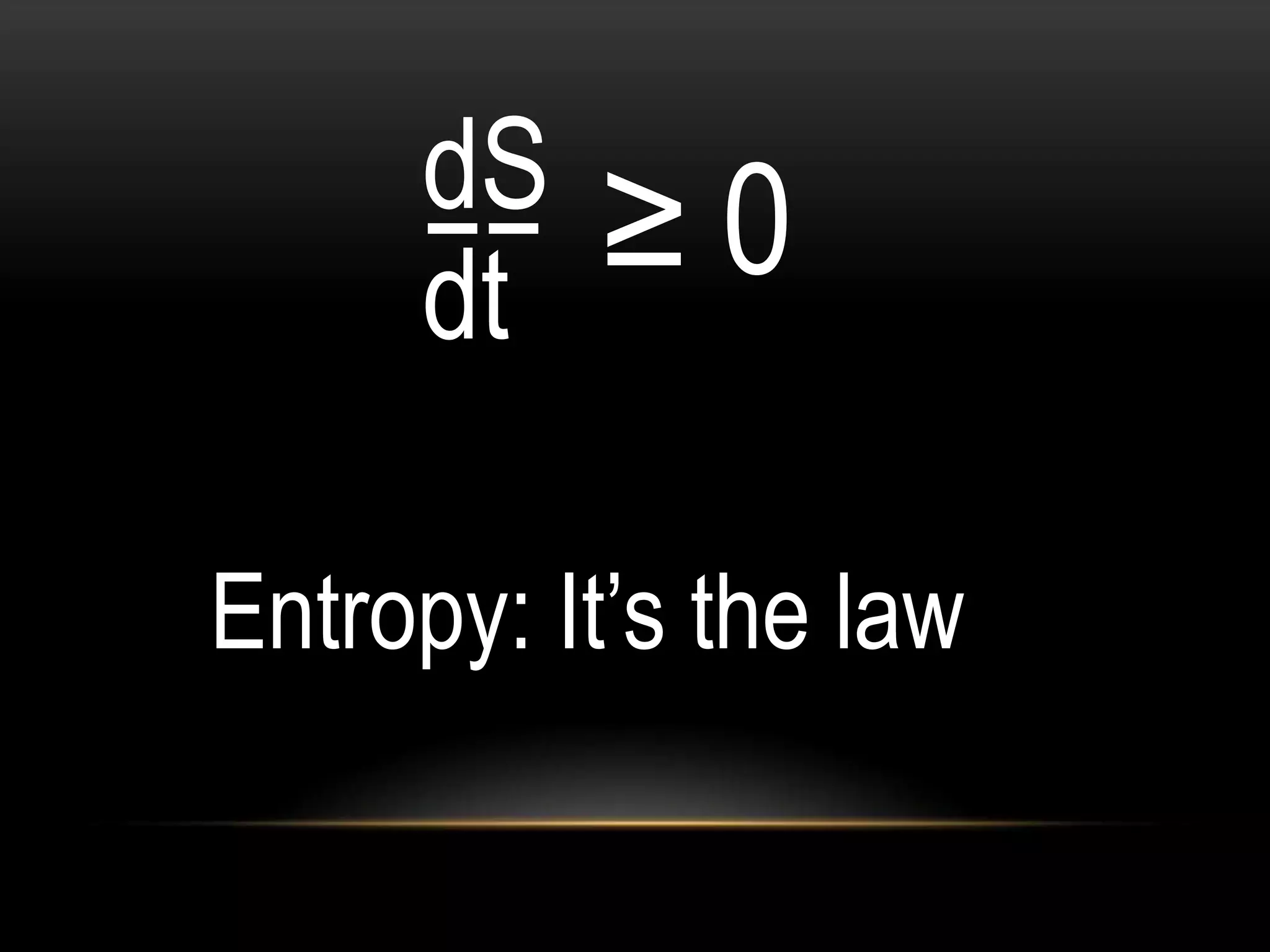
dS
     −−
     dt
          ≥0

Entropy: It’s the law
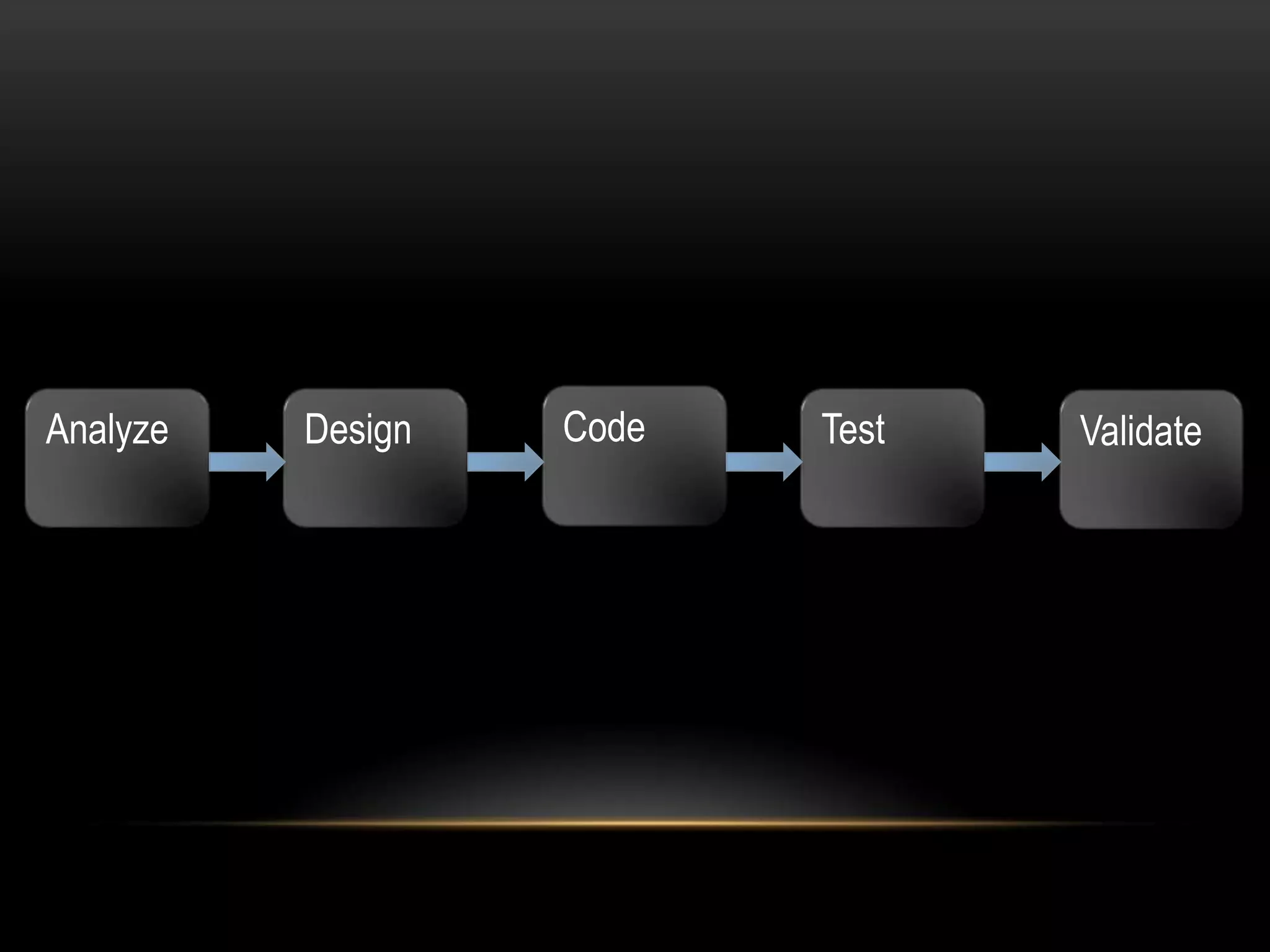
Analyze


          Design


                   Code


                          Test


                                 Validate
Analyze   Design   Code   Test   Validate
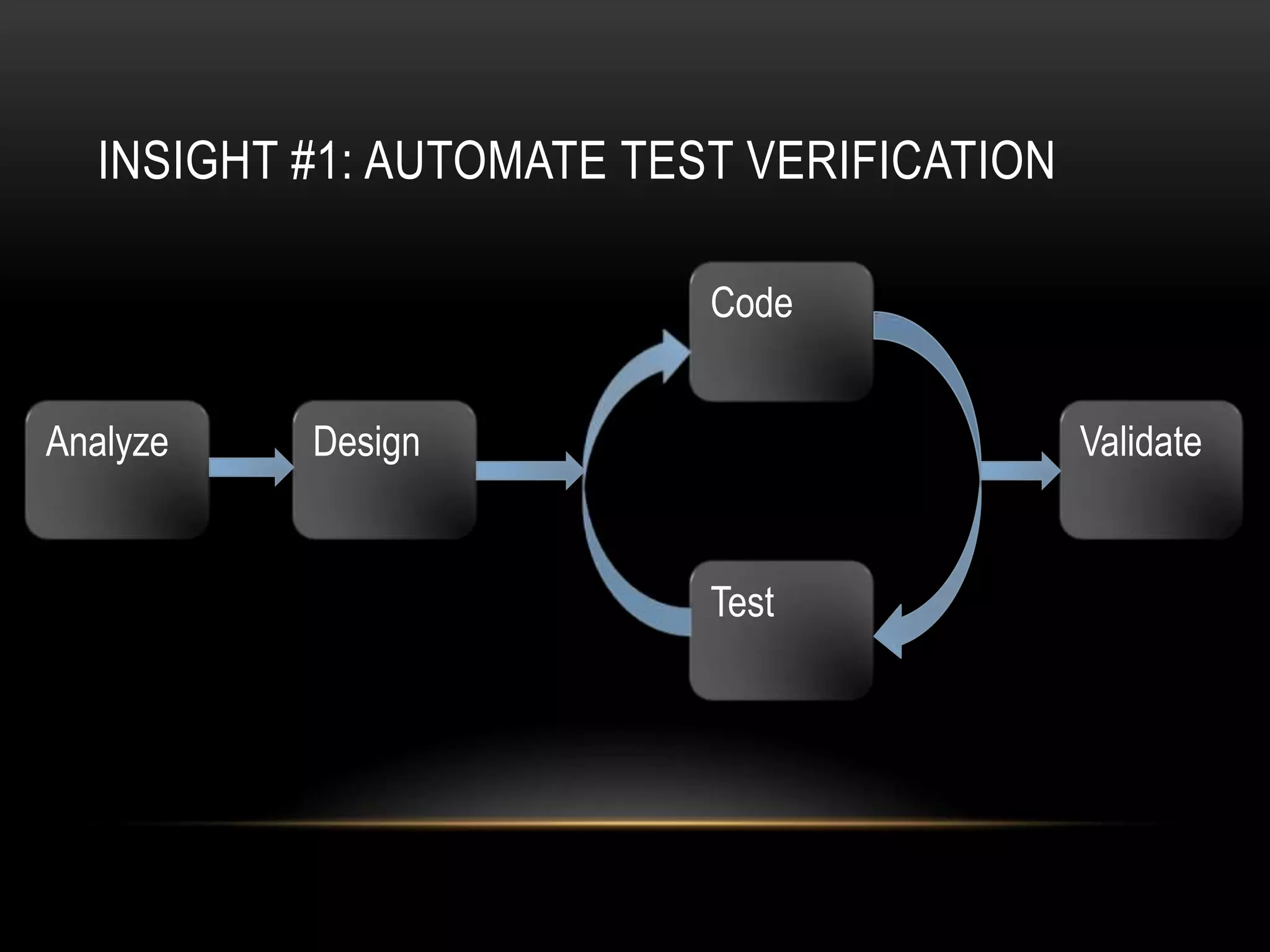
INSIGHT #1: AUTOMATE TEST VERIFICATION

                          Code


Analyze   Design                           Validate


                          Test
[Test]
public void ShouldRouteToEchoAction()
{
         var response = new HttpRequest("GET”,
                "http://localhost/RestMvc/echo/hello"
         ).GetResponse();


         Assert.That(response.StatusCode, Is.EqualTo(200));
         Assert.That(response.Body, Is.EqualTo("hello"));
}
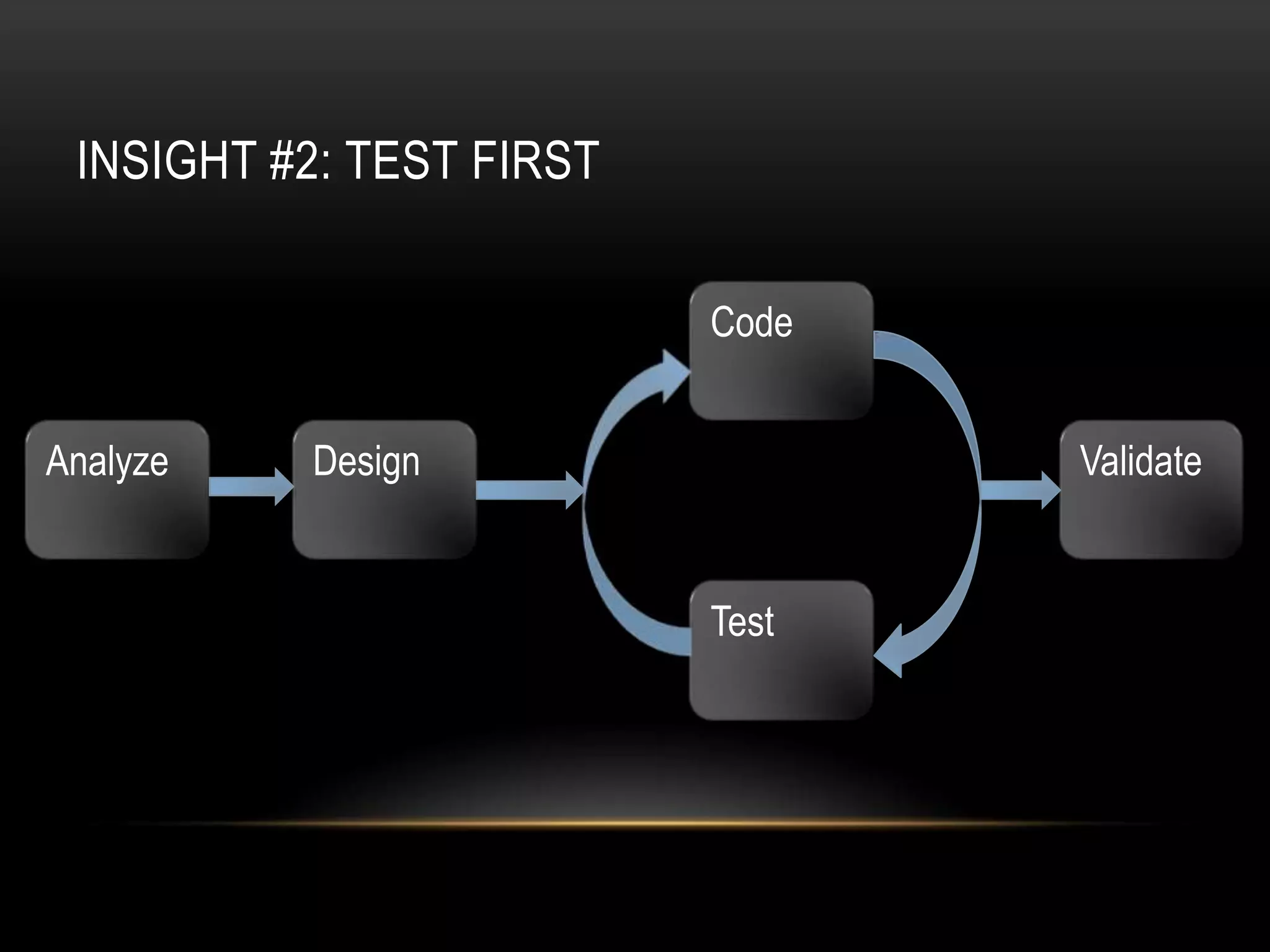
INSIGHT #2: TEST FIRST

                          Code


Analyze   Design                 Validate


                          Test
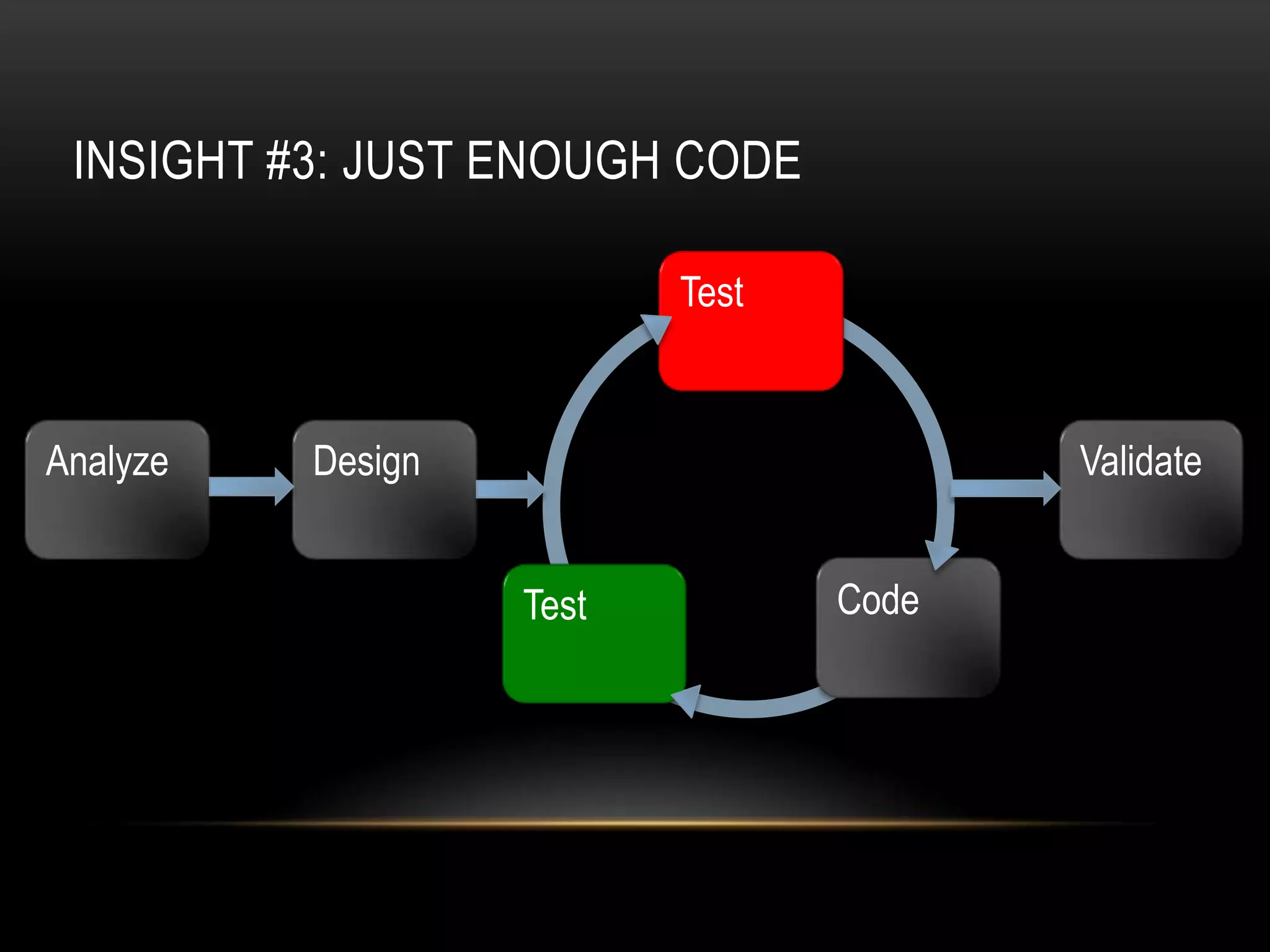
INSIGHT #3: JUST ENOUGH CODE

                          Test


Analyze   Design                        Validate


                   Test          Code
[TestFixture]
public class StackTest
{
        [Test]
        public void NewStackShouldBeEmpty()
        {
                 var stack = new Stack();
                 Assert.That(stack.IsEmpty());
        }
}
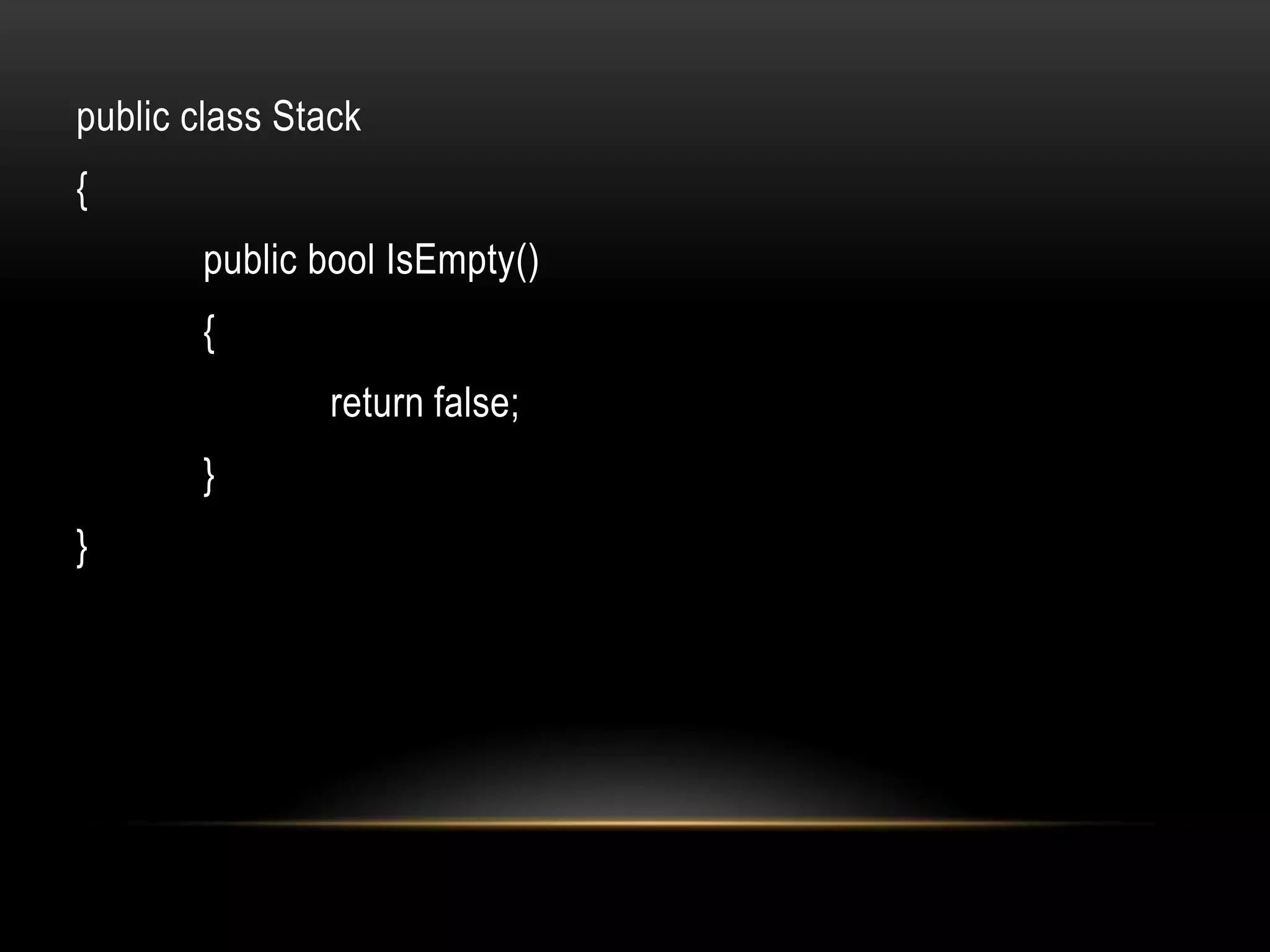
public class Stack
{
        public bool IsEmpty()
        {
                return false;
        }
}
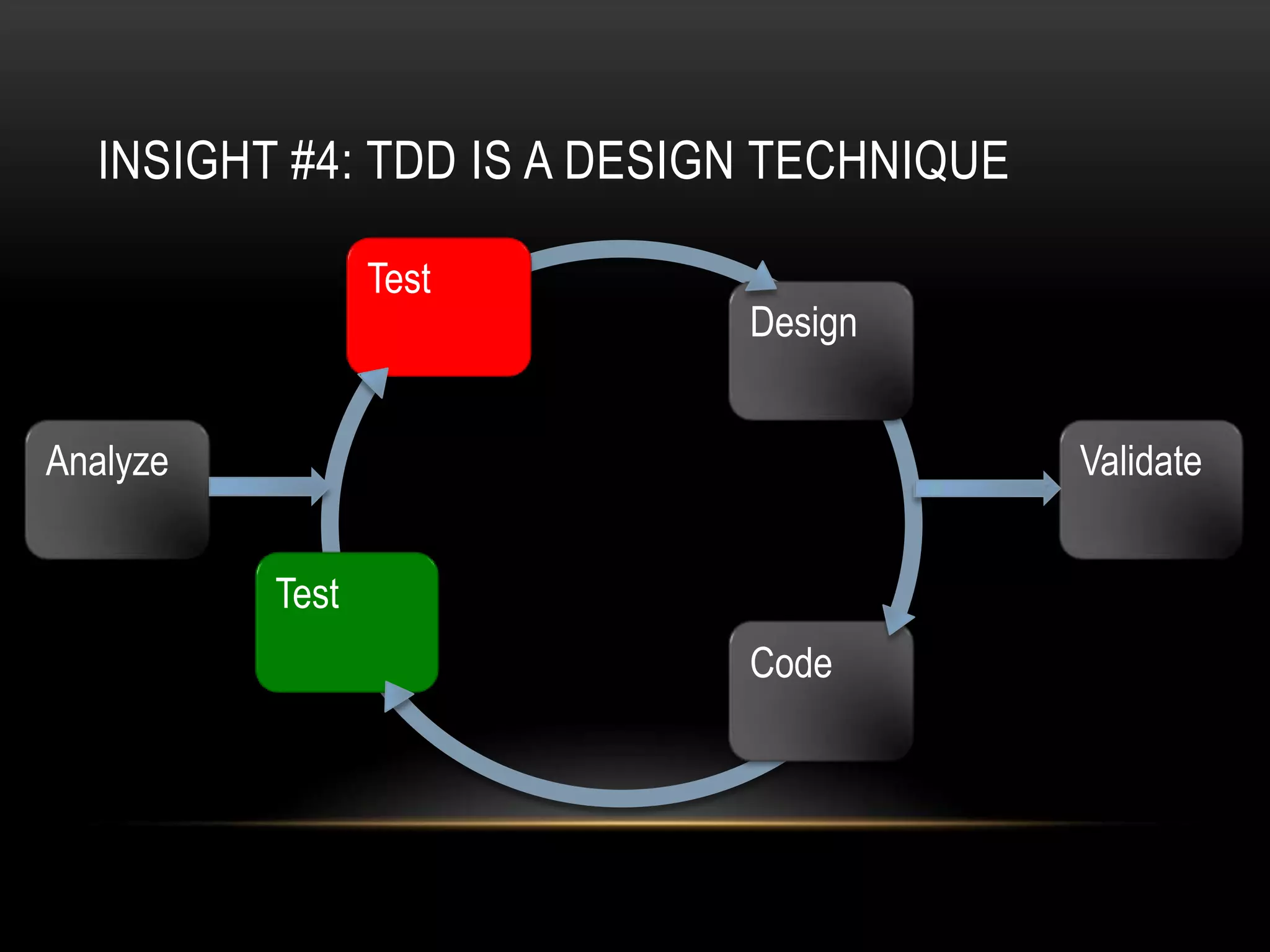
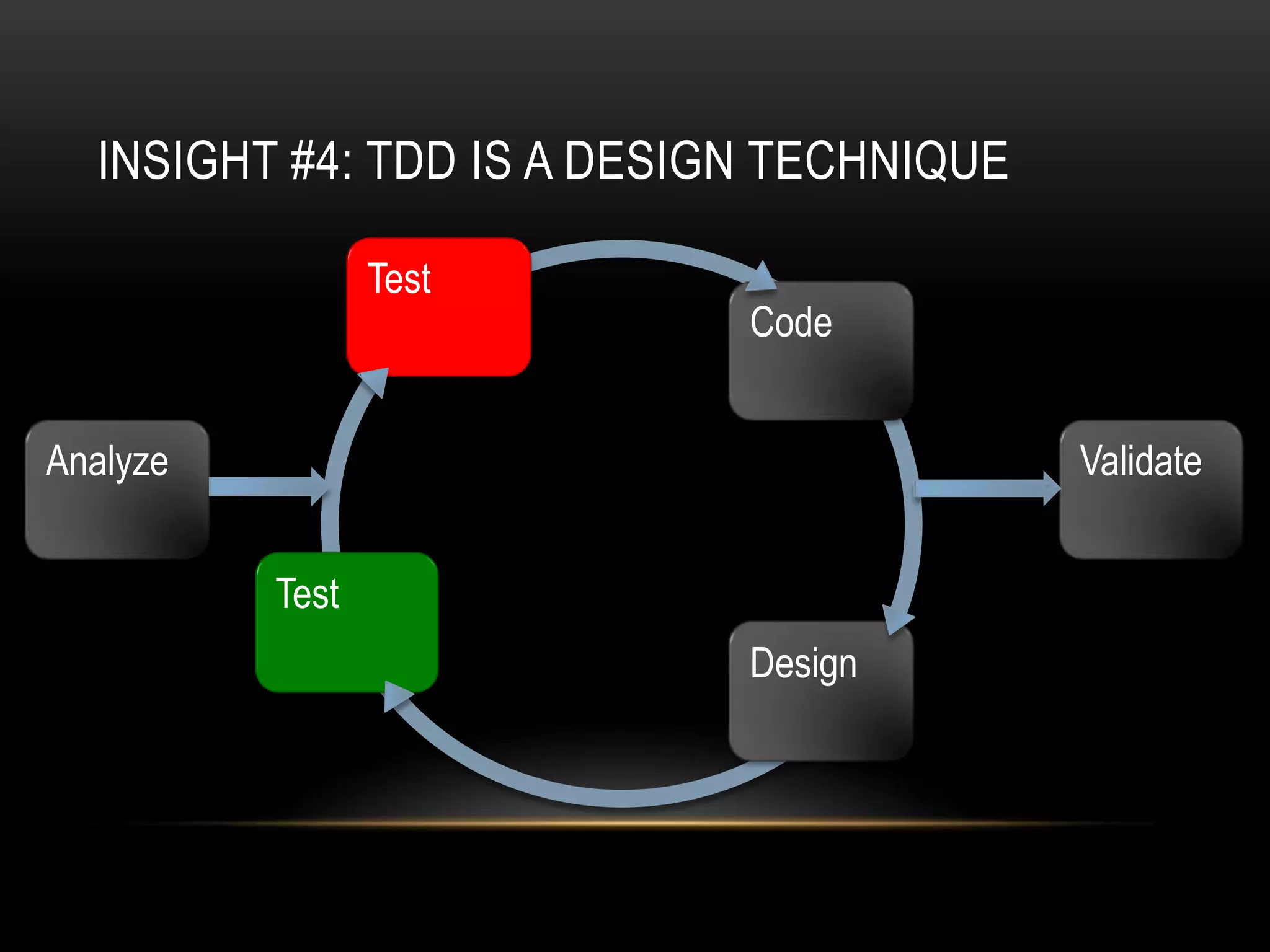
INSIGHT #4: TDD IS A DESIGN TECHNIQUE

                 Test
                            Design


Analyze                                   Validate


          Test
                            Code
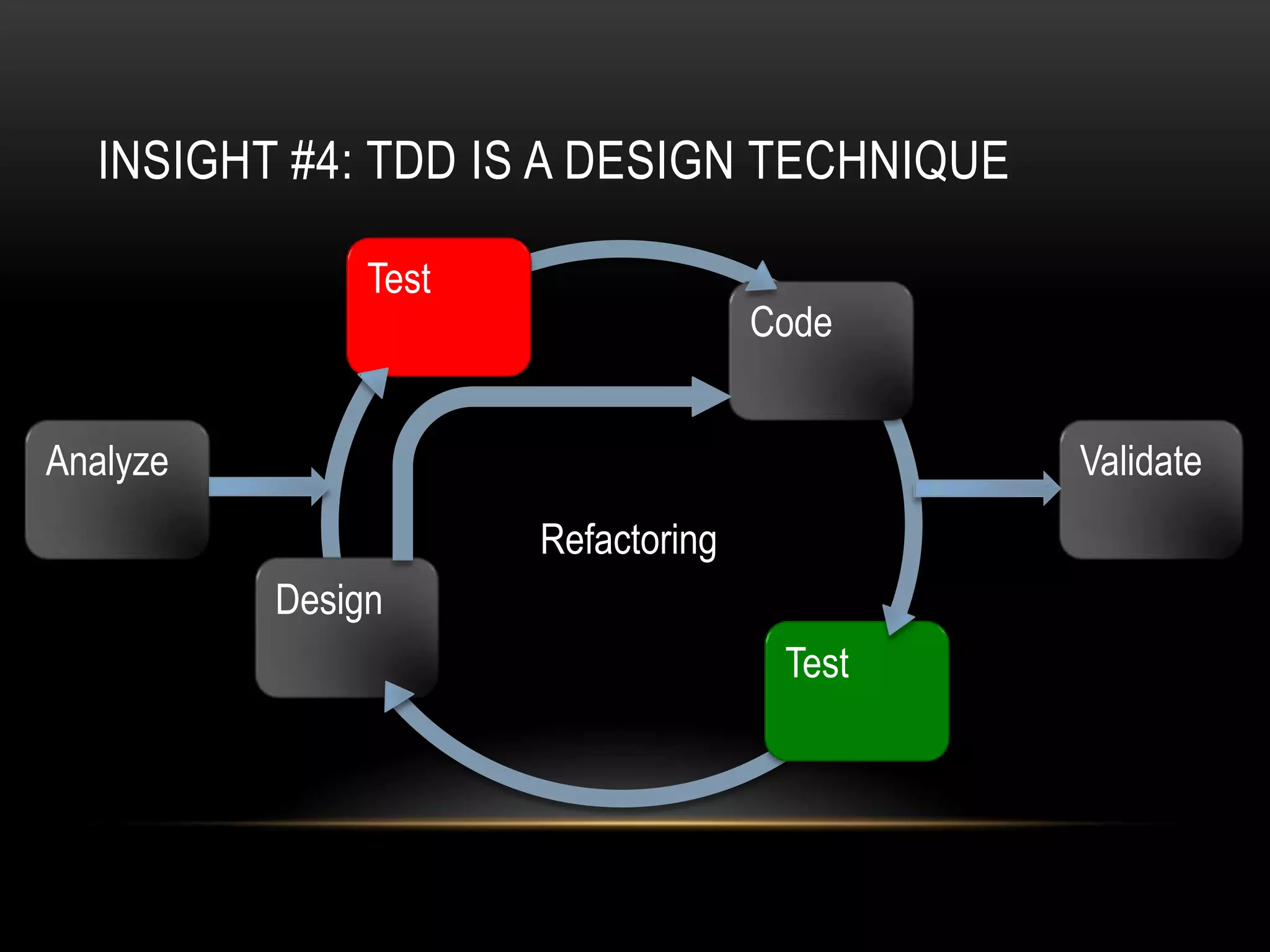
INSIGHT #4: TDD IS A DESIGN TECHNIQUE

                 Test
                            Code


Analyze                                   Validate


          Test
                            Design
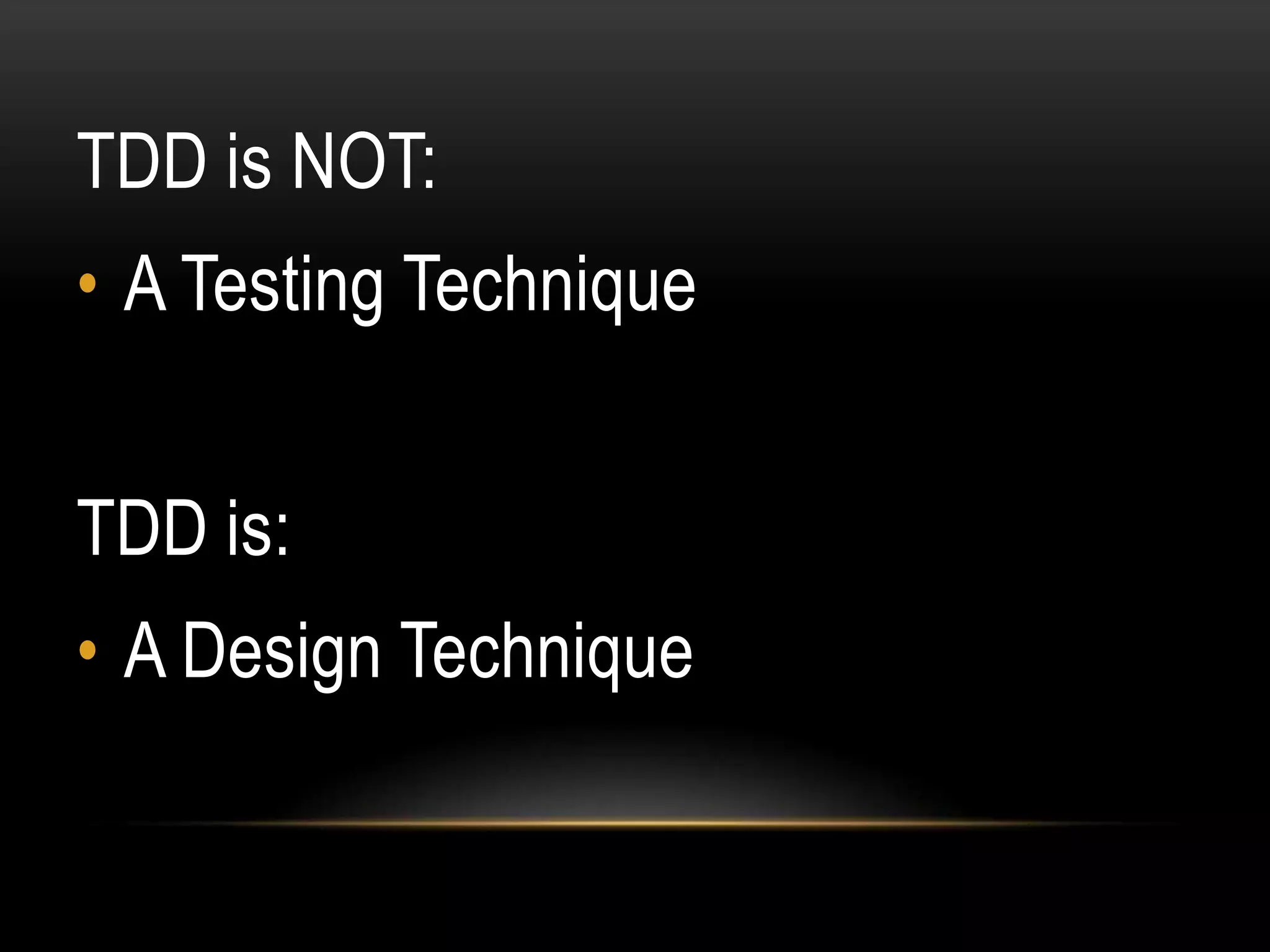
INSIGHT #4: TDD IS A DESIGN TECHNIQUE

               Test
                                    Code


Analyze                                     Validate
                      Refactoring
          Design
                                     Test
TDD is NOT:
• A Testing Technique


TDD is:
• A Design Technique
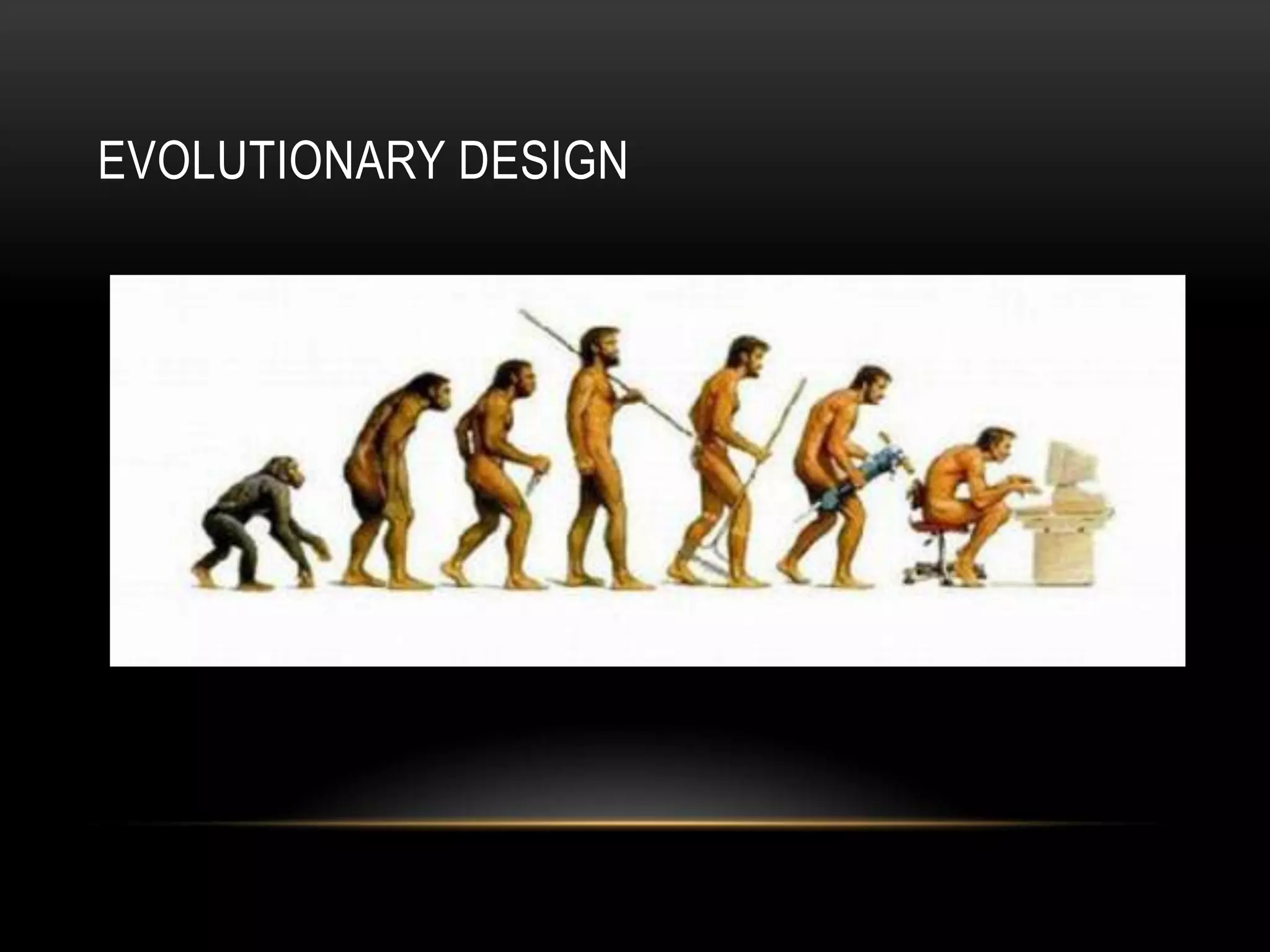
EVOLUTIONARY DESIGN
“Perfection is achieved, not
when there is nothing more to
add, but when there is nothing
left to take away.”
              -Antoine de Saint-Exupery
Simple
Ain’t
Easy
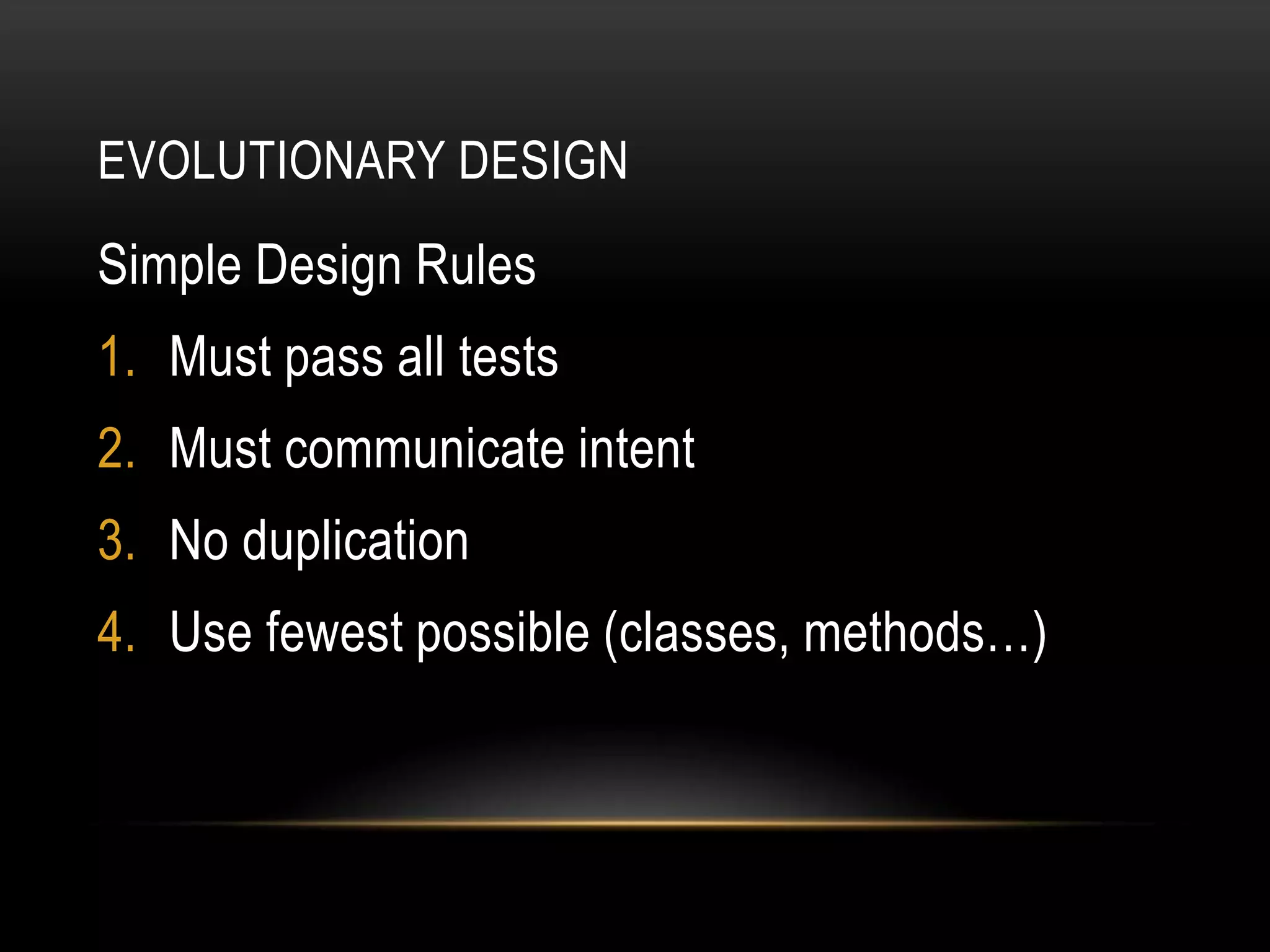
EVOLUTIONARY DESIGN
Simple Design Rules
1. Must pass all tests
2. Must communicate intent
3. No duplication
4. Use fewest possible (classes, methods…)
BEHAVIOR DRIVEN DEVELOPMENT


There are only two hard problems in computer
science:
• cache invalidation, and
• naming things.
 -- Phil Karlton
Test
                      Code


Analyze                       Validate


          Design
                       Test
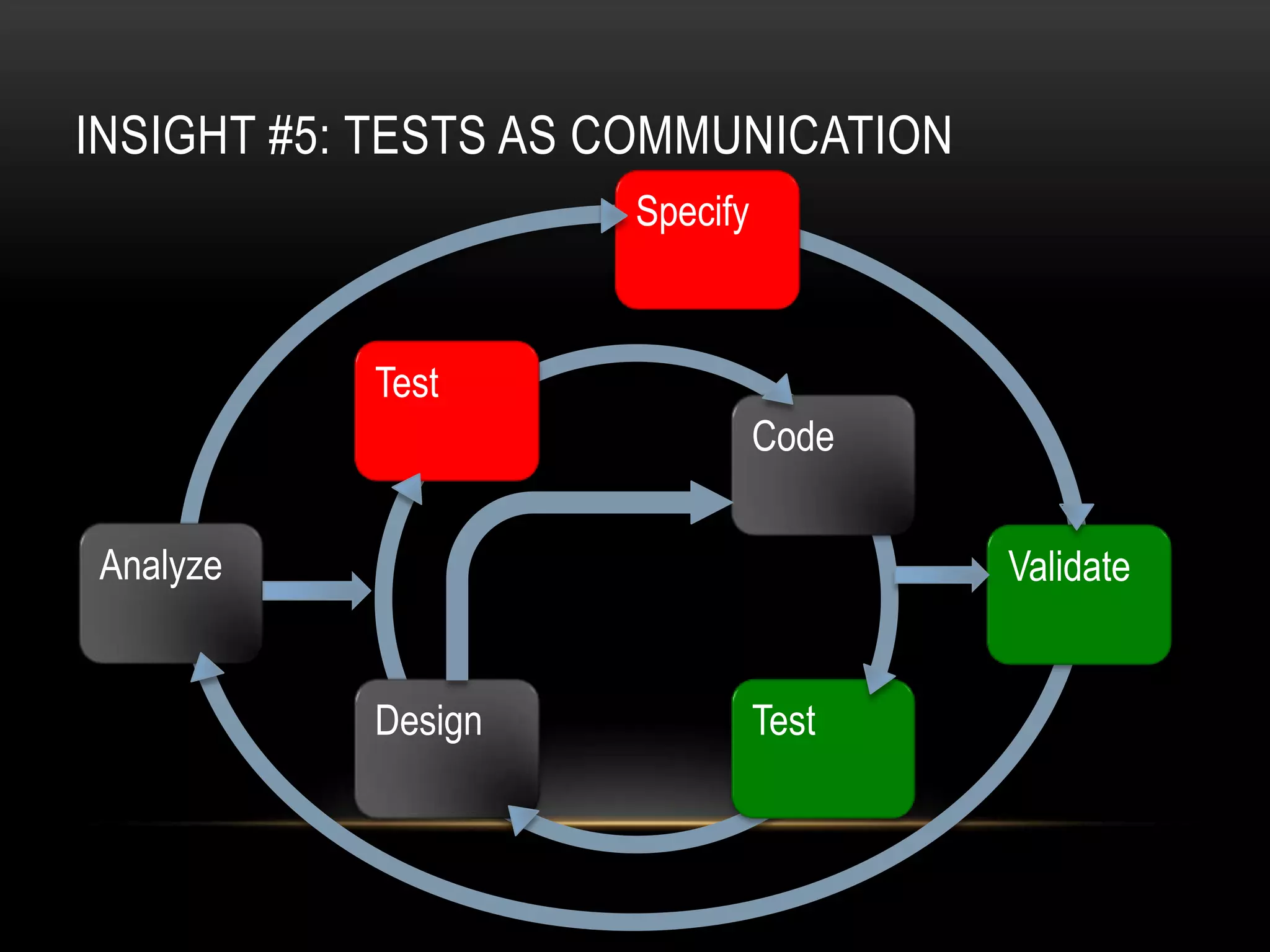
INSIGHT #5: TESTS AS COMMUNICATION
                     Specify


           Test
                               Code


Analyze                               Validate


           Design              Test
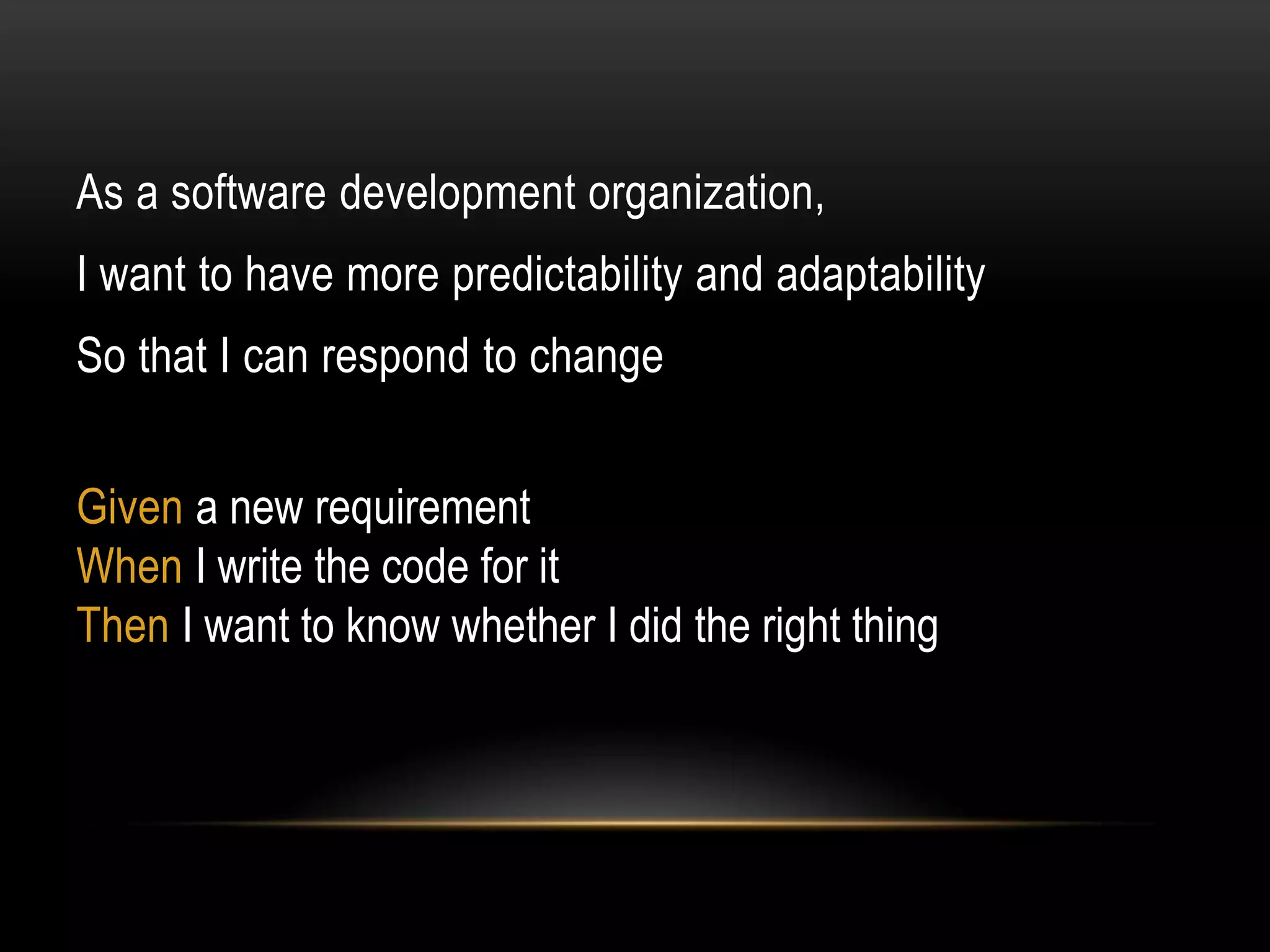
As a software development organization,
I want to have more predictability and adaptability
So that I can respond to change


Given a new requirement
When I write the code for it
Then I want to know whether I did the right thing
private Requirement requirement;

[Given(“a new requirement”)]
public void GivenANewRequirement()
{ requirement = new Requirement(); }

[When(“I write the code for it”)]
public void WhenIWriteTheCodeForIt()
{ requirement.Satisfy(); }

[Then(“I want to know .*”)]
public void ThenIWantToKnowIfItWorked()
{ Assert.That(requirement.IsSatisfied()); }
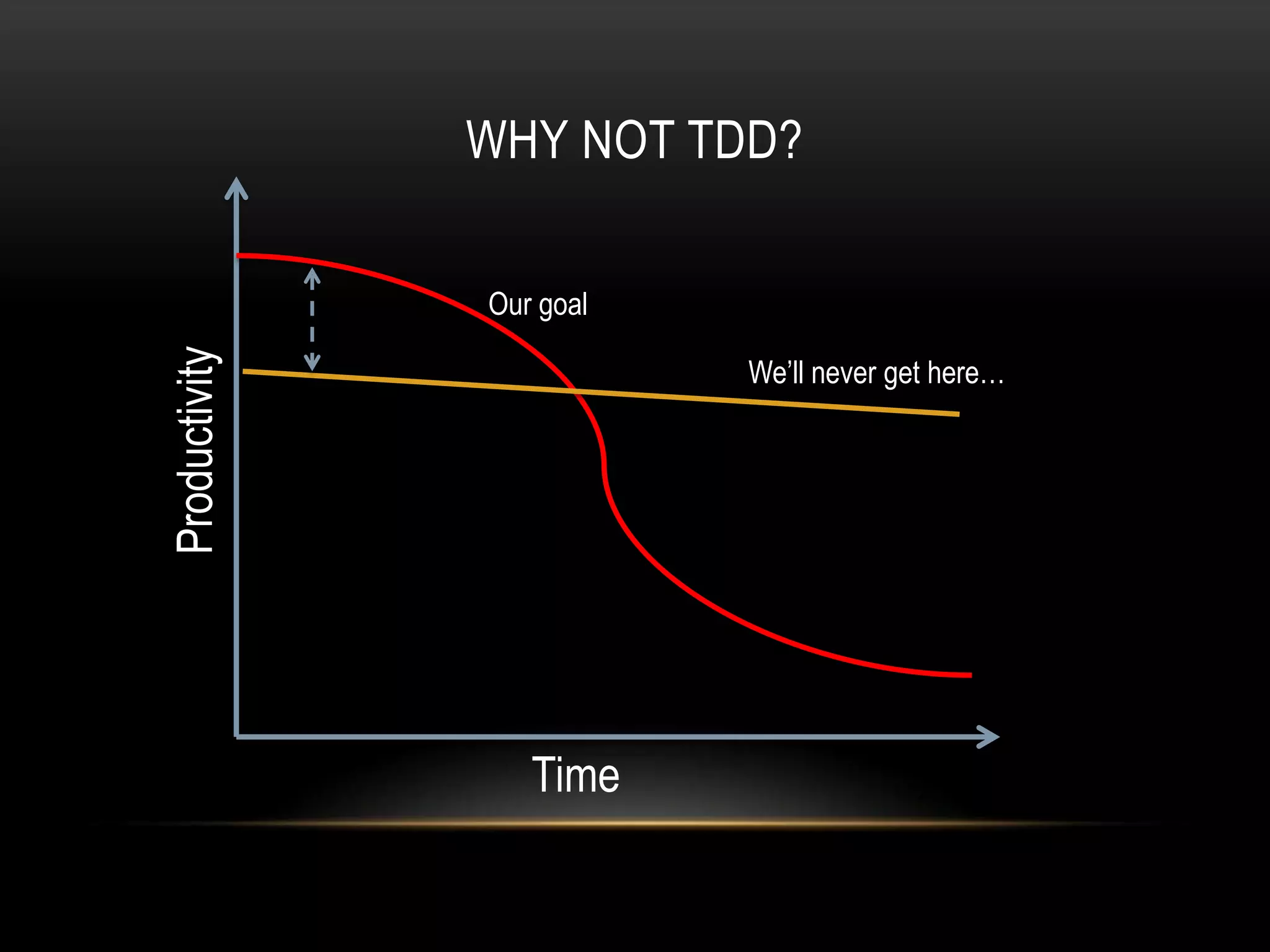
WHY NOT TDD?

               Our goal
Productivity


                          We’ll never get here…


                  Time
TIC TAC TOE


      https://github.com/bbyars/TicTacToe

Tdd and-bdd

  • 1.
    TEST-DRIVEN DEVELOPMENT BEHAVIOR-DRIVEN DEVELOPMENT Brandon Byars bbyars@thoughtworks.com
  • 2.
    As a softwaredevelopment organization, I want to have more predictability and adaptability So that I can respond to change Given a new requirement When I write the code for it Then I want to know whether I did the right thing
  • 3.
    Analyze Design Code Test Validate
  • 4.
    WHY TDD? Productivity Our goal Immature practices Time
  • 5.
    dS −− dt ≥0 Entropy: It’s the law
  • 6.
    Analyze Design Code Test Validate
  • 7.
    Analyze Design Code Test Validate
  • 8.
    INSIGHT #1: AUTOMATETEST VERIFICATION Code Analyze Design Validate Test
  • 9.
    [Test] public void ShouldRouteToEchoAction() { var response = new HttpRequest("GET”, "http://localhost/RestMvc/echo/hello" ).GetResponse(); Assert.That(response.StatusCode, Is.EqualTo(200)); Assert.That(response.Body, Is.EqualTo("hello")); }
  • 10.
    INSIGHT #2: TESTFIRST Code Analyze Design Validate Test
  • 11.
    INSIGHT #3: JUSTENOUGH CODE Test Analyze Design Validate Test Code
  • 12.
    [TestFixture] public class StackTest { [Test] public void NewStackShouldBeEmpty() { var stack = new Stack(); Assert.That(stack.IsEmpty()); } }
  • 13.
    public class Stack { public bool IsEmpty() { return false; } }
  • 14.
    INSIGHT #4: TDDIS A DESIGN TECHNIQUE Test Design Analyze Validate Test Code
  • 15.
    INSIGHT #4: TDDIS A DESIGN TECHNIQUE Test Code Analyze Validate Test Design
  • 16.
    INSIGHT #4: TDDIS A DESIGN TECHNIQUE Test Code Analyze Validate Refactoring Design Test
  • 17.
    TDD is NOT: •A Testing Technique TDD is: • A Design Technique
  • 18.
  • 20.
    “Perfection is achieved,not when there is nothing more to add, but when there is nothing left to take away.” -Antoine de Saint-Exupery
  • 21.
  • 22.
    EVOLUTIONARY DESIGN Simple DesignRules 1. Must pass all tests 2. Must communicate intent 3. No duplication 4. Use fewest possible (classes, methods…)
  • 23.
    BEHAVIOR DRIVEN DEVELOPMENT Thereare only two hard problems in computer science: • cache invalidation, and • naming things. -- Phil Karlton
  • 24.
    Test Code Analyze Validate Design Test
  • 25.
    INSIGHT #5: TESTSAS COMMUNICATION Specify Test Code Analyze Validate Design Test
  • 26.
    As a softwaredevelopment organization, I want to have more predictability and adaptability So that I can respond to change Given a new requirement When I write the code for it Then I want to know whether I did the right thing
  • 27.
    private Requirement requirement; [Given(“anew requirement”)] public void GivenANewRequirement() { requirement = new Requirement(); } [When(“I write the code for it”)] public void WhenIWriteTheCodeForIt() { requirement.Satisfy(); } [Then(“I want to know .*”)] public void ThenIWantToKnowIfItWorked() { Assert.That(requirement.IsSatisfied()); }
  • 28.
    WHY NOT TDD? Our goal Productivity We’ll never get here… Time
  • 29.
    TIC TAC TOE https://github.com/bbyars/TicTacToe

Editor's Notes

  • #2 Interruptions welcome
  • #3 User story (Connectrix –Mike Cohn)How many of you use user stories or acceptance criteria something like this?Generally we recommend writing these *before* you write the code, yes?
  • #4 Standard waterfall caricatureA lot happens between us writing that requirement and our ability to validate the code that satisfies itWhat’s the difference b/t test & validate? (doing the thing right vs doing the right thing)
  • #5 Top curve (at T0) is a caricature of what I’ve experienced when I delayed testing to the end on a large OMS projectFlat line not really flat – it still trends downwards, but at a much slower and more predictable rateCommon way to stabilize red line – throw armies at it, standardize, add bureacracy, change control = change preventionChaos report – very high rate of failure
  • #6 Who knows what this is?Systems tend to disorder over time
  • #8 Start by removing the altitude – can give false sense of prestige (design > code > test) that gets in the way of experimentation
  • #9 You can do this w/o automation, and in fact those who don’t automate tests actually do thisBut test automation gives you a safety net that scales to catch regression bugs.How many of you are comfortable with test automation?
  • #10 Functional test = tests LOTS of code all at onceIf I hadn’t written this, I would have manually tested the same way (through a browser)
  • #11 Why would we do that?Helps specify what we want before writing the codeOtherwise we might not write the test (encourages automation)
  • #12 Allows you to work in very tiny increments, running tests very frequently
  • #13 I wanted to give you an idea of the granularity we’re talking about…
  • #14 Yes, really. Kent Beck called this “Fake it until you make it.” Sometimes you just write the code, and in this case maybe I would have.
  • #17 Design in the small, percolates to larger design issuesWorks b/c you LISTEN to the tests (too many objects to test something – coupling problem; other object too involved = cohesion problem)Tests automatically give you another user = decreased coupling
  • #18 Took me a year to get here…Doesn’t remove need for QAs, although does allow them to focus on higher value workA lot of people want to test private methods when they start TDD.They’re confusing the intent = it’s not about testingWhite box testing is a design smell
  • #19 Evolutionary design is an alternative to a lot of heavy up front designNot necessarily mutually exclusiveAllows responding to change well. To take a strained analogy, imagine you were the first person building gloves. You could guess where to make it flexible, or you could just make it the same material throughout, which is a lot simpler. In the latter strategy, the areas that need to be flexible will become flexible over time as we bend our joints. Similarly, in evolutionary design, the parts of the code that need to be flexible become flexible b/c they change a lot, as opposed to trying to build that flexibility in. Sometimes, it can still make sense to build in some flexibility -> we’ve built enough gloves by now that we know where to make them flexible. But not all problems are as well understood as glove making
  • #20 A lot of people are uncomfortable with evolutionary design, but I want to emphasize that there’s room for multiple design approaches even on the same project. Classical music relies on a composer carefully crafting a musical piece and directing an orchestra to perform it. Jazz relies on a set pattern of chord transitions and a trust amongst the ensemble to make the most of it.
  • #21 TDD followed religiously prevents you from adding anything not needed
  • #22 Regardless of design approach, this is true, but in evolutionary design, TDD helps enforce a focus on simplicityEssential vs. accidental complexity
  • #23 Enabling change4 = Occam’s razorTension b/t them, esp #2 and #4,which is why priority matters
  • #26 * Just sucked in BAs and QAs into the cycle, and by extension, the customerTests serveas documentationSome pursue BDD within the inner circle. Really just a focus on language and business requirements* Emphasize other role involvement
  • #28 Note that I started this talk off with a test…
  • #29 Tests have a costSpikesStartups?Throw away, one-off codeLearning a language / platform
  • #30 Nothing sucks IQ points faster than coding in front of an audience, so if you don’t think I’m an imbecile yet, wait a few minutes…