EXPORTING
Everywhere you export
STEP-BY-STEP GUIDE TO EXPORTING | 2
The Canadian Trade Commissioner Service (TCS) is
pleased to introduce the new Step-by-Step Guide to
Exporting, an essential reference tool for all Canadian
companies currently active or interested in exploring
business opportunities in international markets.
Welcome to exporting
LEARN MORE
See how Trade Commissioners
help companies make better,
timelier and more cost-effective
decisions to achieve their
goals abroad.
The Guide provides insight
gathered from trade commissioners
around the world — Canada’s
most comprehensive network of
international trade professionals.
Whether you’re doing business in
established markets, such as the
E.U. and U.S., or considering
reaching out to markets like China,
India, South Korea, Colombia or
Brazil, global markets offer you
access to new customers, revenue
and ideas. They also provide you
with the flexibility to spread your
business risk and extend the
lifecycle of your products and
services. These advantages are not
possible when you sell only to a
smaller consumer market in Canada.
Trading abroad can boost your
company’s profile, credibility and
bottom line. Companies that export
their products or services sell more,
and are more profitable than those
that don’t. Whatever your company
size or sector, the rewards from
selling your products and services
overseas can have exponential
returns.
The following Guide is intended
to help prepare you to take your
business to the world. Our global
team of trade commissioners are
located in more than 160 cities
worldwide to guide your journey
and support your export success. WATCH THE VIDEO
STEP-BY-STEP GUIDE TO EXPORTING | 3
	 STEP #1	 Getting started: assessing your export potential	6
	 STEP #2	 Globalization: linking to global value chains	13
	 STEP #3	 Charting your route: developing your export plan	18
	 STEP #4	 Setting out: identifying your target market	21
	 STEP #5	 Reaching the customer: developing your export marketing strategy	25
	 STEP #6	 Opening the door: entering your target market	33
	 STEP #7	 Shippers and shipping: delivering the goods	49
	 STEP #8	 Identifying your export financing requirements	55
	 STEP #9	 The fine print: understanding the legal side of international trade	61
	 STEP #10	 Selling online: e-commerce for exporters	70
	 APPENDIX A	 Your exporting checklist	79
	 APPENDIX B	 Resources for exporters	82
	 APPENDIX C	 Glossary of international trade terms	86
Contents of the Step-by-Step Guide to Exporting
STEP-BY-STEP GUIDE TO EXPORTING | 4Return to Table of Contents
•	 assess your company’s export
readiness
•	 build an export plan
•	 research and select your target
market
•	 realize the benefits of free trade
agreements
•	 create an export marketing plan
•	 identify delivery methods for your
target market
•	 develop a sound financial plan
•	 understand the key legal aspects
of international trade
•	 apply corporate social
responsibility practices
Make exporting easier
Doing business outside Canada can be a complex undertaking. The Step-by-
Step Guide to Exporting (the Guide) is intended to help get your business
export-ready and well positioned for commercial success abroad. Learn the
essential principles of exporting whether you are a novice, intermediate or
advanced exporter. The Guide compiles practical insight and proven tips used
successfully by thousands of Canadian firms of all sizes and in all sectors.
The Guide will help you to:
Acknowledgments
Some “Tips” were adapted from
the Canadian Trade Commissioner
Service (TCS) publication, Expand
Your Horizons. “Export myths” were
adapted from Exporting Basics by
Maurice Kogon, Director, Centre for
International Trade Development,
El Camino College, Torrance,
California.
Disclaimer
This information is to be considered
solely as a guide and should not
be quoted as, or considered to be,
a legal authority. It may become
obsolete in whole or in part at any
time without notice.
ISBN: FR5-27/2008E-PDF
Catalogue no.: 978-0-662-48363-2
Please note
The information provided in the Step-by-Step Guide to Exporting
is general in nature. To ensure your particular needs are met, start
right here in Canada by consulting trade commissioners of the
Regional Network of the TCS. As part of Global Affairs Canada, the
TCS has more than 160 offices across Canada and around the world
where dedicated officers support Canadian companies with international
business development advice and connections to qualified local contacts
that will best serve new and expanding exporters’ needs.
Web: tradecommissioner.gc.ca
1-888-306-9991 (toll free in Canada and the United States)
613-944-9991 (in the National Capital Region and outside Canada) or
1-888-576-4444 to speak with a Canada Business Network information
officer
STEP-BY-STEP GUIDE TO EXPORTING | 5Return to Table of Contents
Take your business to the world
The Trade Commissioner Service (TCS) helps Canadian companies navigate
the complexities of international markets. If you want your business to grow
internationally, tap into our expertise.
Located in over 160 cities worldwide, we provide key business insight and
access to an unbeatable network of international contacts. We gather market
intelligence, uncover commercial opportunities and help reduce the costs and
risks of doing business abroad.
Each year, we help thousands of Canadian small and medium-sized enterprises
tackle concrete problems and uncover export opportunities. We make
exporting easier for companies.
EXPAND TO GLOBAL MARKETS
We can help your business navigate
the complexities of global markets.
CONNECT YOUR BUSINESS
Tap into the TCS network
of business professionals.
GAIN BUSINESS INSIGHT
We provide key market insight and
practical business advice.
FIND NEW OPPORTUNITIES
The TCS opens the door to a world
of business opportunities.
FIND KEY CONTACTS
Trade Commissioners can help you
find qualified contacts.
SAVE TIME & MONEY
The TCS helps your company to save
time and money.
REDUCE RISKS
We can help reduce risks and avoid
costly mistakes.
RESOLVE BUSINESS PROBLEMS
We can help you resolve problems
in foreign markets.
Get the TCS advantage
A world of opportunity is waiting. Find a Trade Commissioner specializing in your sector or market
to help you to accelerate your export success. With offices across Canada, we can help companies
prepare for international markets, right here at home. We can assist with export advice and
guidance to help you achieve your international business goals.
FACT:
We accelerate a company’s
export success. On average,
companies using TCS
services export 20.5% more
than those that don’t, and
access 20.9% more markets.
STEP #1
Getting started: assessing
your export potential
1.1	 Exporting: What’s in it for you
1.2	 Are you ready?
1.3	 Evaluating your export potential
1.4	 International business and science,
technology and innovation
1.5	 Export quiz: are you ready?
Return to Table of Contents STEP-BY-STEP GUIDE TO EXPORTING | 6
STEP-BY-STEP GUIDE TO EXPORTING | 7Return to Table of Contents
•	 New knowledge and experience. The global
marketplace abounds with new ideas, approaches and
marketing techniques that could also prove successful
in Canada.
•	 Global competitiveness. The experience your company
gains internationally will help keep you competitive in
Canada and the global marketplace.
•	 Domestic competitiveness. If your company succeeds
in the global marketplace, it will ensure your resilience
to potential foreign competition in Canada.
1.1
Exporting: what’s in it for you
Canada has always been a trading nation. Exports and imports
consistently account for about two thirds of the country’s GDP. As the
liberalization of global commerce continues, more and more Canadian
companies are joining the international market every year.
Why would a company that’s already doing well within Canada consider becoming an exporter?
There are several good reasons to export, including:
•	 Increased sales. If your domestic sales are good,
exporting is a way to expand your market, find foreign
niche markets and take advantage of demand around
the world.
•	 Higher profits. If you can cover fixed costs through
domestic operations or other types of financing, your
export profits can grow very quickly.
•	 Economies of scale. When you have a larger market
base, you can produce on a scale that lets you make
the most of your resources.
•	 Reduced vulnerability. If you diversify into international
markets, you avoid depending on a single marketplace
and suffering from a domestic downturn.
“The demand is out
there. Canadian
companies should
be, too.”
– Export Award Winner
STEP-BY-STEP GUIDE TO EXPORTING | 8Return to Table of Contents
Find other resources on the subject of exporting at
the Canada Business Network.
Exporting goods versus
exporting services
Exporting goods and exporting services present
quite different challenges. The former must deal with
packaging, customs and physical delivery, for example,
while the latter confronts issues such as work permits,
credential validation, language and travel to and from
the market. When exporting goods it is also important
to remember that there is often a service component
that should be anticipated (installation, training, service,
warranty, etc.).
Exporting has many challenges, but you can surmount
them through careful preparation and planning. Among
these challenges are:
•	 Increased costs. You may have to modify packaging or
your products or services, and account for short-term
costs such as extra travel, production of new marketing
materials and additional staff to adapt to markets
abroad.
•	 Level of commitment. It takes time, willingness, effort
and resources to establish and maintain yourself in
foreign markets.
•	 Staying in for the long haul. While exporting holds
great economic promise for most companies, months
or even several years can pass before you see a
significant return on your export investment.
•	 Language and cultural differences. Familiarize yourself
with the differences in language, culture and business
practices so you don’t inadvertently offend your
potential customer and lose a sale.
•	 Paperwork. There’s no way around it, both
Canadian and foreign governments require a lot
of documentation from exporters of products and
services.
•	 Accessibility. You have to be easily available to your
foreign clients.
•	 Competition. You must be sure you’re thoroughly
familiar with the competition in your target market.
Source: Adapted with permission from the Forum for International
Trade Training, (FITT) Going Global.
Finding help
The Canadian Trade Commissioner Service (TCS)
provides resources and contact information to help
businesses with export counselling, marketing strategy
information, market-entry support, export financing and
in-market support.
Access export information and tools through
MY TCS, an online platform for Canadian SMEs
brought to you by the TCS.
•	 Learn about upcoming trade events and
webinars.
•	 Listen to podcasts on a wide variety of export
topics.
•	 Watch video testimonials to enhance your trade
knowledge.
•	 Read editorial content from our flagship
magazine, CanadExport.
•	 Select sectors and markets of interest to receive
information tailored to your needs.
Make the TCS your personal link to business
intelligence from around the world! Create your
profile for MY TCS today.
CUSTOMER
SUCCESS STORY
Canadian businesses AND
TCS working together
The TCS helped this small
Moncton company to become
the global leader in virtual
remote sensing technology.
WATCH THE VIDEO
STEP-BY-STEP GUIDE TO EXPORTING | 9Return to Table of Contents
Financial and legal resources.
Can you:
•	 obtain enough capital or lines of
credit to produce the product or
service for new orders?
•	 find ways to reduce the financial
risks of international trade?
•	 find people to advise you on
the legal and tax implications of
exporting?
•	 deal effectively with different
monetary systems and ensure
protection of your intellectual
property?
Human resource requirements.
Do you have:
•	 the capacity to handle the
extra demand associated with
exporting?
•	 senior management committed
to exporting?
•	 efficient ways of responding
quickly to customer inquiries?
•	 personnel with culturally sensitive
marketing skills?
•	 ways of dealing with language
barriers?
•	 a local contact or “go to” person?
1.2
Are you ready?
An export-ready business is one that has the capacity, resources and
management to deliver a marketable product or service on a global
scale at a competitive price. The trick is to determine whether this
is true of your company – and if it isn’t, how to make it happen.
Your first step is to think about the resources and knowledge your business already has.
Consider the following as a starting point.
Your expectations. 
Do you have:
•	 clear and achievable export
objectives?
•	 a realistic idea of what exporting
entails and the timelines for
results?
•	 an openness to new ways of
doing business?
•	 an understanding of what is
required to succeed in the
international marketplace?
Competitiveness.
Do you have:
•	 a product or service that is
potentially viable in your
target market?
•	 resources to do market research
on the exportability of your
product or service?
•	 proven and sophisticated market-
entry methods?
EXPORT MYTH:
My company is too small to be successful at
exporting.
To succeed in international markets, you don’t
have to be a big firm. Tens of thousands of
Canadian small and medium-sized companies
(SMEs) – those with foreign sales of between
$30,000 and $5 million – are currently exporting
and are doing very well.
STEP-BY-STEP GUIDE TO EXPORTING | 10Return to Table of Contents
•	 Can the packaging be easily
modified to satisfy the demands
of foreign customers?
•	 Is special documentation
required? For example, does
your product have to meet
any technical or regulatory
requirements?
Transportation
•	 How easily can your product be
transported?
•	 Would transportation costs make
competitive pricing a problem?
•	 How efficiently does the target
market process incoming
shipments?
•	 Are specialized containers or
packaging materials required?
Customer profiles
•	 Who already uses your product
or service?
•	 Is your product or service in
broad general use or limited
to a particular group?
•	 Is your product or service popular
with a certain age group?
•	 Are there other significant
demographic patterns to its use?
•	 What climatic or geographic
factors affect the use of your
product or service?
Product modifications
•	 Are modifications required to
make your product appeal to
foreign customers?
•	 What is the shelf life of your
product? Will this be reduced
by time in transit?
1.3
Evaluating your export potential
Can your product or service find a worthwhile market outside Canada?
Answering this question is crucial. If there’s no demand for what you’re
offering, it would be unwise to proceed.
When analyzing the export potential of your products / goods or services, you may
want to account for the following considerations:
TIP:
Special events like
conferences, seminars or
business networking sessions
offer excellent opportunities
to explore market potential
and profit from other people’s
experience with exporting.
Local representation
•	 Do you require a local marketer,
salesperson or other local
representation?
•	 Do products require professional
assembly or other technical skills?
•	 Is after-sales service needed? If
so, is it available locally or do you
have to provide it? Do you have
the resources to do this?
Exporting services
•	 If you’re exporting services, what
is unique or special about them?
•	 Are your services considered to
be world-class?
•	 Do you need to modify your
services to allow for differences
in language, culture and business
environment?
•	 How do you plan to deliver your
services: in person, with a local
partner or by electronic means
such as the Internet?
Capacity
•	 Will you be able to serve both
your existing domestic customers
and new foreign clients?
•	 If your domestic demand
increases, will you still be able to
look after your export customers
and vice versa?
STEP-BY-STEP GUIDE TO EXPORTING | 11Return to Table of Contents
international market or supplying companies in
Global Value Chains can, therefore, be essential to
an STI company’s survival.
If your company falls into this category, you will almost
inevitably have to internationalize. Remember that
“internationalizing” can mean RD collaboration with an
overseas company, forming an international partnership or
investing in a foreign business that complements your own.
Partnerships include research and development (RD)
and the transfer of STI to the global market. An
outward-looking approach to development will ensure
that our exporters have access to leading-edge research
and will ultimately lead to a higher standard of living for
all Canadians.
Canada’s domestic market for many advanced
technologies is relatively small. The aerospace sector, for
example, can’t support the full-fledged commercialization
of a service or product domestically. Finding an
1.4
International business and science,
technology and innovation
Historically, Canada’s leading exports have been natural resources
and commodities. But in a global marketplace, diversifying our exports
into the area of science, technology and innovation (STI) is essential
to maintain a robust and adaptable economy. The Government of
Canada has built formal STI relationships and partnerships with both
established and emerging innovation networks around the world.
International partnerships are an essential catalyst for STI, as these
collaborations often accelerate the pace of discovery and result in
improved commercialization.
STEP-BY-STEP GUIDE TO EXPORTING | 12Return to Table of Contents
12. Have you engaged the
services of a sales representative /
distributor / agent, or partnered
with a local firm?
Yes / No
13. Have you hired a freight
forwarder or customs broker?
Yes / No
14. Do you have a free on board
(FOB) or cost, insurance and
freight (CIF) price list for your
product, or a rate list for your
service?
Yes / No
15. Have you checked if you can sell
or use the technology and trade
name associated with your product
in your target markets without
infringing on existing intellectual
property (IP) rights?
A.	My IP strategy includes IP
searches before entering new
markets.
B.	My IP is registered in Canada
only.
C.	What is IP?
Note: For a more detailed quiz, visit Global
Affairs Canada, Business Women in Trade
Online Assessment.
6. Does your firm have a good track
record of meeting deadlines?
Yes / No
7. Does your product or service
have a distinct competitive
advantage (e.g. quality, price,
uniqueness, innovation) over the
competition in your target market?
Yes / No
8. Have you adapted your
packaging (labelling and / or
promotional materials) to suit your
target market?
Yes / No
9. Do you have the capacity and
resources to provide after-sales
support and service in your target
market?
Yes / No
10. Is your promotional material
available in the language of your
target markets? (e.g. business
cards, brochures, websites)
Yes / No
11. Have you started marketing your
product or service in your target
market(s)?
Yes / No
1. Is your management committed
to sustaining your export effort?
Yes / No
2. Does your management have
international business experience?
Yes / No
3. Have you undertaken any foreign
market research?
A.	Completed primary and
secondary market research,
including a visit to the target
market
B.	Completed some primary and
secondary market research
C.	No
4. Do you have the surplus
production capacity or available
specialists to meet increased
demand for your product or
service?
Yes / No
5. Do you have the financing
required to adapt your product or
service to suit your target market
and to promote it?
A.	Financing is in place
B.	Financing is being arranged
C.	No financing is available /
I don’t know
HOW DID YOU SCORE?
If you selected “A” or answered
“Yes” to:
11–15 questions, congratulations!
You understand the commitment,
strategies and resources needed
to be a successful exporter. At the
very least, you have the foundation
in place to take on the world
and succeed. This would be an
appropriate time to reach out to
the TCS.
7–10 questions, not bad!
However, there may be weaknesses
in your export strategy. It may be
wise to seek advice and guidance
from government experts, export
consultants or the international
trade branch of your financial
institution. This may be an
appropriate time to reach out to a
business development specialist,
such as Business Development
Canada (BDC), to further develop
your business plan.
Less than 7 questions
While you may be ready to visit
faraway lands, you may need to do
more homework before you export.
Consider getting help from the
sources mentioned in this chapter.
1.5
Export quiz: Are you ready?
Want to start exporting today? Take this quiz, check
your score and be sure that you are ready.
TIP:
Trade commissioners can help
you prepare for international
markets and assess the
market potential of your
product / goods or service.
STEP #2
Globalization: linking to
global value chains
2.1	 About globalization
2.2	 Understanding global value chains
2.3	 Growth of global value chains
2.4	 GVCs and Canadian exporters
2.5	 GVCs and your business
Return to Table of Contents STEP-BY-STEP GUIDE TO EXPORTING | 13
STEP-BY-STEP GUIDE TO EXPORTING | 14Return to Table of Contents
2.1
About globalization
The term “economic globalization” refers to the rapid
expansion of international trade and capital flows since
the 1990s. The world’s economies have become even
more closely integrated than ever.
Globalization has caused many businesses to divide their products or services
into components. Instead of producing the components themselves or
obtaining them from domestic suppliers, businesses outsource certain aspects
of the work to other countries. Economists call this co-dependency a Global
Value Chain (GVC).
2.2
Understanding global value chains
A value chain (whether global or not) consists of
activities that bring a good or service from its
conception to its end use and beyond. This includes
design, production, marketing, distribution and support
to the final consumer.
The activities that comprise a value
chain can be contained within
a single firm or divided among
different firms. When those activities
are no longer contained within a
single geographic location, such as a
country, we have a GVC.
Global value chains aren’t new. Trade
and investment were becoming
broadly internationalized in the late
19th and early 20th centuries. But
due to the outbreak of the First
World War, followed by the Great
Depression and the Second World
War, globalization didn’t really move
to the forefront until the last quarter
of the 20th century.
International trade has evolved from
companies that once manufactured
products in one country and sold
them in another. It is also departing
from the branch–plant approach,
wherein a business produced its
goods in a foreign market and sold
them almost exclusively in that
market. Instead, international trade
is now increasingly characterized by
intermediate inputs (for both goods
and services) who may be found
anywhere in the world.
For more information, visit Global
Affairs Canada’s Office of the Chief
Economist.
STEP-BY-STEP GUIDE TO EXPORTING | 15Return to Table of Contents
2.4
GVCs and Canadian
exporters
Global value chains allow each link of the
export chain to specialize in what it does
best. This leads to greater efficiency,
increased productivity and lower
consumer prices for higher-quality goods
and services. At the same time, this trade
environment stimulates the intense
global competition that encourages
innovation.
Companies worldwide have had to adapt to the evolution
of GVCs. For example, non-core activities may be
outsourced to suppliers, partners or affiliates in countries
with lower labour costs or other competitive advantages.
Alternatively, SMEs may supply goods or services to
a GVC established by another company, including a
foreign multinational.
In general, Canada has been reasonably successful at
adapting. Our excellent RD environment and highly
skilled workforce, together with our long experience as a
trading nation, have underpinned this success. However,
Canada now has to meet the challenge of supporting
a technologically advanced and diversified economy.
Canadian businesses can do this by creating GVCs for
their industry sector, by participating in existing chains,
by merging with larger firms or by acquiring other
companies.
2.3
Growth of global
value chains
There are three major forces driving
the growth of GVCs, according to the
Office of the Chief Economist:
1. Declining costs of transportation
Unless time concerns dictate otherwise, companies can
afford to move their goods production and services
provisions to locations that offer the best competitive
advantages.
2. Improved information and communication
technologies
Advances in information and communication
technologies (ICT) mean that companies are much less
limited by distance when operating in foreign markets.
3. Reduced barriers to trade and investment
New bilateral trade and investment treaties, lower global
tariffs and liberalized economies in developing markets,
such as China and India, have allowed companies to gain
access to markets that were formerly closed to them.
CUSTOMER
SUCCESS STORY
Canadian businesses AND
TCS Working together
With the right advice from
TCS, this digital health software
company has been able to turn
heads among industry giants
around the world.
WATCH THE VIDEO
STEP-BY-STEP GUIDE TO EXPORTING | 16Return to Table of Contents
2.5.3
Make investments abroad
to connect to or establish a
global value chain
By investing abroad you can gain immediate access to
a foreign market and expand your company’s sales and
promote its growth. There is a broad spectrum of investment
approaches, ranging from the passive to the active.
You might, for example, join a GVC simply by investing
in a foreign company while taking little or no part in its
operations. Purchasing a foreign firm, or setting up a joint
venture or partnership, is another way to increase your
competitiveness in the local market. This approach can be
very cost-effective if you obtain existing production and
distribution capabilities through the investment, so you don’t
need to build them from the ground up.
At the active end of the spectrum, you could establish a
wholly owned subsidiary in a foreign market. This can help
you drive and benefit from the GVCs of which your company
is a part. The most important advantage is that you aren’t
dependent on a partner, so you can control the direction
your subsidiary will take. You will also have direct contact
with your end users, allowing you to build solid customer
relationships and helping to ensure that your identity isn’t
obscured by the presence of a partner. Finally, your overseas
staff will answer only to you, and all data related to your
foreign operation will be at your sole disposal.
2.5
GVCs and your business
You have a considerable range of strategies for benefiting
from GVCs. The following are among the most common.
2.5.1
Provide intermediate input
for existing value chain
If your product is something that another company (either
Canadian or foreign) uses as an intermediate input, you
may be able to link into their GVC by becoming a supplier.
This is a very common approach and certainly the simplest.
For SMEs, especially those with niche technologies or
specializations, new opportunities are constantly emerging
to sell to multinationals or their suppliers.
2.5.2
Develop your own GVC
through outsourcing
If your company manufactures either finished products
or intermediate inputs, you can set up your own GVC.
Acquiring intermediate inputs – such as raw materials,
components, subsystems and other goods and services
– from foreign suppliers can help you manufacture
your own products at either lower cost or greater
responsiveness to market forces.
STEP-BY-STEP GUIDE TO EXPORTING | 17Return to Table of Contents
2.5.5
Consider supplier diversity
Corporate supplier diversity initiatives facilitate inclusive
sourcing of goods and services from groups that have
been traditionally underrepresented in supply chains.
Diverse suppliers include businesses owned by women,
minorities, indigenous peoples or someone who identifies
as LGBT. If your business is more than 51% owned and
operated by members of designated groups, there may
be opportunities for your business through corporate
supplier diversity initiatives. For example, these initiatives
are present in most Fortune 500 corporations. Some
organizations require that your business be certified in
order to qualify as a diverse supplier. Canadian certifiers
include WEConnect International in Canada (women-
owned businesses), WBE Canada (women-owned
businesses), the Canadian Aboriginal and Minority
Supplier Council and The Canadian Gay and Lesbian
Chamber of Commerce.
2.5.4
Focus on service sectors
The demand for service exports is growing all over the
world. Even if you’re primarily a manufacturer, you may be
able to move up the value chain by branching into value-
added services related to your sector, such as design,
distribution, marketing and logistics.
Secondary industries may provide additional
opportunities. Companies are demanding an increasing
variety of services to facilitate trade, such as financial,
information processing, telecommunications, logistics
and legal services. Your company may have specialized
expertise that is directly applicable to such activities.
LEARN MORE
Looking to source from diverse
suppliers? The Business Women
in International Trade program
leads women-focused trade
missions drawing together
Fortune 500 corporations,
government agencies and
non-profit organizations.
READ THE ARTICLE
TIP:
For more information, see
the TCS’s Linking in to Global
Value Chains: A Guide for
Small and Medium-Sized
Enterprises.
Return to Table of Contents STEP-BY-STEP GUIDE TO EXPORTING | 18
STEP #3
Charting your route:
developing your export plan
3.1	 Why plan?
3.2	 Foundation: your business plan
3.3	 Building on the foundation: your
export plan
“It is critical to understand
your target market abroad
and the major focus of
your business before you
enter the international
marketplace.”
– Export Award Winner
STEP-BY-STEP GUIDE TO EXPORTING | 19Return to Table of Contents
3.2
Foundation:
your business plan
A good export plan begins at home. Now
is the time to review and renew your
business plan if it is out of date. If you
don’t have one, this is definitely the time
to create one.
3.1
Why plan?
If you plan your export project thoroughly,
you’ll have a better chance of doing well
in your target market. Bad planning (or no
planning) can lead to major failure abroad
and could severely damage your domestic
operations as well.
Financial institutions and other lending agencies will not
normally provide funds to a business that lacks a well-
developed export plan. In addition, potential partners
and investors will want to see exactly how you plan to
achieve your objectives.
In short, you’ll get nowhere without an export plan.
This chapter will help you create one.
EXPORT MYTH:
Exporting is too complicated
for my company to undertake.
Remember, you don’t have to
do everything yourself. Outside
experts can represent you, find
overseas customers, manage
sales orders, handle paperwork
and deliver the goods.
TIP:
Contact your industry association to find names
of successful exporters who can provide you with
practical advice. BDC and the Canada Business
Network are two sources for advice.
STEP-BY-STEP GUIDE TO EXPORTING | 20Return to Table of Contents
Products and services
•	 description of products and
services
•	 key and / or unique features that
distinguish your product / services
from those in the target market
adaptation and redesign required
for exporting
•	 production of products and
services
•	 future products / services pipeline
•	 comparative advantage in
production
Market overview
•	 political environment
•	 economic environment
•	 size of market
•	 key market segments
•	 purchasing process and buying
criteria
Introduction
•	 business history
•	 vision and mission statements
•	 purpose of the export plan
•	 organizational goals and
objectives
•	 international market goals
•	 short- and medium-term objectives
for exporting
•	 location and facilities
Organization
•	 ownership
•	 management
•	 staffing
•	 level of commitment by senior
management
•	 relationship between exporting
and domestic operations
•	 corporate experience and
expertise in exporting
•	 strategic alliances
•	 labour market issues abroad
3.3
Building on the foundation: your export plan
Once you’ve polished up your business plan, you can start creating your
export plan. This step isn’t something you’ll finish in a week. Even after
you’ve begun exporting, you’ll need to update it regularly.
An export plan is a business plan that focuses on international markets. It identifies your target
market(s), export goals, necessary resources and anticipated results.
Your export plan should contain the following:
•	 description of industry participants
•	 market share held by imports
•	 tariff and non-tariff barriers
•	 industry trends and other market
factors
•	 market outlook
Market-entry strategy
•	 target market(s)
•	 description of key competitors
•	 analysis of competitive position
•	 product positioning
•	 pricing strategy
•	 terms of sale
•	 distribution strategy
•	 promotion strategy / development
of sales leads
•	 description of intermediaries and
partners
Regulatory and logistical issues
•	 intellectual property protection
•	 other regulatory issues
•	 modes of transportation and cargo
insurance
•	 trade documentation
•	 use of trade service providers
Risk factors
•	 market risks
•	 credit and currency risks
•	 political and other risks
Implementation plan
•	 key activities
•	 evaluation criteria and process
Financial plan
•	 revenues or sources of funding
•	 operating budget
•	 cost of sales
•	 marketing and promotion costs
•	 other expenses or expenditures
Return to Table of Contents STEP-BY-STEP GUIDE TO EXPORTING | 21
STEP #4
Setting out: identifying
your target market
4.1	 Understanding international
market research
4.2	 Types of market research
“Take the time to
examine the local
culture, find out
how things are done
there and adapt.
Part of the process
includes finding the
right local partner.”
– Export award winner
STEP-BY-STEP GUIDE TO EXPORTING | 22Return to Table of Contents
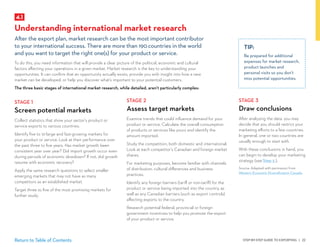
STAGE 2
Assess target markets
Examine trends that could influence demand for your
product or service. Calculate the overall consumption
of products or services like yours and identify the
amount imported.
Study the competition, both domestic and international.
Look at each competitor’s Canadian and foreign market
shares.
For marketing purposes, become familiar with channels
of distribution, cultural differences and business
practices.
Identify any foreign barriers (tariff or non-tariff) for the
product or service being imported into the country, as
well as any Canadian barriers (such as export controls)
affecting exports to the country.
Research potential federal, provincial or foreign
government incentives to help you promote the export
of your product or service.
STAGE 1
Screen potential markets
Collect statistics that show your sector’s product or
service exports to various countries.
Identify five to 10 large and fast-growing markets for
your product or service. Look at their performance over
the past three to five years. Has market growth been
consistent year over year? Did import growth occur even
during periods of economic slowdown? If not, did growth
resume with economic recovery?
Apply the same research questions to select smaller
emerging markets that may not have as many
competitors as an established market.
Target three to five of the most promising markets for
further study.
4.1
Understanding international market research
After the export plan, market research can be the most important contributor
to your international success. There are more than 190 countries in the world
and you want to target the right one(s) for your product or service.
To do this, you need information that will provide a clear picture of the political, economic and cultural
factors affecting your operations in a given market. Market research is the key to understanding your
opportunities. It can confirm that an opportunity actually exists, provide you with insight into how a new
market can be developed, or help you discover what’s important to your potential customers.
The three basic stages of international market research, while detailed, aren’t particularly complex:
STAGE 3
Draw conclusions
After analyzing the data, you may
decide that you should restrict your
marketing efforts to a few countries.
In general, one or two countries are
usually enough to start with.
With these conclusions in hand, you
can begin to develop your marketing
strategy (see Step 5 ).
Source: Adapted with permission from
Western Economic Diversification Canada.
TIP:
Be prepared for additional
expenses for market research,
product launches and
personal visits so you don’t
miss potential opportunities.
STEP-BY-STEP GUIDE TO EXPORTING | 23Return to Table of Contents
direct, personal involvement through
on-site interviews and consultations.
State your company’s objectives
at the outset and present your
questions clearly. For example:
Company description: give a brief
description of your company, its
history, industries and markets
served, professional affiliations
(if any) and your product or service.
Objectives: briefly list or describe one
or more objectives for your planned
export product or service, based on
your secondary market research.
Product or service: clearly describe
the product or service you want to
export.
Questions: base your questions on
your secondary research and be as
specific as possible. You’ll get a
better response if it’s clear that you’ve
carefully researched your subject.
4.2.1
Secondary research
Secondary research can be done
in Canada, using data sources
including periodicals, studies,
market reports, books, surveys and
statistical analyses. Many of these
are available online, as well as from
chambers of commerce, economic
development organizations,
industry and trade associations,
and Canadian companies that are
already doing business in your
target market.
4.2.2
Primary research
After completing your secondary
research, collect market information
through direct contact with potential
customers or other sources. Primary
research almost always demands
4.2
Types of market research
There are many ways to study a market, but the more
detailed and objective your research, the better.
There are two main types of market research: secondary and primary.
4.2.3
Online resources
Canada Business Network
The Canada Business Network’s
export section is a hub for the
Canadian export market and
includes links to market and sector
information, trade statistics and
sources of trade leads and potential
partners.
Canadian Trade Commissioner
Service
The TCS site offers access to
contact information for trade
commissioners that can provide
advice and skills to further your
business abroad.
MY TCS provides access to
hundreds of market reports, export
publications and guides as well as
upcoming trade events, webinars,
podcasts and videos. Create a
profile and opt-in to receive email
notifications of new opportunities
to expand your business through
exporting.
Agri-Food Trade Service
The website of Agriculture and
Agri-food Canada’s Agri-food Trade
Service offers a wealth of market
studies and country reports for
companies in the agri-food sector.
EXPORT MYTH:
I can’t compete overseas.
That’s not necessarily
true. If your business sells
domestically, why wouldn’t
it find customers abroad?
Remember, price isn’t the only
selling point – other factors
such as need, utility, quality,
service and consumer taste
can make you competitive.
STEP-BY-STEP GUIDE TO EXPORTING | 24Return to Table of Contents
4.2.4
Profiling potential markets
Here’s a checklist to help you summarize what you can learn about a possible
market. After you’ve created two or three profiles, compare them to see which
market(s) present the best overall opportunities.
Market type
Is it:
•	 a fully developed market (e.g.
Germany, the U.S.)?
•	 a developing market with rapid
growth (e.g. China, India)?
•	 a developing market with marginal
growth (e.g. many African nations)?
Political highlights
Describe:
•	 the government
•	 who’s who
•	 major political themes
•	 relations with Canada, including
trade agreements
Economic highlights
Describe:
•	 the domestic economy
•	 economic trends
•	 general imports and exports
•	 imports and exports to and from
Canada
Business information
Specify:
•	 the currency
•	 the language(s)
•	 business practices and regulations
•	 differences in legal framework
•	 government procurement
practices
•	 work relationships
•	 office hours
Partnering options
List:
•	 Canadian firms doing business in
the target market
•	 major firms from the target market
doing business in Canada
•	 options for local partners
Support for market-entry
strategies
Identify:
•	 industry associations
•	 trade events in the target market
•	 other networking options
•	 trade media
•	 research facilities
•	 market research sources
CUSTOMER
SUCCESS STORY
Canadian businesses AND
TCS working together
When this Vancouver-based
company was ready to expand
worldwide, they called upon TCS
to sell to the US, Africa, Vietnam
and beyond.
Cultural considerations
Specify:
•	 greetings and forms of address
•	 do’s and don’ts
•	 cultural differences
•	 attitudes toward Canadians
•	 general tips
Travel tips
Describe:
•	 visa, work permits or other entry
requirements
•	 business support services
•	 suitable hotels
•	 telecommunications standards
•	 tipping customs
•	 electrical voltage
•	 religious or statutory holidays
WATCH THE VIDEO
Return to Table of Contents STEP-BY-STEP GUIDE TO EXPORTING | 25
STEP #5
Reaching the customer:
developing your export
marketing strategy
5.1	 Understanding export marketing plans
5.2	 The many Ps of international
marketing
5.3	 Building your export marketing plan
5.4	 Setting prices
5.5	Promotion
5.6	 Marketing tools
STEP-BY-STEP GUIDE TO EXPORTING | 26Return to Table of Contents
TIP:
Building business
relationships in foreign
markets is best done face to
face. Faxes, phone calls and
email should be reserved for
follow-up.
5.1
Understanding export
marketing plans
Long before you fill your first order,
you’ll need an export marketing plan.
You’ve already examined the elements required to
produce an effective export plan under section 3.3. Now,
you’re ready to tackle the specific marketing components
of your export plan. While you’re developing it, remember
not to confuse marketing with advertising, sales or
promotion. Marketing is strategy. The other three are the
tools your strategy will use to reach your target audience.
Canada Business Network lays out the questions you
should be asking while developing a marketing plan and
provides a template to create your own.
A good marketing plan should be built around your
research and will answer the following questions:
•	 What are the characteristics of your target market?
•	 How do your competitors approach the market?
•	 What is the best promotional strategy to use?
•	 How should you adapt your existing marketing
materials, or even your product or service?
TIP:
Be prepared to translate
documents into the
language(s) of the target
market. Current and potential
customers will appreciate it.
5.2
The many Ps of
international marketing
Commonly referred to as the “marketing mix,”
the four Ps of marketing are:
•	 Product. What is your product or service and how
must it be adapted to the market?
•	 Price. What pricing strategy will you use?
•	 Promotion. How will you make your customers aware
of your product or service?
•	 Place. How and where will you deliver or distribute
your product or service?
International trade is more complicated. Add the
following nine Ps to the list to produce the 13 Ps of
International Marketing:
•	 Payment. How complex are international transactions?
•	 Personnel. Does your staff have the necessary skills?
•	 Planning. Have you planned your business, market,
account and sales calls?
•	 Paperwork. Have you completed all the required
documentation?
•	 Practices. Have you considered differences in cultural
and business practices?
•	 Partnerships. Have you selected a partner to create a
stronger market presence?
•	 Policies. What are your current and planned policies?
•	 Positioning. How will you be perceived in the market?
•	 Protection. Have you assessed the risks and taken
steps to protect your company and its intellectual
property?
Source: FITT, Going Global
“Treat all markets
differently. There are
cultural differences out
there that you need to
respect.”
– Export award winner
STEP-BY-STEP GUIDE TO EXPORTING | 27Return to Table of Contents
TIP:
Take sufficient time to collect
background information
on the consumer demand,
competitive landscape,
local import laws, customs
requirements and other
important factors in the
target market.
•	 Market analysis, which describes your target
market’s key economic, social, political and cultural
characteristics, and provides a profile of your target
customer, including buying patterns and factors
influencing purchasing decisions.
•	 Competitive analysis, used to decide pricing and
marketing strategies of your product or service.
•	 Goals, which describe how you will achieve your
objectives in terms of market share, position, revenue
and profit expectations.
•	 Marketing strategy, which includes pricing
recommendations, mode(s) of delivery and proposed
promotional methods.
•	 Implementation, which identifies the activities and
target dates you’ll undertake to carry out your
marketing plan, including a detailed marketing budget.
•	 Evaluation, which describes how you will evaluate your
marketing plan at various stages to determine if your
goals are being achieved and what modifications may
be needed.
•	 Summary, which describes, in a half page, how your
marketing plan goals fit into your overall export plan.
5.3
Building your export
marketing plan
Your marketing plan is a work in progress
that you will have to modify continuously.
As you develop it, consider the following questions:
•	 What is the nature of your industry?
•	 Who are your target customers?
•	 Where are they located?
•	 What is your company’s marketing strategy?
•	 What products or services do you plan to market?
•	 How will you price your products and services?
•	 Which segment of the market will you focus on?
•	 Does your marketing material accurately convey the
quality and value of your products or services and the
professionalism of your company?
As for content, a good marketing plan is closely related
to your export plan and should contain the following
sections:
•	 Executive summary, which describes the purpose of
your marketing plan and how marketing activities will
be used to support your export strategy.
•	 Product or service analysis, which gives a clear
description of your export product or service, its
unique selling points and how marketable it might
be in the target market.
STEP-BY-STEP GUIDE TO EXPORTING | 28Return to Table of Contents
CUSTOMER
SUCCESS STORY
Canadian businesses AND
TCS working together
This environmental technologies
company was able to leverage
insights on local markets to
take their business further
thanks to TCS.
5.4.1
Market demand
As in domestic markets, demand in foreign markets can
affect your price. In other words, what will the market
bear?
For most consumer goods, per capita income is a fairly
good way to gauge a market’s ability to pay. Per capita
income for most industrialized nations is similar to that of
Canada or the United States, while it is much lower for
much of the rest of the world. Often, simplifying products
or services to reduce the selling price may be the best
option in less affluent markets.
Remember that currency valuations affect affordability.
Try to accommodate currency fluctuations and the
comparative value of the Canadian dollar when setting
your price.
Export Development Canada (EDC) provides information
on managing foreign exchange risk.
5.4
Setting prices
Strategic pricing is one of the most
important factors in achieving financial
success. Part of setting a realistic export
price, and therefore an appropriate
profit margin, is to examine production,
delivery and distribution costs,
competition and market demand. You
should also understand the variables of
your target market and other export-
related expenses, such as:
•	 currency exchange rates and fluctuations
•	 market research
•	 customer research and credit checks
•	 receivables / risk insurance
•	 business travel
•	 international postage, cable and telephone rates
•	 translation
•	 commissions, training charges and other costs involving
foreign representatives
•	 consultants and freight forwarders
•	 product or service modification and special packaging
WATCH THE VIDEO
STEP-BY-STEP GUIDE TO EXPORTING | 29Return to Table of Contents
•	 Static pricing – charging the same
price to all customers
•	 Flexible pricing – adjusting prices
for different types of customers
•	 Full cost-based pricing – covering
both fixed and variable costs of
the export sale
•	 Marginal cost – covering only the
variable costs of production and
exporting, while you pay overhead
and other fixed costs out of
domestic sales
•	 Penetration pricing – keeping
your price low to attract
more customers, discourage
competitors and gain quick market
share
•	 Price skimming – pricing the
product high to make optimum
profit among high-end consumers
while there is little competition
After you’ve determined your costs
and chosen your pricing strategy,
establish a competitive price for
your product or service that gives
you an acceptable profit margin.
5.4.3
Pricing strategies
How will each market affect
your pricing? Include product
modifications, shipping and
insurance in your calculations. And,
as mentioned above, you can’t
ignore your competitors’ pricing.
Refer to your market objectives
when setting your price. For
example, are you trying to penetrate
a new market? Looking for long-
term market growth? Or pursuing
an outlet for surplus production?
You may have to tailor your
marketing and pricing objectives
to certain markets (e.g. developing
nations). There are several pricing
strategies available:
5.4.2
Competition
In domestic markets, few companies
can set prices without considering
their competitors’ pricing. This is also
true in exporting.
If you have many competitors in
a foreign market, you may have
to match or undercut the going
price to win a share of the market.
However, if your product or service
is unique, new or demonstrates
superior quality, you may be able
to set a higher price.
STEP-BY-STEP GUIDE TO EXPORTING | 30Return to Table of Contents
Different approaches used to market
goods versus services
Factor For marketing goods For marketing
services
Demonstrations Sample product Presentation of
capabilities
Initial marketing by: Sales representatives Firm’s principals
What do you market? Your product Your
firm and your
services
Local market
presence
Sales / distribution
facility
Office or virtual
office in target
market
Cultural factors Product design and
packaging
Interpersonal
dynamics
Local associations Distributors, marketers Service industry
Local events Trade shows Conferences
(as speaker)
Media Product advertising Press coverage
Local partners Production / distribution
firms
Other service
firms
Government
procurement
Goods acquisition Services
contracts
The table below outlines some of the differences between marketing goods
and marketing services in an export environment.
Documentation
•	 inspection
•	 certification
•	 document preparation
•	 cargo insurance
•	 freight forwarder’s fees
Transportation
•	 lading and related charges
•	 carriage
•	 warehousing and storage
•	 insurance
Customs
•	 customs and other duties
at port of entry
•	 customs brokerage fees
Financing
•	 costs of financing
•	 interest charges
•	 exchange rate fluctuations
•	 export credit insurance
Source: FITT, Going Global
5.4.4
Pricing checklist
Use this handy checklist to track
your costs and develop your pricing
strategy.
Marketing and promotion
•	 agent / distributor fees
•	 advertising, media relations
•	 travel
•	 communications
•	 materials (brochures, business
cards)
•	 trade fairs and exhibitions
Production
•	 unit cost of manufacture
•	 product or service modification
•	 regulatory approval
•	 increased RD costs
•	 labelling / packaging, including
translation
•	 packing / marking
STEP-BY-STEP GUIDE TO EXPORTING | 31Return to Table of Contents
Personal visits. Many cultures value personal contact
as the best means of promotion and building business
relationships.
Trade shows. Attending or participating in international
trade shows allows you to promote your business, check
out the competition and do market research.
Internet. Be prepared to commit time and money to
keeping your website up-to-date, useful to customers
and maintained in other languages.
Social media. Consider the most appropriate online
platform for your audience and market. What is
your demographic and where do they congregate,
communicate and share information with business
peers? Is it Facebook, LinkedIn or Twitter? Or are there
local social media platforms relevant to the market
(e.g. WeChat in China or XING in Germany)?
Branding Canada for agri-food
companies
Is your company in the food and agricultural sector? If
it is, you should know about Canada Brand, a program
developed by Agriculture and Agri-Food Canada in close
partnership with industry and provincial governments.
This initiative is designed to leverage Canada’s strong
international image to increase the sales and profile of
Canadian agri-food products.
TIP:
Get your sales brochures,
website and marketing
proposition translated
right away into the local
language. Make sure to use
local translators to ensure
intercultural effectiveness
when communicating
through the use of text and /
or imagery.
5.5
Promotion
The outcome of your promotional
strategies can make or break your
export venture.
Promotion refers to any or all of the communications
tools listed below that you may use to convince people
to buy your product or service.
Advertising. Carefully select the media that have a wide
circulation within your target audience. If few people
have televisions, is radio a better bet? Or print? Or online
advertising? Or social media? Word of mouth promotion
(testimonials, samples, etc.)?
Promotional materials. You may need to remove
elements that are inappropriate, offensive or meaningless
in the target market. Then have a commercial writer
adapt these materials into the native language, and have
it double-checked by a native of the country.
Direct mail. A targeted direct mail campaign can be very
effective if you do your research and gain experience in
your target market.
Media. Prepare a media kit that includes a profile of your
company, new products/services, newsworthy activities
and any articles published about your company.
TIP:
Be careful to look into the
meanings that your name or
corporate image may have in
the target market.
STEP-BY-STEP GUIDE TO EXPORTING | 32Return to Table of Contents
Videos
•	 Sophisticated and interesting
•	 Professionally translated and produced
•	 Oriented to the quality and benefits of your product
or service
•	 Clear and concise
•	 Make conveniently available on YouTube, Twitter and
other social media channels
Website
•	 Comprehensive and informative
•	 Professionally designed
•	 Easy to navigate
•	 Visually pleasing
•	 Up to date and reliable
•	 Enabled to submit online enquiries (via forms or email)
•	 Capable of allowing online purchasing (if appropriate)
Social media
•	 Set up accounts in social media such as Facebook,
LinkedIn, Twitter, those from consumer organizations
and online review sites
•	 Be aware of the social media that are used in your
targeted market
•	 Be aware of the functionality in these social media,
such as the Share button
•	 Understand how your product shows in search engines
on the Internet
•	 Set up social media analytics so you are aware of your
audience, their referrals of your company, as well as
associated commentary
•	 Be prepared to respond in a positive, proactive
fashion to address customer concerns or demonstrate
appreciation of compliments
5.6
Marketing tools
Developing the right marketing tools is
crucial to the success of your business.
Below is a list of tools and tips to get you started.
Business cards
•	 Professionally designed and high quality
•	 Easy to read
•	 In the appropriate language(s)
•	 Consistent throughout your firm
•	 Distinctive and informative
•	 Up-to-date and complete, including area codes,
country, telephone and fax numbers, postal code,
email and website addresses
Brochures
•	 Creative and appealing
•	 Informative and easy to read, highlighting your
uniqueness
•	 Professionally designed and printed
•	 Visually pleasing
Customer testimonials
•	 Demonstrate that your company is highly
recommended
•	 Represent your best customers
•	 Feature quotes from top executives
•	 Include in your brochure and on your website
News articles
•	 Clearly state that your company is a recognized leader
•	 Quote in your brochure
•	 Reproduce on your letterhead
•	 Display in your office
•	 Send to potential clients
Return to Table of Contents STEP-BY-STEP GUIDE TO EXPORTING | 33
STEP #6
Opening the door: entering
your target market
6.1	 Understanding entry strategies
6.2	 Refining your entry strategy
6.3	 Methods of market entry
6.4	 Free trade agreements
6.5	 Evaluating use of intermediaries
6.6	 Selecting the right intermediary
STEP-BY-STEP GUIDE TO EXPORTING | 34Return to Table of Contents
6.2
Refining your
entry strategy
You’ve chosen the most promising
markets for your product or service.
Now, based on your market research, you must decide
which entry method best suits your needs.
Some factors to consider:
•	 How is business conducted in your target market and
industry sector?
•	 What are your company’s export strengths and
weaknesses?
•	 What is your company’s financial capacity?
•	 What product or service are you planning to export?
•	 How much service and after-sales support will your
customers require?
•	 What trade agreements or barriers apply to your
target market?
6.1
Understanding
entry strategies
Developing a market-entry strategy
simply means finding the best methods of
delivering and distributing your goods.
Or, if you’re exporting services, it means setting up ways
to obtain and manage contracts in the foreign country.
Global Affairs Canada has trade commissioners across
Canada who can:
•	 help you finesse your market-entry strategy.
•	 connect you to the trade commissioners and global
contacts you need – in more than 160 cities around the
world – to help you with the challenges of market entry.
“It’s very important
for new exporters
to partner with
someone who’s
familiar with the
local business
culture.”
– Export award winner
STEP-BY-STEP GUIDE TO EXPORTING | 35Return to Table of Contents
TIP:
Consider short-term trial
contracts to test-run the
arrangement and ensure it
will do what you are seeking.
6.3.2
Indirect exports
For products, you market and sell to an intermediary
such as a foreign distributor. You can also retain a foreign
agent or representative who does not directly purchase
the goods.
For services, you contract with an intermediary who then
negotiates and contracts on your behalf.
For many new exporters, an intermediary may be the
best way to enter a market.
6.3
Methods of market entry
The traditional means of market entry
fall into four broad categories: direct
exports, indirect exports, partnerships
and acquisitions / investments. We’ll
examine each of these and then look at
the question of intermediaries: agents,
distributors and other go-betweens.
6.3.1
Direct exports
For products, you market and sell directly to the client.
For services, you negotiate, contract and work directly
with the client.
Advantages of direct exporting
•	 A higher return on your investment than selling
through an agent or distributor
•	 Allows you to set lower prices and be more competitive
•	 Close contact with your customers
Disadvantages of direct exporting
•	 You don’t have the services of a foreign intermediary
•	 Customers or clients may take longer to get to know you
6.3.3
Partnerships
You might find it advantageous to partner with a local
company whose strategic position complements or
enhances your own. A well-structured partnership can
benefit both parties in the following ways:
•	 Your partner can complement your capabilities and
provide the local expertise, insights and contacts.
•	 Each company focuses on what it does and knows best.
•	 Both partners share the risk.
•	 You can pool ideas and resources to help keep pace
with change.
•	 You can approach several markets simultaneously.
•	 Your partner may provide technology, capital or
market access that you might not be able to afford
on your own.
•	 Partnerships may help resolve problems related to
professional accreditation, movement of personnel
across borders and tax and legal status.
•	 In a highly competitive global market, combining the
technical and financial strengths of two businesses
can make both more competitive.
STEP-BY-STEP GUIDE TO EXPORTING | 36Return to Table of Contents
Cross-licensing – each firm licenses products or services
to the other for sales purposes.
Cross-manufacturing – a type of cross-licensing in which
companies agree to manufacture each other’s products.
Co-marketing – carried out on the basis of a fee or
a percentage of sales to take advantage of existing
distribution networks and domestic markets.
Co-production – the joint production of goods, enabling
your business to use its skills and resources to provide
cheaper manufacturing.
Joint venture – each business contributes capital to a
newly created corporation that they operate together, or
the Canadian and the local business enter into a general
partnership agreement and operate the joint venture as a
partnership.
Using the expertise of lawyers, accountants, bankers
and other professionals is vitally important when
setting up any type of partnership.
All parties must be absolutely clear on who holds which
rights and which responsibilities.
You develop a partnership strategy in three steps:
1.	 Decide whether or not a partnership can work for
you. If your needs can be satisfied in-house, a partner
may not be necessary. If you need financing, you may
be better off looking for investors. But if you require
special expertise or a local market presence, then a
partnership might work very well.
2.	Define the form, structure and objectives that a
partnership must have to suit your needs. To do this,
evaluate your company’s goals, its ability to achieve
them and where you need help in doing so. Then
identify how the partnership must work in order to fill
in those gaps.
3.	Find a partner who meets these criteria and who will
be a good “fit” with your company. It is very important
to select a partner that has the values and approach
to businesses that match your own for a partnership
to be successful.
There are several different forms of partnerships. The
primary options are:
Licensing – a licence is the granting of rights to another
business so that it can legally use your proprietary
technology and / or intellectual property. This usually
does not involve granting all the rights to the property.
Franchising – more than licensing, the franchisee is given
the right to use a set of manufacturing or service delivery
processes, along with established business systems
or trademarks, whose use is controlled by a licensing
agreement.
TIP:
Plan your alliances carefully
and pay attention to the
qualifications of a foreign
agent or distributor. The TCS
can help vet your potential
partner. Talk to a trade
commissioner to request a
bona fide check to qualify
the contact.
Return to Table of Contents
Selling to foreign governments
Foreign governments can present a rich source of contracts for exporters.
The United States government alone procures more than $500 billion in
goods annually. Canada Business provides information on how to navigate
foreign government procurement and has services to help you succeed.
To help Canadian businesses sell to foreign government customers, the
federal government established the Canadian Commercial Corporation (CCC),
a Crown corporation that acts as Canada's government-to-government
contracting organization.
Acquisitions and investments
A partnership isn’t the only way to tap into the resources of a foreign
company. Acquiring a firm in your target market, or making a substantial
investment into one, can achieve the same results.
Through acquisitions and investments, you immediately gain access to the
local market, as well as patents and other intellectual property, resource
availability, access to capital, specialist expertise, proprietary technology
You may also enjoy lower operating and production costs in your foreign
operation than at home.
Working abroad
Exporters of services should be aware of the personal and business issues
involved in working outside Canada. Global Affairs Canada publishes Travel
Advice and Advisories to tell service exporters about potential problems,
Return to Table of Contents
Selling to
multinational
corporations
To sell goods or services to foreign
corporations, it is essential to
conduct research to understand
their supply chain sourcing
practices. Incorporating the
mechanism by which you access the
supply chain should be considered
in developing your market-entry
strategy. Corporations have different
sourcing needs, practices, guidelines
or entry points to their supply chain.
Some approach their supply chain
management in terms of Tier 1 and
Tier 2 suppliers, for example, with
Tier 1 suppliers selling directly to the
corporation and with Tier 2 selling
to Tier 1. Also, some require their
potential suppliers to register their
business on an online portal for
consideration. Many multinational
corporations also have corporate
supplier diversity initiatives to
source from women, indigenous,
minorities and other groups that
the key contacts and process for
entering the supply chain are
typically different (i.e. potential
requirement for certification).
This, however, does not preclude
designated groups from accessing
other parts of the supply chain; it
is simply a unique entry point that
advantage.
You may be wondering where
to start in understanding the
complexities of accessing corporate
supply chains. Information on
websites, talking to corporate
representatives in Canadian
subsidiaries, or meeting with
representatives during business fairs
or networking events can shed light
on sourcing needs and practices.
The Canadian Trade Commissioner
Service can also assist with
providing business intelligence and
qualified contacts. If you are part of
a Canadian women-owned business,
contact the TCS’s Business Women
in International Trade Program.
CUSTOMER
Canadian businesses AND
TCS working together
TCS led this device development
company into the U.S.
Northeast and beyond thanks
to the Canadian Technology
Accelerator.
Canadian businesses can navigate
complex government procurement
markets abroad with confidence
with CCC at their side. CCC is a
trusted Government of Canada
partner that offers companies
services that reduce risk, improve
their access to prospective buyers
and differentiate their offer with
CCC’s government to government
contracting approach and
guarantee of contract performance.
CCC also specializes in contracting
with the U.S. Department of
Defense (U.S. DoD). All U.S. DoD
contracts over USD $150,000 are
contracted through CCC based on
DFARS 225.870. For more
information, visit the CCC’s
Department of Defense page.
Your opportunities for selling to the
U.S. government aren't limited to
defence and aerospace, of course.
Global Affairs Canada’s
Sell2USGov provides a detailed
explanation of U.S. government
procurement and how you may be
able to take advantage of it.
STEP-BY-STEP GUIDE TO EXPORTING | 39Return to Table of Contents
sector-specific initiatives within the WTO, including:
•	 WTO Agreement on Trade Facilitation (TFA);
•	 WTO Agreement on Government Procurement (GPA);
•	 Trade in Services Agreement (TISA);
•	 WTO Information Technology Agreement and its
recent expansion (ITA);
•	 WTO Environmental Goods Agreement (EGA), among
others.
So what is the trick to finding your way through all these
agreements?
1.	 Stay focussed on what you sell and where you want to
sell it.
2.	Identify which barriers and rules could apply to your
specific goods or services in these markets.
3.	Find out if Canada has any agreements in place that
might make it easier for you to sell to, or invest in
these markets.
Global Affairs Canada provides information on Canada’s
FTAs and other trade policy initiatives.
6.4
Free trade agreements
Understanding the role of trade policy in
reaching your export and investment goals
6.4.1
Navigating the global trading
environment
The global trading environment has become increasingly
complex. The World Trade Organization (WTO) has
provided an effective foundation for establishing and
enforcing global trade and investment rules. In addition
to pursuing their interests in WTO forums, WTO member
countries have increasingly sought out other tools to
generate opportunities and ensure fair treatment for
their businesses, as well as create advantages relative
to competitors.
There has been a proliferation of trade and investment
agreements:
on a bilateral or regional basis, that is, outside the WTO:
•	 free trade agreements (FTAs)
•	 foreign investment promotion and protection
agreements (FIPAs);
•	 air transport agreements (ATAs); and
The Canada-European Union Comprehensive
Economic and Trade Agreement (CETA) is a landmark
agreement that provides Canadian exporters with
guaranteed preferential access to the world’s second
largest economy and Canada’s second largest trading
partner after the United States. Visit the CETA portal for
key insights into regional and sectoral benefits, as well
as market-specific overviews, testimonials from Canadian
businesses, and upcoming CETA events and webinars.
Return to Table of Contents
Canada’s free trade agreements
(2016)
In force
• Canada – Korea (CKFTA, 2015)
• Canada – Honduras CHFTA, 2014)
• Canada – Panama CPaFTA, 2013)
• (CJFTA, 2012)
• Canada – Colombia (CCoFTA, 2011)
• Canada – Peru (CPFTA, 2009)
•
(CEFTA, 2009)
• (CCRFTA, 2002)
• Canada – Chile (CCFTA, 1997)
• (CIFTA, 1997)
• North American Free Trade Agreement
(NAFTA, 1994)
• Canada – U.S. Free Trade Agreement CUSFTA, 1989)
Concluded
• Canada – Trans-Pacific Partnership (TPP, 2015)
• Canada – Ukraine (CUFTA, 2015)
• Canada – European Union: Comprehensive Economic
and Trade Agreement CETA, 2014)
NAFTA:
• eliminated almost all duties on goods covered by
• established a framework of rules providing fair
and equitable treatment, transparency and
predictability;
• addressed certain non-tariff barriers to trade; and
• provided formal mechanisms for resolving
disputes.
Since NAFTA’s implementation in 1994, Canada-U.S.
trade has increased nearly 173%. Over $2.4-billion
worth of goods and services now cross the border
depend on Canada-U.S. trade.
Advantages of FTAs
So what are some of the benefits of an FTA to
FTAs help our economy by:
• enabling Canadian businesses to better compete with:
a. local firms in the partner country by providing
preferential market access, and
b.competitors from other countries that enjoy
preferential access to that market.
• improving market access by eliminating or reducing
tariff and non-tariff barrier
• providing fair and equitable treatment, gr eater
predictability and transparency to Canadian exporters,
service suppliers, investors and innovators.
Essentially, FTAs enhance Canada’s competitiveness
Look at the North American Free Trade Agreement
(NAFTA) as an example.
The Canada Tariff Finder is a free online tool that
allows Canadian exporters to check the tariffs
applicable to a specific good in a given foreign
market, with a focus on countries with which Canada
has a Free Trade Agreement.
STEP-BY-STEP GUIDE TO EXPORTING | 41Return to Table of Contents
6.4.3
Market access for goods:
an FTA’s ‘bread and butter’
Parties to an FTA commit to reduce or remove trade
barriers for goods.
Not all tariffs are eliminated immediately upon entry into
force of an FTA, as countries seek to protect sensitive
products or mitigate the effects of tariff elimination
by phasing out tariffs over a defined period. The tariff
outcome of each FTA is reflected in the parties’ tariff
schedules. The modalities for tariff elimination are
outlined in the National Treatment and Market Access
for Goods (NTMA) chapter.
All of Canada’s FTAs seek to secure the best possible
market access outcome for our producers, manufacturers
and exporters, while taking into account Canadian
sensitivities. Naturally, our trading partners are seeking
to do the same for their stakeholders.
That’s why it is important for you to be able to
understand the implications of these FTAs for your
business.
For example, the existence of an FTA between two
countries does not automatically mean that a good
exported from one country to the other will not be
subject to duties. To take advantage of preferential
market access provided in a particular FTA, a good
must meet the rules of origin set out in that agreement.
Therefore, you need to be aware of:
1.	 The product’s tariff classification under the
Harmonized System (HS) Code, which will allow you to
identify the applicable tariff rate.
•	 While HS codes are harmonized internationally up to
the sub-heading (6-digit) level, each country differs
at the domestic nomenclature level. In Canada, the
domestic nomenclature is eight digits while other
countries may be longer.
•	 The Government of Canada offers a HS database
search engine tool to help you find the appropriate
six-digit level HS code that best describes your
product used anywhere in the world
2.	The tariff rate that applies to your products in the
countries you are targeting.
•	 It is also useful to know whether your key
competitors from other countries benefit from
a lower tariff rate.
3.	Whether the tariff rate is being reduced or eliminated
for Canadian products as part of a free trade
agreement between Canada and the country in
question.
•	 If so, the staging category for your products will
determine if a tariff is being eliminated immediately
upon entry into force of an FTA or if it will be
reduced or eliminated over a defined period.
4.	Whether other tariff treatments apply to your products,
such as tariff rate quotas, whereby (products within a
specified quantity are eligible for a preferential tariff
rate.
STEP-BY-STEP GUIDE TO EXPORTING | 42Return to Table of Contents
5.	Whether safeguards (a temporary re-imposition
of tariffs to protect a local industry against import
surges) could be applied to your products.
•	 Safeguards are typically applied only in exceptional
circumstances for certain products as permitted
under the WTO or an FTA.
•	 You can contact the country’s Customs Authority for
more information on any safeguards that are in effect
in that country.
6.	What Rules of Origin (ROOs) apply – both the general
ROOs that appear in the body of an agreement’s
text, as well as the Product-Specific Rules of Origin
(PSROs) in the annex.
•	 If your products do not meet the ROOs, they will
not be eligible for the preferential tariff rates from
the FTA.
•	 Meeting the ROOs in one of Canada’s FTAs does not
mean that you meet the ROOs in another. You need
to look at the specific provisions of a particular FTA.
7.	 What are the origin procedures outlined in the FTA
(e.g. who can apply for an advance ruling on origin
and how).
•	 An advance ruling can be a key tool. It can give
you an idea of how your product will be treated by
the importing party even before the product has
left Canada.
NOTE:
•	 The full text, including tariff schedules and PSRO annexes,
for all of Canada’s free trade agreements that are in force,
can also be found on Global Affairs Canada’s free trade
agreements.
•	 For certain FTAs (e.g. the Canada-European Union
Comprehensive Economic and Trade Agreement [CETA]
and the Trans-Pacific Partnership [TPP]), a draft text is
published prior to entry into force.
•	 Information can also be sought from the Customs Authorities
of the target country or from the Tariffs and Goods Market
Access Division of Global Affairs Canada.
6.4.4
It’s not just about tariffs
There are three important trends to note regarding tariffs
and global trade:
1.	 Overall, global tariffs have decreased as a result
of unilateral tariff reductions as well as WTO
agreements. Bilateral and regional trade agreements
also provide for the elimination or reduction of tariffs,
but only on a preferential basis (e.g. only for goods
originating from each party to the agreement).
2.	Because tariffs have generally decreased, there
has been an increased focus on non-tariff measures
that can affect trade (known as non-tariff barriers).
These measures are permitted to meet legitimate
public policy objectives, but governments need to
ensure that they are the least trade-restrictive option
necessary to achieve those objectives. The goal is for
regulations to be in place to protect the public, while
at the same time allowing trade to flow.
3.	Modern FTAs increasingly address not only tariffs,
but also non-tariff barriers that are restricting or
distorting trade.
The U.S. market is vast, complex and highly
competitive, and can be intimidating to enter. But
thousands of Canadian enterprises — small, medium,
and large — have been very successful south of the
border. More join them every year and there is no
reason that your company cannot be among them.
Find useful information, tips and resources about
entering the United States market in Exporting to
the United States – A Guide for Canadian Businesses.
STEP-BY-STEP GUIDE TO EXPORTING | 43Return to Table of Contents
6.4.5
Let’s get back to the rules
What are some of the shared objectives in strengthening
rules around trade and investment in an FTA? Generally,
FTAs aim to:
•	 enhance the predictability and transparency of doing
business
•	 establish an effective framework that will govern how
trade and investment is conducted
•	 address today’s common challenges to trade and
investment
•	 level the playing field by seeking to ensure strong
labour and environmental standards are upheld as
trade is liberalized, as well as provisions on corporate
social responsibility (CSR) and anti-corruption
We recognize that with increased trade in the digital
environment, more extensive global value chains, rapid
integration of emerging economies and higher risks
associated with intellectual property protection, among
other challenges, companies like yours need clear,
effective and predictable rules in targeted markets.
It is important for you to be aware of the provisions
related to these issues in a trade agreement.
Understanding what the rules are and how they can help
you, will go a long way in ensuring you maximize the
benefits of an agreement.
•	 All countries, including Canada, employ regulations and other measures to meet legitimate
public policy objectives, such as ensuring the safety of our food supply or preventing the spread
of pests or diseases.
•	 Regulations are also necessary to ensure that products are not harmful to consumers, such as
specifications on an infant’s crib.
•	 However, these measures should not be used to unnecessarily restrict trade or discriminate
against foreign products.
Examples of non-tariff measures
Technical regulations
•	 Requiring a wine label to indicate volume
•	 Prohibiting the use of Bisphenol A (BPA)
in baby bottles
Related processes and production
methods
•	 Requiring a specific type of net to catch
a fish
Standards
•	 Labelling for “fair trade” or “organic”
products
Conformity Assessment Procedures
•	 Requiring testing to determine whether
a baby bottle contains BPA
Sanitary and Phytosanitary Measures (SPS)
•	 Requiring animals or animal products to
come from disease-free areas
•	 Mandating specific fumigation treatments
for food products
•	 Setting maximum allowable levels of
pesticide residues
Import and Export Restrictions
•	 Requiring import or export authorizations
for certain products
Internal Taxes
•	 Imposing higher taxes on foreign products
than those produced locally
Customs Valuation
•	 Using indicative or reference prices
instead of the actual paid price to
determine the value of products for
customs purposes
STEP-BY-STEP GUIDE TO EXPORTING | 44Return to Table of Contents
NOTE:
•	 Provisions in specific chapters will outline what is
covered by the obligations of the agreement, what new
access is permitted and how exporters and investors
are to be treated in the market.
•	 Technical summaries, usually by chapter, are available
on Global Affairs Canada’s website for certain FTA
negotiations that have recently concluded (e.g. the TPP
and CETA) or certain agreements that have recently
entered into force (e.g. Canada-Korea FTA).
•	 These technical summaries are an excellent source of
information on the key elements of an FTA, presented
in a way that is easier to “digest” than the full legal text.
•	 As examples, see the technical summaries of the
Trans-Pacific Partnership (TPP), the Canada-
European Union Comprehensive Economic and Trade
Agreement (CETA) and the Canada-Korea FTA
(CKFTA).
For example, free trade agreements typically contain provisions related to the following subjects:
National Treatment
and Market Access for
Goods (NTMA)
•	 Establishes National Treatment – i.e. treatment no less
favourable than that accorded to domestic goods and import /
export restrictions – ensuring that no prohibition or restriction
of importing goods is allowed.
Electronic commerce
(e-Commerce)
•	 Provisions for e-commerce focus on addressing tariff and
non-tariff impediments faced by consumers and businesses
that trade in the electronic environment. A key element for
Canada is a commitment to a permanent customs moratorium
on digitized products that are delivered electronically.
Specific competition
issues, such as state-
owned enterprises
(SOEs)
•	 May establish rules that require greater transparency in the
operation of SOEs, or preclude the provision of subsidies to
SOEs competing with private sector entities.
Investment •	 May include measures to protect Canadian investments
abroad. In the event of an expropriation, measures may require
that expropriations be restricted to those for a public purpose,
be accompanied by due process and non-discrimination, and
have prompt, adequate and effective compensation.
Customs administration
and / or trade
facilitation
•	 Intended to make it easier and less-costly for exporters to get
their products across foreign borders.
Cross-border trade in
services
•	 Intended to promote non-discrimination, as well as greater
predictability, stability and transparency for service
businesses.
Temporary entry of
business persons
•	 Intended to facilitate the entry of certain categories of
business persons and address certain types of restrictions,
such as labour market tests and quotas.
Intellectual property
(IP)
•	 May establish rules and cooperation-based activities that set
a minimum standard for the protection and enforcement of
IP rights.
STEP-BY-STEP GUIDE TO EXPORTING | 45Return to Table of Contents
•	 Typically, agreements will operate on the basis of
“co-existence,” whereby exporters can continue to
use the rules that are the most appropriate and most
trade-facilitating in a particular situation.
Information on how an agreement’s rules will intersect with
those of other agreements (i.e. the agreement’s relation to
other agreements) is typically contained in an agreement’s
Initial Provisions and General Definitions section. This
section, along with any preambular language, is a good
starting point for understanding the overall objectives of
the agreement, as well as familiarizing yourself with the
terminology used in the text.
What can you do if you believe your business is facing
unjustified barriers to trade or investment?
Report the issue to your Trade Commissioner in market,
providing as many details as possible.
Additional sources of information
The World Trade Organization (WTO) website is a good
source of information on the multilateral trade policy
framework:
•	 Understanding the WTO: Basics – Principles of the trading
system. Here you will find explanations for common terms
such as Most-Favoured Nation (MFN) – treatment no less
favourable than that accorded to any other member as well
as National Treatment – treatment no less favourable than
that accorded to domestic businesses;
•	 Understanding the WTO: The Agreements – Non‑tariff
barriers: red tape, etc.
•	 The WTO Agreement on Technical Barriers to Trade
(TBT Agreement);
•	 The WTO Agreement on the Application of Sanitary
and Phytosanitary (SPS) Measures (SPS Agreement);
and
•	 The WTO’s glossary.
6.4.6
What else do you need
to know?
Exceptions and reservations
Just as you need to familiarize yourself with the market
access benefits associated with free trade agreements,
you also need to be aware of the exceptions and
reservations – in other words, what is not covered
by an agreement.
•	 Exceptions are typically laid out in an agreement’s
Non-Conforming Measures (NCMs) and other annexes
that contain exclusions from the obligations of the text.
•	 Exceptions may take the form of specific entities or
may refer more broadly to a type of good, service or
sector (e.g. health and public education).
•	 Reservations and exceptions preserve policy space
for the government in potentially sensitive areas
(e.g. national security).
There are also issues that are beyond the scope of trade
agreements, such as visa requirements, immigration and
permanent employment.
Recognizing the limitations of an agreement can be just
as important as being aware of the new market access
the agreement affords.
Administration of the agreement
•	 The provisions in an agreement will also provide
guidelines when there is more than one agreement
in place in a market (e.g. a trading partner is covered
by both a bilateral agreement and a plurilateral or
regional agreement).
STEP-BY-STEP GUIDE TO EXPORTING | 46Return to Table of Contents
6.5.2
Trading houses
Trading houses are domestic intermediaries that market
your goods or services abroad. A full-service trading
house handles a great many aspects of exporting,
such as market research, transportation, appointing
distributors or agents, exhibiting at trade fairs and
preparing advertising and documentation.
Some trading houses act as “principals” or “export
merchants,” buying products outright from Canadian
suppliers, while others act as “agents,” selling on
commission.
If you prefer not to sell directly to foreign customers
or worry about finding a foreign intermediary, you might
consider using a trading house.
TIP:
Do your due diligence on a
potential agent or
representative to make sure
they will serve your interests.
For example, to ensure that they
aren’t pushing for an exclusive
relationship just to keep your
product or service out of the
market. Consider negotiating a
trial period.
6.5 
Evaluating the use
of intermediaries
Before you jump on a plane and start
knocking on doors, think about using
an intermediary. The right one can save
you an enormous amount of time and
money. There are several types: agents,
representatives, trading houses and
distributors.
6.5.1
Agents and representatives
Agents and representatives aren’t exactly the same.
An agent secures orders from foreign customers in
exchange for a commission. A representative specializes
in sales within a specific geographic area.
Both types of intermediaries may be authorized and
commissioned to enter into contractual sales agreements
with foreign customers on your behalf. This is usually
less costly than setting up your own direct sales
operation. Such an arrangement also gives you control
over the price of your product or service – an important
advantage.
Good foreign agents or representatives can research markets,
advise on financing and transportation options, clear goods
through customs, provide access to potential customers, make
collections and supply information on local business practices,
laws and cultural traditions.
TIP:
Treat foreign agents or
distributors as true partners
and equals to domestic
distribution channels.
6.5.3
Foreign distributors
Unlike agents, distributors actually purchase your product
or service and resell it to local customers. Often, they set
the selling price, provide buyer financing and look after
warranty and service needs.
A bonus is that the distributor can usually provide
after-sales service in the foreign market. On the other
hand, using a foreign distributor may reduce your profit
margins and result in a loss of control over your product
and / or price.
STEP-BY-STEP GUIDE TO EXPORTING | 47Return to Table of Contents
6.6
Selecting the right
intermediary
You can obtain information about
potential intermediaries from the
Canadian Trade Commissioner Service
in Canada and abroad, as well as from
Canadian and foreign trade associations,
business councils and banks.
Before you meet in person, talk to several firms and then
carry out your due diligence to make certain they’re
reputable. You can also protect yourself by entering into
a limited term trial agreement.
To evaluate a prospective intermediary in detail, use
the questionnaire below.
Size of sales force
•	 How many field sales personnel does the agent or
distributor have?
•	 What are its short- and long-range expansion plans,
if any?
•	 Will it have to expand to accommodate your needs
properly? If yes, would it do so?
Sales record
•	 Has its sales growth been consistent over the past
five years? If not, why not?
•	 What are its sales objectives for the next year?
How were they determined?
Territorial analysis
•	 What territory does it now cover? Is it consistent with
the coverage you’re looking for? Is it willing and able
to expand?
•	 Does it have any branch offices in the territory you wish
to cover?
•	 Are its branch offices located where your sales
prospects are greatest?
•	 Are there plans to open additional offices?
Product or service mix
•	 How many product or service lines does it represent?
•	 Are they compatible with yours?
•	 Does it represent any other Canadian firms?
•	 Would there be any conflict of interest?
•	 Would it be willing to alter its present product or service
mix to accommodate yours, if necessary?
•	 What would be the minimum sales volume needed to
justify handling your lines?
•	 Do its sales projections reflect this minimum figure?
•	 From what you know of the territory and the prospective
agent or distributor, is its projection realistic?
Facilities and equipment
•	 Does it have adequate warehouse facilities?
•	 What is its method of stock control?
•	 Are their computers compatible with yours?
•	 What communications facilities does it have?
•	 If servicing is required, is it equipped and qualified to
do so?
•	 If new equipment and / or training are required, to what
extent will you have to share these additional costs?
•	 If necessary, would it be willing to inventory repair parts
and replacement items?
STEP-BY-STEP GUIDE TO EXPORTING | 48Return to Table of Contents
Marketing policies
•	 How is its sales staff compensated?
•	 Does it have special incentive or motivation programs?
•	 Does it use product managers to coordinate sales efforts
for specific lines?
•	 How does it monitor sales performance?
•	 How does it train its sales staff?
•	 Would it be willing to share expenses for sales personnel
to attend seminars?
Customer profile
•	 What types of customers is it currently in contact with?
•	 Are its interests compatible with your lines?
•	 Who are its key accounts?
•	 What percentage of total gross receipts do these
accounts represent?
Principals represented
•	 How many principals does it currently represent?
•	 Would you be its primary supplier?
•	 If not, what percentage of its total business would you
represent? How does this percentage compare with
other suppliers?
Promotional thrust
•	 Can it help you research market information?
•	 What types of media does it use, if any, to promote
sales?
•	 How much of its budget is allocated to advertising? How
is it distributed?
•	 Would you be expected to share promotional costs? If
so, how will this amount be determined?
•	 If it uses direct mail, how many prospects are on its
mailing list?
•	 What printed materials are used to describe its company
and the lines it represents?
•	 If necessary, can it translate your advertising copy?
•	 Does it have its own website?
CUSTOMER
SUCCESS STORY
Canadian businesses AND
TCS working together
TCS assisted this Quebec-based
automotive safety company to
get into gear to take on two new
markets.
WATCH THE VIDEO
Return to Table of Contents STEP-BY-STEP GUIDE TO EXPORTING | 49
STEP #7
Shippers and shipping:
delivering the goods
7.1	 International trade regulations
7.2	 Export declarations
7.3	 Export permits
7.4	 Delivering products
7.5	 Freight forwarders and brokers
7.6	 Packing your goods
7.7	 Labels and marks
7.8	 Transportation insurance
7.9	 Export documentation
7.10	 Duty deferral and duty relief
7.11	 Delivering services: How it’s different
STEP-BY-STEP GUIDE TO EXPORTING | 50Return to Table of Contents
7.1
International trade
regulations
You’ll have to familiarize yourself with
your target market’s import regulations,
product standards and licensing
requirements. If you’re a service exporter,
you may have to acquire professional
or other accreditation from the country
where you’ll be operating.
Trade and international security
The World Customs Organization (WCO) has developed
an initiative to help protect the international supply
chain against terrorist exploitation: the SAFE Framework.
It aims to establish and integrate standards for supply
chain security and management, strengthen cooperation
among customs administrations and promote the
seamless movement of goods through well-secured
international supply chains.
TIP:
Avoid spreading yourself too
thin by entering too many
different markets too quickly.
7.2
Export declarations
Unless you’re exporting to the United
States, reporting your exports is
mandatory under Canadian regulations.
For details on how to do this, download or read online
the Canada Border Services Agency’s Guide to
Exporting Commercial Goods from Canada.
The B13A Export Declaration, along with the
appropriate permits and licences, must also be
prepared by exporters prior to exporting to all
non‑U.S. destinations.
7.3
Export permits
You’ll need an export permit if:
•	 the destination country is on the Area Control
List (where any export, except humanitarian items,
requires an export permit); and / or
•	 the goods are on the Export Control List (goods and
technologies that require export permits pursuant to
the Export and Import Permits Act).
Global Affairs Canada provides detailed information
about export and import controls and permits.
A publication called A Guide to Canada’s Export
Controls is also available.
Companies in the agri-food sector can learn about
export regulations and certifications for food products
at the Canadian Food Inspection Agency.
“Choosing the right
shipping method is
vital to your export
success.”
– Exporter award winner
STEP-BY-STEP GUIDE TO EXPORTING | 51Return to Table of Contents
7.5
Freight forwarders
and brokers
You’ll need to deal with a lot of
documents when delivering products to
foreign countries.
You don’t normally do it all yourself, however – use freight
forwarders and customs brokers to help reduce the
workload abroad.
Freight forwarders will help you improve your delivery times
and customer service. These agencies will negotiate rates for
you with shipping lines, airlines, trucking companies, customs
brokers and insurance firms. They can handle all of your
logistical requirements, or just negotiate your shipping rate;
it’s up to you.
7.4
Delivering products
There are four ways of getting your product to your customer’s
doorstep: by truck, rail, air or ocean. Choosing the right shipping
method, or combination of methods, is vital to export success –
you want the product to get there on time and at the lowest cost.
Agriculture and Agri-food Canada’s Agri-food Trade Service has a useful list of shipping resources
that are applicable to most sectors.
Truck Rail Air  Ocean
Trucking is popular
for shipments within
North America, but
service declines
once you go
beyond the major
industrialized
countries.
Rail is widely used
when shipping to
the United States
or to and from
seaports.
Air is more
expensive than
surface or sea
transport, but the
higher costs may
be offset by faster
delivery, lower
insurance, cheaper
warehousing, exotic
markets and better
inventory control.
Shipping large
items, bulk
commodities and
goods to offshore
markets that do not
require fast delivery
is more economical
by sea.
Using Incoterms
To provide a common terminology for international shipping and minimize misunderstandings, the
International Chamber of Commerce has developed a set of international commerce terms known
as Incoterms. Familiarize yourself with these terms so that you know you are speaking the same
language as your buyer or intermediary.
STEP-BY-STEP GUIDE TO EXPORTING | 52Return to Table of Contents
Marking distinguishes your goods from those of other
shippers. Marks shown on the shipping container must
agree with those on the bill of lading or other shipping
documents; they may include some or all of the following:
•	 buyer’s name or some other form of agreed upon
identification
•	 point / port of entry into the importing country
•	 gross and net weight of the product in kilograms and
pounds
•	 identification of the country of origin, e.g. “made
in Canada”
•	 number of packages
•	 appropriate warnings or cautionary markings
Provide a packing list that identifies and itemizes the
contents of each container. Each container must also
contain a packing list itemizing its contents.
For information on packaging your goods for the EU
marketplace, refer to the CE Marking Guide.
7.8
Transportation insurance
International carriers assume only limited
liability and make the seller responsible
for the goods up to the point of delivery
to the foreign buyer. For this reason, you
must have international transportation
insurance.
7.6
Packing your goods
Assume your products will have a bumpy
ride, particularly if you’re shipping
overseas.
Pack them to survive rough-and-ready cargo handlers
and poor roads.
During transit, handling and storage, your goods may
be exposed to bad weather and extreme temperatures.
If they need special temperature controls or other
protective measures, be sure they get them.
The type of shipping may determine the kind of packing
you should use. For example, if the goods are carried
by ship, you need to know whether they will be placed
above or below deck.
7.7
Labels and marks
Labelling regulations vary widely from
nation to nation, so verify the required
labels before you ship.
Your product may not clear customs if labels don’t
conform to local requirements such as product weight
or electrical standards.
TIP:
Proper packing can also
reduce the risk of theft during
transit.
Marine transportation insurance
protects both ocean- and air-bound
cargo. It also covers connecting
land transportation. There are three
main types of marine transportation
insurance:
1.	Free of particular average (FPA)
insurance is the narrowest type
of coverage. Total losses are
covered, as well as partial losses
at sea if the vessel sinks, burns or
is stranded.
2.	With average (WA) offers greater
protection from partial losses at
sea.
3.	All risk is the most comprehensive
insurance, protecting against
all physical loss or damage
from external causes. Once the
documents transferring title are
delivered to the foreign buyer,
you are no longer liable for the
goods.
STEP-BY-STEP GUIDE TO EXPORTING | 53Return to Table of Contents
7.9.2
Collection
documents
The most important collection
document is probably
the commercial invoice, which
describes the goods in detail and
lists the amount owing by the
foreign buyer. This form is also
used for customs records and
must include:
•	 the date of issue
•	 the names and addresses of the
buyer and seller
•	 the contract or invoice number
•	 a description of the goods and
the unit price  including  the total
weight and number of packages
•	 shipping marks and numbers
•	 the terms of delivery and payment
7.9.1
Shipping
documents
Shipping documents are prepared
by you or your freight forwarder.
They allow the shipment to pass
through customs, be loaded onto
a carrier and be transported to the
destination. Key shipping documents
include:
•	 commercial invoice
•	 special packing or marking list
•	 certificate of origin
•	 certificate of insurance
•	 bill of lading / air waybill*
* A bill of lading is used for land and ocean
freight, while an air waybill is used for air
freight. Note that the ocean bill of lading can
be a negotiable instrument that passes title
to the goods. Other types of bills pass title
to the consignee as soon as the goods are
delivered.
7.9
Export documentation
Export documentation identifies the goods and the
terms of sale. It also provides title to the goods,
evidence of insurance coverage and certifies a certain
quality or standard. Several documents are required for
overseas shipping and fall into two categories:
FACT:
Goods shipped by sea are
typically insured for 110% of
their value, to compensate
for the extra costs involved
in replacing lost goods.
Other collection documents
include:
•	 certificates of origin
•	 certificates of inspection, used
to ensure that goods are free
from defect
•	 import and export licences, as
required (e.g. a NAFTA certificate
of origin)
STEP-BY-STEP GUIDE TO EXPORTING | 54Return to Table of Contents
7.11
Delivering services:
how it’s different
The challenges of delivering services
to a foreign market are just as complex
as those of delivering products. The
challenges are different, however, and
often depend on factors in your target
market, such as:
•	 extent and reliability of telecommunications /
internet links
•	 existence of a reliable IT infrastructure
•	 frequency and convenience of air links between
Canada and the market
•	 technological sophistication, receptivity and flexibility
of customers
•	 potential support through official channels, government
departments and international development agencies
•	 ability to satisfy legal regulations governing work
permits or professional certification
•	 potential to enter into a local partnership
7.10
Duty deferral
and duty relief
If you’re importing goods in order to
re-export them, you might be able
to use the Duties Deferral Program,
administered by the Canada Border
Services Agency (CBSA). The program
relieves or defers payment duties if the
goods are in transit through Canada and
will not be sold here.
There are three components to the Duties Deferral
Program:
1.	The Duties Deferral Program enables eligible
companies to import goods without having to pay
customs duties, as long as they export the goods
after importing them. For more information, refer to
Memorandum D7-4-1, Duty Deferral Program.
2.	With the Drawback Program, duty is refunded
on previously imported goods when these goods
have been exported. For more information, refer
to Memorandum D7-4-2,”Duty Drawback Program.
3.	Customs Bonded Warehouses are regulated by the
CBSA. A bonded warehouse is a facility, operated
by the private sector, in which you may store goods
without having to pay duties and taxes. This could be
beneficial if you’re planning on importing goods for
the purpose of exporting them. For more information,
refer to Memorandum D7-4-4, Customs Bonded
Warehouses.
You’ll most likely be delivering
your services by one, or a
combination of, the following
methods:
•	 Provider visits client. This
is the most common export
activity and involves meeting
the client repeatedly, often at
the site.
•	 Client visits provider. In
industries such as tourism,
thousands of Canadians earn
income by meeting the needs
of foreign visitors.
•	 Establishment in the market.
Large legal and accounting
firms, as well as major banks,
are most likely to use this
method to establish their
presence abroad.
•	 Electronic delivery.
E-business is increasingly
more important for
conducting global business.
Return to Table of Contents STEP-BY-STEP GUIDE TO EXPORTING | 55
STEP #8
Identifying your export
financing requirements
8.1	 Understanding the risks of export
financing
8.2	 Leveraging capital
8.3	 Where to get financial help
8.4	 Methods of collecting payment
8.5	 Insuring against non-payment
STEP-BY-STEP GUIDE TO EXPORTING | 56Return to Table of Contents
8.2
Leveraging capital
Even though Canada is one of the least
expensive countries in the world
in which to do business, the costs of
exporting can add up.
Because of this, your export drive will need a reliable cash
flow. You will also need a comprehensive financial plan for
the export venture. If you don’t have one, it will be very
difficult to arrange the financing your venture may need.
The most important objective of your plan, however, is
ensuring that your company always has sufficient cash or
operating lines of credit. To do this, the plan must include:
•	 a cash budget that highlights your financing
requirements over the next two or three years, so you
can determine the timing and amount of your cash
expenditures.
•	 a capital budget, which is a longer-term overview of
the funds you’ll need to complete your export project,
that provides an operating plan against which you can
measure actual expenditures and revenues and tells you
when the project will start generating positive cash flows.
You’ll need to know the timing of both cash inflows and
outflows. Cash flow planning can help you defend against
such problems as:
•	 exchange rate fluctuations
•	 transmission delays
•	 exchange controls
•	 political events
•	 slow collection of accounts receivable
Accurate details are important to the overall
effectiveness of your export plan.
8.1
Understanding the risks
of export financing
If by chance your first international order
is far larger than you expected, how are
you going to finance the expansion you
need? Payments can take months, and
buyers may default or go out of business.
Self-financing a growing export business can be very
risky, especially for new or smaller exporters. Fortunately,
there are options that can minimize your risks and even
give you a competitive edge.
TIP:
Be prepared to meet
increased demand from a
successful foreign sale. Ask
for advanced payments to
cover the cost of increased
demand and reduce risk.
EXPORT MYTH:
I can’t afford to export.
Yes, you can! Expanding
your capacity to fill foreign
orders won’t necessarily
demand large capital outlays
or a lot of new staff. Sources
such as the Canadian Trade
Commissioner Service
(TCS), Export Development
Canada (EDC), and
the Business Development
Bank of Canada (BDC), offer
help ranging from market-
entry support to the provision
of working capital. Their
services are inexpensive and
often free: the TCS doesn’t
charge for any of its services.
Information to help you learn about export financing is
also available from the Canada Business Network.
Export Development Canada provides an extensive list
of tailored online resources to help you determine your
financing needs.
TIP:
International trade payments
usually take longer to arrive
than domestic ones, so allow
for this in your cash flow
planning.
STEP-BY-STEP GUIDE TO EXPORTING | 57Return to Table of Contents
8.3.3
EDC’s working
capital solutions
Export Development Canada (EDC)
offers several financing products
for Canadian companies to support
their international transactions: to
pay for the up-front costs associated
with the production of a large
export order, to expand into new
markets or to respond to a buyer’s
request for financing. EDC’s role
is to help Canadian companies go,
grow and succeed internationally.
They do this by providing you with
financing to cover costs such as
work in progress, buying equipment
or setting up an office overseas;
providing insurance to protect
against risks such as not getting
paid, political unrest or customer
bankruptcy; working with your bank
to get the bonds you need posted;
and helping you break into new
markets which includes introducing
you to potential customers. For more
information, visit EDC online or call
1-800-229-0575.
8.3
Where to get financial help
There are several sources of financial aid available to Canadian exporters. The TCS can help
you navigate through which of these programs may be of value to your company. A sample of
relevant programs from Global Affairs Canada and other government departments include:
8.3.1
CanExport
CanExport is a new program that
increases the competitiveness of
Canadian companies. It will provide
up to $50 million over five years in
direct financial support to SMEs in
Canada seeking to develop new
export opportunities, particularly in
high-growth priority markets and
sectors. Delivered by the Trade
Commissioner Service (TCS) of
Global Affairs Canada, in partnership
with the National Research Council
Industrial Research Assistance
Program (NRC-IRAP), CanExport
provides financial support for a wide
range of export marketing activities.
8.3.2
Global Opportunities
for Associations
(GOA)
Global Opportunities for
Associations (GOA) provides
contribution funding to support
national associations undertaking
new or expanded international
business development activities, in
strategic markets and sectors, for
the benefit of an entire industry
(member and non-member firms).
Annual non-repayable contributions
range from a minimum of $20,000
to a maximum of $250,000; funding
approvals are made for a one-year
period for activities and related
expenditures taking place between
April 1 and March 31 of the following
year. GOA provides matching funds
of up to 50% of eligible expenses.
8.3.4
BDC’s market
expansion financing
The Business Development Bank
of Canada can help you meet your
working capital needs through
long-term financing and flexible
repayment options. BDC’s Market
Xpansion Loan helps Canadian
companies finance the expansion
of their domestic market or explore
new and larger foreign markets.
The BDC Market Xpansion Loan
is designed to help exporters
realize projects that are key to their
growth and success, without putting
their cash flow at risk. For more
information, visit their website or
call 1-877-232-2269.
Return to Table of Contents
In need of a credit insurance
that is quick and hassle-free?
See how EDC’s Trade Protect
allowed an Ottawa-based
company to focus on making
commercial drones instead of
worrying about getting paid.
AAFC’s AgriMarketing Program
The AgriMarketing Program, overseen by Agriculture
and Agri-food Canada (AAFC), aims to enhance
marketing capacity and competitiveness of Canada’s
agriculture, agri-food, fish and seafood sectors. The
Program assists industry associations to identify market
priorities and equip themselves for success in global
markets, and provides funding for industry associations
to develop and implement long-term international
strategies.
CCC’s government to
government contracting
Additional resources
Canada Business Network
federal and provincial bodies that offer financial
information and assistance to both new and
experienced exporters.
Exporting is too risky.
Exporting doesn’t need
to be riskier than doing
business at home – it’s just
different. Letters of credit,
export credit insurance and
reference checks through
banks and international
credit reporting agencies can
help protect your business.
Trade laws also tend to be
straightforward and legal
advice about them is easily
available.
One of the greatest challenges for a Canadian exporter
is standing out from international competitors in the
eyes of interested buyers. Offer your foreign
government customer the option of an expedited,
government to government contract with a Government
of Canada assurance of contract performance. The
Canadian Commercial Corporation (CCC) works with
you to validate the lead with the customer, lay the
groundwork for an unsolicited joint proposal, negotiate
the contract with the foreign government on favourable
terms, sign the contract and then subcontract to your
company for the work.
Contact us today to find out how CCC can help
qualified companies secure export contracts.
STEP-BY-STEP GUIDE TO EXPORTING | 59Return to Table of Contents
8.4.2
Letters of credit
Letters of credit (L / Cs) name a bank to receive and
check shipping documents and to guarantee payment.
With an L / C, the costs of financing a transaction may
be borne by either the exporter or importer.
Both sight- and term-payment provisions can be arranged.
Letters of credit can be confirmed or unconfirmed. For
example, a Canadian bank can confirm an L / C issued
8.4
Methods of collecting
payment
There are several ways for customers to
pay an invoice in international trade: cash
in advance, letters of credit, documentary
credit, documentary collection and open
account. We’ll examine them in order of
increasing risk to your company.
8.4.1
Cash in advance
Cash in advance is your most secure option because
it eliminates all risk of non-payment and adds to your
working capital. Unfortunately, few foreign buyers are
willing to pay cash in advance, although some will pay
a portion when goods or services are specially ordered.
For services, a retainer might be paid upon signing a
contract, after which progress payments are matched
to deliverables.
TIP:
The type of your currency
holding increases business
opportunities abroad.
For example, Canadian
companies can now use
renminbi (RMB) to trade with
Chinese counterparts. In
addition, RMB is now in the
International Monetary Fund’s
Special Drawing Rights (SDR)
basket, which also brings
advantages for Canadian
business.
by a foreign bank, thus guaranteeing that the Canadian
bank will pay the exporter even if the foreign bank
doesn’t. This kind of L / C is much better for you than
the unconfirmed one.
L / Cs can also be irrevocable, which means they can’t
be cancelled or amended without your approval. The
most secure L / C is one that is both confirmed and
irrevocable.
In practice, an L / C works like this:
•	 The customer arranges an L / C with his or her bank.
•	 The customer’s bank prepares an irrevocable L / C.
This includes specifications as to how you’ll deliver
the goods.
•	 The customer’s bank sends the L / C to your Canadian
bank for confirmation.
•	 Your bank issues a letter of confirmation and sends the
letter and the L / C to you.
•	 You check the L / C very carefully. In particular, you
ensure that it agrees in all respects with the terms of your
contract with the customer. If the L / C’s terms and those
of the contract are different, and if you don’t meet the
L / C’s terms because you overlooked the discrepancy,
the L / C may be deemed invalid and you might not
get paid.
•	 You arrange shipping and delivery with your freight
forwarder. Once the goods are loaded, you get the
appropriate shipping documents from the forwarder; you
use these to prove that you have fully complied with the
terms of the contract.
•	 You take these documents to your bank, which sends
them to the customer’s bank for review. The customer’s
bank sends them to the customer and the customer
obtains the documents that will allow the goods to
be claimed.
•	 The customer’s bank pays your bank, which then pays you.
TIP:
Give your foreign markets
adequate attention, even if
your domestic economy is
booming.
STEP-BY-STEP GUIDE TO EXPORTING | 60Return to Table of Contents
8.4.3
Documentary credit
Exporters can also use sight and term documentary
credits:
A documentary credit calling for a sight draft means that
the exporter is entitled to receive payment on sight,
i.e. upon presentation of the draft to the bank.
A term documentary credit, in contrast, may allow for
payments to be made over terms of 30, 60 or 90 days,
or at some other specified future date.
8.4.4
Documentary collection
In a collection, you ship goods to an importer (your
customer) and forward the shipping documents to a
collecting bank. Next, the customer pays the collecting
bank in exchange for the documents. You then obtain the
money from the bank.
With a collection, no bank has guaranteed that you’ll get
paid, and you’re required to finance the shipment until
your customer receives the goods and pays through a
sight or term draft.
8.4.5
Open account
Open accounts require you to ship goods and pass title
to the customer before payment is made. In these cases,
you’re fully exposed to any credit risk associated with the
customer until payment is received. In addition, because
open account terms usually allow 30, 60 or 90 days
(or even longer) before payment is due, you are, in fact,
financing the transaction for your buyer.
8.5
Insuring against
non‑payment
The effects of your buyer not paying can
be severe and lasting.
You can protect your company through EDC’s  Accounts
Receivable Insurance (ARI). ARI protects you against
non-payment by covering up to 90% of losses resulting
from a wide variety of commercial and political risks.
Better still, you’ll be able to free up your capital and,
possibly, extend more attractive payment terms and
credit options to new customers.
“It’s important to be
diplomatic, especially
when ‘securing
payment’ for overseas
sales. Demanding
payment up front can
be a terrible insult in
some cultures.”
– Exporter
Return to Table of Contents STEP-BY-STEP GUIDE TO EXPORTING | 61
STEP #9
The fine print:
understanding the legal
side of international trade
9.1	 Understanding international contracts
9.2	 Understanding ‘proper law’
9.3	 Contracts for sale of goods
9.4	 Contracts for sale of services
9.5	 Negotiating in other business cultures
9.6	 Corporate social responsibility
9.7	 Meeting international standards
9.8	 Protecting IP rights
9.9	 Resolving disputes
STEP-BY-STEP GUIDE TO EXPORTING | 62Return to Table of Contents
9.3
Contracts for sale of goods
A contract covering the sale of goods
involves transferring, or agreeing to transfer,
goods to a buyer for a sum of money.
The actual transfer of the property distinguishes the
sale of goods from other transactions such as leases
or property loans.
The term “goods” includes all movable things and
excludes real estate and intangibles such as debts,
shares, patents and services. Furthermore, the fact that
money changes hands distinguishes a sale of goods
from other transactions, such as barter or counter-trade.
9.1
Understanding
international contracts
In international trade, contractual
arrangements can be much more
prone to complications than domestic
ones. Language barriers may cause
misunderstandings. Cultural and
geographical impediments may crop up.
Words often have different meanings in
different places.
International business contracts must, therefore, be
specific and all-encompassing. This will go a long way
toward reducing misunderstandings, misconceptions
and disputes.
Finding a legal professional who specializes in
international trade will help you sidestep regulatory
and legal pitfalls and, if necessary, resolve disputes.
You should also acquire some knowledge of international
conventions, the business laws governing your target
market and existing trade agreements between that
market and Canada.
TIP:
From the outset, it is
important to establish which
law is the “proper law.”
9.2
Understanding ‘proper law’
Problems in international business
contracts can occur because of differences
in the laws of the countries involved.
When different laws are applied, results may be
inconsistent and substantive rights may depend on
whose law applies. For example, one law may require
that a contract be written, whereas another may not.
Or, under one law, persons who are not a party to the
contract may have certain rights, whereas under another
law they may have no rights.
“It takes years to build
a market, but only days
to lose it.”
– Export award winner
STEP-BY-STEP GUIDE TO EXPORTING | 63Return to Table of Contents
9.3.4
Unpaid seller’s rights
Your best protection as seller
is payment in advance or upon
delivery. Next is payment by
confirmed letter of credit (preferably
irrevocable). If neither is possible,
then you should take out security
for the unpaid purchase price.
This can take several forms, but the
most common method is to reserve
title or to take a secured interest in
the goods.
9.3.3
Acceptance or
refusal of goods
If you meet all the conditions of the
contract, your buyer must accept
the goods. Refusal to accept them
without justification gives you the
right to sue for damages. If you
breach a condition of the sale, the
buyer can legally reject the goods.
Upon request, you must allow your
buyer to examine the goods. The
buyer can accept or reject them by:
•	 conveying his/her acceptance to
the seller
•	 acting in a manner that is
inconsistent with the seller’s
ownership of the goods, e.g. by
reselling the goods after they are
delivered
•	 keeping the goods without
notifying the seller that he or she
has decided to reject them
Once any of these types of
acceptance or rejection have taken
place, the buyer can no longer
refuse the goods, even if you
have breached a condition of the
contract.
9.3.2
Delivering goods
You must deliver the goods to your
buyer in one of two ways:
•	 Physically, by delivering a legal
document of title, such as a bill of
lading; or
•	 Symbolically, by delivering, for
example, the key to where the
goods are stored.
Your contract should specify where
the delivery will take place. In
international matters, this is usually
defined by using terms as Cost,
Insurance and Freight (CIF) or
Free on Board (FOB).
FACT:
Unless otherwise specified,
the place of delivery is
understood to be your place
of business.
TIP:
Modify products in
compliance with foreign
regulations and cultural
preferences to avoid conflicts.
9.3.1
Transfer of title and
effects of transfer
Several factors hinge on the exact
legal moment when the buyer
takes ownership of the goods (in
formal terms, when title passes or is
transferred from you to the buyer).
Risk: the transfer of title affects the
parties’ rights in case of total or
partial loss, damage or destruction
of the goods.
Rejection: once the transfer of title
has occurred, it may preclude your
buyer from rejecting the goods,
despite valid complaints regarding
quality, quantity or description.
Price: once your buyer takes title,
you can take legal action against
him or her for the full unpaid price,
rather than merely for the lost profit.
Rights of action: after taking title,
the buyer can enforce his or her
property rights through court action
or other methods.
STEP-BY-STEP GUIDE TO EXPORTING | 64Return to Table of Contents
9.5
Negotiating in other
business cultures
The usual Western business practice is
to negotiate a transaction and then build
a buyer-seller relationship around it. In
the business cultures of many countries,
however, this process is reversed.
One starts out by building a personal
relationship with a prospective customer
and, once that relationship has been
established and everyone is comfortable
with it, the actual business negotiations
can begin.
While the ultimate goal of all parties is to sign a contract,
the immediate objective in a relationship-based business
culture is to establish the personal connections. Your
non-Canadian counterparts often see this as a necessary
precondition for serious negotiations.
TIP:
Be patient. Pushing
negotiations onto someone
who isn’t ready will be seen
as rudeness, which can greatly
diminish the possibility of
a sale.
9.4
Contracts for sale of
services
Service contracts can range from
a handshake to pages of legal and
technical specifications.
Whatever the form, both parties should have the same
understanding of:
•	 the service(s) to be provided
•	 the personnel who will provide the service
•	 the facilities to be made available to the client
•	 the date on which the provision of service is to begin
and end
•	 the payments to be made
•	 the benchmarks or dates when payments are to be made
•	 the circumstances under which the contract may be
terminated and any implications in terms of completion
of the work, handing over the work completed to date,
partial payments, penalties, and so on
•	 the procedure in case the client is unable to provide the
agreed personnel, information or facilities
•	 conditions for holdbacks
•	 conditions for the return of bid or performance bonds
or guarantee
•	 procedures for resolving disputes
STEP-BY-STEP GUIDE TO EXPORTING | 65Return to Table of Contents
9.6
Corporate social
responsibility
Corporate social responsibility (CSR)
is generally defined as the voluntary
activities undertaken by an organization,
over and above legal requirements, to
operate in an economically, socially and
environmentally sustainable manner.
Socially responsible practices can enhance a company’s
ability to manage stakeholder relations, prevent conflicts,
mitigate social and environmental risks and contribute
to the sustainable development of communities, regions
and countries.
CSR involves companies understanding the impact of
each of their functions on the surrounding economy,
community and environment, and adjusting their activities
and operations to create value for themselves and other
stakeholders.
9.6.1
Operating according to
CSR principles
The Government of Canada expects that Canadian
companies will promote Canadian values and operate
abroad with the highest ethical standards. They are
expected to respect human rights and all applicable laws
and to meet or exceed widely recognized international
standards for responsible business conduct.
There are good business reasons for integrating CSR
practices into operations and these are becoming
increasingly important to companies’ success abroad.
Among them are:
•	 establishing a good corporate reputation
•	 improving management of social, environmental, legal,
economic and other risks
•	 enhancing the company’s ability to recruit and retain
staff, and maintaining staff morale
•	 obtaining higher operational efficiencies and cost savings
•	 increasing access to markets and capital
•	 fostering good relations with investment partners
and surrounding communities
CSR tools and practices can contribute to an
organization’s long-term business success by helping
them to develop sustainable business practices, manage
social risks and build strong relationships with a broad
range of stakeholders. 
STEP-BY-STEP GUIDE TO EXPORTING | 66Return to Table of Contents
LEARN MORE
The Trade Commissioner
Service is focusing on helping
firms avoid the dangers
associated with corruption.
That’s because “the risk to our
brand is huge” if Canadian
companies get ensnared in
cases of bribery.
The benefits of an extensive
compliance program became
clear to this small Toronto-
based renewable energy
company when it helped to
limit their exposure to bribery
and corruption.
READ THE ARTICLE
READ THE ARTICLE
as the ninth least corrupt country in Transparency
International’s Corruption Perceptions Index and
second in the TRACE Matrix Country Rankings of
Business Bribery Risk.
Canada, like many other countries, has passed laws
against corrupt practices. The Corruption of Foreign
Public Officials Act makes it a criminal offence to
bribe a foreign public official in the course of business.
Businesses convicted under the Corruption of Foreign
Public Officials Act could face heavy fines and individuals
could be sentenced to a maximum of five years in jail.
For more information, please see the Department of
Justice’s Guide to the Act. For a plain-language guide
to this legislation, download EDC’s pamphlet, Keeping
Corruption Out.
For more information on how to prepare your business
for international markets and related potential CSR
concerns, find a trade commissioner to gain their
knowledge of local business practices. Refer also
to Canada’s approach to CSR for Canadian companies
operating abroad.
9.6.2
Dealing with corruption
No country is entirely free of corruption. But if corruption
is deep enough it can hinder economic growth and good
governance, and decay the fabric of society. Corruption
is an obstacle to sustainable development, with the
potential to enlarge economic gaps and breed organized
crime. Unchecked corruption leaves little room for
democracy to flourish, little room for freedom to expand
and little room for justice to prevail.
Significant gains have been made in the global fight
against corruption. Better understanding of its economic,
political and social costs have spurred on recent
international efforts to fight corruption, encourage
transparency and increase accountability. Canada
strongly supports international efforts to combat
corruption, regarding it as a good governance issue,
a crime problem and a drag on economic, social and
political development.
The reputation of Canada and Canadian companies as
trustworthy business partners enhances the impact of
TCS advocacy and makes Canadian businesses more
attractive to local partners. In 2015, Canada ranked
STEP-BY-STEP GUIDE TO EXPORTING | 67Return to Table of Contents
TIP:
Registration of IP in Canada
provides protection only in
Canada. Similar protection
must also be sought in
targeted markets.
•	 find competent standards authorities
to contact in Canada or abroad
•	 identify Canadian, international or
foreign standards in a particular area
•	 locate published or under devel
opment by a specific technical
committee standards
For more information, contact an SCC
information officer at 613-238-3222.
Export Alert! is a free service operated
by the SCC that allows you to monitor
regulatory changes and developments
to trade-related regulations, including
changes under the World Trade
Organization Agreement on Technical
Barriers to Trade, and under its
Agreement on the Application of
Sanitary and Phytosanitary Measures.
Learn about or subscribe to Export
Alert!, which is available through the
SCC with the support of Global Affairs
Canada.
Additional SCC tools
include RegWatch, a database of
standards referenced in federal
legislation and Standards Alert!
If you’re an exporter, you need to
ensure that the standards you use in
your export product or service comply
with those of your intended target
market.
Adopting international standards will
increase your competitiveness, make it
simpler for you to exchange technical
information with foreign experts and
save you money and effort when it
comes to testing and recertifying to
move into a new market.
The best source to learn about
standards is the Standards Council
of Canada. The Council’s website
includes a section devoted to industry-
related issues and provides a free
information service that can help you:
•	 understand SCC’s accreditation
programs, services and activities
•	 identify applicable standards,
regulations and conformity-
assessment procedures that
would apply to market acceptance
of your product
9.7
Meeting international standards
There are international standards for almost everything,
from the ingredients in food to the certification of
electrical equipment.
9.8
Protecting IP rights
Intellectual property (IP) rights are valuable tools to
protect various aspects of innovative business activities.
IP rights very broadly mean legal rights that result from
intellectual activity in the industrial, scientific, literary
and artistic fields.
Trademarks, patents, copyrights and
industrial designs are referred to as
“IP rights.”
•	 Trademarks represent branding
and goodwill
•	 Patents represent technology and
technological improvements
•	 Copyrights represent all original
forms of creative works and their
expressions
•	 Industrial designs represent
a product’s shape, look and
configuration
IP rights are “property” in the sense
that they are based on the legal
right to exclude others from using
the property. Ownership of the
rights can also be transferred. Like
physical assets, IP assets must be
acquired and maintained, accounted
for, valued, monitored closely and
properly managed in order to
extract their full value. 
Every country has an IP office,
whose main responsibility is to
administer their national IP system.
The Canadian Intellectual Property
Office (CIPO) is an agency of
Innovation, Science and Economic
Development Canada (ISED).
STEP-BY-STEP GUIDE TO EXPORTING | 68Return to Table of Contents
6.	Properly mark your products and
services. The following are some
examples for indicating your IP
rights on products and packaging:
•	 Trademarks: Trademark owners
often indicate their registration
through certain symbols, namely,
® (registered), TM (trademark),
SM (service mark), MD (marque
déposée) or MC (marque
de commerce). Although
Canada’s Trademarks Act does
not require the use of these
symbols, it is advisable to use
them. The symbols TM, SM and
MC may be used regardless
of whether the trademark is
registered. The ® and MD, on
the other hand, can be used
only if the mark is registered.
•	 Patents: You may wish to mark
your invention with “Patent
Applied For” or “Patent Pending”
and the patent application
number. These phrases have no
legal effect but may warn others
that you will be able to enforce
your exclusive right to make
the invention, once a patent
is granted.
3.	Develop an IP strategy and be in
a better position to understand
how intellectual property can
support you in achieving your
business goals.
4.	Search international IP databases
in the markets you are interested
in developing to:
•	 identify potential competitors
•	 find possible partners and
markets
•	 anticipate changes in the
marketplace
•	 avoid possible infringement
To find a national IP office in your
target market, visit the Directory
of Intellectual Property Offices.
5.	Formally protect your IP rights.
Seek professional advice for
protecting your products and
services as the formal IP system
can be complex.
9.8.1
Protecting your
business’ IP assets
Enlisting the guidance of an IP
specialist as you follow these steps
will be beneficial.
1.	Learn the basics of IP rules and
laws, both where your business
is based and in the major
countries in which you intend to
do business. IP knowledge within
your target markets can help you
save time and money.
The World Intellectual Property
Organization offers useful
information and resources
specifically for SME’s.
2.	Take stock of your IP assets. Don’t
make assumptions about which
IP assets you actually hold. IP
can provide a foundation for
mergers, joint ventures or RD
agreements.
Conduct “freedom to operate”
searches on trademarks and
patents before commercializing
products and services that may
conflict with the IP rights owned
by others in the marketplace.
•	 Copyrights: You may mark your
work with the symbol ©, the
name of the copyright owner
and the year of first publication.
Marking serves as a general
reminder that the work is
protected by copyright.
•	 Industrial designs: The proper
mark is a capital “D” in a circle
and the name, or abbreviation,
of the design’s proprietor on the
item, its label or packaging.
7.	Preventing / remedying
infringement. When conflict
arises, it is preferable to attempt
to reach a negotiated settlement.
IP litigation, especially in foreign
jurisdictions, should be taken
as a last resort. With awareness
and proper strategic planning,
however, this outcome can usually
be avoided. Ask for IP advice from
a registered professional as early
as possible.
STEP-BY-STEP GUIDE TO EXPORTING | 69Return to Table of Contents
EXPORT MYTHS
By slightly modifying a
patented invention, I can go
“around” the patent and sell
my modified product without
any worry.
WRONG: If a patent has been
properly written and filed
with the help of a registered
patent agent, chances are
it would stand as a solid
defence.
My Canadian IP right
protects me worldwide.
WRONG: IP rights are
territorial – recognized and
enforceable only within the
country or region where they
were granted
IP professionals, like registered patent or trademark
agents or IP lawyers, can help you avoid the common
IP pitfalls made by exporters, such as:
•	 not covering IP issues in contracts with distributors or
outsourcing partners
•	 infringing others’ IP rights
•	 assuming laws are the same everywhere
•	 not checking trademark registrations
•	 not using regional / international systems to streamline
IP registration
•	 using inappropriate local branding
•	 applying for protection too late
•	 disclosing information too early
Visit CIPO’s website for a list of registered qualified
agents for trademarks and patents.
Take advantage of expert services for searching and
registering your IP. The realm of IP is a legal one and
you would be ill-advised to navigate it alone or even
ignore IP all together.
In addition, you may wish to consult the TCS.
TIP:
CIPO, through the Patent
Cooperation Treaty,
can concurrently seek
patent protection in over
140 countries.
9.9
Resolving disputes
Many issues can become controversial
in international trade transactions.
For example:
•	 Disputes with agents
•	 Collection of payments due
•	 Breach of contract or warranty
•	 Intellectual property rights
•	 Secured creditors’ rights, e.g. seizure of assets
•	 Enforcement of foreign judgments
Consult with legal counsel in the jurisdiction of the
contract should a dispute arise to explore options for
dispute resolution.
In certain circumstances, arbitration could be an option.
Also called alternative dispute resolution, arbitration uses
a tribunal to consider the questions over which the parties
are in conflict and to decide how to resolve the questions.
Both the ADR Institute of Canada and the American
Arbitration Association are available to help with
arbitration and offer plenty of resources for further
information.
Return to Table of Contents STEP-BY-STEP GUIDE TO EXPORTING | 70
STEP #10
Selling online:
e-commerce for exporters
10.1	 Understanding e-commerce
10.2	 e-exporting: using the Internet
to export
10.3	 Applications and benefits
10.4	 Assessing your e-commerce potential
10.5	Localization
10.6	 Technical side of e-commerce
10.7	 Finding e-leads
10.8	 Checking e-leads
10.9	e-payments
10.10	 Supporting your online customers
10.11	 Social media networks
“It is very exciting to
arrive at the office in
the morning to realize
you have been selling
all night, while you’ve
been sleeping.”
– E-commerce exporter
STEP-BY-STEP GUIDE TO EXPORTING | 71Return to Table of Contents
10.2
e-exporting: using the Internet
to export
By definition, exporting is the practice of sending or
transporting goods or services to a foreign country for
trade or sale.
In comparison, e-exporting is the practice of receiving and processing orders
online from customers located in foreign countries. The Internet offers some
digital advantages over traditional exporting approaches. Not only can you
reach a large number of potential customers from around the globe without
needing to establish a physical presence in other countries, but you can also:
10.1
Understanding e-commerce
E-commerce (also known as digital commerce) refers
to the act of selling and buying via the Internet.
This definition includes transactions in which not all of the activity takes place
online. A website may play a role in informing a buyer about a product or
offer for which the purchase takes place offline. That is a common model that
is not typically captured in e-commerce statistics. Similarly, a goods producer
or wholesaler may depend on distributors or retailers in other countries to
sell goods to customers using their own e-commerce channels.
E-commerce is virtually an essential approach for both large and small
businesses now that almost all products and services are online. Having a
strong e-commerce presence can increase efficiency and productivity, while
lowering costs. Indeed, if you haven’t already moved at least some of your
business operations to an online model, you could face major threats from
those competitors who are already doing so.
The following section assumes that your business is already a potential
exporter of goods or services through the Internet.
If you don’t have a Web presence, now is the time to build one.
International business assumes an online presence now. The Canada
Business Network has resources to help you learn how to develop your
website and sell online. Refer to BDC’s web design and consulting
services to help you prepare to take your business online.
Why sell online?
Opportunities for online sales are huge and growing. By selling online,
Canadian companies can:
•	 find new customers in overseas markets
•	 conduct business 24 / 7
•	 build brand awareness
•	 access new markets in a low-cost manner
•	 monitor real-time sales to understand what customers are searching for
•	 Customize your product or
service offerings based on the
customer’s location by offering
special links on your website for
different markets (e.g. provide
information in the language and
currency of the target market).
•	 Offer electronic customer
support through a list of
frequently asked questions (FAQ)
on your website or through
email assistance, rather than
by operating a costly and time
consuming toll-free number.
•	 Highlight the features and
benefits of your products
or services using pictures,
descriptions, technical details,
pricing, shipping and return
policies, as well as include
customer testimonials and video
demonstrations.
•	 Promote your company and
build your brand with potential
customers by telling them more
about your company’s history, staff,
location, partners and so on.
•	 Facilitate communication with
international customers through
email. Respond to questions
instantly, notify your customers
of their product shipment status
and send them the latest news or
information on special offerings.
STEP-BY-STEP GUIDE TO EXPORTING | 72Return to Table of Contents
5.	Leverage your website to sell
abroad. The Internet represents
a critical sales tool for SMEs
with limited resources. Consider
developing a multilingual website,
one that offers content in more
than one language. This will
be necessary if you are aiming
to reach customers in multiple
countries where different
languages are used.
6.	Ship your products. Once you
have made a sale, you need to get
your products to your customer.
The international shipping
process can be complicated
at best. To ease the burden of
shipping products abroad, you
can call upon the assistance
of freight forwarders, customs
brokers and fulfillment houses.
3.	Modify your products for foreign
markets. Before entering a
foreign market, you need to be
sure your products are suitable
in their current form. You need
to consider both the tastes and
preferences in your foreign
markets, as well as the specific
foreign regulations that apply to
your products. Note that these
will vary by country, so you may
have to limit the foreign markets
where you sell or intend to sell
your products.
4.	Research the legal issues
related to e-exporting. As with
most business transactions,
informing yourself about the
laws and regulations that govern
e-exporting transactions is critical.
Consult a lawyer specializing in
international law to make sure you
are in compliance with the various
domestic and foreign regulations.
There are seven principal steps
when you are considering
e-exporting:
1.	Evaluate your e-export potential.
Before spending a great deal
of time, effort and money on
e-exporting, take some time to
reflect on your current operations
and product offerings. This
assessment phase will help you
avoid headaches later and will
educate you on what you need
to do to get ready to e-export
(refer to section 10.4).
2.	Develop an e-export plan. If you
are being proactive and thinking
about actively marketing your
products in foreign markets, an
export plan is a definite must.
An e-export plan will help you
to tackle the digital aspects of
commerce.
7.	Get paid. Arranging for online
payment before the goods are
shipped will help you to avoid
having to collect payment after
the goods have been shipped.
Online payment options include
third-party credit card processing
companies, online fund transfer
services and prepaid credit
services, all of which allow
payments and money transfers
to be made through the Internet.
The services these companies
offer are not available in all
countries.
The seven steps are described
in more detail in the Ontario
government’s e-Business Toolkit.
STEP-BY-STEP GUIDE TO EXPORTING | 73Return to Table of Contents
Ask yourself the following questions:
•	 IT resources: How sophisticated
is your Web presence? How
much experience do you have in
managing IT projects? Are you
aware of new technology and how
you can use it?
•	 Management: Your e-business
strategy needs to be developed
in the context of your overall
corporate objectives. Do you
know what parts of your business
should be put online? Is senior
management committed to going
in this direction?
•	 Personnel: Do your employees
understand your e-business
strategy? Have you asked for their
input? Do you have a plan for
training them in the new skills they
might need?
•	 Customers: Do you use online
resources to track competitive
trends and identify potential new
business? Does your e-business
strategy address the security
10.4
Assessing your potential
If you’re going to succeed in e-commerce, you have to
start with a clear-sighted evaluation of your company’s
potential for online business.
10.3
Applications and benefits
E-commerce has many applications, including sales,
customer relations, finance, market research, market
intelligence and procurement.
Some of the benefits these applications
can bring to exporters are:
•	 reduction of the time needed to
deliver and update information
about products or services
•	 flexibility and adaptability of online
marketing and advertising
•	 customer access to your products
or services 24 hours a day, 365
days of the year
•	 faster responses to customers’
needs
•	 more efficient ordering and order
processing
•	 easier access to intelligence
about export essentials such
as demographics, market
characteristics and competitors
•	 electronic rather than physical
delivery of certain products and
services
•	 access to world markets
and, therefore, more export
opportunities
Of course, you’ll still have to deal
with the traditional side of exporting
– shipping, customs regulations and
work permits – just as you would if
you were doing business without
the Internet. From this angle,
e-business hasn’t changed exporting
all that much. What it has done is
make all kinds of export-related
communications and connections
much easier.
For more information, check out
e-Commerce: what to consider
when selling online.
and privacy concerns of your
customers? Is your website
customer-friendly?
•	 Competition: Are you aware of
your competitors’ e-commerce
initiatives and how they could
affect your competitiveness?
•	 Suppliers: Do you know if you
can reduce procurement costs by
purchasing online? Do you use
the Internet to look for suppliers?
Have you used supplier input
to help plan your e-business
strategy?
•	 Profitability: Have you done
cost-benefit analyses for your
e-business strategy? Do you know
how long it will take to amortize
the start-up costs?
At the end of the diagnostic, you’ll
have a detailed analysis of how
ready you are to adopt an e-business
strategy. You will also identify ways
to improve your competitiveness in
this venture.
STEP-BY-STEP GUIDE TO EXPORTING | 74Return to Table of Contents
10.5
Localization
Adapting your website to suit your target
market is called localization.
At least part of an exporter’s website has to present
information in the native language of the target market.
Completely translating a website can be expensive,
so you may prefer to begin by having professional
translators localize only the most important pages.
Other suitability issues relative to localization to consider
are branding, currency denomination and payment
methods. Branding that reflects the market’s customs,
laws and traditions, as well as language, will make a
potential buyer feel more at home. Using local currency
for pricing, shipping and tax calculations will do the same
and will allow customers to compare prices more easily.
Are you ready for
e-commerce?
If you are thinking about making e-commerce a
bigger part of your daily operations, you should
first determine if your company is ready for
e-commerce and the return on investment. If
the picture looks good, you can follow-up with a
plan. The Canada Business Network can help you
further develop your plan.
To discover how to grow your sales abroad
through e-commerce, download BDC’s free
e-book, Succeed with e-commerce.
TIP:
One good pathfinding
tool for accessing e-leads
abroad is available through
the Enterprise Canada
Network, “an industry-led
single window platform that
connects Canadian small
businesses and researchers to
qualified global opportunities,
facilitates international
partnerships and creates
trade through access to
public and private sector
resources.” – Enterprise
Canada Network
Also related to this is the ability to accept payment in
local or U.S. funds and to do so efficiently and simply
and securely.
As international search engine optimization (SEO)
requirements present additional challenges to traditional
SEO, a targeted domain name and hosting strategy
could help ensure your site will be easily found by your
international customers. Refer to the Canada Business
Network for more insight on SEO and how to increase
web traffic to your site.
10.6
Technical side of
e-commerce
Trying to set up your own online presence using in-house
resources is usually not a good idea, unless your business
is quite small and you have access to some very adept
IT people. As a rule, you’ll get much better results if
you outsource the creation of your Web presence to a
service provider specializing in website development.
10.7
Finding e-leads
The Internet is a fruitful source of
electronic business leads from around the
world, usually called e-leads.
There are several ways to track down such virtual
opportunities in international e-marketplaces. For
example, Canadian retailers and their brands can reach
consumers overseas through e-marketplaces, which are
online locations that provide a platform for retailers of all
sizes to conduct business through e-commerce.
STEP-BY-STEP GUIDE TO EXPORTING | 75Return to Table of Contents
TIP:
As in all export operations,
due diligence is an essential
precondition of success.
More than 400 e-marketplaces have been identified
worldwide such as Amazon.com or Alibaba.com. In China
alone, major established e-marketplaces include Tmall,
Jumeii, ASOS China, JD.com, VIP.com, Kaola.com and
Suning.com; each operates dedicated portals selling
popular consumer products such as fashion, health food,
skincare and cosmetics. The benefits of selling online
through e-marketplaces are that you can reach new
customers and build awareness for your brand to help your
business to grow. You can also find out what consumers
want and need through analyzing real-time sales data, to
help you to make better-informed business decisions.
10.8
Checking e-leads
The precautions you take in traditional exporting also
apply to the world of e-business, including:
•	 Know who you’re dealing with. Always verify addresses
and if you can’t identify a potential customer or the
country in which an order originates, don’t proceed
with the deal. The TCS can help validate a potential
customer with a bona fide check.
•	 Verify other characteristics of the potential
customer’s country. How good is its communications
infrastructure? How stable are its financial systems?
What level of political risk does it represent?
•	 Conduct market research. It is a key component of
evaluating e-leads. The principles of market research
are the same for e-business exporting as they are for
traditional exporting.
•	 Monitor credit assessments. They are just as important
in e-business.
TIP:
Arranging for online payment
(before the goods are
shipped) will help you to avoid
having to collect payment after
the goods have been shipped.
Online payment options
include third-party credit
card processing companies,
online fund transfer services
and prepaid credit services,
all of which allow payments
and money transfers to be
made through the Internet.
The services these companies
offer are not available in
all countries. Canadian
companies should be aware of
different e-payment tools used
in other countries.
Shipping and documentation
You can transmit documents electronically via the
Internet, which is much faster than moving the
information around on paper and can be just as secure.
Internet tools and systems can also give you better
control of your shipping logistics.
10.9
E-payments
An e-commerce exporter can, of course, be paid by any
of the traditional methods. Retail customers, though, tend
to pay by credit card. When a credit card payment is
not possible or advisable, you might consider using the
services of a company that, for a transaction fee, obtains
the customer’s electronic payment (e-payment) and
then remits it to you. These specialized businesses often
integrate their payment systems with services such as:
•	 creating online storefronts including catalogues, stock
control and order processing
•	 providing fraud protection
•	 offering multilingual and multicurrency support
•	 issuing letters of credit
•	 providing online, real-time transaction processing
STEP-BY-STEP GUIDE TO EXPORTING | 76Return to Table of Contents
Profile of e-commerce in China: The rapid
expansion of e-commerce in China has grabbed
headlines around the world and reshaped
the business landscape for both foreign and
domestic firms. Already the world’s largest, China’s
e-commerce market has grown by 50% per year
since 2011 and is expected to be worth USD$1 trillion
by 2019. More than half the population in China use
Alipay to pay for online purchases.
For Canadian exporters, selling online in China can
be as simple as shipping directly from Canada to
the consumer, or via engaging one of several third-
party service providers who can facilitate the entire
logistical process, including customs, branding,
marketing and payment. In what traditionally has
been a difficult market for small Canadian companies
to access, e-commerce provides a relatively straight-
forward path to gaining a foothold in China. The
Canada Pavilion on Alibaba’s online shopping site
provides Canadian products and services with
a platform to connect with Alibaba’s 400 million
consumers.
For more information, the TCS at the Consulate
General of Canada in Shanghai has prepared
a guidebook, An Introduction to e-Commerce
in China, to help Canadian companies begin to
understand the Chinese e-commerce landscape.
STEP-BY-STEP GUIDE TO EXPORTING | 77Return to Table of Contents
There are several strategies that can help you reduce the
risks you and your customers face when doing business
online. Be aware of these risks and take steps to deal
with them before they become problematic. For more
information, refer to the Canada Business Network
for insight on e-commerce security, privacy and legal
requirements.
Privacy is a major concern for potential online customers.
You’ll need to convince them that any electronic
transactions they make with you are secure and that
their privacy and personal information will be protected.
In this regard, Canada’s Personal Information Protection
and Electronic Documents Act sets the rules that a
business must obey when it collects, uses or discloses
personal information. The Privacy Commissioner of
Canada provides more information.
10.10
Supporting your online customers
Support for your customers is crucial to ensuring repeat business. You
can do this, of course, through traditional methods such as telephone,
email, fax and the postal system. But a good e-business customer
support system can give you an edge. The potential impact of social
media – positive and negative – should also be considered, especially
when dealing with tech-savvy customers.
CUSTOMER
SUCCESS STORY
Canadian businesses AND
TCS working together
This payroll software company
was able to get entrenched
in new markets faster than
ever thanks to TCS’s Canadian
Technology Accelerator.
WATCH THE VIDEO
STEP-BY-STEP GUIDE TO EXPORTING | 78Return to Table of Contents
To be successful using social media, you must provide
regular updates. Without them, you won’t build the kind
of engagement with your followers that you’re looking
for. Work out an informal schedule that specifies how
often each of the platforms will be updated and by whom.
When it comes to content and messaging, potential
customers are more likely to follow brands in social
channels that offer them benefits (i.e. information,
entertainment or discounts). Social media is about
using interesting content to engage with both existing
customers and potential customers, not about landing a
big name client who “liked” your post or re-tweeted your
message. It is important to first establish the relationship
and be open to engagement. You can add value to
your brand simply by being helpful and by engaging
regularly in the conversation as a subject matter expert
or influencer on topics related to your company’s product
or service offerings.
Include infographics and pictures wherever possible to
make your content more visually interesting. Share or
re-tweet information from recognized authorities in your
sector – such as individuals, associations, government
organizations, reputable news sources – to help reinforce
your message ensure all teams (IT, marketing, social
media etc.) work together to keep links to your products /
services and company are automatically updated.
Consider following LinkedIn and Twitter for updates from
the TCS and watch for trade commissioners from across
Canada and from your target markets.
For more information on how to make the most of social
media networks, refer to BDC’s Social Media Guide for
entrepreneurs.
A common social media mistake made by many
businesses is to rush out and create a Facebook page or
Twitter feed before proper planning. The result can be
wasted resources and poor results. A well-researched
social media strategy is essential to your investment
yielding a favourable return.
To start a strategy, you need to determine your target
audience and its receptivity to using various social media
platforms. Next, focus your initial social efforts on the
platforms your target audience is most likely to use often.
It is important to consider the most appropriate online
platform:
•	 What is your demographic and where do they
congregate, communicate and share information with
business peers?
•	 Is the preferred media Facebook, LinkedIn or Twitter?
Are there other or local social media platforms
relevant to your target market (e.g. WeChat in China
or XING in Germany)?
TIP:
Resist the urge to push sales-
related information only.
Consumers will tune out and
not follow your brand. Don’t
sell first. Try to entertain,
engage and / or educate your
followers. The sales will follow
in due course.
10.11
Social media networks
Social media is an effective business
development tool.
It is best used as an interactive platform for listening
to and sharing information with members of an online
community. Social media can also represent a cost-
effective channel to directly reach out to, and engage
with, thousands of potential consumers and enterprise
customers. Remember to keep your posts social and
conduct yourself appropriately, in compliance with the
established practices of the community.
STEP-BY-STEP GUIDE TO EXPORTING | 79Return to Table of Contents
APPENDIX A
Your exporting checklist
STEP-BY-STEP GUIDE TO EXPORTING | 80Return to Table of Contents
network of Canadian exporters,
commercial banks, people in the
industry or your Canadian trade
commissioner to do the following:
•	 Verify the prospect’s credit rating.
•	 Contact other exporters who have
had dealings with the prospect.
•	 Ask the TCS in your target market
to provide you with information on
the prospect.
•	 Verify the prospect’s business
profile.
Visit prospects
Visits to important prospects in your
market(s) are strongly recommended
because they let you gather insight
into each prospect’s needs. Before
leaving Canada, ask the TCS in the
market you’re visiting to provide you
with advice on timing and organizing
your trip.
•	 Attend a regional trade fair to
continue your market research,
do preliminary promotion and
establish contacts with potential
buyers and associates.
•	 Make arrangements with key
export service providers such as
freight forwarders, trading houses
and customs brokers.
2. MAKING THE DEAL
The following summarizes the way
you arrange a deal and ship goods
to your buyers. If you’re a service
exporter, you won’t have to deal with
documentation, freight forwarding,
shipping or customs clearance.
Check references of prospective
customers
Whether you’re dealing with end
users, retailers or intermediaries,
check their references. Use your
APPENDIX A
Your exporting checklist
Here’s a checklist you can use to track the general
progress of your exporting venture, or simply to get
an overview of the entire process.
1. PLANNING AND PREPARING
Whether you export goods or
services, many of the following
preparatory steps will be similar:
•	 Research the market using
techniques and resources
described in this guide.
•	 Did you take the Export quiz? If
you answered 11-15 questions with
“A” or “Yes”, you are likely well
prepared to request service from
the Canadian Trade Commissioner
Service (TCS). Speak with a
trade commissioner right here
in Canada for information on
trade opportunities and market
intelligence from around the
world.
•	 Ask the TCS in your target market
for help in assessing your market
prospects and to provide you with
a list of qualified contacts.
•	 Visit cities in the region and
talk to potential buyers and
intermediaries.
•	 Request a face-to-face briefing
from an officer of the TCS in
the region to discuss the latest
developments in your target
market.
•	 Develop a network of contacts and
potential partners.
•	 Find out who are your competitors
and potential allies, and who are
the key importers, distributors and
agents for your product or service.
•	 Develop a profile of the ideal
agents and distributors; then,
make a short list of the ones
whose skills and experience
best complement your export
objectives.
•	 If exporting a service, consider
the possibility of finding a
local partner to represent your
interests.
•	 Put together a promotional
package describing your company
and its products or services.
STEP-BY-STEP GUIDE TO EXPORTING | 81Return to Table of Contents
Shipment
The shipment process works like
this:
•	 Your freight forwarder sends the
goods to the carrier.
•	 Your customer receives all relevant
documentation, allowing the
shipment to clear customs.
•	 The goods clear customs at the
destination entry point.
Collection
After the shipment has been sent:
•	 The freight forwarder presents
your bank with the L / C and all
accompanying documentation.
•	 You present your bank with a sight
draft (demand for payment).
•	 Your bank passes the
documentation to the buyer’s bank
with a demand for payment.
•	 The buyer’s bank accepts the
documentation and lets you know
when the funds will be transferred.
•	 Your bank transfers funds to your
account.
Remember that an L / C pays upon
receipt of correct documents, not
upon successful completion of the
transaction. If a name or address
is misspelled, if the shipping date
is wrong or if all charges are not
included, you may be unable to collect.
Prepare other documentation
Your shipment must be accompanied
by all relevant documentation,
including:
•	 commercial invoice
•	 packing slip
•	 shipping instructions
•	 certificate of origin
•	 standards documentation
(if necessary)
•	 health / sanitary certificate
(if necessary)
Freight forwarder involvement
Your freight forwarder prepares the
following documents and delivers
copies to you, your buyer and your
commercial bank:
•	 customs invoice
•	 consular invoices (if required)
•	 special packing or marking list
•	 insurance and certificate of
insurance
•	 bill of lading
Finalize the sale
Finalization normally begins when
your sales department receives
a purchase order from the buyer.
You should respond with an
acknowledgment of the order or
a sales confirmation. Be sure to
confirm the following details:
•	 quantity
•	 payment terms
•	 shipping / trade terms
•	 transportation method
•	 price
Prepare a letter of credit
The process for a letter of credit
(L / C) is:
•	 The buyer issues an instruction to
his or her own bank.
•	 The buyer’s bank sends the L / C
to your bank.
•	 Your bank sends the L / C to you.
Review the L / C carefully with your
freight forwarder, banker and legal
counsel. It must be consistent with
your sales agreement, and you must
comply with all of its provisions.
STEP-BY-STEP GUIDE TO EXPORTING | 82Return to Table of Contents
APPENDIX B
Resources for exporters
STEP-BY-STEP GUIDE TO EXPORTING | 83Return to Table of Contents
The TCS provides services to
Canadian businesses that have
researched and selected their target
market(s) abroad. These services
can help a company prepare for the
international market, assess market
potential, identify qualified contacts
and solve problems. With more than
160 offices in Canada and abroad,
the TCS provides a full range of
international business development
services to Canadian SMEs active or
interested in exporting.
MY TCS is an online platform
offered by the TCS that provides
you with access to market
information and insight on business
opportunities that match your
specific business interests. Opt-in
to receive email notifications about
new export publications, upcoming
trade events, webinars, videos and
podcasts, as well as editorial content
from the TCS flagship magazine,
CanadExport.
APPENDIX B
Resources for exporters
Global Affairs Canada provides information related to
foreign affairs, international trade and development.
LEARN MORE
In need of financial assistance to
travel to target markets, attend
a trade fair or conference,
or conduct market research?
Listen to this podcast to learn
about a new funding program
designed to kickstart your
international expansion.
LISTEN TO THE PODCAST
Using Export Controls Online,
exporters are able to submit
applications for export permits
and certificates, as well as request
amendments. Whether you are
looking to import goods to Canada
or to export to another country,
Export and Import Controls
provides up-to-date information
on controlled products and how to
obtain the necessary permits and
certificates.
CanExport provides financial
support for a wide range of export
marketing activities that increase
the competitiveness of Canadian
companies. CanExport will provide
up to $50 million over five years in
direct financial support to Canadian
SMEs seeking to develop new
export opportunities, particularly
in high-growth priority markets
and sectors.
Global Opportunities for
Associations (GOA) provides
contribution funding to support
national associations undertaking
new or expanded international
business development activities, in
strategic markets and sectors, for
the benefit of an entire industry
(both member and non-member
firms).
The Canadian Business Women
in International Trade (BWIT)
Program provides targeted products
and services to help women
entrepreneurs expand their global
footprint. Visit the TCS website to
learn about BWIT’s trade missions,
sign up to receive news for women
entrepreneurs, join BWIT’s LinkedIn
group and sign up to be part of
the women-owned searchable
directory that is part of Innovation,
Science and Economic Development
Canada’s Canadian Company
Capabilities database.
Canadian Technology Accelerators
(CTAs) provide Canadian high-
growth, market-ready companies
support to access global markets
and entrepreneurship services within
the information and communication
technologies, life sciences and clean
technologies sectors. The CTA
initiative is managed and led by the
TCS, with support and contributions
from stakeholders in Canada as
well as partners from in-market
business accelerators, provincial
governments, international venture
capital firms and industry experts.
STEP-BY-STEP GUIDE TO EXPORTING | 84Return to Table of Contents
Ontario Region
Toronto Regional Office
Ontario
TCS Regional Business Network in Canada
The Canadian Trade Commissioner Service’s Regional Business Network provides on-the-
ground client service across Canada. In order to be more accessible to Canadian clients, Trade
commissioners are located in five regional office hubs and are co-located with partners in every
province. Before you go to market, trade commissioners can best support your international
business goals with export advice, guidance and the right connections to the TCS global network.
To find a trade commissioner near you in Canada, search by location and business sector through
Find a Trade Commissioner or make your selection from the following list:
Prairies and Northwest
Territories Region
Calgary Regional Office
Alberta
Saskatchewan
Manitoba
Northwest Territories
Atlantic Region
Halifax Regional Office
New Brunswick
Nova Scotia
Prince Edward Island
Newfoundland and Labrador
Pacific Region
Vancouver Regional Office
British Columbia
Yukon
Quebec Region
(including Nunavut)
Montreal Regional Office
Quebec
Nunavut
STEP-BY-STEP GUIDE TO EXPORTING | 85Return to Table of Contents
The Canada Business Network is a
government information service for
businesses and start-up entrepreneurs
in Canada. It’s intended to simplify
access to various levels of government.
Innovation, Science and Economic
Development Canada provides
general and specific information of use
to exporters, including market reports
and the Trade Data Online research
tool.
Statistics Canada is Canada’s central
statistical agency. It produces statistics
and statistical reports on Canada’s
population, resources, economy, society
and culture.
The U.S. Commercial Service has a
range of useful research tools, including
market reports and commercial guides
related to world markets.
Other government
organizations
Export Development Canada (EDC)
is Canada’s trade finance agency,
providing financing and insurance
solutions locally and around the
world to help Canadian companies
of any size respond to international
business opportunities.
The Business Development Bank of
Canada (BDC) can help you meet
your working capital needs through
long-term financing and flexible
repayment options. BDC can
provide you with expert guidance
and support to help you seize
opportunities to expand and export
to the U.S. and other international
markets.
The Canadian Commercial
Corporation (CCC) provides
international contracting services
to Canadian exporters selling
to foreign governments, as well
as special market access to
those targeting U.S. government
procurement markets.
The National Research Council’s
Industrial Research Assistance
Program (IRAP) provides innovation
and funding services customized
to your specific needs, helping
you accelerate the growth of your
business through innovation and
technology.
The Agri-Food Trade Service (ATS) of
Agriculture and Agri-Food Canada
provides a full range of market
access, market development and
investment services to Canadian
agri‑food companies.
Indigenous and Northern Affairs
Canada (INAC) is helping Aboriginal
communities get the most from their
economic development potential by
investing in community readiness,
entrepreneurs and businesses,
land management, and strategic
partnerships. The Department is
also removing legislative barriers to
ensure large-scale projects on reserve
promoted by First Nations can proceed.
STEP-BY-STEP GUIDE TO EXPORTING | 86Return to Table of Contents
APPENDIX C
Glossary of international
trade terms
STEP-BY-STEP GUIDE TO EXPORTING | 87Return to Table of Contents
Dumping
The sale of an imported commodity
at a price lower than that at which
it is sold within the exporting
country. Dumping is considered
an actionable trade practice when
it disrupts markets and injures
producers of competitive products
in the importing country. Article VI
of the General Agreement on Tariffs
and Trade permits the imposition
of special anti-dumping duties
against dumped goods equal to
the difference between their export
price and their normal value.
Export quotas
Specific restrictions or ceilings
imposed by an exporting country
on the value or volume of certain
exports designed, for example,
to protect domestic producers
and consumers from temporary
shortages of the goods affected
or to bolster their prices in world
markets.
Export subsidies
Government payments or other
financially quantifiable benefits
provided to domestic producers or
exporters contingent on the export
of their goods and services.
Counter-trade
A general expression meaning
the sale or barter of goods on a
reciprocal basis. There may also be
multilateral transactions involved.
Countervailing duties
Additional duties imposed by
an importing country to offset
government subsidies in an
exporting country, when the
subsidized imports cause material
injury to domestic industry in the
importing country.
APPENDIX C
Glossary of international trade terms
Exporting is more complex than selling in a domestic
market. It is important to understand key trade
expressions, techniques and requirements, such as:
•	 the laws, regulations and practices governing your product or
service in your target market
•	 export documentation, including invoices, bills of lading,
certificates of origin and health and safety certificates
•	 tariffs, customs duties and processing fees, as well as taxes payable
on your shipment
•	 export-related services offered by brokers, trading houses, agents,
freight forwarders and insurance companies
•	 how to label, pack, transport and store your products
•	 payment options such as letters of credit, bills of exchange and
open account transactions
General terms
International trade carries its own
particular terminology. The following
are general trade expressions
that new exporters will encounter
in published sources and trade
discussions.
Anti-dumping duty:
A special duty imposed to offset
the price effect of dumping that has
been determined to be materially
harmful to domestic producers.
(See also, Dumping)
GDP / GNP (gross domestic /
national product)
The total of goods and services
produced by a country.
Subsidy
An economic benefit granted by a
government to producers of goods,
often to strengthen their competitive
position. The subsidy may be direct
(e.g. cash grant) or indirect (e.g. low-
interest export credits guaranteed
by a government agency).
Surcharge or surtax
A tariff or tax on imports in addition
to the existing tariff, often used as a
safeguard measure.
Tariff
A duty (or tax) levied on goods
transported from one customs area
to another. Tariffs raise the prices of
imported goods, making them less
competitive within the market of the
importing country. Under the North
American Free Trade Agreement,
most tariffs on Canadian goods and
services to the United States and
Mexico have been eliminated.
STEP-BY-STEP GUIDE TO EXPORTING | 88Return to Table of Contents
The buyer bears all responsibility
for transporting the goods from the
seller’s place of business to their
destination.
Ex works (EXW)
The price quoted applies only at the
point of origin and the seller agrees
to place the goods at the disposal of
the buyer at the specified place on
the date or within the period fixed.
All other charges are for the account
of the buyer.
Free alongside ship (FAS)
The seller quotes a price for the
goods that includes charges for
delivery of the goods alongside a
vessel at the port. The seller handles
the cost of unloading and wharfage;
loading, ocean transportation, and
insurance are left to the buyer.
Free carrier (FCA)
Recognizing the requirements of
modern transport, including multi-
modal transport, this principle
is similar to free on board (see
below), except that the exporter’s
obligations are met when the goods
are delivered into the custody of the
carrier at the named port. The risk of
loss / damage is transferred to the
buyer at this time, not at the ship’s
rail. The carrier can be any person
contracted to transport the goods
by road, sea, air, rail or a combination
thereof.
Delivered duty paid
This expression puts maximum
responsibility on the seller / exporter
in terms of delivering the goods,
assuming the risk of damage / loss
and paying duty. It is at the other
extreme from delivered ex works
(see below), under which the seller
assumes the least responsibility.
Delivered ex quay
The exporter / seller makes the
goods available to the buyer on the
quay or wharf at the destination
named in the sales contract. There
are two types of ex quay contracts in
use: ex quay duty paid, whereby the
seller incurs the liability to clear the
goods for import, and ex quay duties
on buyer’s account, whereby the
buyer assumes the responsibility.
Delivered ex ship
The exporter / seller must make
the goods available to the buyer
on board the ship at the location
stipulated in the contract. All
responsibility / cost for bringing
the goods up to this point falls on
the seller.
Delivered ex works
This minimal obligation requires
the seller only to make the goods
available to the buyer at the seller’s
premises or factory. The seller is
not responsible for loading the
goods on the vehicle provided by
the buyer, unless otherwise agreed.
International
commerce terms
(Incoterms)
To provide a common terminology
for international shipping, the
following Incoterms have been
developed under the auspices
of the International Chamber of
Commerce.
Cost and freight (CF)
The exporter pays the costs and
freight necessary to get the goods
to the named destination. The risk
of loss or damage is assumed by the
buyer once the goods are loaded at
the port of embarkation.
Cost, insurance and freight (CIF)
The exporter pays the cost of
goods, cargo and insurance plus all
transportation charges to the named
port of destination.
Delivered at frontier
The exporter / seller’s obligations
are met when the goods arrive
at the frontier, but before they
reach the “customs border” of the
importing country named in the
sales contract. The expression is
commonly used when goods are
carried by road or rail.
Free of particular average (FPA)
This type of transportation insurance
provides the narrowest type of
coverage: total losses, and partial
losses at sea if the vessel sinks,
burns or is stranded, are covered.
Free on board (FOB)
The goods are placed on board
the vessel by the seller at the port
of shipment specified in the sales
contract. The risk of loss or damage
is transferred to the buyer when the
goods pass the ship’s rail.
Free on board airport (FOB airport)
Based on the same principles as the
ordinary FOB expression, the seller’s
obligation is fulfilled by delivering
the goods to the air carrier at the
specified airport of departure,
at which point the risk of loss or
damage is transferred to the buyer.
Free on rail (FOR) and free on
truck (FOT)
Again, the same principles apply as
in the case of ordinary FOB, except
that the goods are transported by
rail or road.
With average (WA)
This type of transportation insurance
provides protection from partial
losses at sea.
STEP-BY-STEP GUIDE TO EXPORTING | 89Return to Table of Contents
Dock receipt
A receipt issued by an ocean
carrier to acknowledge receipt of
a shipment at the carrier’s dock
or warehouse facilities. (See also,
Warehouse receipt)
Ex factory
Used in price quotations, an
expression referring to the price
of goods at the exporter’s loading
dock.
Export control list
A list of goods and technologies
that require export permits to be
exported from Canada, pursuant to
the Export and Import Permits Act.
Export permit 
A legal document that is necessary
for the export of goods controlled
by the Government of Canada,
specifically goods included on the
Export Control List (see above) or
goods destined for countries on the
Area Control List).
Freight forwarder
A service company that handles all
aspects of export shipping for a fee.
Insurance certificate
A document prepared by the
exporter or freight forwarder to
provide evidence that insurance
against loss or damage has been
obtained for the goods.
payment to the exporter. It should
provide basic information about the
transaction, including description
of goods, address of shipper
and seller as well as delivery and
payment terms. In some cases, the
commercial invoice is used to assess
customs duties.
Consular invoice
A statement issued by a foreign
consul in the exporting nation
describing the goods purchased.
Some foreign governments require
Canadian exporters to first obtain
consular invoices from their
consulate in Canada. A fee is usually
charged.
Customs declaration
A document that traditionally
accompanies exported goods
bearing such information as the
nature of the goods, their value,
the consignee and their ultimate
destination. Required for statistical
purposes, it accompanies all
controlled goods being exported
under the appropriate permit.
Customs invoice
A document used to clear goods
through customs in the importing
country by providing documentary
evidence of the value of goods. In
some cases, the commercial invoice
may be used for this purpose.
Transportation and
delivery terms
The following are common
terms used in packing, labelling,
transporting and delivering goods
to international markets. They are in
addition to the above Incoterms.
Area control list
A list of countries to which any
export (except humanitarian items)
requires an export permit.
Bill of lading (ocean or airway)
A contract prepared by the carrier
or the freight forwarder with the
owner of the goods. The foreign
buyer needs this document to take
possession of the goods.
Certificate of origin
A document that certifies the
country where the product was
made (i.e. its origin). A common
export document, a certificate of
origin is needed when exporting
to many foreign markets. It must
be used for Canadian-made goods
to qualify for preferential tariff
treatment under the North American
Free Trade Agreement.
Commercial invoice
A document prepared by the
exporter or freight forwarder, and
required by the foreign buyer, to
prove ownership and arrange for
Landed cost
The cost of the exported product
at the port or point of entry into
the foreign market, but before the
addition of foreign tariffs, taxes,
local packaging / assembly costs
and local distributors’ margins.
Product modifications made prior
to shipment are included in the
landed cost.
Packing list
A document prepared by the
exporter showing the quantity and
type of merchandise being shipped
to the foreign customer.
Pro forma invoice
An invoice prepared by the exporter
prior to shipping the goods,
informing the buyer of the goods to
be sent, their value and other key
specifications.
Quotation
An offer by the exporter to sell the
goods at a stated price and under
certain conditions.
Warehouse receipt
A receipt identifying the
commodities deposited in a
recognized warehouse. A non-
negotiable warehouse receipt
specifies to whom the deposited
goods will be delivered or released.
A negotiable receipt states that the
commodities will be released to the
bearer of the receipt.
STEP-BY-STEP GUIDE TO EXPORTING | 90Return to Table of Contents
Export financing house
A company that purchases a
Canadian exporter’s foreign
receivables on a non-recourse
basis upon presentation of proper
documentation. It then organizes
export arrangements and provides
front-end financing to the foreign
buyer.
Factoring house
A company that buys export
receivables at a discount.
Letter of credit (L / C)
An instrument issued by a bank
on behalf of an importer that
guarantees payment to the exporter
for goods or services, provided the
terms of the credit are met.
Letter of credit (confirmed)
A Canadian bank confirms the
validity of a letter of credit issued
by a foreign bank on behalf of the
foreign importer, guaranteeing
payment to the Canadian exporter
provided that all terms in the
document have been met. An
unconfirmed letter of credit does
not guarantee payment so, if the
foreign bank defaults, the Canadian
exporter will not be paid. Canadian
exporters should accept only
confirmed letters of credit as a
form of payment.
Consignment
Delivery of merchandise to the buyer
or distributor, whereby the latter
agrees to sell it and only then pay the
Canadian exporter. The seller retains
ownership of the goods until they
are sold, but also carries all of the
financial burden and risk.
Document of title
A document that provides evidence
of entitlement to ownership of
goods, e.g. carrier’s bill of lading.
Documentary collection
The exporter ships the goods to the
foreign buyer without a confirmed
letter of credit or any other form of
payment guarantee.
Documentary credit (sight and term)
A documentary credit calling for a
sight draft means the exporter is
entitled to receive payment on sight,
i.e. upon presenting the draft to the
bank. A term documentary credit
may allow for payments to be made
over a term of 30, 60 or 90 days, or
at some other specified future date.
Draft (bill of exchange)
A written, unconditional order for
payment from one party (the drawer)
to another (the drawee). It directs
the drawee to pay an indicated
amount to the drawer. A sight draft
calls for immediate payment. A
term draft requires payment over
a specified period.
Financial and
insurance terms
The following are the most
commonly used terms in
international trade financing.
All risk
This is the most comprehensive
type of transportation insurance,
providing protection against all
physical loss or damage from
external causes.
Bid bond
When an exporter is bidding on
a foreign contract, a bid bond
guarantees that the exporter will
take the contract if the bid succeeds.
An exporter who refuses the
contract must pay a penalty equal
to the amount of the bond.
Cash in advance (advance payment)
A foreign customer pays a Canadian
exporter prior to actually receiving
the exporter’s product(s). This form
of payment carries the least risk
from the exporter’s perspective.
Confirming house
A company, based in a foreign
country, that acts as a foreign
buyer’s agent and places confirmed
orders with Canadian exporters.
A confirming house guarantees
payment to the exporters.
Letter of credit (Irrevocable)
A financial institution agrees to
pay an exporter once all terms and
conditions of the transaction are
met. No terms or conditions can
be modified without consent of
all parties.
Open account
An arrangement in which goods are
shipped to the foreign buyer before
the Canadian exporter receives
payment.
STEP-BY-STEP GUIDE TO EXPORTING | 91Return to Table of Contents
Licensing
Although not usually considered to
be a form of partnership, licensing
can lead to partnerships. In licensing
arrangements, a firm sells the rights
to use its products or services but
retains some control.
Trading house
A company specializing in the
exporting and importing of goods
produced or provided by other
companies.
Legal terms
The following are some of the more
common legal terms encountered in
international transactions.
Arbitration
The process of resolving a dispute
or a grievance outside of the court
system by presenting it to an
impartial third party or panel for a
decision that may or may not be
binding.
Contract
A written or oral agreement that the
law will enforce.
Copyright
Protection granted to the authors
and creators of literary, artistic,
dramatic and musical works and
sound recordings.
Cross-licensing
In this form of partnership, each
firm licenses products or services
to the other. It is a relatively
straightforward way for companies
to share products or expertise.
Cross-manufacturing
This is a form of cross-licensing
in which companies agree to
manufacture each other’s products.
It can also be combined with
co-marketing or co-promotion
agreements.
Distributor (importer)
A foreign company that agrees to
purchase a Canadian exporter’s
product(s) and then takes
responsibility for storing, marketing
and selling them.
Franchise
This is a more specific form of
licensing. The franchise is given the
right to use a set of manufacturing
or service delivery processes, along
with established business systems or
trademarks and to control their use
by contractual agreement.
Joint venture
An independent business formed
cooperatively by two or more parent
firms. This type of partnership is
often used to avoid restrictions
on foreign ownership and for
longer-term arrangements that
require joint product development,
manufacturing and marketing.
Partnership, alliance
and market-entry
terms
The following expressions define
the various types of partnership or
alliance arrangements as well as
methods of market entry common in
international trade.
Agent
A foreign representative who tries
to sell your product in the target
market. The agent does not take
possession of – and assumes no
responsibility for – the goods.
Agents are paid on a commission
basis.
Co-marketing
Carried out on the basis of a fee or
percentage of sales, co-marketing is
an effective way to take advantage
of existing distribution networks
and a partner’s knowledge of local
markets.
Co-production
This arrangement involves the joint
production of goods, enabling firms
to optimize their own skills and
resources as well as take advantage
of economies of scale.
Intellectual property (IP)
A collective term used to refer
to new ideas, inventions, designs,
writings, films and so on, protected
by copyright, patents and / or
trademarks.
Patent
A right that entitles the patent
holder, within the country that
granted or recognizes the patent, to
prevent all others from using, making
or selling the subject matter of the
patent for a set period of time.
Trademark
A word, logo, shape or design, or
type of lettering that reflects the
goodwill or customer recognition of
a particular company’s product.

Tcs step-guide-eng canada

  • 1.
  • 2.
    STEP-BY-STEP GUIDE TOEXPORTING | 2 The Canadian Trade Commissioner Service (TCS) is pleased to introduce the new Step-by-Step Guide to Exporting, an essential reference tool for all Canadian companies currently active or interested in exploring business opportunities in international markets. Welcome to exporting LEARN MORE See how Trade Commissioners help companies make better, timelier and more cost-effective decisions to achieve their goals abroad. The Guide provides insight gathered from trade commissioners around the world — Canada’s most comprehensive network of international trade professionals. Whether you’re doing business in established markets, such as the E.U. and U.S., or considering reaching out to markets like China, India, South Korea, Colombia or Brazil, global markets offer you access to new customers, revenue and ideas. They also provide you with the flexibility to spread your business risk and extend the lifecycle of your products and services. These advantages are not possible when you sell only to a smaller consumer market in Canada. Trading abroad can boost your company’s profile, credibility and bottom line. Companies that export their products or services sell more, and are more profitable than those that don’t. Whatever your company size or sector, the rewards from selling your products and services overseas can have exponential returns. The following Guide is intended to help prepare you to take your business to the world. Our global team of trade commissioners are located in more than 160 cities worldwide to guide your journey and support your export success. WATCH THE VIDEO
  • 3.
    STEP-BY-STEP GUIDE TOEXPORTING | 3 STEP #1 Getting started: assessing your export potential 6 STEP #2 Globalization: linking to global value chains 13 STEP #3 Charting your route: developing your export plan 18 STEP #4 Setting out: identifying your target market 21 STEP #5 Reaching the customer: developing your export marketing strategy 25 STEP #6 Opening the door: entering your target market 33 STEP #7 Shippers and shipping: delivering the goods 49 STEP #8 Identifying your export financing requirements 55 STEP #9 The fine print: understanding the legal side of international trade 61 STEP #10 Selling online: e-commerce for exporters 70 APPENDIX A Your exporting checklist 79 APPENDIX B Resources for exporters 82 APPENDIX C Glossary of international trade terms 86 Contents of the Step-by-Step Guide to Exporting
  • 4.
    STEP-BY-STEP GUIDE TOEXPORTING | 4Return to Table of Contents • assess your company’s export readiness • build an export plan • research and select your target market • realize the benefits of free trade agreements • create an export marketing plan • identify delivery methods for your target market • develop a sound financial plan • understand the key legal aspects of international trade • apply corporate social responsibility practices Make exporting easier Doing business outside Canada can be a complex undertaking. The Step-by- Step Guide to Exporting (the Guide) is intended to help get your business export-ready and well positioned for commercial success abroad. Learn the essential principles of exporting whether you are a novice, intermediate or advanced exporter. The Guide compiles practical insight and proven tips used successfully by thousands of Canadian firms of all sizes and in all sectors. The Guide will help you to: Acknowledgments Some “Tips” were adapted from the Canadian Trade Commissioner Service (TCS) publication, Expand Your Horizons. “Export myths” were adapted from Exporting Basics by Maurice Kogon, Director, Centre for International Trade Development, El Camino College, Torrance, California. Disclaimer This information is to be considered solely as a guide and should not be quoted as, or considered to be, a legal authority. It may become obsolete in whole or in part at any time without notice. ISBN: FR5-27/2008E-PDF Catalogue no.: 978-0-662-48363-2 Please note The information provided in the Step-by-Step Guide to Exporting is general in nature. To ensure your particular needs are met, start right here in Canada by consulting trade commissioners of the Regional Network of the TCS. As part of Global Affairs Canada, the TCS has more than 160 offices across Canada and around the world where dedicated officers support Canadian companies with international business development advice and connections to qualified local contacts that will best serve new and expanding exporters’ needs. Web: tradecommissioner.gc.ca 1-888-306-9991 (toll free in Canada and the United States) 613-944-9991 (in the National Capital Region and outside Canada) or 1-888-576-4444 to speak with a Canada Business Network information officer
  • 5.
    STEP-BY-STEP GUIDE TOEXPORTING | 5Return to Table of Contents Take your business to the world The Trade Commissioner Service (TCS) helps Canadian companies navigate the complexities of international markets. If you want your business to grow internationally, tap into our expertise. Located in over 160 cities worldwide, we provide key business insight and access to an unbeatable network of international contacts. We gather market intelligence, uncover commercial opportunities and help reduce the costs and risks of doing business abroad. Each year, we help thousands of Canadian small and medium-sized enterprises tackle concrete problems and uncover export opportunities. We make exporting easier for companies. EXPAND TO GLOBAL MARKETS We can help your business navigate the complexities of global markets. CONNECT YOUR BUSINESS Tap into the TCS network of business professionals. GAIN BUSINESS INSIGHT We provide key market insight and practical business advice. FIND NEW OPPORTUNITIES The TCS opens the door to a world of business opportunities. FIND KEY CONTACTS Trade Commissioners can help you find qualified contacts. SAVE TIME & MONEY The TCS helps your company to save time and money. REDUCE RISKS We can help reduce risks and avoid costly mistakes. RESOLVE BUSINESS PROBLEMS We can help you resolve problems in foreign markets. Get the TCS advantage A world of opportunity is waiting. Find a Trade Commissioner specializing in your sector or market to help you to accelerate your export success. With offices across Canada, we can help companies prepare for international markets, right here at home. We can assist with export advice and guidance to help you achieve your international business goals. FACT: We accelerate a company’s export success. On average, companies using TCS services export 20.5% more than those that don’t, and access 20.9% more markets.
  • 6.
    STEP #1 Getting started:assessing your export potential 1.1 Exporting: What’s in it for you 1.2 Are you ready? 1.3 Evaluating your export potential 1.4 International business and science, technology and innovation 1.5 Export quiz: are you ready? Return to Table of Contents STEP-BY-STEP GUIDE TO EXPORTING | 6
  • 7.
    STEP-BY-STEP GUIDE TOEXPORTING | 7Return to Table of Contents • New knowledge and experience. The global marketplace abounds with new ideas, approaches and marketing techniques that could also prove successful in Canada. • Global competitiveness. The experience your company gains internationally will help keep you competitive in Canada and the global marketplace. • Domestic competitiveness. If your company succeeds in the global marketplace, it will ensure your resilience to potential foreign competition in Canada. 1.1 Exporting: what’s in it for you Canada has always been a trading nation. Exports and imports consistently account for about two thirds of the country’s GDP. As the liberalization of global commerce continues, more and more Canadian companies are joining the international market every year. Why would a company that’s already doing well within Canada consider becoming an exporter? There are several good reasons to export, including: • Increased sales. If your domestic sales are good, exporting is a way to expand your market, find foreign niche markets and take advantage of demand around the world. • Higher profits. If you can cover fixed costs through domestic operations or other types of financing, your export profits can grow very quickly. • Economies of scale. When you have a larger market base, you can produce on a scale that lets you make the most of your resources. • Reduced vulnerability. If you diversify into international markets, you avoid depending on a single marketplace and suffering from a domestic downturn. “The demand is out there. Canadian companies should be, too.” – Export Award Winner
  • 8.
    STEP-BY-STEP GUIDE TOEXPORTING | 8Return to Table of Contents Find other resources on the subject of exporting at the Canada Business Network. Exporting goods versus exporting services Exporting goods and exporting services present quite different challenges. The former must deal with packaging, customs and physical delivery, for example, while the latter confronts issues such as work permits, credential validation, language and travel to and from the market. When exporting goods it is also important to remember that there is often a service component that should be anticipated (installation, training, service, warranty, etc.). Exporting has many challenges, but you can surmount them through careful preparation and planning. Among these challenges are: • Increased costs. You may have to modify packaging or your products or services, and account for short-term costs such as extra travel, production of new marketing materials and additional staff to adapt to markets abroad. • Level of commitment. It takes time, willingness, effort and resources to establish and maintain yourself in foreign markets. • Staying in for the long haul. While exporting holds great economic promise for most companies, months or even several years can pass before you see a significant return on your export investment. • Language and cultural differences. Familiarize yourself with the differences in language, culture and business practices so you don’t inadvertently offend your potential customer and lose a sale. • Paperwork. There’s no way around it, both Canadian and foreign governments require a lot of documentation from exporters of products and services. • Accessibility. You have to be easily available to your foreign clients. • Competition. You must be sure you’re thoroughly familiar with the competition in your target market. Source: Adapted with permission from the Forum for International Trade Training, (FITT) Going Global. Finding help The Canadian Trade Commissioner Service (TCS) provides resources and contact information to help businesses with export counselling, marketing strategy information, market-entry support, export financing and in-market support. Access export information and tools through MY TCS, an online platform for Canadian SMEs brought to you by the TCS. • Learn about upcoming trade events and webinars. • Listen to podcasts on a wide variety of export topics. • Watch video testimonials to enhance your trade knowledge. • Read editorial content from our flagship magazine, CanadExport. • Select sectors and markets of interest to receive information tailored to your needs. Make the TCS your personal link to business intelligence from around the world! Create your profile for MY TCS today. CUSTOMER SUCCESS STORY Canadian businesses AND TCS working together The TCS helped this small Moncton company to become the global leader in virtual remote sensing technology. WATCH THE VIDEO
  • 9.
    STEP-BY-STEP GUIDE TOEXPORTING | 9Return to Table of Contents Financial and legal resources. Can you: • obtain enough capital or lines of credit to produce the product or service for new orders? • find ways to reduce the financial risks of international trade? • find people to advise you on the legal and tax implications of exporting? • deal effectively with different monetary systems and ensure protection of your intellectual property? Human resource requirements. Do you have: • the capacity to handle the extra demand associated with exporting? • senior management committed to exporting? • efficient ways of responding quickly to customer inquiries? • personnel with culturally sensitive marketing skills? • ways of dealing with language barriers? • a local contact or “go to” person? 1.2 Are you ready? An export-ready business is one that has the capacity, resources and management to deliver a marketable product or service on a global scale at a competitive price. The trick is to determine whether this is true of your company – and if it isn’t, how to make it happen. Your first step is to think about the resources and knowledge your business already has. Consider the following as a starting point. Your expectations.  Do you have: • clear and achievable export objectives? • a realistic idea of what exporting entails and the timelines for results? • an openness to new ways of doing business? • an understanding of what is required to succeed in the international marketplace? Competitiveness. Do you have: • a product or service that is potentially viable in your target market? • resources to do market research on the exportability of your product or service? • proven and sophisticated market- entry methods? EXPORT MYTH: My company is too small to be successful at exporting. To succeed in international markets, you don’t have to be a big firm. Tens of thousands of Canadian small and medium-sized companies (SMEs) – those with foreign sales of between $30,000 and $5 million – are currently exporting and are doing very well.
  • 10.
    STEP-BY-STEP GUIDE TOEXPORTING | 10Return to Table of Contents • Can the packaging be easily modified to satisfy the demands of foreign customers? • Is special documentation required? For example, does your product have to meet any technical or regulatory requirements? Transportation • How easily can your product be transported? • Would transportation costs make competitive pricing a problem? • How efficiently does the target market process incoming shipments? • Are specialized containers or packaging materials required? Customer profiles • Who already uses your product or service? • Is your product or service in broad general use or limited to a particular group? • Is your product or service popular with a certain age group? • Are there other significant demographic patterns to its use? • What climatic or geographic factors affect the use of your product or service? Product modifications • Are modifications required to make your product appeal to foreign customers? • What is the shelf life of your product? Will this be reduced by time in transit? 1.3 Evaluating your export potential Can your product or service find a worthwhile market outside Canada? Answering this question is crucial. If there’s no demand for what you’re offering, it would be unwise to proceed. When analyzing the export potential of your products / goods or services, you may want to account for the following considerations: TIP: Special events like conferences, seminars or business networking sessions offer excellent opportunities to explore market potential and profit from other people’s experience with exporting. Local representation • Do you require a local marketer, salesperson or other local representation? • Do products require professional assembly or other technical skills? • Is after-sales service needed? If so, is it available locally or do you have to provide it? Do you have the resources to do this? Exporting services • If you’re exporting services, what is unique or special about them? • Are your services considered to be world-class? • Do you need to modify your services to allow for differences in language, culture and business environment? • How do you plan to deliver your services: in person, with a local partner or by electronic means such as the Internet? Capacity • Will you be able to serve both your existing domestic customers and new foreign clients? • If your domestic demand increases, will you still be able to look after your export customers and vice versa?
  • 11.
    STEP-BY-STEP GUIDE TOEXPORTING | 11Return to Table of Contents international market or supplying companies in Global Value Chains can, therefore, be essential to an STI company’s survival. If your company falls into this category, you will almost inevitably have to internationalize. Remember that “internationalizing” can mean RD collaboration with an overseas company, forming an international partnership or investing in a foreign business that complements your own. Partnerships include research and development (RD) and the transfer of STI to the global market. An outward-looking approach to development will ensure that our exporters have access to leading-edge research and will ultimately lead to a higher standard of living for all Canadians. Canada’s domestic market for many advanced technologies is relatively small. The aerospace sector, for example, can’t support the full-fledged commercialization of a service or product domestically. Finding an 1.4 International business and science, technology and innovation Historically, Canada’s leading exports have been natural resources and commodities. But in a global marketplace, diversifying our exports into the area of science, technology and innovation (STI) is essential to maintain a robust and adaptable economy. The Government of Canada has built formal STI relationships and partnerships with both established and emerging innovation networks around the world. International partnerships are an essential catalyst for STI, as these collaborations often accelerate the pace of discovery and result in improved commercialization.
  • 12.
    STEP-BY-STEP GUIDE TOEXPORTING | 12Return to Table of Contents 12. Have you engaged the services of a sales representative / distributor / agent, or partnered with a local firm? Yes / No 13. Have you hired a freight forwarder or customs broker? Yes / No 14. Do you have a free on board (FOB) or cost, insurance and freight (CIF) price list for your product, or a rate list for your service? Yes / No 15. Have you checked if you can sell or use the technology and trade name associated with your product in your target markets without infringing on existing intellectual property (IP) rights? A. My IP strategy includes IP searches before entering new markets. B. My IP is registered in Canada only. C. What is IP? Note: For a more detailed quiz, visit Global Affairs Canada, Business Women in Trade Online Assessment. 6. Does your firm have a good track record of meeting deadlines? Yes / No 7. Does your product or service have a distinct competitive advantage (e.g. quality, price, uniqueness, innovation) over the competition in your target market? Yes / No 8. Have you adapted your packaging (labelling and / or promotional materials) to suit your target market? Yes / No 9. Do you have the capacity and resources to provide after-sales support and service in your target market? Yes / No 10. Is your promotional material available in the language of your target markets? (e.g. business cards, brochures, websites) Yes / No 11. Have you started marketing your product or service in your target market(s)? Yes / No 1. Is your management committed to sustaining your export effort? Yes / No 2. Does your management have international business experience? Yes / No 3. Have you undertaken any foreign market research? A. Completed primary and secondary market research, including a visit to the target market B. Completed some primary and secondary market research C. No 4. Do you have the surplus production capacity or available specialists to meet increased demand for your product or service? Yes / No 5. Do you have the financing required to adapt your product or service to suit your target market and to promote it? A. Financing is in place B. Financing is being arranged C. No financing is available / I don’t know HOW DID YOU SCORE? If you selected “A” or answered “Yes” to: 11–15 questions, congratulations! You understand the commitment, strategies and resources needed to be a successful exporter. At the very least, you have the foundation in place to take on the world and succeed. This would be an appropriate time to reach out to the TCS. 7–10 questions, not bad! However, there may be weaknesses in your export strategy. It may be wise to seek advice and guidance from government experts, export consultants or the international trade branch of your financial institution. This may be an appropriate time to reach out to a business development specialist, such as Business Development Canada (BDC), to further develop your business plan. Less than 7 questions While you may be ready to visit faraway lands, you may need to do more homework before you export. Consider getting help from the sources mentioned in this chapter. 1.5 Export quiz: Are you ready? Want to start exporting today? Take this quiz, check your score and be sure that you are ready. TIP: Trade commissioners can help you prepare for international markets and assess the market potential of your product / goods or service.
  • 13.
    STEP #2 Globalization: linkingto global value chains 2.1 About globalization 2.2 Understanding global value chains 2.3 Growth of global value chains 2.4 GVCs and Canadian exporters 2.5 GVCs and your business Return to Table of Contents STEP-BY-STEP GUIDE TO EXPORTING | 13
  • 14.
    STEP-BY-STEP GUIDE TOEXPORTING | 14Return to Table of Contents 2.1 About globalization The term “economic globalization” refers to the rapid expansion of international trade and capital flows since the 1990s. The world’s economies have become even more closely integrated than ever. Globalization has caused many businesses to divide their products or services into components. Instead of producing the components themselves or obtaining them from domestic suppliers, businesses outsource certain aspects of the work to other countries. Economists call this co-dependency a Global Value Chain (GVC). 2.2 Understanding global value chains A value chain (whether global or not) consists of activities that bring a good or service from its conception to its end use and beyond. This includes design, production, marketing, distribution and support to the final consumer. The activities that comprise a value chain can be contained within a single firm or divided among different firms. When those activities are no longer contained within a single geographic location, such as a country, we have a GVC. Global value chains aren’t new. Trade and investment were becoming broadly internationalized in the late 19th and early 20th centuries. But due to the outbreak of the First World War, followed by the Great Depression and the Second World War, globalization didn’t really move to the forefront until the last quarter of the 20th century. International trade has evolved from companies that once manufactured products in one country and sold them in another. It is also departing from the branch–plant approach, wherein a business produced its goods in a foreign market and sold them almost exclusively in that market. Instead, international trade is now increasingly characterized by intermediate inputs (for both goods and services) who may be found anywhere in the world. For more information, visit Global Affairs Canada’s Office of the Chief Economist.
  • 15.
    STEP-BY-STEP GUIDE TOEXPORTING | 15Return to Table of Contents 2.4 GVCs and Canadian exporters Global value chains allow each link of the export chain to specialize in what it does best. This leads to greater efficiency, increased productivity and lower consumer prices for higher-quality goods and services. At the same time, this trade environment stimulates the intense global competition that encourages innovation. Companies worldwide have had to adapt to the evolution of GVCs. For example, non-core activities may be outsourced to suppliers, partners or affiliates in countries with lower labour costs or other competitive advantages. Alternatively, SMEs may supply goods or services to a GVC established by another company, including a foreign multinational. In general, Canada has been reasonably successful at adapting. Our excellent RD environment and highly skilled workforce, together with our long experience as a trading nation, have underpinned this success. However, Canada now has to meet the challenge of supporting a technologically advanced and diversified economy. Canadian businesses can do this by creating GVCs for their industry sector, by participating in existing chains, by merging with larger firms or by acquiring other companies. 2.3 Growth of global value chains There are three major forces driving the growth of GVCs, according to the Office of the Chief Economist: 1. Declining costs of transportation Unless time concerns dictate otherwise, companies can afford to move their goods production and services provisions to locations that offer the best competitive advantages. 2. Improved information and communication technologies Advances in information and communication technologies (ICT) mean that companies are much less limited by distance when operating in foreign markets. 3. Reduced barriers to trade and investment New bilateral trade and investment treaties, lower global tariffs and liberalized economies in developing markets, such as China and India, have allowed companies to gain access to markets that were formerly closed to them. CUSTOMER SUCCESS STORY Canadian businesses AND TCS Working together With the right advice from TCS, this digital health software company has been able to turn heads among industry giants around the world. WATCH THE VIDEO
  • 16.
    STEP-BY-STEP GUIDE TOEXPORTING | 16Return to Table of Contents 2.5.3 Make investments abroad to connect to or establish a global value chain By investing abroad you can gain immediate access to a foreign market and expand your company’s sales and promote its growth. There is a broad spectrum of investment approaches, ranging from the passive to the active. You might, for example, join a GVC simply by investing in a foreign company while taking little or no part in its operations. Purchasing a foreign firm, or setting up a joint venture or partnership, is another way to increase your competitiveness in the local market. This approach can be very cost-effective if you obtain existing production and distribution capabilities through the investment, so you don’t need to build them from the ground up. At the active end of the spectrum, you could establish a wholly owned subsidiary in a foreign market. This can help you drive and benefit from the GVCs of which your company is a part. The most important advantage is that you aren’t dependent on a partner, so you can control the direction your subsidiary will take. You will also have direct contact with your end users, allowing you to build solid customer relationships and helping to ensure that your identity isn’t obscured by the presence of a partner. Finally, your overseas staff will answer only to you, and all data related to your foreign operation will be at your sole disposal. 2.5 GVCs and your business You have a considerable range of strategies for benefiting from GVCs. The following are among the most common. 2.5.1 Provide intermediate input for existing value chain If your product is something that another company (either Canadian or foreign) uses as an intermediate input, you may be able to link into their GVC by becoming a supplier. This is a very common approach and certainly the simplest. For SMEs, especially those with niche technologies or specializations, new opportunities are constantly emerging to sell to multinationals or their suppliers. 2.5.2 Develop your own GVC through outsourcing If your company manufactures either finished products or intermediate inputs, you can set up your own GVC. Acquiring intermediate inputs – such as raw materials, components, subsystems and other goods and services – from foreign suppliers can help you manufacture your own products at either lower cost or greater responsiveness to market forces.
  • 17.
    STEP-BY-STEP GUIDE TOEXPORTING | 17Return to Table of Contents 2.5.5 Consider supplier diversity Corporate supplier diversity initiatives facilitate inclusive sourcing of goods and services from groups that have been traditionally underrepresented in supply chains. Diverse suppliers include businesses owned by women, minorities, indigenous peoples or someone who identifies as LGBT. If your business is more than 51% owned and operated by members of designated groups, there may be opportunities for your business through corporate supplier diversity initiatives. For example, these initiatives are present in most Fortune 500 corporations. Some organizations require that your business be certified in order to qualify as a diverse supplier. Canadian certifiers include WEConnect International in Canada (women- owned businesses), WBE Canada (women-owned businesses), the Canadian Aboriginal and Minority Supplier Council and The Canadian Gay and Lesbian Chamber of Commerce. 2.5.4 Focus on service sectors The demand for service exports is growing all over the world. Even if you’re primarily a manufacturer, you may be able to move up the value chain by branching into value- added services related to your sector, such as design, distribution, marketing and logistics. Secondary industries may provide additional opportunities. Companies are demanding an increasing variety of services to facilitate trade, such as financial, information processing, telecommunications, logistics and legal services. Your company may have specialized expertise that is directly applicable to such activities. LEARN MORE Looking to source from diverse suppliers? The Business Women in International Trade program leads women-focused trade missions drawing together Fortune 500 corporations, government agencies and non-profit organizations. READ THE ARTICLE TIP: For more information, see the TCS’s Linking in to Global Value Chains: A Guide for Small and Medium-Sized Enterprises.
  • 18.
    Return to Tableof Contents STEP-BY-STEP GUIDE TO EXPORTING | 18 STEP #3 Charting your route: developing your export plan 3.1 Why plan? 3.2 Foundation: your business plan 3.3 Building on the foundation: your export plan “It is critical to understand your target market abroad and the major focus of your business before you enter the international marketplace.” – Export Award Winner
  • 19.
    STEP-BY-STEP GUIDE TOEXPORTING | 19Return to Table of Contents 3.2 Foundation: your business plan A good export plan begins at home. Now is the time to review and renew your business plan if it is out of date. If you don’t have one, this is definitely the time to create one. 3.1 Why plan? If you plan your export project thoroughly, you’ll have a better chance of doing well in your target market. Bad planning (or no planning) can lead to major failure abroad and could severely damage your domestic operations as well. Financial institutions and other lending agencies will not normally provide funds to a business that lacks a well- developed export plan. In addition, potential partners and investors will want to see exactly how you plan to achieve your objectives. In short, you’ll get nowhere without an export plan. This chapter will help you create one. EXPORT MYTH: Exporting is too complicated for my company to undertake. Remember, you don’t have to do everything yourself. Outside experts can represent you, find overseas customers, manage sales orders, handle paperwork and deliver the goods. TIP: Contact your industry association to find names of successful exporters who can provide you with practical advice. BDC and the Canada Business Network are two sources for advice.
  • 20.
    STEP-BY-STEP GUIDE TOEXPORTING | 20Return to Table of Contents Products and services • description of products and services • key and / or unique features that distinguish your product / services from those in the target market adaptation and redesign required for exporting • production of products and services • future products / services pipeline • comparative advantage in production Market overview • political environment • economic environment • size of market • key market segments • purchasing process and buying criteria Introduction • business history • vision and mission statements • purpose of the export plan • organizational goals and objectives • international market goals • short- and medium-term objectives for exporting • location and facilities Organization • ownership • management • staffing • level of commitment by senior management • relationship between exporting and domestic operations • corporate experience and expertise in exporting • strategic alliances • labour market issues abroad 3.3 Building on the foundation: your export plan Once you’ve polished up your business plan, you can start creating your export plan. This step isn’t something you’ll finish in a week. Even after you’ve begun exporting, you’ll need to update it regularly. An export plan is a business plan that focuses on international markets. It identifies your target market(s), export goals, necessary resources and anticipated results. Your export plan should contain the following: • description of industry participants • market share held by imports • tariff and non-tariff barriers • industry trends and other market factors • market outlook Market-entry strategy • target market(s) • description of key competitors • analysis of competitive position • product positioning • pricing strategy • terms of sale • distribution strategy • promotion strategy / development of sales leads • description of intermediaries and partners Regulatory and logistical issues • intellectual property protection • other regulatory issues • modes of transportation and cargo insurance • trade documentation • use of trade service providers Risk factors • market risks • credit and currency risks • political and other risks Implementation plan • key activities • evaluation criteria and process Financial plan • revenues or sources of funding • operating budget • cost of sales • marketing and promotion costs • other expenses or expenditures
  • 21.
    Return to Tableof Contents STEP-BY-STEP GUIDE TO EXPORTING | 21 STEP #4 Setting out: identifying your target market 4.1 Understanding international market research 4.2 Types of market research “Take the time to examine the local culture, find out how things are done there and adapt. Part of the process includes finding the right local partner.” – Export award winner
  • 22.
    STEP-BY-STEP GUIDE TOEXPORTING | 22Return to Table of Contents STAGE 2 Assess target markets Examine trends that could influence demand for your product or service. Calculate the overall consumption of products or services like yours and identify the amount imported. Study the competition, both domestic and international. Look at each competitor’s Canadian and foreign market shares. For marketing purposes, become familiar with channels of distribution, cultural differences and business practices. Identify any foreign barriers (tariff or non-tariff) for the product or service being imported into the country, as well as any Canadian barriers (such as export controls) affecting exports to the country. Research potential federal, provincial or foreign government incentives to help you promote the export of your product or service. STAGE 1 Screen potential markets Collect statistics that show your sector’s product or service exports to various countries. Identify five to 10 large and fast-growing markets for your product or service. Look at their performance over the past three to five years. Has market growth been consistent year over year? Did import growth occur even during periods of economic slowdown? If not, did growth resume with economic recovery? Apply the same research questions to select smaller emerging markets that may not have as many competitors as an established market. Target three to five of the most promising markets for further study. 4.1 Understanding international market research After the export plan, market research can be the most important contributor to your international success. There are more than 190 countries in the world and you want to target the right one(s) for your product or service. To do this, you need information that will provide a clear picture of the political, economic and cultural factors affecting your operations in a given market. Market research is the key to understanding your opportunities. It can confirm that an opportunity actually exists, provide you with insight into how a new market can be developed, or help you discover what’s important to your potential customers. The three basic stages of international market research, while detailed, aren’t particularly complex: STAGE 3 Draw conclusions After analyzing the data, you may decide that you should restrict your marketing efforts to a few countries. In general, one or two countries are usually enough to start with. With these conclusions in hand, you can begin to develop your marketing strategy (see Step 5 ). Source: Adapted with permission from Western Economic Diversification Canada. TIP: Be prepared for additional expenses for market research, product launches and personal visits so you don’t miss potential opportunities.
  • 23.
    STEP-BY-STEP GUIDE TOEXPORTING | 23Return to Table of Contents direct, personal involvement through on-site interviews and consultations. State your company’s objectives at the outset and present your questions clearly. For example: Company description: give a brief description of your company, its history, industries and markets served, professional affiliations (if any) and your product or service. Objectives: briefly list or describe one or more objectives for your planned export product or service, based on your secondary market research. Product or service: clearly describe the product or service you want to export. Questions: base your questions on your secondary research and be as specific as possible. You’ll get a better response if it’s clear that you’ve carefully researched your subject. 4.2.1 Secondary research Secondary research can be done in Canada, using data sources including periodicals, studies, market reports, books, surveys and statistical analyses. Many of these are available online, as well as from chambers of commerce, economic development organizations, industry and trade associations, and Canadian companies that are already doing business in your target market. 4.2.2 Primary research After completing your secondary research, collect market information through direct contact with potential customers or other sources. Primary research almost always demands 4.2 Types of market research There are many ways to study a market, but the more detailed and objective your research, the better. There are two main types of market research: secondary and primary. 4.2.3 Online resources Canada Business Network The Canada Business Network’s export section is a hub for the Canadian export market and includes links to market and sector information, trade statistics and sources of trade leads and potential partners. Canadian Trade Commissioner Service The TCS site offers access to contact information for trade commissioners that can provide advice and skills to further your business abroad. MY TCS provides access to hundreds of market reports, export publications and guides as well as upcoming trade events, webinars, podcasts and videos. Create a profile and opt-in to receive email notifications of new opportunities to expand your business through exporting. Agri-Food Trade Service The website of Agriculture and Agri-food Canada’s Agri-food Trade Service offers a wealth of market studies and country reports for companies in the agri-food sector. EXPORT MYTH: I can’t compete overseas. That’s not necessarily true. If your business sells domestically, why wouldn’t it find customers abroad? Remember, price isn’t the only selling point – other factors such as need, utility, quality, service and consumer taste can make you competitive.
  • 24.
    STEP-BY-STEP GUIDE TOEXPORTING | 24Return to Table of Contents 4.2.4 Profiling potential markets Here’s a checklist to help you summarize what you can learn about a possible market. After you’ve created two or three profiles, compare them to see which market(s) present the best overall opportunities. Market type Is it: • a fully developed market (e.g. Germany, the U.S.)? • a developing market with rapid growth (e.g. China, India)? • a developing market with marginal growth (e.g. many African nations)? Political highlights Describe: • the government • who’s who • major political themes • relations with Canada, including trade agreements Economic highlights Describe: • the domestic economy • economic trends • general imports and exports • imports and exports to and from Canada Business information Specify: • the currency • the language(s) • business practices and regulations • differences in legal framework • government procurement practices • work relationships • office hours Partnering options List: • Canadian firms doing business in the target market • major firms from the target market doing business in Canada • options for local partners Support for market-entry strategies Identify: • industry associations • trade events in the target market • other networking options • trade media • research facilities • market research sources CUSTOMER SUCCESS STORY Canadian businesses AND TCS working together When this Vancouver-based company was ready to expand worldwide, they called upon TCS to sell to the US, Africa, Vietnam and beyond. Cultural considerations Specify: • greetings and forms of address • do’s and don’ts • cultural differences • attitudes toward Canadians • general tips Travel tips Describe: • visa, work permits or other entry requirements • business support services • suitable hotels • telecommunications standards • tipping customs • electrical voltage • religious or statutory holidays WATCH THE VIDEO
  • 25.
    Return to Tableof Contents STEP-BY-STEP GUIDE TO EXPORTING | 25 STEP #5 Reaching the customer: developing your export marketing strategy 5.1 Understanding export marketing plans 5.2 The many Ps of international marketing 5.3 Building your export marketing plan 5.4 Setting prices 5.5 Promotion 5.6 Marketing tools
  • 26.
    STEP-BY-STEP GUIDE TOEXPORTING | 26Return to Table of Contents TIP: Building business relationships in foreign markets is best done face to face. Faxes, phone calls and email should be reserved for follow-up. 5.1 Understanding export marketing plans Long before you fill your first order, you’ll need an export marketing plan. You’ve already examined the elements required to produce an effective export plan under section 3.3. Now, you’re ready to tackle the specific marketing components of your export plan. While you’re developing it, remember not to confuse marketing with advertising, sales or promotion. Marketing is strategy. The other three are the tools your strategy will use to reach your target audience. Canada Business Network lays out the questions you should be asking while developing a marketing plan and provides a template to create your own. A good marketing plan should be built around your research and will answer the following questions: • What are the characteristics of your target market? • How do your competitors approach the market? • What is the best promotional strategy to use? • How should you adapt your existing marketing materials, or even your product or service? TIP: Be prepared to translate documents into the language(s) of the target market. Current and potential customers will appreciate it. 5.2 The many Ps of international marketing Commonly referred to as the “marketing mix,” the four Ps of marketing are: • Product. What is your product or service and how must it be adapted to the market? • Price. What pricing strategy will you use? • Promotion. How will you make your customers aware of your product or service? • Place. How and where will you deliver or distribute your product or service? International trade is more complicated. Add the following nine Ps to the list to produce the 13 Ps of International Marketing: • Payment. How complex are international transactions? • Personnel. Does your staff have the necessary skills? • Planning. Have you planned your business, market, account and sales calls? • Paperwork. Have you completed all the required documentation? • Practices. Have you considered differences in cultural and business practices? • Partnerships. Have you selected a partner to create a stronger market presence? • Policies. What are your current and planned policies? • Positioning. How will you be perceived in the market? • Protection. Have you assessed the risks and taken steps to protect your company and its intellectual property? Source: FITT, Going Global “Treat all markets differently. There are cultural differences out there that you need to respect.” – Export award winner
  • 27.
    STEP-BY-STEP GUIDE TOEXPORTING | 27Return to Table of Contents TIP: Take sufficient time to collect background information on the consumer demand, competitive landscape, local import laws, customs requirements and other important factors in the target market. • Market analysis, which describes your target market’s key economic, social, political and cultural characteristics, and provides a profile of your target customer, including buying patterns and factors influencing purchasing decisions. • Competitive analysis, used to decide pricing and marketing strategies of your product or service. • Goals, which describe how you will achieve your objectives in terms of market share, position, revenue and profit expectations. • Marketing strategy, which includes pricing recommendations, mode(s) of delivery and proposed promotional methods. • Implementation, which identifies the activities and target dates you’ll undertake to carry out your marketing plan, including a detailed marketing budget. • Evaluation, which describes how you will evaluate your marketing plan at various stages to determine if your goals are being achieved and what modifications may be needed. • Summary, which describes, in a half page, how your marketing plan goals fit into your overall export plan. 5.3 Building your export marketing plan Your marketing plan is a work in progress that you will have to modify continuously. As you develop it, consider the following questions: • What is the nature of your industry? • Who are your target customers? • Where are they located? • What is your company’s marketing strategy? • What products or services do you plan to market? • How will you price your products and services? • Which segment of the market will you focus on? • Does your marketing material accurately convey the quality and value of your products or services and the professionalism of your company? As for content, a good marketing plan is closely related to your export plan and should contain the following sections: • Executive summary, which describes the purpose of your marketing plan and how marketing activities will be used to support your export strategy. • Product or service analysis, which gives a clear description of your export product or service, its unique selling points and how marketable it might be in the target market.
  • 28.
    STEP-BY-STEP GUIDE TOEXPORTING | 28Return to Table of Contents CUSTOMER SUCCESS STORY Canadian businesses AND TCS working together This environmental technologies company was able to leverage insights on local markets to take their business further thanks to TCS. 5.4.1 Market demand As in domestic markets, demand in foreign markets can affect your price. In other words, what will the market bear? For most consumer goods, per capita income is a fairly good way to gauge a market’s ability to pay. Per capita income for most industrialized nations is similar to that of Canada or the United States, while it is much lower for much of the rest of the world. Often, simplifying products or services to reduce the selling price may be the best option in less affluent markets. Remember that currency valuations affect affordability. Try to accommodate currency fluctuations and the comparative value of the Canadian dollar when setting your price. Export Development Canada (EDC) provides information on managing foreign exchange risk. 5.4 Setting prices Strategic pricing is one of the most important factors in achieving financial success. Part of setting a realistic export price, and therefore an appropriate profit margin, is to examine production, delivery and distribution costs, competition and market demand. You should also understand the variables of your target market and other export- related expenses, such as: • currency exchange rates and fluctuations • market research • customer research and credit checks • receivables / risk insurance • business travel • international postage, cable and telephone rates • translation • commissions, training charges and other costs involving foreign representatives • consultants and freight forwarders • product or service modification and special packaging WATCH THE VIDEO
  • 29.
    STEP-BY-STEP GUIDE TOEXPORTING | 29Return to Table of Contents • Static pricing – charging the same price to all customers • Flexible pricing – adjusting prices for different types of customers • Full cost-based pricing – covering both fixed and variable costs of the export sale • Marginal cost – covering only the variable costs of production and exporting, while you pay overhead and other fixed costs out of domestic sales • Penetration pricing – keeping your price low to attract more customers, discourage competitors and gain quick market share • Price skimming – pricing the product high to make optimum profit among high-end consumers while there is little competition After you’ve determined your costs and chosen your pricing strategy, establish a competitive price for your product or service that gives you an acceptable profit margin. 5.4.3 Pricing strategies How will each market affect your pricing? Include product modifications, shipping and insurance in your calculations. And, as mentioned above, you can’t ignore your competitors’ pricing. Refer to your market objectives when setting your price. For example, are you trying to penetrate a new market? Looking for long- term market growth? Or pursuing an outlet for surplus production? You may have to tailor your marketing and pricing objectives to certain markets (e.g. developing nations). There are several pricing strategies available: 5.4.2 Competition In domestic markets, few companies can set prices without considering their competitors’ pricing. This is also true in exporting. If you have many competitors in a foreign market, you may have to match or undercut the going price to win a share of the market. However, if your product or service is unique, new or demonstrates superior quality, you may be able to set a higher price.
  • 30.
    STEP-BY-STEP GUIDE TOEXPORTING | 30Return to Table of Contents Different approaches used to market goods versus services Factor For marketing goods For marketing services Demonstrations Sample product Presentation of capabilities Initial marketing by: Sales representatives Firm’s principals What do you market? Your product Your firm and your services Local market presence Sales / distribution facility Office or virtual office in target market Cultural factors Product design and packaging Interpersonal dynamics Local associations Distributors, marketers Service industry Local events Trade shows Conferences (as speaker) Media Product advertising Press coverage Local partners Production / distribution firms Other service firms Government procurement Goods acquisition Services contracts The table below outlines some of the differences between marketing goods and marketing services in an export environment. Documentation • inspection • certification • document preparation • cargo insurance • freight forwarder’s fees Transportation • lading and related charges • carriage • warehousing and storage • insurance Customs • customs and other duties at port of entry • customs brokerage fees Financing • costs of financing • interest charges • exchange rate fluctuations • export credit insurance Source: FITT, Going Global 5.4.4 Pricing checklist Use this handy checklist to track your costs and develop your pricing strategy. Marketing and promotion • agent / distributor fees • advertising, media relations • travel • communications • materials (brochures, business cards) • trade fairs and exhibitions Production • unit cost of manufacture • product or service modification • regulatory approval • increased RD costs • labelling / packaging, including translation • packing / marking
  • 31.
    STEP-BY-STEP GUIDE TOEXPORTING | 31Return to Table of Contents Personal visits. Many cultures value personal contact as the best means of promotion and building business relationships. Trade shows. Attending or participating in international trade shows allows you to promote your business, check out the competition and do market research. Internet. Be prepared to commit time and money to keeping your website up-to-date, useful to customers and maintained in other languages. Social media. Consider the most appropriate online platform for your audience and market. What is your demographic and where do they congregate, communicate and share information with business peers? Is it Facebook, LinkedIn or Twitter? Or are there local social media platforms relevant to the market (e.g. WeChat in China or XING in Germany)? Branding Canada for agri-food companies Is your company in the food and agricultural sector? If it is, you should know about Canada Brand, a program developed by Agriculture and Agri-Food Canada in close partnership with industry and provincial governments. This initiative is designed to leverage Canada’s strong international image to increase the sales and profile of Canadian agri-food products. TIP: Get your sales brochures, website and marketing proposition translated right away into the local language. Make sure to use local translators to ensure intercultural effectiveness when communicating through the use of text and / or imagery. 5.5 Promotion The outcome of your promotional strategies can make or break your export venture. Promotion refers to any or all of the communications tools listed below that you may use to convince people to buy your product or service. Advertising. Carefully select the media that have a wide circulation within your target audience. If few people have televisions, is radio a better bet? Or print? Or online advertising? Or social media? Word of mouth promotion (testimonials, samples, etc.)? Promotional materials. You may need to remove elements that are inappropriate, offensive or meaningless in the target market. Then have a commercial writer adapt these materials into the native language, and have it double-checked by a native of the country. Direct mail. A targeted direct mail campaign can be very effective if you do your research and gain experience in your target market. Media. Prepare a media kit that includes a profile of your company, new products/services, newsworthy activities and any articles published about your company. TIP: Be careful to look into the meanings that your name or corporate image may have in the target market.
  • 32.
    STEP-BY-STEP GUIDE TOEXPORTING | 32Return to Table of Contents Videos • Sophisticated and interesting • Professionally translated and produced • Oriented to the quality and benefits of your product or service • Clear and concise • Make conveniently available on YouTube, Twitter and other social media channels Website • Comprehensive and informative • Professionally designed • Easy to navigate • Visually pleasing • Up to date and reliable • Enabled to submit online enquiries (via forms or email) • Capable of allowing online purchasing (if appropriate) Social media • Set up accounts in social media such as Facebook, LinkedIn, Twitter, those from consumer organizations and online review sites • Be aware of the social media that are used in your targeted market • Be aware of the functionality in these social media, such as the Share button • Understand how your product shows in search engines on the Internet • Set up social media analytics so you are aware of your audience, their referrals of your company, as well as associated commentary • Be prepared to respond in a positive, proactive fashion to address customer concerns or demonstrate appreciation of compliments 5.6 Marketing tools Developing the right marketing tools is crucial to the success of your business. Below is a list of tools and tips to get you started. Business cards • Professionally designed and high quality • Easy to read • In the appropriate language(s) • Consistent throughout your firm • Distinctive and informative • Up-to-date and complete, including area codes, country, telephone and fax numbers, postal code, email and website addresses Brochures • Creative and appealing • Informative and easy to read, highlighting your uniqueness • Professionally designed and printed • Visually pleasing Customer testimonials • Demonstrate that your company is highly recommended • Represent your best customers • Feature quotes from top executives • Include in your brochure and on your website News articles • Clearly state that your company is a recognized leader • Quote in your brochure • Reproduce on your letterhead • Display in your office • Send to potential clients
  • 33.
    Return to Tableof Contents STEP-BY-STEP GUIDE TO EXPORTING | 33 STEP #6 Opening the door: entering your target market 6.1 Understanding entry strategies 6.2 Refining your entry strategy 6.3 Methods of market entry 6.4 Free trade agreements 6.5 Evaluating use of intermediaries 6.6 Selecting the right intermediary
  • 34.
    STEP-BY-STEP GUIDE TOEXPORTING | 34Return to Table of Contents 6.2 Refining your entry strategy You’ve chosen the most promising markets for your product or service. Now, based on your market research, you must decide which entry method best suits your needs. Some factors to consider: • How is business conducted in your target market and industry sector? • What are your company’s export strengths and weaknesses? • What is your company’s financial capacity? • What product or service are you planning to export? • How much service and after-sales support will your customers require? • What trade agreements or barriers apply to your target market? 6.1 Understanding entry strategies Developing a market-entry strategy simply means finding the best methods of delivering and distributing your goods. Or, if you’re exporting services, it means setting up ways to obtain and manage contracts in the foreign country. Global Affairs Canada has trade commissioners across Canada who can: • help you finesse your market-entry strategy. • connect you to the trade commissioners and global contacts you need – in more than 160 cities around the world – to help you with the challenges of market entry. “It’s very important for new exporters to partner with someone who’s familiar with the local business culture.” – Export award winner
  • 35.
    STEP-BY-STEP GUIDE TOEXPORTING | 35Return to Table of Contents TIP: Consider short-term trial contracts to test-run the arrangement and ensure it will do what you are seeking. 6.3.2 Indirect exports For products, you market and sell to an intermediary such as a foreign distributor. You can also retain a foreign agent or representative who does not directly purchase the goods. For services, you contract with an intermediary who then negotiates and contracts on your behalf. For many new exporters, an intermediary may be the best way to enter a market. 6.3 Methods of market entry The traditional means of market entry fall into four broad categories: direct exports, indirect exports, partnerships and acquisitions / investments. We’ll examine each of these and then look at the question of intermediaries: agents, distributors and other go-betweens. 6.3.1 Direct exports For products, you market and sell directly to the client. For services, you negotiate, contract and work directly with the client. Advantages of direct exporting • A higher return on your investment than selling through an agent or distributor • Allows you to set lower prices and be more competitive • Close contact with your customers Disadvantages of direct exporting • You don’t have the services of a foreign intermediary • Customers or clients may take longer to get to know you 6.3.3 Partnerships You might find it advantageous to partner with a local company whose strategic position complements or enhances your own. A well-structured partnership can benefit both parties in the following ways: • Your partner can complement your capabilities and provide the local expertise, insights and contacts. • Each company focuses on what it does and knows best. • Both partners share the risk. • You can pool ideas and resources to help keep pace with change. • You can approach several markets simultaneously. • Your partner may provide technology, capital or market access that you might not be able to afford on your own. • Partnerships may help resolve problems related to professional accreditation, movement of personnel across borders and tax and legal status. • In a highly competitive global market, combining the technical and financial strengths of two businesses can make both more competitive.
  • 36.
    STEP-BY-STEP GUIDE TOEXPORTING | 36Return to Table of Contents Cross-licensing – each firm licenses products or services to the other for sales purposes. Cross-manufacturing – a type of cross-licensing in which companies agree to manufacture each other’s products. Co-marketing – carried out on the basis of a fee or a percentage of sales to take advantage of existing distribution networks and domestic markets. Co-production – the joint production of goods, enabling your business to use its skills and resources to provide cheaper manufacturing. Joint venture – each business contributes capital to a newly created corporation that they operate together, or the Canadian and the local business enter into a general partnership agreement and operate the joint venture as a partnership. Using the expertise of lawyers, accountants, bankers and other professionals is vitally important when setting up any type of partnership. All parties must be absolutely clear on who holds which rights and which responsibilities. You develop a partnership strategy in three steps: 1. Decide whether or not a partnership can work for you. If your needs can be satisfied in-house, a partner may not be necessary. If you need financing, you may be better off looking for investors. But if you require special expertise or a local market presence, then a partnership might work very well. 2. Define the form, structure and objectives that a partnership must have to suit your needs. To do this, evaluate your company’s goals, its ability to achieve them and where you need help in doing so. Then identify how the partnership must work in order to fill in those gaps. 3. Find a partner who meets these criteria and who will be a good “fit” with your company. It is very important to select a partner that has the values and approach to businesses that match your own for a partnership to be successful. There are several different forms of partnerships. The primary options are: Licensing – a licence is the granting of rights to another business so that it can legally use your proprietary technology and / or intellectual property. This usually does not involve granting all the rights to the property. Franchising – more than licensing, the franchisee is given the right to use a set of manufacturing or service delivery processes, along with established business systems or trademarks, whose use is controlled by a licensing agreement. TIP: Plan your alliances carefully and pay attention to the qualifications of a foreign agent or distributor. The TCS can help vet your potential partner. Talk to a trade commissioner to request a bona fide check to qualify the contact.
  • 37.
    Return to Tableof Contents Selling to foreign governments Foreign governments can present a rich source of contracts for exporters. The United States government alone procures more than $500 billion in goods annually. Canada Business provides information on how to navigate foreign government procurement and has services to help you succeed. To help Canadian businesses sell to foreign government customers, the federal government established the Canadian Commercial Corporation (CCC), a Crown corporation that acts as Canada's government-to-government contracting organization. Acquisitions and investments A partnership isn’t the only way to tap into the resources of a foreign company. Acquiring a firm in your target market, or making a substantial investment into one, can achieve the same results. Through acquisitions and investments, you immediately gain access to the local market, as well as patents and other intellectual property, resource availability, access to capital, specialist expertise, proprietary technology You may also enjoy lower operating and production costs in your foreign operation than at home. Working abroad Exporters of services should be aware of the personal and business issues involved in working outside Canada. Global Affairs Canada publishes Travel Advice and Advisories to tell service exporters about potential problems,
  • 38.
    Return to Tableof Contents Selling to multinational corporations To sell goods or services to foreign corporations, it is essential to conduct research to understand their supply chain sourcing practices. Incorporating the mechanism by which you access the supply chain should be considered in developing your market-entry strategy. Corporations have different sourcing needs, practices, guidelines or entry points to their supply chain. Some approach their supply chain management in terms of Tier 1 and Tier 2 suppliers, for example, with Tier 1 suppliers selling directly to the corporation and with Tier 2 selling to Tier 1. Also, some require their potential suppliers to register their business on an online portal for consideration. Many multinational corporations also have corporate supplier diversity initiatives to source from women, indigenous, minorities and other groups that the key contacts and process for entering the supply chain are typically different (i.e. potential requirement for certification). This, however, does not preclude designated groups from accessing other parts of the supply chain; it is simply a unique entry point that advantage. You may be wondering where to start in understanding the complexities of accessing corporate supply chains. Information on websites, talking to corporate representatives in Canadian subsidiaries, or meeting with representatives during business fairs or networking events can shed light on sourcing needs and practices. The Canadian Trade Commissioner Service can also assist with providing business intelligence and qualified contacts. If you are part of a Canadian women-owned business, contact the TCS’s Business Women in International Trade Program. CUSTOMER Canadian businesses AND TCS working together TCS led this device development company into the U.S. Northeast and beyond thanks to the Canadian Technology Accelerator. Canadian businesses can navigate complex government procurement markets abroad with confidence with CCC at their side. CCC is a trusted Government of Canada partner that offers companies services that reduce risk, improve their access to prospective buyers and differentiate their offer with CCC’s government to government contracting approach and guarantee of contract performance. CCC also specializes in contracting with the U.S. Department of Defense (U.S. DoD). All U.S. DoD contracts over USD $150,000 are contracted through CCC based on DFARS 225.870. For more information, visit the CCC’s Department of Defense page. Your opportunities for selling to the U.S. government aren't limited to defence and aerospace, of course. Global Affairs Canada’s Sell2USGov provides a detailed explanation of U.S. government procurement and how you may be able to take advantage of it.
  • 39.
    STEP-BY-STEP GUIDE TOEXPORTING | 39Return to Table of Contents sector-specific initiatives within the WTO, including: • WTO Agreement on Trade Facilitation (TFA); • WTO Agreement on Government Procurement (GPA); • Trade in Services Agreement (TISA); • WTO Information Technology Agreement and its recent expansion (ITA); • WTO Environmental Goods Agreement (EGA), among others. So what is the trick to finding your way through all these agreements? 1. Stay focussed on what you sell and where you want to sell it. 2. Identify which barriers and rules could apply to your specific goods or services in these markets. 3. Find out if Canada has any agreements in place that might make it easier for you to sell to, or invest in these markets. Global Affairs Canada provides information on Canada’s FTAs and other trade policy initiatives. 6.4 Free trade agreements Understanding the role of trade policy in reaching your export and investment goals 6.4.1 Navigating the global trading environment The global trading environment has become increasingly complex. The World Trade Organization (WTO) has provided an effective foundation for establishing and enforcing global trade and investment rules. In addition to pursuing their interests in WTO forums, WTO member countries have increasingly sought out other tools to generate opportunities and ensure fair treatment for their businesses, as well as create advantages relative to competitors. There has been a proliferation of trade and investment agreements: on a bilateral or regional basis, that is, outside the WTO: • free trade agreements (FTAs) • foreign investment promotion and protection agreements (FIPAs); • air transport agreements (ATAs); and The Canada-European Union Comprehensive Economic and Trade Agreement (CETA) is a landmark agreement that provides Canadian exporters with guaranteed preferential access to the world’s second largest economy and Canada’s second largest trading partner after the United States. Visit the CETA portal for key insights into regional and sectoral benefits, as well as market-specific overviews, testimonials from Canadian businesses, and upcoming CETA events and webinars.
  • 40.
    Return to Tableof Contents Canada’s free trade agreements (2016) In force • Canada – Korea (CKFTA, 2015) • Canada – Honduras CHFTA, 2014) • Canada – Panama CPaFTA, 2013) • (CJFTA, 2012) • Canada – Colombia (CCoFTA, 2011) • Canada – Peru (CPFTA, 2009) • (CEFTA, 2009) • (CCRFTA, 2002) • Canada – Chile (CCFTA, 1997) • (CIFTA, 1997) • North American Free Trade Agreement (NAFTA, 1994) • Canada – U.S. Free Trade Agreement CUSFTA, 1989) Concluded • Canada – Trans-Pacific Partnership (TPP, 2015) • Canada – Ukraine (CUFTA, 2015) • Canada – European Union: Comprehensive Economic and Trade Agreement CETA, 2014) NAFTA: • eliminated almost all duties on goods covered by • established a framework of rules providing fair and equitable treatment, transparency and predictability; • addressed certain non-tariff barriers to trade; and • provided formal mechanisms for resolving disputes. Since NAFTA’s implementation in 1994, Canada-U.S. trade has increased nearly 173%. Over $2.4-billion worth of goods and services now cross the border depend on Canada-U.S. trade. Advantages of FTAs So what are some of the benefits of an FTA to FTAs help our economy by: • enabling Canadian businesses to better compete with: a. local firms in the partner country by providing preferential market access, and b.competitors from other countries that enjoy preferential access to that market. • improving market access by eliminating or reducing tariff and non-tariff barrier • providing fair and equitable treatment, gr eater predictability and transparency to Canadian exporters, service suppliers, investors and innovators. Essentially, FTAs enhance Canada’s competitiveness Look at the North American Free Trade Agreement (NAFTA) as an example. The Canada Tariff Finder is a free online tool that allows Canadian exporters to check the tariffs applicable to a specific good in a given foreign market, with a focus on countries with which Canada has a Free Trade Agreement.
  • 41.
    STEP-BY-STEP GUIDE TOEXPORTING | 41Return to Table of Contents 6.4.3 Market access for goods: an FTA’s ‘bread and butter’ Parties to an FTA commit to reduce or remove trade barriers for goods. Not all tariffs are eliminated immediately upon entry into force of an FTA, as countries seek to protect sensitive products or mitigate the effects of tariff elimination by phasing out tariffs over a defined period. The tariff outcome of each FTA is reflected in the parties’ tariff schedules. The modalities for tariff elimination are outlined in the National Treatment and Market Access for Goods (NTMA) chapter. All of Canada’s FTAs seek to secure the best possible market access outcome for our producers, manufacturers and exporters, while taking into account Canadian sensitivities. Naturally, our trading partners are seeking to do the same for their stakeholders. That’s why it is important for you to be able to understand the implications of these FTAs for your business. For example, the existence of an FTA between two countries does not automatically mean that a good exported from one country to the other will not be subject to duties. To take advantage of preferential market access provided in a particular FTA, a good must meet the rules of origin set out in that agreement. Therefore, you need to be aware of: 1. The product’s tariff classification under the Harmonized System (HS) Code, which will allow you to identify the applicable tariff rate. • While HS codes are harmonized internationally up to the sub-heading (6-digit) level, each country differs at the domestic nomenclature level. In Canada, the domestic nomenclature is eight digits while other countries may be longer. • The Government of Canada offers a HS database search engine tool to help you find the appropriate six-digit level HS code that best describes your product used anywhere in the world 2. The tariff rate that applies to your products in the countries you are targeting. • It is also useful to know whether your key competitors from other countries benefit from a lower tariff rate. 3. Whether the tariff rate is being reduced or eliminated for Canadian products as part of a free trade agreement between Canada and the country in question. • If so, the staging category for your products will determine if a tariff is being eliminated immediately upon entry into force of an FTA or if it will be reduced or eliminated over a defined period. 4. Whether other tariff treatments apply to your products, such as tariff rate quotas, whereby (products within a specified quantity are eligible for a preferential tariff rate.
  • 42.
    STEP-BY-STEP GUIDE TOEXPORTING | 42Return to Table of Contents 5. Whether safeguards (a temporary re-imposition of tariffs to protect a local industry against import surges) could be applied to your products. • Safeguards are typically applied only in exceptional circumstances for certain products as permitted under the WTO or an FTA. • You can contact the country’s Customs Authority for more information on any safeguards that are in effect in that country. 6. What Rules of Origin (ROOs) apply – both the general ROOs that appear in the body of an agreement’s text, as well as the Product-Specific Rules of Origin (PSROs) in the annex. • If your products do not meet the ROOs, they will not be eligible for the preferential tariff rates from the FTA. • Meeting the ROOs in one of Canada’s FTAs does not mean that you meet the ROOs in another. You need to look at the specific provisions of a particular FTA. 7. What are the origin procedures outlined in the FTA (e.g. who can apply for an advance ruling on origin and how). • An advance ruling can be a key tool. It can give you an idea of how your product will be treated by the importing party even before the product has left Canada. NOTE: • The full text, including tariff schedules and PSRO annexes, for all of Canada’s free trade agreements that are in force, can also be found on Global Affairs Canada’s free trade agreements. • For certain FTAs (e.g. the Canada-European Union Comprehensive Economic and Trade Agreement [CETA] and the Trans-Pacific Partnership [TPP]), a draft text is published prior to entry into force. • Information can also be sought from the Customs Authorities of the target country or from the Tariffs and Goods Market Access Division of Global Affairs Canada. 6.4.4 It’s not just about tariffs There are three important trends to note regarding tariffs and global trade: 1. Overall, global tariffs have decreased as a result of unilateral tariff reductions as well as WTO agreements. Bilateral and regional trade agreements also provide for the elimination or reduction of tariffs, but only on a preferential basis (e.g. only for goods originating from each party to the agreement). 2. Because tariffs have generally decreased, there has been an increased focus on non-tariff measures that can affect trade (known as non-tariff barriers). These measures are permitted to meet legitimate public policy objectives, but governments need to ensure that they are the least trade-restrictive option necessary to achieve those objectives. The goal is for regulations to be in place to protect the public, while at the same time allowing trade to flow. 3. Modern FTAs increasingly address not only tariffs, but also non-tariff barriers that are restricting or distorting trade. The U.S. market is vast, complex and highly competitive, and can be intimidating to enter. But thousands of Canadian enterprises — small, medium, and large — have been very successful south of the border. More join them every year and there is no reason that your company cannot be among them. Find useful information, tips and resources about entering the United States market in Exporting to the United States – A Guide for Canadian Businesses.
  • 43.
    STEP-BY-STEP GUIDE TOEXPORTING | 43Return to Table of Contents 6.4.5 Let’s get back to the rules What are some of the shared objectives in strengthening rules around trade and investment in an FTA? Generally, FTAs aim to: • enhance the predictability and transparency of doing business • establish an effective framework that will govern how trade and investment is conducted • address today’s common challenges to trade and investment • level the playing field by seeking to ensure strong labour and environmental standards are upheld as trade is liberalized, as well as provisions on corporate social responsibility (CSR) and anti-corruption We recognize that with increased trade in the digital environment, more extensive global value chains, rapid integration of emerging economies and higher risks associated with intellectual property protection, among other challenges, companies like yours need clear, effective and predictable rules in targeted markets. It is important for you to be aware of the provisions related to these issues in a trade agreement. Understanding what the rules are and how they can help you, will go a long way in ensuring you maximize the benefits of an agreement. • All countries, including Canada, employ regulations and other measures to meet legitimate public policy objectives, such as ensuring the safety of our food supply or preventing the spread of pests or diseases. • Regulations are also necessary to ensure that products are not harmful to consumers, such as specifications on an infant’s crib. • However, these measures should not be used to unnecessarily restrict trade or discriminate against foreign products. Examples of non-tariff measures Technical regulations • Requiring a wine label to indicate volume • Prohibiting the use of Bisphenol A (BPA) in baby bottles Related processes and production methods • Requiring a specific type of net to catch a fish Standards • Labelling for “fair trade” or “organic” products Conformity Assessment Procedures • Requiring testing to determine whether a baby bottle contains BPA Sanitary and Phytosanitary Measures (SPS) • Requiring animals or animal products to come from disease-free areas • Mandating specific fumigation treatments for food products • Setting maximum allowable levels of pesticide residues Import and Export Restrictions • Requiring import or export authorizations for certain products Internal Taxes • Imposing higher taxes on foreign products than those produced locally Customs Valuation • Using indicative or reference prices instead of the actual paid price to determine the value of products for customs purposes
  • 44.
    STEP-BY-STEP GUIDE TOEXPORTING | 44Return to Table of Contents NOTE: • Provisions in specific chapters will outline what is covered by the obligations of the agreement, what new access is permitted and how exporters and investors are to be treated in the market. • Technical summaries, usually by chapter, are available on Global Affairs Canada’s website for certain FTA negotiations that have recently concluded (e.g. the TPP and CETA) or certain agreements that have recently entered into force (e.g. Canada-Korea FTA). • These technical summaries are an excellent source of information on the key elements of an FTA, presented in a way that is easier to “digest” than the full legal text. • As examples, see the technical summaries of the Trans-Pacific Partnership (TPP), the Canada- European Union Comprehensive Economic and Trade Agreement (CETA) and the Canada-Korea FTA (CKFTA). For example, free trade agreements typically contain provisions related to the following subjects: National Treatment and Market Access for Goods (NTMA) • Establishes National Treatment – i.e. treatment no less favourable than that accorded to domestic goods and import / export restrictions – ensuring that no prohibition or restriction of importing goods is allowed. Electronic commerce (e-Commerce) • Provisions for e-commerce focus on addressing tariff and non-tariff impediments faced by consumers and businesses that trade in the electronic environment. A key element for Canada is a commitment to a permanent customs moratorium on digitized products that are delivered electronically. Specific competition issues, such as state- owned enterprises (SOEs) • May establish rules that require greater transparency in the operation of SOEs, or preclude the provision of subsidies to SOEs competing with private sector entities. Investment • May include measures to protect Canadian investments abroad. In the event of an expropriation, measures may require that expropriations be restricted to those for a public purpose, be accompanied by due process and non-discrimination, and have prompt, adequate and effective compensation. Customs administration and / or trade facilitation • Intended to make it easier and less-costly for exporters to get their products across foreign borders. Cross-border trade in services • Intended to promote non-discrimination, as well as greater predictability, stability and transparency for service businesses. Temporary entry of business persons • Intended to facilitate the entry of certain categories of business persons and address certain types of restrictions, such as labour market tests and quotas. Intellectual property (IP) • May establish rules and cooperation-based activities that set a minimum standard for the protection and enforcement of IP rights.
  • 45.
    STEP-BY-STEP GUIDE TOEXPORTING | 45Return to Table of Contents • Typically, agreements will operate on the basis of “co-existence,” whereby exporters can continue to use the rules that are the most appropriate and most trade-facilitating in a particular situation. Information on how an agreement’s rules will intersect with those of other agreements (i.e. the agreement’s relation to other agreements) is typically contained in an agreement’s Initial Provisions and General Definitions section. This section, along with any preambular language, is a good starting point for understanding the overall objectives of the agreement, as well as familiarizing yourself with the terminology used in the text. What can you do if you believe your business is facing unjustified barriers to trade or investment? Report the issue to your Trade Commissioner in market, providing as many details as possible. Additional sources of information The World Trade Organization (WTO) website is a good source of information on the multilateral trade policy framework: • Understanding the WTO: Basics – Principles of the trading system. Here you will find explanations for common terms such as Most-Favoured Nation (MFN) – treatment no less favourable than that accorded to any other member as well as National Treatment – treatment no less favourable than that accorded to domestic businesses; • Understanding the WTO: The Agreements – Non‑tariff barriers: red tape, etc. • The WTO Agreement on Technical Barriers to Trade (TBT Agreement); • The WTO Agreement on the Application of Sanitary and Phytosanitary (SPS) Measures (SPS Agreement); and • The WTO’s glossary. 6.4.6 What else do you need to know? Exceptions and reservations Just as you need to familiarize yourself with the market access benefits associated with free trade agreements, you also need to be aware of the exceptions and reservations – in other words, what is not covered by an agreement. • Exceptions are typically laid out in an agreement’s Non-Conforming Measures (NCMs) and other annexes that contain exclusions from the obligations of the text. • Exceptions may take the form of specific entities or may refer more broadly to a type of good, service or sector (e.g. health and public education). • Reservations and exceptions preserve policy space for the government in potentially sensitive areas (e.g. national security). There are also issues that are beyond the scope of trade agreements, such as visa requirements, immigration and permanent employment. Recognizing the limitations of an agreement can be just as important as being aware of the new market access the agreement affords. Administration of the agreement • The provisions in an agreement will also provide guidelines when there is more than one agreement in place in a market (e.g. a trading partner is covered by both a bilateral agreement and a plurilateral or regional agreement).
  • 46.
    STEP-BY-STEP GUIDE TOEXPORTING | 46Return to Table of Contents 6.5.2 Trading houses Trading houses are domestic intermediaries that market your goods or services abroad. A full-service trading house handles a great many aspects of exporting, such as market research, transportation, appointing distributors or agents, exhibiting at trade fairs and preparing advertising and documentation. Some trading houses act as “principals” or “export merchants,” buying products outright from Canadian suppliers, while others act as “agents,” selling on commission. If you prefer not to sell directly to foreign customers or worry about finding a foreign intermediary, you might consider using a trading house. TIP: Do your due diligence on a potential agent or representative to make sure they will serve your interests. For example, to ensure that they aren’t pushing for an exclusive relationship just to keep your product or service out of the market. Consider negotiating a trial period. 6.5  Evaluating the use of intermediaries Before you jump on a plane and start knocking on doors, think about using an intermediary. The right one can save you an enormous amount of time and money. There are several types: agents, representatives, trading houses and distributors. 6.5.1 Agents and representatives Agents and representatives aren’t exactly the same. An agent secures orders from foreign customers in exchange for a commission. A representative specializes in sales within a specific geographic area. Both types of intermediaries may be authorized and commissioned to enter into contractual sales agreements with foreign customers on your behalf. This is usually less costly than setting up your own direct sales operation. Such an arrangement also gives you control over the price of your product or service – an important advantage. Good foreign agents or representatives can research markets, advise on financing and transportation options, clear goods through customs, provide access to potential customers, make collections and supply information on local business practices, laws and cultural traditions. TIP: Treat foreign agents or distributors as true partners and equals to domestic distribution channels. 6.5.3 Foreign distributors Unlike agents, distributors actually purchase your product or service and resell it to local customers. Often, they set the selling price, provide buyer financing and look after warranty and service needs. A bonus is that the distributor can usually provide after-sales service in the foreign market. On the other hand, using a foreign distributor may reduce your profit margins and result in a loss of control over your product and / or price.
  • 47.
    STEP-BY-STEP GUIDE TOEXPORTING | 47Return to Table of Contents 6.6 Selecting the right intermediary You can obtain information about potential intermediaries from the Canadian Trade Commissioner Service in Canada and abroad, as well as from Canadian and foreign trade associations, business councils and banks. Before you meet in person, talk to several firms and then carry out your due diligence to make certain they’re reputable. You can also protect yourself by entering into a limited term trial agreement. To evaluate a prospective intermediary in detail, use the questionnaire below. Size of sales force • How many field sales personnel does the agent or distributor have? • What are its short- and long-range expansion plans, if any? • Will it have to expand to accommodate your needs properly? If yes, would it do so? Sales record • Has its sales growth been consistent over the past five years? If not, why not? • What are its sales objectives for the next year? How were they determined? Territorial analysis • What territory does it now cover? Is it consistent with the coverage you’re looking for? Is it willing and able to expand? • Does it have any branch offices in the territory you wish to cover? • Are its branch offices located where your sales prospects are greatest? • Are there plans to open additional offices? Product or service mix • How many product or service lines does it represent? • Are they compatible with yours? • Does it represent any other Canadian firms? • Would there be any conflict of interest? • Would it be willing to alter its present product or service mix to accommodate yours, if necessary? • What would be the minimum sales volume needed to justify handling your lines? • Do its sales projections reflect this minimum figure? • From what you know of the territory and the prospective agent or distributor, is its projection realistic? Facilities and equipment • Does it have adequate warehouse facilities? • What is its method of stock control? • Are their computers compatible with yours? • What communications facilities does it have? • If servicing is required, is it equipped and qualified to do so? • If new equipment and / or training are required, to what extent will you have to share these additional costs? • If necessary, would it be willing to inventory repair parts and replacement items?
  • 48.
    STEP-BY-STEP GUIDE TOEXPORTING | 48Return to Table of Contents Marketing policies • How is its sales staff compensated? • Does it have special incentive or motivation programs? • Does it use product managers to coordinate sales efforts for specific lines? • How does it monitor sales performance? • How does it train its sales staff? • Would it be willing to share expenses for sales personnel to attend seminars? Customer profile • What types of customers is it currently in contact with? • Are its interests compatible with your lines? • Who are its key accounts? • What percentage of total gross receipts do these accounts represent? Principals represented • How many principals does it currently represent? • Would you be its primary supplier? • If not, what percentage of its total business would you represent? How does this percentage compare with other suppliers? Promotional thrust • Can it help you research market information? • What types of media does it use, if any, to promote sales? • How much of its budget is allocated to advertising? How is it distributed? • Would you be expected to share promotional costs? If so, how will this amount be determined? • If it uses direct mail, how many prospects are on its mailing list? • What printed materials are used to describe its company and the lines it represents? • If necessary, can it translate your advertising copy? • Does it have its own website? CUSTOMER SUCCESS STORY Canadian businesses AND TCS working together TCS assisted this Quebec-based automotive safety company to get into gear to take on two new markets. WATCH THE VIDEO
  • 49.
    Return to Tableof Contents STEP-BY-STEP GUIDE TO EXPORTING | 49 STEP #7 Shippers and shipping: delivering the goods 7.1 International trade regulations 7.2 Export declarations 7.3 Export permits 7.4 Delivering products 7.5 Freight forwarders and brokers 7.6 Packing your goods 7.7 Labels and marks 7.8 Transportation insurance 7.9 Export documentation 7.10 Duty deferral and duty relief 7.11 Delivering services: How it’s different
  • 50.
    STEP-BY-STEP GUIDE TOEXPORTING | 50Return to Table of Contents 7.1 International trade regulations You’ll have to familiarize yourself with your target market’s import regulations, product standards and licensing requirements. If you’re a service exporter, you may have to acquire professional or other accreditation from the country where you’ll be operating. Trade and international security The World Customs Organization (WCO) has developed an initiative to help protect the international supply chain against terrorist exploitation: the SAFE Framework. It aims to establish and integrate standards for supply chain security and management, strengthen cooperation among customs administrations and promote the seamless movement of goods through well-secured international supply chains. TIP: Avoid spreading yourself too thin by entering too many different markets too quickly. 7.2 Export declarations Unless you’re exporting to the United States, reporting your exports is mandatory under Canadian regulations. For details on how to do this, download or read online the Canada Border Services Agency’s Guide to Exporting Commercial Goods from Canada. The B13A Export Declaration, along with the appropriate permits and licences, must also be prepared by exporters prior to exporting to all non‑U.S. destinations. 7.3 Export permits You’ll need an export permit if: • the destination country is on the Area Control List (where any export, except humanitarian items, requires an export permit); and / or • the goods are on the Export Control List (goods and technologies that require export permits pursuant to the Export and Import Permits Act). Global Affairs Canada provides detailed information about export and import controls and permits. A publication called A Guide to Canada’s Export Controls is also available. Companies in the agri-food sector can learn about export regulations and certifications for food products at the Canadian Food Inspection Agency. “Choosing the right shipping method is vital to your export success.” – Exporter award winner
  • 51.
    STEP-BY-STEP GUIDE TOEXPORTING | 51Return to Table of Contents 7.5 Freight forwarders and brokers You’ll need to deal with a lot of documents when delivering products to foreign countries. You don’t normally do it all yourself, however – use freight forwarders and customs brokers to help reduce the workload abroad. Freight forwarders will help you improve your delivery times and customer service. These agencies will negotiate rates for you with shipping lines, airlines, trucking companies, customs brokers and insurance firms. They can handle all of your logistical requirements, or just negotiate your shipping rate; it’s up to you. 7.4 Delivering products There are four ways of getting your product to your customer’s doorstep: by truck, rail, air or ocean. Choosing the right shipping method, or combination of methods, is vital to export success – you want the product to get there on time and at the lowest cost. Agriculture and Agri-food Canada’s Agri-food Trade Service has a useful list of shipping resources that are applicable to most sectors. Truck Rail Air  Ocean Trucking is popular for shipments within North America, but service declines once you go beyond the major industrialized countries. Rail is widely used when shipping to the United States or to and from seaports. Air is more expensive than surface or sea transport, but the higher costs may be offset by faster delivery, lower insurance, cheaper warehousing, exotic markets and better inventory control. Shipping large items, bulk commodities and goods to offshore markets that do not require fast delivery is more economical by sea. Using Incoterms To provide a common terminology for international shipping and minimize misunderstandings, the International Chamber of Commerce has developed a set of international commerce terms known as Incoterms. Familiarize yourself with these terms so that you know you are speaking the same language as your buyer or intermediary.
  • 52.
    STEP-BY-STEP GUIDE TOEXPORTING | 52Return to Table of Contents Marking distinguishes your goods from those of other shippers. Marks shown on the shipping container must agree with those on the bill of lading or other shipping documents; they may include some or all of the following: • buyer’s name or some other form of agreed upon identification • point / port of entry into the importing country • gross and net weight of the product in kilograms and pounds • identification of the country of origin, e.g. “made in Canada” • number of packages • appropriate warnings or cautionary markings Provide a packing list that identifies and itemizes the contents of each container. Each container must also contain a packing list itemizing its contents. For information on packaging your goods for the EU marketplace, refer to the CE Marking Guide. 7.8 Transportation insurance International carriers assume only limited liability and make the seller responsible for the goods up to the point of delivery to the foreign buyer. For this reason, you must have international transportation insurance. 7.6 Packing your goods Assume your products will have a bumpy ride, particularly if you’re shipping overseas. Pack them to survive rough-and-ready cargo handlers and poor roads. During transit, handling and storage, your goods may be exposed to bad weather and extreme temperatures. If they need special temperature controls or other protective measures, be sure they get them. The type of shipping may determine the kind of packing you should use. For example, if the goods are carried by ship, you need to know whether they will be placed above or below deck. 7.7 Labels and marks Labelling regulations vary widely from nation to nation, so verify the required labels before you ship. Your product may not clear customs if labels don’t conform to local requirements such as product weight or electrical standards. TIP: Proper packing can also reduce the risk of theft during transit. Marine transportation insurance protects both ocean- and air-bound cargo. It also covers connecting land transportation. There are three main types of marine transportation insurance: 1. Free of particular average (FPA) insurance is the narrowest type of coverage. Total losses are covered, as well as partial losses at sea if the vessel sinks, burns or is stranded. 2. With average (WA) offers greater protection from partial losses at sea. 3. All risk is the most comprehensive insurance, protecting against all physical loss or damage from external causes. Once the documents transferring title are delivered to the foreign buyer, you are no longer liable for the goods.
  • 53.
    STEP-BY-STEP GUIDE TOEXPORTING | 53Return to Table of Contents 7.9.2 Collection documents The most important collection document is probably the commercial invoice, which describes the goods in detail and lists the amount owing by the foreign buyer. This form is also used for customs records and must include: • the date of issue • the names and addresses of the buyer and seller • the contract or invoice number • a description of the goods and the unit price  including  the total weight and number of packages • shipping marks and numbers • the terms of delivery and payment 7.9.1 Shipping documents Shipping documents are prepared by you or your freight forwarder. They allow the shipment to pass through customs, be loaded onto a carrier and be transported to the destination. Key shipping documents include: • commercial invoice • special packing or marking list • certificate of origin • certificate of insurance • bill of lading / air waybill* * A bill of lading is used for land and ocean freight, while an air waybill is used for air freight. Note that the ocean bill of lading can be a negotiable instrument that passes title to the goods. Other types of bills pass title to the consignee as soon as the goods are delivered. 7.9 Export documentation Export documentation identifies the goods and the terms of sale. It also provides title to the goods, evidence of insurance coverage and certifies a certain quality or standard. Several documents are required for overseas shipping and fall into two categories: FACT: Goods shipped by sea are typically insured for 110% of their value, to compensate for the extra costs involved in replacing lost goods. Other collection documents include: • certificates of origin • certificates of inspection, used to ensure that goods are free from defect • import and export licences, as required (e.g. a NAFTA certificate of origin)
  • 54.
    STEP-BY-STEP GUIDE TOEXPORTING | 54Return to Table of Contents 7.11 Delivering services: how it’s different The challenges of delivering services to a foreign market are just as complex as those of delivering products. The challenges are different, however, and often depend on factors in your target market, such as: • extent and reliability of telecommunications / internet links • existence of a reliable IT infrastructure • frequency and convenience of air links between Canada and the market • technological sophistication, receptivity and flexibility of customers • potential support through official channels, government departments and international development agencies • ability to satisfy legal regulations governing work permits or professional certification • potential to enter into a local partnership 7.10 Duty deferral and duty relief If you’re importing goods in order to re-export them, you might be able to use the Duties Deferral Program, administered by the Canada Border Services Agency (CBSA). The program relieves or defers payment duties if the goods are in transit through Canada and will not be sold here. There are three components to the Duties Deferral Program: 1. The Duties Deferral Program enables eligible companies to import goods without having to pay customs duties, as long as they export the goods after importing them. For more information, refer to Memorandum D7-4-1, Duty Deferral Program. 2. With the Drawback Program, duty is refunded on previously imported goods when these goods have been exported. For more information, refer to Memorandum D7-4-2,”Duty Drawback Program. 3. Customs Bonded Warehouses are regulated by the CBSA. A bonded warehouse is a facility, operated by the private sector, in which you may store goods without having to pay duties and taxes. This could be beneficial if you’re planning on importing goods for the purpose of exporting them. For more information, refer to Memorandum D7-4-4, Customs Bonded Warehouses. You’ll most likely be delivering your services by one, or a combination of, the following methods: • Provider visits client. This is the most common export activity and involves meeting the client repeatedly, often at the site. • Client visits provider. In industries such as tourism, thousands of Canadians earn income by meeting the needs of foreign visitors. • Establishment in the market. Large legal and accounting firms, as well as major banks, are most likely to use this method to establish their presence abroad. • Electronic delivery. E-business is increasingly more important for conducting global business.
  • 55.
    Return to Tableof Contents STEP-BY-STEP GUIDE TO EXPORTING | 55 STEP #8 Identifying your export financing requirements 8.1 Understanding the risks of export financing 8.2 Leveraging capital 8.3 Where to get financial help 8.4 Methods of collecting payment 8.5 Insuring against non-payment
  • 56.
    STEP-BY-STEP GUIDE TOEXPORTING | 56Return to Table of Contents 8.2 Leveraging capital Even though Canada is one of the least expensive countries in the world in which to do business, the costs of exporting can add up. Because of this, your export drive will need a reliable cash flow. You will also need a comprehensive financial plan for the export venture. If you don’t have one, it will be very difficult to arrange the financing your venture may need. The most important objective of your plan, however, is ensuring that your company always has sufficient cash or operating lines of credit. To do this, the plan must include: • a cash budget that highlights your financing requirements over the next two or three years, so you can determine the timing and amount of your cash expenditures. • a capital budget, which is a longer-term overview of the funds you’ll need to complete your export project, that provides an operating plan against which you can measure actual expenditures and revenues and tells you when the project will start generating positive cash flows. You’ll need to know the timing of both cash inflows and outflows. Cash flow planning can help you defend against such problems as: • exchange rate fluctuations • transmission delays • exchange controls • political events • slow collection of accounts receivable Accurate details are important to the overall effectiveness of your export plan. 8.1 Understanding the risks of export financing If by chance your first international order is far larger than you expected, how are you going to finance the expansion you need? Payments can take months, and buyers may default or go out of business. Self-financing a growing export business can be very risky, especially for new or smaller exporters. Fortunately, there are options that can minimize your risks and even give you a competitive edge. TIP: Be prepared to meet increased demand from a successful foreign sale. Ask for advanced payments to cover the cost of increased demand and reduce risk. EXPORT MYTH: I can’t afford to export. Yes, you can! Expanding your capacity to fill foreign orders won’t necessarily demand large capital outlays or a lot of new staff. Sources such as the Canadian Trade Commissioner Service (TCS), Export Development Canada (EDC), and the Business Development Bank of Canada (BDC), offer help ranging from market- entry support to the provision of working capital. Their services are inexpensive and often free: the TCS doesn’t charge for any of its services. Information to help you learn about export financing is also available from the Canada Business Network. Export Development Canada provides an extensive list of tailored online resources to help you determine your financing needs. TIP: International trade payments usually take longer to arrive than domestic ones, so allow for this in your cash flow planning.
  • 57.
    STEP-BY-STEP GUIDE TOEXPORTING | 57Return to Table of Contents 8.3.3 EDC’s working capital solutions Export Development Canada (EDC) offers several financing products for Canadian companies to support their international transactions: to pay for the up-front costs associated with the production of a large export order, to expand into new markets or to respond to a buyer’s request for financing. EDC’s role is to help Canadian companies go, grow and succeed internationally. They do this by providing you with financing to cover costs such as work in progress, buying equipment or setting up an office overseas; providing insurance to protect against risks such as not getting paid, political unrest or customer bankruptcy; working with your bank to get the bonds you need posted; and helping you break into new markets which includes introducing you to potential customers. For more information, visit EDC online or call 1-800-229-0575. 8.3 Where to get financial help There are several sources of financial aid available to Canadian exporters. The TCS can help you navigate through which of these programs may be of value to your company. A sample of relevant programs from Global Affairs Canada and other government departments include: 8.3.1 CanExport CanExport is a new program that increases the competitiveness of Canadian companies. It will provide up to $50 million over five years in direct financial support to SMEs in Canada seeking to develop new export opportunities, particularly in high-growth priority markets and sectors. Delivered by the Trade Commissioner Service (TCS) of Global Affairs Canada, in partnership with the National Research Council Industrial Research Assistance Program (NRC-IRAP), CanExport provides financial support for a wide range of export marketing activities. 8.3.2 Global Opportunities for Associations (GOA) Global Opportunities for Associations (GOA) provides contribution funding to support national associations undertaking new or expanded international business development activities, in strategic markets and sectors, for the benefit of an entire industry (member and non-member firms). Annual non-repayable contributions range from a minimum of $20,000 to a maximum of $250,000; funding approvals are made for a one-year period for activities and related expenditures taking place between April 1 and March 31 of the following year. GOA provides matching funds of up to 50% of eligible expenses. 8.3.4 BDC’s market expansion financing The Business Development Bank of Canada can help you meet your working capital needs through long-term financing and flexible repayment options. BDC’s Market Xpansion Loan helps Canadian companies finance the expansion of their domestic market or explore new and larger foreign markets. The BDC Market Xpansion Loan is designed to help exporters realize projects that are key to their growth and success, without putting their cash flow at risk. For more information, visit their website or call 1-877-232-2269.
  • 58.
    Return to Tableof Contents In need of a credit insurance that is quick and hassle-free? See how EDC’s Trade Protect allowed an Ottawa-based company to focus on making commercial drones instead of worrying about getting paid. AAFC’s AgriMarketing Program The AgriMarketing Program, overseen by Agriculture and Agri-food Canada (AAFC), aims to enhance marketing capacity and competitiveness of Canada’s agriculture, agri-food, fish and seafood sectors. The Program assists industry associations to identify market priorities and equip themselves for success in global markets, and provides funding for industry associations to develop and implement long-term international strategies. CCC’s government to government contracting Additional resources Canada Business Network federal and provincial bodies that offer financial information and assistance to both new and experienced exporters. Exporting is too risky. Exporting doesn’t need to be riskier than doing business at home – it’s just different. Letters of credit, export credit insurance and reference checks through banks and international credit reporting agencies can help protect your business. Trade laws also tend to be straightforward and legal advice about them is easily available. One of the greatest challenges for a Canadian exporter is standing out from international competitors in the eyes of interested buyers. Offer your foreign government customer the option of an expedited, government to government contract with a Government of Canada assurance of contract performance. The Canadian Commercial Corporation (CCC) works with you to validate the lead with the customer, lay the groundwork for an unsolicited joint proposal, negotiate the contract with the foreign government on favourable terms, sign the contract and then subcontract to your company for the work. Contact us today to find out how CCC can help qualified companies secure export contracts.
  • 59.
    STEP-BY-STEP GUIDE TOEXPORTING | 59Return to Table of Contents 8.4.2 Letters of credit Letters of credit (L / Cs) name a bank to receive and check shipping documents and to guarantee payment. With an L / C, the costs of financing a transaction may be borne by either the exporter or importer. Both sight- and term-payment provisions can be arranged. Letters of credit can be confirmed or unconfirmed. For example, a Canadian bank can confirm an L / C issued 8.4 Methods of collecting payment There are several ways for customers to pay an invoice in international trade: cash in advance, letters of credit, documentary credit, documentary collection and open account. We’ll examine them in order of increasing risk to your company. 8.4.1 Cash in advance Cash in advance is your most secure option because it eliminates all risk of non-payment and adds to your working capital. Unfortunately, few foreign buyers are willing to pay cash in advance, although some will pay a portion when goods or services are specially ordered. For services, a retainer might be paid upon signing a contract, after which progress payments are matched to deliverables. TIP: The type of your currency holding increases business opportunities abroad. For example, Canadian companies can now use renminbi (RMB) to trade with Chinese counterparts. In addition, RMB is now in the International Monetary Fund’s Special Drawing Rights (SDR) basket, which also brings advantages for Canadian business. by a foreign bank, thus guaranteeing that the Canadian bank will pay the exporter even if the foreign bank doesn’t. This kind of L / C is much better for you than the unconfirmed one. L / Cs can also be irrevocable, which means they can’t be cancelled or amended without your approval. The most secure L / C is one that is both confirmed and irrevocable. In practice, an L / C works like this: • The customer arranges an L / C with his or her bank. • The customer’s bank prepares an irrevocable L / C. This includes specifications as to how you’ll deliver the goods. • The customer’s bank sends the L / C to your Canadian bank for confirmation. • Your bank issues a letter of confirmation and sends the letter and the L / C to you. • You check the L / C very carefully. In particular, you ensure that it agrees in all respects with the terms of your contract with the customer. If the L / C’s terms and those of the contract are different, and if you don’t meet the L / C’s terms because you overlooked the discrepancy, the L / C may be deemed invalid and you might not get paid. • You arrange shipping and delivery with your freight forwarder. Once the goods are loaded, you get the appropriate shipping documents from the forwarder; you use these to prove that you have fully complied with the terms of the contract. • You take these documents to your bank, which sends them to the customer’s bank for review. The customer’s bank sends them to the customer and the customer obtains the documents that will allow the goods to be claimed. • The customer’s bank pays your bank, which then pays you. TIP: Give your foreign markets adequate attention, even if your domestic economy is booming.
  • 60.
    STEP-BY-STEP GUIDE TOEXPORTING | 60Return to Table of Contents 8.4.3 Documentary credit Exporters can also use sight and term documentary credits: A documentary credit calling for a sight draft means that the exporter is entitled to receive payment on sight, i.e. upon presentation of the draft to the bank. A term documentary credit, in contrast, may allow for payments to be made over terms of 30, 60 or 90 days, or at some other specified future date. 8.4.4 Documentary collection In a collection, you ship goods to an importer (your customer) and forward the shipping documents to a collecting bank. Next, the customer pays the collecting bank in exchange for the documents. You then obtain the money from the bank. With a collection, no bank has guaranteed that you’ll get paid, and you’re required to finance the shipment until your customer receives the goods and pays through a sight or term draft. 8.4.5 Open account Open accounts require you to ship goods and pass title to the customer before payment is made. In these cases, you’re fully exposed to any credit risk associated with the customer until payment is received. In addition, because open account terms usually allow 30, 60 or 90 days (or even longer) before payment is due, you are, in fact, financing the transaction for your buyer. 8.5 Insuring against non‑payment The effects of your buyer not paying can be severe and lasting. You can protect your company through EDC’s  Accounts Receivable Insurance (ARI). ARI protects you against non-payment by covering up to 90% of losses resulting from a wide variety of commercial and political risks. Better still, you’ll be able to free up your capital and, possibly, extend more attractive payment terms and credit options to new customers. “It’s important to be diplomatic, especially when ‘securing payment’ for overseas sales. Demanding payment up front can be a terrible insult in some cultures.” – Exporter
  • 61.
    Return to Tableof Contents STEP-BY-STEP GUIDE TO EXPORTING | 61 STEP #9 The fine print: understanding the legal side of international trade 9.1 Understanding international contracts 9.2 Understanding ‘proper law’ 9.3 Contracts for sale of goods 9.4 Contracts for sale of services 9.5 Negotiating in other business cultures 9.6 Corporate social responsibility 9.7 Meeting international standards 9.8 Protecting IP rights 9.9 Resolving disputes
  • 62.
    STEP-BY-STEP GUIDE TOEXPORTING | 62Return to Table of Contents 9.3 Contracts for sale of goods A contract covering the sale of goods involves transferring, or agreeing to transfer, goods to a buyer for a sum of money. The actual transfer of the property distinguishes the sale of goods from other transactions such as leases or property loans. The term “goods” includes all movable things and excludes real estate and intangibles such as debts, shares, patents and services. Furthermore, the fact that money changes hands distinguishes a sale of goods from other transactions, such as barter or counter-trade. 9.1 Understanding international contracts In international trade, contractual arrangements can be much more prone to complications than domestic ones. Language barriers may cause misunderstandings. Cultural and geographical impediments may crop up. Words often have different meanings in different places. International business contracts must, therefore, be specific and all-encompassing. This will go a long way toward reducing misunderstandings, misconceptions and disputes. Finding a legal professional who specializes in international trade will help you sidestep regulatory and legal pitfalls and, if necessary, resolve disputes. You should also acquire some knowledge of international conventions, the business laws governing your target market and existing trade agreements between that market and Canada. TIP: From the outset, it is important to establish which law is the “proper law.” 9.2 Understanding ‘proper law’ Problems in international business contracts can occur because of differences in the laws of the countries involved. When different laws are applied, results may be inconsistent and substantive rights may depend on whose law applies. For example, one law may require that a contract be written, whereas another may not. Or, under one law, persons who are not a party to the contract may have certain rights, whereas under another law they may have no rights. “It takes years to build a market, but only days to lose it.” – Export award winner
  • 63.
    STEP-BY-STEP GUIDE TOEXPORTING | 63Return to Table of Contents 9.3.4 Unpaid seller’s rights Your best protection as seller is payment in advance or upon delivery. Next is payment by confirmed letter of credit (preferably irrevocable). If neither is possible, then you should take out security for the unpaid purchase price. This can take several forms, but the most common method is to reserve title or to take a secured interest in the goods. 9.3.3 Acceptance or refusal of goods If you meet all the conditions of the contract, your buyer must accept the goods. Refusal to accept them without justification gives you the right to sue for damages. If you breach a condition of the sale, the buyer can legally reject the goods. Upon request, you must allow your buyer to examine the goods. The buyer can accept or reject them by: • conveying his/her acceptance to the seller • acting in a manner that is inconsistent with the seller’s ownership of the goods, e.g. by reselling the goods after they are delivered • keeping the goods without notifying the seller that he or she has decided to reject them Once any of these types of acceptance or rejection have taken place, the buyer can no longer refuse the goods, even if you have breached a condition of the contract. 9.3.2 Delivering goods You must deliver the goods to your buyer in one of two ways: • Physically, by delivering a legal document of title, such as a bill of lading; or • Symbolically, by delivering, for example, the key to where the goods are stored. Your contract should specify where the delivery will take place. In international matters, this is usually defined by using terms as Cost, Insurance and Freight (CIF) or Free on Board (FOB). FACT: Unless otherwise specified, the place of delivery is understood to be your place of business. TIP: Modify products in compliance with foreign regulations and cultural preferences to avoid conflicts. 9.3.1 Transfer of title and effects of transfer Several factors hinge on the exact legal moment when the buyer takes ownership of the goods (in formal terms, when title passes or is transferred from you to the buyer). Risk: the transfer of title affects the parties’ rights in case of total or partial loss, damage or destruction of the goods. Rejection: once the transfer of title has occurred, it may preclude your buyer from rejecting the goods, despite valid complaints regarding quality, quantity or description. Price: once your buyer takes title, you can take legal action against him or her for the full unpaid price, rather than merely for the lost profit. Rights of action: after taking title, the buyer can enforce his or her property rights through court action or other methods.
  • 64.
    STEP-BY-STEP GUIDE TOEXPORTING | 64Return to Table of Contents 9.5 Negotiating in other business cultures The usual Western business practice is to negotiate a transaction and then build a buyer-seller relationship around it. In the business cultures of many countries, however, this process is reversed. One starts out by building a personal relationship with a prospective customer and, once that relationship has been established and everyone is comfortable with it, the actual business negotiations can begin. While the ultimate goal of all parties is to sign a contract, the immediate objective in a relationship-based business culture is to establish the personal connections. Your non-Canadian counterparts often see this as a necessary precondition for serious negotiations. TIP: Be patient. Pushing negotiations onto someone who isn’t ready will be seen as rudeness, which can greatly diminish the possibility of a sale. 9.4 Contracts for sale of services Service contracts can range from a handshake to pages of legal and technical specifications. Whatever the form, both parties should have the same understanding of: • the service(s) to be provided • the personnel who will provide the service • the facilities to be made available to the client • the date on which the provision of service is to begin and end • the payments to be made • the benchmarks or dates when payments are to be made • the circumstances under which the contract may be terminated and any implications in terms of completion of the work, handing over the work completed to date, partial payments, penalties, and so on • the procedure in case the client is unable to provide the agreed personnel, information or facilities • conditions for holdbacks • conditions for the return of bid or performance bonds or guarantee • procedures for resolving disputes
  • 65.
    STEP-BY-STEP GUIDE TOEXPORTING | 65Return to Table of Contents 9.6 Corporate social responsibility Corporate social responsibility (CSR) is generally defined as the voluntary activities undertaken by an organization, over and above legal requirements, to operate in an economically, socially and environmentally sustainable manner. Socially responsible practices can enhance a company’s ability to manage stakeholder relations, prevent conflicts, mitigate social and environmental risks and contribute to the sustainable development of communities, regions and countries. CSR involves companies understanding the impact of each of their functions on the surrounding economy, community and environment, and adjusting their activities and operations to create value for themselves and other stakeholders. 9.6.1 Operating according to CSR principles The Government of Canada expects that Canadian companies will promote Canadian values and operate abroad with the highest ethical standards. They are expected to respect human rights and all applicable laws and to meet or exceed widely recognized international standards for responsible business conduct. There are good business reasons for integrating CSR practices into operations and these are becoming increasingly important to companies’ success abroad. Among them are: • establishing a good corporate reputation • improving management of social, environmental, legal, economic and other risks • enhancing the company’s ability to recruit and retain staff, and maintaining staff morale • obtaining higher operational efficiencies and cost savings • increasing access to markets and capital • fostering good relations with investment partners and surrounding communities CSR tools and practices can contribute to an organization’s long-term business success by helping them to develop sustainable business practices, manage social risks and build strong relationships with a broad range of stakeholders. 
  • 66.
    STEP-BY-STEP GUIDE TOEXPORTING | 66Return to Table of Contents LEARN MORE The Trade Commissioner Service is focusing on helping firms avoid the dangers associated with corruption. That’s because “the risk to our brand is huge” if Canadian companies get ensnared in cases of bribery. The benefits of an extensive compliance program became clear to this small Toronto- based renewable energy company when it helped to limit their exposure to bribery and corruption. READ THE ARTICLE READ THE ARTICLE as the ninth least corrupt country in Transparency International’s Corruption Perceptions Index and second in the TRACE Matrix Country Rankings of Business Bribery Risk. Canada, like many other countries, has passed laws against corrupt practices. The Corruption of Foreign Public Officials Act makes it a criminal offence to bribe a foreign public official in the course of business. Businesses convicted under the Corruption of Foreign Public Officials Act could face heavy fines and individuals could be sentenced to a maximum of five years in jail. For more information, please see the Department of Justice’s Guide to the Act. For a plain-language guide to this legislation, download EDC’s pamphlet, Keeping Corruption Out. For more information on how to prepare your business for international markets and related potential CSR concerns, find a trade commissioner to gain their knowledge of local business practices. Refer also to Canada’s approach to CSR for Canadian companies operating abroad. 9.6.2 Dealing with corruption No country is entirely free of corruption. But if corruption is deep enough it can hinder economic growth and good governance, and decay the fabric of society. Corruption is an obstacle to sustainable development, with the potential to enlarge economic gaps and breed organized crime. Unchecked corruption leaves little room for democracy to flourish, little room for freedom to expand and little room for justice to prevail. Significant gains have been made in the global fight against corruption. Better understanding of its economic, political and social costs have spurred on recent international efforts to fight corruption, encourage transparency and increase accountability. Canada strongly supports international efforts to combat corruption, regarding it as a good governance issue, a crime problem and a drag on economic, social and political development. The reputation of Canada and Canadian companies as trustworthy business partners enhances the impact of TCS advocacy and makes Canadian businesses more attractive to local partners. In 2015, Canada ranked
  • 67.
    STEP-BY-STEP GUIDE TOEXPORTING | 67Return to Table of Contents TIP: Registration of IP in Canada provides protection only in Canada. Similar protection must also be sought in targeted markets. • find competent standards authorities to contact in Canada or abroad • identify Canadian, international or foreign standards in a particular area • locate published or under devel opment by a specific technical committee standards For more information, contact an SCC information officer at 613-238-3222. Export Alert! is a free service operated by the SCC that allows you to monitor regulatory changes and developments to trade-related regulations, including changes under the World Trade Organization Agreement on Technical Barriers to Trade, and under its Agreement on the Application of Sanitary and Phytosanitary Measures. Learn about or subscribe to Export Alert!, which is available through the SCC with the support of Global Affairs Canada. Additional SCC tools include RegWatch, a database of standards referenced in federal legislation and Standards Alert! If you’re an exporter, you need to ensure that the standards you use in your export product or service comply with those of your intended target market. Adopting international standards will increase your competitiveness, make it simpler for you to exchange technical information with foreign experts and save you money and effort when it comes to testing and recertifying to move into a new market. The best source to learn about standards is the Standards Council of Canada. The Council’s website includes a section devoted to industry- related issues and provides a free information service that can help you: • understand SCC’s accreditation programs, services and activities • identify applicable standards, regulations and conformity- assessment procedures that would apply to market acceptance of your product 9.7 Meeting international standards There are international standards for almost everything, from the ingredients in food to the certification of electrical equipment. 9.8 Protecting IP rights Intellectual property (IP) rights are valuable tools to protect various aspects of innovative business activities. IP rights very broadly mean legal rights that result from intellectual activity in the industrial, scientific, literary and artistic fields. Trademarks, patents, copyrights and industrial designs are referred to as “IP rights.” • Trademarks represent branding and goodwill • Patents represent technology and technological improvements • Copyrights represent all original forms of creative works and their expressions • Industrial designs represent a product’s shape, look and configuration IP rights are “property” in the sense that they are based on the legal right to exclude others from using the property. Ownership of the rights can also be transferred. Like physical assets, IP assets must be acquired and maintained, accounted for, valued, monitored closely and properly managed in order to extract their full value.  Every country has an IP office, whose main responsibility is to administer their national IP system. The Canadian Intellectual Property Office (CIPO) is an agency of Innovation, Science and Economic Development Canada (ISED).
  • 68.
    STEP-BY-STEP GUIDE TOEXPORTING | 68Return to Table of Contents 6. Properly mark your products and services. The following are some examples for indicating your IP rights on products and packaging: • Trademarks: Trademark owners often indicate their registration through certain symbols, namely, ® (registered), TM (trademark), SM (service mark), MD (marque déposée) or MC (marque de commerce). Although Canada’s Trademarks Act does not require the use of these symbols, it is advisable to use them. The symbols TM, SM and MC may be used regardless of whether the trademark is registered. The ® and MD, on the other hand, can be used only if the mark is registered. • Patents: You may wish to mark your invention with “Patent Applied For” or “Patent Pending” and the patent application number. These phrases have no legal effect but may warn others that you will be able to enforce your exclusive right to make the invention, once a patent is granted. 3. Develop an IP strategy and be in a better position to understand how intellectual property can support you in achieving your business goals. 4. Search international IP databases in the markets you are interested in developing to: • identify potential competitors • find possible partners and markets • anticipate changes in the marketplace • avoid possible infringement To find a national IP office in your target market, visit the Directory of Intellectual Property Offices. 5. Formally protect your IP rights. Seek professional advice for protecting your products and services as the formal IP system can be complex. 9.8.1 Protecting your business’ IP assets Enlisting the guidance of an IP specialist as you follow these steps will be beneficial. 1. Learn the basics of IP rules and laws, both where your business is based and in the major countries in which you intend to do business. IP knowledge within your target markets can help you save time and money. The World Intellectual Property Organization offers useful information and resources specifically for SME’s. 2. Take stock of your IP assets. Don’t make assumptions about which IP assets you actually hold. IP can provide a foundation for mergers, joint ventures or RD agreements. Conduct “freedom to operate” searches on trademarks and patents before commercializing products and services that may conflict with the IP rights owned by others in the marketplace. • Copyrights: You may mark your work with the symbol ©, the name of the copyright owner and the year of first publication. Marking serves as a general reminder that the work is protected by copyright. • Industrial designs: The proper mark is a capital “D” in a circle and the name, or abbreviation, of the design’s proprietor on the item, its label or packaging. 7. Preventing / remedying infringement. When conflict arises, it is preferable to attempt to reach a negotiated settlement. IP litigation, especially in foreign jurisdictions, should be taken as a last resort. With awareness and proper strategic planning, however, this outcome can usually be avoided. Ask for IP advice from a registered professional as early as possible.
  • 69.
    STEP-BY-STEP GUIDE TOEXPORTING | 69Return to Table of Contents EXPORT MYTHS By slightly modifying a patented invention, I can go “around” the patent and sell my modified product without any worry. WRONG: If a patent has been properly written and filed with the help of a registered patent agent, chances are it would stand as a solid defence. My Canadian IP right protects me worldwide. WRONG: IP rights are territorial – recognized and enforceable only within the country or region where they were granted IP professionals, like registered patent or trademark agents or IP lawyers, can help you avoid the common IP pitfalls made by exporters, such as: • not covering IP issues in contracts with distributors or outsourcing partners • infringing others’ IP rights • assuming laws are the same everywhere • not checking trademark registrations • not using regional / international systems to streamline IP registration • using inappropriate local branding • applying for protection too late • disclosing information too early Visit CIPO’s website for a list of registered qualified agents for trademarks and patents. Take advantage of expert services for searching and registering your IP. The realm of IP is a legal one and you would be ill-advised to navigate it alone or even ignore IP all together. In addition, you may wish to consult the TCS. TIP: CIPO, through the Patent Cooperation Treaty, can concurrently seek patent protection in over 140 countries. 9.9 Resolving disputes Many issues can become controversial in international trade transactions. For example: • Disputes with agents • Collection of payments due • Breach of contract or warranty • Intellectual property rights • Secured creditors’ rights, e.g. seizure of assets • Enforcement of foreign judgments Consult with legal counsel in the jurisdiction of the contract should a dispute arise to explore options for dispute resolution. In certain circumstances, arbitration could be an option. Also called alternative dispute resolution, arbitration uses a tribunal to consider the questions over which the parties are in conflict and to decide how to resolve the questions. Both the ADR Institute of Canada and the American Arbitration Association are available to help with arbitration and offer plenty of resources for further information.
  • 70.
    Return to Tableof Contents STEP-BY-STEP GUIDE TO EXPORTING | 70 STEP #10 Selling online: e-commerce for exporters 10.1 Understanding e-commerce 10.2 e-exporting: using the Internet to export 10.3 Applications and benefits 10.4 Assessing your e-commerce potential 10.5 Localization 10.6 Technical side of e-commerce 10.7 Finding e-leads 10.8 Checking e-leads 10.9 e-payments 10.10 Supporting your online customers 10.11 Social media networks “It is very exciting to arrive at the office in the morning to realize you have been selling all night, while you’ve been sleeping.” – E-commerce exporter
  • 71.
    STEP-BY-STEP GUIDE TOEXPORTING | 71Return to Table of Contents 10.2 e-exporting: using the Internet to export By definition, exporting is the practice of sending or transporting goods or services to a foreign country for trade or sale. In comparison, e-exporting is the practice of receiving and processing orders online from customers located in foreign countries. The Internet offers some digital advantages over traditional exporting approaches. Not only can you reach a large number of potential customers from around the globe without needing to establish a physical presence in other countries, but you can also: 10.1 Understanding e-commerce E-commerce (also known as digital commerce) refers to the act of selling and buying via the Internet. This definition includes transactions in which not all of the activity takes place online. A website may play a role in informing a buyer about a product or offer for which the purchase takes place offline. That is a common model that is not typically captured in e-commerce statistics. Similarly, a goods producer or wholesaler may depend on distributors or retailers in other countries to sell goods to customers using their own e-commerce channels. E-commerce is virtually an essential approach for both large and small businesses now that almost all products and services are online. Having a strong e-commerce presence can increase efficiency and productivity, while lowering costs. Indeed, if you haven’t already moved at least some of your business operations to an online model, you could face major threats from those competitors who are already doing so. The following section assumes that your business is already a potential exporter of goods or services through the Internet. If you don’t have a Web presence, now is the time to build one. International business assumes an online presence now. The Canada Business Network has resources to help you learn how to develop your website and sell online. Refer to BDC’s web design and consulting services to help you prepare to take your business online. Why sell online? Opportunities for online sales are huge and growing. By selling online, Canadian companies can: • find new customers in overseas markets • conduct business 24 / 7 • build brand awareness • access new markets in a low-cost manner • monitor real-time sales to understand what customers are searching for • Customize your product or service offerings based on the customer’s location by offering special links on your website for different markets (e.g. provide information in the language and currency of the target market). • Offer electronic customer support through a list of frequently asked questions (FAQ) on your website or through email assistance, rather than by operating a costly and time consuming toll-free number. • Highlight the features and benefits of your products or services using pictures, descriptions, technical details, pricing, shipping and return policies, as well as include customer testimonials and video demonstrations. • Promote your company and build your brand with potential customers by telling them more about your company’s history, staff, location, partners and so on. • Facilitate communication with international customers through email. Respond to questions instantly, notify your customers of their product shipment status and send them the latest news or information on special offerings.
  • 72.
    STEP-BY-STEP GUIDE TOEXPORTING | 72Return to Table of Contents 5. Leverage your website to sell abroad. The Internet represents a critical sales tool for SMEs with limited resources. Consider developing a multilingual website, one that offers content in more than one language. This will be necessary if you are aiming to reach customers in multiple countries where different languages are used. 6. Ship your products. Once you have made a sale, you need to get your products to your customer. The international shipping process can be complicated at best. To ease the burden of shipping products abroad, you can call upon the assistance of freight forwarders, customs brokers and fulfillment houses. 3. Modify your products for foreign markets. Before entering a foreign market, you need to be sure your products are suitable in their current form. You need to consider both the tastes and preferences in your foreign markets, as well as the specific foreign regulations that apply to your products. Note that these will vary by country, so you may have to limit the foreign markets where you sell or intend to sell your products. 4. Research the legal issues related to e-exporting. As with most business transactions, informing yourself about the laws and regulations that govern e-exporting transactions is critical. Consult a lawyer specializing in international law to make sure you are in compliance with the various domestic and foreign regulations. There are seven principal steps when you are considering e-exporting: 1. Evaluate your e-export potential. Before spending a great deal of time, effort and money on e-exporting, take some time to reflect on your current operations and product offerings. This assessment phase will help you avoid headaches later and will educate you on what you need to do to get ready to e-export (refer to section 10.4). 2. Develop an e-export plan. If you are being proactive and thinking about actively marketing your products in foreign markets, an export plan is a definite must. An e-export plan will help you to tackle the digital aspects of commerce. 7. Get paid. Arranging for online payment before the goods are shipped will help you to avoid having to collect payment after the goods have been shipped. Online payment options include third-party credit card processing companies, online fund transfer services and prepaid credit services, all of which allow payments and money transfers to be made through the Internet. The services these companies offer are not available in all countries. The seven steps are described in more detail in the Ontario government’s e-Business Toolkit.
  • 73.
    STEP-BY-STEP GUIDE TOEXPORTING | 73Return to Table of Contents Ask yourself the following questions: • IT resources: How sophisticated is your Web presence? How much experience do you have in managing IT projects? Are you aware of new technology and how you can use it? • Management: Your e-business strategy needs to be developed in the context of your overall corporate objectives. Do you know what parts of your business should be put online? Is senior management committed to going in this direction? • Personnel: Do your employees understand your e-business strategy? Have you asked for their input? Do you have a plan for training them in the new skills they might need? • Customers: Do you use online resources to track competitive trends and identify potential new business? Does your e-business strategy address the security 10.4 Assessing your potential If you’re going to succeed in e-commerce, you have to start with a clear-sighted evaluation of your company’s potential for online business. 10.3 Applications and benefits E-commerce has many applications, including sales, customer relations, finance, market research, market intelligence and procurement. Some of the benefits these applications can bring to exporters are: • reduction of the time needed to deliver and update information about products or services • flexibility and adaptability of online marketing and advertising • customer access to your products or services 24 hours a day, 365 days of the year • faster responses to customers’ needs • more efficient ordering and order processing • easier access to intelligence about export essentials such as demographics, market characteristics and competitors • electronic rather than physical delivery of certain products and services • access to world markets and, therefore, more export opportunities Of course, you’ll still have to deal with the traditional side of exporting – shipping, customs regulations and work permits – just as you would if you were doing business without the Internet. From this angle, e-business hasn’t changed exporting all that much. What it has done is make all kinds of export-related communications and connections much easier. For more information, check out e-Commerce: what to consider when selling online. and privacy concerns of your customers? Is your website customer-friendly? • Competition: Are you aware of your competitors’ e-commerce initiatives and how they could affect your competitiveness? • Suppliers: Do you know if you can reduce procurement costs by purchasing online? Do you use the Internet to look for suppliers? Have you used supplier input to help plan your e-business strategy? • Profitability: Have you done cost-benefit analyses for your e-business strategy? Do you know how long it will take to amortize the start-up costs? At the end of the diagnostic, you’ll have a detailed analysis of how ready you are to adopt an e-business strategy. You will also identify ways to improve your competitiveness in this venture.
  • 74.
    STEP-BY-STEP GUIDE TOEXPORTING | 74Return to Table of Contents 10.5 Localization Adapting your website to suit your target market is called localization. At least part of an exporter’s website has to present information in the native language of the target market. Completely translating a website can be expensive, so you may prefer to begin by having professional translators localize only the most important pages. Other suitability issues relative to localization to consider are branding, currency denomination and payment methods. Branding that reflects the market’s customs, laws and traditions, as well as language, will make a potential buyer feel more at home. Using local currency for pricing, shipping and tax calculations will do the same and will allow customers to compare prices more easily. Are you ready for e-commerce? If you are thinking about making e-commerce a bigger part of your daily operations, you should first determine if your company is ready for e-commerce and the return on investment. If the picture looks good, you can follow-up with a plan. The Canada Business Network can help you further develop your plan. To discover how to grow your sales abroad through e-commerce, download BDC’s free e-book, Succeed with e-commerce. TIP: One good pathfinding tool for accessing e-leads abroad is available through the Enterprise Canada Network, “an industry-led single window platform that connects Canadian small businesses and researchers to qualified global opportunities, facilitates international partnerships and creates trade through access to public and private sector resources.” – Enterprise Canada Network Also related to this is the ability to accept payment in local or U.S. funds and to do so efficiently and simply and securely. As international search engine optimization (SEO) requirements present additional challenges to traditional SEO, a targeted domain name and hosting strategy could help ensure your site will be easily found by your international customers. Refer to the Canada Business Network for more insight on SEO and how to increase web traffic to your site. 10.6 Technical side of e-commerce Trying to set up your own online presence using in-house resources is usually not a good idea, unless your business is quite small and you have access to some very adept IT people. As a rule, you’ll get much better results if you outsource the creation of your Web presence to a service provider specializing in website development. 10.7 Finding e-leads The Internet is a fruitful source of electronic business leads from around the world, usually called e-leads. There are several ways to track down such virtual opportunities in international e-marketplaces. For example, Canadian retailers and their brands can reach consumers overseas through e-marketplaces, which are online locations that provide a platform for retailers of all sizes to conduct business through e-commerce.
  • 75.
    STEP-BY-STEP GUIDE TOEXPORTING | 75Return to Table of Contents TIP: As in all export operations, due diligence is an essential precondition of success. More than 400 e-marketplaces have been identified worldwide such as Amazon.com or Alibaba.com. In China alone, major established e-marketplaces include Tmall, Jumeii, ASOS China, JD.com, VIP.com, Kaola.com and Suning.com; each operates dedicated portals selling popular consumer products such as fashion, health food, skincare and cosmetics. The benefits of selling online through e-marketplaces are that you can reach new customers and build awareness for your brand to help your business to grow. You can also find out what consumers want and need through analyzing real-time sales data, to help you to make better-informed business decisions. 10.8 Checking e-leads The precautions you take in traditional exporting also apply to the world of e-business, including: • Know who you’re dealing with. Always verify addresses and if you can’t identify a potential customer or the country in which an order originates, don’t proceed with the deal. The TCS can help validate a potential customer with a bona fide check. • Verify other characteristics of the potential customer’s country. How good is its communications infrastructure? How stable are its financial systems? What level of political risk does it represent? • Conduct market research. It is a key component of evaluating e-leads. The principles of market research are the same for e-business exporting as they are for traditional exporting. • Monitor credit assessments. They are just as important in e-business. TIP: Arranging for online payment (before the goods are shipped) will help you to avoid having to collect payment after the goods have been shipped. Online payment options include third-party credit card processing companies, online fund transfer services and prepaid credit services, all of which allow payments and money transfers to be made through the Internet. The services these companies offer are not available in all countries. Canadian companies should be aware of different e-payment tools used in other countries. Shipping and documentation You can transmit documents electronically via the Internet, which is much faster than moving the information around on paper and can be just as secure. Internet tools and systems can also give you better control of your shipping logistics. 10.9 E-payments An e-commerce exporter can, of course, be paid by any of the traditional methods. Retail customers, though, tend to pay by credit card. When a credit card payment is not possible or advisable, you might consider using the services of a company that, for a transaction fee, obtains the customer’s electronic payment (e-payment) and then remits it to you. These specialized businesses often integrate their payment systems with services such as: • creating online storefronts including catalogues, stock control and order processing • providing fraud protection • offering multilingual and multicurrency support • issuing letters of credit • providing online, real-time transaction processing
  • 76.
    STEP-BY-STEP GUIDE TOEXPORTING | 76Return to Table of Contents Profile of e-commerce in China: The rapid expansion of e-commerce in China has grabbed headlines around the world and reshaped the business landscape for both foreign and domestic firms. Already the world’s largest, China’s e-commerce market has grown by 50% per year since 2011 and is expected to be worth USD$1 trillion by 2019. More than half the population in China use Alipay to pay for online purchases. For Canadian exporters, selling online in China can be as simple as shipping directly from Canada to the consumer, or via engaging one of several third- party service providers who can facilitate the entire logistical process, including customs, branding, marketing and payment. In what traditionally has been a difficult market for small Canadian companies to access, e-commerce provides a relatively straight- forward path to gaining a foothold in China. The Canada Pavilion on Alibaba’s online shopping site provides Canadian products and services with a platform to connect with Alibaba’s 400 million consumers. For more information, the TCS at the Consulate General of Canada in Shanghai has prepared a guidebook, An Introduction to e-Commerce in China, to help Canadian companies begin to understand the Chinese e-commerce landscape.
  • 77.
    STEP-BY-STEP GUIDE TOEXPORTING | 77Return to Table of Contents There are several strategies that can help you reduce the risks you and your customers face when doing business online. Be aware of these risks and take steps to deal with them before they become problematic. For more information, refer to the Canada Business Network for insight on e-commerce security, privacy and legal requirements. Privacy is a major concern for potential online customers. You’ll need to convince them that any electronic transactions they make with you are secure and that their privacy and personal information will be protected. In this regard, Canada’s Personal Information Protection and Electronic Documents Act sets the rules that a business must obey when it collects, uses or discloses personal information. The Privacy Commissioner of Canada provides more information. 10.10 Supporting your online customers Support for your customers is crucial to ensuring repeat business. You can do this, of course, through traditional methods such as telephone, email, fax and the postal system. But a good e-business customer support system can give you an edge. The potential impact of social media – positive and negative – should also be considered, especially when dealing with tech-savvy customers. CUSTOMER SUCCESS STORY Canadian businesses AND TCS working together This payroll software company was able to get entrenched in new markets faster than ever thanks to TCS’s Canadian Technology Accelerator. WATCH THE VIDEO
  • 78.
    STEP-BY-STEP GUIDE TOEXPORTING | 78Return to Table of Contents To be successful using social media, you must provide regular updates. Without them, you won’t build the kind of engagement with your followers that you’re looking for. Work out an informal schedule that specifies how often each of the platforms will be updated and by whom. When it comes to content and messaging, potential customers are more likely to follow brands in social channels that offer them benefits (i.e. information, entertainment or discounts). Social media is about using interesting content to engage with both existing customers and potential customers, not about landing a big name client who “liked” your post or re-tweeted your message. It is important to first establish the relationship and be open to engagement. You can add value to your brand simply by being helpful and by engaging regularly in the conversation as a subject matter expert or influencer on topics related to your company’s product or service offerings. Include infographics and pictures wherever possible to make your content more visually interesting. Share or re-tweet information from recognized authorities in your sector – such as individuals, associations, government organizations, reputable news sources – to help reinforce your message ensure all teams (IT, marketing, social media etc.) work together to keep links to your products / services and company are automatically updated. Consider following LinkedIn and Twitter for updates from the TCS and watch for trade commissioners from across Canada and from your target markets. For more information on how to make the most of social media networks, refer to BDC’s Social Media Guide for entrepreneurs. A common social media mistake made by many businesses is to rush out and create a Facebook page or Twitter feed before proper planning. The result can be wasted resources and poor results. A well-researched social media strategy is essential to your investment yielding a favourable return. To start a strategy, you need to determine your target audience and its receptivity to using various social media platforms. Next, focus your initial social efforts on the platforms your target audience is most likely to use often. It is important to consider the most appropriate online platform: • What is your demographic and where do they congregate, communicate and share information with business peers? • Is the preferred media Facebook, LinkedIn or Twitter? Are there other or local social media platforms relevant to your target market (e.g. WeChat in China or XING in Germany)? TIP: Resist the urge to push sales- related information only. Consumers will tune out and not follow your brand. Don’t sell first. Try to entertain, engage and / or educate your followers. The sales will follow in due course. 10.11 Social media networks Social media is an effective business development tool. It is best used as an interactive platform for listening to and sharing information with members of an online community. Social media can also represent a cost- effective channel to directly reach out to, and engage with, thousands of potential consumers and enterprise customers. Remember to keep your posts social and conduct yourself appropriately, in compliance with the established practices of the community.
  • 79.
    STEP-BY-STEP GUIDE TOEXPORTING | 79Return to Table of Contents APPENDIX A Your exporting checklist
  • 80.
    STEP-BY-STEP GUIDE TOEXPORTING | 80Return to Table of Contents network of Canadian exporters, commercial banks, people in the industry or your Canadian trade commissioner to do the following: • Verify the prospect’s credit rating. • Contact other exporters who have had dealings with the prospect. • Ask the TCS in your target market to provide you with information on the prospect. • Verify the prospect’s business profile. Visit prospects Visits to important prospects in your market(s) are strongly recommended because they let you gather insight into each prospect’s needs. Before leaving Canada, ask the TCS in the market you’re visiting to provide you with advice on timing and organizing your trip. • Attend a regional trade fair to continue your market research, do preliminary promotion and establish contacts with potential buyers and associates. • Make arrangements with key export service providers such as freight forwarders, trading houses and customs brokers. 2. MAKING THE DEAL The following summarizes the way you arrange a deal and ship goods to your buyers. If you’re a service exporter, you won’t have to deal with documentation, freight forwarding, shipping or customs clearance. Check references of prospective customers Whether you’re dealing with end users, retailers or intermediaries, check their references. Use your APPENDIX A Your exporting checklist Here’s a checklist you can use to track the general progress of your exporting venture, or simply to get an overview of the entire process. 1. PLANNING AND PREPARING Whether you export goods or services, many of the following preparatory steps will be similar: • Research the market using techniques and resources described in this guide. • Did you take the Export quiz? If you answered 11-15 questions with “A” or “Yes”, you are likely well prepared to request service from the Canadian Trade Commissioner Service (TCS). Speak with a trade commissioner right here in Canada for information on trade opportunities and market intelligence from around the world. • Ask the TCS in your target market for help in assessing your market prospects and to provide you with a list of qualified contacts. • Visit cities in the region and talk to potential buyers and intermediaries. • Request a face-to-face briefing from an officer of the TCS in the region to discuss the latest developments in your target market. • Develop a network of contacts and potential partners. • Find out who are your competitors and potential allies, and who are the key importers, distributors and agents for your product or service. • Develop a profile of the ideal agents and distributors; then, make a short list of the ones whose skills and experience best complement your export objectives. • If exporting a service, consider the possibility of finding a local partner to represent your interests. • Put together a promotional package describing your company and its products or services.
  • 81.
    STEP-BY-STEP GUIDE TOEXPORTING | 81Return to Table of Contents Shipment The shipment process works like this: • Your freight forwarder sends the goods to the carrier. • Your customer receives all relevant documentation, allowing the shipment to clear customs. • The goods clear customs at the destination entry point. Collection After the shipment has been sent: • The freight forwarder presents your bank with the L / C and all accompanying documentation. • You present your bank with a sight draft (demand for payment). • Your bank passes the documentation to the buyer’s bank with a demand for payment. • The buyer’s bank accepts the documentation and lets you know when the funds will be transferred. • Your bank transfers funds to your account. Remember that an L / C pays upon receipt of correct documents, not upon successful completion of the transaction. If a name or address is misspelled, if the shipping date is wrong or if all charges are not included, you may be unable to collect. Prepare other documentation Your shipment must be accompanied by all relevant documentation, including: • commercial invoice • packing slip • shipping instructions • certificate of origin • standards documentation (if necessary) • health / sanitary certificate (if necessary) Freight forwarder involvement Your freight forwarder prepares the following documents and delivers copies to you, your buyer and your commercial bank: • customs invoice • consular invoices (if required) • special packing or marking list • insurance and certificate of insurance • bill of lading Finalize the sale Finalization normally begins when your sales department receives a purchase order from the buyer. You should respond with an acknowledgment of the order or a sales confirmation. Be sure to confirm the following details: • quantity • payment terms • shipping / trade terms • transportation method • price Prepare a letter of credit The process for a letter of credit (L / C) is: • The buyer issues an instruction to his or her own bank. • The buyer’s bank sends the L / C to your bank. • Your bank sends the L / C to you. Review the L / C carefully with your freight forwarder, banker and legal counsel. It must be consistent with your sales agreement, and you must comply with all of its provisions.
  • 82.
    STEP-BY-STEP GUIDE TOEXPORTING | 82Return to Table of Contents APPENDIX B Resources for exporters
  • 83.
    STEP-BY-STEP GUIDE TOEXPORTING | 83Return to Table of Contents The TCS provides services to Canadian businesses that have researched and selected their target market(s) abroad. These services can help a company prepare for the international market, assess market potential, identify qualified contacts and solve problems. With more than 160 offices in Canada and abroad, the TCS provides a full range of international business development services to Canadian SMEs active or interested in exporting. MY TCS is an online platform offered by the TCS that provides you with access to market information and insight on business opportunities that match your specific business interests. Opt-in to receive email notifications about new export publications, upcoming trade events, webinars, videos and podcasts, as well as editorial content from the TCS flagship magazine, CanadExport. APPENDIX B Resources for exporters Global Affairs Canada provides information related to foreign affairs, international trade and development. LEARN MORE In need of financial assistance to travel to target markets, attend a trade fair or conference, or conduct market research? Listen to this podcast to learn about a new funding program designed to kickstart your international expansion. LISTEN TO THE PODCAST Using Export Controls Online, exporters are able to submit applications for export permits and certificates, as well as request amendments. Whether you are looking to import goods to Canada or to export to another country, Export and Import Controls provides up-to-date information on controlled products and how to obtain the necessary permits and certificates. CanExport provides financial support for a wide range of export marketing activities that increase the competitiveness of Canadian companies. CanExport will provide up to $50 million over five years in direct financial support to Canadian SMEs seeking to develop new export opportunities, particularly in high-growth priority markets and sectors. Global Opportunities for Associations (GOA) provides contribution funding to support national associations undertaking new or expanded international business development activities, in strategic markets and sectors, for the benefit of an entire industry (both member and non-member firms). The Canadian Business Women in International Trade (BWIT) Program provides targeted products and services to help women entrepreneurs expand their global footprint. Visit the TCS website to learn about BWIT’s trade missions, sign up to receive news for women entrepreneurs, join BWIT’s LinkedIn group and sign up to be part of the women-owned searchable directory that is part of Innovation, Science and Economic Development Canada’s Canadian Company Capabilities database. Canadian Technology Accelerators (CTAs) provide Canadian high- growth, market-ready companies support to access global markets and entrepreneurship services within the information and communication technologies, life sciences and clean technologies sectors. The CTA initiative is managed and led by the TCS, with support and contributions from stakeholders in Canada as well as partners from in-market business accelerators, provincial governments, international venture capital firms and industry experts.
  • 84.
    STEP-BY-STEP GUIDE TOEXPORTING | 84Return to Table of Contents Ontario Region Toronto Regional Office Ontario TCS Regional Business Network in Canada The Canadian Trade Commissioner Service’s Regional Business Network provides on-the- ground client service across Canada. In order to be more accessible to Canadian clients, Trade commissioners are located in five regional office hubs and are co-located with partners in every province. Before you go to market, trade commissioners can best support your international business goals with export advice, guidance and the right connections to the TCS global network. To find a trade commissioner near you in Canada, search by location and business sector through Find a Trade Commissioner or make your selection from the following list: Prairies and Northwest Territories Region Calgary Regional Office Alberta Saskatchewan Manitoba Northwest Territories Atlantic Region Halifax Regional Office New Brunswick Nova Scotia Prince Edward Island Newfoundland and Labrador Pacific Region Vancouver Regional Office British Columbia Yukon Quebec Region (including Nunavut) Montreal Regional Office Quebec Nunavut
  • 85.
    STEP-BY-STEP GUIDE TOEXPORTING | 85Return to Table of Contents The Canada Business Network is a government information service for businesses and start-up entrepreneurs in Canada. It’s intended to simplify access to various levels of government. Innovation, Science and Economic Development Canada provides general and specific information of use to exporters, including market reports and the Trade Data Online research tool. Statistics Canada is Canada’s central statistical agency. It produces statistics and statistical reports on Canada’s population, resources, economy, society and culture. The U.S. Commercial Service has a range of useful research tools, including market reports and commercial guides related to world markets. Other government organizations Export Development Canada (EDC) is Canada’s trade finance agency, providing financing and insurance solutions locally and around the world to help Canadian companies of any size respond to international business opportunities. The Business Development Bank of Canada (BDC) can help you meet your working capital needs through long-term financing and flexible repayment options. BDC can provide you with expert guidance and support to help you seize opportunities to expand and export to the U.S. and other international markets. The Canadian Commercial Corporation (CCC) provides international contracting services to Canadian exporters selling to foreign governments, as well as special market access to those targeting U.S. government procurement markets. The National Research Council’s Industrial Research Assistance Program (IRAP) provides innovation and funding services customized to your specific needs, helping you accelerate the growth of your business through innovation and technology. The Agri-Food Trade Service (ATS) of Agriculture and Agri-Food Canada provides a full range of market access, market development and investment services to Canadian agri‑food companies. Indigenous and Northern Affairs Canada (INAC) is helping Aboriginal communities get the most from their economic development potential by investing in community readiness, entrepreneurs and businesses, land management, and strategic partnerships. The Department is also removing legislative barriers to ensure large-scale projects on reserve promoted by First Nations can proceed.
  • 86.
    STEP-BY-STEP GUIDE TOEXPORTING | 86Return to Table of Contents APPENDIX C Glossary of international trade terms
  • 87.
    STEP-BY-STEP GUIDE TOEXPORTING | 87Return to Table of Contents Dumping The sale of an imported commodity at a price lower than that at which it is sold within the exporting country. Dumping is considered an actionable trade practice when it disrupts markets and injures producers of competitive products in the importing country. Article VI of the General Agreement on Tariffs and Trade permits the imposition of special anti-dumping duties against dumped goods equal to the difference between their export price and their normal value. Export quotas Specific restrictions or ceilings imposed by an exporting country on the value or volume of certain exports designed, for example, to protect domestic producers and consumers from temporary shortages of the goods affected or to bolster their prices in world markets. Export subsidies Government payments or other financially quantifiable benefits provided to domestic producers or exporters contingent on the export of their goods and services. Counter-trade A general expression meaning the sale or barter of goods on a reciprocal basis. There may also be multilateral transactions involved. Countervailing duties Additional duties imposed by an importing country to offset government subsidies in an exporting country, when the subsidized imports cause material injury to domestic industry in the importing country. APPENDIX C Glossary of international trade terms Exporting is more complex than selling in a domestic market. It is important to understand key trade expressions, techniques and requirements, such as: • the laws, regulations and practices governing your product or service in your target market • export documentation, including invoices, bills of lading, certificates of origin and health and safety certificates • tariffs, customs duties and processing fees, as well as taxes payable on your shipment • export-related services offered by brokers, trading houses, agents, freight forwarders and insurance companies • how to label, pack, transport and store your products • payment options such as letters of credit, bills of exchange and open account transactions General terms International trade carries its own particular terminology. The following are general trade expressions that new exporters will encounter in published sources and trade discussions. Anti-dumping duty: A special duty imposed to offset the price effect of dumping that has been determined to be materially harmful to domestic producers. (See also, Dumping) GDP / GNP (gross domestic / national product) The total of goods and services produced by a country. Subsidy An economic benefit granted by a government to producers of goods, often to strengthen their competitive position. The subsidy may be direct (e.g. cash grant) or indirect (e.g. low- interest export credits guaranteed by a government agency). Surcharge or surtax A tariff or tax on imports in addition to the existing tariff, often used as a safeguard measure. Tariff A duty (or tax) levied on goods transported from one customs area to another. Tariffs raise the prices of imported goods, making them less competitive within the market of the importing country. Under the North American Free Trade Agreement, most tariffs on Canadian goods and services to the United States and Mexico have been eliminated.
  • 88.
    STEP-BY-STEP GUIDE TOEXPORTING | 88Return to Table of Contents The buyer bears all responsibility for transporting the goods from the seller’s place of business to their destination. Ex works (EXW) The price quoted applies only at the point of origin and the seller agrees to place the goods at the disposal of the buyer at the specified place on the date or within the period fixed. All other charges are for the account of the buyer. Free alongside ship (FAS) The seller quotes a price for the goods that includes charges for delivery of the goods alongside a vessel at the port. The seller handles the cost of unloading and wharfage; loading, ocean transportation, and insurance are left to the buyer. Free carrier (FCA) Recognizing the requirements of modern transport, including multi- modal transport, this principle is similar to free on board (see below), except that the exporter’s obligations are met when the goods are delivered into the custody of the carrier at the named port. The risk of loss / damage is transferred to the buyer at this time, not at the ship’s rail. The carrier can be any person contracted to transport the goods by road, sea, air, rail or a combination thereof. Delivered duty paid This expression puts maximum responsibility on the seller / exporter in terms of delivering the goods, assuming the risk of damage / loss and paying duty. It is at the other extreme from delivered ex works (see below), under which the seller assumes the least responsibility. Delivered ex quay The exporter / seller makes the goods available to the buyer on the quay or wharf at the destination named in the sales contract. There are two types of ex quay contracts in use: ex quay duty paid, whereby the seller incurs the liability to clear the goods for import, and ex quay duties on buyer’s account, whereby the buyer assumes the responsibility. Delivered ex ship The exporter / seller must make the goods available to the buyer on board the ship at the location stipulated in the contract. All responsibility / cost for bringing the goods up to this point falls on the seller. Delivered ex works This minimal obligation requires the seller only to make the goods available to the buyer at the seller’s premises or factory. The seller is not responsible for loading the goods on the vehicle provided by the buyer, unless otherwise agreed. International commerce terms (Incoterms) To provide a common terminology for international shipping, the following Incoterms have been developed under the auspices of the International Chamber of Commerce. Cost and freight (CF) The exporter pays the costs and freight necessary to get the goods to the named destination. The risk of loss or damage is assumed by the buyer once the goods are loaded at the port of embarkation. Cost, insurance and freight (CIF) The exporter pays the cost of goods, cargo and insurance plus all transportation charges to the named port of destination. Delivered at frontier The exporter / seller’s obligations are met when the goods arrive at the frontier, but before they reach the “customs border” of the importing country named in the sales contract. The expression is commonly used when goods are carried by road or rail. Free of particular average (FPA) This type of transportation insurance provides the narrowest type of coverage: total losses, and partial losses at sea if the vessel sinks, burns or is stranded, are covered. Free on board (FOB) The goods are placed on board the vessel by the seller at the port of shipment specified in the sales contract. The risk of loss or damage is transferred to the buyer when the goods pass the ship’s rail. Free on board airport (FOB airport) Based on the same principles as the ordinary FOB expression, the seller’s obligation is fulfilled by delivering the goods to the air carrier at the specified airport of departure, at which point the risk of loss or damage is transferred to the buyer. Free on rail (FOR) and free on truck (FOT) Again, the same principles apply as in the case of ordinary FOB, except that the goods are transported by rail or road. With average (WA) This type of transportation insurance provides protection from partial losses at sea.
  • 89.
    STEP-BY-STEP GUIDE TOEXPORTING | 89Return to Table of Contents Dock receipt A receipt issued by an ocean carrier to acknowledge receipt of a shipment at the carrier’s dock or warehouse facilities. (See also, Warehouse receipt) Ex factory Used in price quotations, an expression referring to the price of goods at the exporter’s loading dock. Export control list A list of goods and technologies that require export permits to be exported from Canada, pursuant to the Export and Import Permits Act. Export permit  A legal document that is necessary for the export of goods controlled by the Government of Canada, specifically goods included on the Export Control List (see above) or goods destined for countries on the Area Control List). Freight forwarder A service company that handles all aspects of export shipping for a fee. Insurance certificate A document prepared by the exporter or freight forwarder to provide evidence that insurance against loss or damage has been obtained for the goods. payment to the exporter. It should provide basic information about the transaction, including description of goods, address of shipper and seller as well as delivery and payment terms. In some cases, the commercial invoice is used to assess customs duties. Consular invoice A statement issued by a foreign consul in the exporting nation describing the goods purchased. Some foreign governments require Canadian exporters to first obtain consular invoices from their consulate in Canada. A fee is usually charged. Customs declaration A document that traditionally accompanies exported goods bearing such information as the nature of the goods, their value, the consignee and their ultimate destination. Required for statistical purposes, it accompanies all controlled goods being exported under the appropriate permit. Customs invoice A document used to clear goods through customs in the importing country by providing documentary evidence of the value of goods. In some cases, the commercial invoice may be used for this purpose. Transportation and delivery terms The following are common terms used in packing, labelling, transporting and delivering goods to international markets. They are in addition to the above Incoterms. Area control list A list of countries to which any export (except humanitarian items) requires an export permit. Bill of lading (ocean or airway) A contract prepared by the carrier or the freight forwarder with the owner of the goods. The foreign buyer needs this document to take possession of the goods. Certificate of origin A document that certifies the country where the product was made (i.e. its origin). A common export document, a certificate of origin is needed when exporting to many foreign markets. It must be used for Canadian-made goods to qualify for preferential tariff treatment under the North American Free Trade Agreement. Commercial invoice A document prepared by the exporter or freight forwarder, and required by the foreign buyer, to prove ownership and arrange for Landed cost The cost of the exported product at the port or point of entry into the foreign market, but before the addition of foreign tariffs, taxes, local packaging / assembly costs and local distributors’ margins. Product modifications made prior to shipment are included in the landed cost. Packing list A document prepared by the exporter showing the quantity and type of merchandise being shipped to the foreign customer. Pro forma invoice An invoice prepared by the exporter prior to shipping the goods, informing the buyer of the goods to be sent, their value and other key specifications. Quotation An offer by the exporter to sell the goods at a stated price and under certain conditions. Warehouse receipt A receipt identifying the commodities deposited in a recognized warehouse. A non- negotiable warehouse receipt specifies to whom the deposited goods will be delivered or released. A negotiable receipt states that the commodities will be released to the bearer of the receipt.
  • 90.
    STEP-BY-STEP GUIDE TOEXPORTING | 90Return to Table of Contents Export financing house A company that purchases a Canadian exporter’s foreign receivables on a non-recourse basis upon presentation of proper documentation. It then organizes export arrangements and provides front-end financing to the foreign buyer. Factoring house A company that buys export receivables at a discount. Letter of credit (L / C) An instrument issued by a bank on behalf of an importer that guarantees payment to the exporter for goods or services, provided the terms of the credit are met. Letter of credit (confirmed) A Canadian bank confirms the validity of a letter of credit issued by a foreign bank on behalf of the foreign importer, guaranteeing payment to the Canadian exporter provided that all terms in the document have been met. An unconfirmed letter of credit does not guarantee payment so, if the foreign bank defaults, the Canadian exporter will not be paid. Canadian exporters should accept only confirmed letters of credit as a form of payment. Consignment Delivery of merchandise to the buyer or distributor, whereby the latter agrees to sell it and only then pay the Canadian exporter. The seller retains ownership of the goods until they are sold, but also carries all of the financial burden and risk. Document of title A document that provides evidence of entitlement to ownership of goods, e.g. carrier’s bill of lading. Documentary collection The exporter ships the goods to the foreign buyer without a confirmed letter of credit or any other form of payment guarantee. Documentary credit (sight and term) A documentary credit calling for a sight draft means the exporter is entitled to receive payment on sight, i.e. upon presenting the draft to the bank. A term documentary credit may allow for payments to be made over a term of 30, 60 or 90 days, or at some other specified future date. Draft (bill of exchange) A written, unconditional order for payment from one party (the drawer) to another (the drawee). It directs the drawee to pay an indicated amount to the drawer. A sight draft calls for immediate payment. A term draft requires payment over a specified period. Financial and insurance terms The following are the most commonly used terms in international trade financing. All risk This is the most comprehensive type of transportation insurance, providing protection against all physical loss or damage from external causes. Bid bond When an exporter is bidding on a foreign contract, a bid bond guarantees that the exporter will take the contract if the bid succeeds. An exporter who refuses the contract must pay a penalty equal to the amount of the bond. Cash in advance (advance payment) A foreign customer pays a Canadian exporter prior to actually receiving the exporter’s product(s). This form of payment carries the least risk from the exporter’s perspective. Confirming house A company, based in a foreign country, that acts as a foreign buyer’s agent and places confirmed orders with Canadian exporters. A confirming house guarantees payment to the exporters. Letter of credit (Irrevocable) A financial institution agrees to pay an exporter once all terms and conditions of the transaction are met. No terms or conditions can be modified without consent of all parties. Open account An arrangement in which goods are shipped to the foreign buyer before the Canadian exporter receives payment.
  • 91.
    STEP-BY-STEP GUIDE TOEXPORTING | 91Return to Table of Contents Licensing Although not usually considered to be a form of partnership, licensing can lead to partnerships. In licensing arrangements, a firm sells the rights to use its products or services but retains some control. Trading house A company specializing in the exporting and importing of goods produced or provided by other companies. Legal terms The following are some of the more common legal terms encountered in international transactions. Arbitration The process of resolving a dispute or a grievance outside of the court system by presenting it to an impartial third party or panel for a decision that may or may not be binding. Contract A written or oral agreement that the law will enforce. Copyright Protection granted to the authors and creators of literary, artistic, dramatic and musical works and sound recordings. Cross-licensing In this form of partnership, each firm licenses products or services to the other. It is a relatively straightforward way for companies to share products or expertise. Cross-manufacturing This is a form of cross-licensing in which companies agree to manufacture each other’s products. It can also be combined with co-marketing or co-promotion agreements. Distributor (importer) A foreign company that agrees to purchase a Canadian exporter’s product(s) and then takes responsibility for storing, marketing and selling them. Franchise This is a more specific form of licensing. The franchise is given the right to use a set of manufacturing or service delivery processes, along with established business systems or trademarks and to control their use by contractual agreement. Joint venture An independent business formed cooperatively by two or more parent firms. This type of partnership is often used to avoid restrictions on foreign ownership and for longer-term arrangements that require joint product development, manufacturing and marketing. Partnership, alliance and market-entry terms The following expressions define the various types of partnership or alliance arrangements as well as methods of market entry common in international trade. Agent A foreign representative who tries to sell your product in the target market. The agent does not take possession of – and assumes no responsibility for – the goods. Agents are paid on a commission basis. Co-marketing Carried out on the basis of a fee or percentage of sales, co-marketing is an effective way to take advantage of existing distribution networks and a partner’s knowledge of local markets. Co-production This arrangement involves the joint production of goods, enabling firms to optimize their own skills and resources as well as take advantage of economies of scale. Intellectual property (IP) A collective term used to refer to new ideas, inventions, designs, writings, films and so on, protected by copyright, patents and / or trademarks. Patent A right that entitles the patent holder, within the country that granted or recognizes the patent, to prevent all others from using, making or selling the subject matter of the patent for a set period of time. Trademark A word, logo, shape or design, or type of lettering that reflects the goodwill or customer recognition of a particular company’s product.