


tcpO2 Site Selection
PeriFlux 6000 | tcpO2 made intelligent
Disclaimer
The information contained in this document is intended to provide general
information only. It is not intended to be, nor does it constitute, medical advice.
Under no circumstances is the information contained in this document to be
interpreted as a recommendation for a particular treatment for specific
individuals. In all cases it is recommended that clinicians perform their own
interpretations of data in conjunction with the clinical assessment of their patient.
Due to Perimed’s commitment to continuous improvement of our products, all
specifications are subject to change without notice.
All information and content in this document is protected by copyright. All rights
are reserved. Users are prohibited from modifying, copying, distributing,
transmitting, displaying, publishing, selling, licensing, creating derivative works,
or using any information available in or through the document for commercial or
public purposes. All responsibility for any liability, loss or risk, personal or
otherwise, which is incurred as a consequence, directly or indirectly, of the use
and application of any of the material in this document is specifically disclaimed.
• Calibration
• tcpO2 Site Selection
• Electrode Maintenance
• Interpreting Curves and Results
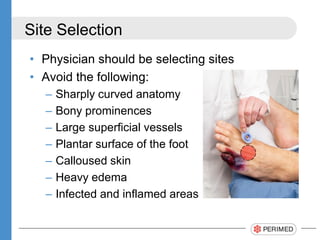
Site Selection
• Physician should be selecting sites
• Avoid the following:
– Sharply curved anatomy
– Bony prominences
– Large superficial vessels
– Plantar surface of the foot
– Calloused skin
– Heavy edema
– Infected and inflamed areas
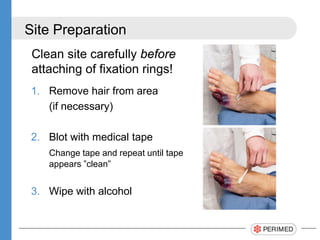
Site Preparation
1. Remove hair from area
(if necessary)
2. Blot with medical tape
Change tape and repeat until tape
appears ”clean”
3. Wipe with alcohol
Clean site carefully before
attaching of fixation rings!
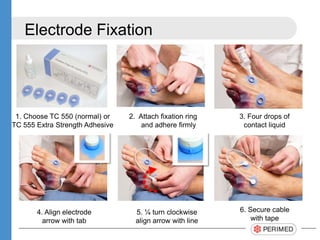
Electrode Fixation
4. Align electrode
arrow with tab
6. Secure cable
with tape
5. ¼ turn clockwise
align arrow with line
2. Attach fixation ring
and adhere firmly
3. Four drops of
contact liquid
1. Choose TC 550 (normal) or
TC 555 Extra Strength Adhesive
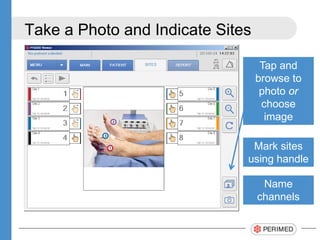
Take a Photo and Indicate Sites
Mark sites
using handle
Name
channels
Tap and
browse to
photo or
choose
image
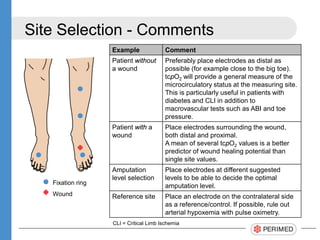
Site Selection - Comments
Fixation ring
Wound
Example Comment
Patient without
a wound
Preferably place electrodes as distal as
possible (for example close to the big toe).
tcpO2 will provide a general measure of the
microcirculatory status at the measuring site.
This is particularly useful in patients with
diabetes and CLI in addition to
macrovascular tests such as ABI and toe
pressure.
Patient with a
wound
Place electrodes surrounding the wound,
both distal and proximal.
A mean of several tcpO2 values is a better
predictor of wound healing potential than
single site values.
Amputation
level selection
Place electrodes at different suggested
levels to be able to decide the optimal
amputation level.
Reference site Place an electrode on the contralateral side
as a reference/control. If possible, rule out
arterial hypoxemia with pulse oximetry.
CLI = Critical Limb Ischemia
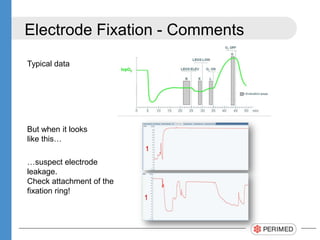
Electrode Fixation - Comments
But when it looks
like this…
…suspect electrode
leakage.
Check attachment of the
fixation ring!
Typical data
Thank You!
PeriFlux 6000 | tcpO2 made intelligent
www.perimed-instruments.com

Tcpo2 site selection

  • 1.
    tcpO2 Site Selection PeriFlux6000 | tcpO2 made intelligent
  • 2.
    Disclaimer The information containedin this document is intended to provide general information only. It is not intended to be, nor does it constitute, medical advice. Under no circumstances is the information contained in this document to be interpreted as a recommendation for a particular treatment for specific individuals. In all cases it is recommended that clinicians perform their own interpretations of data in conjunction with the clinical assessment of their patient. Due to Perimed’s commitment to continuous improvement of our products, all specifications are subject to change without notice. All information and content in this document is protected by copyright. All rights are reserved. Users are prohibited from modifying, copying, distributing, transmitting, displaying, publishing, selling, licensing, creating derivative works, or using any information available in or through the document for commercial or public purposes. All responsibility for any liability, loss or risk, personal or otherwise, which is incurred as a consequence, directly or indirectly, of the use and application of any of the material in this document is specifically disclaimed.
  • 3.
    • Calibration • tcpO2Site Selection • Electrode Maintenance • Interpreting Curves and Results
  • 4.
    Site Selection • Physicianshould be selecting sites • Avoid the following: – Sharply curved anatomy – Bony prominences – Large superficial vessels – Plantar surface of the foot – Calloused skin – Heavy edema – Infected and inflamed areas
  • 5.
    Site Preparation 1. Removehair from area (if necessary) 2. Blot with medical tape Change tape and repeat until tape appears ”clean” 3. Wipe with alcohol Clean site carefully before attaching of fixation rings!
  • 6.
    Electrode Fixation 4. Alignelectrode arrow with tab 6. Secure cable with tape 5. ¼ turn clockwise align arrow with line 2. Attach fixation ring and adhere firmly 3. Four drops of contact liquid 1. Choose TC 550 (normal) or TC 555 Extra Strength Adhesive
  • 7.
    Take a Photoand Indicate Sites Mark sites using handle Name channels Tap and browse to photo or choose image
  • 8.
    Site Selection -Comments Fixation ring Wound Example Comment Patient without a wound Preferably place electrodes as distal as possible (for example close to the big toe). tcpO2 will provide a general measure of the microcirculatory status at the measuring site. This is particularly useful in patients with diabetes and CLI in addition to macrovascular tests such as ABI and toe pressure. Patient with a wound Place electrodes surrounding the wound, both distal and proximal. A mean of several tcpO2 values is a better predictor of wound healing potential than single site values. Amputation level selection Place electrodes at different suggested levels to be able to decide the optimal amputation level. Reference site Place an electrode on the contralateral side as a reference/control. If possible, rule out arterial hypoxemia with pulse oximetry. CLI = Critical Limb Ischemia
  • 9.
    Electrode Fixation -Comments But when it looks like this… …suspect electrode leakage. Check attachment of the fixation ring! Typical data
  • 10.
    Thank You! PeriFlux 6000| tcpO2 made intelligent www.perimed-instruments.com