Tbilisi presentation
Barbare G, Salome
2022-2023
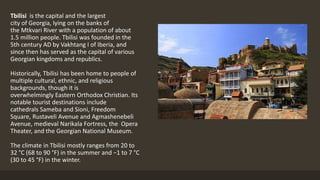
Tbilisi is the capital and the largest
city of Georgia, lying on the banks of
the Mtkvari River with a population of about
1.5 million people. Tbilisi was founded in the
5th century AD by Vakhtang I of Iberia, and
since then has served as the capital of various
Georgian kingdoms and republics.
Historically, Tbilisi has been home to people of
multiple cultural, ethnic, and religious
backgrounds, though it is
overwhelmingly Eastern Orthodox Christian. Its
notable tourist destinations include
cathedrals Sameba and Sioni, Freedom
Square, Rustaveli Avenue and Agmashenebeli
Avenue, medieval Narikala Fortress, the Opera
Theater, and the Georgian National Museum.
The climate in Tbilisi mostly ranges from 20 to
32 °C (68 to 90 °F) in the summer and −1 to 7 °C
(30 to 45 °F) in the winter.
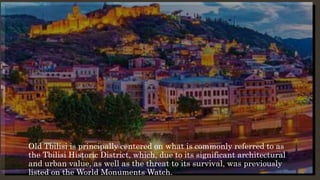
Old Tbilisi is principally centered on what is commonly referred to as
the Tbilisi Historic District, which, due to its significant architectural
and urban value, as well as the threat to its survival, was previously
listed on the World Monuments Watch.
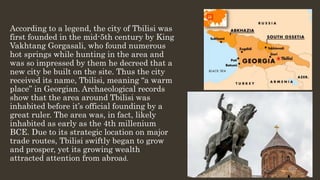
According to a legend, the city of Tbilisi was
first founded in the mid-5th century by King
Vakhtang Gorgasali, who found numerous
hot springs while hunting in the area and
was so impressed by them he decreed that a
new city be built on the site. Thus the city
received its name, Tbilisi, meaning “a warm
place” in Georgian. Archaeological records
show that the area around Tbilisi was
inhabited before it’s official founding by a
great ruler. The area was, in fact, likely
inhabited as early as the 4th millenium
BCE. Due to its strategic location on major
trade routes, Tbilisi swiftly began to grow
and prosper, yet its growing wealth
attracted attention from abroad.
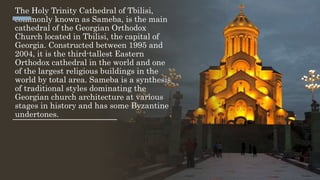
The Holy Trinity Cathedral of Tbilisi,
commonly known as Sameba, is the main
cathedral of the Georgian Orthodox
Church located in Tbilisi, the capital of
Georgia. Constructed between 1995 and
2004, it is the third-tallest Eastern
Orthodox cathedral in the world and one
of the largest religious buildings in the
world by total area. Sameba is a synthesis
of traditional styles dominating the
Georgian church architecture at various
stages in history and has some Byzantine
undertones.
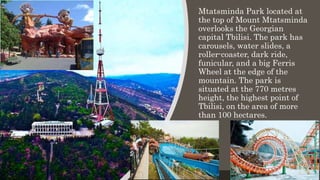
Mtatsminda Park located at
the top of Mount Mtatsminda
overlooks the Georgian
capital Tbilisi. The park has
carousels, water slides, a
roller-coaster, dark ride,
funicular, and a big Ferris
Wheel at the edge of the
mountain. The park is
situated at the 770 metres
height, the highest point of
Tbilisi, on the area of more
than 100 hectares.
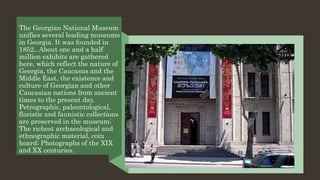
The Georgian National Museum
unifies several leading museums
in Georgia. It was founded in
1852.. About one and a half
million exhibits are gathered
here, which reflect the nature of
Georgia, the Caucasus and the
Middle East, the existence and
culture of Georgian and other
Caucasian nations from ancient
times to the present day.
Petrographic, paleontological,
floristic and faunistic collections
are preserved in the museum;
The richest archaeological and
ethnographic material, coin
hoard; Photographs of the XIX
and XX centuries.
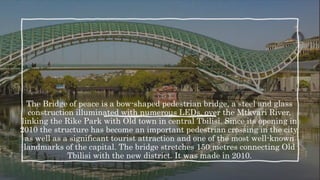
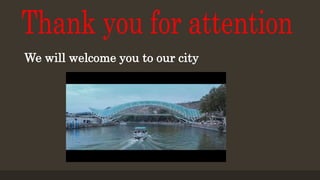
The Bridge of peace is a bow-shaped pedestrian bridge, a steel and glass
construction illuminated with numerous LEDs, over the Mtkvari River,
linking the Rike Park with Old town in central Tbilisi. Since its opening in
2010 the structure has become an important pedestrian crossing in the city,
as well as a significant tourist attraction and one of the most well-known
landmarks of the capital. The bridge stretches 150 metres connecting Old
Tbilisi with the new district. It was made in 2010.
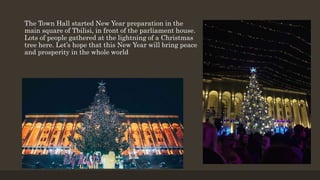
The Town Hall started New Year preparation in the
main square of Tbilisi, in front of the parliament house.
Lots of people gathered at the lightning of a Christmas
tree here. Let’s hope that this New Year will bring peace
and prosperity in the whole world
We will welcome you to our city

Tbilisi-presentation.pptx

  • 1.
  • 2.
    Tbilisi is thecapital and the largest city of Georgia, lying on the banks of the Mtkvari River with a population of about 1.5 million people. Tbilisi was founded in the 5th century AD by Vakhtang I of Iberia, and since then has served as the capital of various Georgian kingdoms and republics. Historically, Tbilisi has been home to people of multiple cultural, ethnic, and religious backgrounds, though it is overwhelmingly Eastern Orthodox Christian. Its notable tourist destinations include cathedrals Sameba and Sioni, Freedom Square, Rustaveli Avenue and Agmashenebeli Avenue, medieval Narikala Fortress, the Opera Theater, and the Georgian National Museum. The climate in Tbilisi mostly ranges from 20 to 32 °C (68 to 90 °F) in the summer and −1 to 7 °C (30 to 45 °F) in the winter.
  • 3.
    Old Tbilisi isprincipally centered on what is commonly referred to as the Tbilisi Historic District, which, due to its significant architectural and urban value, as well as the threat to its survival, was previously listed on the World Monuments Watch.
  • 4.
    According to alegend, the city of Tbilisi was first founded in the mid-5th century by King Vakhtang Gorgasali, who found numerous hot springs while hunting in the area and was so impressed by them he decreed that a new city be built on the site. Thus the city received its name, Tbilisi, meaning “a warm place” in Georgian. Archaeological records show that the area around Tbilisi was inhabited before it’s official founding by a great ruler. The area was, in fact, likely inhabited as early as the 4th millenium BCE. Due to its strategic location on major trade routes, Tbilisi swiftly began to grow and prosper, yet its growing wealth attracted attention from abroad.
  • 5.
    The Holy TrinityCathedral of Tbilisi, commonly known as Sameba, is the main cathedral of the Georgian Orthodox Church located in Tbilisi, the capital of Georgia. Constructed between 1995 and 2004, it is the third-tallest Eastern Orthodox cathedral in the world and one of the largest religious buildings in the world by total area. Sameba is a synthesis of traditional styles dominating the Georgian church architecture at various stages in history and has some Byzantine undertones.
  • 6.
    Mtatsminda Park locatedat the top of Mount Mtatsminda overlooks the Georgian capital Tbilisi. The park has carousels, water slides, a roller-coaster, dark ride, funicular, and a big Ferris Wheel at the edge of the mountain. The park is situated at the 770 metres height, the highest point of Tbilisi, on the area of more than 100 hectares.
  • 7.
    The Georgian NationalMuseum unifies several leading museums in Georgia. It was founded in 1852.. About one and a half million exhibits are gathered here, which reflect the nature of Georgia, the Caucasus and the Middle East, the existence and culture of Georgian and other Caucasian nations from ancient times to the present day. Petrographic, paleontological, floristic and faunistic collections are preserved in the museum; The richest archaeological and ethnographic material, coin hoard; Photographs of the XIX and XX centuries.
  • 8.
    The Bridge ofpeace is a bow-shaped pedestrian bridge, a steel and glass construction illuminated with numerous LEDs, over the Mtkvari River, linking the Rike Park with Old town in central Tbilisi. Since its opening in 2010 the structure has become an important pedestrian crossing in the city, as well as a significant tourist attraction and one of the most well-known landmarks of the capital. The bridge stretches 150 metres connecting Old Tbilisi with the new district. It was made in 2010.
  • 9.
    The Town Hallstarted New Year preparation in the main square of Tbilisi, in front of the parliament house. Lots of people gathered at the lightning of a Christmas tree here. Let’s hope that this New Year will bring peace and prosperity in the whole world
  • 10.
    We will welcomeyou to our city