TBar: Revisiting Template-based
Automated Program Repair
Kui LIU, Anil Koyuncu, Dongsun Kim and Tegawendé F. Bissyandé
SnT, University of Luxembourg, Luxembourg
2019-07-17, Wednesday @ISSTA 2019, Beijing, China
1
> Fix Pattern
Fix pattern: e.g., PAR, kim2013ICSE [23].
Fix template: e.g., SOFix, liu2018SANER [40].
Abstract modification: e.g., SimFix, jiang2018ISSTA [18].
Mutation operator: e.g., CapGen, wen2018ICSE [69].
Modification rule: e.g., ssFix, xin2017ASE [74].
Code transform: e.g., Genesis, long2017FSE [41].
Program transformation schemas: e.g., SketchFix, hua2018ICSE[17].
“A fix pattern is a pair of a code context representing a buggy code entity
and a set of related change operations, which can be applied to a given
buggy code entity to generate fixing code.” ---- Liu et al. TSE 2018 [35].
FP: <Code Context, {Change Operations}>
2
> Limited Characterization of Fix Patterns
APR Tool Venue Number of Fix Patterns
PAR [23] ICSE-2013 10
jMutRepair [40] ISSTA-2016 2
HDRepair [29] SANER-2016 11
NPEfix [13] SANER-2017 9
ssFix [74] ASE-2017 34
Genesis [41] FSE-2017 108
S3 [25] ASE-2017 4
ELIXIR [62] ASE-2017 8
SketchFix [17] ICSE-2018 6
SOFix [40] SANER-2018 12
SimFix [18] ISSTA-2018 16
CapGen [69] ICSE-2018 30
AVATAR [39] SANER-2019 13
1.Diversity of fix
patterns.
2.Bug fix performance
of each fix pattern.
3.Fault localization
sensitiveness of fix
patterns.
3
> Study Methodology
1. SLR: Systematically review the APR literature related to fix patterns.
2. Taxonomy: enumerate and summarize fix patterns.
3. A Baseline Repair Tool: implement a comprehensive pattern based APR tool.
4. Empirical Study on Performance and Sensitiveness.
4
SLR and Taxonomy
5
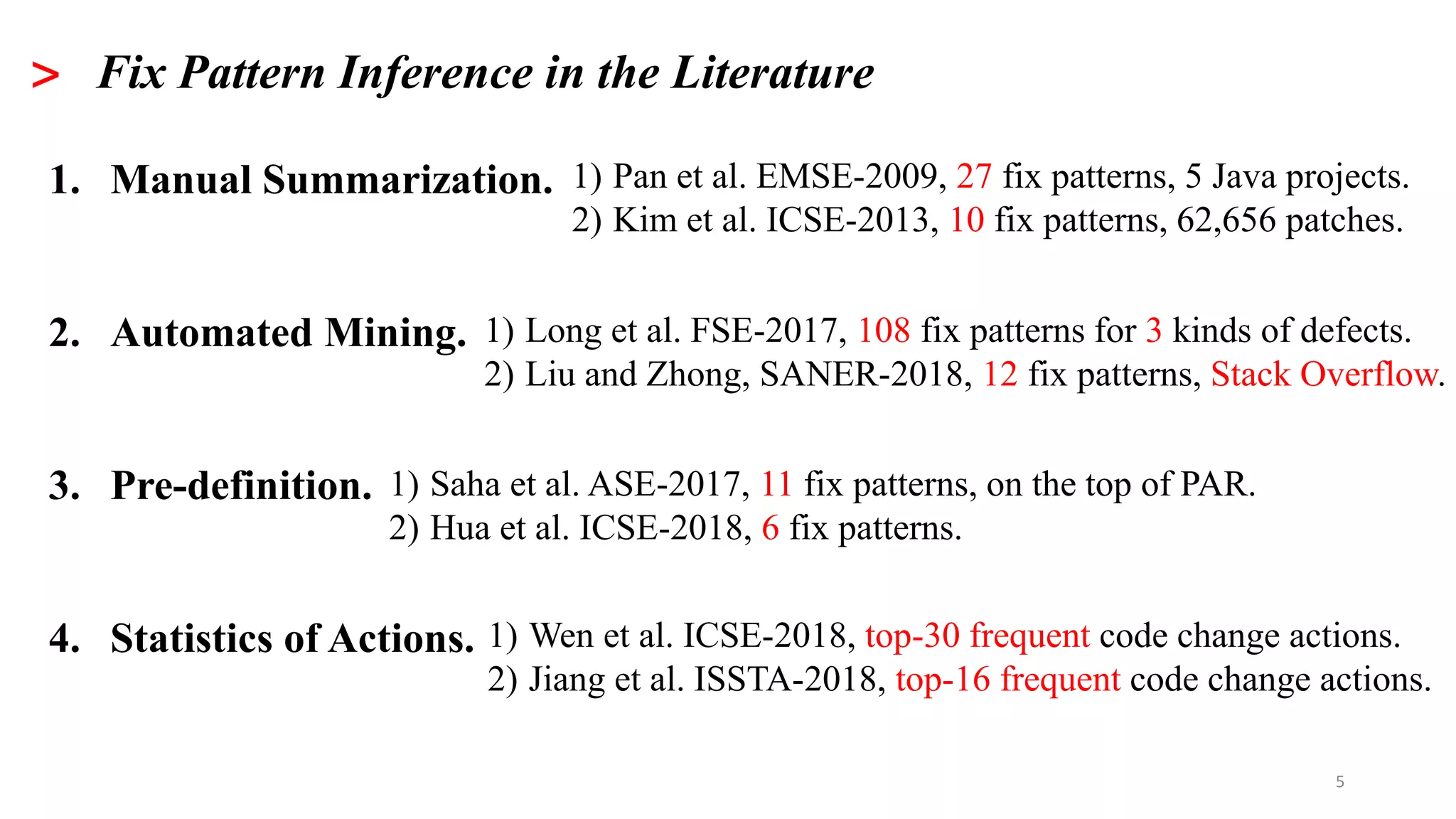
> Fix Pattern Inference in the Literature
1. Manual Summarization.
2. Automated Mining.
3. Pre-definition.
4. Statistics of Actions.
1) Pan et al. EMSE-2009, 27 fix patterns, 5 Java projects.
2) Kim et al. ICSE-2013, 10 fix patterns, 62,656 patches.
1) Long et al. FSE-2017, 108 fix patterns for 3 kinds of defects.
2) Liu and Zhong, SANER-2018, 12 fix patterns, Stack Overflow.
1) Saha et al. ASE-2017, 11 fix patterns, on the top of PAR.
2) Hua et al. ICSE-2018, 6 fix patterns.
1) Wen et al. ICSE-2018, top-30 frequent code change actions.
2) Jiang et al. ISSTA-2018, top-16 frequent code change actions.
6
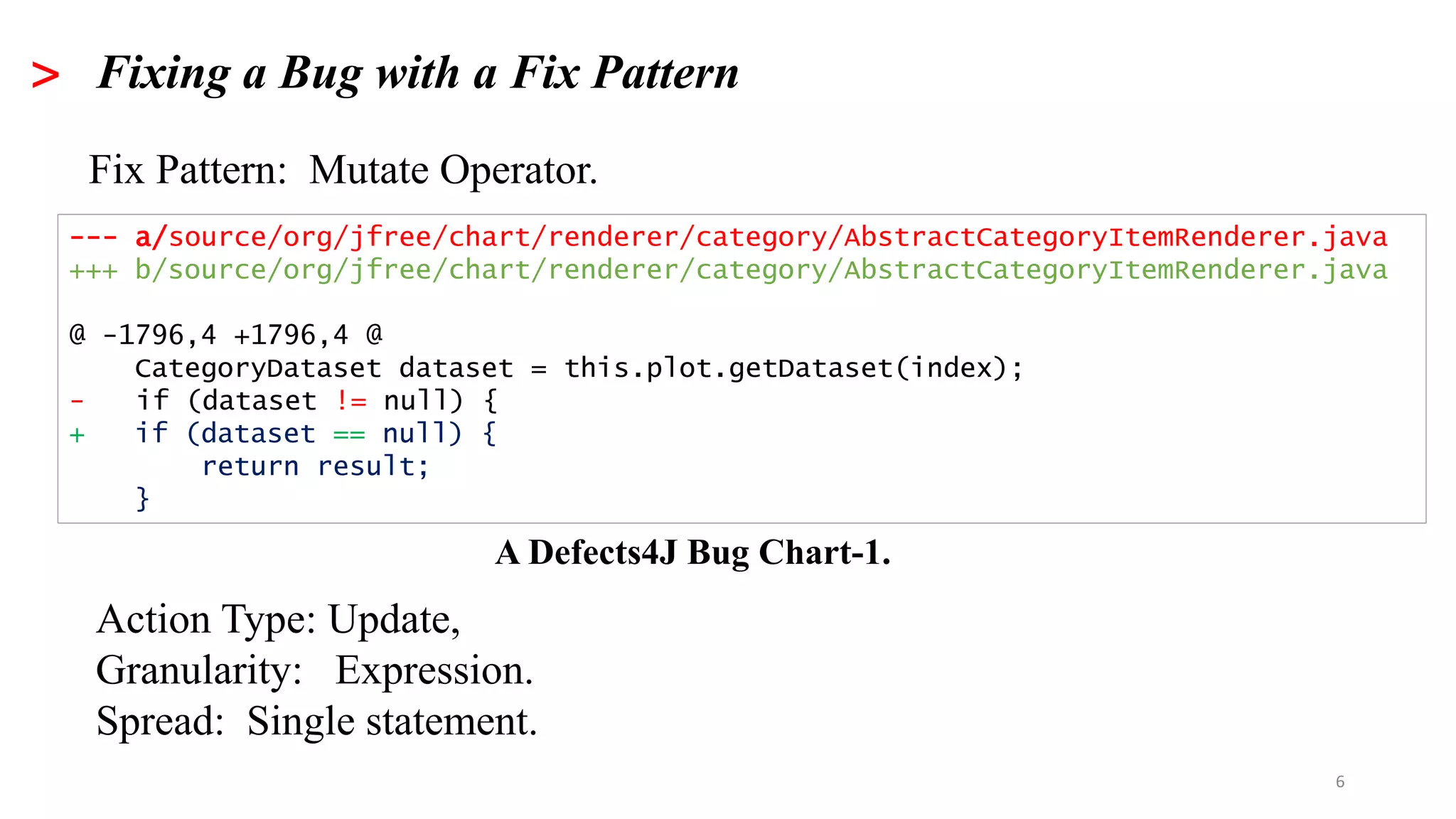
> Fixing a Bug with a Fix Pattern
--- a/source/org/jfree/chart/renderer/category/AbstractCategoryItemRenderer.java
+++ b/source/org/jfree/chart/renderer/category/AbstractCategoryItemRenderer.java
@ -1796,4 +1796,4 @
CategoryDataset dataset = this.plot.getDataset(index);
- if (dataset != null) {
+ if (dataset == null) {
return result;
}
A Defects4J Bug Chart-1.
Action Type: Update,
Granularity: Expression.
Spread: Single statement.
Fix Pattern: Mutate Operator.
7
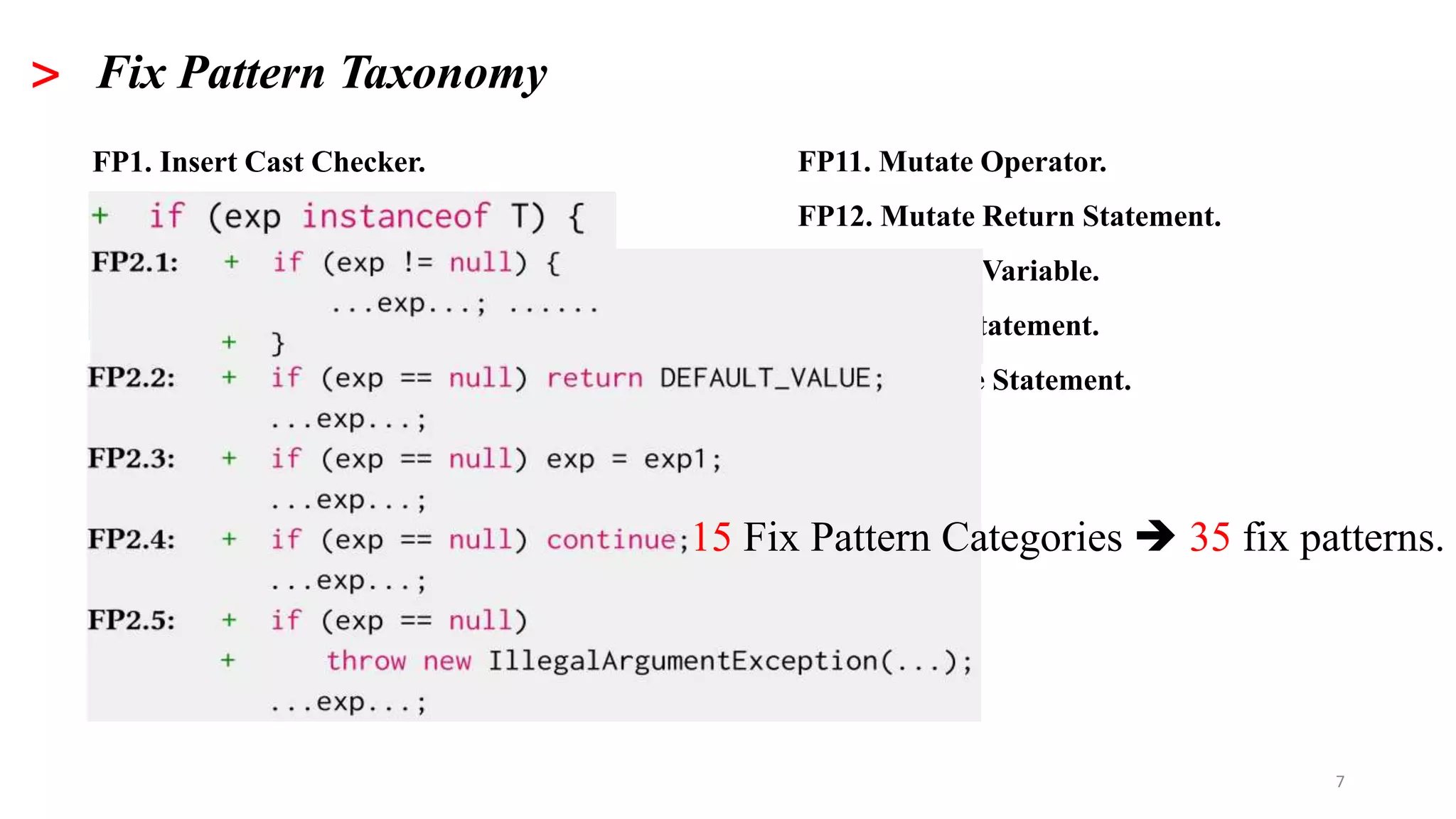
> Fix Pattern Taxonomy
FP1. Insert Cast Checker.
FP2. Insert Null Pointer Checker.
FP3. Insert Range Checker.
FP4. Insert Missed Statement.
FP5. Mutate Class Instance Creation.
FP6. Mutate Conditional Expression.
FP7. Mutate Data Type.
FP8. Mutate Integer Division Operation.
FP9. Mutate Literal Expression.
FP10. Mutate Method Invocation Expression.
FP11. Mutate Operator.
FP12. Mutate Return Statement.
FP13. Mutate Variable.
FP14. Move Statement.
FP15. Remove Statement.
15 Fix Pattern Categories  35 fix patterns.
8
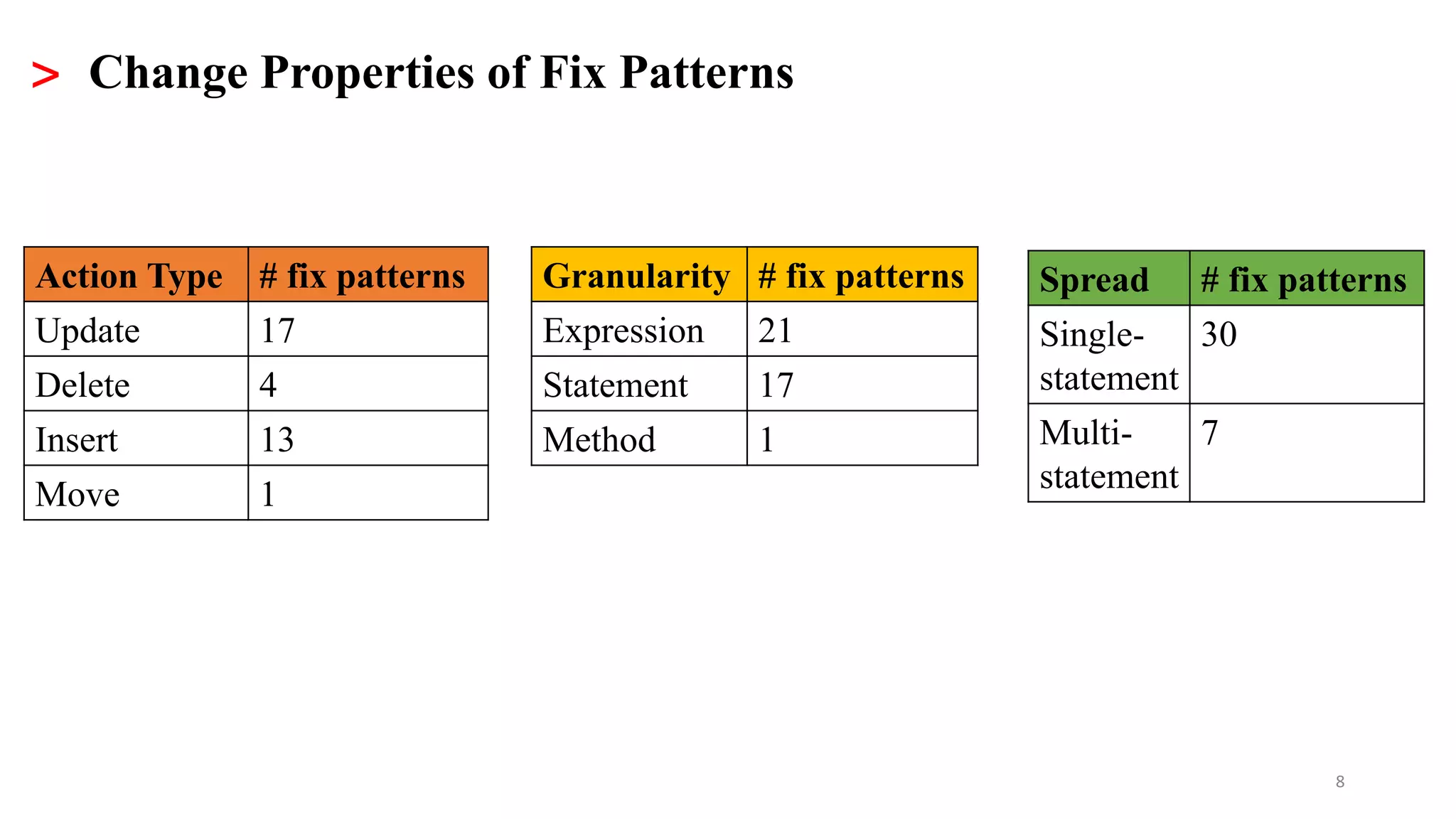
> Change Properties of Fix Patterns
Action Type # fix patterns
Update 17
Delete 4
Insert 13
Move 1
Granularity # fix patterns
Expression 21
Statement 17
Method 1
Spread # fix patterns
Single-
statement
30
Multi-
statement
7
9
TBar: a Baseline APR System
10
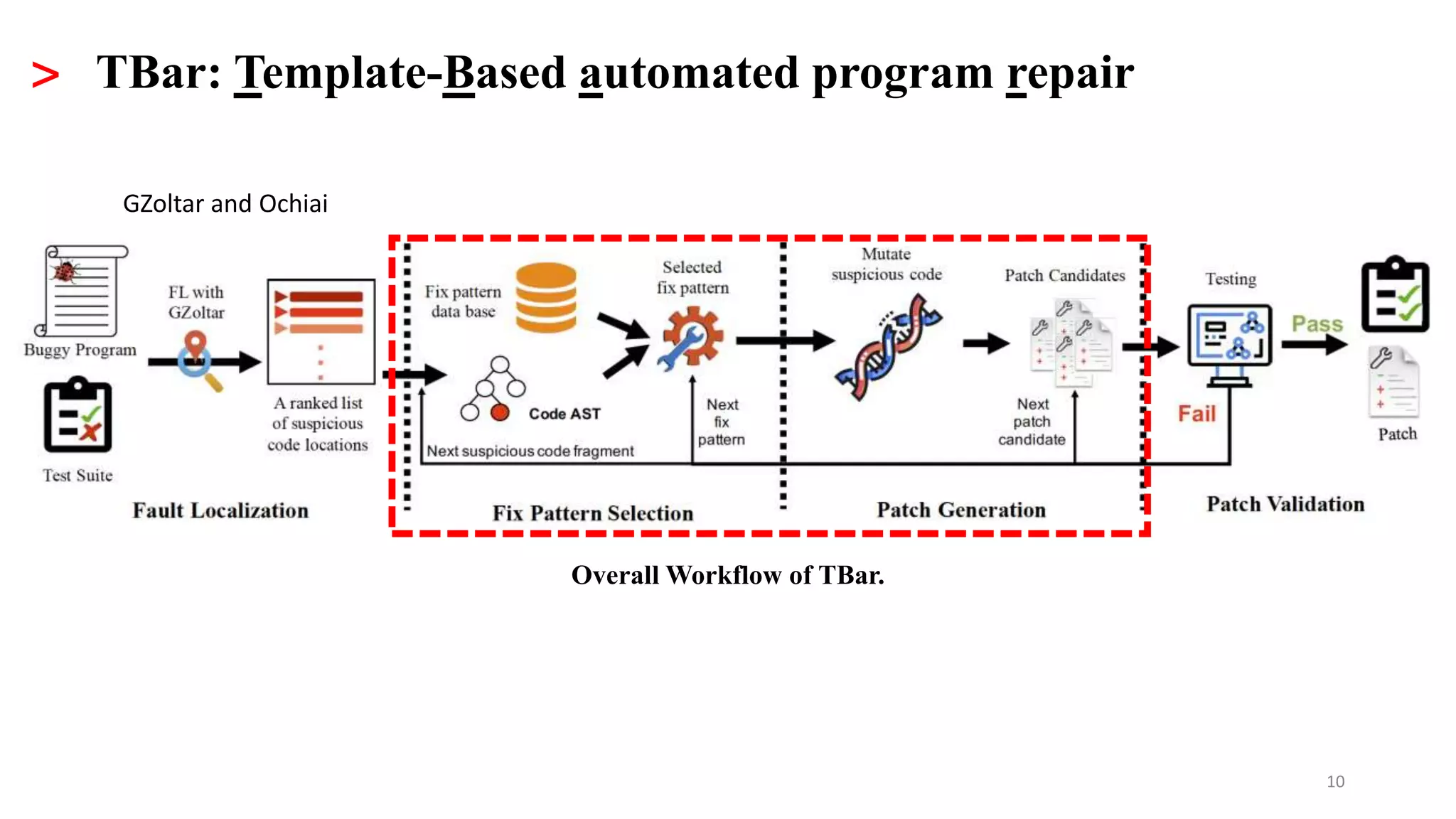
> TBar: Template-Based automated program repair
Overall Workflow of TBar.
GZoltar and Ochiai
11
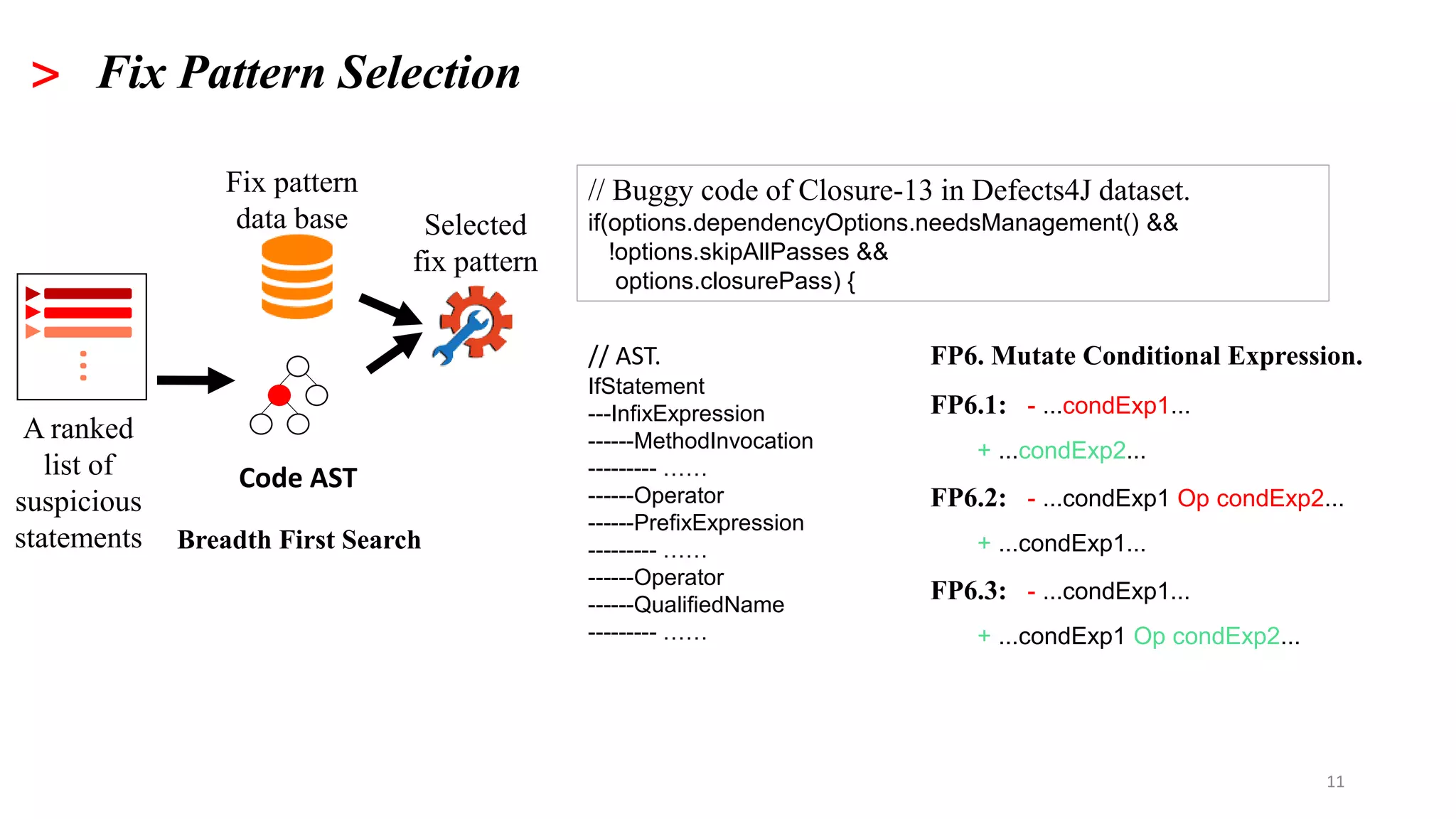
> Fix Pattern Selection
Selected
fix pattern
A ranked
list of
suspicious
statements
Fix pattern
data base
Code AST
…
// Buggy code of Closure-13 in Defects4J dataset.
if(options.dependencyOptions.needsManagement() &&
!options.skipAllPasses &&
options.closurePass) {
// AST.
IfStatement
---InfixExpression
------MethodInvocation
--------- ……
------Operator
------PrefixExpression
--------- ……
------Operator
------QualifiedName
--------- ……
FP6. Mutate Conditional Expression.
FP6.1: - ...condExp1...
+ ...condExp2...
FP6.2: - ...condExp1 Op condExp2...
+ ...condExp1...
FP6.3: - ...condExp1...
+ ...condExp1 Op condExp2...
Breadth First Search
12
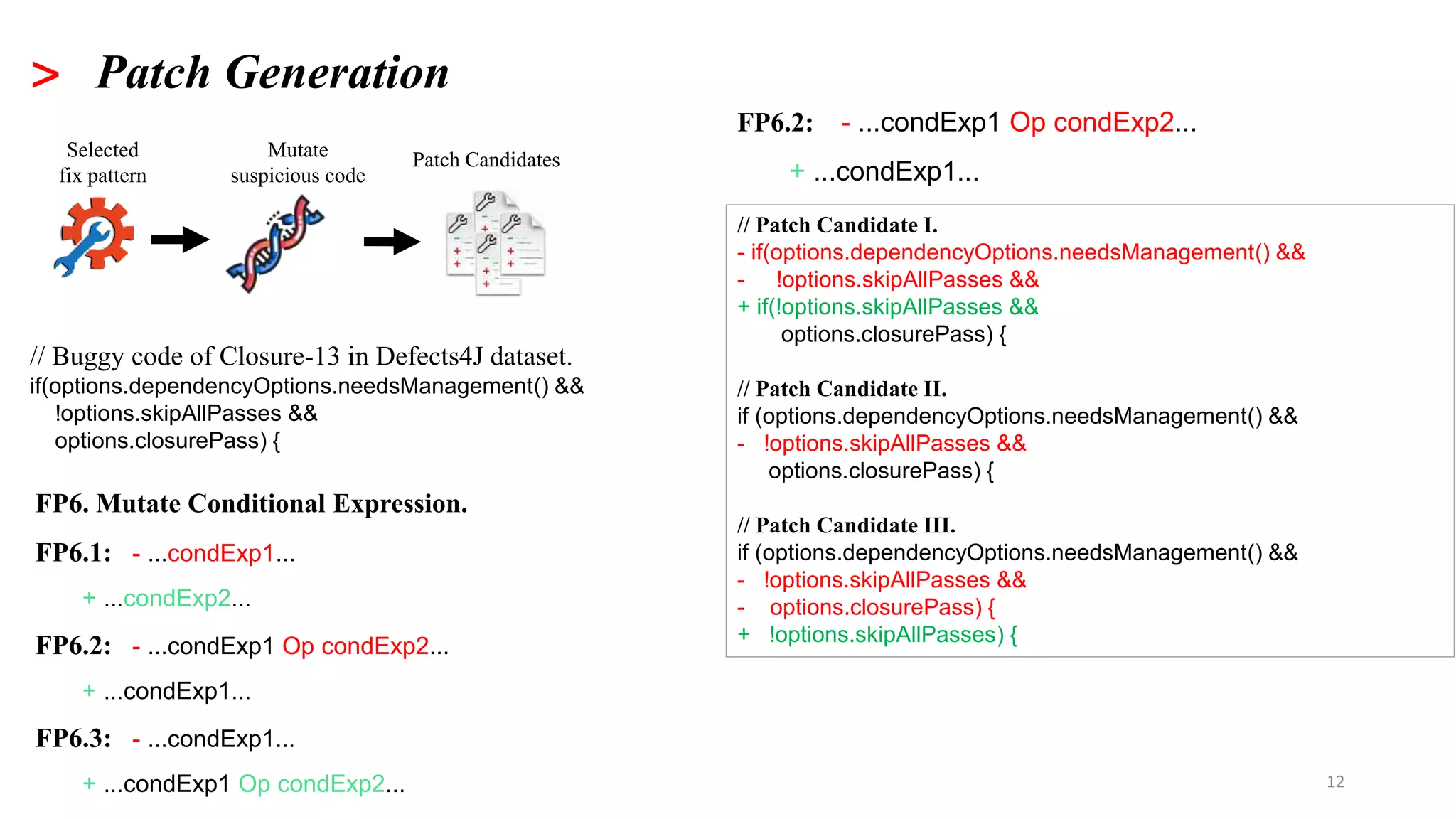
> Patch Generation
// Buggy code of Closure-13 in Defects4J dataset.
if(options.dependencyOptions.needsManagement() &&
!options.skipAllPasses &&
options.closurePass) {
// Patch Candidate I.
- if(options.dependencyOptions.needsManagement() &&
- !options.skipAllPasses &&
+ if(!options.skipAllPasses &&
options.closurePass) {
// Patch Candidate II.
if (options.dependencyOptions.needsManagement() &&
- !options.skipAllPasses &&
options.closurePass) {
// Patch Candidate III.
if (options.dependencyOptions.needsManagement() &&
- !options.skipAllPasses &&
- options.closurePass) {
+ !options.skipAllPasses) {
FP6.2: - ...condExp1 Op condExp2...
+ ...condExp1...
Patch CandidatesSelected
fix pattern
Mutate
suspicious code
FP6. Mutate Conditional Expression.
FP6.1: - ...condExp1...
+ ...condExp2...
FP6.2: - ...condExp1 Op condExp2...
+ ...condExp1...
FP6.3: - ...condExp1...
+ ...condExp1 Op condExp2...
13
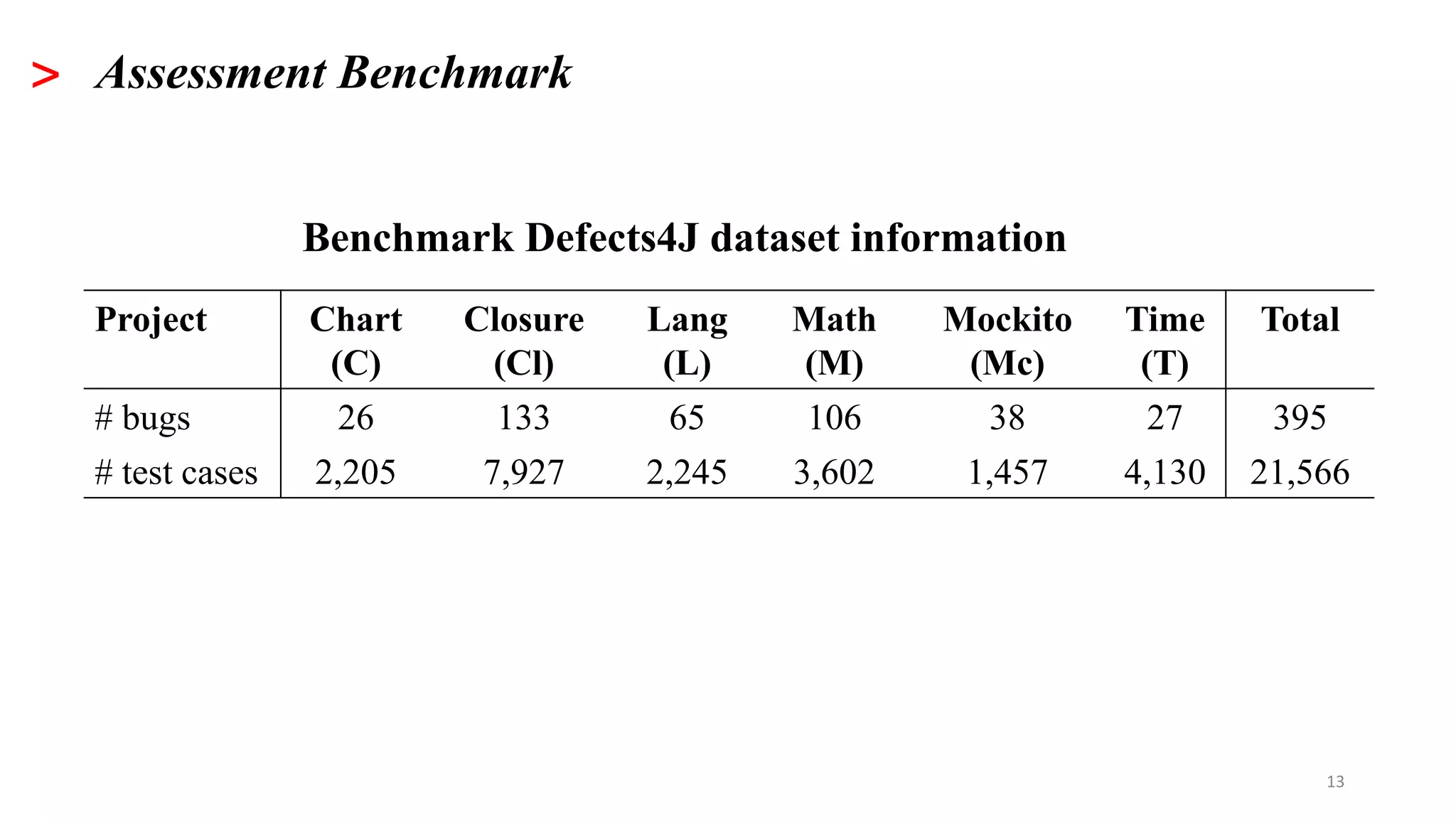
> Assessment Benchmark
Project Chart
(C)
Closure
(Cl)
Lang
(L)
Math
(M)
Mockito
(Mc)
Time
(T)
Total
# bugs 26 133 65 106 38 27 395
# test cases 2,205 7,927 2,245 3,602 1,457 4,130 21,566
Benchmark Defects4J dataset information
14
Repair Suitability of Fix Patterns
15
> Experiment #1: TBar with Perfect Fault Localization
Research Questions :
RQ1. How many bugs from Defects4J can be correctly fixed by
fix patterns from our taxonomy?
RQ2. Can each Defects4J bug be fixed by different fix patterns?
RQ3. What are the properties of fix patterns that are successfully
used to fix bugs?
16
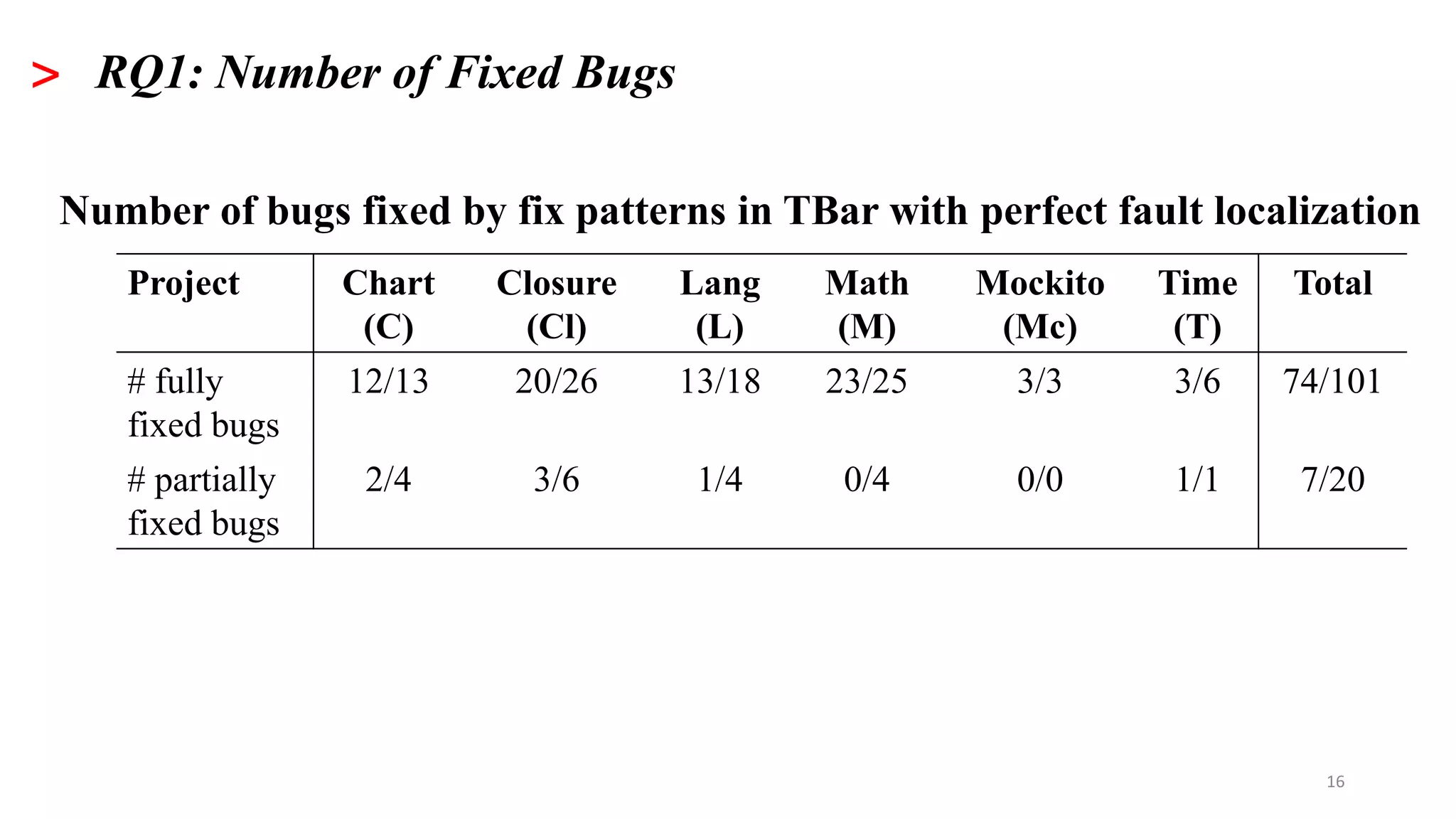
> RQ1: Number of Fixed Bugs
Project Chart
(C)
Closure
(Cl)
Lang
(L)
Math
(M)
Mockito
(Mc)
Time
(T)
Total
# fully
fixed bugs
12/13 20/26 13/18 23/25 3/3 3/6 74/101
# partially
fixed bugs
2/4 3/6 1/4 0/4 0/0 1/1 7/20
Number of bugs fixed by fix patterns in TBar with perfect fault localization
17
> Limitation and Discussion
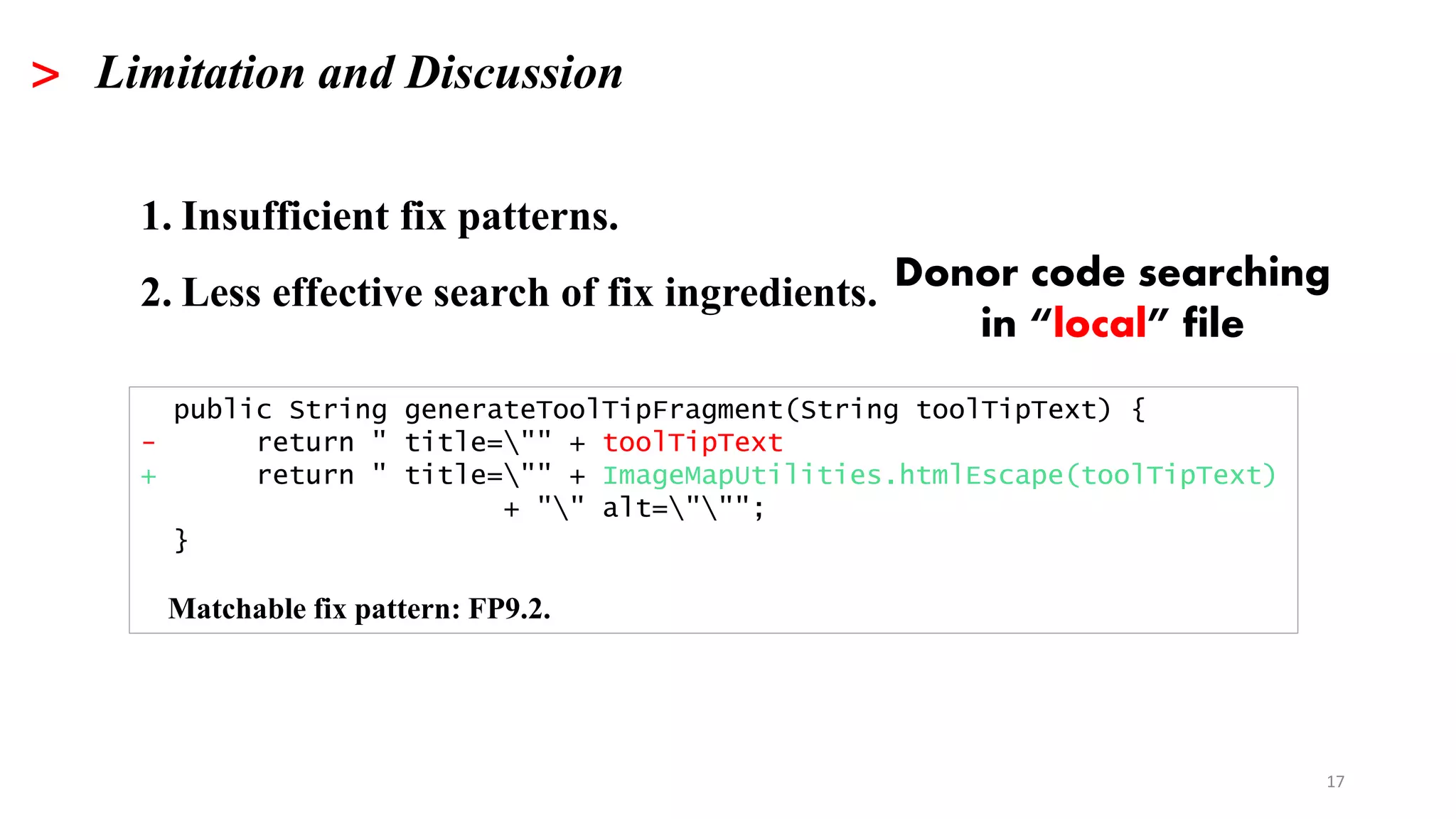
1. Insufficient fix patterns.
2. Less effective search of fix ingredients.
public String generateToolTipFragment(String toolTipText) {
- return " title="" + toolTipText
+ return " title="" + ImageMapUtilities.htmlEscape(toolTipText)
+ "" alt=""";
}
Matchable fix pattern: FP9.2.
Donor code searching
in “local” file
18
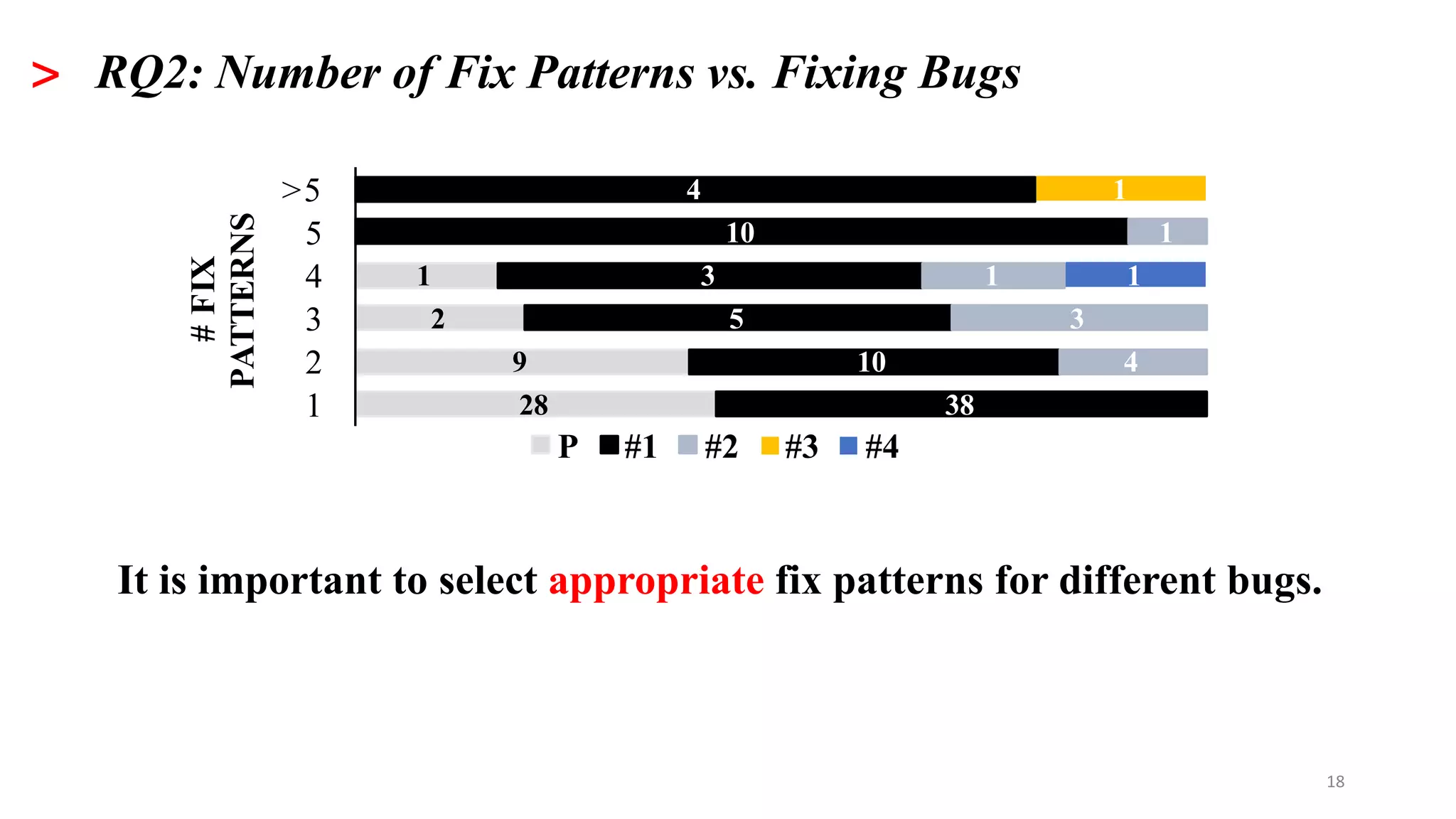
> RQ2: Number of Fix Patterns vs. Fixing Bugs
28
9
2
1
38
10
5
3
10
4
4
3
1
1
1
1
1
2
3
4
5
>5#FIX
PATTERNS
P #1 #2 #3 #4
It is important to select appropriate fix patterns for different bugs.
19
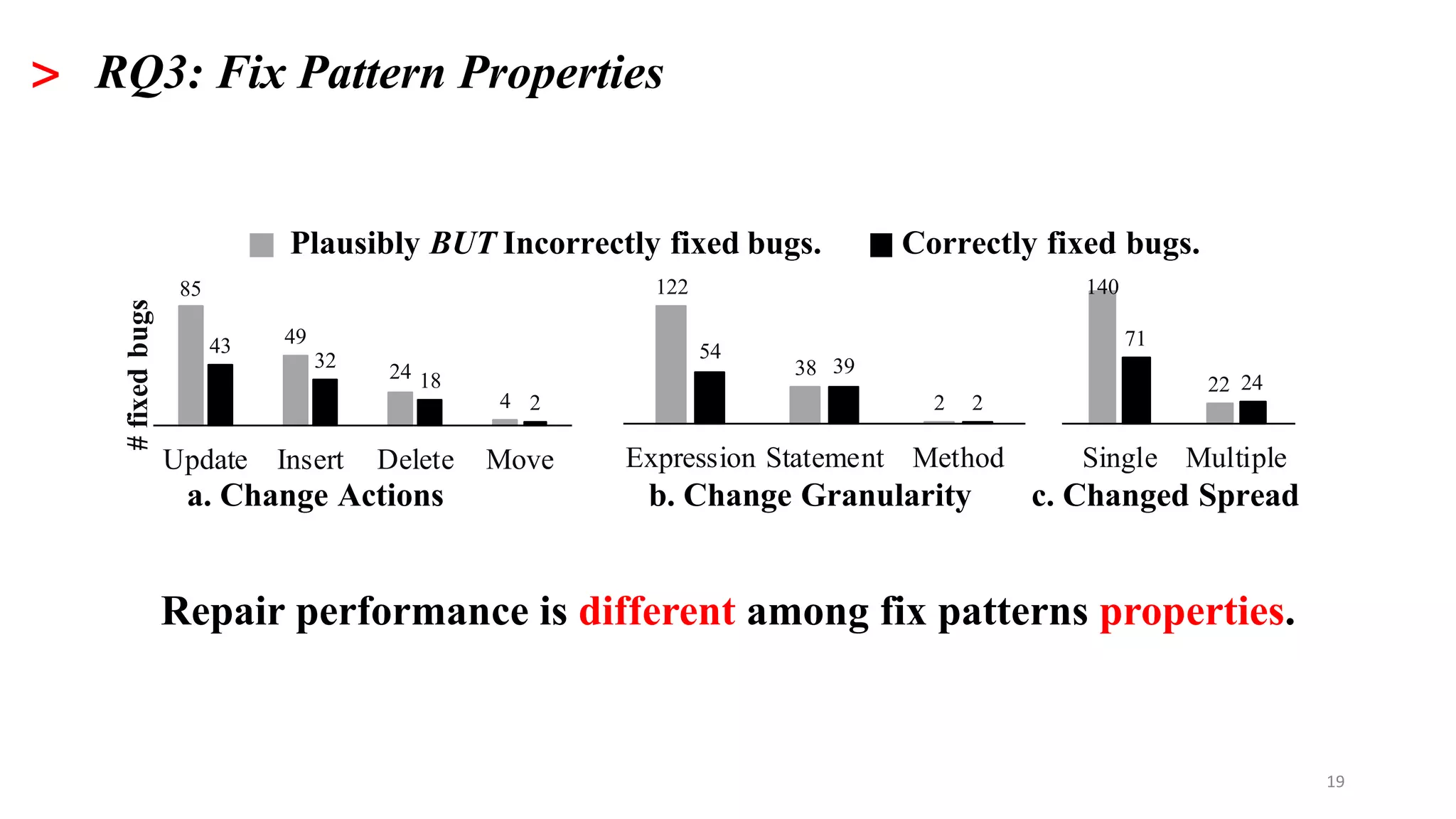
> RQ3: Fix Pattern Properties
85
49
24
4
43
32
18
2
Update Insert Delete Move
#fixedbugs
122
38
2
54
39
2
Expression Statement Method
140
22
71
24
Single Multiple
Plausibly BUT Incorrectly fixed bugs. Correctly fixed bugs.
a. Change Actions b. Change Granularity c. Changed Spread
Repair performance is different among fix patterns properties.
20
Repair Performance Comparison
21
> Experiment #2: TBar with Normal Fault Localization
Research Questions:
RQ4. What performance can be achieved by TBar in a standard
and practical repair scenario?
RQ5. To what extent are the fix pattern based repair tool sensitive
to noise in fault localization (i.e., spotting bug positions)?
22
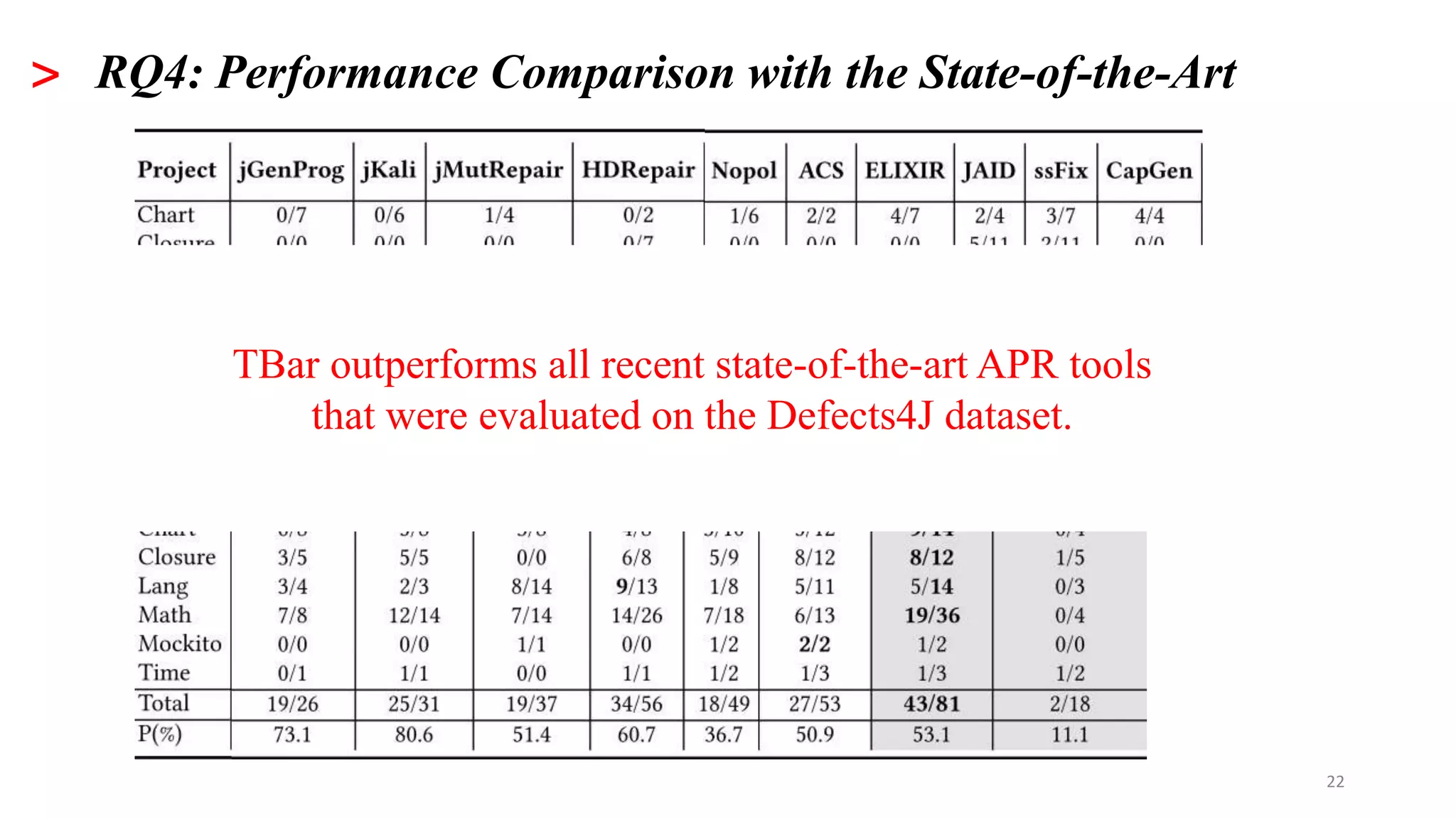
> RQ4: Performance Comparison with the State-of-the-Art
TBar outperforms all recent state-of-the-art APR tools
that were evaluated on the Defects4J dataset.
23
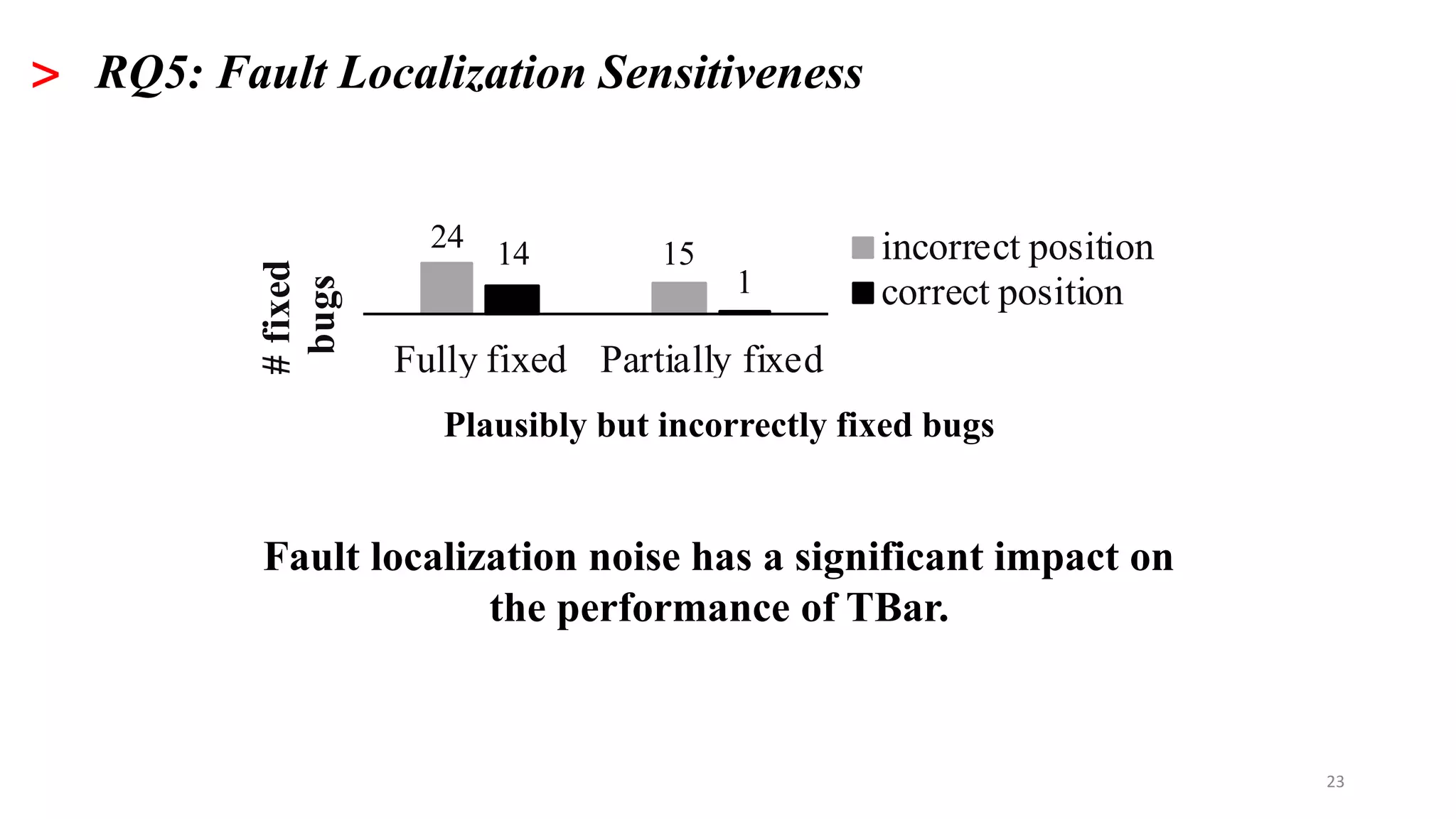
> RQ5: Fault Localization Sensitiveness
Fault localization noise has a significant impact on
the performance of TBar.
Plausibly but incorrectly fixed bugs
24 1514
1
Fully fixed Partially fixed
#fixed
bugs
incorrect position
correct position
24
> DISCUSSION
1. Fix pattern diversity.
2. Fix pattern selection.
3. Donor code searching.
4. Patch prioritization.
5. Fault Localization Sensitiveness.
25
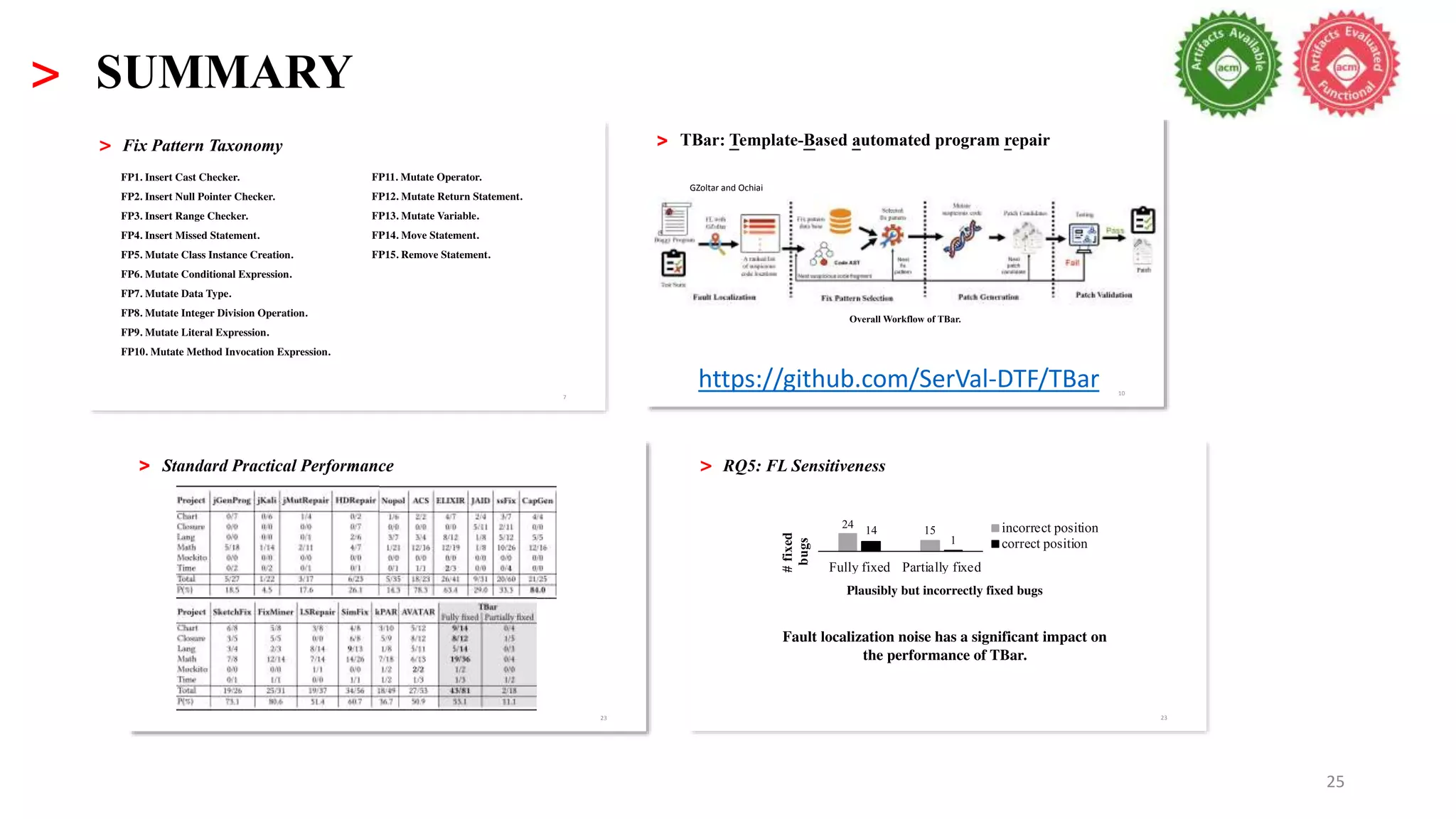
> SUMMARY
10
> TBar: Template-Based automated program repair
Overall Workflow of TBar.
GZoltar and Ochiai
23
> Standard Practical Performance
https://github.com/SerVal-DTF/TBar

TBar: Revisiting Template-based Automated Program Repair

  • 1.
    TBar: Revisiting Template-based AutomatedProgram Repair Kui LIU, Anil Koyuncu, Dongsun Kim and Tegawendé F. Bissyandé SnT, University of Luxembourg, Luxembourg 2019-07-17, Wednesday @ISSTA 2019, Beijing, China
  • 2.
    1 > Fix Pattern Fixpattern: e.g., PAR, kim2013ICSE [23]. Fix template: e.g., SOFix, liu2018SANER [40]. Abstract modification: e.g., SimFix, jiang2018ISSTA [18]. Mutation operator: e.g., CapGen, wen2018ICSE [69]. Modification rule: e.g., ssFix, xin2017ASE [74]. Code transform: e.g., Genesis, long2017FSE [41]. Program transformation schemas: e.g., SketchFix, hua2018ICSE[17]. “A fix pattern is a pair of a code context representing a buggy code entity and a set of related change operations, which can be applied to a given buggy code entity to generate fixing code.” ---- Liu et al. TSE 2018 [35]. FP: <Code Context, {Change Operations}>
  • 3.
    2 > Limited Characterizationof Fix Patterns APR Tool Venue Number of Fix Patterns PAR [23] ICSE-2013 10 jMutRepair [40] ISSTA-2016 2 HDRepair [29] SANER-2016 11 NPEfix [13] SANER-2017 9 ssFix [74] ASE-2017 34 Genesis [41] FSE-2017 108 S3 [25] ASE-2017 4 ELIXIR [62] ASE-2017 8 SketchFix [17] ICSE-2018 6 SOFix [40] SANER-2018 12 SimFix [18] ISSTA-2018 16 CapGen [69] ICSE-2018 30 AVATAR [39] SANER-2019 13 1.Diversity of fix patterns. 2.Bug fix performance of each fix pattern. 3.Fault localization sensitiveness of fix patterns.
  • 4.
    3 > Study Methodology 1.SLR: Systematically review the APR literature related to fix patterns. 2. Taxonomy: enumerate and summarize fix patterns. 3. A Baseline Repair Tool: implement a comprehensive pattern based APR tool. 4. Empirical Study on Performance and Sensitiveness.
  • 5.
  • 6.
    5 > Fix PatternInference in the Literature 1. Manual Summarization. 2. Automated Mining. 3. Pre-definition. 4. Statistics of Actions. 1) Pan et al. EMSE-2009, 27 fix patterns, 5 Java projects. 2) Kim et al. ICSE-2013, 10 fix patterns, 62,656 patches. 1) Long et al. FSE-2017, 108 fix patterns for 3 kinds of defects. 2) Liu and Zhong, SANER-2018, 12 fix patterns, Stack Overflow. 1) Saha et al. ASE-2017, 11 fix patterns, on the top of PAR. 2) Hua et al. ICSE-2018, 6 fix patterns. 1) Wen et al. ICSE-2018, top-30 frequent code change actions. 2) Jiang et al. ISSTA-2018, top-16 frequent code change actions.
  • 7.
    6 > Fixing aBug with a Fix Pattern --- a/source/org/jfree/chart/renderer/category/AbstractCategoryItemRenderer.java +++ b/source/org/jfree/chart/renderer/category/AbstractCategoryItemRenderer.java @ -1796,4 +1796,4 @ CategoryDataset dataset = this.plot.getDataset(index); - if (dataset != null) { + if (dataset == null) { return result; } A Defects4J Bug Chart-1. Action Type: Update, Granularity: Expression. Spread: Single statement. Fix Pattern: Mutate Operator.
  • 8.
    7 > Fix PatternTaxonomy FP1. Insert Cast Checker. FP2. Insert Null Pointer Checker. FP3. Insert Range Checker. FP4. Insert Missed Statement. FP5. Mutate Class Instance Creation. FP6. Mutate Conditional Expression. FP7. Mutate Data Type. FP8. Mutate Integer Division Operation. FP9. Mutate Literal Expression. FP10. Mutate Method Invocation Expression. FP11. Mutate Operator. FP12. Mutate Return Statement. FP13. Mutate Variable. FP14. Move Statement. FP15. Remove Statement. 15 Fix Pattern Categories  35 fix patterns.
  • 9.
    8 > Change Propertiesof Fix Patterns Action Type # fix patterns Update 17 Delete 4 Insert 13 Move 1 Granularity # fix patterns Expression 21 Statement 17 Method 1 Spread # fix patterns Single- statement 30 Multi- statement 7
  • 10.
  • 11.
    10 > TBar: Template-Basedautomated program repair Overall Workflow of TBar. GZoltar and Ochiai
  • 12.
    11 > Fix PatternSelection Selected fix pattern A ranked list of suspicious statements Fix pattern data base Code AST … // Buggy code of Closure-13 in Defects4J dataset. if(options.dependencyOptions.needsManagement() && !options.skipAllPasses && options.closurePass) { // AST. IfStatement ---InfixExpression ------MethodInvocation --------- …… ------Operator ------PrefixExpression --------- …… ------Operator ------QualifiedName --------- …… FP6. Mutate Conditional Expression. FP6.1: - ...condExp1... + ...condExp2... FP6.2: - ...condExp1 Op condExp2... + ...condExp1... FP6.3: - ...condExp1... + ...condExp1 Op condExp2... Breadth First Search
  • 13.
    12 > Patch Generation //Buggy code of Closure-13 in Defects4J dataset. if(options.dependencyOptions.needsManagement() && !options.skipAllPasses && options.closurePass) { // Patch Candidate I. - if(options.dependencyOptions.needsManagement() && - !options.skipAllPasses && + if(!options.skipAllPasses && options.closurePass) { // Patch Candidate II. if (options.dependencyOptions.needsManagement() && - !options.skipAllPasses && options.closurePass) { // Patch Candidate III. if (options.dependencyOptions.needsManagement() && - !options.skipAllPasses && - options.closurePass) { + !options.skipAllPasses) { FP6.2: - ...condExp1 Op condExp2... + ...condExp1... Patch CandidatesSelected fix pattern Mutate suspicious code FP6. Mutate Conditional Expression. FP6.1: - ...condExp1... + ...condExp2... FP6.2: - ...condExp1 Op condExp2... + ...condExp1... FP6.3: - ...condExp1... + ...condExp1 Op condExp2...
  • 14.
    13 > Assessment Benchmark ProjectChart (C) Closure (Cl) Lang (L) Math (M) Mockito (Mc) Time (T) Total # bugs 26 133 65 106 38 27 395 # test cases 2,205 7,927 2,245 3,602 1,457 4,130 21,566 Benchmark Defects4J dataset information
  • 15.
  • 16.
    15 > Experiment #1:TBar with Perfect Fault Localization Research Questions : RQ1. How many bugs from Defects4J can be correctly fixed by fix patterns from our taxonomy? RQ2. Can each Defects4J bug be fixed by different fix patterns? RQ3. What are the properties of fix patterns that are successfully used to fix bugs?
  • 17.
    16 > RQ1: Numberof Fixed Bugs Project Chart (C) Closure (Cl) Lang (L) Math (M) Mockito (Mc) Time (T) Total # fully fixed bugs 12/13 20/26 13/18 23/25 3/3 3/6 74/101 # partially fixed bugs 2/4 3/6 1/4 0/4 0/0 1/1 7/20 Number of bugs fixed by fix patterns in TBar with perfect fault localization
  • 18.
    17 > Limitation andDiscussion 1. Insufficient fix patterns. 2. Less effective search of fix ingredients. public String generateToolTipFragment(String toolTipText) { - return " title="" + toolTipText + return " title="" + ImageMapUtilities.htmlEscape(toolTipText) + "" alt="""; } Matchable fix pattern: FP9.2. Donor code searching in “local” file
  • 19.
    18 > RQ2: Numberof Fix Patterns vs. Fixing Bugs 28 9 2 1 38 10 5 3 10 4 4 3 1 1 1 1 1 2 3 4 5 >5#FIX PATTERNS P #1 #2 #3 #4 It is important to select appropriate fix patterns for different bugs.
  • 20.
    19 > RQ3: FixPattern Properties 85 49 24 4 43 32 18 2 Update Insert Delete Move #fixedbugs 122 38 2 54 39 2 Expression Statement Method 140 22 71 24 Single Multiple Plausibly BUT Incorrectly fixed bugs. Correctly fixed bugs. a. Change Actions b. Change Granularity c. Changed Spread Repair performance is different among fix patterns properties.
  • 21.
  • 22.
    21 > Experiment #2:TBar with Normal Fault Localization Research Questions: RQ4. What performance can be achieved by TBar in a standard and practical repair scenario? RQ5. To what extent are the fix pattern based repair tool sensitive to noise in fault localization (i.e., spotting bug positions)?
  • 23.
    22 > RQ4: PerformanceComparison with the State-of-the-Art TBar outperforms all recent state-of-the-art APR tools that were evaluated on the Defects4J dataset.
  • 24.
    23 > RQ5: FaultLocalization Sensitiveness Fault localization noise has a significant impact on the performance of TBar. Plausibly but incorrectly fixed bugs 24 1514 1 Fully fixed Partially fixed #fixed bugs incorrect position correct position
  • 25.
    24 > DISCUSSION 1. Fixpattern diversity. 2. Fix pattern selection. 3. Donor code searching. 4. Patch prioritization. 5. Fault Localization Sensitiveness.
  • 26.
    25 > SUMMARY 10 > TBar:Template-Based automated program repair Overall Workflow of TBar. GZoltar and Ochiai 23 > Standard Practical Performance https://github.com/SerVal-DTF/TBar

Editor's Notes

  • #2 Good morning, every one, my name is Kui Liu. I am a PhD student from University of Luxembourg. In a recent decade, different APR tools have been proposed to fix bugs in different ways. Our work is to build a new base line to encourage people for advancing program repair.
  • #3 Fix Pattern is defined as a pair … It is also names as ..
  • #4 In the literature, fix patterns have been widely used in program repair. And have achieved promising results. However, different tools use different fix patterns. It is not qualified. How diverse are the fix patterns used by the state-of-the-art? This study is trying to answer these questions.
  • #5 To answer these questions, this work consists of four parts.
  • #7 Forum like stack overflow.
  • #8  Looking at this patch, we can find that the action type is “update”, replacing the buggy operator with another one. The directly impacted granularity is an operator, which is a kind of expression, so the granularity of this fix pattern is Expression. This fix pattern is mutating operator, that means, only one statement will be impacted by it. So the spread is single statement.
  • #9 According to a literature review, we summarized fix patterns into 15 categories. So that, the 15 categories include 35 fix patterns.
  • #10 Let’s take a look at the properties of these 35 fix patterns. From the aspect of action types. There are 4 types.
  • #13 With the AST node information, we will match fix patterns for the statement in terms of breadth first search.
  • #14 Change condExp1 with condExp2, the question is where do we find the ccocndExp2.
  • #16 Now, let us take a look at the repair …
  • #17 In this experiment, we focus on these three questions.
  • #18 We have two kinds of results: fully fixed bugs and partially fixed bugs. There results are very promising.
  • #19 However,
  • #20 Y-axis
  • #21 The correct patches are mainly generated by update and insert action type fix patterns. Expresion, and Statement, and Single, However, they also can generate more plausible patches than others.
  • #22 We further compare the performance of TBar with the state-of-the-art.
  • #23 Assessment of TBar
  • #24 Checking ICSE2019 Paper This baseline outperforms the state-of-the-art in terms of the number of fixed bugs.
  • #25 Why they are plausible?