Understanding Tax Increment Financing (TIF)
TIF: What is it? A local government financing tool that can be used to target development to specific areas to capture new tax dollars to fund the needed public improvements that would not otherwise have occurred.
TIF’s Purpose Promote, stimulate and develop the general and economic welfare of Kansas and its communities.  Assist in development and redevelopment of areas designated as blighted, environmentally contaminated, conservation, and enterprise zones. -taken from Kansas Statutes
TIF Pays for Public Improvements Allows part or all of future growth in property tax revenue resulting from redevelopment to be used to pay for the public improvements involved in a project.
Public Improvements TIF will Finance Sanitary and storm sewers and lift stations; Drainage conduits, channels and levees; Street grading, paving, curbing and guttering; Street lighting fixtures, connection and facilities; Underground gas, water, heating and electrical service and connections; Drives and driveway approaches in right-of-way;
Public Improvements (cont.) Sidewalks and pedestrian under and overpasses; Water mains and extensions; Parking facilities; Landscaping and plants, fountains, shelters, benches, sculptures, lighting and similar amenities and;
Public Improvements (cont.) All related expenses to redevelop and finance the redevelopment project (such as bond and legal counsel, or other required studies).
TIF Includes: Incremental increases in property tax revenues from: County City Unified School District Any other taxing subdivision levying real property taxes Does not include:  state authorized school district levy (20 mills) and state mill levy (1.5 mills).
Calculating the Increment
Items Needed for Calculation (Example:  Anybiz, Inc.) Original market value ($25,000) New market value ($100,000) Assessment rate (25% because property is commercial) Mill rate (Ottawa’s is 136.538)
Calculations  before  TIF Project 1.  Multiply original market value prior to creation of TIF district by the assessment rate. O.M.V. is $25,000 A.R. is 25% (business) $25,000(.25) = $6,250 in assessed valuation 2.  Multiply assessed valuation of $6,250 by mill rate of 136.538. $6,250(.136538) = $853.36 3.  Taxes equal $853.36 prior to the establishment of the TIF district.
Calculations  after  TIF Project 1.  Multiply new market value after TIF district is created by the assessment rate. N.M.V. is $100,000 A.R. is 25% (business) $100,000(.25) = $25,000 in assessed valuation. 2.  Multiply assessed valuation of $25,000 by mill rate of 136.538. $25,000(.136.538) = $3,413.45. 3.  Taxes equal $3,413.45 after the TIF project.
The department store’s increment A soybean field is assessed at $25,000 and generates $853 of property taxes per year. A developer builds a department store on the grounds, increasing the market value to $1,000,000. The generated property taxes will increase to $34,135. The increment of property taxes to be used for investment into the TIF district is $33,282. $853 $34,135
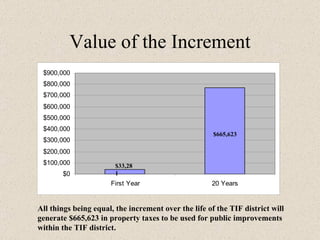
Value of the Increment $33,281 $665,623 All things being equal, the increment over the life of the TIF district will  generate $665,623 in property taxes to be used for public improvements  within the TIF district.
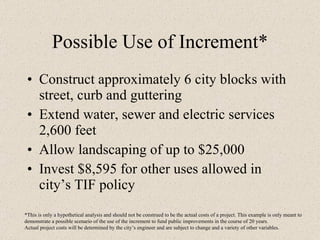
Possible Use of Increment* Construct approximately 6 city blocks with street, curb and guttering Extend water, sewer and electric services 2,600 feet Allow landscaping of up to $25,000 Invest $8,595 for other uses allowed in city’s TIF policy *This is only a hypothetical analysis and should not be construed to be the actual costs of a project. This example is only meant to demonstrate a possible scenario of the use of the increment to fund public improvements in the course of 20 years. Actual project costs will be determined by the city’s engineer and are subject to change and a variety of other variables.
Financing TIF
Types of TIF Bonds Special obligation bonds Industrial revenue bonds Full faith and credit or G.O. bonds Private activity bonds
TIF Repayment Options Property tax increments generated within redevelopment district;  (preferred) From revenues of the city derived from or held in connection with the undertaking and carrying out of any redevelopment project or projects; Any private sources, contributions or other financial assistance from the state or federal government; Increased franchise fees collected from utilities and other businesses using public right-of-way within the redevelopment district; Local sales and use taxes collected or;  By any combination of these methods.
TIF Eligibility
Areas Eligible for TIF Blighted areas Conservation areas Enterprise zones Must be within city limits
Enterprise Zones Areas: designated prior to July 1, 1992; conservation, development or redevelop is necessary to promote the general and economic welfare of such city and; typically include properties that are undeveloped and may serve as future industrial/business park sites or residential subdivisions. -taken from Kansas Statutes
Areas Eligible in the Ottawa Area
Areas Eligible in the Ottawa Area: Franklin County Enterprise Zones within city limits High Priority Enterprise Zones within city limits Enterprise Zones outside city limits
Areas Eligible in the Ottawa Area: City of Ottawa Enterprise Zones within city limits High Priority Enterprise Zones within city limits
Areas Eligible in the Ottawa Area:  Northeast Industrial Park
Areas Eligible in the Ottawa Area:  K-68 Corridor * *Requires annexation into the city limits
Areas Eligible in the Ottawa Area:  15 th  and 17 th  Streets
Areas Eligible in the Ottawa Area:  The   Granger Property * *Requires annexation into the city limits
Areas Eligible in the Ottawa Area:  Fogle Quarry * *Requires annexation into the city limits
The TIF Process
The TIF Process The City Commission establishes a TIF district by adopting a resolution, holding a public hearing and then passing an ordinance creating the TIF district. A redevelopment plan is then created for the project area that is consistent with the comprehensive plan after a resolution, public hearing and ordinance have been adopted by the City Commission. -taken from TIF policy
TIF Success Stories Merriam – Homestead Village 5.2 acre extended hotel project Estimated project costs: $4,250,000 Leavenworth – Wal-Mart 13 to 15 acres for construction of Wal-Mart Estimated project costs: $5,200,000 Wichita – 21 st  and Grove Street About one square mile for strip mall, branch bank, Cessna training facility Estimated project costs: $17,000,000
TIF Success Stories Lenexa – Thompson Farm Preservation  Project 83.5 acres for renovation of historic home and commercial district Estimated project costs: $1,600,000 Kansas City, KS – East Armourdale 10 acres for warehouse facility Estimated project costs: $2,500,000 Kansas City, KS – Gateway Gardens Approximately one city block Estimated project costs: $6,000,000
Olathe’s Success Story: 151 st  Street $6.9 million in public improvements 5 commercial entities 214 acres of vacant field developed into commercial district
Questions or Comments?

Tax Increment Financing

  • 1.
  • 2.
    TIF: What isit? A local government financing tool that can be used to target development to specific areas to capture new tax dollars to fund the needed public improvements that would not otherwise have occurred.
  • 3.
    TIF’s Purpose Promote,stimulate and develop the general and economic welfare of Kansas and its communities. Assist in development and redevelopment of areas designated as blighted, environmentally contaminated, conservation, and enterprise zones. -taken from Kansas Statutes
  • 4.
    TIF Pays forPublic Improvements Allows part or all of future growth in property tax revenue resulting from redevelopment to be used to pay for the public improvements involved in a project.
  • 5.
    Public Improvements TIFwill Finance Sanitary and storm sewers and lift stations; Drainage conduits, channels and levees; Street grading, paving, curbing and guttering; Street lighting fixtures, connection and facilities; Underground gas, water, heating and electrical service and connections; Drives and driveway approaches in right-of-way;
  • 6.
    Public Improvements (cont.)Sidewalks and pedestrian under and overpasses; Water mains and extensions; Parking facilities; Landscaping and plants, fountains, shelters, benches, sculptures, lighting and similar amenities and;
  • 7.
    Public Improvements (cont.)All related expenses to redevelop and finance the redevelopment project (such as bond and legal counsel, or other required studies).
  • 8.
    TIF Includes: Incrementalincreases in property tax revenues from: County City Unified School District Any other taxing subdivision levying real property taxes Does not include: state authorized school district levy (20 mills) and state mill levy (1.5 mills).
  • 9.
  • 10.
    Items Needed forCalculation (Example: Anybiz, Inc.) Original market value ($25,000) New market value ($100,000) Assessment rate (25% because property is commercial) Mill rate (Ottawa’s is 136.538)
  • 11.
    Calculations before TIF Project 1. Multiply original market value prior to creation of TIF district by the assessment rate. O.M.V. is $25,000 A.R. is 25% (business) $25,000(.25) = $6,250 in assessed valuation 2. Multiply assessed valuation of $6,250 by mill rate of 136.538. $6,250(.136538) = $853.36 3. Taxes equal $853.36 prior to the establishment of the TIF district.
  • 12.
    Calculations after TIF Project 1. Multiply new market value after TIF district is created by the assessment rate. N.M.V. is $100,000 A.R. is 25% (business) $100,000(.25) = $25,000 in assessed valuation. 2. Multiply assessed valuation of $25,000 by mill rate of 136.538. $25,000(.136.538) = $3,413.45. 3. Taxes equal $3,413.45 after the TIF project.
  • 13.
    The department store’sincrement A soybean field is assessed at $25,000 and generates $853 of property taxes per year. A developer builds a department store on the grounds, increasing the market value to $1,000,000. The generated property taxes will increase to $34,135. The increment of property taxes to be used for investment into the TIF district is $33,282. $853 $34,135
  • 14.
    Value of theIncrement $33,281 $665,623 All things being equal, the increment over the life of the TIF district will generate $665,623 in property taxes to be used for public improvements within the TIF district.
  • 15.
    Possible Use ofIncrement* Construct approximately 6 city blocks with street, curb and guttering Extend water, sewer and electric services 2,600 feet Allow landscaping of up to $25,000 Invest $8,595 for other uses allowed in city’s TIF policy *This is only a hypothetical analysis and should not be construed to be the actual costs of a project. This example is only meant to demonstrate a possible scenario of the use of the increment to fund public improvements in the course of 20 years. Actual project costs will be determined by the city’s engineer and are subject to change and a variety of other variables.
  • 16.
  • 17.
    Types of TIFBonds Special obligation bonds Industrial revenue bonds Full faith and credit or G.O. bonds Private activity bonds
  • 18.
    TIF Repayment OptionsProperty tax increments generated within redevelopment district; (preferred) From revenues of the city derived from or held in connection with the undertaking and carrying out of any redevelopment project or projects; Any private sources, contributions or other financial assistance from the state or federal government; Increased franchise fees collected from utilities and other businesses using public right-of-way within the redevelopment district; Local sales and use taxes collected or; By any combination of these methods.
  • 19.
  • 20.
    Areas Eligible forTIF Blighted areas Conservation areas Enterprise zones Must be within city limits
  • 21.
    Enterprise Zones Areas:designated prior to July 1, 1992; conservation, development or redevelop is necessary to promote the general and economic welfare of such city and; typically include properties that are undeveloped and may serve as future industrial/business park sites or residential subdivisions. -taken from Kansas Statutes
  • 22.
    Areas Eligible inthe Ottawa Area
  • 23.
    Areas Eligible inthe Ottawa Area: Franklin County Enterprise Zones within city limits High Priority Enterprise Zones within city limits Enterprise Zones outside city limits
  • 24.
    Areas Eligible inthe Ottawa Area: City of Ottawa Enterprise Zones within city limits High Priority Enterprise Zones within city limits
  • 25.
    Areas Eligible inthe Ottawa Area: Northeast Industrial Park
  • 26.
    Areas Eligible inthe Ottawa Area: K-68 Corridor * *Requires annexation into the city limits
  • 27.
    Areas Eligible inthe Ottawa Area: 15 th and 17 th Streets
  • 28.
    Areas Eligible inthe Ottawa Area: The Granger Property * *Requires annexation into the city limits
  • 29.
    Areas Eligible inthe Ottawa Area: Fogle Quarry * *Requires annexation into the city limits
  • 30.
  • 31.
    The TIF ProcessThe City Commission establishes a TIF district by adopting a resolution, holding a public hearing and then passing an ordinance creating the TIF district. A redevelopment plan is then created for the project area that is consistent with the comprehensive plan after a resolution, public hearing and ordinance have been adopted by the City Commission. -taken from TIF policy
  • 32.
    TIF Success StoriesMerriam – Homestead Village 5.2 acre extended hotel project Estimated project costs: $4,250,000 Leavenworth – Wal-Mart 13 to 15 acres for construction of Wal-Mart Estimated project costs: $5,200,000 Wichita – 21 st and Grove Street About one square mile for strip mall, branch bank, Cessna training facility Estimated project costs: $17,000,000
  • 33.
    TIF Success StoriesLenexa – Thompson Farm Preservation Project 83.5 acres for renovation of historic home and commercial district Estimated project costs: $1,600,000 Kansas City, KS – East Armourdale 10 acres for warehouse facility Estimated project costs: $2,500,000 Kansas City, KS – Gateway Gardens Approximately one city block Estimated project costs: $6,000,000
  • 34.
    Olathe’s Success Story:151 st Street $6.9 million in public improvements 5 commercial entities 214 acres of vacant field developed into commercial district
  • 35.