Detroiter Is Crowned
Miss Junior America
Sophia Rochon hadn't ever thought
about entering a beauty pageant. She
enjoyed watching the competitions on tele-
vision, but never dreamed that one day she
would be one of the girls on the stage.
Then, after an anonymous nomi-
nation, she received a package in the
mail for the Miss Junior America
Competition. Just for the fun of it, she
filled out the forms.
But what seemed like simple "fun"
turned into an opportunity.
Rochon was crowned the 2005 Miss
Junior America in Georgia last November.
She went through rwo rounds of the
pageant prior to the Nationals, where she
won for the city and then Miss Junior
Michigan before finally grabbing the top
honor. "I was in awe and really shocked
because it was my first pageant," she said.
Along with the impressive tide, the 18-
year-old Detroit native received a $10,000
college scholarship.
She says the funds will come in handy
at Michigan State University where she's
majoring in human biology. When she's
not studying, she's fulfilling her duties as
Miss Junior America, speaking at various
schools, youth rallies and conventions.
She said she advises other young people
to defY peer pressure and negative stereo-
types, but most of all she urges them to,
"Know yourself and be confident in who
you are."
The fourth of 7 children, Sophia
Rochon understands the importance of
being her own person. Last spring, she
graduated Cum Laude from the Marvin
L. Winans Academy of Performing Arts.
She is trained in several forms of dance
such as African, jazz, hip hop, ballet, and
modern. And, she spent a summer with
the Debbie Allen Dance Academy in
Culver City, California.
These days, Rochon is preparing for
television appearances, trips abroad and
the Miss USA Competition in October
2006. Eventually, she plans to go to med-
ical school and become a plastic surgeon.
She says her goal is to assist children born
with physical deformities. •:•
- Tawana Holly
APRIL 2006/ AfricanAmericanFamily 11
JUNE 2006/ AfricanAmericanFamily 11
A Healthy
Attitude
Teen sheds a ton and
changes his life
BY 'lAwANA HoLLY
L
ately, 14-year-old Martin Singleton
has been greeted by friends and fami-
ly members with dropped jaws, looks
of utter surprise and questions like 'What
did you do?' and 'Marty, is that you?'
The dramatic reactions ate due to his
amazing weight loss. Martin has dropped
about 100 pounds, and he did it without
the use offad diets and loads of exercise.
"It was just a lifestyle change.. .I just
changed the way I was eating, I started
eating healthier," he explains. And,
although he makes it sound effortless he
and his patents, Stephen and Teri Singleton,
admit that his transformation took a lot of
research, prayer and determination.
At age 12, weighing approximately 300
pounds, Martin decided to take control of
his health. He says the loss ofhis grand-
father to cancer motivated him to get in
shape. He knew it was what his granddad
wanted, so he began to take little steps
to achieve a slimmer body. The first was
research. He says that with help from his
mother, he started checking healthy eating
Web sites to learn all that he could about
different foods, meal preparation and using
natural products.
Next, he stopped eating junk food,
which used to be a nightly ritual with his
father. Also, he began to decline certain
foods and prepare meals that consisted
oflots of fruits and vegetables along with
many organic ingredients. Last, bur not
least, he says he asked God for help. "That's
how I was able to stick to it," explains
Martin. "God helped me through it."
"Unbelievably, it (the weight) just
peeled off of him," says Teri Singleton. She
says that roughly six months afrer his life-
style change, the excess pounds were gone.
She adds the entire family is feeling better
and eating healthier because of Martin.
Stephen who describes the experience as
"quite interesting," believes his son's deter-
mination could be a source of inspiration to
people trying to overcome all kinds of issues.
He's been invited to tell his story to
22 AfricanAmericanFamily I AUGUST 2006
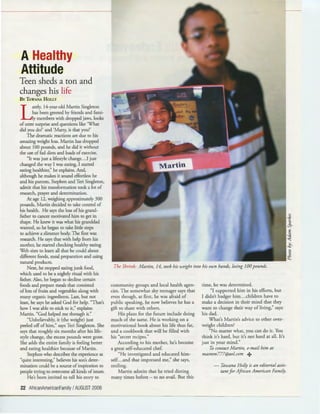
The Shrink: Martin, 14, took his weight into his own hands, losing 100 pounds.
community groups and local health agen-
cies. The somewhat shy teenager says that
even though, at first, he was afraid of
public speaking, he now believes he has a
gift to share with others.
His plans for the future include doing
much of the same. He is working on a
motivational book about his life thus far,
and a cookbook that will be filled with
his "secret recipes."
According to his mother, he's become
a great self-educated chef.
"He investigated and educated him-
self...and that impressed me," she says,
smiling.
Martin admits that he tried dieting
many times before - to no avail. Bur this
time, he was determined.
"I supported him in his efforts, bur
I didn't badger him...children have to
make a decision in their mind that they
want to change their way of living," says
his dad.
What's Martin's advice to other over-
weight children?
"No matter what, you can do it. You
think it's hard, but it's not hard at all. It's
just in your mind."
To contact Martin, e-mail him at
masmm777@aol.com +
- Tawana Holly is an editorial assis-
tantfor African American Family.
Arts & Trends
Bound by Strings
A talented family shares their love of music with the world.
By Tawana Holly
M
aybe a twist on
a familiar adage
is true: The
family that plays together
stays together.
The saying certainly fits
Lafayette and Constance
Price along with their four
children, Raphael, Charis,
Carmen and Rachel, bet-
ter known as The Price
Family Strings.
For almost 10 years,
this Detroit clan of clas-
sical musicians has been
entertaining audiences
of all types, from young
students to dignitaries,
around the globe.
It all began in 1975
when Lafayette and
Constance married and
started performing togeth-
er. Both school administrators at Martin
Luther King Academy in Detroit, each
holds a bachelor's, master's and doctorate
degree in the fields of music and educa-
tion.
"It became a family affair from the fact
that the children were exposed to music
in the home," says Constance. "They
started to study and become proficient
enough to work together."
Beginning at age 4, Constance
trained each of the children using the
Suzuki Violin Method, a philosophy
she researched for her dissertation. This
unique approach to learning, which
originated in Japan after World War II,
strives to create high ability and beautiful
character in its students through a nur-
turing environment.
As the children got older, they took
up their respective stringed instruments.
Charis, 25, also a reading specialist, plays
the violoncello. Carmen, a 20-year-old
junior at the University of Michigan
majoring in music and pre-health,
decided to switch to the viola. On the
double bass is the youngest of the bunch,
Rachel, 17, a senior at Renaissance High
School. And Raphael, a 27-year-old
teacher, continues playing the violin.
By incorporating mom's talent on the
violin along with dad's accompaniment
on the piano, the sextet was formed.
Even though her children are now suc-
cessful young adults who have received
numerous awards and academic honors,
Constance remembers how, when grow-
ing up, they were typical adolescents.
"They didn't always want to practice,"
she laughs. "But they enjoyed the perfor-
mance part of music and they enjoyed
the social and emotional stimulation."
She references the book The Mozart
E./feet by Don Campbell and agrees with
its philosophy that music has healing
powers that are good for the mind, body
and spirit. "We view music as a source
of spiritual uplift. It brings joy and good
feelings to people," says Constance.
With a diverse repertoire, each per-
formance is a chance to expose people
to something different. According to
Constance, their concerts consist of a
cross section of music, from classical and
jazz, to some sacred melodies and works
by Black composers. She says her favor-
ire is a Dvorak opus
because it incorporates
the entire family.
"The greatest source
of satisfaction that I
get is the intimate part
of sharing and enjoy-
ing music together,"
says Constance.
The family takes
great pleasure in play-
ing at every event,
whether it's a wedding,
a student workshop
or a recital. Still, the
matriarch explains
that they have the
most fun at their
yearly engagement at
the Michigan State
Fair. This September,
they'll captivate listen-
ers with their talents
on the stage of the
community arts building located on the
fairgrounds.
"You meet people from all types of
backgrounds, and to have them sit and
enjoy your music is really rewarding,"
Constance says.
Even though there are several efforts
striving to encourage African Americans
to take up strings, there is still a criti-
cal need to create more opportunities
for youngsters. "It's our responsibility.
The interest and the talent is there," says
Constance, who, with the support of her
parents, was first taught to play classical
music as a child by highly trained pro-
fessionals in the Detroit Public Schools
system.
As an educator, she believes that,
particularly in a school setting, playing
instruments teaches kids discipline, con-
centration, teamwork and respect.
As for her family, says Constance, "It's
been a source of developing unity."
The Price Family Strings can be
reached at (313) 863-8188 or www.
raphaelprice.com. For school-related per-
formances, fax (313) 341-7014.
AUGUST 2007 I AfricanAmericanFamily 13
Ages &Stages
By Tawana Holly
Baby blemishes
Breakouts aren't just a teen trial
C
radle cap and diaper rash are
conditions parents may expect to
see when they have a newborn.
But how about acne? For many moms
and dads, it comes as a surprise when their
little bundles ofjoy suddenly develop
pimples.
According to Dr. Stacy Leatherwood,
a senior staffattending physician in the
department ofpediatrics at Detroit's Henry
Ford Hospital, the blemishes are fairly
common, and affect about 20 percent of
infants.
There are two types ofacne that could
develop during a child's first year. One
is neonatal acne, also known as baby
acne, which occurs within three to four
weeks after birth and is the result of the
stimulation ofthe baby's sebaceous (or
oil-producing) glands caused by maternal
hormones after delivery. The other type,
which is called infantile acne, is different
because it's the result ofa 3- or 4-month-
old baby's own hormones internally
stimulating the glands.
Dr. Lisa Markman, a pediatrician at
Children's Hospital ofMichigan in Detroit,
says that neonatal and infantile acne, unlike
a rash or some other condition, are skin
complications that can be determined by
the child's age- along with their location
on the body.
She says that both forms appear
spontaneously and look like little
protruding red, yellow or white bumps.
Typically, these papules or pustules are
localized to the face - specifically the
cheeks, forehead and nose.
Markman adds that male babies
are more likely to be affected than
female babies because of their levels of
testosterone, especially in the case of
infantile acne, which is slightly more severe
and lasts longer.
Although the acne is an annoyance (to
everyone except the baby), she says no
treatment is needed because the pimples
don't last.
"This is a newborn condition that goes
away on its own," says Markman.
Usually, it will disappear within three to
12 months. However, as with any medical
problem, all cases are not the same and the
acne could persist for a longer period of
time.
Both doctors agree that parents should
continue with normal washing ofthe
infant, using warm water and baby
soaps. They warn against using cleansing
products, lotions or oils with fragrances,
which could irritate the child's skin. They
also warn that parents should not use any
acne medications, such as benwyl peroxide,
without a physician's consent.
Also, Markman advises parents not to
pick or pop the bumps - even though
there's no evidence that the pimples will
leave scars when they dear- since it could
cause fUrther inflammation.
As for fUture concerns, the relationship
between baby and teenage acne is
in appearance only. Markman and
Leatherwood said that no studies show
that a child who experiences neonatal acne
will have more severe acne problems as an
adolescent.
Howeve,r, the doctors say that ifa child
has infantile acne, then there is an increased
risk for a recurrence ofacne in the teen
years. That's because this particular form of
baby acne has an internal origin rather than
being caused by the secondary hormones of
the mother, like that ofneonatal acne.
Regardless ofthe type ofacne,
Leatherwood explains that there is no way
to prevent it.
"It's nothing that you did wrong or that
you can do to improve it," she says.
Regardless, the doctors recommend
contacting the family's primary health
care provider ifparents have questions or
concerns regarding their baby's complexion
or any other condition. Otherwise, jokes
Markman, parents should "wait to get their
baby's picture taken." Ill
- Tawana Holly is a staffwriterfor
African American Family Magazine, a sister
publication oJMetro Parent magazine.
COMMON CAUSE
By Tawana Holly
Canton Asperger's Network
LAUGHING,
SHARING AND
UNDERSTANDING
WHAT IT'S LIKE TO
RAISE A CHILD
WITH ASPERGER'S
SYNDROME
Ann Marie Cooley admits that trying to
explain her son Ryan's disorder is pretty tricky
- especially when it's to someone who hasn't
experienced it.
At the age of 4, Ryan was diagnosed with
Asperger's syndrome, an autism spectrum
disorder that's characterized by difficulties in
social interaction and restricted, stereotyped
patterns of behavior, interests and activities.
Although Ryan, who's now 13 years old, is
on the milder end of the spectrum - with
traits such as a lack of eye contact with oth-
ers, unimaginative play and little quirks like
being a puzzle whiz or constantly lining things
up - Cooley says the challenges she faces
with Ryan aren't always understood by people
with "neuro-typical" children. That's why the
Canton Asperger's Nerwork (CAN) has been a
bit of a saving grace.
"It's so nice to know that there's others
who understand exacdy what you're going
through," says Cooley. "People who are sitting
there nodding their heads or laughing along
with you, because they just totally know what
you are talking about and can laugh with you
or even cry with you, if necessary."
In July 2005, Cooley, along with Barbara
Dame, who also has a child with Asperger's,
formed the group with that purpose in mind.
Cooley says parents often feel alone in dealing
with these types of situations, so the goal for
the rwo women was to create a support system
where families could come together and share
personal experiences, provide resources - and,
most of all, be encouraged.
Contrary to irs name, the group is not
exclusive: Parents from any community who
have children with autism spectrum disorders
are welcome to join. Cooley, a stay-at-home
mom of 4, also has a son, Nathan, who's been
diagnosed with high-functioning autism and
the concern she has for both boys is the same.
Like any parent, Cooley wants the best for
her children. Thus far, she says she's been for-
tunate to find good doctors and a school sys-
tem that understand the needs of her children
and does all it can to help.
As for the future, her hopes are similar to
6 DR. MOM SPECIAL EDITION • FALLJWINTER 2008 • METROPARENT.COM
SHOW YOUR SUPPORT!
Have your parent support
group featured in an upcoming
issue of Special Edition.
Send an e-mail to
specialedition@metroparent.com
to be featured in Common
Cause, our profile of a local
parent support group. Let us -
and our readers - know about
the issue that's near and dear
to your heart.
those of other parents in the group. "I would
love to see them go to college. And I'd love to
see them get married, have children and just
flourish and do what makes them happy," says
Cooley, who knows the hurdles they'll face
due to their social challenges.
She adds, "Our kids are pretty much nor-
mal kids, they just have some social issues ...
Growing up is hard enough as it i~, bur throw
in something like Asperger's, and it makes it
harder.
"They just need one or rwo good friends to
understand them and accept them just as they
are, quirks and all, and get them through." lr!J
- Tawana Holly
CANTON ASPERGER'S
NETWORK MEETING
INFORMATION
CAN meets every third
Wednesday from 7-9 p.m. at
Tonda Elementary School in
Canton. For details, visit www.
cantonaspergersnetwork.com.
LEARN &GROw • tweens & teens
By Tawana Holly
Lazy days
Studies show kids get
sluggish in their teens. What
can parents do?
This may not be news to some parents, but
now it's a documented fact- teenagers
are lazy. A recent study published by the
Journal ofthe American MedicalAssociation
described adolescents as sluggish couch
potatoes.
According to the report, funded by the
National Institute of Child Health and
Human Development, as children become
teens, they become less active. From
2000 to 2006, using a device
called an accelerometer,
researchers tracked
activity levels
ofyoungsters
ages 9, 11, 12
and 15 during the
school week and on
weekends. And?
The study showed
that while 90 percent of
9-year-olds got a couple
of hours of physical
activity most days,
fewer than 3 percent
of 15-year-olds
did. Although the
device could not be
worn during water
or contact sports,
the research revealed
that most teens barely
got the minimum hour
of moderate-to-vigorous
activity recommended by
the government.
That's not a surprise to
Dr. Allison Ball, a pediatrician
at Children's Hospital of
Michigan in Detroit, who says
similar studies also show a lack
of physical activity among
teens -which continues into
adulthood.
"I think that as kids get older,
they're less likely to play outside and
run around," says Ball, who believes
the inactivity is due to kids watching more
TV, playing video games and surfing the
Internet. "All of the screen time that they have
definitely puts a damper on how much time
they're getting outside to play."
She adds that inactivity during childhood
~----------- - -
Walking the dog,
shooting hoops
or bicycling are
all things that teens
can do to boost their
physical fitness.
and adolescence sets kids up for bad habits
that could increase their risks for health-
related problems including high blood
pressure, heart disease, high cholesterol and
diabetes. Ball says she sees more young people
diagnosed at earlier ages with these ailments as
a result of obesity, which she considers to be a
growing epidemic.
She says studies have shown that more than
two-thirds ofyoung kids who are overweight
will become obese adults with shortened life
expectancies - a detrimental trend for future
generations.
So, what can parents do? First and
foremost, Ball says, moms and dads need
to set good examples for children by
demonstrating healthy habits.
"They need to show that physical activity
does not mean going to a gym and working
out in a machine," Ball says. "It has to be
made fun and not too regimented." Walking
the dog, shooting hoops or bicycling are all
things that teens can do to boost their physical
fitness.
Another way to promote better health and
pull kids out of their daily routine is to turn
exercise into a family outing. Ball suggests
parents try activities, such as hiking, skating,
swimming or going to a local park. And,
whether it's a scheduled activity or just some
backyard fun, Ball says a good way to keep
kids interested is by inviting a few of their
friends or some neighbors along for the fun.
"I don't expect kids to get up and run a
marathon, but there's lots of things families
can do together that would promote physical
activity," says Ball.
However, in addition to the exercise,
she says healthy eating is just as important.
Ball says that families, schools and health
professionals must instill proper eating habits
in youngsters by limiting portion sizes and fast
food consumption.
A healthy lifestyle, above all, is all about
parents and children putting in the effort and
finding things that work for them, she says. IJ
- Tawana Holly is assistant
editorfor Metro Parent.

TawanaH Articles

  • 1.
    Detroiter Is Crowned MissJunior America Sophia Rochon hadn't ever thought about entering a beauty pageant. She enjoyed watching the competitions on tele- vision, but never dreamed that one day she would be one of the girls on the stage. Then, after an anonymous nomi- nation, she received a package in the mail for the Miss Junior America Competition. Just for the fun of it, she filled out the forms. But what seemed like simple "fun" turned into an opportunity. Rochon was crowned the 2005 Miss Junior America in Georgia last November. She went through rwo rounds of the pageant prior to the Nationals, where she won for the city and then Miss Junior Michigan before finally grabbing the top honor. "I was in awe and really shocked because it was my first pageant," she said. Along with the impressive tide, the 18- year-old Detroit native received a $10,000 college scholarship. She says the funds will come in handy at Michigan State University where she's majoring in human biology. When she's not studying, she's fulfilling her duties as Miss Junior America, speaking at various schools, youth rallies and conventions. She said she advises other young people to defY peer pressure and negative stereo- types, but most of all she urges them to, "Know yourself and be confident in who you are." The fourth of 7 children, Sophia Rochon understands the importance of being her own person. Last spring, she graduated Cum Laude from the Marvin L. Winans Academy of Performing Arts. She is trained in several forms of dance such as African, jazz, hip hop, ballet, and modern. And, she spent a summer with the Debbie Allen Dance Academy in Culver City, California. These days, Rochon is preparing for television appearances, trips abroad and the Miss USA Competition in October 2006. Eventually, she plans to go to med- ical school and become a plastic surgeon. She says her goal is to assist children born with physical deformities. •:• - Tawana Holly APRIL 2006/ AfricanAmericanFamily 11
  • 2.
  • 3.
    A Healthy Attitude Teen shedsa ton and changes his life BY 'lAwANA HoLLY L ately, 14-year-old Martin Singleton has been greeted by friends and fami- ly members with dropped jaws, looks of utter surprise and questions like 'What did you do?' and 'Marty, is that you?' The dramatic reactions ate due to his amazing weight loss. Martin has dropped about 100 pounds, and he did it without the use offad diets and loads of exercise. "It was just a lifestyle change.. .I just changed the way I was eating, I started eating healthier," he explains. And, although he makes it sound effortless he and his patents, Stephen and Teri Singleton, admit that his transformation took a lot of research, prayer and determination. At age 12, weighing approximately 300 pounds, Martin decided to take control of his health. He says the loss ofhis grand- father to cancer motivated him to get in shape. He knew it was what his granddad wanted, so he began to take little steps to achieve a slimmer body. The first was research. He says that with help from his mother, he started checking healthy eating Web sites to learn all that he could about different foods, meal preparation and using natural products. Next, he stopped eating junk food, which used to be a nightly ritual with his father. Also, he began to decline certain foods and prepare meals that consisted oflots of fruits and vegetables along with many organic ingredients. Last, bur not least, he says he asked God for help. "That's how I was able to stick to it," explains Martin. "God helped me through it." "Unbelievably, it (the weight) just peeled off of him," says Teri Singleton. She says that roughly six months afrer his life- style change, the excess pounds were gone. She adds the entire family is feeling better and eating healthier because of Martin. Stephen who describes the experience as "quite interesting," believes his son's deter- mination could be a source of inspiration to people trying to overcome all kinds of issues. He's been invited to tell his story to 22 AfricanAmericanFamily I AUGUST 2006 The Shrink: Martin, 14, took his weight into his own hands, losing 100 pounds. community groups and local health agen- cies. The somewhat shy teenager says that even though, at first, he was afraid of public speaking, he now believes he has a gift to share with others. His plans for the future include doing much of the same. He is working on a motivational book about his life thus far, and a cookbook that will be filled with his "secret recipes." According to his mother, he's become a great self-educated chef. "He investigated and educated him- self...and that impressed me," she says, smiling. Martin admits that he tried dieting many times before - to no avail. Bur this time, he was determined. "I supported him in his efforts, bur I didn't badger him...children have to make a decision in their mind that they want to change their way of living," says his dad. What's Martin's advice to other over- weight children? "No matter what, you can do it. You think it's hard, but it's not hard at all. It's just in your mind." To contact Martin, e-mail him at masmm777@aol.com + - Tawana Holly is an editorial assis- tantfor African American Family.
  • 4.
    Arts & Trends Boundby Strings A talented family shares their love of music with the world. By Tawana Holly M aybe a twist on a familiar adage is true: The family that plays together stays together. The saying certainly fits Lafayette and Constance Price along with their four children, Raphael, Charis, Carmen and Rachel, bet- ter known as The Price Family Strings. For almost 10 years, this Detroit clan of clas- sical musicians has been entertaining audiences of all types, from young students to dignitaries, around the globe. It all began in 1975 when Lafayette and Constance married and started performing togeth- er. Both school administrators at Martin Luther King Academy in Detroit, each holds a bachelor's, master's and doctorate degree in the fields of music and educa- tion. "It became a family affair from the fact that the children were exposed to music in the home," says Constance. "They started to study and become proficient enough to work together." Beginning at age 4, Constance trained each of the children using the Suzuki Violin Method, a philosophy she researched for her dissertation. This unique approach to learning, which originated in Japan after World War II, strives to create high ability and beautiful character in its students through a nur- turing environment. As the children got older, they took up their respective stringed instruments. Charis, 25, also a reading specialist, plays the violoncello. Carmen, a 20-year-old junior at the University of Michigan majoring in music and pre-health, decided to switch to the viola. On the double bass is the youngest of the bunch, Rachel, 17, a senior at Renaissance High School. And Raphael, a 27-year-old teacher, continues playing the violin. By incorporating mom's talent on the violin along with dad's accompaniment on the piano, the sextet was formed. Even though her children are now suc- cessful young adults who have received numerous awards and academic honors, Constance remembers how, when grow- ing up, they were typical adolescents. "They didn't always want to practice," she laughs. "But they enjoyed the perfor- mance part of music and they enjoyed the social and emotional stimulation." She references the book The Mozart E./feet by Don Campbell and agrees with its philosophy that music has healing powers that are good for the mind, body and spirit. "We view music as a source of spiritual uplift. It brings joy and good feelings to people," says Constance. With a diverse repertoire, each per- formance is a chance to expose people to something different. According to Constance, their concerts consist of a cross section of music, from classical and jazz, to some sacred melodies and works by Black composers. She says her favor- ire is a Dvorak opus because it incorporates the entire family. "The greatest source of satisfaction that I get is the intimate part of sharing and enjoy- ing music together," says Constance. The family takes great pleasure in play- ing at every event, whether it's a wedding, a student workshop or a recital. Still, the matriarch explains that they have the most fun at their yearly engagement at the Michigan State Fair. This September, they'll captivate listen- ers with their talents on the stage of the community arts building located on the fairgrounds. "You meet people from all types of backgrounds, and to have them sit and enjoy your music is really rewarding," Constance says. Even though there are several efforts striving to encourage African Americans to take up strings, there is still a criti- cal need to create more opportunities for youngsters. "It's our responsibility. The interest and the talent is there," says Constance, who, with the support of her parents, was first taught to play classical music as a child by highly trained pro- fessionals in the Detroit Public Schools system. As an educator, she believes that, particularly in a school setting, playing instruments teaches kids discipline, con- centration, teamwork and respect. As for her family, says Constance, "It's been a source of developing unity." The Price Family Strings can be reached at (313) 863-8188 or www. raphaelprice.com. For school-related per- formances, fax (313) 341-7014. AUGUST 2007 I AfricanAmericanFamily 13
  • 5.
    Ages &Stages By TawanaHolly Baby blemishes Breakouts aren't just a teen trial C radle cap and diaper rash are conditions parents may expect to see when they have a newborn. But how about acne? For many moms and dads, it comes as a surprise when their little bundles ofjoy suddenly develop pimples. According to Dr. Stacy Leatherwood, a senior staffattending physician in the department ofpediatrics at Detroit's Henry Ford Hospital, the blemishes are fairly common, and affect about 20 percent of infants. There are two types ofacne that could develop during a child's first year. One is neonatal acne, also known as baby acne, which occurs within three to four weeks after birth and is the result of the stimulation ofthe baby's sebaceous (or oil-producing) glands caused by maternal hormones after delivery. The other type, which is called infantile acne, is different because it's the result ofa 3- or 4-month- old baby's own hormones internally stimulating the glands. Dr. Lisa Markman, a pediatrician at Children's Hospital ofMichigan in Detroit, says that neonatal and infantile acne, unlike a rash or some other condition, are skin complications that can be determined by the child's age- along with their location on the body. She says that both forms appear spontaneously and look like little protruding red, yellow or white bumps. Typically, these papules or pustules are localized to the face - specifically the cheeks, forehead and nose. Markman adds that male babies are more likely to be affected than female babies because of their levels of testosterone, especially in the case of infantile acne, which is slightly more severe and lasts longer. Although the acne is an annoyance (to everyone except the baby), she says no treatment is needed because the pimples don't last. "This is a newborn condition that goes away on its own," says Markman. Usually, it will disappear within three to 12 months. However, as with any medical problem, all cases are not the same and the acne could persist for a longer period of time. Both doctors agree that parents should continue with normal washing ofthe infant, using warm water and baby soaps. They warn against using cleansing products, lotions or oils with fragrances, which could irritate the child's skin. They also warn that parents should not use any acne medications, such as benwyl peroxide, without a physician's consent. Also, Markman advises parents not to pick or pop the bumps - even though there's no evidence that the pimples will leave scars when they dear- since it could cause fUrther inflammation. As for fUture concerns, the relationship between baby and teenage acne is in appearance only. Markman and Leatherwood said that no studies show that a child who experiences neonatal acne will have more severe acne problems as an adolescent. Howeve,r, the doctors say that ifa child has infantile acne, then there is an increased risk for a recurrence ofacne in the teen years. That's because this particular form of baby acne has an internal origin rather than being caused by the secondary hormones of the mother, like that ofneonatal acne. Regardless ofthe type ofacne, Leatherwood explains that there is no way to prevent it. "It's nothing that you did wrong or that you can do to improve it," she says. Regardless, the doctors recommend contacting the family's primary health care provider ifparents have questions or concerns regarding their baby's complexion or any other condition. Otherwise, jokes Markman, parents should "wait to get their baby's picture taken." Ill - Tawana Holly is a staffwriterfor African American Family Magazine, a sister publication oJMetro Parent magazine.
  • 6.
    COMMON CAUSE By TawanaHolly Canton Asperger's Network LAUGHING, SHARING AND UNDERSTANDING WHAT IT'S LIKE TO RAISE A CHILD WITH ASPERGER'S SYNDROME Ann Marie Cooley admits that trying to explain her son Ryan's disorder is pretty tricky - especially when it's to someone who hasn't experienced it. At the age of 4, Ryan was diagnosed with Asperger's syndrome, an autism spectrum disorder that's characterized by difficulties in social interaction and restricted, stereotyped patterns of behavior, interests and activities. Although Ryan, who's now 13 years old, is on the milder end of the spectrum - with traits such as a lack of eye contact with oth- ers, unimaginative play and little quirks like being a puzzle whiz or constantly lining things up - Cooley says the challenges she faces with Ryan aren't always understood by people with "neuro-typical" children. That's why the Canton Asperger's Nerwork (CAN) has been a bit of a saving grace. "It's so nice to know that there's others who understand exacdy what you're going through," says Cooley. "People who are sitting there nodding their heads or laughing along with you, because they just totally know what you are talking about and can laugh with you or even cry with you, if necessary." In July 2005, Cooley, along with Barbara Dame, who also has a child with Asperger's, formed the group with that purpose in mind. Cooley says parents often feel alone in dealing with these types of situations, so the goal for the rwo women was to create a support system where families could come together and share personal experiences, provide resources - and, most of all, be encouraged. Contrary to irs name, the group is not exclusive: Parents from any community who have children with autism spectrum disorders are welcome to join. Cooley, a stay-at-home mom of 4, also has a son, Nathan, who's been diagnosed with high-functioning autism and the concern she has for both boys is the same. Like any parent, Cooley wants the best for her children. Thus far, she says she's been for- tunate to find good doctors and a school sys- tem that understand the needs of her children and does all it can to help. As for the future, her hopes are similar to 6 DR. MOM SPECIAL EDITION • FALLJWINTER 2008 • METROPARENT.COM SHOW YOUR SUPPORT! Have your parent support group featured in an upcoming issue of Special Edition. Send an e-mail to specialedition@metroparent.com to be featured in Common Cause, our profile of a local parent support group. Let us - and our readers - know about the issue that's near and dear to your heart. those of other parents in the group. "I would love to see them go to college. And I'd love to see them get married, have children and just flourish and do what makes them happy," says Cooley, who knows the hurdles they'll face due to their social challenges. She adds, "Our kids are pretty much nor- mal kids, they just have some social issues ... Growing up is hard enough as it i~, bur throw in something like Asperger's, and it makes it harder. "They just need one or rwo good friends to understand them and accept them just as they are, quirks and all, and get them through." lr!J - Tawana Holly CANTON ASPERGER'S NETWORK MEETING INFORMATION CAN meets every third Wednesday from 7-9 p.m. at Tonda Elementary School in Canton. For details, visit www. cantonaspergersnetwork.com.
  • 7.
    LEARN &GROw •tweens & teens By Tawana Holly Lazy days Studies show kids get sluggish in their teens. What can parents do? This may not be news to some parents, but now it's a documented fact- teenagers are lazy. A recent study published by the Journal ofthe American MedicalAssociation described adolescents as sluggish couch potatoes. According to the report, funded by the National Institute of Child Health and Human Development, as children become teens, they become less active. From 2000 to 2006, using a device called an accelerometer, researchers tracked activity levels ofyoungsters ages 9, 11, 12 and 15 during the school week and on weekends. And? The study showed that while 90 percent of 9-year-olds got a couple of hours of physical activity most days, fewer than 3 percent of 15-year-olds did. Although the device could not be worn during water or contact sports, the research revealed that most teens barely got the minimum hour of moderate-to-vigorous activity recommended by the government. That's not a surprise to Dr. Allison Ball, a pediatrician at Children's Hospital of Michigan in Detroit, who says similar studies also show a lack of physical activity among teens -which continues into adulthood. "I think that as kids get older, they're less likely to play outside and run around," says Ball, who believes the inactivity is due to kids watching more TV, playing video games and surfing the Internet. "All of the screen time that they have definitely puts a damper on how much time they're getting outside to play." She adds that inactivity during childhood ~----------- - - Walking the dog, shooting hoops or bicycling are all things that teens can do to boost their physical fitness. and adolescence sets kids up for bad habits that could increase their risks for health- related problems including high blood pressure, heart disease, high cholesterol and diabetes. Ball says she sees more young people diagnosed at earlier ages with these ailments as a result of obesity, which she considers to be a growing epidemic. She says studies have shown that more than two-thirds ofyoung kids who are overweight will become obese adults with shortened life expectancies - a detrimental trend for future generations. So, what can parents do? First and foremost, Ball says, moms and dads need to set good examples for children by demonstrating healthy habits. "They need to show that physical activity does not mean going to a gym and working out in a machine," Ball says. "It has to be made fun and not too regimented." Walking the dog, shooting hoops or bicycling are all things that teens can do to boost their physical fitness. Another way to promote better health and pull kids out of their daily routine is to turn exercise into a family outing. Ball suggests parents try activities, such as hiking, skating, swimming or going to a local park. And, whether it's a scheduled activity or just some backyard fun, Ball says a good way to keep kids interested is by inviting a few of their friends or some neighbors along for the fun. "I don't expect kids to get up and run a marathon, but there's lots of things families can do together that would promote physical activity," says Ball. However, in addition to the exercise, she says healthy eating is just as important. Ball says that families, schools and health professionals must instill proper eating habits in youngsters by limiting portion sizes and fast food consumption. A healthy lifestyle, above all, is all about parents and children putting in the effort and finding things that work for them, she says. IJ - Tawana Holly is assistant editorfor Metro Parent.