BIOCHEMISTRY CASE STUDY
By Leah Olson
CONSIDER THE FOLLOWING PATIENT:
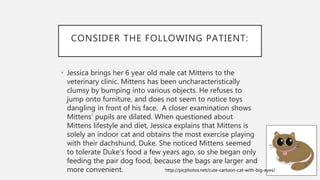
• Jessica brings her 6 year old male cat Mittens to the
veterinary clinic. Mittens has been uncharacteristically
clumsy by bumping into various objects. He refuses to
jump onto furniture, and does not seem to notice toys
dangling in front of his face. A closer examination shows
Mittens’ pupils are dilated. When questioned about
Mittens lifestyle and diet, Jessica explains that Mittens is
solely an indoor cat and obtains the most exercise playing
with their dachshund, Duke. She noticed Mittens seemed
to tolerate Duke’s food a few years ago, so she began only
feeding the pair dog food, because the bags are larger and
more convenient. http://picphotos.net/cute-cartoon-cat-with-big-eyes/
What would be your initial
diagnosis of Mittens?
What tests would you perform to
confirm you diagnosis of mittens?
DIAGNOSIS: CENTRAL RETINAL
DEGENERATION
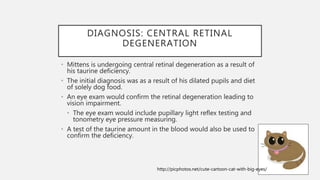
• Mittens is undergoing central retinal degeneration as a result of
his taurine deficiency.
• The initial diagnosis was as a result of his dilated pupils and diet
of solely dog food.
• An eye exam would confirm the retinal degeneration leading to
vision impairment.
• The eye exam would include pupillary light reflex testing and
tonometry eye pressure measuring.
• A test of the taurine amount in the blood would also be used to
confirm the deficiency.
http://picphotos.net/cute-cartoon-cat-with-big-eyes/
TAURINE
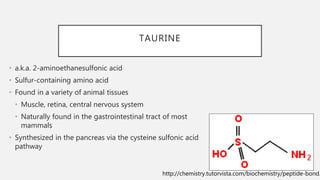
• a.k.a. 2-aminoethanesulfonic acid
• Sulfur-containing amino acid
• Found in a variety of animal tissues
• Muscle, retina, central nervous system
• Naturally found in the gastrointestinal tract of most
mammals
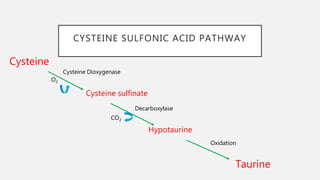
• Synthesized in the pancreas via the cysteine sulfonic acid
pathway
http://chemistry.tutorvista.com/biochemistry/peptide-bond.
CYSTEINE SULFONIC ACID PATHWAY
Cysteine
Cysteine sulfinate
Hypotaurine
Taurine
Cysteine Dioxygenase
Decarboxylase
Oxidation
CO2
O2
TAURINE DEFICIENCY IN CATS
• Taurine was not recognized as an essential amino acid for cats
until the 1980’s.
• Most mammals, including dogs, can synthesize taurine from
cysteine. Cats lack this metabolic pathway, and must have taurine
in their diet.
• Most cat foods contain adequate taurine amounts, but dog food
will not. Cats have different nutrient requirements, and cannot
survive on only dog food.
• Outdoor cats can receive taurine by hunting.
• Necessary for normal vision, digestion, heart muscle function,
pregnancy, fetal development, and immune system
TREATMENT
• Unfortunately for Mittens, his retinas have suffered
permanent damage.
• Changing his diet to an adequate cat food will stop further
retinal degeneration and prevent heart damage.
• Mittens will also be placed on a taurine supplement for
several months.
http://picphotos.net/cute-cartoon-cat-with-big-eyes/
WORKS CITED
• PetPlace.com. "Progressive Retinal Degeneration (PRD) in Cats."
Progressive Retinal Degeneration in Cats. IHC Group, 29 June 2015.
Web. 15 Dec. 2016.
• "Taurine Deficiency in Cats | Information on Feline Taurine Deficiency."
Information on Feline Taurine Deficiency. Petwave Corporation,
Aug. 2016. Web. 15 Dec. 2016.
• "Taurine Deficiency in Cats." PetMD. PetMD, LLC, n.d. Web. 15 Dec. 2016.
• Yuill, Cheryl. "Taurine in Cats." VCA Animal Hospitals. VCA Animal
Hospitals, n.d. Web. 15 Dec. 2016.

Taurine Deficiency Case Study

  • 1.
  • 2.
    CONSIDER THE FOLLOWINGPATIENT: • Jessica brings her 6 year old male cat Mittens to the veterinary clinic. Mittens has been uncharacteristically clumsy by bumping into various objects. He refuses to jump onto furniture, and does not seem to notice toys dangling in front of his face. A closer examination shows Mittens’ pupils are dilated. When questioned about Mittens lifestyle and diet, Jessica explains that Mittens is solely an indoor cat and obtains the most exercise playing with their dachshund, Duke. She noticed Mittens seemed to tolerate Duke’s food a few years ago, so she began only feeding the pair dog food, because the bags are larger and more convenient. http://picphotos.net/cute-cartoon-cat-with-big-eyes/
  • 3.
    What would beyour initial diagnosis of Mittens?
  • 4.
    What tests wouldyou perform to confirm you diagnosis of mittens?
  • 5.
    DIAGNOSIS: CENTRAL RETINAL DEGENERATION •Mittens is undergoing central retinal degeneration as a result of his taurine deficiency. • The initial diagnosis was as a result of his dilated pupils and diet of solely dog food. • An eye exam would confirm the retinal degeneration leading to vision impairment. • The eye exam would include pupillary light reflex testing and tonometry eye pressure measuring. • A test of the taurine amount in the blood would also be used to confirm the deficiency. http://picphotos.net/cute-cartoon-cat-with-big-eyes/
  • 6.
    TAURINE • a.k.a. 2-aminoethanesulfonicacid • Sulfur-containing amino acid • Found in a variety of animal tissues • Muscle, retina, central nervous system • Naturally found in the gastrointestinal tract of most mammals • Synthesized in the pancreas via the cysteine sulfonic acid pathway http://chemistry.tutorvista.com/biochemistry/peptide-bond.
  • 7.
    CYSTEINE SULFONIC ACIDPATHWAY Cysteine Cysteine sulfinate Hypotaurine Taurine Cysteine Dioxygenase Decarboxylase Oxidation CO2 O2
  • 8.
    TAURINE DEFICIENCY INCATS • Taurine was not recognized as an essential amino acid for cats until the 1980’s. • Most mammals, including dogs, can synthesize taurine from cysteine. Cats lack this metabolic pathway, and must have taurine in their diet. • Most cat foods contain adequate taurine amounts, but dog food will not. Cats have different nutrient requirements, and cannot survive on only dog food. • Outdoor cats can receive taurine by hunting. • Necessary for normal vision, digestion, heart muscle function, pregnancy, fetal development, and immune system
  • 9.
    TREATMENT • Unfortunately forMittens, his retinas have suffered permanent damage. • Changing his diet to an adequate cat food will stop further retinal degeneration and prevent heart damage. • Mittens will also be placed on a taurine supplement for several months. http://picphotos.net/cute-cartoon-cat-with-big-eyes/
  • 10.
    WORKS CITED • PetPlace.com."Progressive Retinal Degeneration (PRD) in Cats." Progressive Retinal Degeneration in Cats. IHC Group, 29 June 2015. Web. 15 Dec. 2016. • "Taurine Deficiency in Cats | Information on Feline Taurine Deficiency." Information on Feline Taurine Deficiency. Petwave Corporation, Aug. 2016. Web. 15 Dec. 2016. • "Taurine Deficiency in Cats." PetMD. PetMD, LLC, n.d. Web. 15 Dec. 2016. • Yuill, Cheryl. "Taurine in Cats." VCA Animal Hospitals. VCA Animal Hospitals, n.d. Web. 15 Dec. 2016.