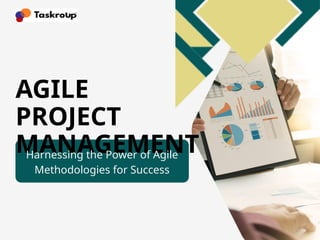
AGILE
PROJECT
MANAGEMENT
Harnessing the Power of Agile
Methodologies for Success
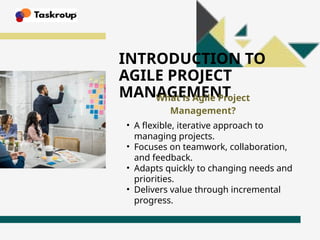
INTRODUCTION TO
AGILE PROJECT
MANAGEMENT
• A flexible, iterative approach to
managing projects.
• Focuses on teamwork, collaboration,
and feedback.
• Adapts quickly to changing needs and
priorities.
• Delivers value through incremental
progress.
What is Agile Project
Management?
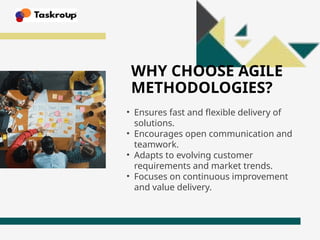
WHY CHOOSE AGILE
METHODOLOGIES?
• Ensures fast and flexible delivery of
solutions.
• Encourages open communication and
teamwork.
• Adapts to evolving customer
requirements and market trends.
• Focuses on continuous improvement
and value delivery.
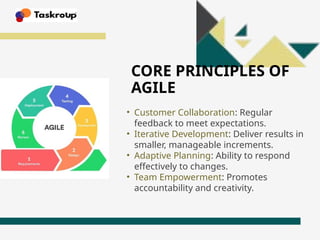
CORE PRINCIPLES OF
AGILE
• Customer Collaboration: Regular
feedback to meet expectations.
• Iterative Development: Deliver results in
smaller, manageable increments.
• Adaptive Planning: Ability to respond
effectively to changes.
• Team Empowerment: Promotes
accountability and creativity.
POPULAR AGILE
METHODOLOGIES
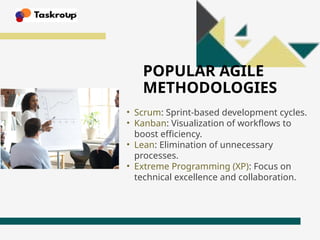
• Scrum: Sprint-based development cycles.
• Kanban: Visualization of workflows to
boost efficiency.
• Lean: Elimination of unnecessary
processes.
• Extreme Programming (XP): Focus on
technical excellence and collaboration.
KEY BENEFITS OF
AGILE PROJECT
MANAGEMENT
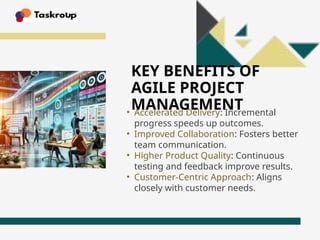
• Accelerated Delivery: Incremental
progress speeds up outcomes.
• Improved Collaboration: Fosters better
team communication.
• Higher Product Quality: Continuous
testing and feedback improve results.
• Customer-Centric Approach: Aligns
closely with customer needs.
AGILE IN ACTION:
REAL-WORLD
APPLICATIONS
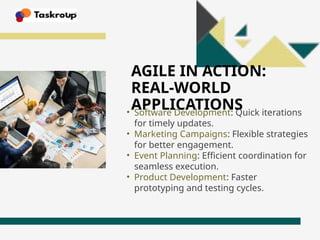
• Software Development: Quick iterations
for timely updates.
• Marketing Campaigns: Flexible strategies
for better engagement.
• Event Planning: Efficient coordination for
seamless execution.
• Product Development: Faster
prototyping and testing cycles.
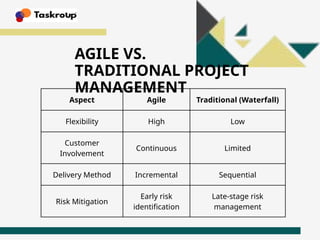
Aspect Agile Traditional (Waterfall)
Flexibility High Low
Customer
Involvement
Continuous Limited
Delivery Method Incremental Sequential
Risk Mitigation
Early risk
identification
Late-stage risk
management
AGILE VS.
TRADITIONAL PROJECT
MANAGEMENT
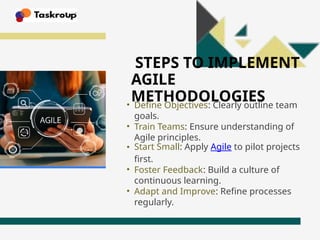
STEPS TO IMPLEMENT
AGILE
METHODOLOGIES
• Define Objectives: Clearly outline team
goals.
• Train Teams: Ensure understanding of
Agile principles.
• Start Small: Apply Agile to pilot projects
first.
• Foster Feedback: Build a culture of
continuous learning.
• Adapt and Improve: Refine processes
regularly.
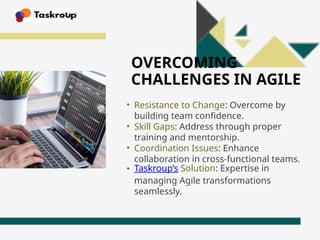
OVERCOMING
CHALLENGES IN AGILE
• Resistance to Change: Overcome by
building team confidence.
• Skill Gaps: Address through proper
training and mentorship.
• Coordination Issues: Enhance
collaboration in cross-functional teams.
• Taskroup’s Solution: Expertise in
managing Agile transformations
seamlessly.
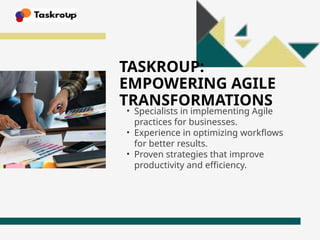
TASKROUP:
EMPOWERING AGILE
TRANSFORMATIONS
• Specialists in implementing Agile
practices for businesses.
• Experience in optimizing workflows
for better results.
• Proven strategies that improve
productivity and efficiency.
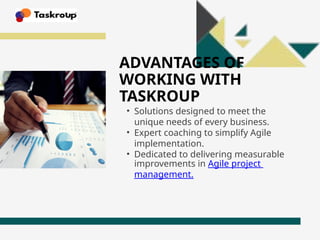
ADVANTAGES OF
WORKING WITH
TASKROUP
• Solutions designed to meet the
unique needs of every business.
• Expert coaching to simplify Agile
implementation.
• Dedicated to delivering measurable
improvements in Agile project
management.
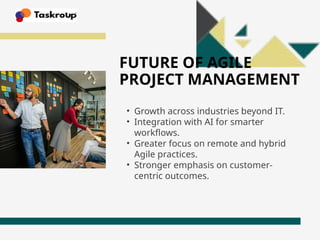
FUTURE OF AGILE
PROJECT MANAGEMENT
• Growth across industries beyond IT.
• Integration with AI for smarter
workflows.
• Greater focus on remote and hybrid
Agile practices.
• Stronger emphasis on customer-
centric outcomes.
WHY TASKROUP IS YOUR
AGILE PARTNER
• Trusted partner for businesses
worldwide.
• Deep knowledge of
Agile methodologies.
• Commitment to helping you achieve
your project goals efficiently.
CONTACT
US www.taskroup.co
m
social@taskroup.com
9788214770

Taskroup - Agile Project Management.pptx

  • 1.
    AGILE PROJECT MANAGEMENT Harnessing the Powerof Agile Methodologies for Success
  • 2.
    INTRODUCTION TO AGILE PROJECT MANAGEMENT •A flexible, iterative approach to managing projects. • Focuses on teamwork, collaboration, and feedback. • Adapts quickly to changing needs and priorities. • Delivers value through incremental progress. What is Agile Project Management?
  • 3.
    WHY CHOOSE AGILE METHODOLOGIES? •Ensures fast and flexible delivery of solutions. • Encourages open communication and teamwork. • Adapts to evolving customer requirements and market trends. • Focuses on continuous improvement and value delivery.
  • 4.
    CORE PRINCIPLES OF AGILE •Customer Collaboration: Regular feedback to meet expectations. • Iterative Development: Deliver results in smaller, manageable increments. • Adaptive Planning: Ability to respond effectively to changes. • Team Empowerment: Promotes accountability and creativity.
  • 5.
    POPULAR AGILE METHODOLOGIES • Scrum:Sprint-based development cycles. • Kanban: Visualization of workflows to boost efficiency. • Lean: Elimination of unnecessary processes. • Extreme Programming (XP): Focus on technical excellence and collaboration.
  • 6.
    KEY BENEFITS OF AGILEPROJECT MANAGEMENT • Accelerated Delivery: Incremental progress speeds up outcomes. • Improved Collaboration: Fosters better team communication. • Higher Product Quality: Continuous testing and feedback improve results. • Customer-Centric Approach: Aligns closely with customer needs.
  • 7.
    AGILE IN ACTION: REAL-WORLD APPLICATIONS •Software Development: Quick iterations for timely updates. • Marketing Campaigns: Flexible strategies for better engagement. • Event Planning: Efficient coordination for seamless execution. • Product Development: Faster prototyping and testing cycles.
  • 8.
    Aspect Agile Traditional(Waterfall) Flexibility High Low Customer Involvement Continuous Limited Delivery Method Incremental Sequential Risk Mitigation Early risk identification Late-stage risk management AGILE VS. TRADITIONAL PROJECT MANAGEMENT
  • 9.
    STEPS TO IMPLEMENT AGILE METHODOLOGIES •Define Objectives: Clearly outline team goals. • Train Teams: Ensure understanding of Agile principles. • Start Small: Apply Agile to pilot projects first. • Foster Feedback: Build a culture of continuous learning. • Adapt and Improve: Refine processes regularly.
  • 10.
    OVERCOMING CHALLENGES IN AGILE •Resistance to Change: Overcome by building team confidence. • Skill Gaps: Address through proper training and mentorship. • Coordination Issues: Enhance collaboration in cross-functional teams. • Taskroup’s Solution: Expertise in managing Agile transformations seamlessly.
  • 11.
    TASKROUP: EMPOWERING AGILE TRANSFORMATIONS • Specialistsin implementing Agile practices for businesses. • Experience in optimizing workflows for better results. • Proven strategies that improve productivity and efficiency.
  • 12.
    ADVANTAGES OF WORKING WITH TASKROUP •Solutions designed to meet the unique needs of every business. • Expert coaching to simplify Agile implementation. • Dedicated to delivering measurable improvements in Agile project management.
  • 13.
    FUTURE OF AGILE PROJECTMANAGEMENT • Growth across industries beyond IT. • Integration with AI for smarter workflows. • Greater focus on remote and hybrid Agile practices. • Stronger emphasis on customer- centric outcomes.
  • 14.
    WHY TASKROUP ISYOUR AGILE PARTNER • Trusted partner for businesses worldwide. • Deep knowledge of Agile methodologies. • Commitment to helping you achieve your project goals efficiently.
  • 15.