1
“Enhancing business and personal performance by using brain science”
Copyright: The Center for Applied Neuroscience 2013
Successful recruitment is
fundamentally an exercise in
alignment …………
……. aligning the right person
with the right job.
“Enhancing business and personal performance by using brain science”
09/10/2016 Copyright: The Center for Applied Neuroscience 3
“Despite a universal acknowledgement that hiring good people is a key source of
competitive advantage, we could find only a few companies that excel at one or more
aspects of the hiring process, and just a handful that come anywhere close to ‘gold
standard’.
Clearly, organizations need to take a serious look at the challenges facing them. They
need to stop treating recruitment as a big surprise. They must develop best practices,
which in many cases will mean drastically revamping the hiring processes. They need to
educate their line managers so that they can hire effectively. And they need to ensure
that their HR managers provide the right support.
Given the ad hoc, lack of specified criteria, and
inconsistency of practices among companies we studied,
it’s no wonder that usually about a third of promising hires
depart within three years of being recruited. It’s one thing
to take a poor approach to hiring. But, what really stuns
us that many CEOs do not recognize their recruiting
situation for what it is.”
“Enhancing business and personal performance by using brain science”
“Matching people to jobs is a critical driver of employee
engagement.
This is one area where HR professionals can play an
important role in helping line managers design jobs
effectively, and develop selection processes that match
individuals to jobs.”
The Chartered Institute of Personnel and Development
Copyright: The Center for Applied Neuroscience 2002
“Enhancing business and personal performance by using brain science”
09/10/2016 5
“Enhancing business and personal performance by using brain science”
09/10/2016 6
“Enhancing business and personal performance by using brain science”
7
“80% of staff turnover can be
attributed to mistakes made during
the employee selection and
recruitment process.”
“Enhancing business and personal performance by using brain science”
Copyright: The Center for Applied Neuroscience 2002
“The chances are good that up to 66%
of your company’s hiring decisions
will prove to be mistakes in the first
twelve months.”
Peter Drucker, Management Consultant
“Enhancing business and personal performance by using brain science”
The Psychological Bulletin Vol 96 No1 Michigan State University – School of Business Manchester University
Interview and CV
Background checks and
references
Skills and abilities testing
Suitability benchmarking
Work aptitude assessment
Work environment matching
‘Talent Finder’s ‘Successful Recruitment Formula’ is based on data compiled from a
variety of academic studies which show that predictors of high performance potential
significantly increase the likelihood of success as each of the factors is added.
“Enhancing business and personal performance by using brain science”
09/10/2016 10
Critical Job Performance Activities
Eligibility
= High Performance Potential
THE SUCCESSFUL RECRUITMENT FORMULA
+ Aptitude + Environment Match+ Suitability
Copyright: The Center for Applied Neuroscience 2013
CORE
TRAITS
Does the candidate’s
work aptitude match the
job?
Will the candidate be
comfortable working in the
job environment??
Is the candidate eligible
for the job?
Is the candidate suitable
for the job?
STEP 1
Does the candidate
possess the core traits
required for the job?
STEP 2
STEP 3
STEP 4
STEP 5
‘Eligibility’ determines if a candidate has the
necessary education, skills and prior experience
required to deliver excellent performance in the role.
It indicates if the candidate is able to perform the
role to a high standard. At this step it is important
that the candidate’s CV, references and other
credentials are checked thoroughly to ensure
authenticity.
The eligibility step remains the most popular part of
the recruitment process because it is relatively easy
to assess. But, while it is easy to assess, by itself, it
is a very poor predictor of whether a candidate will
succeed or fail. Research has shown that a lack of
education, skills or experience only account for 11
per cent of candidates’ failure to succeed in their
jobs. Failure is largely due to a lack of behavioural
suitability, not a lack of knowledge or skills.
STEP 1
Is the candidate
eligible for the
job?
09/10/2016 14
Producing accurate answers to the questions
in the following pages will enable you to
complete the benchmarking process quickly
and accurately. It is suggested that you also
record on paper the answers the questions
so that you can refer to them as you
complete the benchmarking process.
Copyright: The Center for Applied Neuroscience 2013
Before starting the job benchmarking process, it is important to
spend some time thinking carefully about what the successful
candidate must do to achieve performance excellence in the
role. It is also important to be clear about how the candidate’s
performance in the role will be measured.
09/10/2016 15
09/10/2016 16
Finance Manager – Accounts Payable
09/10/2016 17
Finance Manager – Accounts Payable
Collect, process and evaluate high volume financial information
Demonstrate superior accuracy, attention to detail and commitment to meeting deadlines.
Work with minimum supervision
Follow strict operating procedures
Operate the Company’s computerised accounts system
09/10/2016 18
Finance Manager – Accounts Payable
Collect, process and evaluate high volume financial information
Demonstrate superior accuracy, attention to detail and commitment to meeting deadlines.
Work with minimum supervision
Follow strict operating procedures
Operate the Company’s computerised accounts system
Number of invoices outstanding
Total value of overdue invoices
Cash Flow
Cycle time to resolve an invoice error
09/10/2016 19
Finance Manager – Accounts Payable
Collect, process and evaluate high volume financial information
Demonstrate superior accuracy, attention to detail and commitment to meeting deadlines.
Work with minimum supervision
Follow strict operating procedures
Operate the Company’s computerised accounts system
Number of invoices outstanding
Total value of overdue invoices
Cash Flow
Cycle time to resolve an invoice error
Initiating telephone enquiries with a wide range of internal and external customers; dealing
with telephone queries from other departments; instructing and coaching employees in the use
of the computerised accounts system
STEP 2
Is the candidate
suitable for the job?
‘Suitability’ means that the candidate has the
natural behavioural strengths that will help them to
excel in the job. It indicates if the candidate is likely
to perform the role to a high standard. It is
counterproductive for an individual to perform in a
role that does not match his or her behavioural
preferences because, not only does the individual’s
level of enjoyment and job satisfaction decrease, but
so does job performance. A ‘Harvard Business
Review’ study has showed that the level of
recruitment failure almost doubles when no “job
suitability match” is undertaken by the employer.
Some jobs, such as accountancy and computer
programming ,require a stronger emphasis on
eligibility, while other jobs such as sales and
customer service usually require a stronger
emphasis on suitability. However, regardless of the
emphasis, it is essential to assess both eligibility
and suitability in order to obtain an accurate overall
Finishing
Evaluating
Focusing
Innovating
Delivering
Supporting
Co-ordinating
Initiating
8
6
6
4
4
4
2
1
STEP 3
Does the
candidate’s work
aptitude match
the job?
‘Work aptitude’ match is designed to predict someone's
potential to learn or acquire the skills to perform specific
tasks. There are many factors to be considered when
designing a job specification, but aptitude is the one most
often overlooked. It is about wanting to engage in the
activities that need to be done. Enjoying the activities in a
job naturally promotes a good attitude. For example, the
individual who is good at working with tools and
machinery may not be as successful in roles that require
them to be creative or artistic.
One problem is that people often confuse aptitude and
skills. A skill is the ability to perform a task. Given
sufficient intelligence and drive, a person can become
competent in just about anything they set their mind to.
But, if they do not have a natural aptitude for the job, they
are not likely to be very happy doing it. Also, unused
aptitude is a potential source of frustration and
restlessness.
Orderly and efficient
Investigative and analytical
Logical and mathematical
Social and empathetic
Practical and mechanical
Competitive and entrepreneurial
Outgoing and expressive
Creative and artistic
8
8
7
5
5
4
2
1
STEP 4
Does the
candidate possess
the core traits
required for the
job?
During the past few years there has been growing interest
in a number of ‘core traits’ that are widely associated with
excellent personal and business performance. Although
the terminology varies from one study to another, the six
traits measured by PRISM below feature prominently in
most research findings. These traits are closely associated
with what is known as an internal locus of control. This
means that the individuals believe that their behaviour
determines what happens to them and that they can control
their own behaviour. As the environment around them
changes, they can either attribute success and failure to
things they have control over, or to forces outside their
influence. Which orientation they choose has a bearing on
their long-term success.
Internal locus of control has featured fairly consistently in
studies on the psychological characteristics of
entrepreneurs. These core traits also have a strong
correlation with what is known as ‘Mental Toughness’.
Conscientiousness
Emotional stability
Self-motivation
Decisiveness
Relationship management
Flexibility
6
6
5
3
3
1
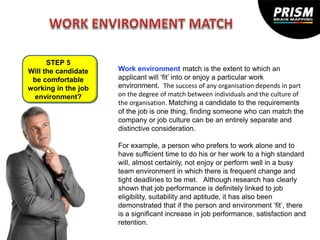
STEP 5
Will the candidate
be comfortable
working in the job
environment?
Work environment match is the extent to which an
applicant will ‘fit’ into or enjoy a particular work
environment. The success of any organisation depends in part
on the degree of match between individuals and the culture of
the organisation. Matching a candidate to the requirements
of the job is one thing, finding someone who can match the
company or job culture can be an entirely separate and
distinctive consideration.
For example, a person who prefers to work alone and to
have sufficient time to do his or her work to a high standard
will, almost certainly, not enjoy or perform well in a busy
team environment in which there is frequent change and
tight deadlines to be met. Although research has clearly
shown that job performance is definitely linked to job
eligibility, suitability and aptitude, it has also been
demonstrated that if the person and environment ‘fit’, there
is a significant increase in job performance, satisfaction and
retention.
The online recruitment tool for the 21st
century
SIMPLE
FAST
ACCURATE
“Enhancing business and personal performance by using brain science”
Talent finder presentation

Talent finder presentation

  • 1.
  • 2.
    “Enhancing business andpersonal performance by using brain science” Copyright: The Center for Applied Neuroscience 2013 Successful recruitment is fundamentally an exercise in alignment ………… ……. aligning the right person with the right job.
  • 3.
    “Enhancing business andpersonal performance by using brain science” 09/10/2016 Copyright: The Center for Applied Neuroscience 3 “Despite a universal acknowledgement that hiring good people is a key source of competitive advantage, we could find only a few companies that excel at one or more aspects of the hiring process, and just a handful that come anywhere close to ‘gold standard’. Clearly, organizations need to take a serious look at the challenges facing them. They need to stop treating recruitment as a big surprise. They must develop best practices, which in many cases will mean drastically revamping the hiring processes. They need to educate their line managers so that they can hire effectively. And they need to ensure that their HR managers provide the right support. Given the ad hoc, lack of specified criteria, and inconsistency of practices among companies we studied, it’s no wonder that usually about a third of promising hires depart within three years of being recruited. It’s one thing to take a poor approach to hiring. But, what really stuns us that many CEOs do not recognize their recruiting situation for what it is.”
  • 4.
    “Enhancing business andpersonal performance by using brain science” “Matching people to jobs is a critical driver of employee engagement. This is one area where HR professionals can play an important role in helping line managers design jobs effectively, and develop selection processes that match individuals to jobs.” The Chartered Institute of Personnel and Development Copyright: The Center for Applied Neuroscience 2002
  • 5.
    “Enhancing business andpersonal performance by using brain science” 09/10/2016 5
  • 6.
    “Enhancing business andpersonal performance by using brain science” 09/10/2016 6
  • 7.
    “Enhancing business andpersonal performance by using brain science” 7 “80% of staff turnover can be attributed to mistakes made during the employee selection and recruitment process.”
  • 8.
    “Enhancing business andpersonal performance by using brain science” Copyright: The Center for Applied Neuroscience 2002 “The chances are good that up to 66% of your company’s hiring decisions will prove to be mistakes in the first twelve months.” Peter Drucker, Management Consultant
  • 9.
    “Enhancing business andpersonal performance by using brain science” The Psychological Bulletin Vol 96 No1 Michigan State University – School of Business Manchester University Interview and CV Background checks and references Skills and abilities testing Suitability benchmarking Work aptitude assessment Work environment matching ‘Talent Finder’s ‘Successful Recruitment Formula’ is based on data compiled from a variety of academic studies which show that predictors of high performance potential significantly increase the likelihood of success as each of the factors is added.
  • 10.
    “Enhancing business andpersonal performance by using brain science” 09/10/2016 10 Critical Job Performance Activities Eligibility = High Performance Potential THE SUCCESSFUL RECRUITMENT FORMULA + Aptitude + Environment Match+ Suitability
  • 11.
    Copyright: The Centerfor Applied Neuroscience 2013 CORE TRAITS
  • 12.
    Does the candidate’s workaptitude match the job? Will the candidate be comfortable working in the job environment?? Is the candidate eligible for the job? Is the candidate suitable for the job? STEP 1 Does the candidate possess the core traits required for the job? STEP 2 STEP 3 STEP 4 STEP 5
  • 13.
    ‘Eligibility’ determines ifa candidate has the necessary education, skills and prior experience required to deliver excellent performance in the role. It indicates if the candidate is able to perform the role to a high standard. At this step it is important that the candidate’s CV, references and other credentials are checked thoroughly to ensure authenticity. The eligibility step remains the most popular part of the recruitment process because it is relatively easy to assess. But, while it is easy to assess, by itself, it is a very poor predictor of whether a candidate will succeed or fail. Research has shown that a lack of education, skills or experience only account for 11 per cent of candidates’ failure to succeed in their jobs. Failure is largely due to a lack of behavioural suitability, not a lack of knowledge or skills. STEP 1 Is the candidate eligible for the job?
  • 14.
    09/10/2016 14 Producing accurateanswers to the questions in the following pages will enable you to complete the benchmarking process quickly and accurately. It is suggested that you also record on paper the answers the questions so that you can refer to them as you complete the benchmarking process. Copyright: The Center for Applied Neuroscience 2013 Before starting the job benchmarking process, it is important to spend some time thinking carefully about what the successful candidate must do to achieve performance excellence in the role. It is also important to be clear about how the candidate’s performance in the role will be measured.
  • 15.
  • 16.
    09/10/2016 16 Finance Manager– Accounts Payable
  • 17.
    09/10/2016 17 Finance Manager– Accounts Payable Collect, process and evaluate high volume financial information Demonstrate superior accuracy, attention to detail and commitment to meeting deadlines. Work with minimum supervision Follow strict operating procedures Operate the Company’s computerised accounts system
  • 18.
    09/10/2016 18 Finance Manager– Accounts Payable Collect, process and evaluate high volume financial information Demonstrate superior accuracy, attention to detail and commitment to meeting deadlines. Work with minimum supervision Follow strict operating procedures Operate the Company’s computerised accounts system Number of invoices outstanding Total value of overdue invoices Cash Flow Cycle time to resolve an invoice error
  • 19.
    09/10/2016 19 Finance Manager– Accounts Payable Collect, process and evaluate high volume financial information Demonstrate superior accuracy, attention to detail and commitment to meeting deadlines. Work with minimum supervision Follow strict operating procedures Operate the Company’s computerised accounts system Number of invoices outstanding Total value of overdue invoices Cash Flow Cycle time to resolve an invoice error Initiating telephone enquiries with a wide range of internal and external customers; dealing with telephone queries from other departments; instructing and coaching employees in the use of the computerised accounts system
  • 20.
    STEP 2 Is thecandidate suitable for the job? ‘Suitability’ means that the candidate has the natural behavioural strengths that will help them to excel in the job. It indicates if the candidate is likely to perform the role to a high standard. It is counterproductive for an individual to perform in a role that does not match his or her behavioural preferences because, not only does the individual’s level of enjoyment and job satisfaction decrease, but so does job performance. A ‘Harvard Business Review’ study has showed that the level of recruitment failure almost doubles when no “job suitability match” is undertaken by the employer. Some jobs, such as accountancy and computer programming ,require a stronger emphasis on eligibility, while other jobs such as sales and customer service usually require a stronger emphasis on suitability. However, regardless of the emphasis, it is essential to assess both eligibility and suitability in order to obtain an accurate overall
  • 21.
  • 22.
    STEP 3 Does the candidate’swork aptitude match the job? ‘Work aptitude’ match is designed to predict someone's potential to learn or acquire the skills to perform specific tasks. There are many factors to be considered when designing a job specification, but aptitude is the one most often overlooked. It is about wanting to engage in the activities that need to be done. Enjoying the activities in a job naturally promotes a good attitude. For example, the individual who is good at working with tools and machinery may not be as successful in roles that require them to be creative or artistic. One problem is that people often confuse aptitude and skills. A skill is the ability to perform a task. Given sufficient intelligence and drive, a person can become competent in just about anything they set their mind to. But, if they do not have a natural aptitude for the job, they are not likely to be very happy doing it. Also, unused aptitude is a potential source of frustration and restlessness.
  • 23.
    Orderly and efficient Investigativeand analytical Logical and mathematical Social and empathetic Practical and mechanical Competitive and entrepreneurial Outgoing and expressive Creative and artistic 8 8 7 5 5 4 2 1
  • 24.
    STEP 4 Does the candidatepossess the core traits required for the job? During the past few years there has been growing interest in a number of ‘core traits’ that are widely associated with excellent personal and business performance. Although the terminology varies from one study to another, the six traits measured by PRISM below feature prominently in most research findings. These traits are closely associated with what is known as an internal locus of control. This means that the individuals believe that their behaviour determines what happens to them and that they can control their own behaviour. As the environment around them changes, they can either attribute success and failure to things they have control over, or to forces outside their influence. Which orientation they choose has a bearing on their long-term success. Internal locus of control has featured fairly consistently in studies on the psychological characteristics of entrepreneurs. These core traits also have a strong correlation with what is known as ‘Mental Toughness’.
  • 25.
  • 26.
    STEP 5 Will thecandidate be comfortable working in the job environment? Work environment match is the extent to which an applicant will ‘fit’ into or enjoy a particular work environment. The success of any organisation depends in part on the degree of match between individuals and the culture of the organisation. Matching a candidate to the requirements of the job is one thing, finding someone who can match the company or job culture can be an entirely separate and distinctive consideration. For example, a person who prefers to work alone and to have sufficient time to do his or her work to a high standard will, almost certainly, not enjoy or perform well in a busy team environment in which there is frequent change and tight deadlines to be met. Although research has clearly shown that job performance is definitely linked to job eligibility, suitability and aptitude, it has also been demonstrated that if the person and environment ‘fit’, there is a significant increase in job performance, satisfaction and retention.
  • 27.
    The online recruitmenttool for the 21st century SIMPLE FAST ACCURATE
  • 29.
    “Enhancing business andpersonal performance by using brain science”