Online Intellectual Property in
the Age of MOOCs
Rosemary Talab,
Professor, K-State
talab@ksu.edu
Slideshare
Disclaimer
Opinions are my own
Audience participation requested
Audience survey
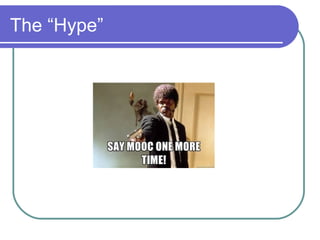
The “Hype”
Overview
MOOC Landscape
Ownership Issues
Intellectual Property
Copyright Basics
Bills/Lawsuits
Faculty Guidelines
Overview
MOOC Landscape
Ownership Issues
Intellectual Property
Copyright Basics
Bills/Lawsuits
Faculty Guidelines
MOOC Landscape
3.17 million students
196 countries (Outsell, 2013)
edX self-sustaining
Coursera & Udacity commercial
Spinoffs – MITx, Berkeleyx, etc.
MOOC Landscape
Bill Gates (2013):
“Decoupling” of degree from knowledge
acquisition
Use of alternate evidence (badges,
certificates, etc.)
“Global phenomenon”
http://tinyurl.com/musst8v
MOOC Landscape
 EU Mooc Production Fellowship (2013)
 Uses iversity
 Fellows - 25,000 Euros and assistance
 Fellows retain all rights to content
https://moocfellowship.org/info
 Coursera in Canada and Australia
 Udacity has 606 communities worldwide
MOOC Landscape
Online courses time-consuming
Merit, tenure/promotion variable
Online use more university resources
Multi-national/multi-campus universities
Territory?
Ownership Issues
Growth of course “production values”
Result is increased use of institutional
resources
Shutterstock - art and photographs
online
27 million images
Jon Oringer is billionaire
 Forbes, June 2013
http://tinyurl.com/p9m7v7b
MOOC Landscape
Decreased tenured faculty
Increased adjunct faculty
Increased costs/tuition
Decreased federal/state support
Rise of online for-profits (Capella,
Walden, U of Phoenix, etc.)
Overview
MOOC Landscape
Ownership Issues
Intellectual Property
Copyright Basics
Bills/Lawsuits
Course Guidelines
Ownership Issues
Who owns a course?
Who decides?
Who gets what in MOOC licensing?
Is there a MOOC IP model?
Do old IP models apply?
Ownership Issues
University owns/wants to own online IP
Instructional design
Technical/infrastructure investment
Personnel
Faculty
MOOC IP ownership varies
Various MOOC license models
Ownership Issues
Overview
MOOC Landscape
Ownership Issues
Intellectual Property
Copyright Basics
Bills/Lawsuits
Course Guidelines
Intellectual Property
Michigan/Coursera contract
Revenue bulk to host/provider
Substantial university investment
 “Multi-media content”
 “High-production-value”
 Disabilities, badges, etc.
(Chronicle, 2012, p. 2)
Course IP - Instructor/University decision
Overview
MOOC Landscape
Ownership Issues
Intellectual Property
Copyright Basics
Bills/Lawsuits
Course Guidelines
Copyright Basics
Make a copy
Make a derivative work
Distribute copies
Perform work in public on website
(videos)
Display work (still image, each
copyrighted)
Section 101, Title 17 U.S.C.
Copyright Basics
Faculty Own:
Negotiated IP (“life of course”, alterations,
etc.)
Syllabus – copyright
Original materials
Derivative works
Ideas
Presentation
Copyright Basics
Faculty must know:
Federal law, state, institutional policies
Contract law supersedes copyright law
Definitions:
Substantial use
Work for hire
Definitions vary by institution/state
Contract Law
K-State – “written statement…from…
unit leader concerning level of use of …
support/facilities…”
Extra compensation
IP protection
Substantial Use
K-State – “creator received staff, salary
or material support beyond that normally
provided to the creator”
Instructor-initiated or otherwise
Institution-provided support
(technical/monetary/other)
Substantial Use
“Substantial resources”:
Used for many distance courses
 Institution as owner
Also depends on:
Platform requirements
Contract
IP policy
Work for Hire
K-State owns:
Rights associated with works produced
as ‘works made for hire’ or
Works that make "substantial use of
institutional resources”
Overview
MOOC Landscape
Ownership Issues
Intellectual Property
Copyright Basics
Bills/Lawsuits
Course Guidelines
Bill/Lawsuits
 California SB 520:
Grants for high demand courses to be
offered online
 Arizona State professors’ lawsuit
Violated the ABOR Intellectual Property
Policy
Appropriated course
Used former prof’s syllabus, assignments,
name and image
Overview
MOOC Landscape
Ownership Issues
Intellectual Property
Copyright Basics
Bills/Lawsuits
Faculty Guidelines
Faculty Guidelines
Know Applicable IP policies
State Board of Regents or other
Institution
Pertinent sections (work for hire, etc.)
Claim rights to original materials
Claim rights to class lectures and course
materials
Negotiate a reasonable approach
Faculty Guidelines
Creative Commons approach
Faculty committees
Purdue MOOC RFP Committee
Online Course Committees
IP discussions
Faculty Guidelines
Rutgers Advisory Council
Credit bearing guidelines
Non-credit bearing guidelines
MOOC offered through Rutgers approved
through Rutgers curricular review
regardless of format
Time is now to voice concerns
Finding a balance helps everyone
Summation
Carly Nelson (former AAUP President)
"If we lose the battle over intellectual property,
it's over”
"Being a professor will no longer be a
professional career or a professional identity”
Faculty will find themselves in "a service
industry”
 http://chronicle.com/article/article-content/139743/
Summation
Do faculty want compensation based on
intellectual property rights or collective
bargaining?
Will tenured faculty IP rights be
reduced?
Will institutions become courseware
Walmarts?
Will research universities will be
separated?
Fini
Fair Use Resources
Visual Resources Association:
http://www.arl.org/pp/ppcopyright/codefairuse/index.shtml
Visual Resources Association Statement on Images
http://www.vraweb.org/organization/pdf/VRAFairUseGuidelines
Fair Use Evaluator
http://librarycopyright.net/resources/fairuse
References
 Purdue MOOC proposal
https://www.distance.purdue.edu/
 Rutgers Statement on MOOCs
 http://senate.rutgers.edu/ICAConMassiveOpenOnlin
References
 BerkeleyX (3-year MOOC development)
 https://www.edx.org/school/uc%20berkeleyx/allcourses
 MITx
http://web.mit.edu/newsoffice/2013/oeit-joins-office-of-digital-
 UC Irvine prof replaced
https://chronicle.com/blogs/wiredcampus/professor-leaves-a-
/
References
 Bart, M. (2010). Intellectual Property, Copyright, and
Harassment: Navigating the Murky Legal Waters of
Online Teaching. Faculty Focus. Retrieved from
http://www.facultyfocus.com/articles/online-education/intellec
 Chronicle of Higher Education. (2012). The U. of
Michigan's Contract With Coursera. Retrieved from
http://chronicle.com/article/Document-Examine-the-U-of/1330
References
 Rivard, R. (2013). Who owns a MOOC?
http://www.insidehighered.com/news/2013/03/19/u-c
 E-Literate. (2013). California’s Online
Education Bill SB 520 Passes Senate.
 http://mfeldstein.com/californias-online-education-bi
References
 Porter, J. (2013). MOOCs, outsourcing and
restrictive ip licensing
 http://aims.muohio.edu/2013/02/26/moocs-
outsourcing-and-restrictive-ip-licensing/
 Berkeley Resource Center for Online
Education. UC Berkeley. Berkeleyx.
http://online.berkeley.edu/moocs/berkeleyx
References
 Voss, B. (2013). Massive Open Online Courses
(MOOCs): A Primer for University and College Board
Members. Association of Governing Boards of
Universities and Colleges.
http://agb.org/sites/agb.org/files/report_2013_MOOCs.pdf
 Kolowich, S. (2013). Harvard professors call for
greater oversight of MOOCs. Wired Campus.
http://tinyurl.com/ojbgr7o
 Schmidt, P. (2013). AAUP sees moocs as spawning
new threats to professors' intellectual property.
Chronicle of Higher Education.
http://chronicle.com/article/article-content/139743/
References
 Talab, R. (2008). Using digital materials in
online courses: A cautionary tale of Georgia
State University. TechTrends, 4(52), (in
press).
 Talab, R. (2007). Distance education, public
domain, free and “fair use” resources: A
webliography. TechTrends, 4(51), pp. 9+.
 Talab, R. (2003). An initial look at the TEACH
Act. TechTrends 2(47), pp. 2+.
References
 Talab, R. (2007). Faculty distance courseware
ownership and the “Wal-Mart” approach to
higher education. 5(51), TechTrends, pp. 9+.
 Talab, R., & Butler, R. (2007). Shared
electronic spaces in the classroom: Copyright,
privacy, and guidelines. TechTrends 1(51), pp.
12+.
 Talab, R. (2003). An initial look at the TEACH
Act. TechTrends 2(47), pp. 2+.

Talab c2c i_pand_moocs

  • 1.
    Online Intellectual Propertyin the Age of MOOCs Rosemary Talab, Professor, K-State talab@ksu.edu Slideshare
  • 2.
    Disclaimer Opinions are myown Audience participation requested Audience survey
  • 3.
  • 4.
    Overview MOOC Landscape Ownership Issues IntellectualProperty Copyright Basics Bills/Lawsuits Faculty Guidelines
  • 5.
    Overview MOOC Landscape Ownership Issues IntellectualProperty Copyright Basics Bills/Lawsuits Faculty Guidelines
  • 6.
    MOOC Landscape 3.17 millionstudents 196 countries (Outsell, 2013) edX self-sustaining Coursera & Udacity commercial Spinoffs – MITx, Berkeleyx, etc.
  • 7.
    MOOC Landscape Bill Gates(2013): “Decoupling” of degree from knowledge acquisition Use of alternate evidence (badges, certificates, etc.) “Global phenomenon” http://tinyurl.com/musst8v
  • 8.
    MOOC Landscape  EUMooc Production Fellowship (2013)  Uses iversity  Fellows - 25,000 Euros and assistance  Fellows retain all rights to content https://moocfellowship.org/info  Coursera in Canada and Australia  Udacity has 606 communities worldwide
  • 9.
    MOOC Landscape Online coursestime-consuming Merit, tenure/promotion variable Online use more university resources Multi-national/multi-campus universities Territory?
  • 10.
    Ownership Issues Growth ofcourse “production values” Result is increased use of institutional resources Shutterstock - art and photographs online 27 million images Jon Oringer is billionaire  Forbes, June 2013 http://tinyurl.com/p9m7v7b
  • 11.
    MOOC Landscape Decreased tenuredfaculty Increased adjunct faculty Increased costs/tuition Decreased federal/state support Rise of online for-profits (Capella, Walden, U of Phoenix, etc.)
  • 12.
    Overview MOOC Landscape Ownership Issues IntellectualProperty Copyright Basics Bills/Lawsuits Course Guidelines
  • 13.
    Ownership Issues Who ownsa course? Who decides? Who gets what in MOOC licensing? Is there a MOOC IP model? Do old IP models apply?
  • 14.
    Ownership Issues University owns/wantsto own online IP Instructional design Technical/infrastructure investment Personnel Faculty MOOC IP ownership varies Various MOOC license models
  • 15.
  • 16.
    Overview MOOC Landscape Ownership Issues IntellectualProperty Copyright Basics Bills/Lawsuits Course Guidelines
  • 17.
    Intellectual Property Michigan/Coursera contract Revenuebulk to host/provider Substantial university investment  “Multi-media content”  “High-production-value”  Disabilities, badges, etc. (Chronicle, 2012, p. 2) Course IP - Instructor/University decision
  • 18.
    Overview MOOC Landscape Ownership Issues IntellectualProperty Copyright Basics Bills/Lawsuits Course Guidelines
  • 19.
    Copyright Basics Make acopy Make a derivative work Distribute copies Perform work in public on website (videos) Display work (still image, each copyrighted) Section 101, Title 17 U.S.C.
  • 20.
    Copyright Basics Faculty Own: NegotiatedIP (“life of course”, alterations, etc.) Syllabus – copyright Original materials Derivative works Ideas Presentation
  • 21.
    Copyright Basics Faculty mustknow: Federal law, state, institutional policies Contract law supersedes copyright law Definitions: Substantial use Work for hire Definitions vary by institution/state
  • 22.
    Contract Law K-State –“written statement…from… unit leader concerning level of use of … support/facilities…” Extra compensation IP protection
  • 23.
    Substantial Use K-State –“creator received staff, salary or material support beyond that normally provided to the creator” Instructor-initiated or otherwise Institution-provided support (technical/monetary/other)
  • 24.
    Substantial Use “Substantial resources”: Usedfor many distance courses  Institution as owner Also depends on: Platform requirements Contract IP policy
  • 25.
    Work for Hire K-Stateowns: Rights associated with works produced as ‘works made for hire’ or Works that make "substantial use of institutional resources”
  • 26.
    Overview MOOC Landscape Ownership Issues IntellectualProperty Copyright Basics Bills/Lawsuits Course Guidelines
  • 27.
    Bill/Lawsuits  California SB520: Grants for high demand courses to be offered online  Arizona State professors’ lawsuit Violated the ABOR Intellectual Property Policy Appropriated course Used former prof’s syllabus, assignments, name and image
  • 28.
    Overview MOOC Landscape Ownership Issues IntellectualProperty Copyright Basics Bills/Lawsuits Faculty Guidelines
  • 29.
    Faculty Guidelines Know ApplicableIP policies State Board of Regents or other Institution Pertinent sections (work for hire, etc.) Claim rights to original materials Claim rights to class lectures and course materials Negotiate a reasonable approach
  • 30.
    Faculty Guidelines Creative Commonsapproach Faculty committees Purdue MOOC RFP Committee Online Course Committees IP discussions
  • 31.
    Faculty Guidelines Rutgers AdvisoryCouncil Credit bearing guidelines Non-credit bearing guidelines MOOC offered through Rutgers approved through Rutgers curricular review regardless of format Time is now to voice concerns Finding a balance helps everyone
  • 32.
    Summation Carly Nelson (formerAAUP President) "If we lose the battle over intellectual property, it's over” "Being a professor will no longer be a professional career or a professional identity” Faculty will find themselves in "a service industry”  http://chronicle.com/article/article-content/139743/
  • 33.
    Summation Do faculty wantcompensation based on intellectual property rights or collective bargaining? Will tenured faculty IP rights be reduced? Will institutions become courseware Walmarts? Will research universities will be separated?
  • 34.
  • 35.
    Fair Use Resources VisualResources Association: http://www.arl.org/pp/ppcopyright/codefairuse/index.shtml Visual Resources Association Statement on Images http://www.vraweb.org/organization/pdf/VRAFairUseGuidelines Fair Use Evaluator http://librarycopyright.net/resources/fairuse
  • 36.
    References  Purdue MOOCproposal https://www.distance.purdue.edu/  Rutgers Statement on MOOCs  http://senate.rutgers.edu/ICAConMassiveOpenOnlin
  • 37.
    References  BerkeleyX (3-yearMOOC development)  https://www.edx.org/school/uc%20berkeleyx/allcourses  MITx http://web.mit.edu/newsoffice/2013/oeit-joins-office-of-digital-  UC Irvine prof replaced https://chronicle.com/blogs/wiredcampus/professor-leaves-a- /
  • 38.
    References  Bart, M.(2010). Intellectual Property, Copyright, and Harassment: Navigating the Murky Legal Waters of Online Teaching. Faculty Focus. Retrieved from http://www.facultyfocus.com/articles/online-education/intellec  Chronicle of Higher Education. (2012). The U. of Michigan's Contract With Coursera. Retrieved from http://chronicle.com/article/Document-Examine-the-U-of/1330
  • 39.
    References  Rivard, R.(2013). Who owns a MOOC? http://www.insidehighered.com/news/2013/03/19/u-c  E-Literate. (2013). California’s Online Education Bill SB 520 Passes Senate.  http://mfeldstein.com/californias-online-education-bi
  • 40.
    References  Porter, J.(2013). MOOCs, outsourcing and restrictive ip licensing  http://aims.muohio.edu/2013/02/26/moocs- outsourcing-and-restrictive-ip-licensing/  Berkeley Resource Center for Online Education. UC Berkeley. Berkeleyx. http://online.berkeley.edu/moocs/berkeleyx
  • 41.
    References  Voss, B.(2013). Massive Open Online Courses (MOOCs): A Primer for University and College Board Members. Association of Governing Boards of Universities and Colleges. http://agb.org/sites/agb.org/files/report_2013_MOOCs.pdf  Kolowich, S. (2013). Harvard professors call for greater oversight of MOOCs. Wired Campus. http://tinyurl.com/ojbgr7o  Schmidt, P. (2013). AAUP sees moocs as spawning new threats to professors' intellectual property. Chronicle of Higher Education. http://chronicle.com/article/article-content/139743/
  • 42.
    References  Talab, R.(2008). Using digital materials in online courses: A cautionary tale of Georgia State University. TechTrends, 4(52), (in press).  Talab, R. (2007). Distance education, public domain, free and “fair use” resources: A webliography. TechTrends, 4(51), pp. 9+.  Talab, R. (2003). An initial look at the TEACH Act. TechTrends 2(47), pp. 2+.
  • 43.
    References  Talab, R.(2007). Faculty distance courseware ownership and the “Wal-Mart” approach to higher education. 5(51), TechTrends, pp. 9+.  Talab, R., & Butler, R. (2007). Shared electronic spaces in the classroom: Copyright, privacy, and guidelines. TechTrends 1(51), pp. 12+.  Talab, R. (2003). An initial look at the TEACH Act. TechTrends 2(47), pp. 2+.