SIMPLIFYING MODEL-BASED
SYSTEMS ENGINEERING
AN IMPLEMENTATION JOURNEY
This white paper is sponsored by Dassault Systèmes.
CONTENTS
EXECUTIVE SUMMARY	 1
INTRODUCTION TO MBSE	 1
ORGANIZATION	1
READINESS	1
INITIATIVE SCALABILITY	​6
EDUCATE LEADERSHIP AND THE WORKFORCE​	 6
GOVERNANCE	​6
ADOPTION	​7
EVOLUTION	​7
SURVEYS	​8
PROCESS​	 8
TAXONOMY​	 8
TERMS AND DEFINITIONS​	 8
REQUIREMENTS​	 9
METHODOLOGY VS. PROCESS	​9
TRIBAL KNOWLEDGE​	 10
STANDARDS​	 10
TECHNOLOGY​	 10
ARE WE MAKING MBSE HARDER THAN IT SHOULD BE?​	 10
INFORMATION TECHNOLOGY​	 11
TRUSTED DATA​	 11
SOLUTIONS	​11
IMPLEMENTATION​	 11
CONCLUSION​	 13
REFERENCES​	 14
ABOUT THE AUTHORS	​15
ABOUT SMS_THINKTANK​	 16
©2020 SMS_ThinkTank™, LLC	 1
EXECUTIVE SUMMARY
Model-Based Systems Engineering (MBSE) is perhaps one of the most misunderstood and often
abused acronyms in the engineering vernacular. Many companies struggle to understand how it will
improve their entire product lifecycle and address the ever-increasing complexity of products. In many
companies, executives and middle management experience a lack of understanding regarding the rapid
pace of today’s technology and its impact on organizations and processes. Technical practitioners
may gain additional insight as they focus their energies on establishing strong MBSE practices. The
successful implementation of MBSE includes transformations and enhancements in three key areas:
organization, process and technology.
This white paper shares proper planning and implementation considerations in adopting an MBSE
practice. It provides a high-level view, defines critical components to help success and identifies many
problematic areas to avoid in an implementation journey.
INTRODUCTION TO MBSE
The complexity of systems is rapidly increasing across all industries. Embedded systems and interactive
environments account for an increasing share of a product’s features and its total cost. Through Digital
Transformation, companies seek to stay competitive and lead in their market segments. In an engineering
driven environment, MBSE is widely regarded as a critical component in this digital transformation.
MBSE is the formalized application of modeling to support system requirements, design, analysis,
verification and validation activities beginning in the conceptual design phase and continuing throughout
development and later lifecycle phases.1
Many white papers highlight the benefits of implementing an MBSE way of thinking. This white paper
uses the phrase, “way of thinking” because the journey spans the entire product lifecycle from product
development, manufacturing, in-use, maintenance and retirement. The MBSE journey takes leadership,
resources and patience.
How do you quantify good engineering? The direct benefits for MBSE can be a bit hard to measure. Some
companies have developed complex measurements relating to schedule slips, field recalls, risk analysis
and more. This white paper argues that the greatest benefit will be the ability to address the exponentially
raising product complexity as a result of greater stakeholder demands. Though a challenge to quantify,
tracking improvements as part of a company’s MBSE program helps keep management and the wider
team remain engaged. Consider the reduced rework errors; improved efficiency from process refinement
and optimization; and better product quality. Workforce benefits include improved communication and
collaboration using an MBSE governance model, and common use of terms and sharable system models.
Engineering teams applying MBSE rigor and discipline to system design and optimization can free up time
for innovation. Both indirect and direct benefits deserve attention.
ORGANIZATION
READINESS
Many companies can relate to unsavory reports of a false start. Mistakenly, companies decide to
investigate solution providers before MBSE needs are identified. The result can be massive confusion.
New tools require a different way of thinking. The common solution – discussed later in this white paper
– is to implement a cultural transformation within an organization.
2
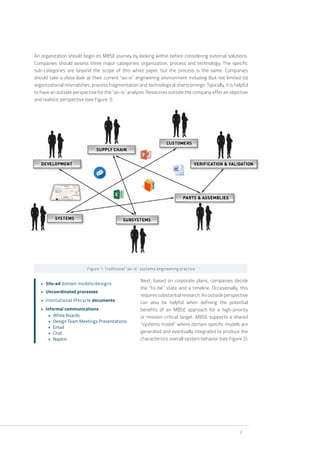
An organization should begin its MBSE journey by looking within before considering external solutions.
Companies should assess three major categories: organization, process and technology. The specific
sub-categories are beyond the scope of this white paper, but the process is the same. Companies
should take a close look at their current “as-is” engineering environment including (but not limited to)
organizational mismatches, process fragmentation and technological shortcomings. Typically, it is helpful
to have an outside perspective for the “as-is” analysis. Resources outside the company offer an objective
and realistic perspective (see Figure 1).
Figure 1: Traditional “as-is” systems engineering practice
Next, based on corporate plans, companies decide
the “to-be” state and a timeline. Occasionally, this
requiressubstantialresearch.Anoutsideperspective
can also be helpful when defining the potential
benefits of an MBSE approach for a high-priority
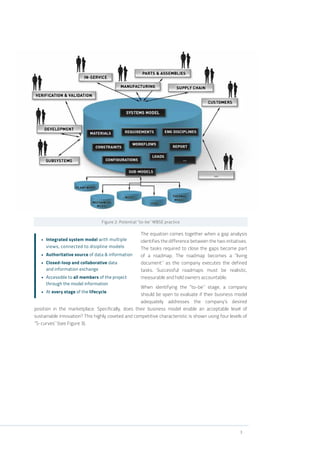
or mission-critical target. MBSE supports a shared
“systems model” where domain specific models are
generated and eventually integrated to produce the
characteristic overall system behavior (see Figure 2).
•	 Silo-ed domain models/designs
•	 Uncoordinated processes
•	 Institutional lifecycle documents
•	 Informal communications
•	 White Boards
•	 Design Team Meetings Presentations
•	 Email
•	 Chat
•	 Napkin
3
Figure 2: Potential “to-be” MBSE practice
The equation comes together when a gap analysis
identifies the difference between the two initiatives.
The tasks required to close the gaps become part
of a roadmap. The roadmap becomes a “living
document” as the company executes the defined
tasks. Successful roadmaps must be realistic,
measurable and hold owners accountable.
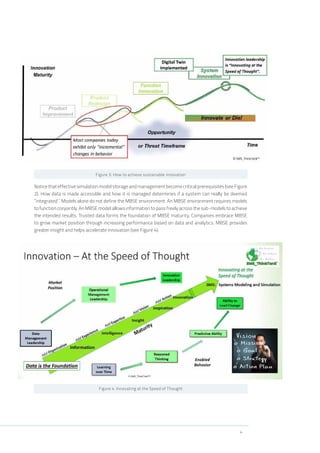
When identifying the “to-be” stage, a company
should be open to evaluate if their business model
adequately addresses the company’s desired
position in the marketplace. Specifically, does their business model enable an acceptable level of
sustainable innovation? This highly coveted and competitive characteristic is shown using four levels of
“S-curves” (see Figure 3).
•	 Integrated system model with multiple
views, connected to disipline models
•	 Authoritative source of data & information
•	 Closed-loop and collaborative data
and information exchange
•	 Accessible to all members of the project
through the model information
•	 At every stage of the lifecycle
4
Figure 3: How to achieve sustainable innovation
Notice that effective simulation model storage and management become critical prerequisites (see Figure
2). How data is made accessible and how it is managed determines if a system can really be deemed
“integrated”. Models alone do not define the MBSE environment. An MBSE environment requires models
to function conjointly. An MBSE model allows information to pass freely across the sub-models to achieve
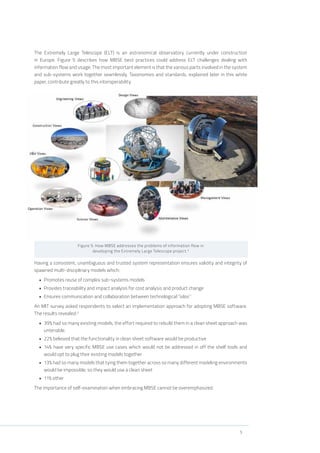
the intended results. Trusted data forms the foundation of MBSE maturity. Companies embrace MBSE
to grow market position through increasing performance based on data and analytics. MBSE provides
greater insight and helps accelerate innovation (see Figure 4).
Figure 4: Innovating at the Speed of Thought
5
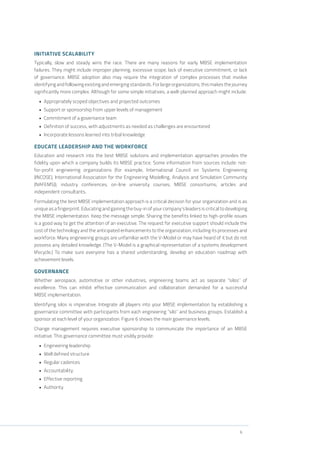
The Extremely Large Telescope (ELT) is an astronomical observatory currently under construction
in Europe. Figure 5 describes how MBSE best practices could address ELT challenges dealing with
information flow and usage. The most important element is that the various parts involved in the system
and sub-systems work together seamlessly. Taxonomies and standards, explained later in this white
paper, contribute greatly to this interoperability.
Figure 5: How MBSE addresses the problems of information flow in
developing the Extremely Large Telescope project.2
Having a consistent, unambiguous and trusted system representation ensures validity and integrity of
spawned multi-disciplinary models which:
•	 Promotes reuse of complex sub-systems models
•	 Provides traceability and impact analysis for cost analysis and product change
•	 Ensures communication and collaboration between technological “silos”
An MIT survey asked respondents to select an implementation approach for adopting MBSE software.
The results revealed:3
•	 39% had so many existing models, the effort required to rebuild them in a clean sheet approach was
untenable.
•	 22% believed that the functionality in clean sheet software would be productive
•	 14% have very specific MBSE use cases which would not be addressed in off the shelf tools and
would opt to plug their existing models together
•	 13% had so many models that tying them together across so many different modeling environments
would be impossible, so they would use a clean sheet
•	 11% other
The importance of self-examination when embracing MBSE cannot be overemphasized.
6
INITIATIVE SCALABILITY
Typically, slow and steady wins the race. There are many reasons for early MBSE implementation
failures. They might include improper planning, excessive scope, lack of executive commitment, or lack
of governance. MBSE adoption also may require the integration of complex processes that involve
identifying and following existing and emerging standards. For large organizations, this makes the journey
significantly more complex. Although for some simple initiatives, a well-planned approach might include:
•	 Appropriately scoped objectives and projected outcomes
•	 Support or sponsorship from upper levels of management
•	 Commitment of a governance team
•	 Definition of success, with adjustments as needed as challenges are encountered
•	 Incorporate lessons learned into tribal knowledge
EDUCATE LEADERSHIP AND THE WORKFORCE
Education and research into the best MBSE solutions and implementation approaches provides the
fidelity upon which a company builds its MBSE practice. Some information from sources include: not-
for-profit engineering organizations (for example, International Council on Systems Engineering
(INCOSE), International Association for the Engineering Modelling, Analysis and Simulation Community
(NAFEMS)); industry conferences; on-line university courses; MBSE consortiums; articles and
independent consultants.
Formulating the best MBSE implementation approach is a critical decision for your organization and is as
unique as a fingerprint. Educating and gaining the buy-in of your company’s leaders is critical to developing
the MBSE implementation. Keep the message simple. Sharing the benefits linked to high-profile issues
is a good way to get the attention of an executive. The request for executive support should include the
cost of the technology and the anticipated enhancements to the organization, including its processes and
workforce. Many engineering groups are unfamiliar with the V-Model or may have heard of it but do not
possess any detailed knowledge. (The V-Model is a graphical representation of a systems development
lifecycle.) To make sure everyone has a shared understanding, develop an education roadmap with
achievement levels.
GOVERNANCE
Whether aerospace, automotive or other industries, engineering teams act as separate “silos” of
excellence. This can inhibit effective communication and collaboration demanded for a successful
MBSE implementation.
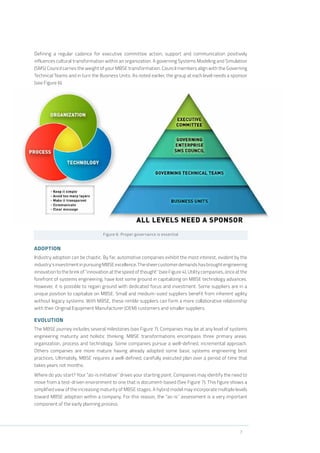
Identifying silos is imperative. Integrate all players into your MBSE implementation by establishing a
governance committee with participants from each engineering “silo” and business groups. Establish a
sponsor at each level of your organization. Figure 6 shows the main governance levels.
Change management requires executive sponsorship to communicate the importance of an MBSE
initiative. This governance committee must visibly provide:
•	 Engineering leadership
•	 Well defined structure
•	 Regular cadences
•	 Accountability
•	 Effective reporting
•	 Authority
7
Defining a regular cadence for executive committee action, support and communication positively
influences cultural transformation within an organization. A governing Systems Modeling and Simulation
(SMS) Council carries the weight of your MBSE transformation. Council members align with the Governing
Technical Teams and in turn the Business Units. As noted earlier, the group at each level needs a sponsor
(see Figure 6).
Figure 6: Proper governance is essential
ADOPTION
Industry adoption can be chaotic. By far, automotive companies exhibit the most interest, evident by the
industry’sinvestmentinpursuingMBSEexcellence.Thesheercustomerdemandshasbroughtengineering
innovation to the brink of “innovation at the speed of thought” (see Figure 4). Utility companies, once at the
forefront of systems engineering, have lost some ground in capitalizing on MBSE technology advances.
However, it is possible to regain ground with dedicated focus and investment. Some suppliers are in a
unique position to capitalize on MBSE. Small and medium-sized suppliers benefit from inherent agility
without legacy systems. With MBSE, these nimble suppliers can form a more collaborative relationship
with their Original Equipment Manufacturer (OEM) customers and smaller suppliers.
EVOLUTION
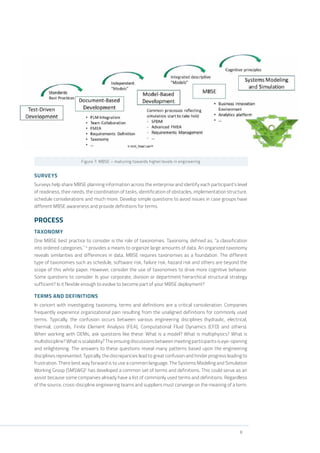
The MBSE journey includes several milestones (see Figure 7). Companies may be at any level of systems
engineering maturity and holistic thinking. MBSE transformations encompass three primary areas:
organization, process and technology. Some companies pursue a well-defined, incremental approach.
Others companies are more mature having already adopted some basic systems engineering best
practices. Ultimately, MBSE requires a well-defined, carefully executed plan over a period of time that
takes years not months.
Where do you start? Your “as-is initiative” drives your starting point. Companies may identify the need to
move from a test-driven environment to one that is document-based (See Figure 7). This figure shows a
simplified view of the increasing maturity of MBSE stages. A hybrid model may incorporate multiple levels
toward MBSE adoption within a company. For this reason, the “as-is” assessment is a very important
component of the early planning process.
8
Figure 7: MBSE – maturing towards higher levels in engineering
SURVEYS
Surveys help share MBSE planning information across the enterprise and identify each participant’s level
of readiness, their needs, the coordination of tasks, identification of obstacles, implementation structure,
schedule considerations and much more. Develop simple questions to avoid issues in case groups have
different MBSE awareness and provide definitions for terms.
PROCESS
TAXONOMY
One MBSE best practice to consider is the role of taxonomies. Taxonomy, defined as, “a classification
into ordered categories,” 4
provides a means to organize large amounts of data. An organized taxonomy
reveals similarities and differences in data. MBSE requires taxonomies as a foundation. The different
type of taxonomies such as schedule, software risk, failure risk, hazard risk and others are beyond the
scope of this white paper. However, consider the use of taxonomies to drive more cognitive behavior.
Some questions to consider: Is your corporate, division or department hierarchical structural strategy
sufficient? Is it flexible enough to evolve to become part of your MBSE deployment?
TERMS AND DEFINITIONS
In concert with investigating taxonomy, terms and definitions are a critical consideration. Companies
frequently experience organizational pain resulting from the unaligned definitions for commonly used
terms. Typically, the confusion occurs between various engineering disciplines (hydraulic, electrical,
thermal, controls, Finite Element Analysis (FEA), Computational Fluid Dynamics (CFD) and others).
When working with OEMs, ask questions like these: What is a model? What is multiphysics? What is
multidiscipline? What is scalability? The ensuing discussions between meeting participants is eye-opening
and enlightening. The answers to these questions reveal many patterns based upon the engineering
disciplines represented. Typically, the discrepancies lead to great confusion and hinder progress leading to
frustration. There best way forward is to use a common language. The Systems Modeling and Simulation
Working Group (SMSWG)5
has developed a common set of terms and definitions. This could serve as an
assist because some companies already have a list of commonly used terms and definitions. Regardless
of the source, cross-discipline engineering teams and suppliers must converge on the meaning of a term.
9
REQUIREMENTS
Everyonehasheardthephrase“garbage-in,garbage-out”.Oneofthegreatestchallengesinimplementing
an MBSE practice is the ability to author, manage and link well-written requirements that can be readily
decomposed with test cases. System requirements form the basis of system integration and verification
activities. They act as a reference for validation and stakeholder acceptance. Requirements provide a
strong link between various technical disciplines throughout the project. They provide the impact of
change for a given condition or set of conditions. Requirements ensure compliance with strict regulatory
requirements in aerospace, automotive and energy. Government agencies dictate the compliance to
critical product and process operations and dependencies before the OEM can bring their products to
market. Most requirements include (but are not limited to): functional, performance, usability, interface,
cost, schedule, operational, environmental and others
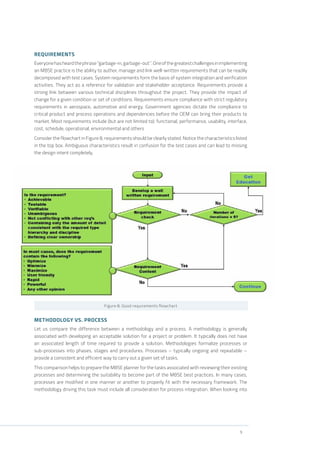
Consider the flowchart in Figure 8, requirements should be clearly stated. Notice the characteristics listed
in the top box. Ambiguous characteristics result in confusion for the test cases and can lead to missing
the design intent completely.
Figure 8: Good requirements flowchart
METHODOLOGY VS. PROCESS
Let us compare the difference between a methodology and a process. A methodology is generally
associated with developing an acceptable solution for a project or problem. It typically does not have
an associated length of time required to provide a solution. Methodologies formalize processes or
sub-processes into phases, stages and procedures. Processes – typically ongoing and repeatable –
provide a consistent and efficient way to carry out a given set of tasks.
This comparison helps to prepare the MBSE planner for the tasks associated with reviewing their existing
processes and determining the suitability to become part of the MBSE best practices. In many cases,
processes are modified in one manner or another to properly fit with the necessary framework. The
methodology driving this task must include all consideration for process integration. When looking into
10
an organization that is contemplating the MBSE journey, requirements are the most critical prerequisite.
Without strong requirements, companies may produce products as they have done in the past, which may
no longer be sustainable. The sheer complexity of future projects leaves companies with no alternative
but to embrace MBSE with all the inherent challenges of late adoption.
TRIBAL KNOWLEDGE
Tribal knowledge is the information that is part of someone’s gray matter and found scattered across
computer drives in your engineering organization. Capitalizing on tribal knowledge provides a huge
advantage in developing MBSE best practices. By capturing this knowledge, components of the MBSE
implementation become more “intelligent” which leads to greater efficiency and promotes more cognitive
behaviors. In many cases, for an organization this knowledge answers the questions of “why” the
company is using this strategy or method which leads to great process efficiency, optimization and, in
some cases, innovation.
Do not underestimate the value of tribal knowledge. Decades of experience can sometimes get lost over
time as employees retire or move on to another job.
STANDARDS
The importance of identifying and linking disparate processes is part of the MBSE central nervous
system. To thread together trusted processes, linking or integrating methods must be identified, tested
and validated. This ensures the correctness of the data, speeds model data flow, accuracy, completeness,
size and manageability among other benefits.
MBSE interoperability reveals that standards interoperability is the greatest gap among MBSE
implementations. Too many standards can be worse than too few. To address the complexities of
model-based interoperability, be prepared to investigate some existing and emerging standards:
Modelica, Functional Mock-up Interface/Functional Mock-up Unit (FMI/FMU), System Structure and
Parameterization (SSP), Product Data Exchange Specification/Standard for the Exchange of Product
model data (PDES/STEP AP), Long-term Archiving and Retrieval (LOTAR), Modelling and Simulation
Information in a Collaborative Systems Engineering Context (MoSSEC), Organization for the Advancement
of Structured Information Standards/Open Services for Lifecycle Collaboration (OASIS/OSLC), Resource
Description Framework (RDF), Extensible Markup Language/XML Metadata Interchange (XML/XMI),
UnifiedModelingLanguageDiagram(UMLDI),ObjectManagementGroup(OMG),RequirementsFunctional
Logical Physical (RFLP), Requirements Interchange Format (ReqIF), Systems Modeling Language (SysML)
v2, Unrestricted Access Framework (UAF), Modeling and Simulation (MODSIM) and other standards.
TECHNOLOGY
ARE WE MAKING MBSE HARDER THAN IT SHOULD BE?
Some industries, especially Aerospace & Defense (A&D), are well versed in systems engineering and
embrace the pursuit of formal implementations of MBSE. Very large A&D corporations have the challenge
of aligning many partnerships and suppliers each with dependencies. Their overall development is
extremely complex allowing only a small margin of error.
Additionally, this journey has been an extreme focus for many years. Could the implementation
challenges experienced by A&D companies influence agile small and medium-sized industries attempts?
The automotive industry has an entirely different approach in delivering their products to consumers.
With high volume, relatively low costs and escalating consumer demands for features, many automotive
companies are in a highly reactive state. As a result, the rapid turnaround of new models can be
compromised. Other industries are in the same position.
11
Does the approach have to be “all-in”? Are there points of diminishing returns? Are there solutions that
can effectively address targeted areas of the organization that would deliver early successes? This
white paper believes the answer is a profound “yes!”. It does not focus on specific software solutions but
instead shares best practices.
INFORMATION TECHNOLOGY
Is the proper technology (solutions and infrastructure elements) in place and supported to allow for
scalable data sharing, real-time and mobile access to data and information? The capability to enable
the analysis of data, typically large sets of business, simulation, test or general process data is the
foundation of the MBSE journey. Hardware and software with adequate support must be in place to
support enterprise-wide modeling and simulation. Typically, simulation models are stored in a sea of
hard drives across the enterprise with little or no ability for one to determine their existence. Effective
simulation model storage and management is a critical prerequisite. (For more information, see Figure 1
and Figure 2.)
This is a crucial IT contribution and justification to involve your IT leaders early in the planning stages.
Trusted data forms the foundation of MBSE maturity (see Figure 4).
TRUSTED DATA
After defining requirements and model storage, trusted data is one of the greatest challenges. The
accuracy of the Computer Aided Engineering (CAE) and data multi-domain models (mechanical, electrical,
controls,fluids,thermal,optics,acousticsandothers)isfrequentlynottrustedandasaresult,considerable
time is wasted in reproducing simulations. This has been witnessed within the same department and
especially across engineering domains. Creating a common directory of commonly used system models
will greatly accelerate the development of a project and help reap the benefits of an MBSE implementation
(see Figure 2).
SOLUTIONS
Solutions should have a dedicated white paper and this white paper provides basic guidance. When
planning for a set of software solutions for an MBSE implementation, keep in mind that some companies
experienced “more is not better”. Look for software solutions that are easily integrated and scalable.
Let your gap analysis discussed earlier be your guide. Also learn from those that have deployed or are
deploying MBSE in your industry.
IMPLEMENTATION
A company’s implementation approach should take the form of a Y and U model or YU model
(see Figure 9). Progressive development is a holistic development integrating process, methods and tools.
Once the gaps are clearly defined from the “as-is” and the “to-be” states, the recommendations derived
from the gap analysis should serve as a roadmap. By carefully prioritizing and scheduling the tasks into
short-, medium- and long-term initiatives, the implementation plan is developed.
12
SYSTEMS ENGINEERING DEPLOYMENT - 4U MODEL
PATHWAY TO EXCELLENCE: PROGRESSIVE DEPLOYMENT OF THE TOOLED-UP PROCESS
Figure 9: Model-Based Systems Engineering deployment model (used by permission of Dassault Systèmes)
MBSE moves toward a shared system model where domain specific models are generated and integrated
with the system model to simulate overall system behavior (see Figure 10). MBSE can be a complex
initiative. Do not expect an overnight adoption. MBSE requires taking incremental steps. Collaborate with
your software solution partner based upon your plan.
13
Figure 10: Potential “To-Be” MBSE Practice
CONCLUSION
MBSE moves an organization toward using
a shared system model (see Figure 10).
With considerable planning, the perceived journey
may not be as traumatic as anticipated, especially for
small to medium-sized businesses. The successful
implementation of MBSE includes transformations
in three key areas: organization, process
and technology.
Organizational transformations start with gaining commitments from all levels of management and
practitioners fused with the drive for success is critical to begin this evolution. Do not perceive this as a
cultural change but as cultural growth. Collaboration is the lifeblood of implementation.
Process transformation starts with examining the area(s) to transform. Like fingerprints, no two MBSE
implementations will be identical. The establishment and maintenance of a solid data and process
management environment is crucial.
Executive sponsorship, corporate education and an outside point of view when needed all contribute
to successful MBSE implementations. Governance involving executives, management and practitioners
also accelerate and sustain progress. Establish milestones and reward accomplishments. Prioritize tasks
and leverage high ROI short-term achievements, while ensuring proper linkage to the medium- and
long-term goals.
•	 Integrated system model with multiple
views, connected to disipline models
•	 Authoritative source of data & information
•	 Closed-loop and collaborative data
and information exchange
•	 Accessible to all members of the project
through the model information
•	 At every stage of the lifecycle
14
Avoid “all-in” scenarios because these typically lead to false starts and confuse the organization. Slow
and steady will win the race. Scrutinize existing product requirements for quality and linked test cases.
The quality and maturity of engineering requirements (functional, regulatory, performance and others)
dictate the rate of your MBSE adoption. This can deliver huge dividends along the journey.
Technology considerations include robust data, where the source is trusted and sound process
management environment. Regenerating models across various disciplines helps to improve the
accuracy of results. However, this wastes considerable resources. MBSE helps solve this issue when with
up-front planning.
The adoption of MBSE will take time and patience. Remember, MBSE is not a tool but a journey.
REFERENCES
1.	 System Modeling and Simulation Working Group (SMSWG), joint INCOSE and NAFEMS initiative.
2.	 commons.wikimedia.org/wiki/Category:European_Southern_Observatory_Images
3.	 B. Cameron; MIT; https://www.linkedin.com/posts/activity-6269998376104787968-Xw91
4.	 www.dictionary.com/browse/taxonomy?s=t
5.	 www.nafems.org/about/technical-working-groups/systems_modeling/smstermsdefinitions
15
Edward A. Ladzinski is the CEO and Co-Founder of SMS_ThinkTank™. He
began his career as a Manufacturing Engineer, NC Programmer and Tool
Designer with Burroughs Corp. (now Unisys Corp.). In 1978 he joined IBM in
the Kingston, NY laboratory as a Research & Development Engineer. During
his 32-year career with IBM, Mr. Ladzinski worked in many different positions
within engineering including systems research, systems product design/
development and analysis/simulation. Immediately upon his retirement from
IBM, Mr. Ladzinski joined Dassault Systèmes as the Systems Engineering
leader for North America. In 2014, he left Dassault Systèmes and formed his
own company dedicated solely to systems engineering. Mr. Ladzinski serves
on the NAFEMS Americas Steering Committee and is the co-founder of the
Stochastics Working Group, Simulation Data Management working group
and the joint INCOSE/NAFEMS Systems Modeling and Simulation working
group. He is also the chairman of the Analysis & Simulation and Systems
Engineering tracks at COE (Community of Experts, www.coe.org). He was
awarded the distinction of COE Fellow in 2013 and is the winner of the best
Engineering and Analysis Division conference paper with presentations on
Systems Engineering and Collaboration in both 2012 and 2016. He was
elected to the COE Board of Directors in 2016. He is an engineering graduate
of RIT (Rochester Institute of Technology) and performed graduate work
in Engineering and Business at RIT and UNCC (University of North Carolina
Charlotte), respectively. In his spare time, he is a guest lecturer at industry/
technology conferences and several university events
CEO & Co-founder
+1-704-254-1643
ed.ladzinski@smsthinktank.com
Managing Partner & Co-founder
+1-630-423-2497
frank.popielas@smsthinktank.com
Frank W. Popielas is the Managing Partner and Co-founder of
SMS_ThinkTank™. He has over 20 years of global experience in engineering
and R&D product and materials development, IP management, as well
as testing, with a specific focus on the development and application
of simulation tools and the establishment of the required supporting
infrastructure at Dana Holding Corporation. His expertise includes
technology exchange and transfer, business assessments in engineering
and manufacturing focusing on the virtual aspect, as well as process
development and democratization of its application in this area. Mr.
Popielas has been a member of the NAFEMS Americas Steering Committee
since 2011. He is the founding chairman of the joint System Modeling
and Simulation Working Group (SMSWG) between NAFEMS and INCOSE
in 2013 and continues his leading role in the SMSWG as Co-chair since
August 2016. He was awarded over 35 granted patents globally on the
areas of sealing, shielding and fuel cells with over 30 publications globally
covering all the mentioned areas with the focus on the past decade on
virtual engineering, its tools and practices. He participates in various and
speaking engagements at conferences and various companies, interviews,
case studies and teaching engagements. He holds an MSc degree in
Engineering, majoring in Theoretical Physics from the Technological
University (MIS&A – Institute for Steels and Alloys) in Moscow, Russia and
is fluent in English, German and Russian.
ABOUT THE AUTHORS
16
ABOUT SMS_THINKTANK
SMS_ThinkTank™ LLC is the global resource and leader in system modeling and simulation, bringing
the worlds of systems engineering and computer aided engineering together. SMS_ThinkTank™
is a vendor neutral firm which provides strategic systems engineering and CAE management consulting
to help enterprises embrace Model-Based Systems Engineering (MBSE) to achieve sustainable
innovation bringing higher quality products to market faster. SMS_ThinkTank™ helps enterprises
in developing the methodologies to support these new technologies including emerging systems
engineering and CAE standards.
To learn more, visit www.smsthinktank.com or call +1-877-254-5171

Simplifying Model-Based Systems Engineering - an Implementation Journey White Paper

  • 1.
    SIMPLIFYING MODEL-BASED SYSTEMS ENGINEERING ANIMPLEMENTATION JOURNEY This white paper is sponsored by Dassault Systèmes.
  • 2.
    CONTENTS EXECUTIVE SUMMARY 1 INTRODUCTIONTO MBSE 1 ORGANIZATION 1 READINESS 1 INITIATIVE SCALABILITY ​6 EDUCATE LEADERSHIP AND THE WORKFORCE​ 6 GOVERNANCE ​6 ADOPTION ​7 EVOLUTION ​7 SURVEYS ​8 PROCESS​ 8 TAXONOMY​ 8 TERMS AND DEFINITIONS​ 8 REQUIREMENTS​ 9 METHODOLOGY VS. PROCESS ​9 TRIBAL KNOWLEDGE​ 10 STANDARDS​ 10 TECHNOLOGY​ 10 ARE WE MAKING MBSE HARDER THAN IT SHOULD BE?​ 10 INFORMATION TECHNOLOGY​ 11 TRUSTED DATA​ 11 SOLUTIONS ​11 IMPLEMENTATION​ 11 CONCLUSION​ 13 REFERENCES​ 14 ABOUT THE AUTHORS ​15 ABOUT SMS_THINKTANK​ 16
  • 3.
    ©2020 SMS_ThinkTank™, LLC 1 EXECUTIVE SUMMARY Model-Based Systems Engineering (MBSE) is perhaps one of the most misunderstood and often abused acronyms in the engineering vernacular. Many companies struggle to understand how it will improve their entire product lifecycle and address the ever-increasing complexity of products. In many companies, executives and middle management experience a lack of understanding regarding the rapid pace of today’s technology and its impact on organizations and processes. Technical practitioners may gain additional insight as they focus their energies on establishing strong MBSE practices. The successful implementation of MBSE includes transformations and enhancements in three key areas: organization, process and technology. This white paper shares proper planning and implementation considerations in adopting an MBSE practice. It provides a high-level view, defines critical components to help success and identifies many problematic areas to avoid in an implementation journey. INTRODUCTION TO MBSE The complexity of systems is rapidly increasing across all industries. Embedded systems and interactive environments account for an increasing share of a product’s features and its total cost. Through Digital Transformation, companies seek to stay competitive and lead in their market segments. In an engineering driven environment, MBSE is widely regarded as a critical component in this digital transformation. MBSE is the formalized application of modeling to support system requirements, design, analysis, verification and validation activities beginning in the conceptual design phase and continuing throughout development and later lifecycle phases.1 Many white papers highlight the benefits of implementing an MBSE way of thinking. This white paper uses the phrase, “way of thinking” because the journey spans the entire product lifecycle from product development, manufacturing, in-use, maintenance and retirement. The MBSE journey takes leadership, resources and patience. How do you quantify good engineering? The direct benefits for MBSE can be a bit hard to measure. Some companies have developed complex measurements relating to schedule slips, field recalls, risk analysis and more. This white paper argues that the greatest benefit will be the ability to address the exponentially raising product complexity as a result of greater stakeholder demands. Though a challenge to quantify, tracking improvements as part of a company’s MBSE program helps keep management and the wider team remain engaged. Consider the reduced rework errors; improved efficiency from process refinement and optimization; and better product quality. Workforce benefits include improved communication and collaboration using an MBSE governance model, and common use of terms and sharable system models. Engineering teams applying MBSE rigor and discipline to system design and optimization can free up time for innovation. Both indirect and direct benefits deserve attention. ORGANIZATION READINESS Many companies can relate to unsavory reports of a false start. Mistakenly, companies decide to investigate solution providers before MBSE needs are identified. The result can be massive confusion. New tools require a different way of thinking. The common solution – discussed later in this white paper – is to implement a cultural transformation within an organization.
  • 4.
    2 An organization shouldbegin its MBSE journey by looking within before considering external solutions. Companies should assess three major categories: organization, process and technology. The specific sub-categories are beyond the scope of this white paper, but the process is the same. Companies should take a close look at their current “as-is” engineering environment including (but not limited to) organizational mismatches, process fragmentation and technological shortcomings. Typically, it is helpful to have an outside perspective for the “as-is” analysis. Resources outside the company offer an objective and realistic perspective (see Figure 1). Figure 1: Traditional “as-is” systems engineering practice Next, based on corporate plans, companies decide the “to-be” state and a timeline. Occasionally, this requiressubstantialresearch.Anoutsideperspective can also be helpful when defining the potential benefits of an MBSE approach for a high-priority or mission-critical target. MBSE supports a shared “systems model” where domain specific models are generated and eventually integrated to produce the characteristic overall system behavior (see Figure 2). • Silo-ed domain models/designs • Uncoordinated processes • Institutional lifecycle documents • Informal communications • White Boards • Design Team Meetings Presentations • Email • Chat • Napkin
  • 5.
    3 Figure 2: Potential“to-be” MBSE practice The equation comes together when a gap analysis identifies the difference between the two initiatives. The tasks required to close the gaps become part of a roadmap. The roadmap becomes a “living document” as the company executes the defined tasks. Successful roadmaps must be realistic, measurable and hold owners accountable. When identifying the “to-be” stage, a company should be open to evaluate if their business model adequately addresses the company’s desired position in the marketplace. Specifically, does their business model enable an acceptable level of sustainable innovation? This highly coveted and competitive characteristic is shown using four levels of “S-curves” (see Figure 3). • Integrated system model with multiple views, connected to disipline models • Authoritative source of data & information • Closed-loop and collaborative data and information exchange • Accessible to all members of the project through the model information • At every stage of the lifecycle
  • 6.
    4 Figure 3: Howto achieve sustainable innovation Notice that effective simulation model storage and management become critical prerequisites (see Figure 2). How data is made accessible and how it is managed determines if a system can really be deemed “integrated”. Models alone do not define the MBSE environment. An MBSE environment requires models to function conjointly. An MBSE model allows information to pass freely across the sub-models to achieve the intended results. Trusted data forms the foundation of MBSE maturity. Companies embrace MBSE to grow market position through increasing performance based on data and analytics. MBSE provides greater insight and helps accelerate innovation (see Figure 4). Figure 4: Innovating at the Speed of Thought
  • 7.
    5 The Extremely LargeTelescope (ELT) is an astronomical observatory currently under construction in Europe. Figure 5 describes how MBSE best practices could address ELT challenges dealing with information flow and usage. The most important element is that the various parts involved in the system and sub-systems work together seamlessly. Taxonomies and standards, explained later in this white paper, contribute greatly to this interoperability. Figure 5: How MBSE addresses the problems of information flow in developing the Extremely Large Telescope project.2 Having a consistent, unambiguous and trusted system representation ensures validity and integrity of spawned multi-disciplinary models which: • Promotes reuse of complex sub-systems models • Provides traceability and impact analysis for cost analysis and product change • Ensures communication and collaboration between technological “silos” An MIT survey asked respondents to select an implementation approach for adopting MBSE software. The results revealed:3 • 39% had so many existing models, the effort required to rebuild them in a clean sheet approach was untenable. • 22% believed that the functionality in clean sheet software would be productive • 14% have very specific MBSE use cases which would not be addressed in off the shelf tools and would opt to plug their existing models together • 13% had so many models that tying them together across so many different modeling environments would be impossible, so they would use a clean sheet • 11% other The importance of self-examination when embracing MBSE cannot be overemphasized.
  • 8.
    6 INITIATIVE SCALABILITY Typically, slowand steady wins the race. There are many reasons for early MBSE implementation failures. They might include improper planning, excessive scope, lack of executive commitment, or lack of governance. MBSE adoption also may require the integration of complex processes that involve identifying and following existing and emerging standards. For large organizations, this makes the journey significantly more complex. Although for some simple initiatives, a well-planned approach might include: • Appropriately scoped objectives and projected outcomes • Support or sponsorship from upper levels of management • Commitment of a governance team • Definition of success, with adjustments as needed as challenges are encountered • Incorporate lessons learned into tribal knowledge EDUCATE LEADERSHIP AND THE WORKFORCE Education and research into the best MBSE solutions and implementation approaches provides the fidelity upon which a company builds its MBSE practice. Some information from sources include: not- for-profit engineering organizations (for example, International Council on Systems Engineering (INCOSE), International Association for the Engineering Modelling, Analysis and Simulation Community (NAFEMS)); industry conferences; on-line university courses; MBSE consortiums; articles and independent consultants. Formulating the best MBSE implementation approach is a critical decision for your organization and is as unique as a fingerprint. Educating and gaining the buy-in of your company’s leaders is critical to developing the MBSE implementation. Keep the message simple. Sharing the benefits linked to high-profile issues is a good way to get the attention of an executive. The request for executive support should include the cost of the technology and the anticipated enhancements to the organization, including its processes and workforce. Many engineering groups are unfamiliar with the V-Model or may have heard of it but do not possess any detailed knowledge. (The V-Model is a graphical representation of a systems development lifecycle.) To make sure everyone has a shared understanding, develop an education roadmap with achievement levels. GOVERNANCE Whether aerospace, automotive or other industries, engineering teams act as separate “silos” of excellence. This can inhibit effective communication and collaboration demanded for a successful MBSE implementation. Identifying silos is imperative. Integrate all players into your MBSE implementation by establishing a governance committee with participants from each engineering “silo” and business groups. Establish a sponsor at each level of your organization. Figure 6 shows the main governance levels. Change management requires executive sponsorship to communicate the importance of an MBSE initiative. This governance committee must visibly provide: • Engineering leadership • Well defined structure • Regular cadences • Accountability • Effective reporting • Authority
  • 9.
    7 Defining a regularcadence for executive committee action, support and communication positively influences cultural transformation within an organization. A governing Systems Modeling and Simulation (SMS) Council carries the weight of your MBSE transformation. Council members align with the Governing Technical Teams and in turn the Business Units. As noted earlier, the group at each level needs a sponsor (see Figure 6). Figure 6: Proper governance is essential ADOPTION Industry adoption can be chaotic. By far, automotive companies exhibit the most interest, evident by the industry’sinvestmentinpursuingMBSEexcellence.Thesheercustomerdemandshasbroughtengineering innovation to the brink of “innovation at the speed of thought” (see Figure 4). Utility companies, once at the forefront of systems engineering, have lost some ground in capitalizing on MBSE technology advances. However, it is possible to regain ground with dedicated focus and investment. Some suppliers are in a unique position to capitalize on MBSE. Small and medium-sized suppliers benefit from inherent agility without legacy systems. With MBSE, these nimble suppliers can form a more collaborative relationship with their Original Equipment Manufacturer (OEM) customers and smaller suppliers. EVOLUTION The MBSE journey includes several milestones (see Figure 7). Companies may be at any level of systems engineering maturity and holistic thinking. MBSE transformations encompass three primary areas: organization, process and technology. Some companies pursue a well-defined, incremental approach. Others companies are more mature having already adopted some basic systems engineering best practices. Ultimately, MBSE requires a well-defined, carefully executed plan over a period of time that takes years not months. Where do you start? Your “as-is initiative” drives your starting point. Companies may identify the need to move from a test-driven environment to one that is document-based (See Figure 7). This figure shows a simplified view of the increasing maturity of MBSE stages. A hybrid model may incorporate multiple levels toward MBSE adoption within a company. For this reason, the “as-is” assessment is a very important component of the early planning process.
  • 10.
    8 Figure 7: MBSE– maturing towards higher levels in engineering SURVEYS Surveys help share MBSE planning information across the enterprise and identify each participant’s level of readiness, their needs, the coordination of tasks, identification of obstacles, implementation structure, schedule considerations and much more. Develop simple questions to avoid issues in case groups have different MBSE awareness and provide definitions for terms. PROCESS TAXONOMY One MBSE best practice to consider is the role of taxonomies. Taxonomy, defined as, “a classification into ordered categories,” 4 provides a means to organize large amounts of data. An organized taxonomy reveals similarities and differences in data. MBSE requires taxonomies as a foundation. The different type of taxonomies such as schedule, software risk, failure risk, hazard risk and others are beyond the scope of this white paper. However, consider the use of taxonomies to drive more cognitive behavior. Some questions to consider: Is your corporate, division or department hierarchical structural strategy sufficient? Is it flexible enough to evolve to become part of your MBSE deployment? TERMS AND DEFINITIONS In concert with investigating taxonomy, terms and definitions are a critical consideration. Companies frequently experience organizational pain resulting from the unaligned definitions for commonly used terms. Typically, the confusion occurs between various engineering disciplines (hydraulic, electrical, thermal, controls, Finite Element Analysis (FEA), Computational Fluid Dynamics (CFD) and others). When working with OEMs, ask questions like these: What is a model? What is multiphysics? What is multidiscipline? What is scalability? The ensuing discussions between meeting participants is eye-opening and enlightening. The answers to these questions reveal many patterns based upon the engineering disciplines represented. Typically, the discrepancies lead to great confusion and hinder progress leading to frustration. There best way forward is to use a common language. The Systems Modeling and Simulation Working Group (SMSWG)5 has developed a common set of terms and definitions. This could serve as an assist because some companies already have a list of commonly used terms and definitions. Regardless of the source, cross-discipline engineering teams and suppliers must converge on the meaning of a term.
  • 11.
    9 REQUIREMENTS Everyonehasheardthephrase“garbage-in,garbage-out”.Oneofthegreatestchallengesinimplementing an MBSE practiceis the ability to author, manage and link well-written requirements that can be readily decomposed with test cases. System requirements form the basis of system integration and verification activities. They act as a reference for validation and stakeholder acceptance. Requirements provide a strong link between various technical disciplines throughout the project. They provide the impact of change for a given condition or set of conditions. Requirements ensure compliance with strict regulatory requirements in aerospace, automotive and energy. Government agencies dictate the compliance to critical product and process operations and dependencies before the OEM can bring their products to market. Most requirements include (but are not limited to): functional, performance, usability, interface, cost, schedule, operational, environmental and others Consider the flowchart in Figure 8, requirements should be clearly stated. Notice the characteristics listed in the top box. Ambiguous characteristics result in confusion for the test cases and can lead to missing the design intent completely. Figure 8: Good requirements flowchart METHODOLOGY VS. PROCESS Let us compare the difference between a methodology and a process. A methodology is generally associated with developing an acceptable solution for a project or problem. It typically does not have an associated length of time required to provide a solution. Methodologies formalize processes or sub-processes into phases, stages and procedures. Processes – typically ongoing and repeatable – provide a consistent and efficient way to carry out a given set of tasks. This comparison helps to prepare the MBSE planner for the tasks associated with reviewing their existing processes and determining the suitability to become part of the MBSE best practices. In many cases, processes are modified in one manner or another to properly fit with the necessary framework. The methodology driving this task must include all consideration for process integration. When looking into
  • 12.
    10 an organization thatis contemplating the MBSE journey, requirements are the most critical prerequisite. Without strong requirements, companies may produce products as they have done in the past, which may no longer be sustainable. The sheer complexity of future projects leaves companies with no alternative but to embrace MBSE with all the inherent challenges of late adoption. TRIBAL KNOWLEDGE Tribal knowledge is the information that is part of someone’s gray matter and found scattered across computer drives in your engineering organization. Capitalizing on tribal knowledge provides a huge advantage in developing MBSE best practices. By capturing this knowledge, components of the MBSE implementation become more “intelligent” which leads to greater efficiency and promotes more cognitive behaviors. In many cases, for an organization this knowledge answers the questions of “why” the company is using this strategy or method which leads to great process efficiency, optimization and, in some cases, innovation. Do not underestimate the value of tribal knowledge. Decades of experience can sometimes get lost over time as employees retire or move on to another job. STANDARDS The importance of identifying and linking disparate processes is part of the MBSE central nervous system. To thread together trusted processes, linking or integrating methods must be identified, tested and validated. This ensures the correctness of the data, speeds model data flow, accuracy, completeness, size and manageability among other benefits. MBSE interoperability reveals that standards interoperability is the greatest gap among MBSE implementations. Too many standards can be worse than too few. To address the complexities of model-based interoperability, be prepared to investigate some existing and emerging standards: Modelica, Functional Mock-up Interface/Functional Mock-up Unit (FMI/FMU), System Structure and Parameterization (SSP), Product Data Exchange Specification/Standard for the Exchange of Product model data (PDES/STEP AP), Long-term Archiving and Retrieval (LOTAR), Modelling and Simulation Information in a Collaborative Systems Engineering Context (MoSSEC), Organization for the Advancement of Structured Information Standards/Open Services for Lifecycle Collaboration (OASIS/OSLC), Resource Description Framework (RDF), Extensible Markup Language/XML Metadata Interchange (XML/XMI), UnifiedModelingLanguageDiagram(UMLDI),ObjectManagementGroup(OMG),RequirementsFunctional Logical Physical (RFLP), Requirements Interchange Format (ReqIF), Systems Modeling Language (SysML) v2, Unrestricted Access Framework (UAF), Modeling and Simulation (MODSIM) and other standards. TECHNOLOGY ARE WE MAKING MBSE HARDER THAN IT SHOULD BE? Some industries, especially Aerospace & Defense (A&D), are well versed in systems engineering and embrace the pursuit of formal implementations of MBSE. Very large A&D corporations have the challenge of aligning many partnerships and suppliers each with dependencies. Their overall development is extremely complex allowing only a small margin of error. Additionally, this journey has been an extreme focus for many years. Could the implementation challenges experienced by A&D companies influence agile small and medium-sized industries attempts? The automotive industry has an entirely different approach in delivering their products to consumers. With high volume, relatively low costs and escalating consumer demands for features, many automotive companies are in a highly reactive state. As a result, the rapid turnaround of new models can be compromised. Other industries are in the same position.
  • 13.
    11 Does the approachhave to be “all-in”? Are there points of diminishing returns? Are there solutions that can effectively address targeted areas of the organization that would deliver early successes? This white paper believes the answer is a profound “yes!”. It does not focus on specific software solutions but instead shares best practices. INFORMATION TECHNOLOGY Is the proper technology (solutions and infrastructure elements) in place and supported to allow for scalable data sharing, real-time and mobile access to data and information? The capability to enable the analysis of data, typically large sets of business, simulation, test or general process data is the foundation of the MBSE journey. Hardware and software with adequate support must be in place to support enterprise-wide modeling and simulation. Typically, simulation models are stored in a sea of hard drives across the enterprise with little or no ability for one to determine their existence. Effective simulation model storage and management is a critical prerequisite. (For more information, see Figure 1 and Figure 2.) This is a crucial IT contribution and justification to involve your IT leaders early in the planning stages. Trusted data forms the foundation of MBSE maturity (see Figure 4). TRUSTED DATA After defining requirements and model storage, trusted data is one of the greatest challenges. The accuracy of the Computer Aided Engineering (CAE) and data multi-domain models (mechanical, electrical, controls,fluids,thermal,optics,acousticsandothers)isfrequentlynottrustedandasaresult,considerable time is wasted in reproducing simulations. This has been witnessed within the same department and especially across engineering domains. Creating a common directory of commonly used system models will greatly accelerate the development of a project and help reap the benefits of an MBSE implementation (see Figure 2). SOLUTIONS Solutions should have a dedicated white paper and this white paper provides basic guidance. When planning for a set of software solutions for an MBSE implementation, keep in mind that some companies experienced “more is not better”. Look for software solutions that are easily integrated and scalable. Let your gap analysis discussed earlier be your guide. Also learn from those that have deployed or are deploying MBSE in your industry. IMPLEMENTATION A company’s implementation approach should take the form of a Y and U model or YU model (see Figure 9). Progressive development is a holistic development integrating process, methods and tools. Once the gaps are clearly defined from the “as-is” and the “to-be” states, the recommendations derived from the gap analysis should serve as a roadmap. By carefully prioritizing and scheduling the tasks into short-, medium- and long-term initiatives, the implementation plan is developed.
  • 14.
    12 SYSTEMS ENGINEERING DEPLOYMENT- 4U MODEL PATHWAY TO EXCELLENCE: PROGRESSIVE DEPLOYMENT OF THE TOOLED-UP PROCESS Figure 9: Model-Based Systems Engineering deployment model (used by permission of Dassault Systèmes) MBSE moves toward a shared system model where domain specific models are generated and integrated with the system model to simulate overall system behavior (see Figure 10). MBSE can be a complex initiative. Do not expect an overnight adoption. MBSE requires taking incremental steps. Collaborate with your software solution partner based upon your plan.
  • 15.
    13 Figure 10: Potential“To-Be” MBSE Practice CONCLUSION MBSE moves an organization toward using a shared system model (see Figure 10). With considerable planning, the perceived journey may not be as traumatic as anticipated, especially for small to medium-sized businesses. The successful implementation of MBSE includes transformations in three key areas: organization, process and technology. Organizational transformations start with gaining commitments from all levels of management and practitioners fused with the drive for success is critical to begin this evolution. Do not perceive this as a cultural change but as cultural growth. Collaboration is the lifeblood of implementation. Process transformation starts with examining the area(s) to transform. Like fingerprints, no two MBSE implementations will be identical. The establishment and maintenance of a solid data and process management environment is crucial. Executive sponsorship, corporate education and an outside point of view when needed all contribute to successful MBSE implementations. Governance involving executives, management and practitioners also accelerate and sustain progress. Establish milestones and reward accomplishments. Prioritize tasks and leverage high ROI short-term achievements, while ensuring proper linkage to the medium- and long-term goals. • Integrated system model with multiple views, connected to disipline models • Authoritative source of data & information • Closed-loop and collaborative data and information exchange • Accessible to all members of the project through the model information • At every stage of the lifecycle
  • 16.
    14 Avoid “all-in” scenariosbecause these typically lead to false starts and confuse the organization. Slow and steady will win the race. Scrutinize existing product requirements for quality and linked test cases. The quality and maturity of engineering requirements (functional, regulatory, performance and others) dictate the rate of your MBSE adoption. This can deliver huge dividends along the journey. Technology considerations include robust data, where the source is trusted and sound process management environment. Regenerating models across various disciplines helps to improve the accuracy of results. However, this wastes considerable resources. MBSE helps solve this issue when with up-front planning. The adoption of MBSE will take time and patience. Remember, MBSE is not a tool but a journey. REFERENCES 1. System Modeling and Simulation Working Group (SMSWG), joint INCOSE and NAFEMS initiative. 2. commons.wikimedia.org/wiki/Category:European_Southern_Observatory_Images 3. B. Cameron; MIT; https://www.linkedin.com/posts/activity-6269998376104787968-Xw91 4. www.dictionary.com/browse/taxonomy?s=t 5. www.nafems.org/about/technical-working-groups/systems_modeling/smstermsdefinitions
  • 17.
    15 Edward A. Ladzinskiis the CEO and Co-Founder of SMS_ThinkTank™. He began his career as a Manufacturing Engineer, NC Programmer and Tool Designer with Burroughs Corp. (now Unisys Corp.). In 1978 he joined IBM in the Kingston, NY laboratory as a Research & Development Engineer. During his 32-year career with IBM, Mr. Ladzinski worked in many different positions within engineering including systems research, systems product design/ development and analysis/simulation. Immediately upon his retirement from IBM, Mr. Ladzinski joined Dassault Systèmes as the Systems Engineering leader for North America. In 2014, he left Dassault Systèmes and formed his own company dedicated solely to systems engineering. Mr. Ladzinski serves on the NAFEMS Americas Steering Committee and is the co-founder of the Stochastics Working Group, Simulation Data Management working group and the joint INCOSE/NAFEMS Systems Modeling and Simulation working group. He is also the chairman of the Analysis & Simulation and Systems Engineering tracks at COE (Community of Experts, www.coe.org). He was awarded the distinction of COE Fellow in 2013 and is the winner of the best Engineering and Analysis Division conference paper with presentations on Systems Engineering and Collaboration in both 2012 and 2016. He was elected to the COE Board of Directors in 2016. He is an engineering graduate of RIT (Rochester Institute of Technology) and performed graduate work in Engineering and Business at RIT and UNCC (University of North Carolina Charlotte), respectively. In his spare time, he is a guest lecturer at industry/ technology conferences and several university events CEO & Co-founder +1-704-254-1643 ed.ladzinski@smsthinktank.com Managing Partner & Co-founder +1-630-423-2497 frank.popielas@smsthinktank.com Frank W. Popielas is the Managing Partner and Co-founder of SMS_ThinkTank™. He has over 20 years of global experience in engineering and R&D product and materials development, IP management, as well as testing, with a specific focus on the development and application of simulation tools and the establishment of the required supporting infrastructure at Dana Holding Corporation. His expertise includes technology exchange and transfer, business assessments in engineering and manufacturing focusing on the virtual aspect, as well as process development and democratization of its application in this area. Mr. Popielas has been a member of the NAFEMS Americas Steering Committee since 2011. He is the founding chairman of the joint System Modeling and Simulation Working Group (SMSWG) between NAFEMS and INCOSE in 2013 and continues his leading role in the SMSWG as Co-chair since August 2016. He was awarded over 35 granted patents globally on the areas of sealing, shielding and fuel cells with over 30 publications globally covering all the mentioned areas with the focus on the past decade on virtual engineering, its tools and practices. He participates in various and speaking engagements at conferences and various companies, interviews, case studies and teaching engagements. He holds an MSc degree in Engineering, majoring in Theoretical Physics from the Technological University (MIS&A – Institute for Steels and Alloys) in Moscow, Russia and is fluent in English, German and Russian. ABOUT THE AUTHORS
  • 18.
    16 ABOUT SMS_THINKTANK SMS_ThinkTank™ LLCis the global resource and leader in system modeling and simulation, bringing the worlds of systems engineering and computer aided engineering together. SMS_ThinkTank™ is a vendor neutral firm which provides strategic systems engineering and CAE management consulting to help enterprises embrace Model-Based Systems Engineering (MBSE) to achieve sustainable innovation bringing higher quality products to market faster. SMS_ThinkTank™ helps enterprises in developing the methodologies to support these new technologies including emerging systems engineering and CAE standards. To learn more, visit www.smsthinktank.com or call +1-877-254-5171