tablet granulation and compression and processiong and problems
1.
INDO AMERICAN SCHOOLOF PHARMACY
JONNALAGADDA, NARASARAOPET, PALNADU (Dt), A.P-522601
Affiliated to Acharya Nagarjuna University,Permitted by Govt,ofA.P
Approved by AICTE &PCI
PRESENTED BY: M.SUDHAMANI
K.PAVANI
4th
B.PHARMACY
2.
INTRODUCTION TO PHARMACEUTICALANALYSIS
Pharmaceutical analysis is the branch of analytical chemistry that
deals with the identification, quantification, and characterization
of pharmaceutical substances.
It plays a crucial role in ensuring the safety, efficacy, and quality
of pharmaceutical products, such as drugs, medicines, and
related formulations. This field is essential in drug development,
manufacturing, and regulation to meet health and safety
standards.
3.
Introduction to IRSPECTROSCOPY
Infra-red spectroscopy is one of the most powerful
analytical techniques, the technique is based on a chemical
substance showing marked selective absorption in the infrared
region[4].
The IR spectrum provides the largest number of characteristic
properties of a compound. It also serves powerful analytical
tool for the study of molecular structure.
4.
NEW ADAVANCEMENTS OFIR SPECTROSCOPY
Infrared (IR) spectroscopy has seen several advancements over the years,
significantly improving its capabilities and applications. Some key
advancement includes:
Portable and handheld FTIR spectrometers advancement: the development
of compact, portable FTIR devices enables on-site analysis without needing a
laboratory setting. These portable devices are now capable of providing
rapid and high-quality analysis.
Raman- ir coupling (raman-ftir) advancement: combining Raman
spectroscopy with FTIR offers complementary molecular information and
enhances structural analysis, especially for complex pharmaceutical
formulations and polymorph characterization.
Hyperspectral imaging advancement: integrating FTIR with hyperspectral
imaging enables detailed chemical and spatial mapping of samples, helping
in identifying the distribution of active pharmaceutical ingredients (apis) and
excipients in formulations.
Attenuated total reflectance (ATR)-FTIR advancement: ATR-FTIR has
advanced with better sensitivity and the ability to analyze samples
5.
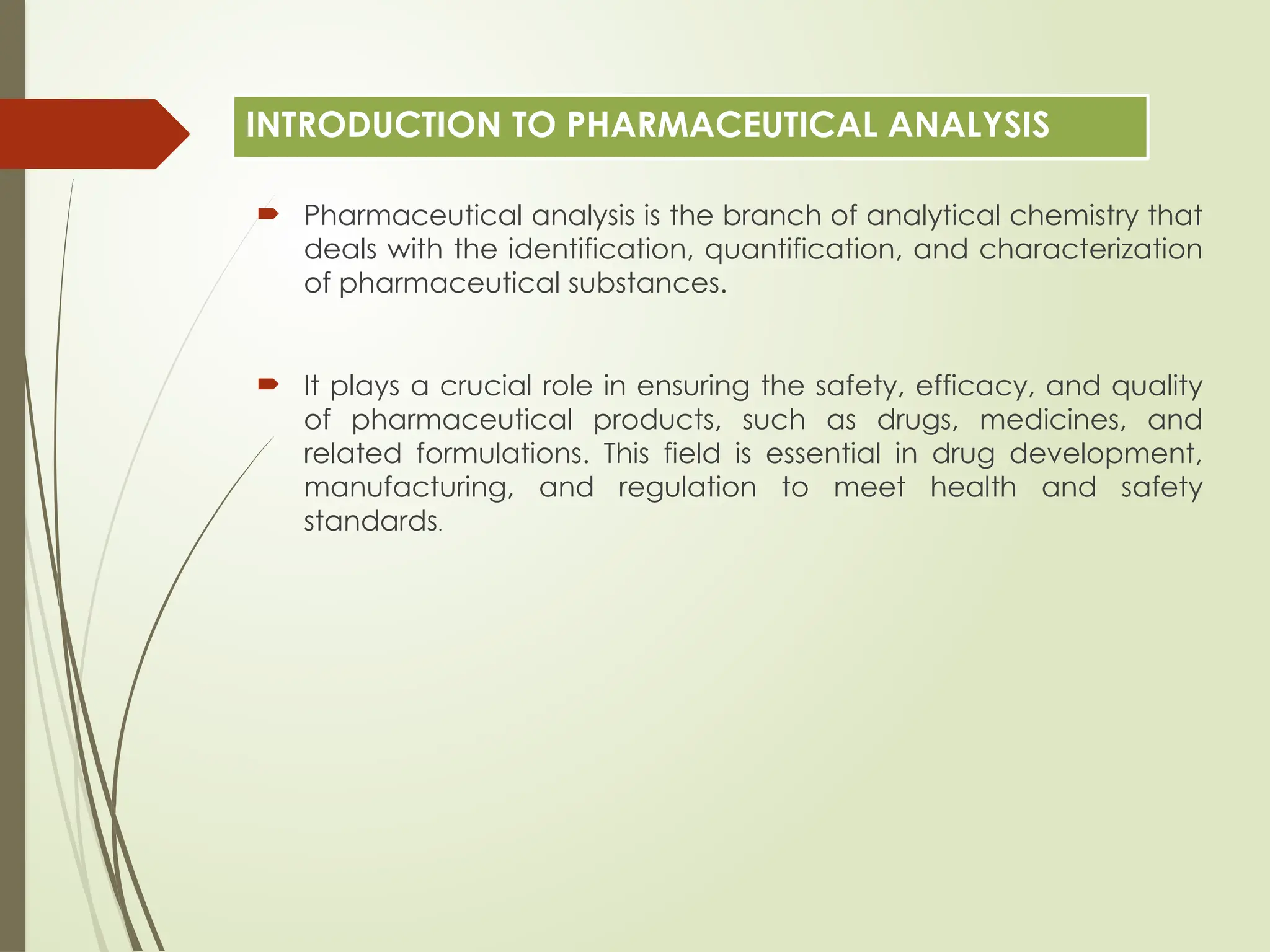
NMR INTRODUCTION :
NMR spectroscopy the characteristics absorption of energy by certain spinning
nuclei in a strong magnetic field.
Nuclei of atoms are consider to spin they can be considered as rotating electrical
charge and consequently along with there electrical properties they posses angular
momentum.
NMR spectroscopy just like IR and UV regarded as a process where by energy from
an external wavelength radio frequency end to the electromagnetic spectrum.
6.
NEW ADVANCEMENTS OFNMR SPECTROSCOPY
High-Resolution Magic Angle Spinning (HR-MAS) NMR Advancement:
HR-MAS NMR allows for the analysis of solid and semi-solid samples without the need
for sample dissolution. This technique is particularly useful in studying pharmaceutical formulations
such as tablets and complex drug formulations that require high spatial resolution.[38]
2D and 3D NMR Spectroscopy for Complex Drug Structures Advancement:
The use of two-dimensional (2D) and three-dimensional (3D) NMR spectroscopy has
improved the structural characterization of complex drug molecules, including understanding
molecular interactions, conformational changes, and reaction mechanisms in pharmaceutical
compounds.[39]
NMR in Drug Metabolism Studies Advancement:
NMR spectroscopy is increasingly used in drug metabolism studies to understand the
biotransformation of pharmaceutical compounds. It provides detailed insights into the metabolic
pathways, including the identification of metabolites and their interactions with enzymes.[40]
Quantitative NMR (qNMR) for Drug Content Analysis Advancement
Quantitative NMR (qNMR) has emerged as a highly accurate and reproducible
technique for the quantification of active pharmaceutical ingredients (APIs) in pharmaceutical
products, offering a non-destructive alternative to traditional methods like HPLC.[41]
NMR as a Tool for Polymorph Screening Advancement:
NMR spectroscopy is now commonly used for polymorph screening, helping to
identify different crystal forms (polymorphs) of active pharmaceutical ingredients (APIs). This is
crucial because different polymorphs can have varying solubility and bioavailability, impacting
the drugs Efficacy.
7.
UV-VISIBLE SPECTROSCOPY
INTRODUCTION:
Ultravioletspectroscopy is a concerned with the study
of absorption of UV radiation which ranges from 200-
400nm.Compounds which are colored ,absorb radiation from
400- 800nm
Wavelength in the Ultraviolet region are usually
expressed in nanometers(1nm=10-7cm )
Spectroscopy is a measurments of electro magnetic radiation
(EMR).Electromagnetic radiation is made up of discrete particle
called photorosis
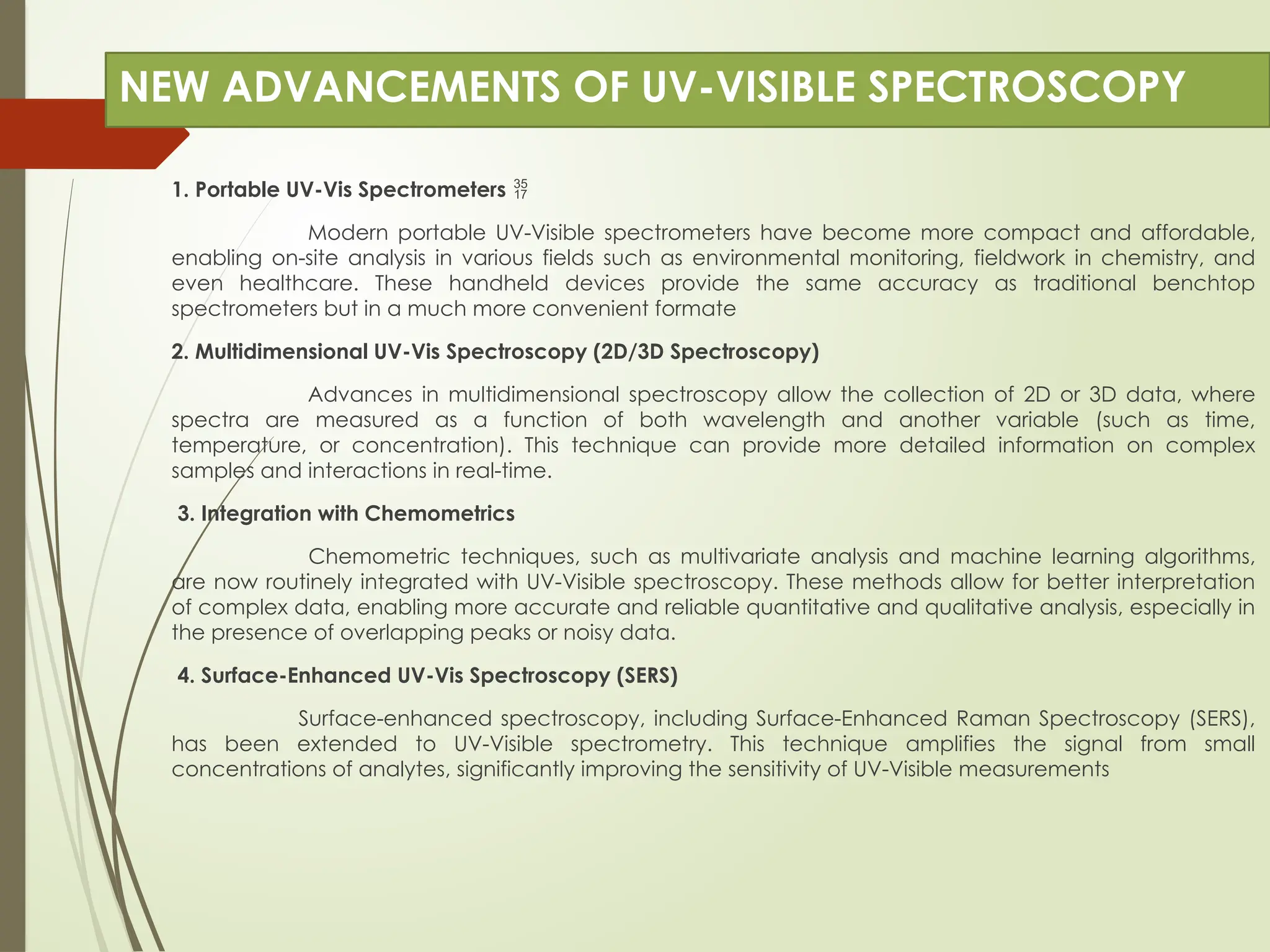
NEW ADVANCEMENTS OFUV-VISIBLE SPECTROSCOPY
1. Portable UV-Vis Spectrometers
Modern portable UV-Visible spectrometers have become more compact and affordable,
enabling on-site analysis in various fields such as environmental monitoring, fieldwork in chemistry, and
even healthcare. These handheld devices provide the same accuracy as traditional benchtop
spectrometers but in a much more convenient formate
2. Multidimensional UV-Vis Spectroscopy (2D/3D Spectroscopy)
Advances in multidimensional spectroscopy allow the collection of 2D or 3D data, where
spectra are measured as a function of both wavelength and another variable (such as time,
temperature, or concentration). This technique can provide more detailed information on complex
samples and interactions in real-time.
3. Integration with Chemometrics
Chemometric techniques, such as multivariate analysis and machine learning algorithms,
are now routinely integrated with UV-Visible spectroscopy. These methods allow for better interpretation
of complex data, enabling more accurate and reliable quantitative and qualitative analysis, especially in
the presence of overlapping peaks or noisy data.
4. Surface-Enhanced UV-Vis Spectroscopy (SERS)
Surface-enhanced spectroscopy, including Surface-Enhanced Raman Spectroscopy (SERS),
has been extended to UV-Visible spectrometry. This technique amplifies the signal from small
concentrations of analytes, significantly improving the sensitivity of UV-Visible measurements
10.
• APPLICATIONS OFIR SPECTROSCOPY:
• 1.Identifications of organic compounds
• 2.Quality control and pharmaceutical analysis
• 3.Environment monitoring
• 4.polymer analysis
• 5.polymer analysis
• APPLICATIONS OF NMR SPECTROSCOPY
• 1.Structural elucidation and organic compounds
• 2.protein and nucleic acid structure determination
• 3.Metabolomics and biomarker discovery
• 4.Drug –protein interactions
•
• APPLICATIONS OF UV-VISIBLE SPECTRISCOPY
• 1.Photochemical and photophysical studies
• 2.Analysis of nano materials
• 3.Determination of heavy metals in solutions
• 4. studying the stability of drugs
•
Applications of IR, NMR,UV-VISIBLE SPECTROSCOPY:
![Introduction to IR SPECTROSCOPY
Infra-red spectroscopy is one of the most powerful
analytical techniques, the technique is based on a chemical
substance showing marked selective absorption in the infrared
region[4].
The IR spectrum provides the largest number of characteristic
properties of a compound. It also serves powerful analytical
tool for the study of molecular structure.](https://image.slidesharecdn.com/sudhaoral-250326131103-6fe573dc/75/tablet-granulation-and-compression-and-processiong-and-problems-3-2048.jpg)
![NEW ADVANCEMENTS OF NMR SPECTROSCOPY
High-Resolution Magic Angle Spinning (HR-MAS) NMR Advancement:
HR-MAS NMR allows for the analysis of solid and semi-solid samples without the need
for sample dissolution. This technique is particularly useful in studying pharmaceutical formulations
such as tablets and complex drug formulations that require high spatial resolution.[38]
2D and 3D NMR Spectroscopy for Complex Drug Structures Advancement:
The use of two-dimensional (2D) and three-dimensional (3D) NMR spectroscopy has
improved the structural characterization of complex drug molecules, including understanding
molecular interactions, conformational changes, and reaction mechanisms in pharmaceutical
compounds.[39]
NMR in Drug Metabolism Studies Advancement:
NMR spectroscopy is increasingly used in drug metabolism studies to understand the
biotransformation of pharmaceutical compounds. It provides detailed insights into the metabolic
pathways, including the identification of metabolites and their interactions with enzymes.[40]
Quantitative NMR (qNMR) for Drug Content Analysis Advancement
Quantitative NMR (qNMR) has emerged as a highly accurate and reproducible
technique for the quantification of active pharmaceutical ingredients (APIs) in pharmaceutical
products, offering a non-destructive alternative to traditional methods like HPLC.[41]
NMR as a Tool for Polymorph Screening Advancement:
NMR spectroscopy is now commonly used for polymorph screening, helping to
identify different crystal forms (polymorphs) of active pharmaceutical ingredients (APIs). This is
crucial because different polymorphs can have varying solubility and bioavailability, impacting
the drugs Efficacy.](https://image.slidesharecdn.com/sudhaoral-250326131103-6fe573dc/75/tablet-granulation-and-compression-and-processiong-and-problems-6-2048.jpg)