CSM 399
Lecture 3
Jan 2016
Web based concepts and development
Emmanuel Ofori Oppong
eoforioppong@yahoo.com // 0244213859
HTML Tables
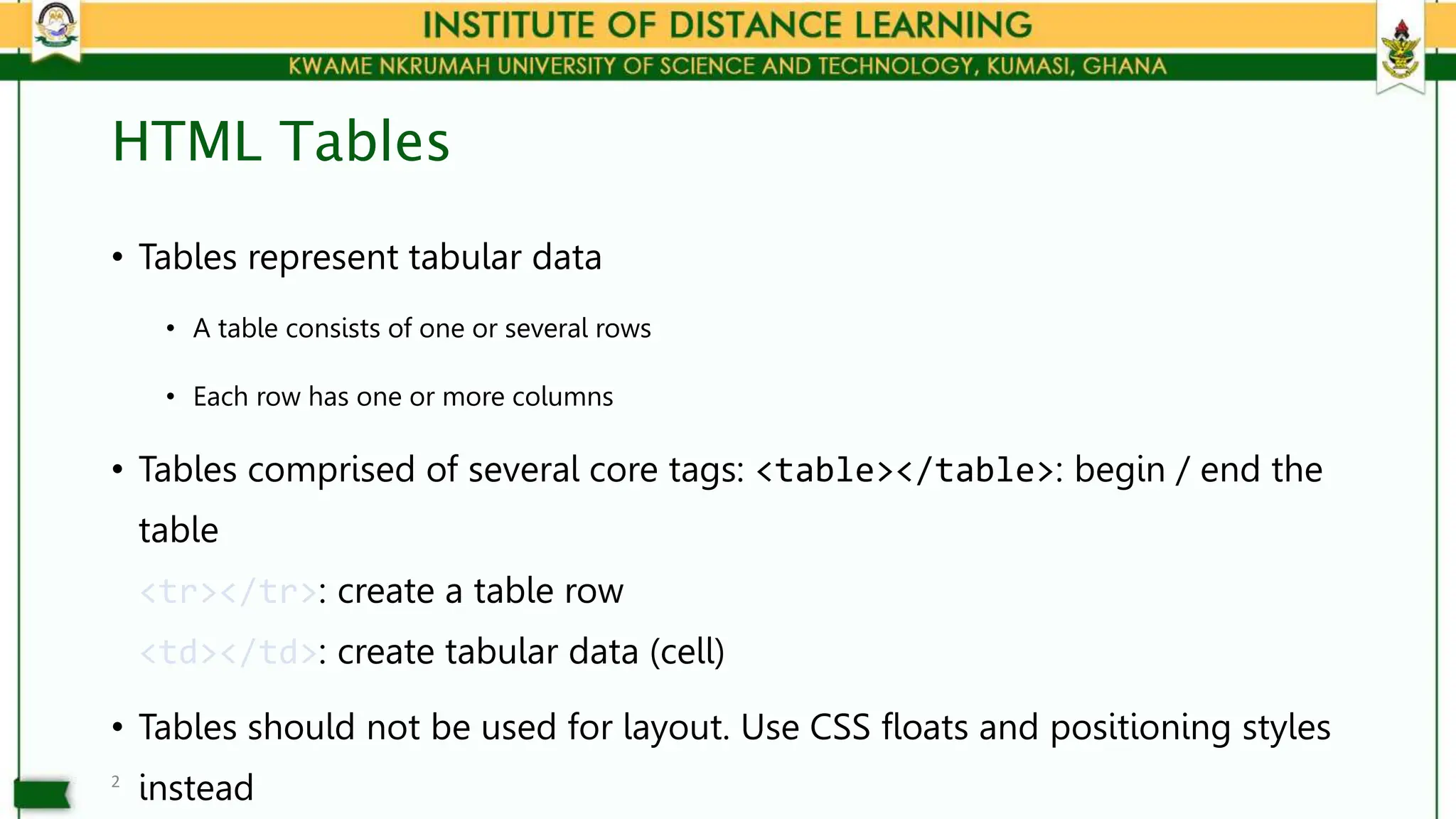
HTML Tables
• Tables represent tabular data
• A table consists of one or several rows
• Each row has one or more columns
• Tables comprised of several core tags: <table></table>: begin / end the
table
<tr></tr>: create a table row
<td></td>: create tabular data (cell)
• Tables should not be used for layout. Use CSS floats and positioning styles
instead
2
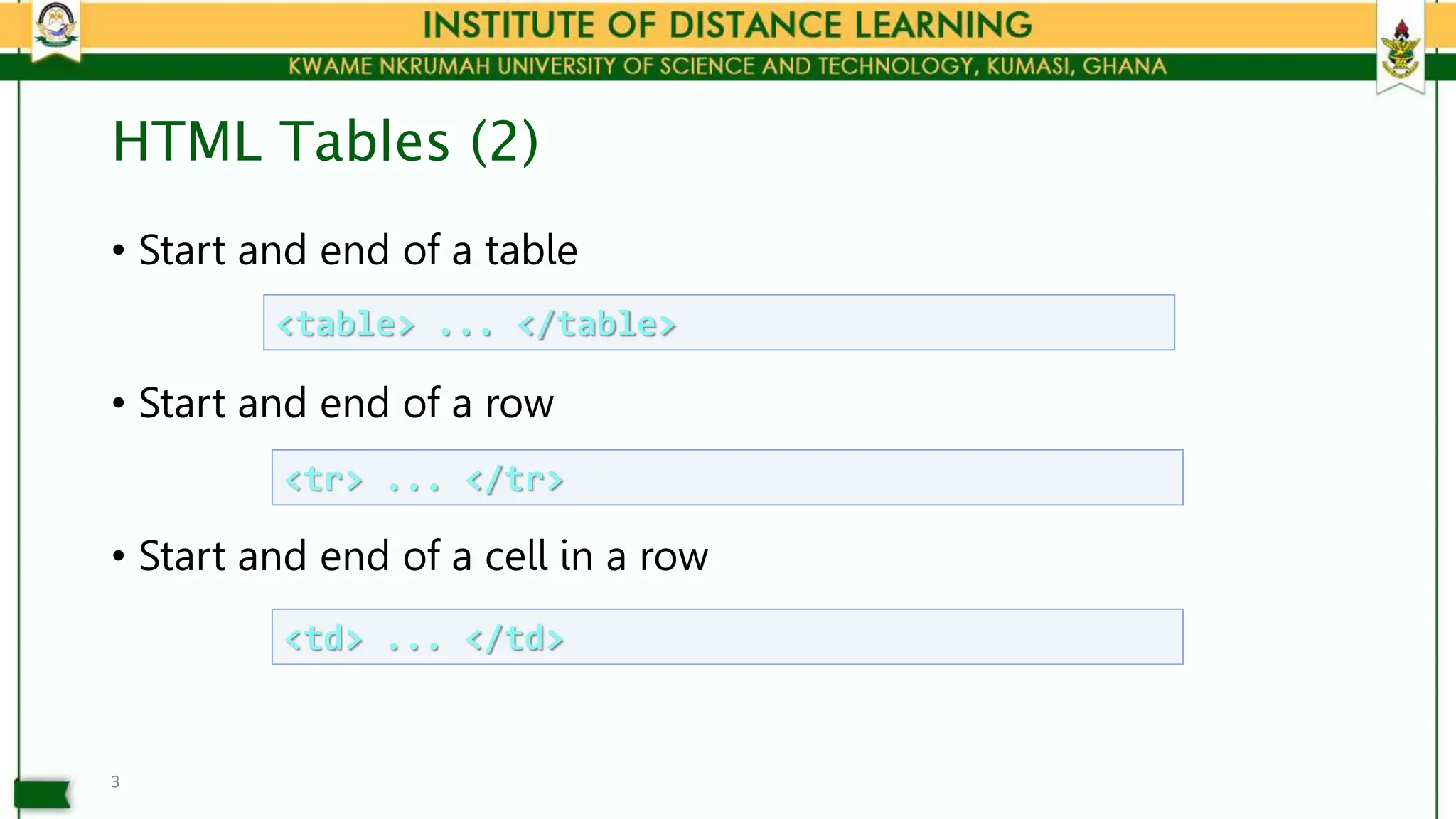
HTML Tables (2)
• Start and end of a table
• Start and end of a row
• Start and end of a cell in a row
3
<table> ... </table>
<tr> ... </tr>
<td> ... </td>
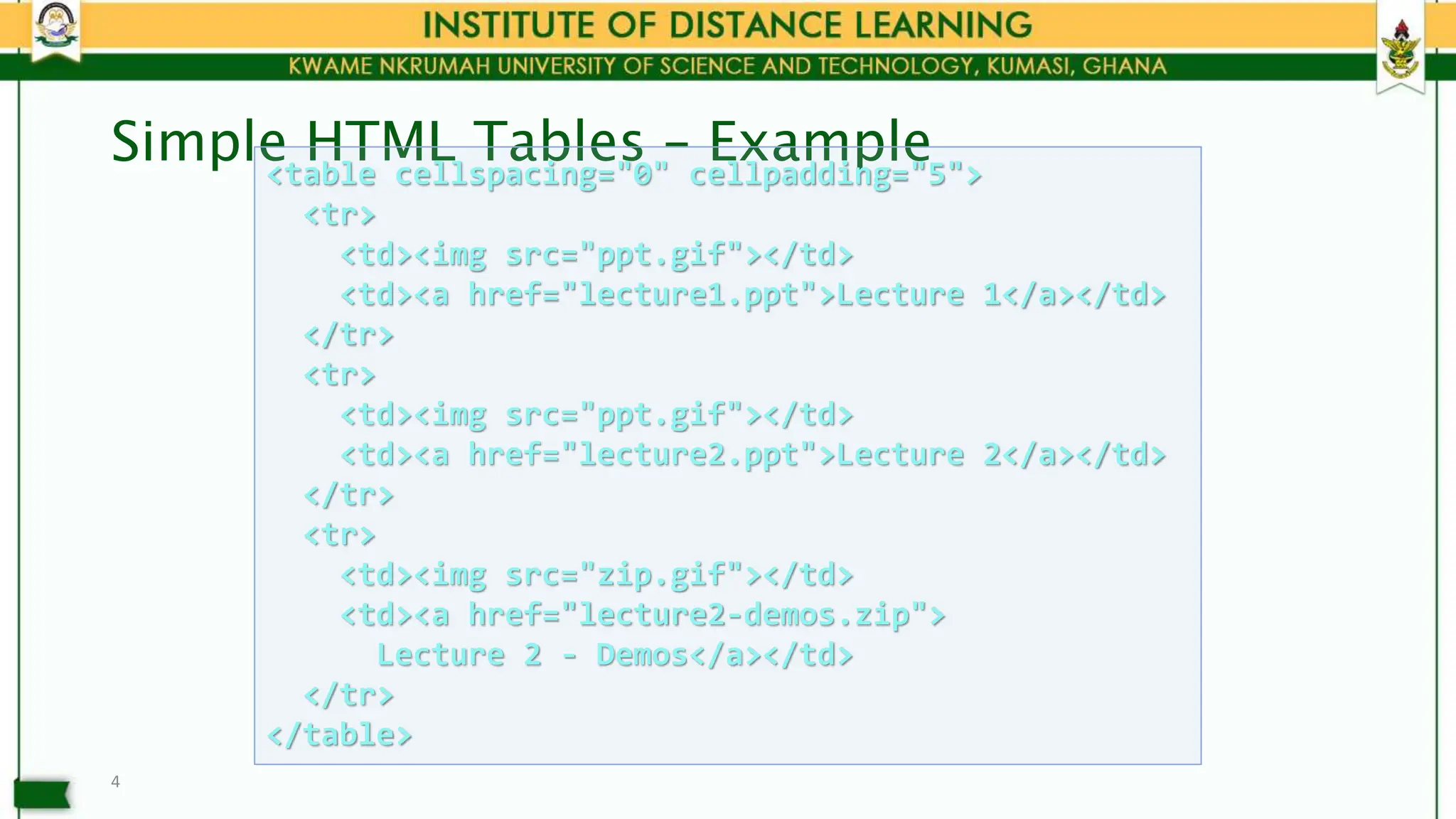
Simple HTML Tables – Example
4
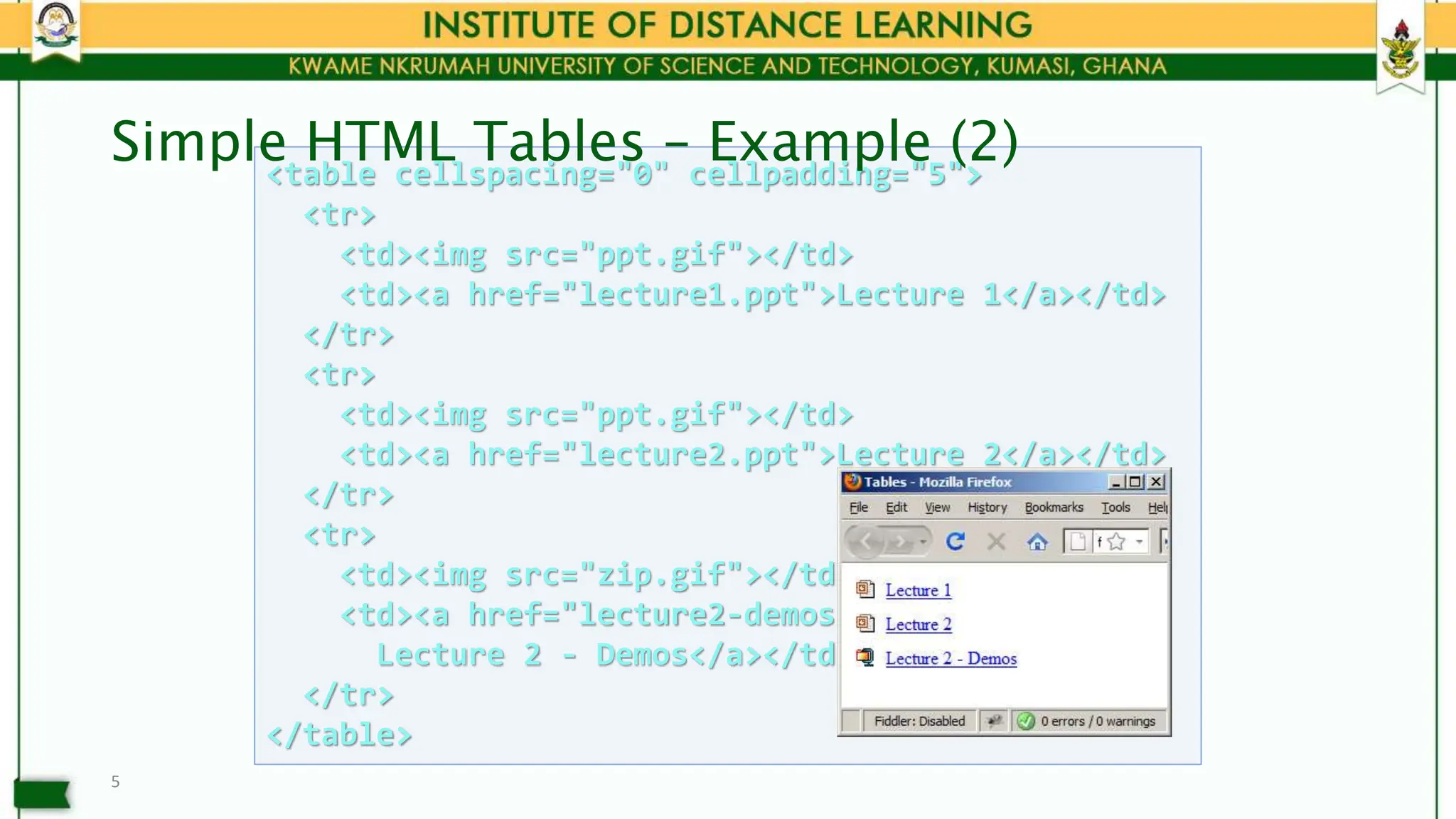
<table cellspacing="0" cellpadding="5">
<tr>
<td><img src="ppt.gif"></td>
<td><a href="lecture1.ppt">Lecture 1</a></td>
</tr>
<tr>
<td><img src="ppt.gif"></td>
<td><a href="lecture2.ppt">Lecture 2</a></td>
</tr>
<tr>
<td><img src="zip.gif"></td>
<td><a href="lecture2-demos.zip">
Lecture 2 - Demos</a></td>
</tr>
</table>
<table cellspacing="0" cellpadding="5">
<tr>
<td><img src="ppt.gif"></td>
<td><a href="lecture1.ppt">Lecture 1</a></td>
</tr>
<tr>
<td><img src="ppt.gif"></td>
<td><a href="lecture2.ppt">Lecture 2</a></td>
</tr>
<tr>
<td><img src="zip.gif"></td>
<td><a href="lecture2-demos.zip">
Lecture 2 - Demos</a></td>
</tr>
</table>
Simple HTML Tables – Example (2)
5
Complete HTML Tables
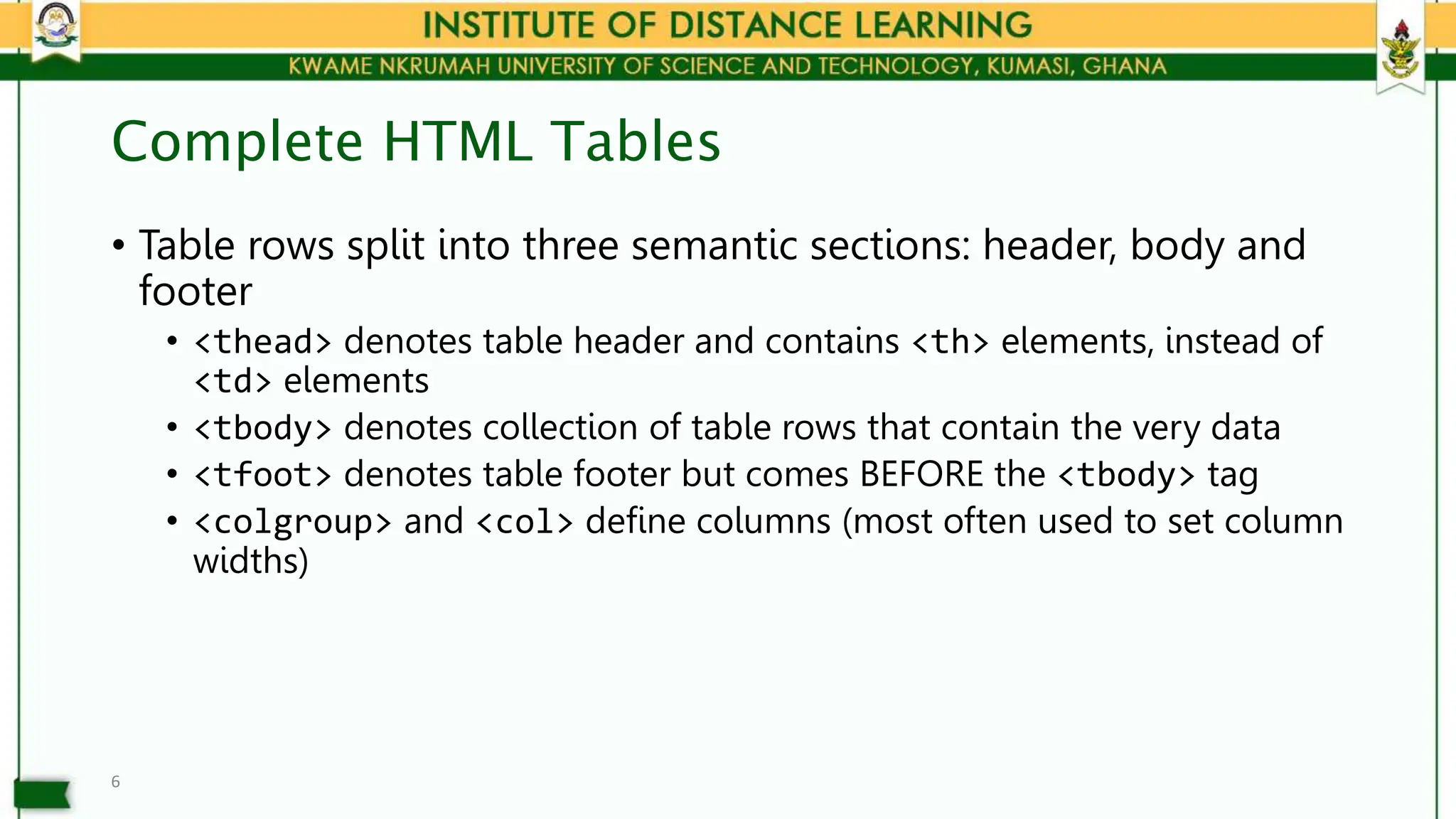
• Table rows split into three semantic sections: header, body and
footer
• <thead> denotes table header and contains <th> elements, instead of
<td> elements
• <tbody> denotes collection of table rows that contain the very data
• <tfoot> denotes table footer but comes BEFORE the <tbody> tag
• <colgroup> and <col> define columns (most often used to set column
widths)
6
Complete HTML Table: Example
7
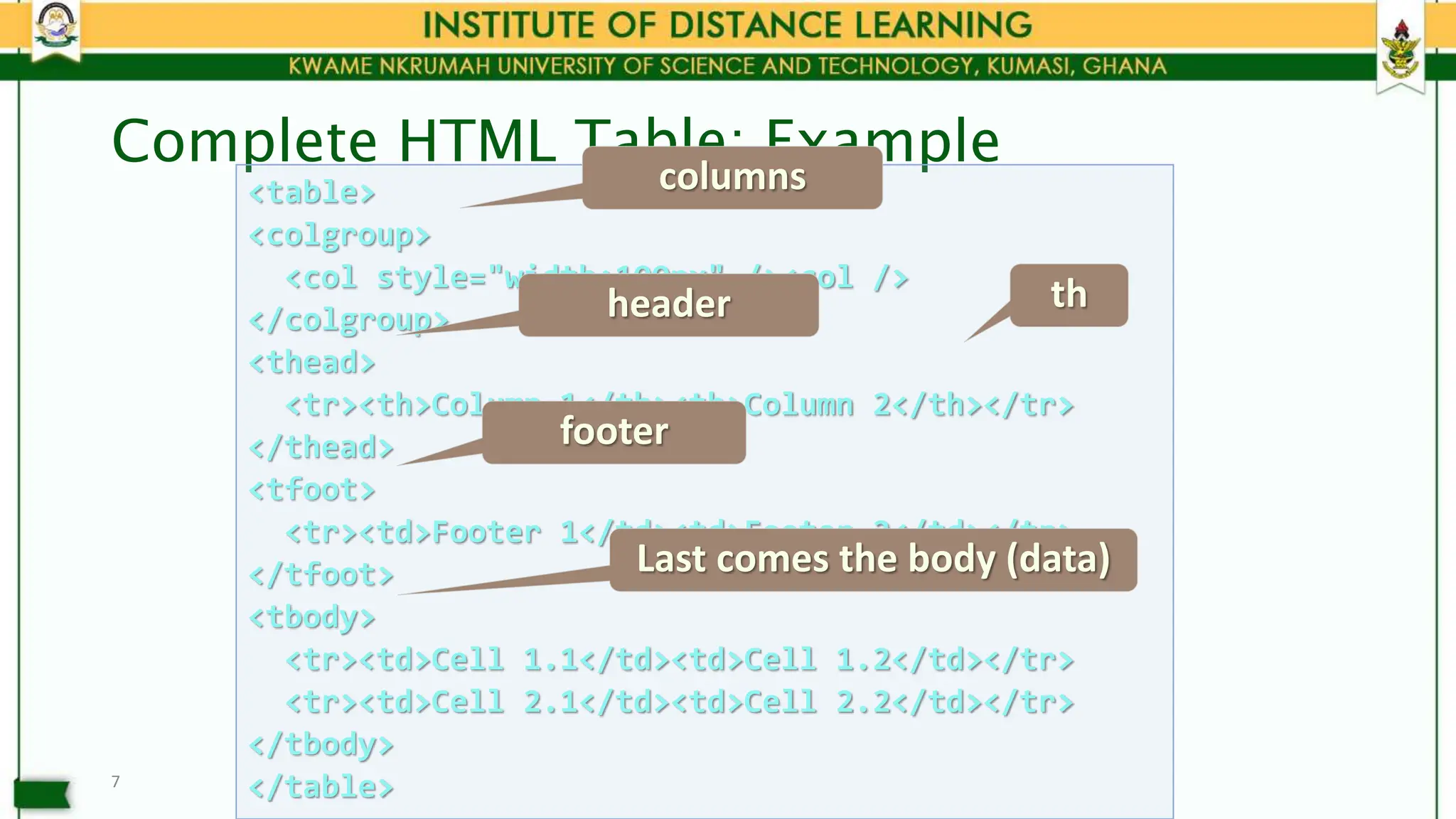
<table>
<colgroup>
<col style="width:100px" /><col />
</colgroup>
<thead>
<tr><th>Column 1</th><th>Column 2</th></tr>
</thead>
<tfoot>
<tr><td>Footer 1</td><td>Footer 2</td></tr>
</tfoot>
<tbody>
<tr><td>Cell 1.1</td><td>Cell 1.2</td></tr>
<tr><td>Cell 2.1</td><td>Cell 2.2</td></tr>
</tbody>
</table>
header
footer
Last comes the body (data)
th
columns
<table>
<colgroup>
<col style="width:200px" /><col />
</colgroup>
<thead>
<tr><th>Column 1</th><th>Column 2</th></tr>
</thead>
<tfoot>
<tr><td>Footer 1</td><td>Footer 2</td></tr>
</tfoot>
<tbody>
<tr><td>Cell 1.1</td><td>Cell 1.2</td></tr>
<tr><td>Cell 2.1</td><td>Cell 2.2</td></tr>
</tbody>
</table>
Complete HTML Table:
Example (2)
8
table-full.html
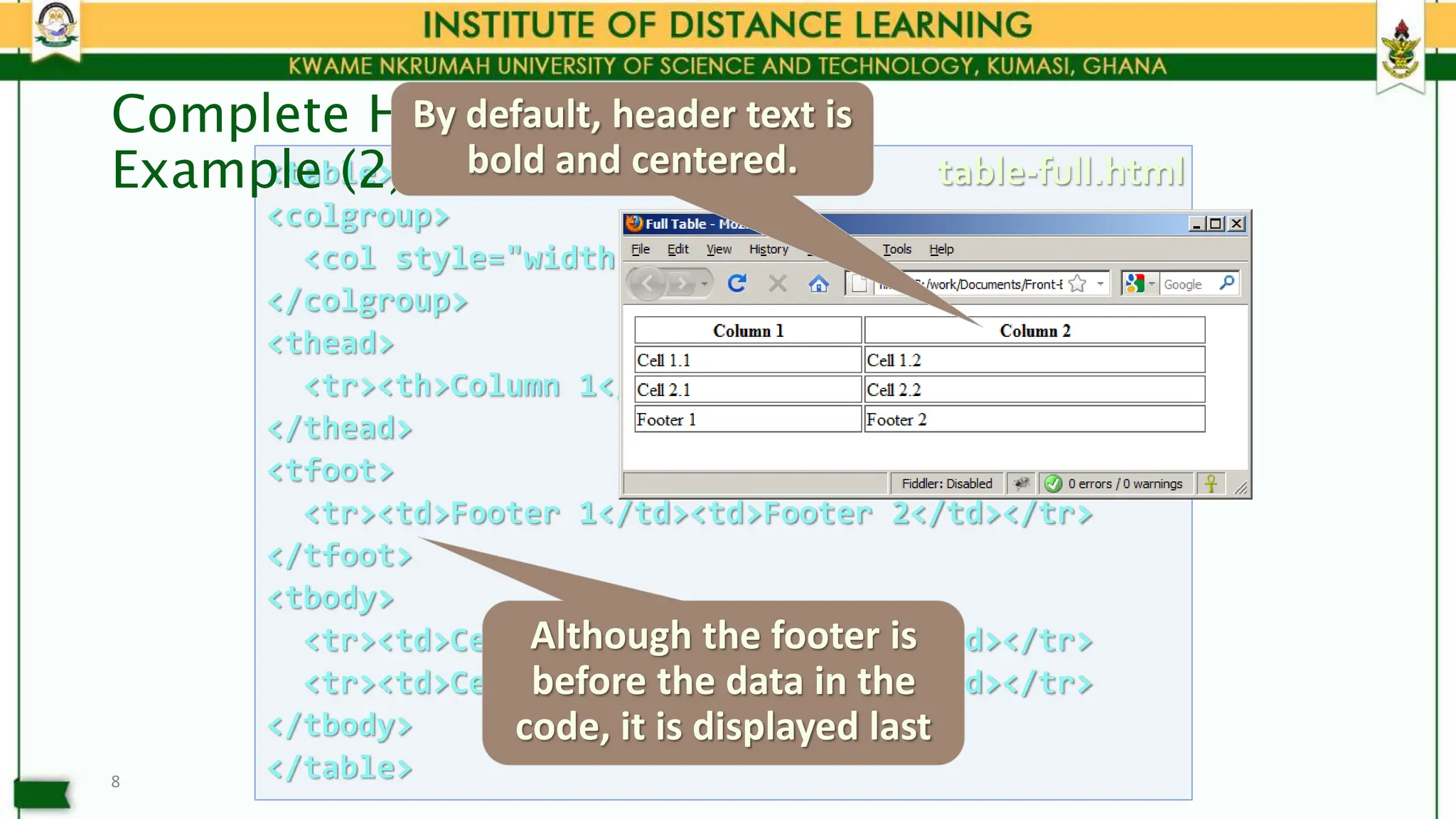
Although the footer is
before the data in the
code, it is displayed last
By default, header text is
bold and centered.
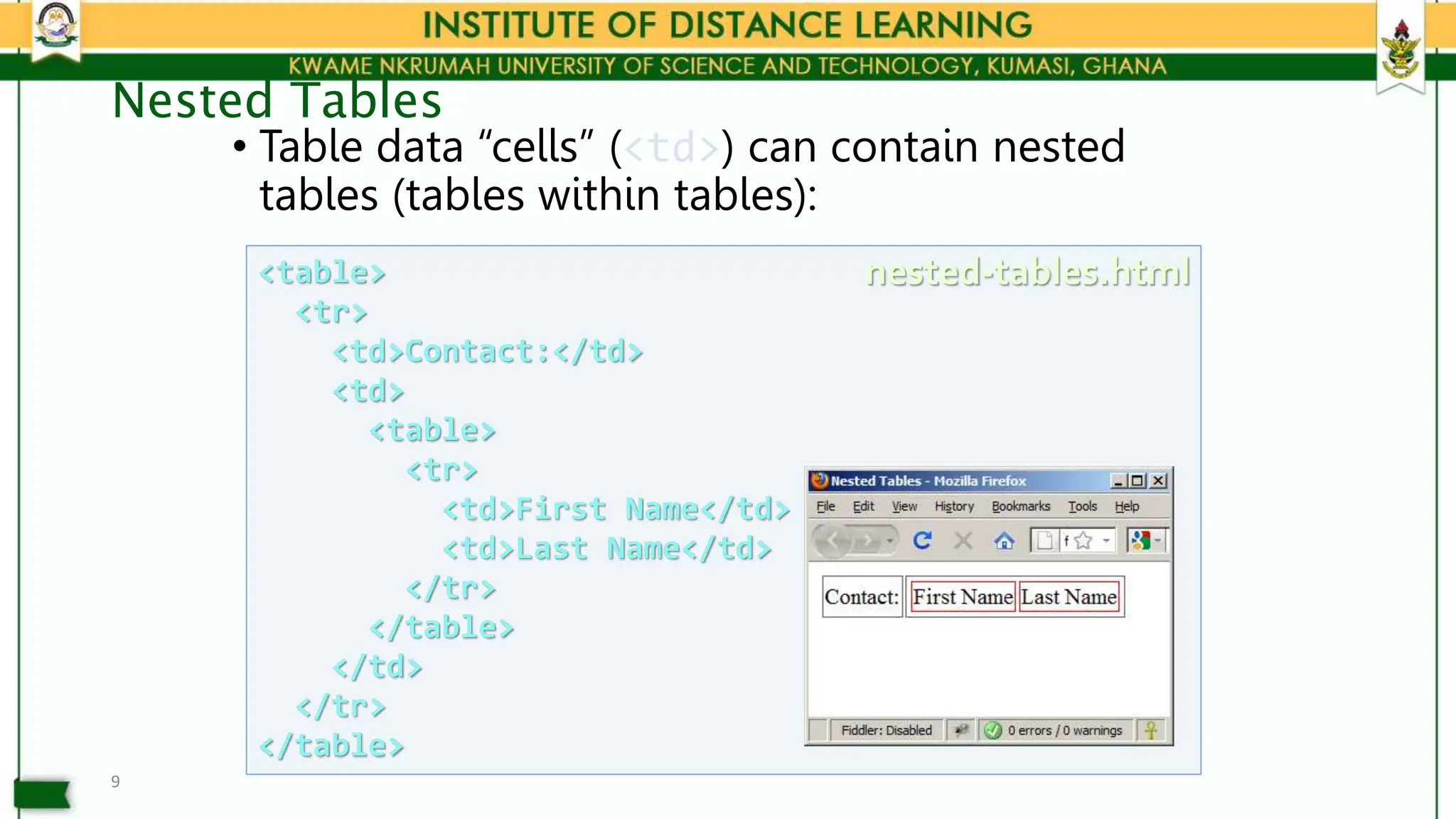
Nested Tables
• Table data “cells” (<td>) can contain nested
tables (tables within tables):
9
<table>
<tr>
<td>Contact:</td>
<td>
<table>
<tr>
<td>First Name</td>
<td>Last Name</td>
</tr>
</table>
</td>
</tr>
</table>
nested-tables.html
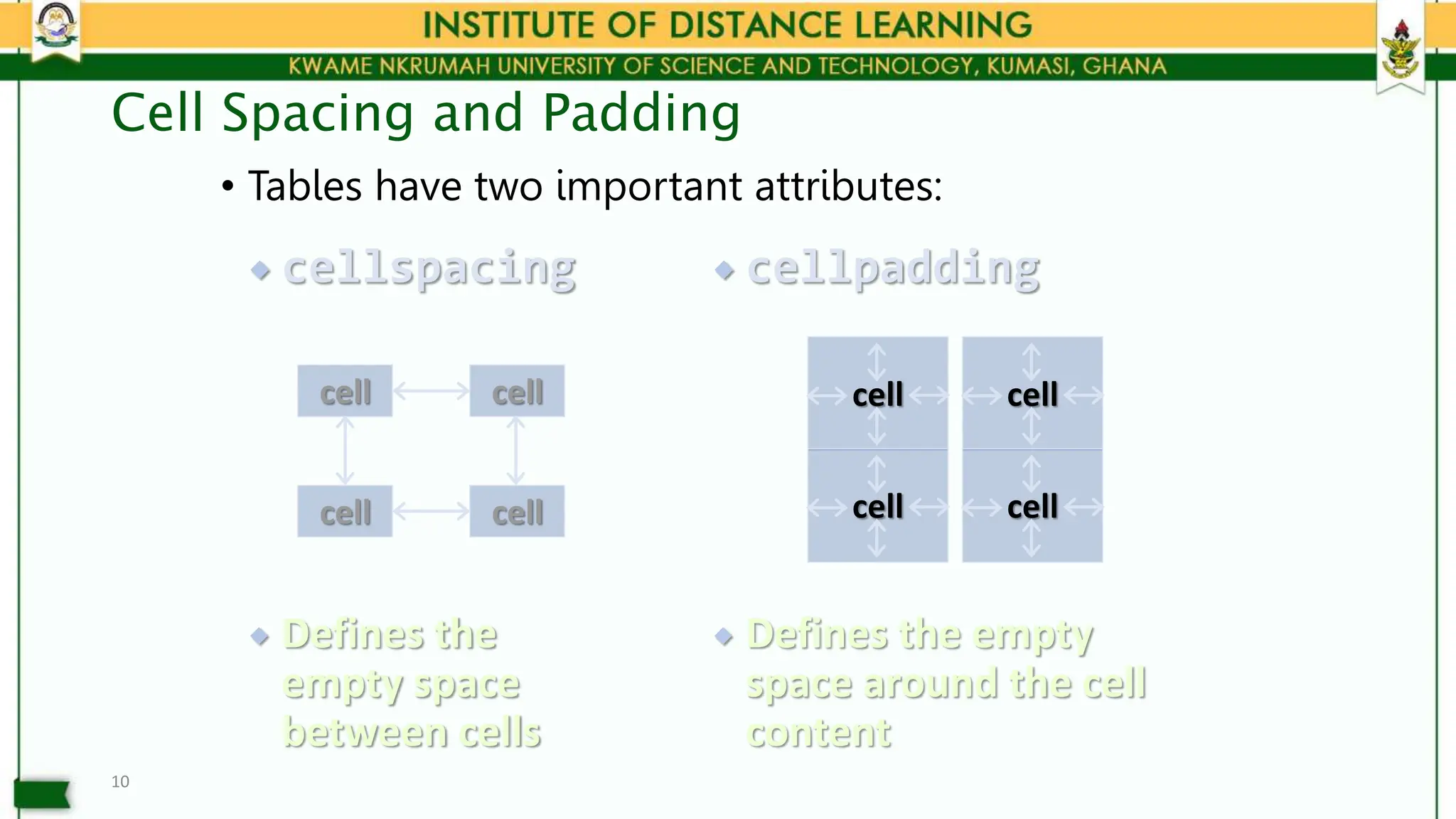
 cellpadding
 Defines the empty
space around the cell
content
 cellspacing
 Defines the
empty space
between cells
Cell Spacing and Padding
• Tables have two important attributes:
10
cell cell
cell cell
cell
cell
cell
cell
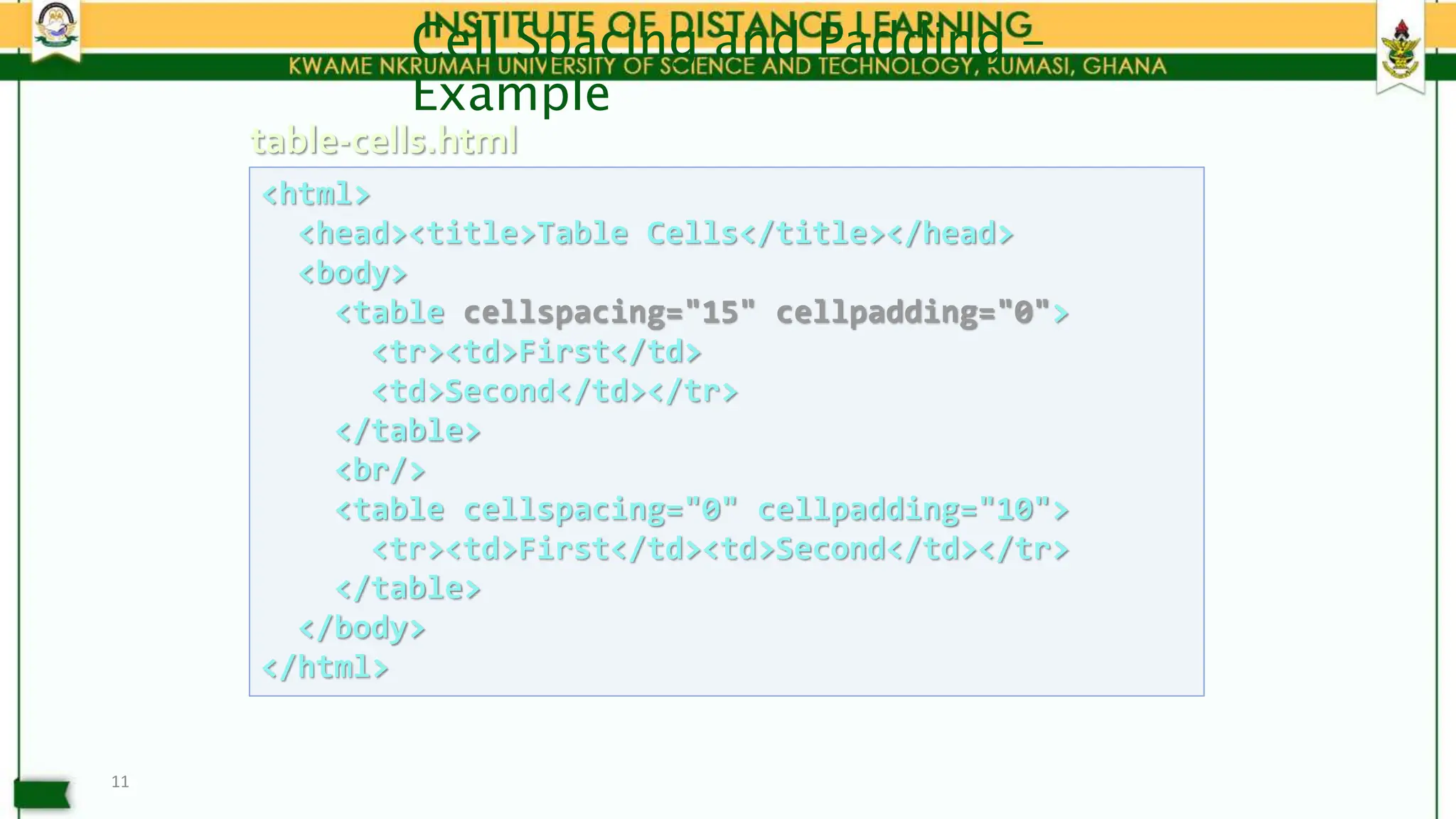
Cell Spacing and Padding –
Example
11
<html>
<head><title>Table Cells</title></head>
<body>
<table cellspacing="15" cellpadding="0">
<tr><td>First</td>
<td>Second</td></tr>
</table>
<br/>
<table cellspacing="0" cellpadding="10">
<tr><td>First</td><td>Second</td></tr>
</table>
</body>
</html>
table-cells.html
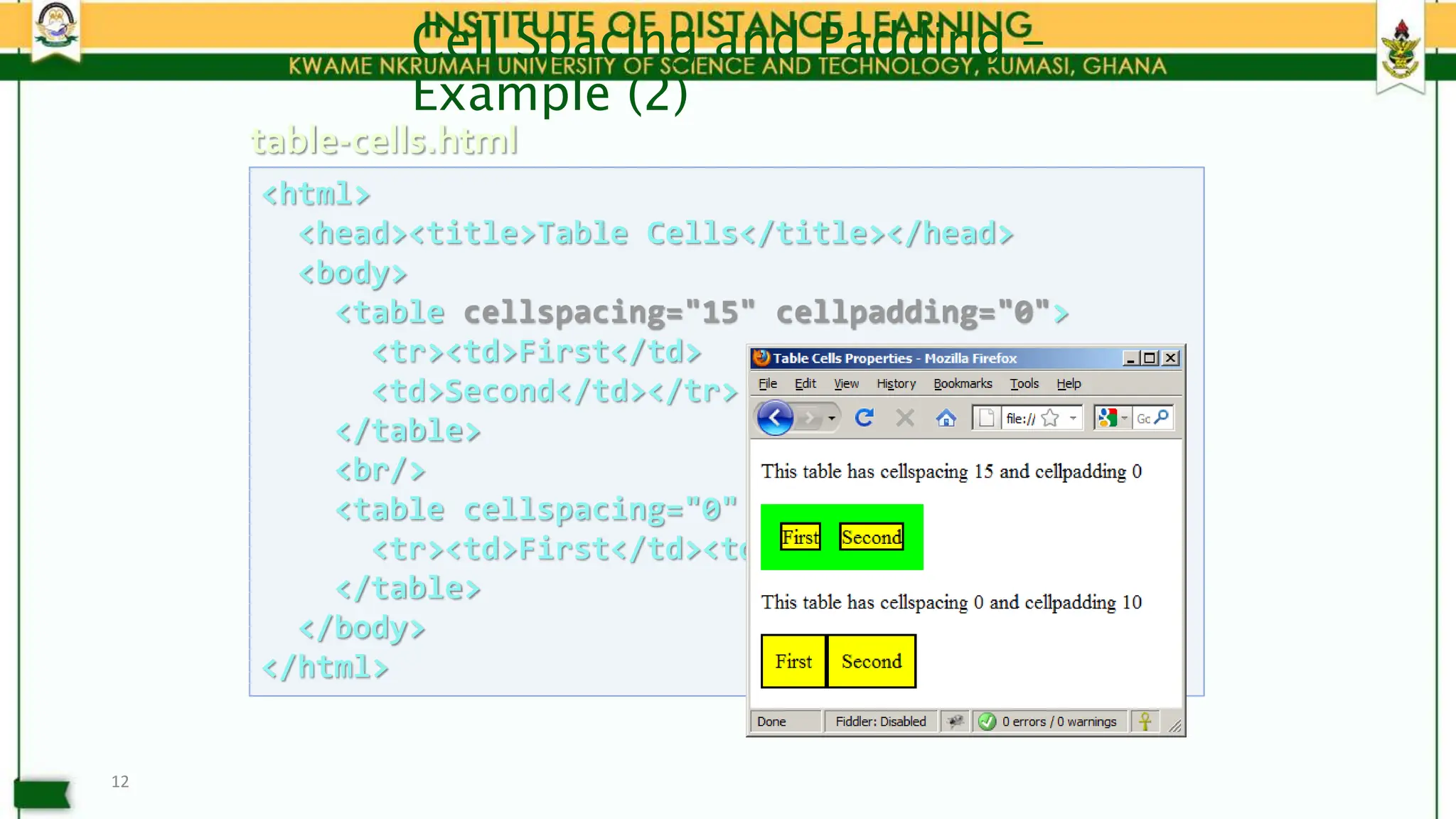
Cell Spacing and Padding –
Example (2)
12
<html>
<head><title>Table Cells</title></head>
<body>
<table cellspacing="15" cellpadding="0">
<tr><td>First</td>
<td>Second</td></tr>
</table>
<br/>
<table cellspacing="0" cellpadding="10">
<tr><td>First</td><td>Second</td></tr>
</table>
</body>
</html>
table-cells.html
 rowspan
 Defines how
many rows the
cell occupies
 colspan
 Defines how
many columns
the cell occupies
Column and Row Span
• Table cells have two important attributes:
13
cell[1,1] cell[1,2]
cell[2,1]
colspan="1"
colspan="1"
colspan="2"
cell[1,1]
cell[1,2]
cell[2,1]
rowspan="2" rowspan="1"
rowspan="1"
Column and Row Span – Example
14
<table cellspacing="0">
<tr class="1"><td>Cell[1,1]</td>
<td colspan="2">Cell[2,1]</td></tr>
<tr class=“2"><td>Cell[1,2]</td>
<td rowspan="2">Cell[2,2]</td>
<td>Cell[3,2]</td></tr>
<tr class=“3"><td>Cell[1,3]</td>
<td>Cell[2,3]</td></tr>
</table>
table-colspan-rowspan.html
<table cellspacing="0">
<tr class="1"><td>Cell[1,1]</td>
<td colspan="2">Cell[2,1]</td></tr>
<tr class=“2"><td>Cell[1,2]</td>
<td rowspan="2">Cell[2,2]</td>
<td>Cell[3,2]</td></tr>
<tr class=“3"><td>Cell[1,3]</td>
<td>Cell[2,3]</td></tr>
</table>
Column and Row Span –
Example (2)
15
table-colspan-rowspan.html
Cell[2,3]
Cell[1,3]
Cell[3,2]
Cell[2,2]
Cell[1,2]
Cell[2,1]
Cell[1,1]
HTML Forms
Entering User Data from a Web Page
HTML Forms
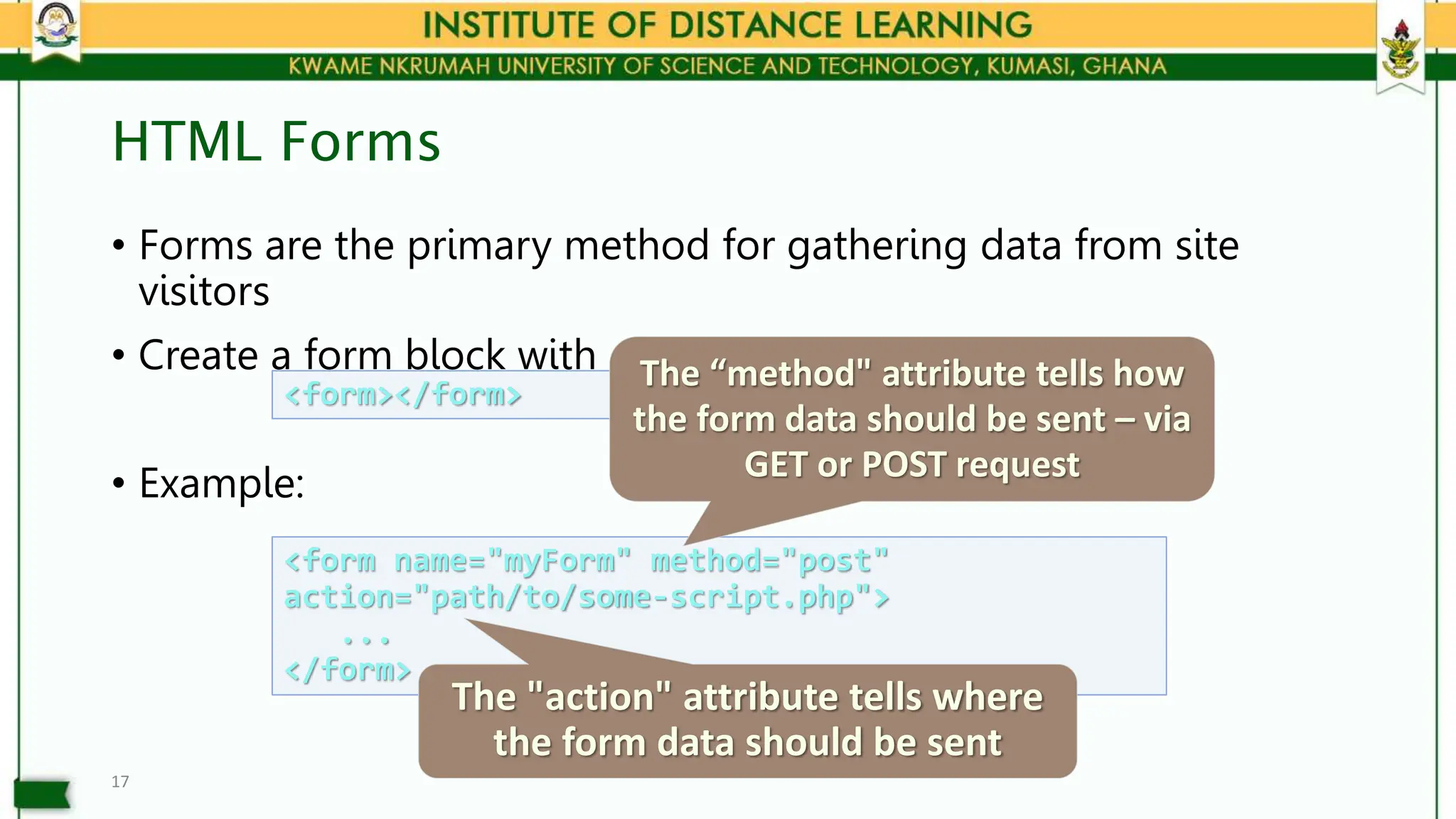
• Forms are the primary method for gathering data from site
visitors
• Create a form block with
• Example:
17
<form></form>
<form name="myForm" method="post"
action="path/to/some-script.php">
...
</form>
The "action" attribute tells where
the form data should be sent
The “method" attribute tells how
the form data should be sent – via
GET or POST request
Form Fields
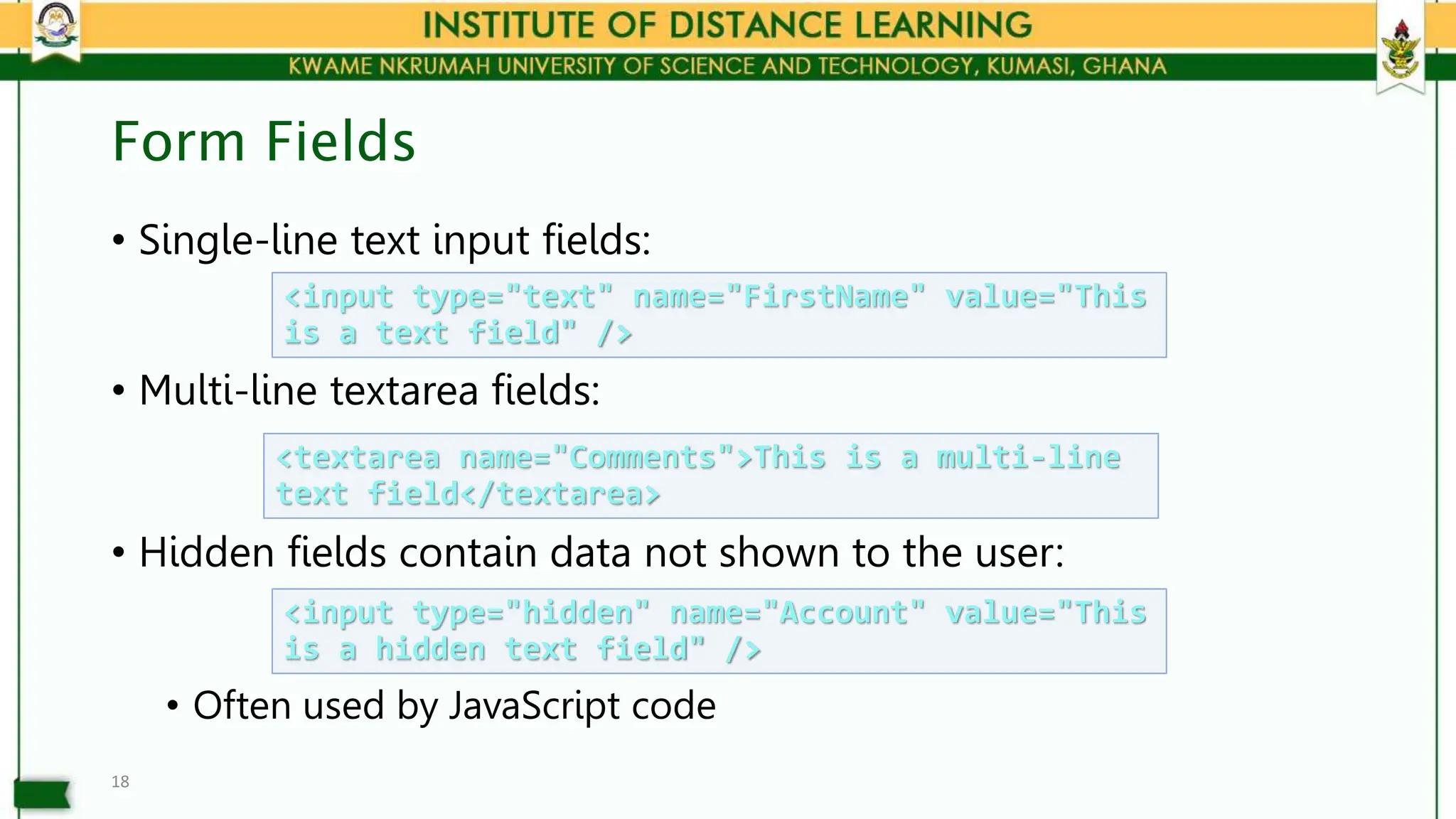
• Single-line text input fields:
• Multi-line textarea fields:
• Hidden fields contain data not shown to the user:
• Often used by JavaScript code
18
<input type="text" name="FirstName" value="This
is a text field" />
<textarea name="Comments">This is a multi-line
text field</textarea>
<input type="hidden" name="Account" value="This
is a hidden text field" />
Fieldsets
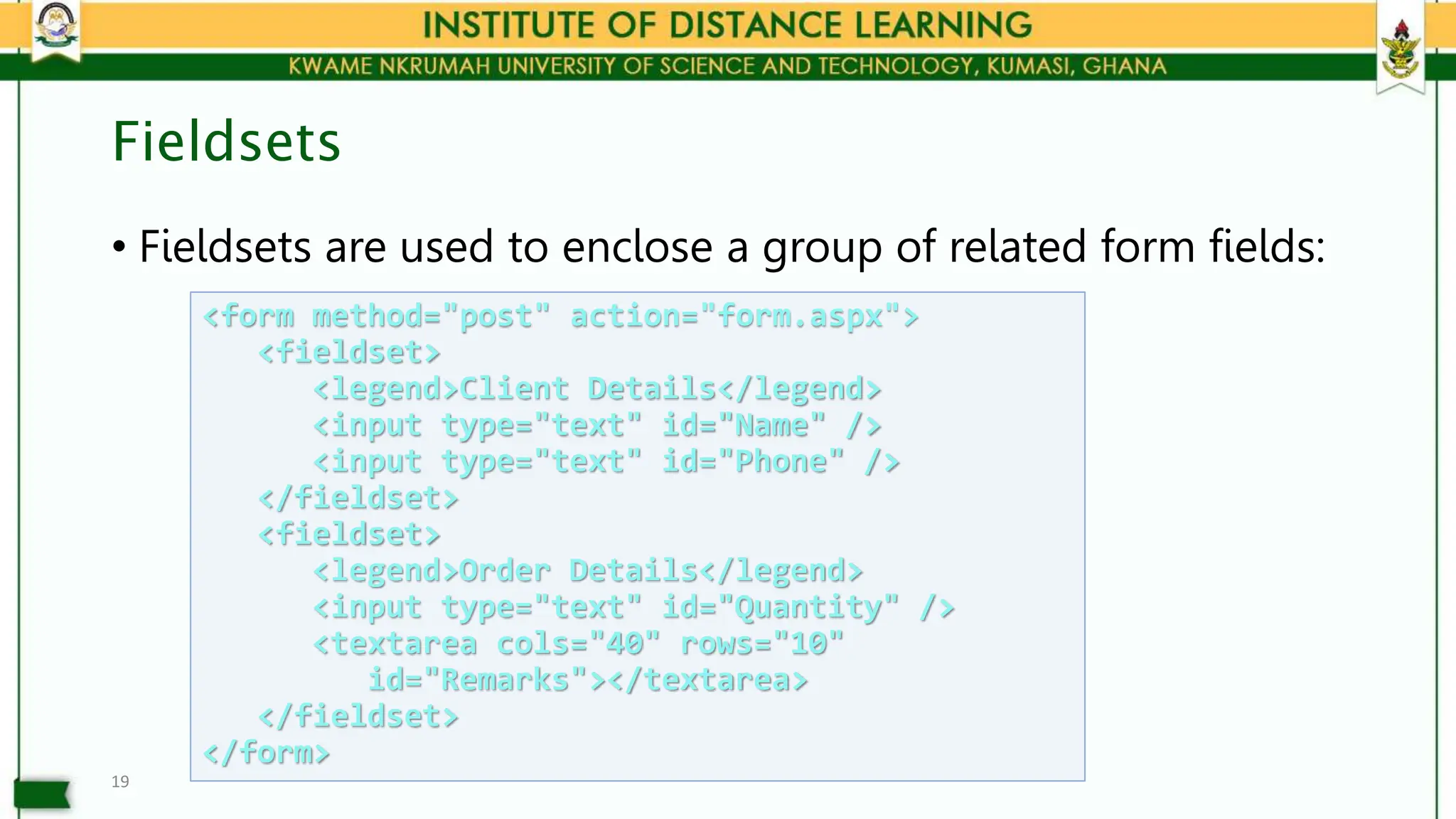
• Fieldsets are used to enclose a group of related form fields:
19
<form method="post" action="form.aspx">
<fieldset>
<legend>Client Details</legend>
<input type="text" id="Name" />
<input type="text" id="Phone" />
</fieldset>
<fieldset>
<legend>Order Details</legend>
<input type="text" id="Quantity" />
<textarea cols="40" rows="10"
id="Remarks"></textarea>
</fieldset>
</form>
Form Input Controls
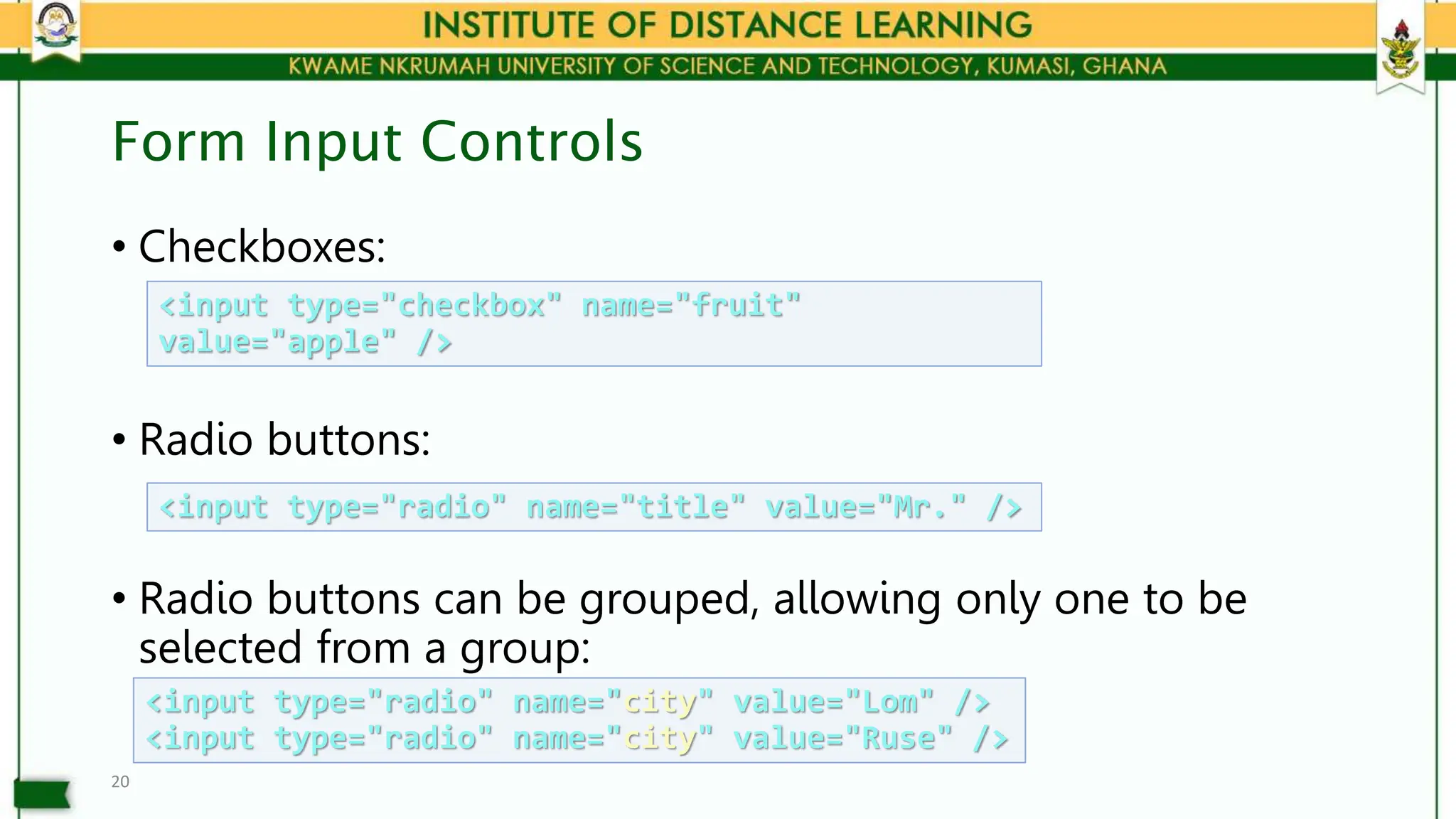
• Checkboxes:
• Radio buttons:
• Radio buttons can be grouped, allowing only one to be
selected from a group:
20
<input type="checkbox" name="fruit"
value="apple" />
<input type="radio" name="title" value="Mr." />
<input type="radio" name="city" value="Lom" />
<input type="radio" name="city" value="Ruse" />
Other Form Controls
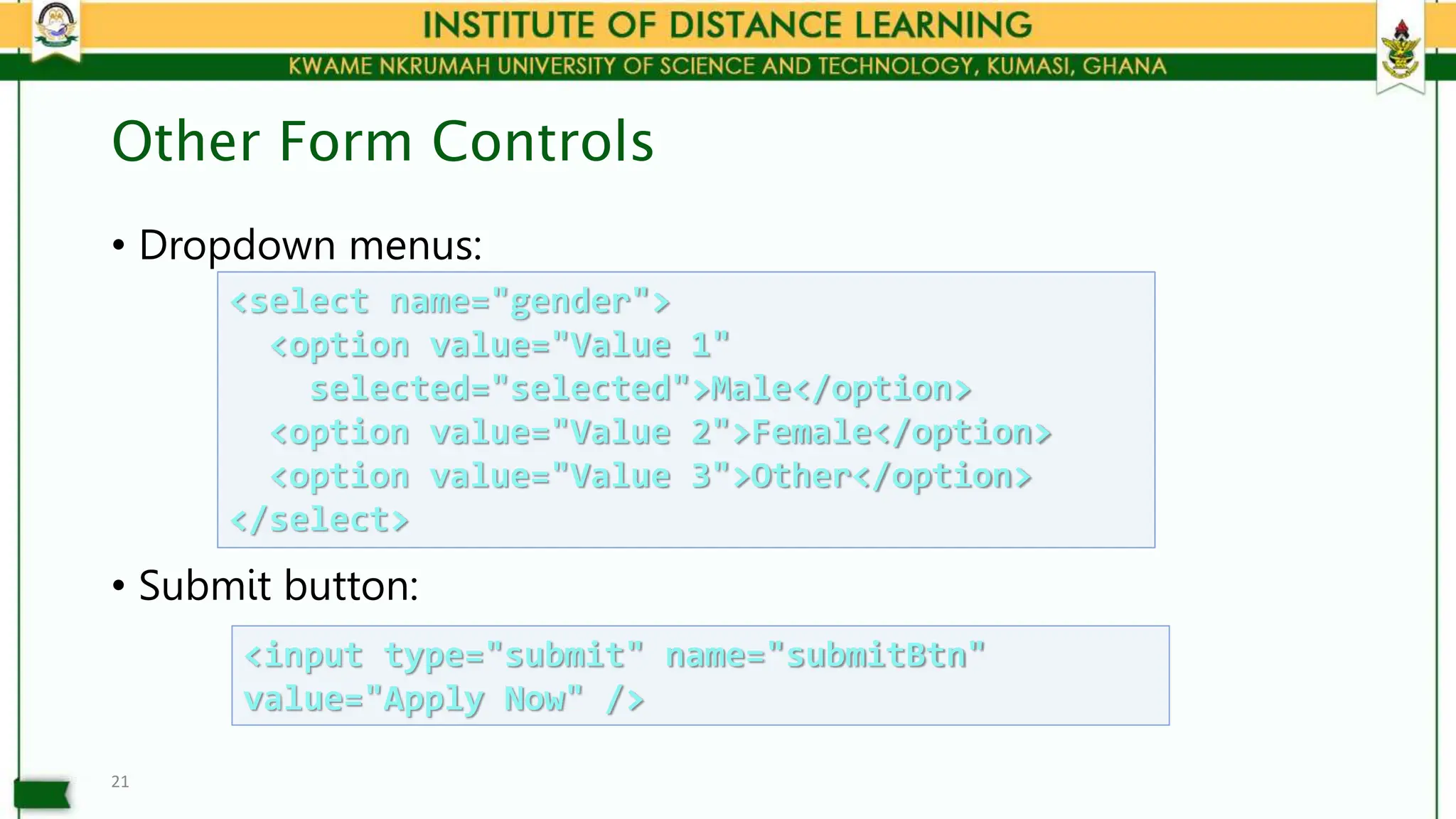
• Dropdown menus:
• Submit button:
21
<select name="gender">
<option value="Value 1"
selected="selected">Male</option>
<option value="Value 2">Female</option>
<option value="Value 3">Other</option>
</select>
<input type="submit" name="submitBtn"
value="Apply Now" />
Other Form Controls (2)
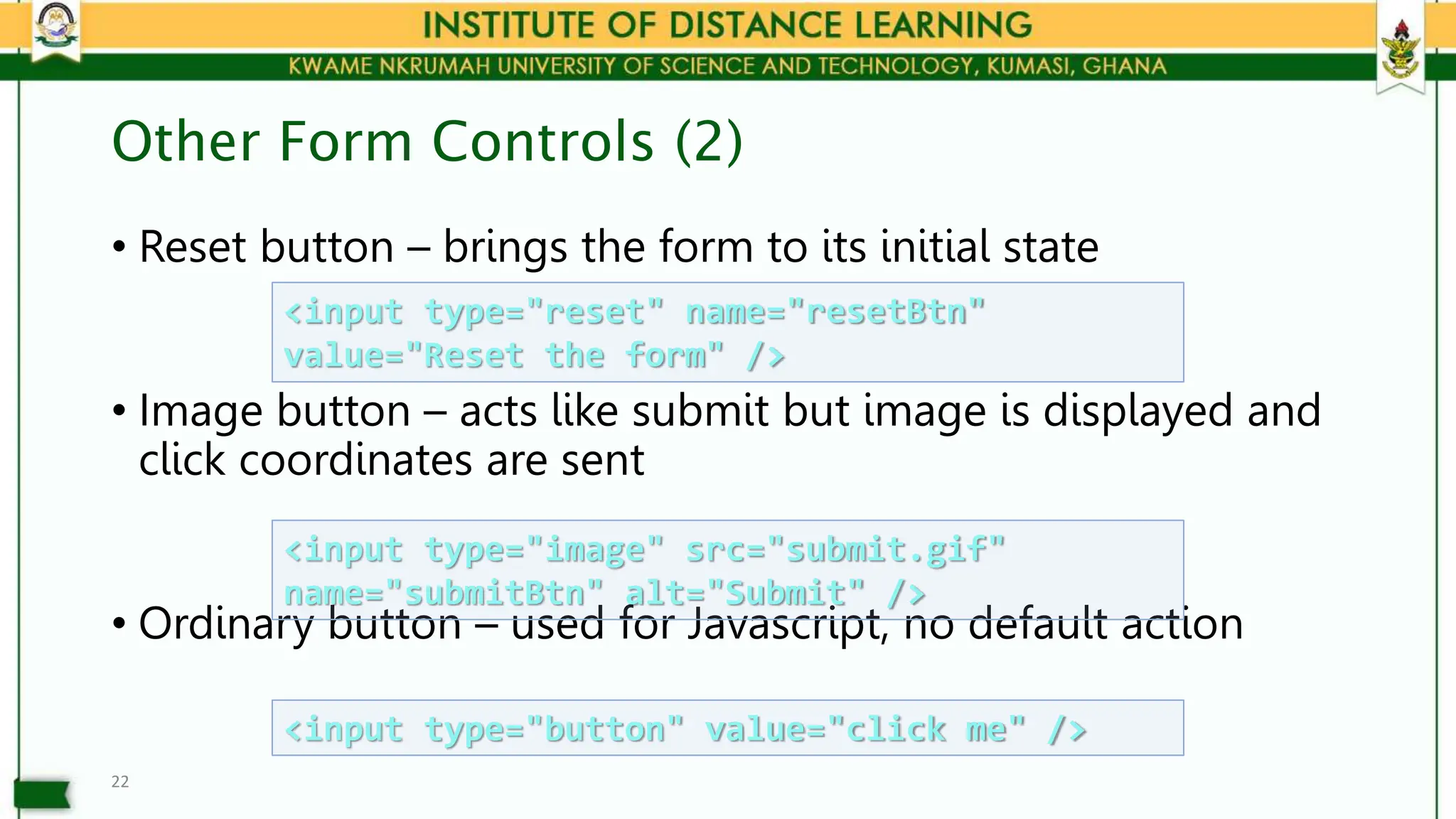
• Reset button – brings the form to its initial state
• Image button – acts like submit but image is displayed and
click coordinates are sent
• Ordinary button – used for Javascript, no default action
22
<input type="reset" name="resetBtn"
value="Reset the form" />
<input type="image" src="submit.gif"
name="submitBtn" alt="Submit" />
<input type="button" value="click me" />
Other Form Controls (3)
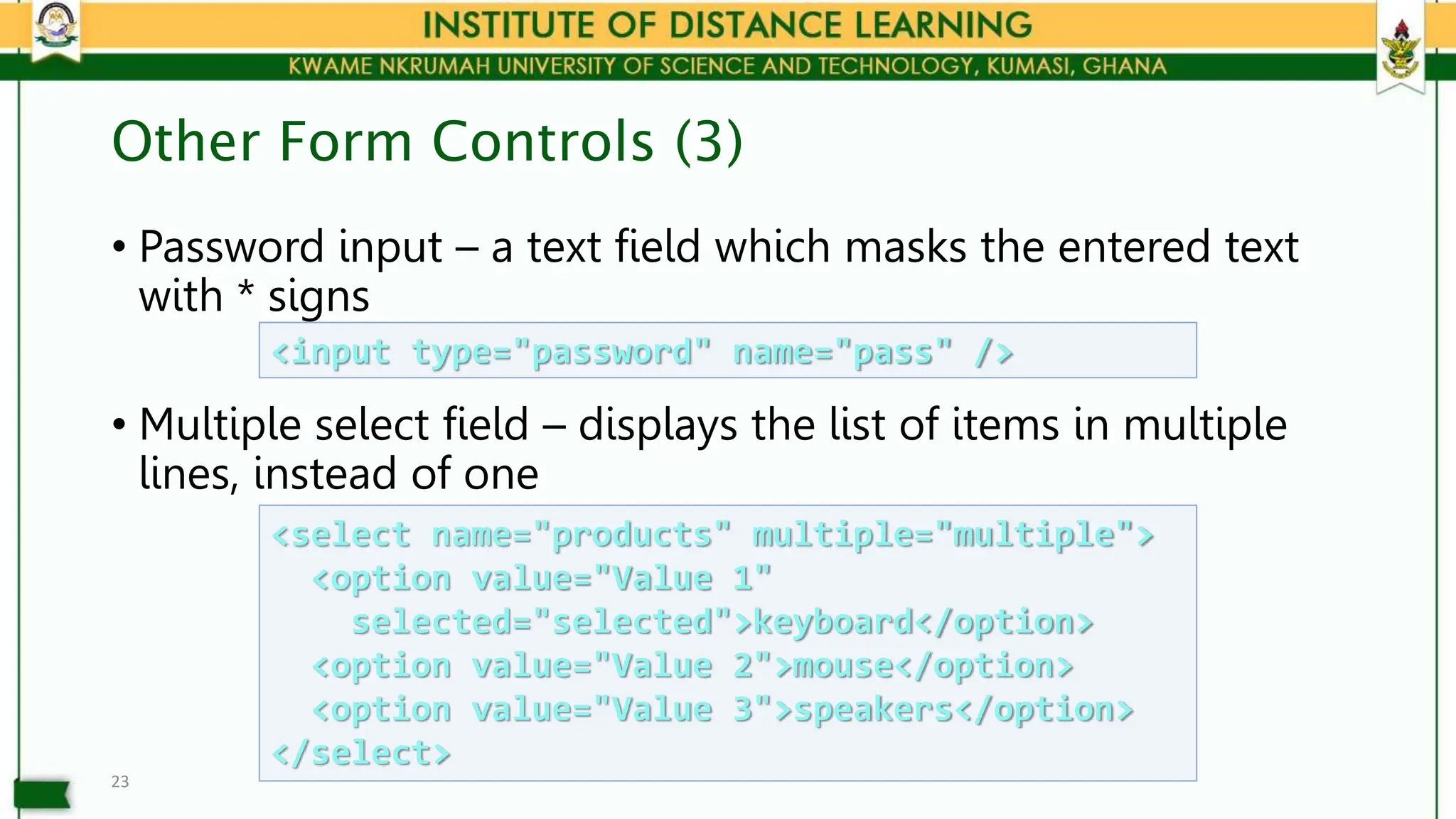
• Password input – a text field which masks the entered text
with * signs
• Multiple select field – displays the list of items in multiple
lines, instead of one
23
<input type="password" name="pass" />
<select name="products" multiple="multiple">
<option value="Value 1"
selected="selected">keyboard</option>
<option value="Value 2">mouse</option>
<option value="Value 3">speakers</option>
</select>
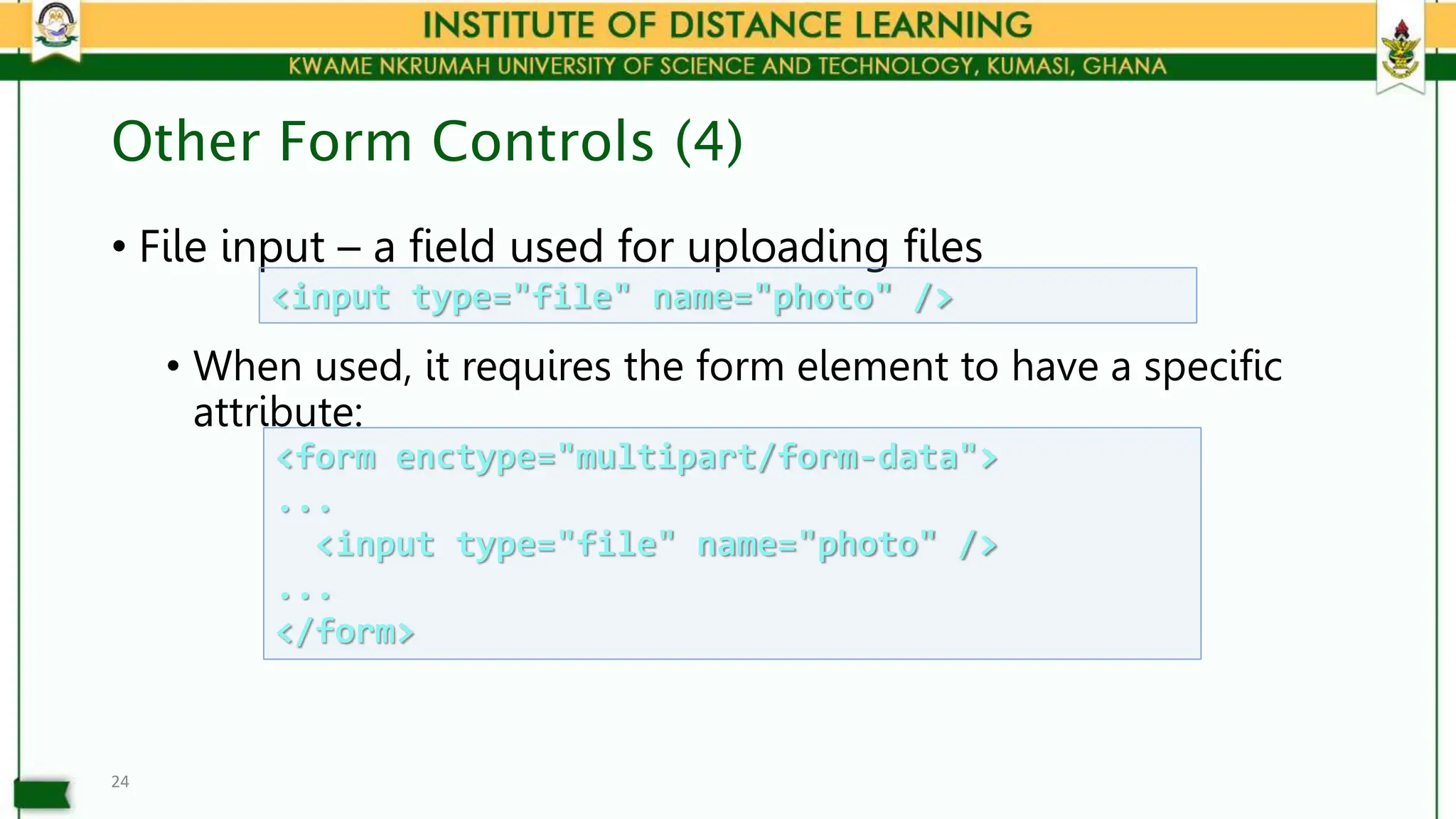
Other Form Controls (4)
• File input – a field used for uploading files
• When used, it requires the form element to have a specific
attribute:
24
<input type="file" name="photo" />
<form enctype="multipart/form-data">
...
<input type="file" name="photo" />
...
</form>
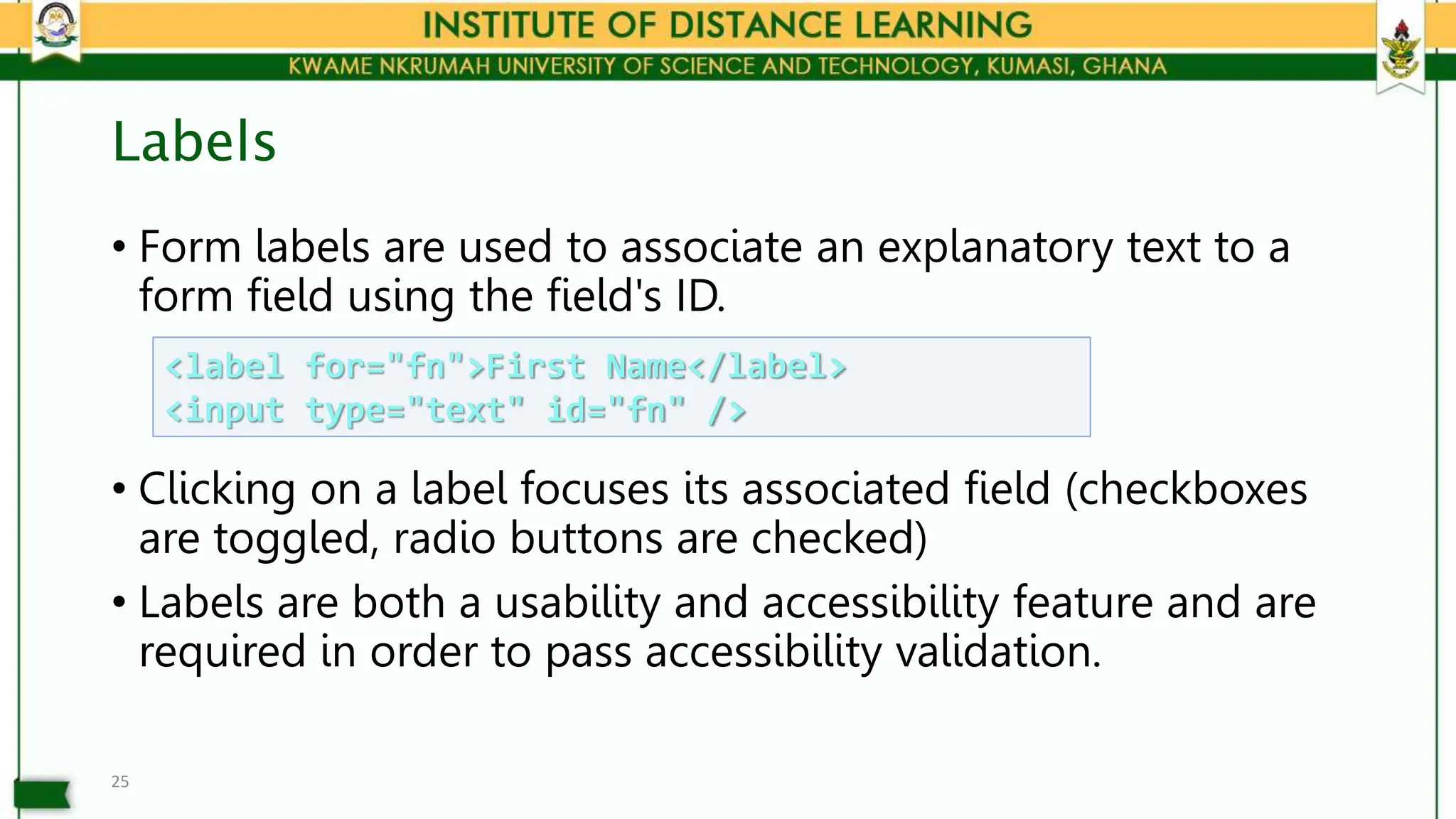
Labels
• Form labels are used to associate an explanatory text to a
form field using the field's ID.
• Clicking on a label focuses its associated field (checkboxes
are toggled, radio buttons are checked)
• Labels are both a usability and accessibility feature and are
required in order to pass accessibility validation.
25
<label for="fn">First Name</label>
<input type="text" id="fn" />
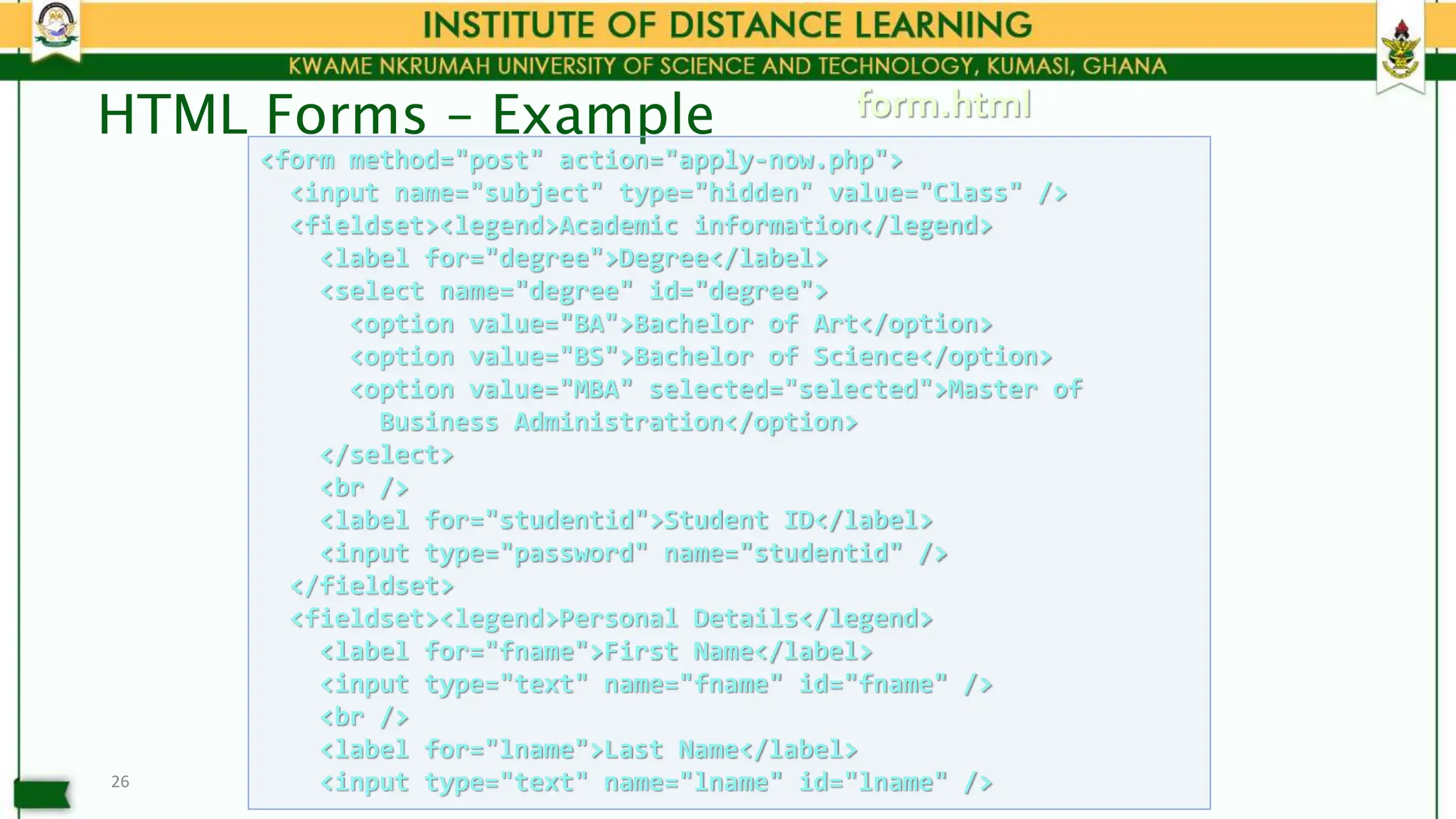
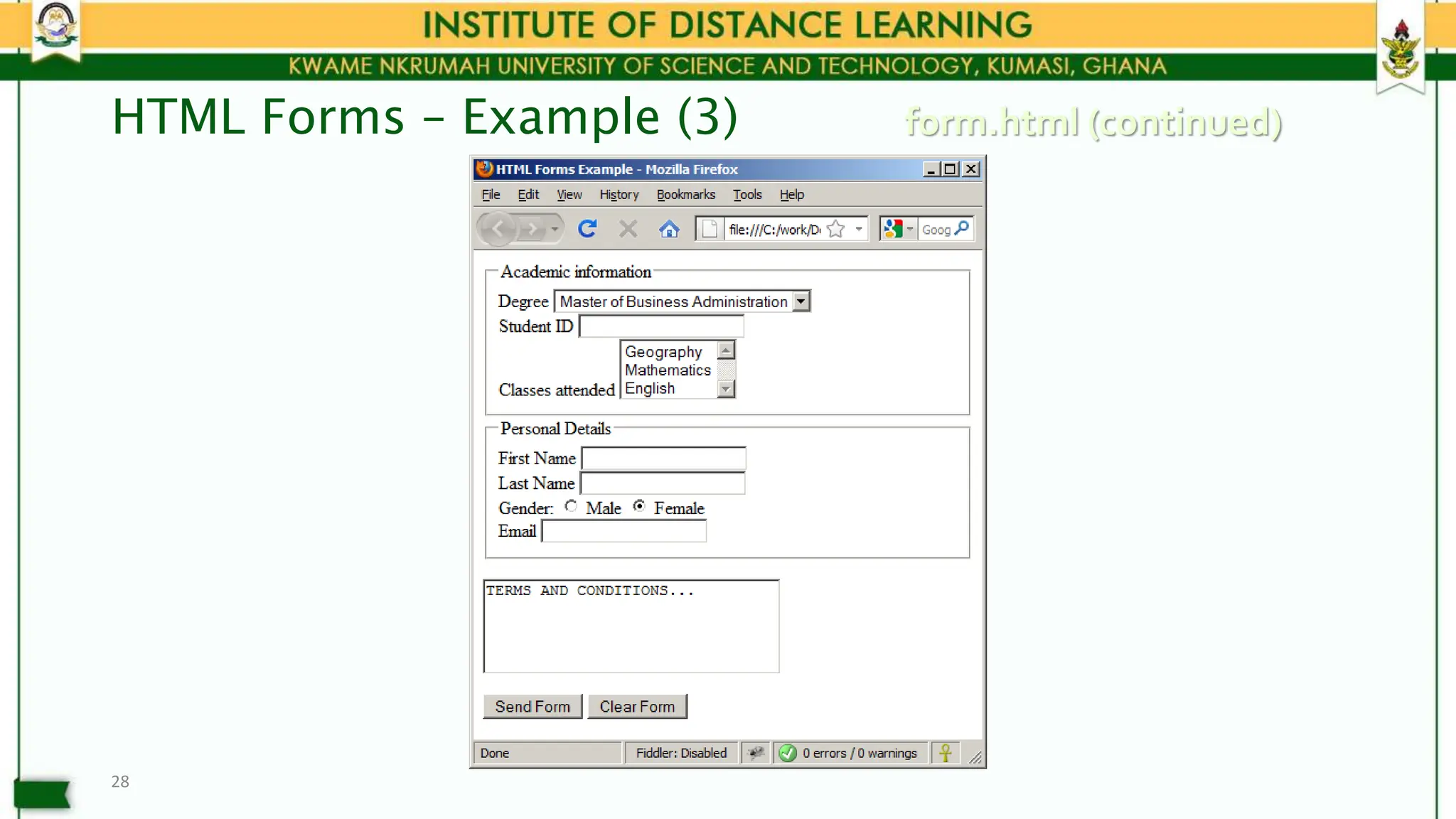
HTML Forms – Example
26
<form method="post" action="apply-now.php">
<input name="subject" type="hidden" value="Class" />
<fieldset><legend>Academic information</legend>
<label for="degree">Degree</label>
<select name="degree" id="degree">
<option value="BA">Bachelor of Art</option>
<option value="BS">Bachelor of Science</option>
<option value="MBA" selected="selected">Master of
Business Administration</option>
</select>
<br />
<label for="studentid">Student ID</label>
<input type="password" name="studentid" />
</fieldset>
<fieldset><legend>Personal Details</legend>
<label for="fname">First Name</label>
<input type="text" name="fname" id="fname" />
<br />
<label for="lname">Last Name</label>
<input type="text" name="lname" id="lname" />
form.html
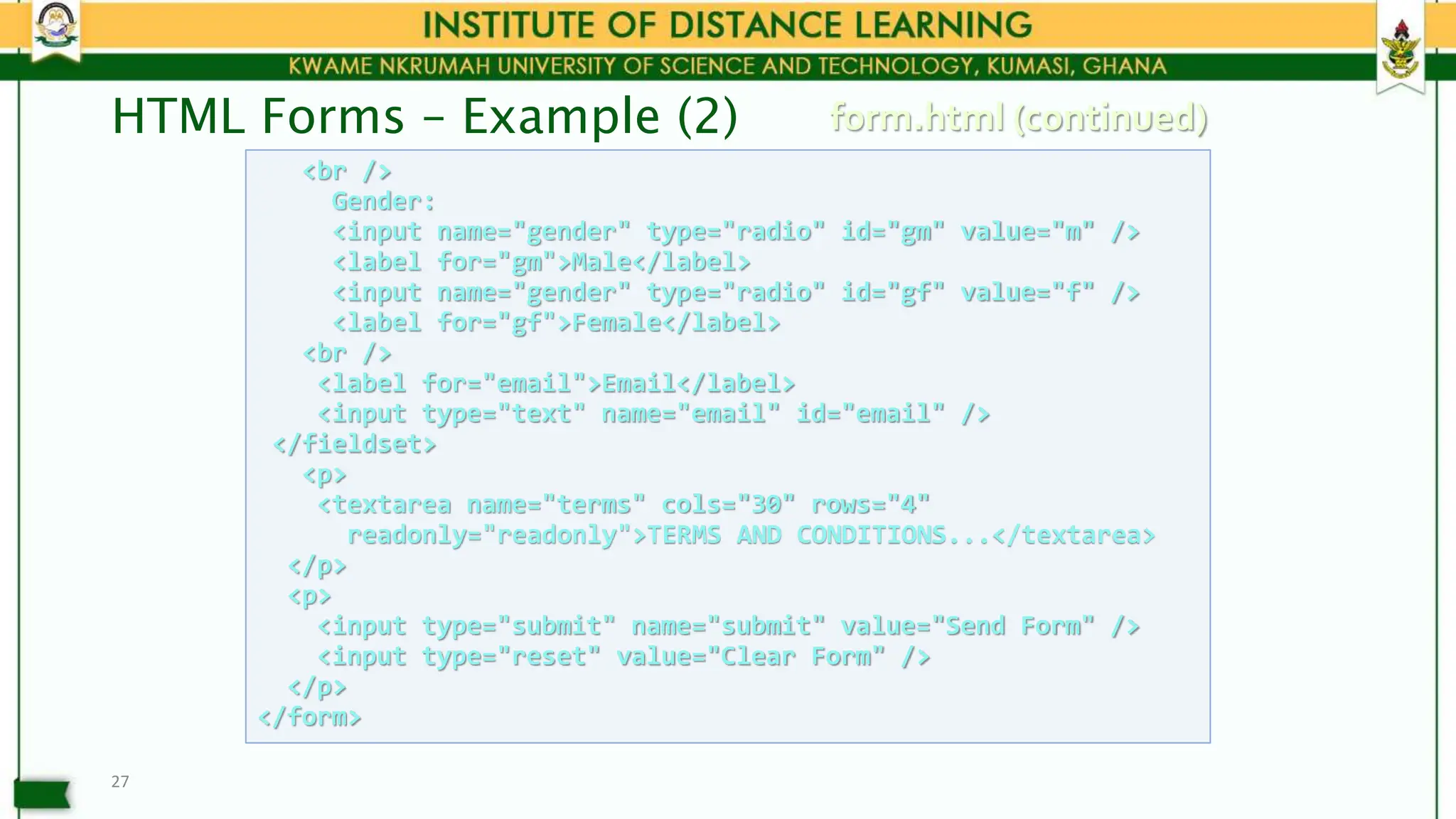
HTML Forms – Example (2)
27
<br />
Gender:
<input name="gender" type="radio" id="gm" value="m" />
<label for="gm">Male</label>
<input name="gender" type="radio" id="gf" value="f" />
<label for="gf">Female</label>
<br />
<label for="email">Email</label>
<input type="text" name="email" id="email" />
</fieldset>
<p>
<textarea name="terms" cols="30" rows="4"
readonly="readonly">TERMS AND CONDITIONS...</textarea>
</p>
<p>
<input type="submit" name="submit" value="Send Form" />
<input type="reset" value="Clear Form" />
</p>
</form>
form.html (continued)
HTML Forms – Example (3)
28
TabIndex
• The tabindex HTML attribute controls the order in which form
fields and hyperlinks are focused when repeatedly pressing the
TAB key
• tabindex="0" (zero) - "natural" order
• If X > Y, then elements with tabindex="X" are iterated before elements
with tabindex="Y"
• Elements with negative tabindex are skipped, however, this is not
defined in the standard
29
<input type="text" tabindex="10" />
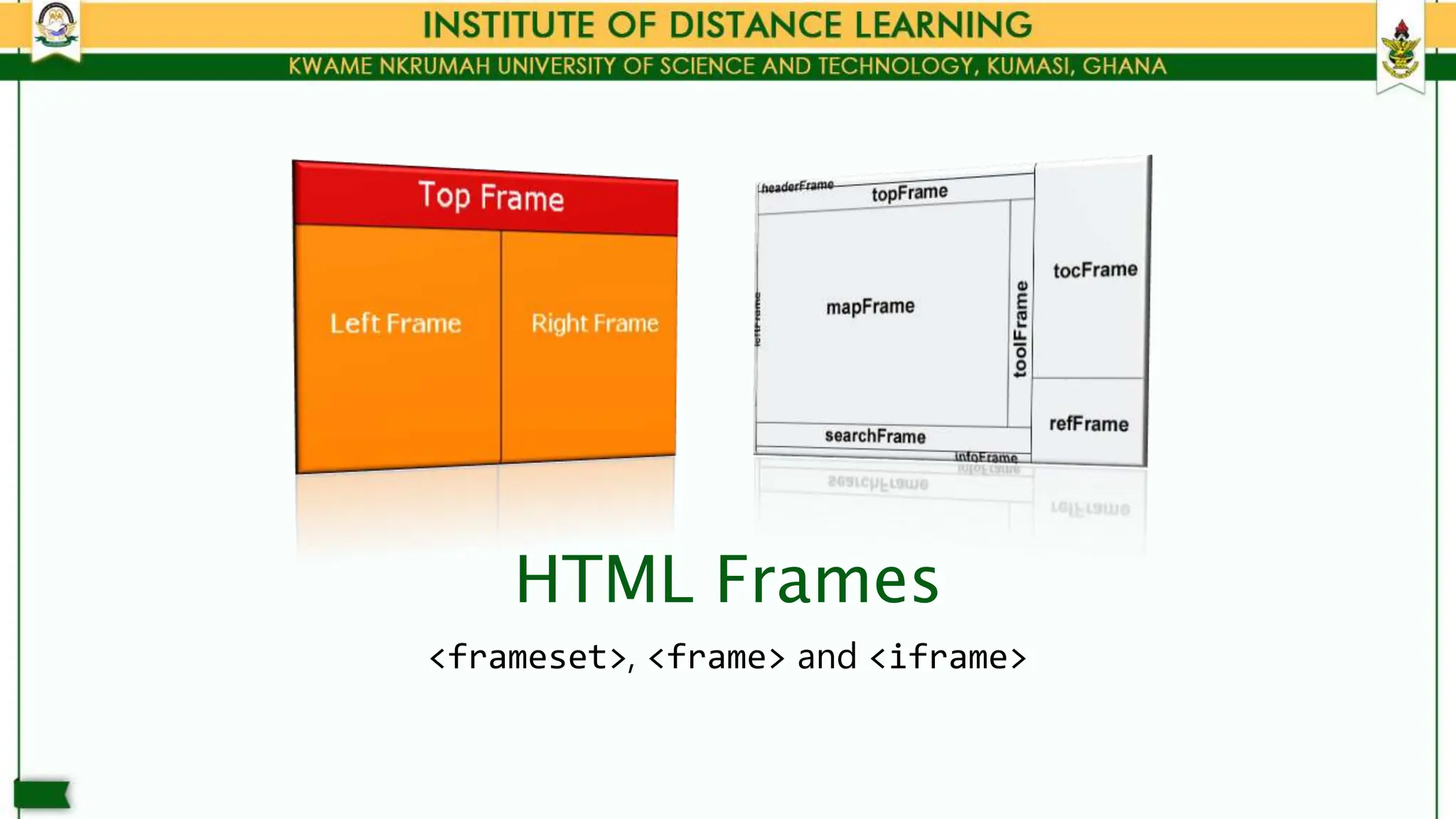
HTML Frames
<frameset>, <frame> and <iframe>
HTML Frames
• Frames provide a way to show multiple HTML documents in a
single Web page
• The page can be split into separate views (frames) horizontally
and vertically
• Frames were popular in the early ages of HTML development,
but now their usage is rejected
• Frames are not supported by all user agents (browsers, search
engines, etc.)
• A <noframes> element is used to provide content for non-compatible
agents.
31
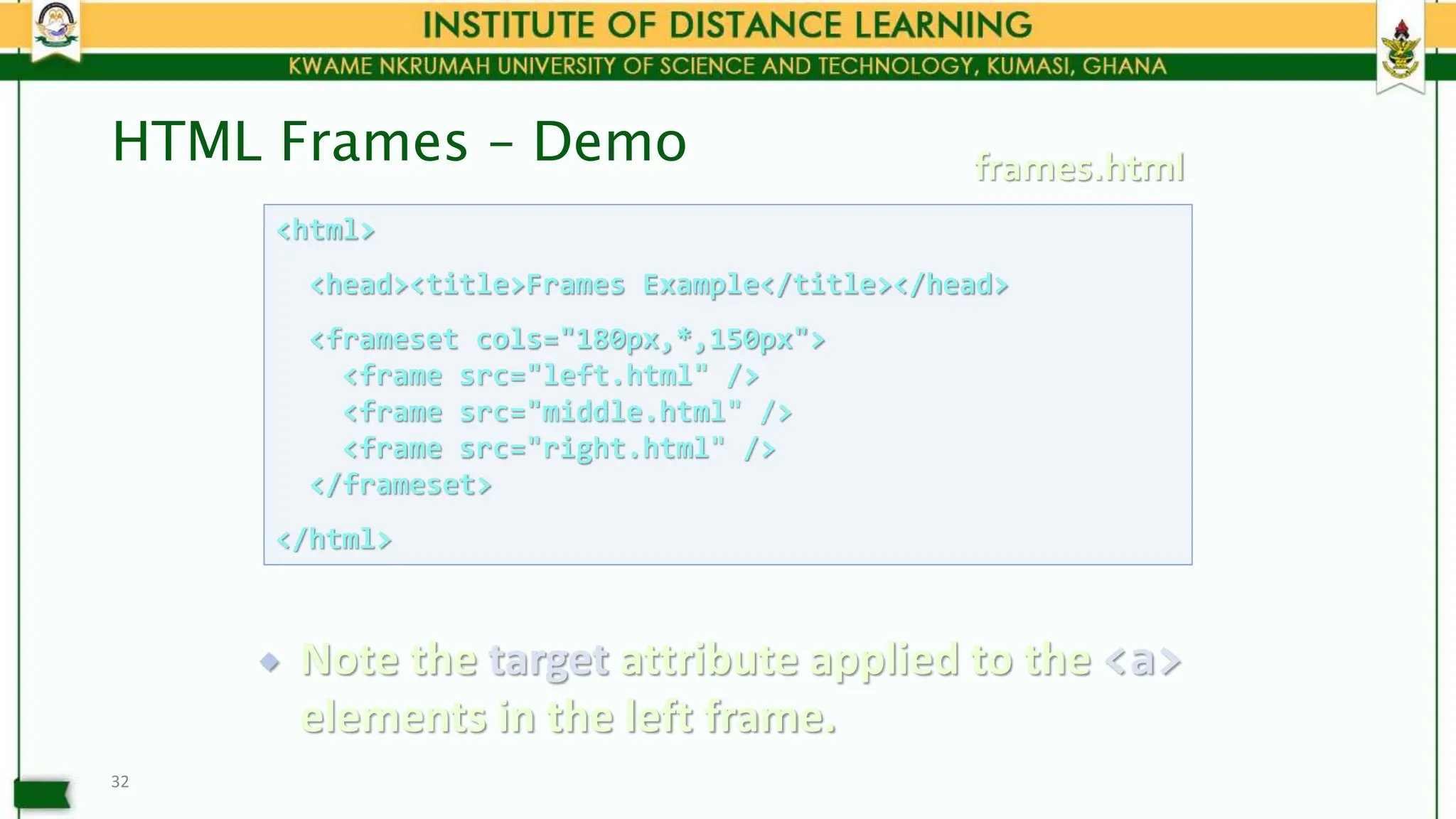
HTML Frames – Demo
32
<html>
<head><title>Frames Example</title></head>
<frameset cols="180px,*,150px">
<frame src="left.html" />
<frame src="middle.html" />
<frame src="right.html" />
</frameset>
</html>
frames.html
 Note the target attribute applied to the <a>
elements in the left frame.
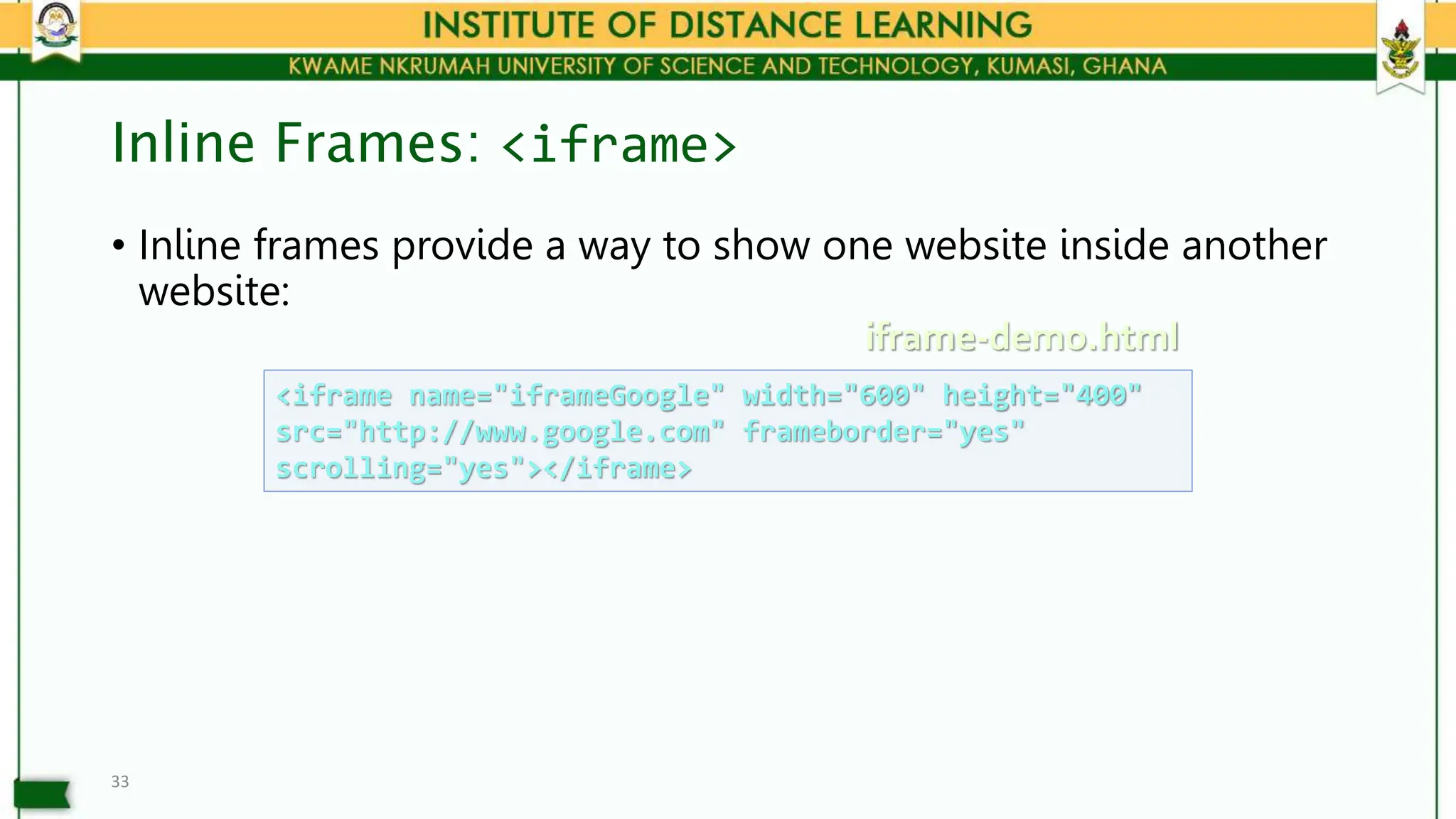
Inline Frames: <iframe>
• Inline frames provide a way to show one website inside another
website:
33
<iframe name="iframeGoogle" width="600" height="400"
src="http://www.google.com" frameborder="yes"
scrolling="yes"></iframe>
iframe-demo.html
Thank You
For any concerns, please contact
elearning@knust.edu.gh
elearningknust@gmail.com
0322 191132
Jan 2014

Tables and their padding in HTML etc.pptx

  • 1.
    CSM 399 Lecture 3 Jan2016 Web based concepts and development Emmanuel Ofori Oppong eoforioppong@yahoo.com // 0244213859
  • 2.
  • 3.
    HTML Tables • Tablesrepresent tabular data • A table consists of one or several rows • Each row has one or more columns • Tables comprised of several core tags: <table></table>: begin / end the table <tr></tr>: create a table row <td></td>: create tabular data (cell) • Tables should not be used for layout. Use CSS floats and positioning styles instead 2
  • 4.
    HTML Tables (2) •Start and end of a table • Start and end of a row • Start and end of a cell in a row 3 <table> ... </table> <tr> ... </tr> <td> ... </td>
  • 5.
    Simple HTML Tables– Example 4 <table cellspacing="0" cellpadding="5"> <tr> <td><img src="ppt.gif"></td> <td><a href="lecture1.ppt">Lecture 1</a></td> </tr> <tr> <td><img src="ppt.gif"></td> <td><a href="lecture2.ppt">Lecture 2</a></td> </tr> <tr> <td><img src="zip.gif"></td> <td><a href="lecture2-demos.zip"> Lecture 2 - Demos</a></td> </tr> </table>
  • 6.
    <table cellspacing="0" cellpadding="5"> <tr> <td><imgsrc="ppt.gif"></td> <td><a href="lecture1.ppt">Lecture 1</a></td> </tr> <tr> <td><img src="ppt.gif"></td> <td><a href="lecture2.ppt">Lecture 2</a></td> </tr> <tr> <td><img src="zip.gif"></td> <td><a href="lecture2-demos.zip"> Lecture 2 - Demos</a></td> </tr> </table> Simple HTML Tables – Example (2) 5
  • 7.
    Complete HTML Tables •Table rows split into three semantic sections: header, body and footer • <thead> denotes table header and contains <th> elements, instead of <td> elements • <tbody> denotes collection of table rows that contain the very data • <tfoot> denotes table footer but comes BEFORE the <tbody> tag • <colgroup> and <col> define columns (most often used to set column widths) 6
  • 8.
    Complete HTML Table:Example 7 <table> <colgroup> <col style="width:100px" /><col /> </colgroup> <thead> <tr><th>Column 1</th><th>Column 2</th></tr> </thead> <tfoot> <tr><td>Footer 1</td><td>Footer 2</td></tr> </tfoot> <tbody> <tr><td>Cell 1.1</td><td>Cell 1.2</td></tr> <tr><td>Cell 2.1</td><td>Cell 2.2</td></tr> </tbody> </table> header footer Last comes the body (data) th columns
  • 9.
    <table> <colgroup> <col style="width:200px" /><col/> </colgroup> <thead> <tr><th>Column 1</th><th>Column 2</th></tr> </thead> <tfoot> <tr><td>Footer 1</td><td>Footer 2</td></tr> </tfoot> <tbody> <tr><td>Cell 1.1</td><td>Cell 1.2</td></tr> <tr><td>Cell 2.1</td><td>Cell 2.2</td></tr> </tbody> </table> Complete HTML Table: Example (2) 8 table-full.html Although the footer is before the data in the code, it is displayed last By default, header text is bold and centered.
  • 10.
    Nested Tables • Tabledata “cells” (<td>) can contain nested tables (tables within tables): 9 <table> <tr> <td>Contact:</td> <td> <table> <tr> <td>First Name</td> <td>Last Name</td> </tr> </table> </td> </tr> </table> nested-tables.html
  • 11.
     cellpadding  Definesthe empty space around the cell content  cellspacing  Defines the empty space between cells Cell Spacing and Padding • Tables have two important attributes: 10 cell cell cell cell cell cell cell cell
  • 12.
    Cell Spacing andPadding – Example 11 <html> <head><title>Table Cells</title></head> <body> <table cellspacing="15" cellpadding="0"> <tr><td>First</td> <td>Second</td></tr> </table> <br/> <table cellspacing="0" cellpadding="10"> <tr><td>First</td><td>Second</td></tr> </table> </body> </html> table-cells.html
  • 13.
    Cell Spacing andPadding – Example (2) 12 <html> <head><title>Table Cells</title></head> <body> <table cellspacing="15" cellpadding="0"> <tr><td>First</td> <td>Second</td></tr> </table> <br/> <table cellspacing="0" cellpadding="10"> <tr><td>First</td><td>Second</td></tr> </table> </body> </html> table-cells.html
  • 14.
     rowspan  Defineshow many rows the cell occupies  colspan  Defines how many columns the cell occupies Column and Row Span • Table cells have two important attributes: 13 cell[1,1] cell[1,2] cell[2,1] colspan="1" colspan="1" colspan="2" cell[1,1] cell[1,2] cell[2,1] rowspan="2" rowspan="1" rowspan="1"
  • 15.
    Column and RowSpan – Example 14 <table cellspacing="0"> <tr class="1"><td>Cell[1,1]</td> <td colspan="2">Cell[2,1]</td></tr> <tr class=“2"><td>Cell[1,2]</td> <td rowspan="2">Cell[2,2]</td> <td>Cell[3,2]</td></tr> <tr class=“3"><td>Cell[1,3]</td> <td>Cell[2,3]</td></tr> </table> table-colspan-rowspan.html
  • 16.
    <table cellspacing="0"> <tr class="1"><td>Cell[1,1]</td> <tdcolspan="2">Cell[2,1]</td></tr> <tr class=“2"><td>Cell[1,2]</td> <td rowspan="2">Cell[2,2]</td> <td>Cell[3,2]</td></tr> <tr class=“3"><td>Cell[1,3]</td> <td>Cell[2,3]</td></tr> </table> Column and Row Span – Example (2) 15 table-colspan-rowspan.html Cell[2,3] Cell[1,3] Cell[3,2] Cell[2,2] Cell[1,2] Cell[2,1] Cell[1,1]
  • 17.
    HTML Forms Entering UserData from a Web Page
  • 18.
    HTML Forms • Formsare the primary method for gathering data from site visitors • Create a form block with • Example: 17 <form></form> <form name="myForm" method="post" action="path/to/some-script.php"> ... </form> The "action" attribute tells where the form data should be sent The “method" attribute tells how the form data should be sent – via GET or POST request
  • 19.
    Form Fields • Single-linetext input fields: • Multi-line textarea fields: • Hidden fields contain data not shown to the user: • Often used by JavaScript code 18 <input type="text" name="FirstName" value="This is a text field" /> <textarea name="Comments">This is a multi-line text field</textarea> <input type="hidden" name="Account" value="This is a hidden text field" />
  • 20.
    Fieldsets • Fieldsets areused to enclose a group of related form fields: 19 <form method="post" action="form.aspx"> <fieldset> <legend>Client Details</legend> <input type="text" id="Name" /> <input type="text" id="Phone" /> </fieldset> <fieldset> <legend>Order Details</legend> <input type="text" id="Quantity" /> <textarea cols="40" rows="10" id="Remarks"></textarea> </fieldset> </form>
  • 21.
    Form Input Controls •Checkboxes: • Radio buttons: • Radio buttons can be grouped, allowing only one to be selected from a group: 20 <input type="checkbox" name="fruit" value="apple" /> <input type="radio" name="title" value="Mr." /> <input type="radio" name="city" value="Lom" /> <input type="radio" name="city" value="Ruse" />
  • 22.
    Other Form Controls •Dropdown menus: • Submit button: 21 <select name="gender"> <option value="Value 1" selected="selected">Male</option> <option value="Value 2">Female</option> <option value="Value 3">Other</option> </select> <input type="submit" name="submitBtn" value="Apply Now" />
  • 23.
    Other Form Controls(2) • Reset button – brings the form to its initial state • Image button – acts like submit but image is displayed and click coordinates are sent • Ordinary button – used for Javascript, no default action 22 <input type="reset" name="resetBtn" value="Reset the form" /> <input type="image" src="submit.gif" name="submitBtn" alt="Submit" /> <input type="button" value="click me" />
  • 24.
    Other Form Controls(3) • Password input – a text field which masks the entered text with * signs • Multiple select field – displays the list of items in multiple lines, instead of one 23 <input type="password" name="pass" /> <select name="products" multiple="multiple"> <option value="Value 1" selected="selected">keyboard</option> <option value="Value 2">mouse</option> <option value="Value 3">speakers</option> </select>
  • 25.
    Other Form Controls(4) • File input – a field used for uploading files • When used, it requires the form element to have a specific attribute: 24 <input type="file" name="photo" /> <form enctype="multipart/form-data"> ... <input type="file" name="photo" /> ... </form>
  • 26.
    Labels • Form labelsare used to associate an explanatory text to a form field using the field's ID. • Clicking on a label focuses its associated field (checkboxes are toggled, radio buttons are checked) • Labels are both a usability and accessibility feature and are required in order to pass accessibility validation. 25 <label for="fn">First Name</label> <input type="text" id="fn" />
  • 27.
    HTML Forms –Example 26 <form method="post" action="apply-now.php"> <input name="subject" type="hidden" value="Class" /> <fieldset><legend>Academic information</legend> <label for="degree">Degree</label> <select name="degree" id="degree"> <option value="BA">Bachelor of Art</option> <option value="BS">Bachelor of Science</option> <option value="MBA" selected="selected">Master of Business Administration</option> </select> <br /> <label for="studentid">Student ID</label> <input type="password" name="studentid" /> </fieldset> <fieldset><legend>Personal Details</legend> <label for="fname">First Name</label> <input type="text" name="fname" id="fname" /> <br /> <label for="lname">Last Name</label> <input type="text" name="lname" id="lname" /> form.html
  • 28.
    HTML Forms –Example (2) 27 <br /> Gender: <input name="gender" type="radio" id="gm" value="m" /> <label for="gm">Male</label> <input name="gender" type="radio" id="gf" value="f" /> <label for="gf">Female</label> <br /> <label for="email">Email</label> <input type="text" name="email" id="email" /> </fieldset> <p> <textarea name="terms" cols="30" rows="4" readonly="readonly">TERMS AND CONDITIONS...</textarea> </p> <p> <input type="submit" name="submit" value="Send Form" /> <input type="reset" value="Clear Form" /> </p> </form> form.html (continued)
  • 29.
  • 30.
    TabIndex • The tabindexHTML attribute controls the order in which form fields and hyperlinks are focused when repeatedly pressing the TAB key • tabindex="0" (zero) - "natural" order • If X > Y, then elements with tabindex="X" are iterated before elements with tabindex="Y" • Elements with negative tabindex are skipped, however, this is not defined in the standard 29 <input type="text" tabindex="10" />
  • 31.
  • 32.
    HTML Frames • Framesprovide a way to show multiple HTML documents in a single Web page • The page can be split into separate views (frames) horizontally and vertically • Frames were popular in the early ages of HTML development, but now their usage is rejected • Frames are not supported by all user agents (browsers, search engines, etc.) • A <noframes> element is used to provide content for non-compatible agents. 31
  • 33.
    HTML Frames –Demo 32 <html> <head><title>Frames Example</title></head> <frameset cols="180px,*,150px"> <frame src="left.html" /> <frame src="middle.html" /> <frame src="right.html" /> </frameset> </html> frames.html  Note the target attribute applied to the <a> elements in the left frame.
  • 34.
    Inline Frames: <iframe> •Inline frames provide a way to show one website inside another website: 33 <iframe name="iframeGoogle" width="600" height="400" src="http://www.google.com" frameborder="yes" scrolling="yes"></iframe> iframe-demo.html
  • 35.
    Thank You For anyconcerns, please contact elearning@knust.edu.gh elearningknust@gmail.com 0322 191132 Jan 2014

Editor's Notes