Dining Etiquette
What is Dining Etiquette?
• A set of rules that govern the
expectations of social and dining
behavior in a workplace, group or
society.
• Table manners are visible signs that
you are a polished and
knowledgeable professional.
Why Interview Over a Meal?
• Employers need to trust you can represent
them in social settings with customers,
clients, colleagues and competitors. They
will be watching your dining manners. Why?
• The focus is on the interview, not the food!
• Eat a light snack before you go. Why?
• It’s NOT about the food!
For Today:
• You have been invited to an
interview at a local
restaurant for lunch.
• You know the names of the
people you will be meeting
from the email invite.
• You know the specifics like
date, time, place.
• You have applied for the
position and have had a
phone screen.
What do you need to do BEFORE
the interview/lunch?
• Make sure you know where you’re
going! Don’t trust your phone! Arrive
on time!
• Check out the menu – especially if you
have dietary restrictions! Why?
• Link with those attending on LinkedIn.
Why?
• Read the paper/watch the news/know
what’s going on in the world. Why?
• What 2 things do you NOT talk about?
When you arrive at the
restaurant:
• What do you do if you don’t see the
people you are meeting?
• Introduce yourself and wait to be
suggested where to sit.
• How do you know what to do/when
to do?
• What’s the role of the employer
throughout the meal/interview?
How to get started:
• How do you know what to order?
• What about alcohol?
• What to do if you get the wrong
order/food?
• Tricks/attempts to make you
mess up!
• Wait for employer to bring up
business matters. Why?
Table Settings
• Put napkin on lap as soon as host does.
Napkins remain on your lap until
completion of meal. Never use as a
bib.
• If napkin falls on the floor, signal a
member of the serving staff for a new
one.
• Pick up silverware from the outside in –
toward your plate.
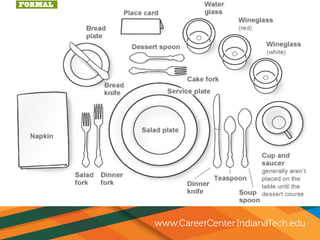
Let’s understand the table
setting:
• What goes where? Understanding
what you have, what it’s used for, and
when to use certain elements of the
place setting.
• Coffee cup & saucer never leaves
table. It can also be used as a trash
spot. 
• Difference in round table vs. oblong.
• What, who, how and when to pass.
Passing
• Salt and pepper are always passed
together, as is the packet container.
• Food is served from the left and dishes
are cleared from the right.
• Everything gets passed to the right. If
you are first to take the bread basket,
offer to your left first, take your piece,
then pass to the right.
• When butter is passed, take enough
for yourself and place it on the edge of
your B&B plate.
Courses
• Appetizer
• Soup
• Salad
• Entrée
• Dessert
• Plated verses served
Ordering
• Take your lead from the employer
when ordering.
• Do not order the most expensive item
on the menu. Why?
• Order something that will be easy to
eat and not messy – no spaghetti,
chicken wings, ribs, etc.
• Do not order alcohol! If the host
orders a bottle of wine and insists,
only take sips from ONE glass.
Eating Tips
• Eat rolls by tearing off bite size pieces
and buttering only one piece at a time.
• Cut your salad if the leaves are too
large.
• If food spills off your plate, you may
pick it up with a piece of your
silverware and place it on the edge of
your plate.
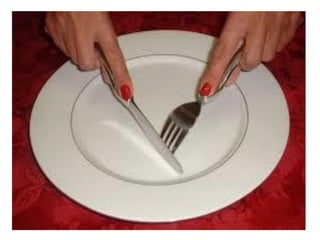
Utensils
• Do not make a fist around the
handle of the utensil.
• Continental style: cut food one bite
at a time, use the fork in left hand,
tines down, to spear the food and
bring to mouth.
• American Standard style: cut food a
few bites at a time, lay the knife
across the plate (sharp edges
toward you), and switch fork to right
hand to eat.
Service
• Wait for the employer to pick up his/her
fork to eat first.
• Wait until everyone at the table has
been served before beginning to eat.
• Never reach across the table for
something, always ask for it to be
passed.
• Keep pace with your dining partners,
don’t finish too far ahead or too far
behind. Why?
• Take small bites! You’ll be answering
questions.
More on Service
• “Eat from the outside in.”
• Use one utensil for each course, but keep
your knife if you used it for salad.
• Unused silverware is left on the table.
• Never put dirty silverware directly on the
table, use your plate or bread/butter
plate.
• Kill the wait staff with kindness. Reflection
of how you treat others!
More Eating Tips
• Do not talk with food in your mouth.
• Chew with your mouth closed.
• Do not blow on your soup to cool it; stir
it gently to cool off. Spoon soup away
from you to eat.
• Do not leave the spoon in the bowl – put
it on the saucer/platter.
• Never rest your elbows on the table –
forearms are ok.
• Taste your food before seasoning it.
Why?
Even More Eating Tips
• For hard to scoop items, use your knife
or a piece of bread to push the items
onto your fork.
• If you don’t like something, don’t eat it,
but don’t make a big deal out of it.
• If you don’t like coffee or don’t want
anymore refills, simply place your hand
over the cup when offered, or tell the
waiter “no, thank you.”
When You Are Finished
• Lay your fork and knife (sharp side of
knife inward), at the 4:00/10:00
position.
• Leave plate where it is – don’t push it
away.
• Used napkin goes to the left your
plate, not on top of the plate.
• Do not ask for a doggy bag or to-go
bag. Why?
• Do not ask for a toothpick.
• Do not offer to pay; host pays.
Common Sense Etiquette
• Turn off phone before any meal or
interview, better yet, don’t take your
phone to the interview/lunch.
• Men should never wear a hat at the
table.
• Do not smoke before or at an interview
meal. Why?
• Excuse yourself to go to the restroom
to blow your nose – don’t blow your
nose into your napkin.
Additional Tips
• If you drop a utensil, pick it up and
ask for a new one. If you can’t reach
it, let the server know it’s down
there.
• What happens if you spill?
• If you need to excuse yourself, put
your napkin on the back of your chair
or next to your plate.
Final Etiquette Points
• Use “please” and “thank-you” and
always be polite to the wait staff.
• Remember: the main point of the
meal is the interview, not the food.
• Follow up with any reimbursements,
mileage, etc. as directed! Follow
directions!
• Always send a thank-you note for the
interview and the meal.
Questions?
Table Manners for business proffesionals

Table Manners for business proffesionals

  • 1.
  • 2.
    What is DiningEtiquette? • A set of rules that govern the expectations of social and dining behavior in a workplace, group or society. • Table manners are visible signs that you are a polished and knowledgeable professional.
  • 3.
    Why Interview Overa Meal? • Employers need to trust you can represent them in social settings with customers, clients, colleagues and competitors. They will be watching your dining manners. Why? • The focus is on the interview, not the food! • Eat a light snack before you go. Why? • It’s NOT about the food!
  • 4.
    For Today: • Youhave been invited to an interview at a local restaurant for lunch. • You know the names of the people you will be meeting from the email invite. • You know the specifics like date, time, place. • You have applied for the position and have had a phone screen.
  • 5.
    What do youneed to do BEFORE the interview/lunch? • Make sure you know where you’re going! Don’t trust your phone! Arrive on time! • Check out the menu – especially if you have dietary restrictions! Why? • Link with those attending on LinkedIn. Why? • Read the paper/watch the news/know what’s going on in the world. Why? • What 2 things do you NOT talk about?
  • 6.
    When you arriveat the restaurant: • What do you do if you don’t see the people you are meeting? • Introduce yourself and wait to be suggested where to sit. • How do you know what to do/when to do? • What’s the role of the employer throughout the meal/interview?
  • 7.
    How to getstarted: • How do you know what to order? • What about alcohol? • What to do if you get the wrong order/food? • Tricks/attempts to make you mess up! • Wait for employer to bring up business matters. Why?
  • 8.
    Table Settings • Putnapkin on lap as soon as host does. Napkins remain on your lap until completion of meal. Never use as a bib. • If napkin falls on the floor, signal a member of the serving staff for a new one. • Pick up silverware from the outside in – toward your plate.
  • 10.
    Let’s understand thetable setting: • What goes where? Understanding what you have, what it’s used for, and when to use certain elements of the place setting. • Coffee cup & saucer never leaves table. It can also be used as a trash spot.  • Difference in round table vs. oblong. • What, who, how and when to pass.
  • 11.
    Passing • Salt andpepper are always passed together, as is the packet container. • Food is served from the left and dishes are cleared from the right. • Everything gets passed to the right. If you are first to take the bread basket, offer to your left first, take your piece, then pass to the right. • When butter is passed, take enough for yourself and place it on the edge of your B&B plate.
  • 12.
    Courses • Appetizer • Soup •Salad • Entrée • Dessert • Plated verses served
  • 13.
    Ordering • Take yourlead from the employer when ordering. • Do not order the most expensive item on the menu. Why? • Order something that will be easy to eat and not messy – no spaghetti, chicken wings, ribs, etc. • Do not order alcohol! If the host orders a bottle of wine and insists, only take sips from ONE glass.
  • 14.
    Eating Tips • Eatrolls by tearing off bite size pieces and buttering only one piece at a time. • Cut your salad if the leaves are too large. • If food spills off your plate, you may pick it up with a piece of your silverware and place it on the edge of your plate.
  • 15.
    Utensils • Do notmake a fist around the handle of the utensil. • Continental style: cut food one bite at a time, use the fork in left hand, tines down, to spear the food and bring to mouth. • American Standard style: cut food a few bites at a time, lay the knife across the plate (sharp edges toward you), and switch fork to right hand to eat.
  • 17.
    Service • Wait forthe employer to pick up his/her fork to eat first. • Wait until everyone at the table has been served before beginning to eat. • Never reach across the table for something, always ask for it to be passed. • Keep pace with your dining partners, don’t finish too far ahead or too far behind. Why? • Take small bites! You’ll be answering questions.
  • 18.
    More on Service •“Eat from the outside in.” • Use one utensil for each course, but keep your knife if you used it for salad. • Unused silverware is left on the table. • Never put dirty silverware directly on the table, use your plate or bread/butter plate. • Kill the wait staff with kindness. Reflection of how you treat others!
  • 19.
    More Eating Tips •Do not talk with food in your mouth. • Chew with your mouth closed. • Do not blow on your soup to cool it; stir it gently to cool off. Spoon soup away from you to eat. • Do not leave the spoon in the bowl – put it on the saucer/platter. • Never rest your elbows on the table – forearms are ok. • Taste your food before seasoning it. Why?
  • 20.
    Even More EatingTips • For hard to scoop items, use your knife or a piece of bread to push the items onto your fork. • If you don’t like something, don’t eat it, but don’t make a big deal out of it. • If you don’t like coffee or don’t want anymore refills, simply place your hand over the cup when offered, or tell the waiter “no, thank you.”
  • 21.
    When You AreFinished • Lay your fork and knife (sharp side of knife inward), at the 4:00/10:00 position. • Leave plate where it is – don’t push it away. • Used napkin goes to the left your plate, not on top of the plate. • Do not ask for a doggy bag or to-go bag. Why? • Do not ask for a toothpick. • Do not offer to pay; host pays.
  • 22.
    Common Sense Etiquette •Turn off phone before any meal or interview, better yet, don’t take your phone to the interview/lunch. • Men should never wear a hat at the table. • Do not smoke before or at an interview meal. Why? • Excuse yourself to go to the restroom to blow your nose – don’t blow your nose into your napkin.
  • 23.
    Additional Tips • Ifyou drop a utensil, pick it up and ask for a new one. If you can’t reach it, let the server know it’s down there. • What happens if you spill? • If you need to excuse yourself, put your napkin on the back of your chair or next to your plate.
  • 24.
    Final Etiquette Points •Use “please” and “thank-you” and always be polite to the wait staff. • Remember: the main point of the meal is the interview, not the food. • Follow up with any reimbursements, mileage, etc. as directed! Follow directions! • Always send a thank-you note for the interview and the meal.
  • 25.