Karakoram international university Gilgi
t Baltistan
Presentation Given By Ma'am Shameem
Presentation prepared By Muhammad Sulaiman Muhammadi
Student Registration Number is 2020-KIU-BS 1284
Book subject title Syntax BS 5th semester
Department of English literature and linguistics Karakorum inter
national university Gilgit Baltistan
Introduction to Syntax P
hrase Structure
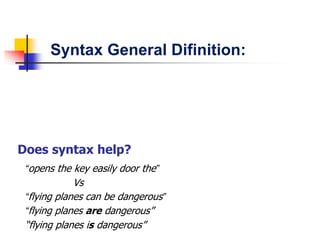
Does syntax help?
“opens the key easily door the”
Vs
“flying planes can be dangerous”
“flying planes are dangerous”
“flying planes is dangerous”
Syntax General Difinition:
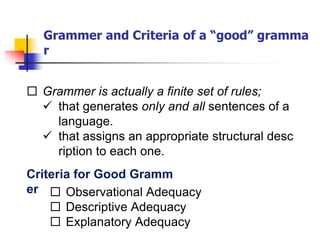
Grammer and Criteria of a “good” gramma
r
 Grammer is actually a finite set of rules;
 that generates only and all sentences of a
language.
 that assigns an appropriate structural desc
ription to each one.
Criteria for Good Gramm
er  Observational Adequacy
 Descriptive Adequacy
 Explanatory Adequacy
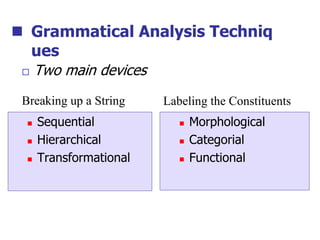
 Grammatical Analysis Techniq
ues
 Two main devices
 Morphological
 Categorial
 Functional
 Sequential
 Hierarchical
 Transformational
Breaking up a String Labeling the Constituents
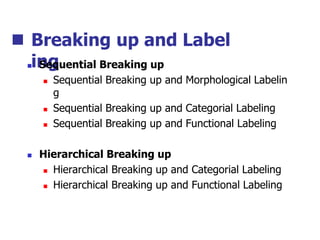
 Breaking up and Label
ing
 Sequential Breaking up
 Sequential Breaking up and Morphological Labelin
g
 Sequential Breaking up and Categorial Labeling
 Sequential Breaking up and Functional Labeling
 Hierarchical Breaking up
 Hierarchical Breaking up and Categorial Labeling
 Hierarchical Breaking up and Functional Labeling
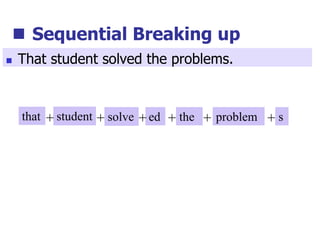
 Sequential Breaking up
that student solve ed the problem s
+ + + + + +
 That student solved the problems.
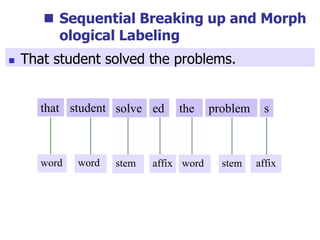
 Sequential Breaking up and Morph
ological Labeling
 That student solved the problems.
that student solve ed the problem s
word word stem affix word stem affix
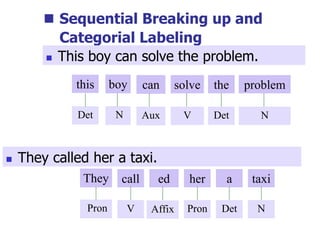
 Sequential Breaking up and
Categorial Labeling
 This boy can solve the problem.
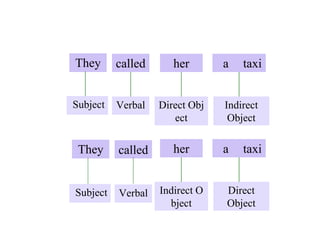
 They called her a taxi.
this boy can solve the problem
Det N Aux V Det N
They call ed taxi
Pron V Affix N
her
Pron
a
Det
They called taxi
Subject Verbal Indirect
Object
her
Direct Obj
ect
a
They called
Subject Verbal
taxi
Direct
Object
her
Indirect O
bject
a
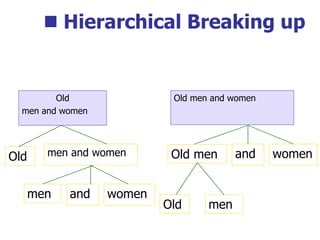
 Hierarchical Breaking up
Old
men and women
Old men and women
Old men and women Old men and women
women
and
men
men
Old
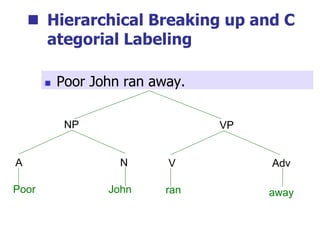
 Hierarchical Breaking up and C
ategorial Labeling
S
VP
V Adv
ran away
NP
A N
Poor John
 Poor John ran away.
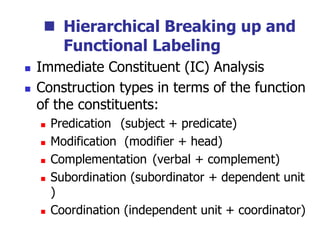
 Hierarchical Breaking up and
Functional Labeling
 Immediate Constituent (IC) Analysis
 Construction types in terms of the function
of the constituents:
 Predication (subject + predicate)
 Modification (modifier + head)
 Complementation (verbal + complement)
 Subordination (subordinator + dependent unit
)
 Coordination (independent unit + coordinator)
 Predication
 [Birds]subject [fly]predicate
S
Predicate
Subject
Birds fly
 Modification
 [A]modifier [flower]head
 John [slept]head [in the room]modifier
S
Predicate
Subject
John Head Modifier
slept In the room
 Complementation
 He [saw]verbal [a lake]complement
S
Predicate
Subject
He Verbal Complement
saw a lake
 Subordination
 John slept [in]subordinator [the room]dependent unit
S
Predicate
Subject
John Head Modifier
slept
the room
Subordinator Dependent Unit
in
 Coordination
 [John came in time] independent unit [but]coordinator [Mary was not r
eady] independent unit
S
Coordinator
Independent Unit
John came in time but Mary was not ready
Independent Unit
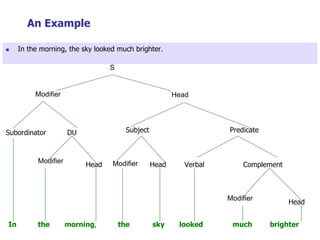
S
Head
Modifier
In the morning, the sky looked much brighter
Subordinator DU Predicate
Subject
Head
Head
Head Verbal Complement
Modifier
Modifier
Modifier
 In the morning, the sky looked much brighter.
An Example
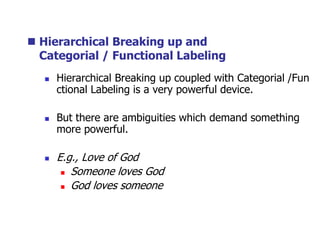
 Hierarchical Breaking up and
Categorial / Functional Labeling
 Hierarchical Breaking up coupled with Categorial /Fun
ctional Labeling is a very powerful device.
 But there are ambiguities which demand something
more powerful.
 E.g., Love of God
 Someone loves God
 God loves someone
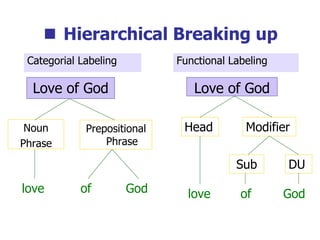
 Hierarchical Breaking up
Love of God Love of God
Noun
Phrase
Prepositional
Phrase
Head
DU
Modifier
God
of
love
Sub
love of God
Categorial Labeling Functional Labeling
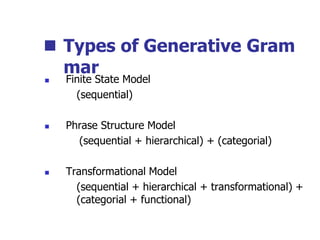
 Types of Generative Gram
mar
 Finite State Model
(sequential)
 Phrase Structure Model
(sequential + hierarchical) + (categorial)
 Transformational Model
(sequential + hierarchical + transformational) +
(categorial + functional)
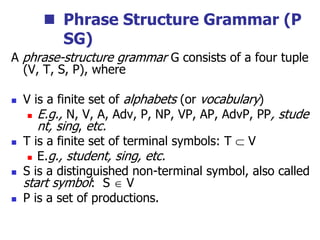
 Phrase Structure Grammar (P
SG)
A phrase-structure grammar G consists of a four tuple
(V, T, S, P), where
 V is a finite set of alphabets (or vocabulary)
 E.g., N, V, A, Adv, P, NP, VP, AP, AdvP, PP, stude
nt, sing, etc.
 T is a finite set of terminal symbols: T  V
 E.g., student, sing, etc.
 S is a distinguished non-terminal symbol, also called
start symbol: S  V
 P is a set of productions.
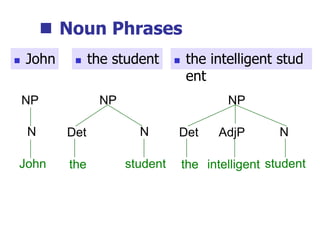
 Noun Phrases
John
NP
N
student
NP
N
the
Det
student
NP
N
the
Det
intelligent
AdjP
 John  the student  the intelligent stud
ent
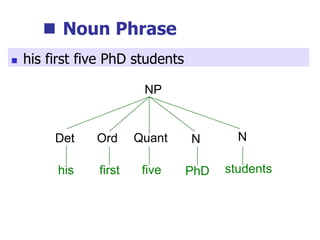
 Noun Phrase
five
NP
Quant
his
Det
first
Ord
students
N
PhD
N
 his first five PhD students
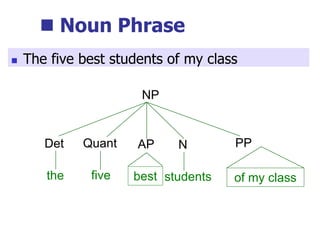
 Noun Phrase
five
NP
Quant
the
Det
students
N
best
AP
of my class
PP
 The five best students of my class
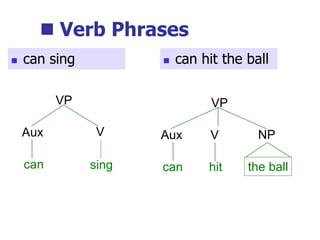
 Verb Phrases
sing
VP
V
can
Aux
the ball
VP
NP
can
Aux
hit
V
 can sing  can hit the ball
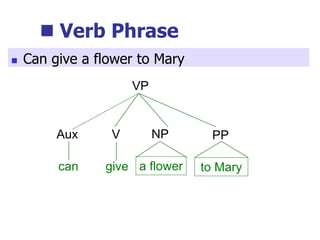
 Verb Phrase
a flower
VP
NP
can
Aux
give
V
to Mary
PP
 Can give a flower to Mary
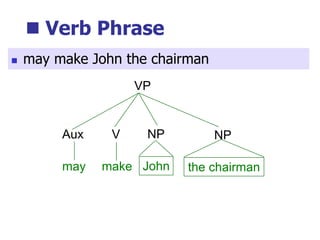
 Verb Phrase
John
VP
NP
may
Aux
make
V
the chairman
NP
 may make John the chairman
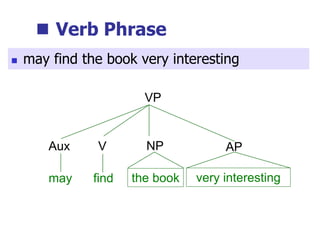
 Verb Phrase
the book
VP
NP
may
Aux
find
V
very interesting
AP
 may find the book very interesting
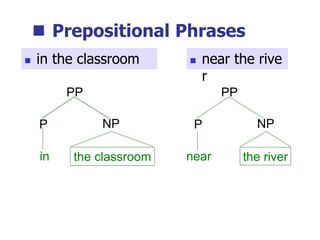
 Prepositional Phrases
 in the classroom
the river
PP
NP
near
P
the classroom
PP
NP
in
P
 near the rive
r
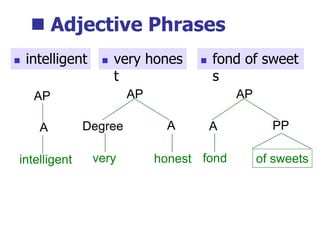
 Adjective Phrases
intelligent
AP
A
honest
AP
A
very
Degree
of sweets
AP
PP
fond
A
 intelligent  very hones
t
 fond of sweet
s
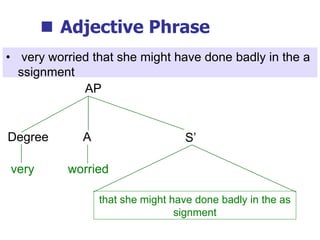
 Adjective Phrase
• very worried that she might have done badly in the a
ssignment
that she might have done badly in the as
signment
AP
S’
very
Degree
worried
A
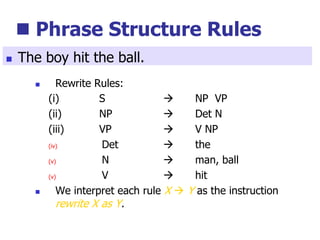
 Phrase Structure Rules
 Rewrite Rules:
(i) S  NP VP
(ii) NP  Det N
(iii) VP  V NP
(iv) Det  the
(v) N  man, ball
(v) V  hit
 We interpret each rule X  Y as the instruction
rewrite X as Y.
 The boy hit the ball.
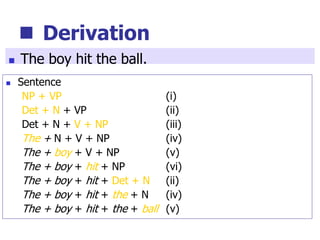
 Derivation
 Sentence
NP + VP (i)
Det + N + VP (ii)
Det + N + V + NP (iii)
The + N + V + NP (iv)
The + boy + V + NP (v)
The + boy + hit + NP (vi)
The + boy + hit + Det + N (ii)
The + boy + hit + the + N (iv)
The + boy + hit + the + ball (v)
 The boy hit the ball.

Syntax presentation 01.pptx

  • 1.
    Karakoram international universityGilgi t Baltistan Presentation Given By Ma'am Shameem Presentation prepared By Muhammad Sulaiman Muhammadi Student Registration Number is 2020-KIU-BS 1284 Book subject title Syntax BS 5th semester Department of English literature and linguistics Karakorum inter national university Gilgit Baltistan
  • 2.
    Introduction to SyntaxP hrase Structure
  • 3.
    Does syntax help? “opensthe key easily door the” Vs “flying planes can be dangerous” “flying planes are dangerous” “flying planes is dangerous” Syntax General Difinition:
  • 4.
    Grammer and Criteriaof a “good” gramma r  Grammer is actually a finite set of rules;  that generates only and all sentences of a language.  that assigns an appropriate structural desc ription to each one. Criteria for Good Gramm er  Observational Adequacy  Descriptive Adequacy  Explanatory Adequacy
  • 5.
     Grammatical AnalysisTechniq ues  Two main devices  Morphological  Categorial  Functional  Sequential  Hierarchical  Transformational Breaking up a String Labeling the Constituents
  • 6.
     Breaking upand Label ing  Sequential Breaking up  Sequential Breaking up and Morphological Labelin g  Sequential Breaking up and Categorial Labeling  Sequential Breaking up and Functional Labeling  Hierarchical Breaking up  Hierarchical Breaking up and Categorial Labeling  Hierarchical Breaking up and Functional Labeling
  • 7.
     Sequential Breakingup that student solve ed the problem s + + + + + +  That student solved the problems.
  • 8.
     Sequential Breakingup and Morph ological Labeling  That student solved the problems. that student solve ed the problem s word word stem affix word stem affix
  • 9.
     Sequential Breakingup and Categorial Labeling  This boy can solve the problem.  They called her a taxi. this boy can solve the problem Det N Aux V Det N They call ed taxi Pron V Affix N her Pron a Det
  • 10.
    They called taxi SubjectVerbal Indirect Object her Direct Obj ect a They called Subject Verbal taxi Direct Object her Indirect O bject a
  • 11.
     Hierarchical Breakingup Old men and women Old men and women Old men and women Old men and women women and men men Old
  • 12.
     Hierarchical Breakingup and C ategorial Labeling S VP V Adv ran away NP A N Poor John  Poor John ran away.
  • 13.
     Hierarchical Breakingup and Functional Labeling  Immediate Constituent (IC) Analysis  Construction types in terms of the function of the constituents:  Predication (subject + predicate)  Modification (modifier + head)  Complementation (verbal + complement)  Subordination (subordinator + dependent unit )  Coordination (independent unit + coordinator)
  • 14.
     Predication  [Birds]subject[fly]predicate S Predicate Subject Birds fly
  • 15.
     Modification  [A]modifier[flower]head  John [slept]head [in the room]modifier S Predicate Subject John Head Modifier slept In the room
  • 16.
     Complementation  He[saw]verbal [a lake]complement S Predicate Subject He Verbal Complement saw a lake
  • 17.
     Subordination  Johnslept [in]subordinator [the room]dependent unit S Predicate Subject John Head Modifier slept the room Subordinator Dependent Unit in
  • 18.
     Coordination  [Johncame in time] independent unit [but]coordinator [Mary was not r eady] independent unit S Coordinator Independent Unit John came in time but Mary was not ready Independent Unit
  • 19.
    S Head Modifier In the morning,the sky looked much brighter Subordinator DU Predicate Subject Head Head Head Verbal Complement Modifier Modifier Modifier  In the morning, the sky looked much brighter. An Example
  • 20.
     Hierarchical Breakingup and Categorial / Functional Labeling  Hierarchical Breaking up coupled with Categorial /Fun ctional Labeling is a very powerful device.  But there are ambiguities which demand something more powerful.  E.g., Love of God  Someone loves God  God loves someone
  • 21.
     Hierarchical Breakingup Love of God Love of God Noun Phrase Prepositional Phrase Head DU Modifier God of love Sub love of God Categorial Labeling Functional Labeling
  • 22.
     Types ofGenerative Gram mar  Finite State Model (sequential)  Phrase Structure Model (sequential + hierarchical) + (categorial)  Transformational Model (sequential + hierarchical + transformational) + (categorial + functional)
  • 23.
     Phrase StructureGrammar (P SG) A phrase-structure grammar G consists of a four tuple (V, T, S, P), where  V is a finite set of alphabets (or vocabulary)  E.g., N, V, A, Adv, P, NP, VP, AP, AdvP, PP, stude nt, sing, etc.  T is a finite set of terminal symbols: T  V  E.g., student, sing, etc.  S is a distinguished non-terminal symbol, also called start symbol: S  V  P is a set of productions.
  • 24.
  • 25.
  • 26.
     Noun Phrase five NP Quant the Det students N best AP ofmy class PP  The five best students of my class
  • 27.
     Verb Phrases sing VP V can Aux theball VP NP can Aux hit V  can sing  can hit the ball
  • 28.
     Verb Phrase aflower VP NP can Aux give V to Mary PP  Can give a flower to Mary
  • 29.
     Verb Phrase John VP NP may Aux make V thechairman NP  may make John the chairman
  • 30.
     Verb Phrase thebook VP NP may Aux find V very interesting AP  may find the book very interesting
  • 31.
     Prepositional Phrases in the classroom the river PP NP near P the classroom PP NP in P  near the rive r
  • 32.
     Adjective Phrases intelligent AP A honest AP A very Degree ofsweets AP PP fond A  intelligent  very hones t  fond of sweet s
  • 33.
     Adjective Phrase •very worried that she might have done badly in the a ssignment that she might have done badly in the as signment AP S’ very Degree worried A
  • 34.
     Phrase StructureRules  Rewrite Rules: (i) S  NP VP (ii) NP  Det N (iii) VP  V NP (iv) Det  the (v) N  man, ball (v) V  hit  We interpret each rule X  Y as the instruction rewrite X as Y.  The boy hit the ball.
  • 35.
     Derivation  Sentence NP+ VP (i) Det + N + VP (ii) Det + N + V + NP (iii) The + N + V + NP (iv) The + boy + V + NP (v) The + boy + hit + NP (vi) The + boy + hit + Det + N (ii) The + boy + hit + the + N (iv) The + boy + hit + the + ball (v)  The boy hit the ball.