Download to read offline
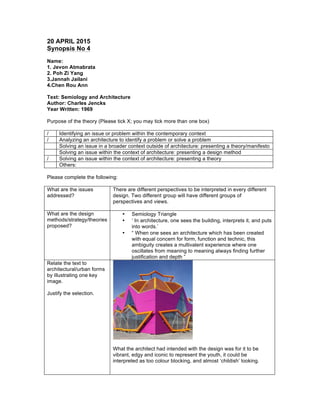
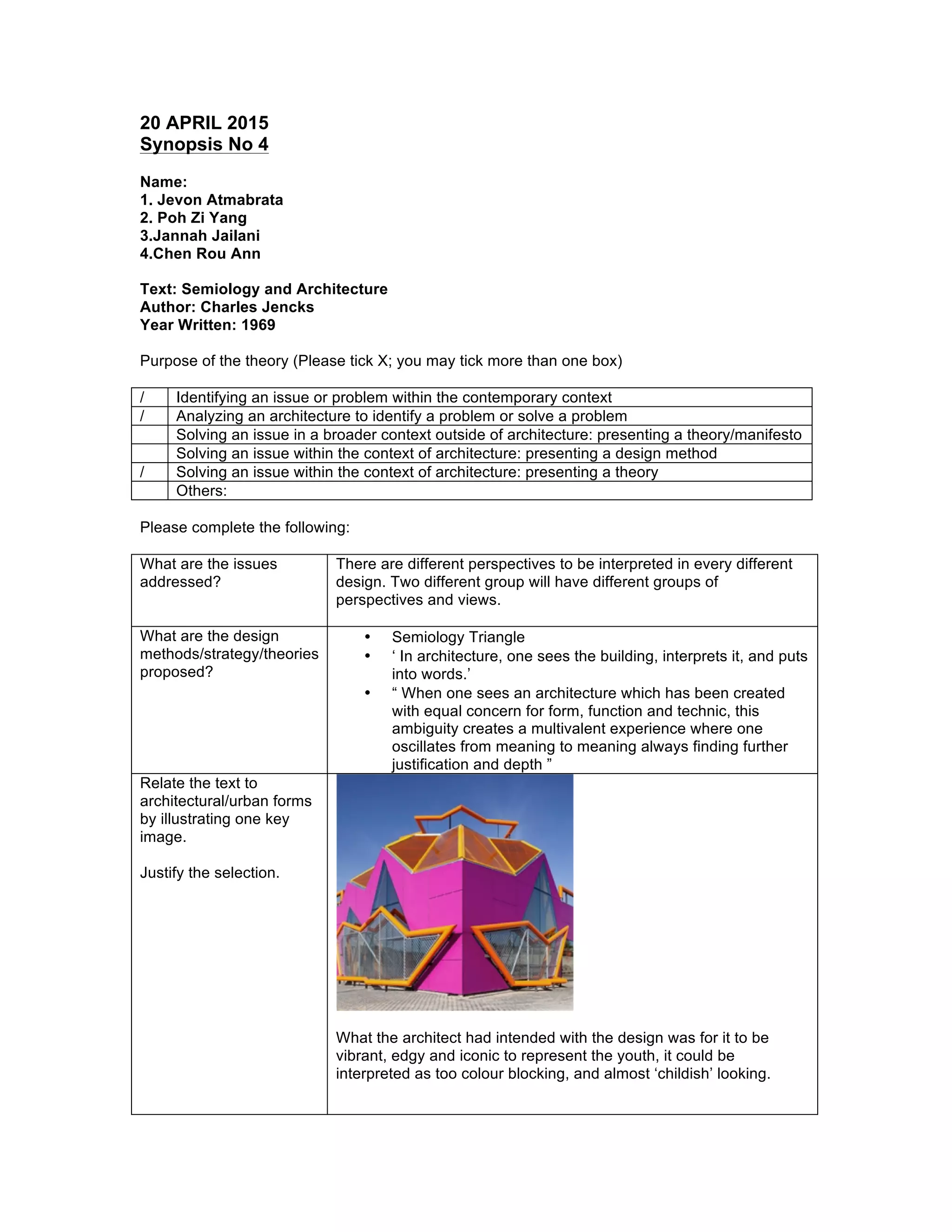

Charles Jencks' 1969 theory of Semiology and Architecture addressed different perspectives in design. The theory proposed the Semiology Triangle to analyze how people see and interpret buildings. It also suggested that ambiguity in design can create a multivalent experience where meanings are found on different levels. As an example, a vibrant, edgy building intended to represent youth could be interpreted as too colorful or "childish" looking depending on the perspective.


![THEORIES OF ARCHITECTURE & URBANISM [ARC61303] [ARC2224]- Synopsis: Interpret...](https://cdn.slidesharecdn.com/ss_thumbnails/angeline0302068synopses-theoryofarchitectureandurbanism-141219021324-conversion-gate02-thumbnail.jpg?width=640&height=640&fit=bounds)


![Asian architecture [arc2234] case study paper](https://cdn.slidesharecdn.com/ss_thumbnails/asianarchitecturearc2234-casestudypaper-141209082112-conversion-gate01-thumbnail.jpg?width=640&height=640&fit=bounds)
![Building structures report [individual]](https://cdn.slidesharecdn.com/ss_thumbnails/buildingstructuresreportindividual-141209081355-conversion-gate02-thumbnail.jpg?width=640&height=640&fit=bounds)
![Building structure [arc 2523]](https://cdn.slidesharecdn.com/ss_thumbnails/buildingstructurearc2523-141209081131-conversion-gate01-thumbnail.jpg?width=640&height=640&fit=bounds)
![Building services report [final]](https://cdn.slidesharecdn.com/ss_thumbnails/buildingservicesreportfinal-141209075559-conversion-gate02-thumbnail.jpg?width=640&height=640&fit=bounds)

![Building science report [singapore] final](https://cdn.slidesharecdn.com/ss_thumbnails/buildingsciencereportsingaporefinal-140718022230-phpapp02-thumbnail.jpg?width=640&height=640&fit=bounds)
![Building science report [malaysia] final](https://cdn.slidesharecdn.com/ss_thumbnails/buildingsciencereportmalaysiafinal-140718021607-phpapp02-thumbnail.jpg?width=640&height=640&fit=bounds)


