Download to read offline
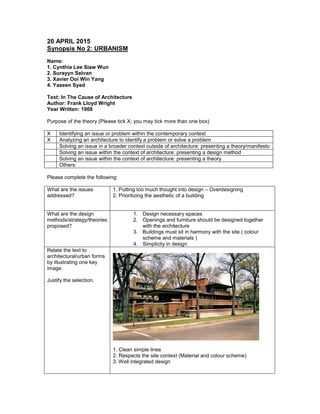


Frank Lloyd Wright's 1908 text "In The Cause of Architecture" addresses two main issues with contemporary architecture: overdesigning buildings and prioritizing aesthetics over functionality. Wright proposes a design strategy of simplicity, with an emphasis on designing only necessary spaces, selecting materials and colors that harmonize with the site, and integrating openings and furniture into the overall architectural design. The key image that relates to Wright's theories is a building with clean, simple lines that respects the site context through its material and color scheme, representing an integrated, unoverdesigned design.


