2
Symmetry ,in physicsthe concept that the properties of particles such
as atoms and molecules remain unchanged after being subjected to a
variety of symmetry transformation or “operations”. The application of
symmetry to physics leads to the important conclusion that certain
certain physical laws particularly conservation laws, governing the
behaviour of objects and particles are not affected when their geometric
Coordinates are transformed by means of symmetry operations. Valid
symmetry operations are those that can be performed without changing
the appearance of an object . Elementary particles are also said to have
internal symmetry; these symmetries are useful in classifying particles.
There is a fairly strong proof that only minimal physical assumptions
that the product of C,P and T is a good symmetry of any theory.
SYMMETRY
4
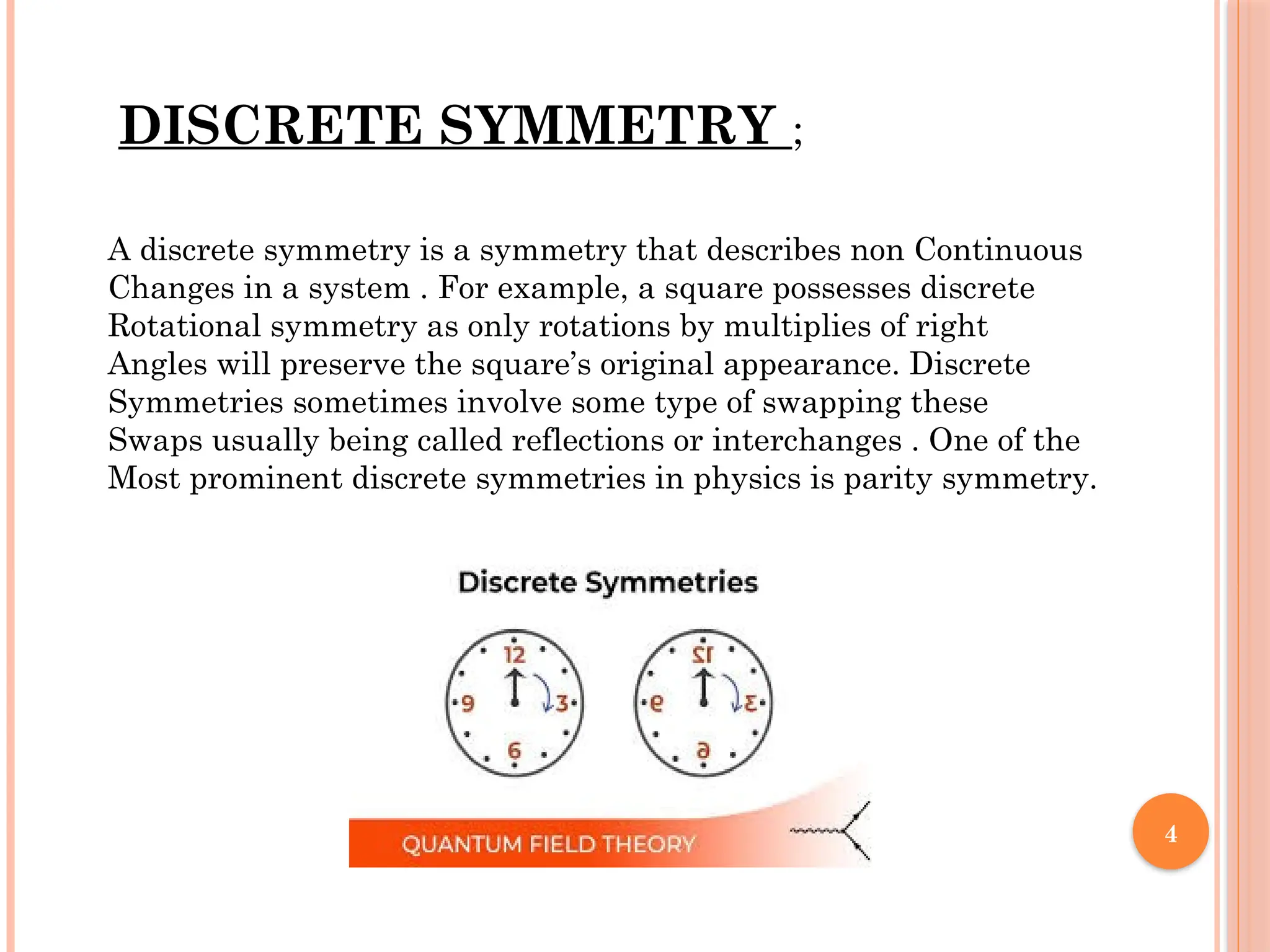
A discrete symmetryis a symmetry that describes non Continuous
Changes in a system . For example, a square possesses discrete
Rotational symmetry as only rotations by multiplies of right
Angles will preserve the square’s original appearance. Discrete
Symmetries sometimes involve some type of swapping these
Swaps usually being called reflections or interchanges . One of the
Most prominent discrete symmetries in physics is parity symmetry.
DISCRETE SYMMETRY ;
5.
5
CONTINUOUS SYMMETRY
In physicscontinuous symmetry is an intuitive idea corresponding
to the concept of viewing some symmetries as motion, as opposed to
discrete symmetry ,e.g. reflection symmetry, which is invariant under
a kind of flip from one state to another. However ,a discrete symmetry
can always be reinterpreted as a subset of some higher-dimensional
continuous symmetry, e.g. reflection of 2-D object in 3-D space.
6.
6
TERMS IN DISCRETESYMMETRY
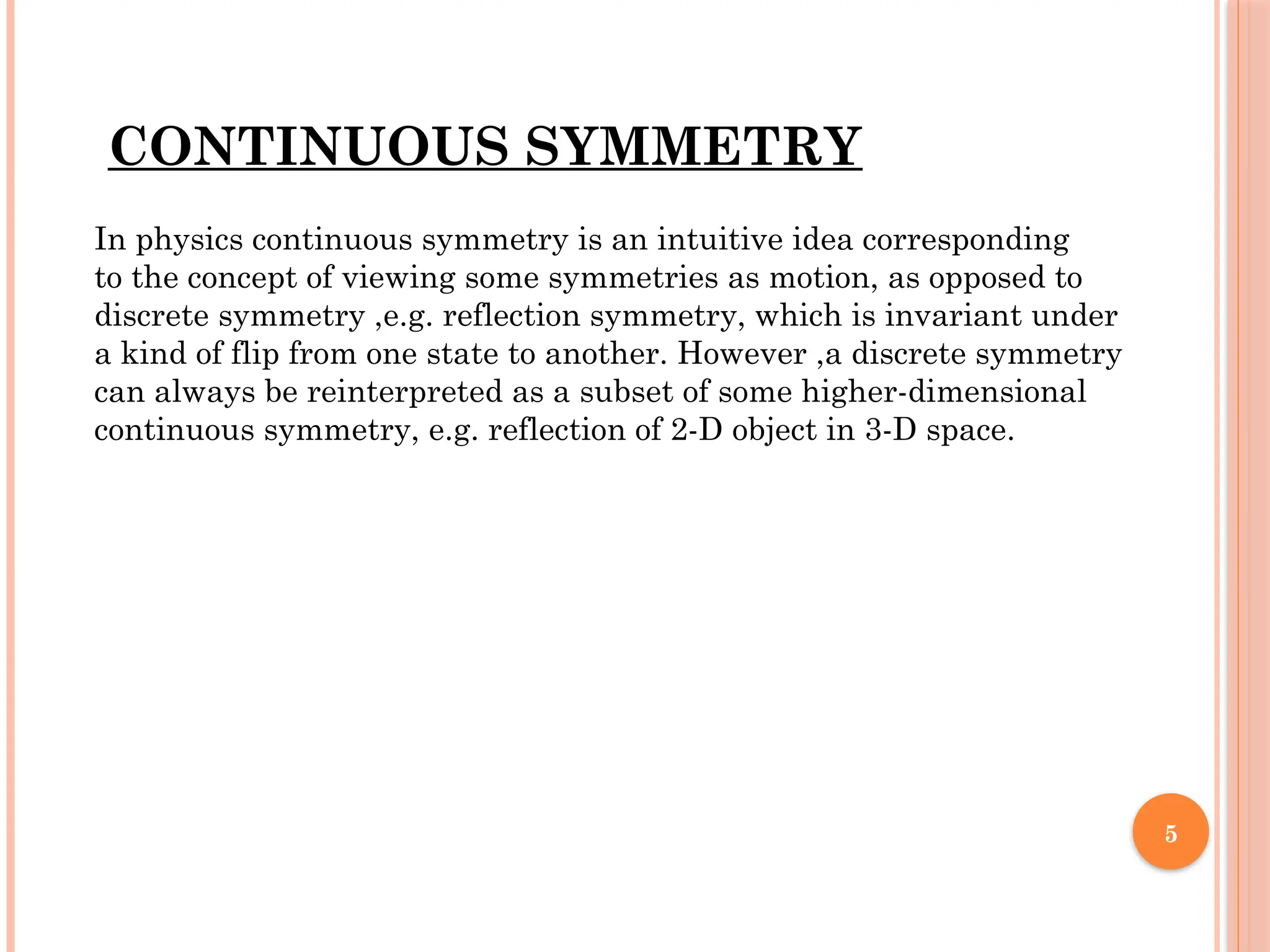
1 .CHARGE CONJUGATION
In physics , charge conjugation is a transformation that switches
all particles with their corresponding antiparticles, thus changing
the sign of all charges; not only electric charge but also the charges
relevant to other forces . The term C- symmetry is an abbreviation
of the phrase charge conjugation symmetry and is used in the
discussions of the symmetry of physical laws.
7.
7
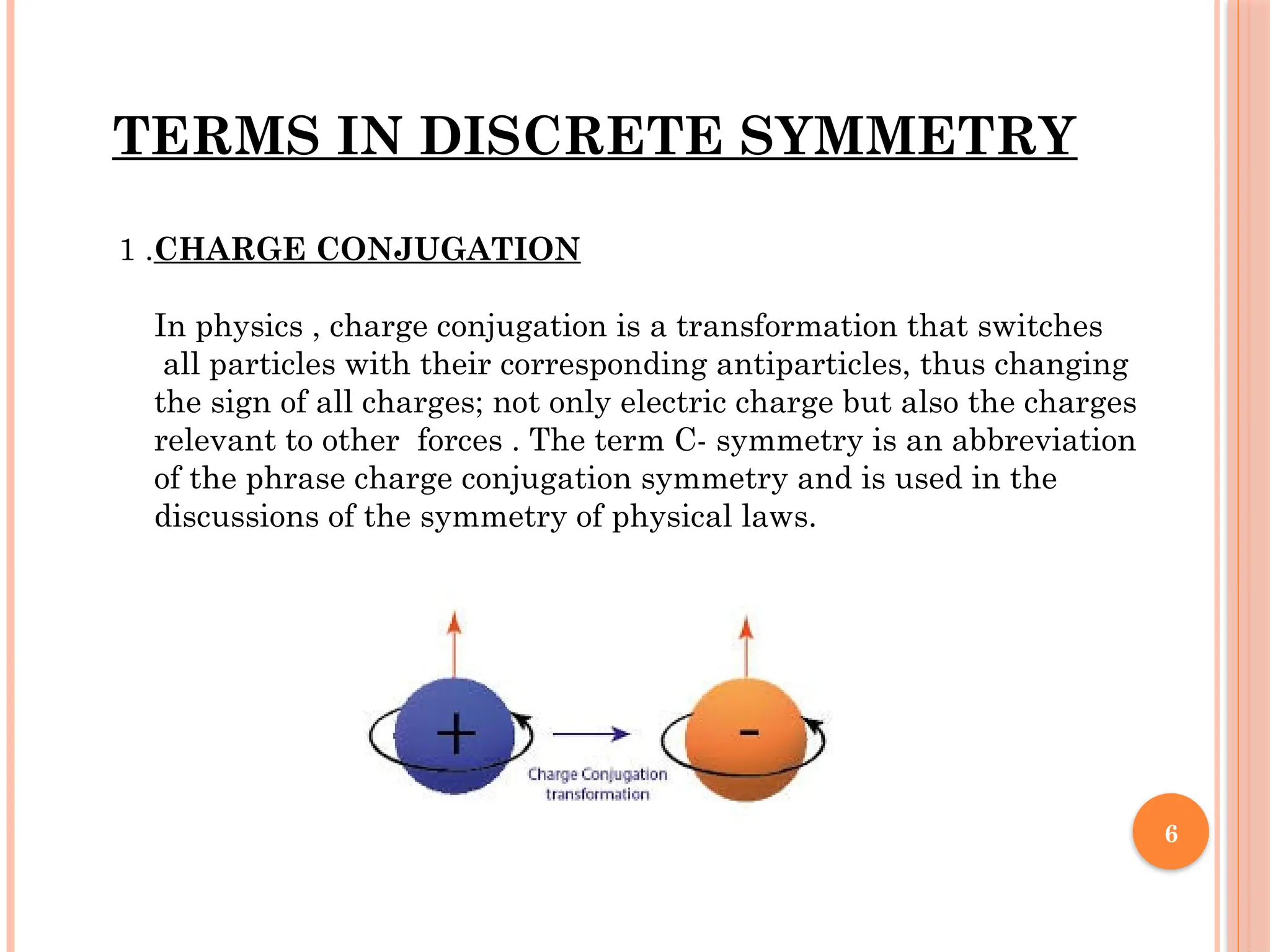
2 . PARITY
Inphysics ,parity transformation is the flip in the sign of one
Spatial coordinate. In three dimensions , it can also refer to
the simultaneous flip in the sign of all three spatial coordinates.
P : x -x
y ↔ -y
z -z
It can also be thought of as a test for chirality of a physical
Phenomenon.
8.
8
3. TIME REVERSALSYMMETRY
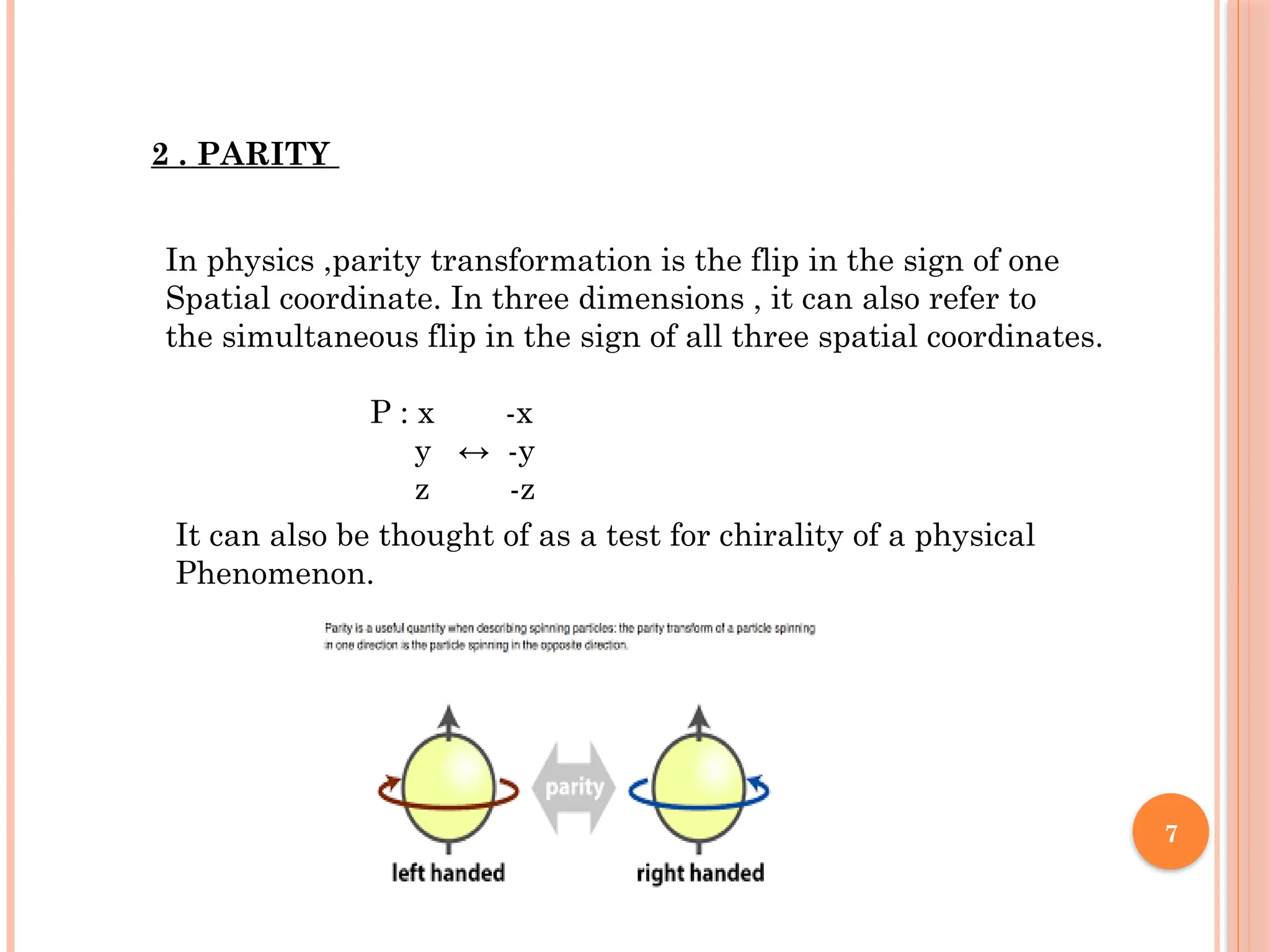
Time reversal symmetry is the theoretical symmetry of physical
Laws under the transformation of time reversal,
T: t→ -t
Since the second law of thermodynamics state that entropy increases
As time flows toward the future ,in general the macroscopic universe
Does not show symmetry under time reversal.
9.
9
EXPERIMENT FOR THEEVIDENCE OF P SYMMETRY
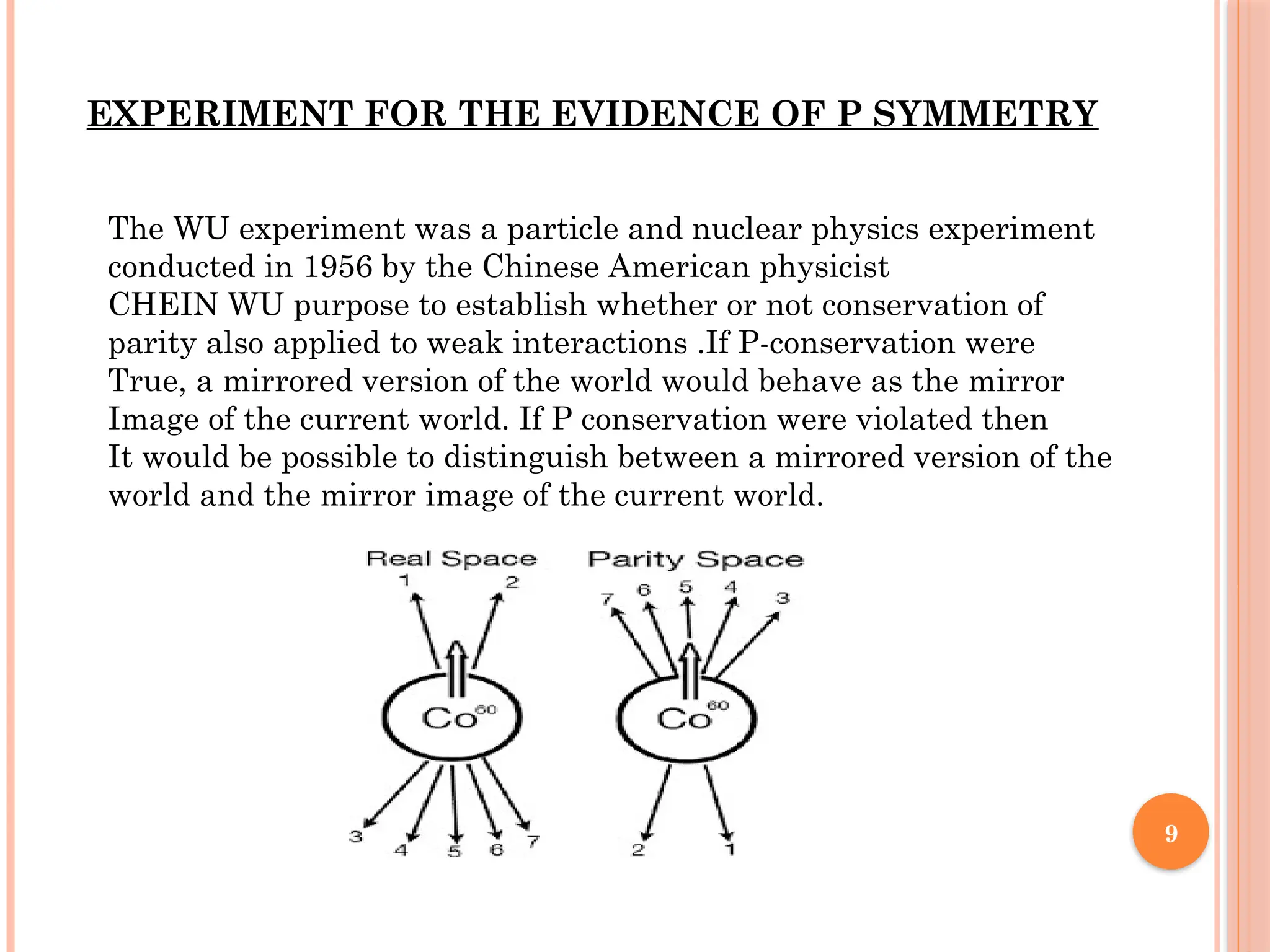
The WU experiment was a particle and nuclear physics experiment
conducted in 1956 by the Chinese American physicist
CHEIN WU purpose to establish whether or not conservation of
parity also applied to weak interactions .If P-conservation were
True, a mirrored version of the world would behave as the mirror
Image of the current world. If P conservation were violated then
It would be possible to distinguish between a mirrored version of the
world and the mirror image of the current world.
10.
10
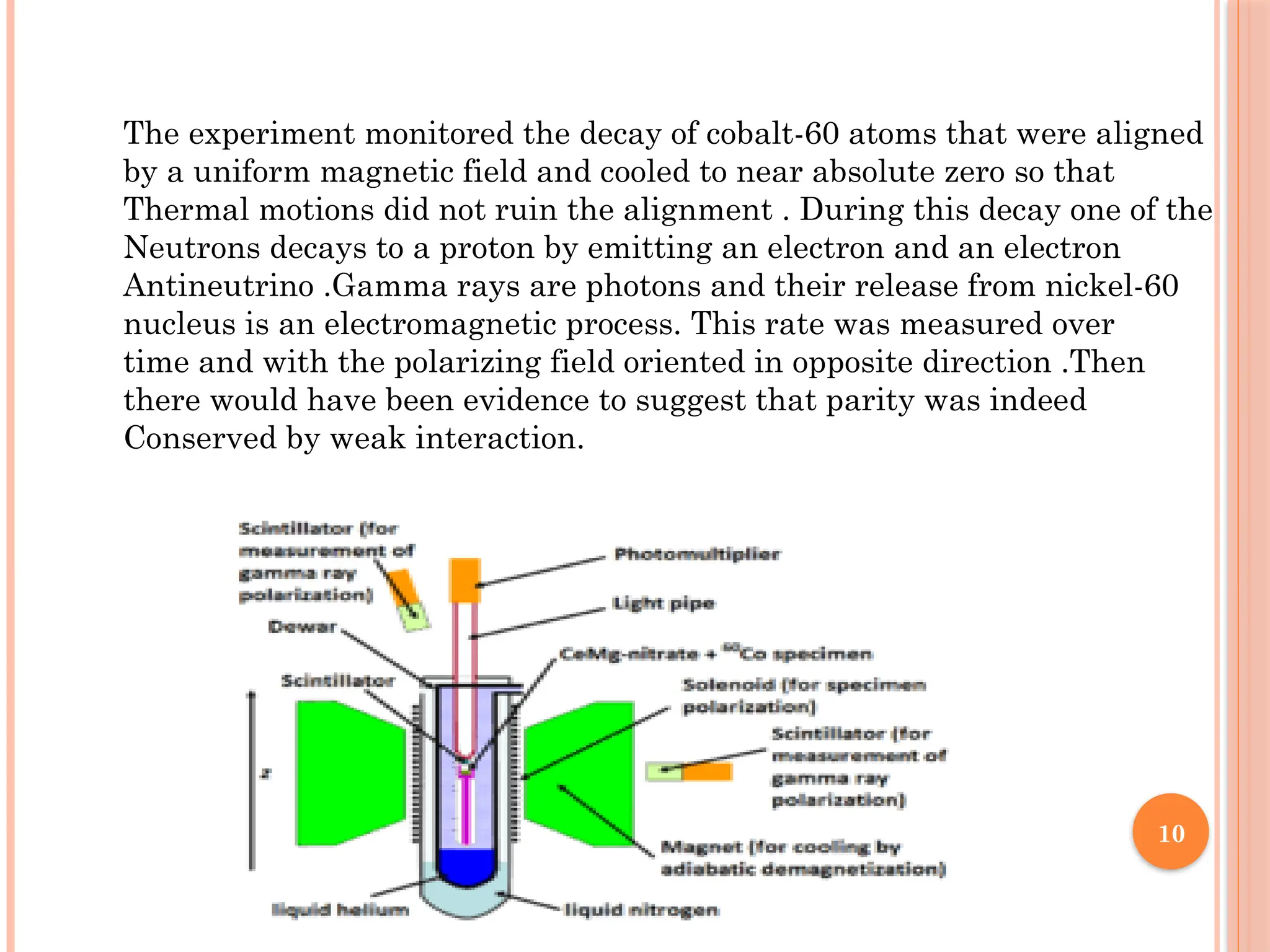
The experiment monitoredthe decay of cobalt-60 atoms that were aligned
by a uniform magnetic field and cooled to near absolute zero so that
Thermal motions did not ruin the alignment . During this decay one of the
Neutrons decays to a proton by emitting an electron and an electron
Antineutrino .Gamma rays are photons and their release from nickel-60
nucleus is an electromagnetic process. This rate was measured over
time and with the polarizing field oriented in opposite direction .Then
there would have been evidence to suggest that parity was indeed
Conserved by weak interaction.
11.
CP VIOLATION
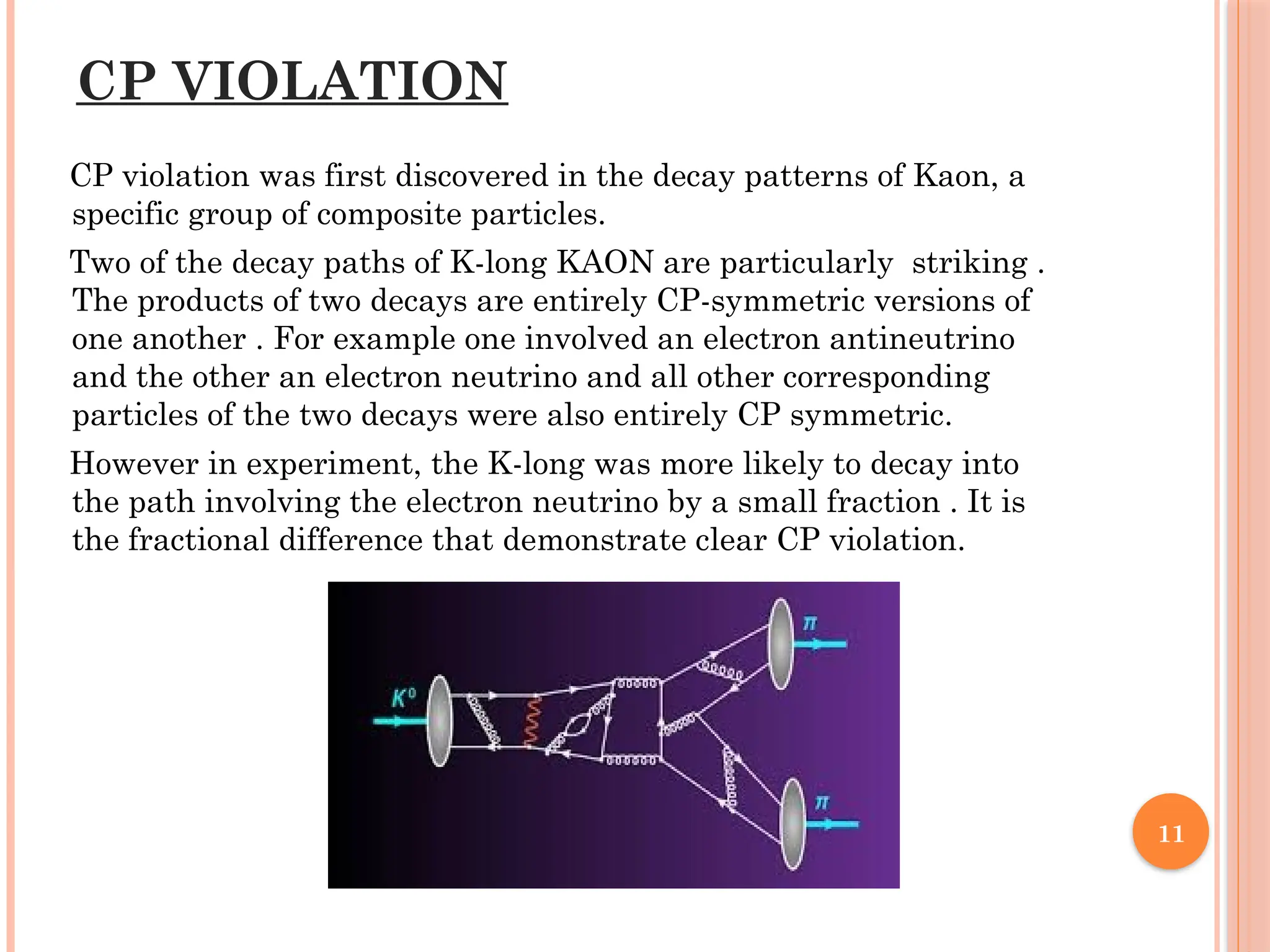
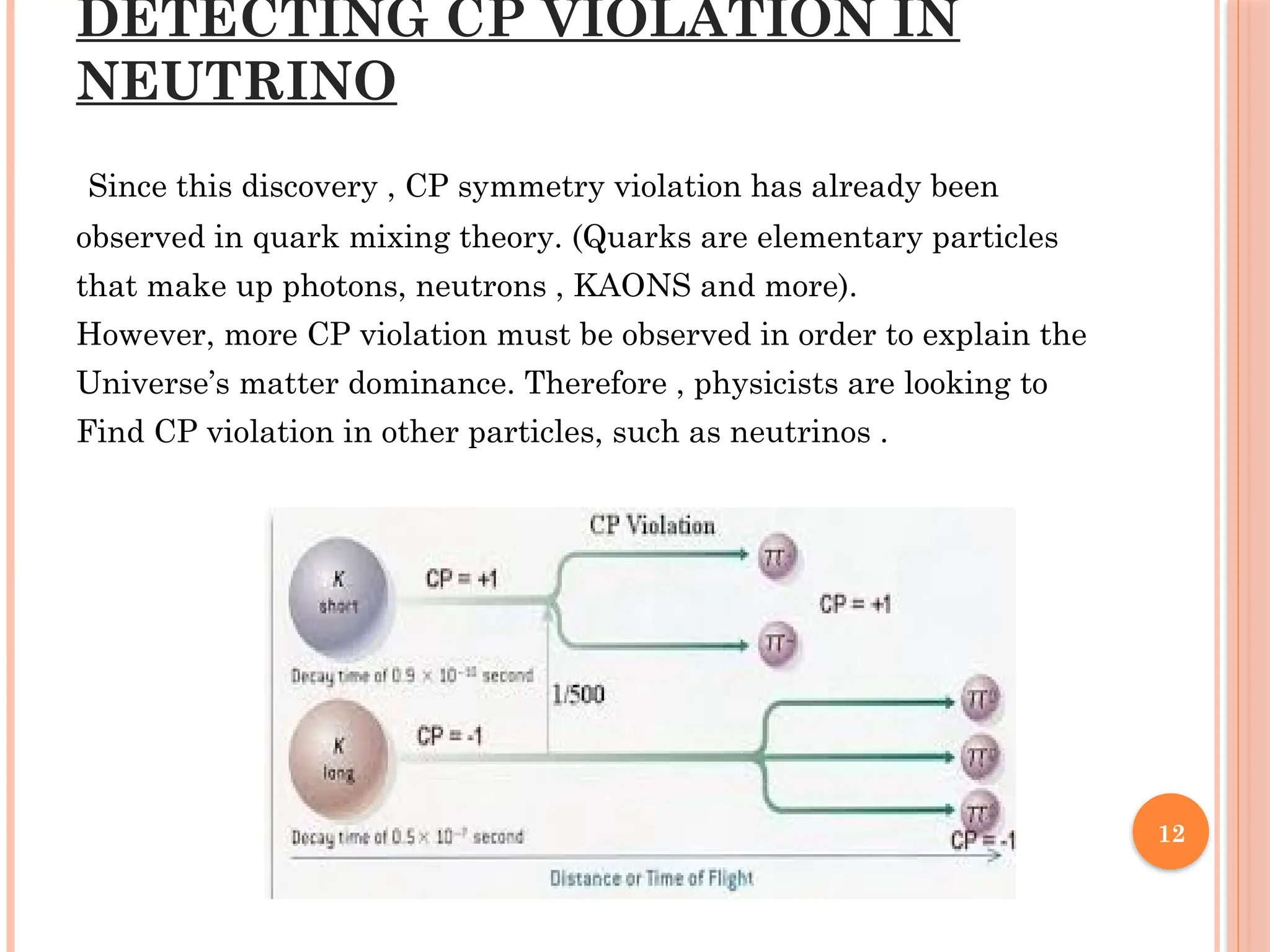
CP violationwas first discovered in the decay patterns of Kaon, a
specific group of composite particles.
Two of the decay paths of K-long KAON are particularly striking .
The products of two decays are entirely CP-symmetric versions of
one another . For example one involved an electron antineutrino
and the other an electron neutrino and all other corresponding
particles of the two decays were also entirely CP symmetric.
However in experiment, the K-long was more likely to decay into
the path involving the electron neutrino by a small fraction . It is
the fractional difference that demonstrate clear CP violation.
11
12.
12
DETECTING CP VIOLATIONIN
NEUTRINO
Since this discovery , CP symmetry violation has already been
observed in quark mixing theory. (Quarks are elementary particles
that make up photons, neutrons , KAONS and more).
However, more CP violation must be observed in order to explain the
Universe’s matter dominance. Therefore , physicists are looking to
Find CP violation in other particles, such as neutrinos .
13.
13
NEUTRINOS VIOLATE P-
SYMMETRY
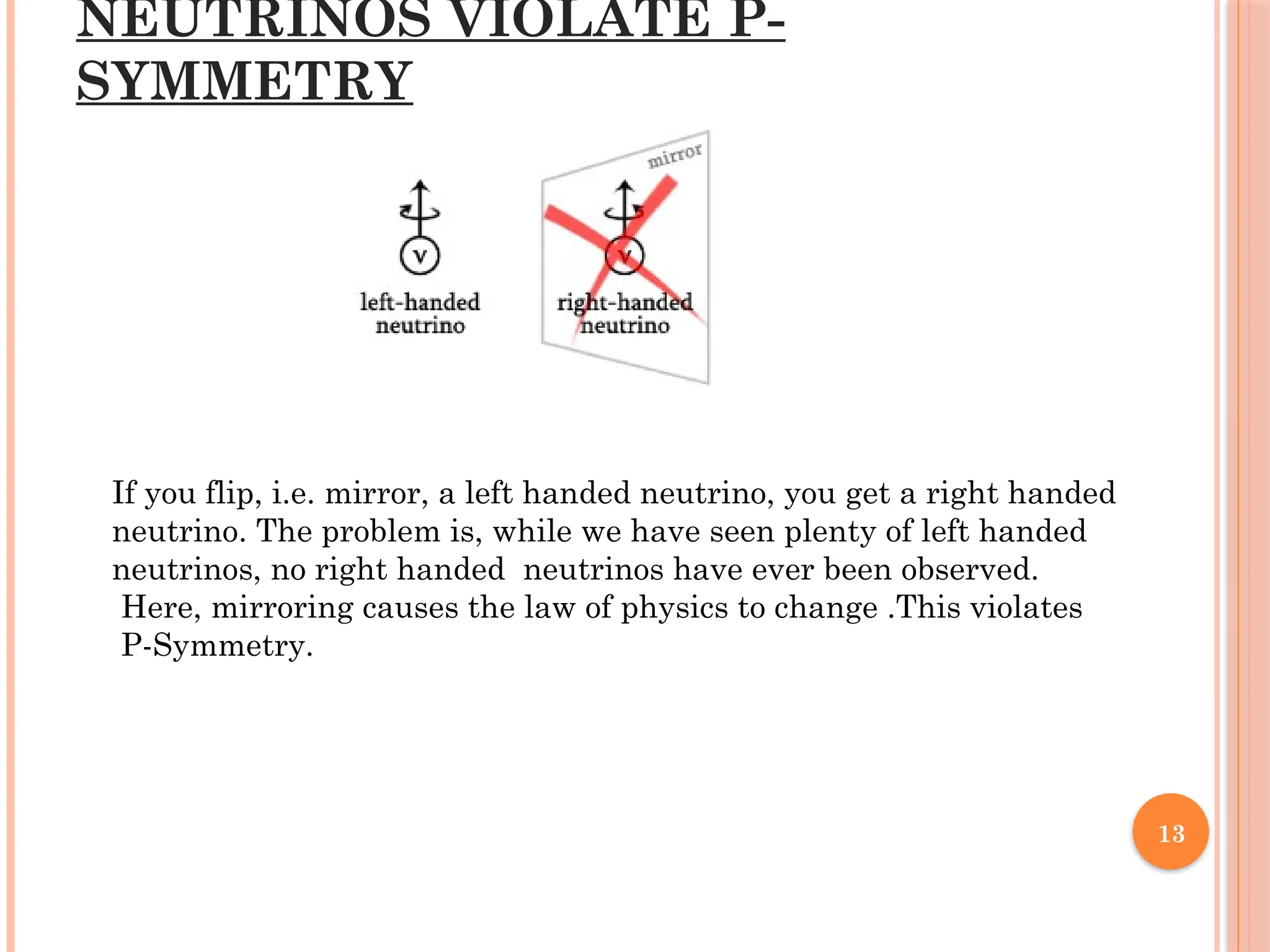
Ifyou flip, i.e. mirror, a left handed neutrino, you get a right handed
neutrino. The problem is, while we have seen plenty of left handed
neutrinos, no right handed neutrinos have ever been observed.
Here, mirroring causes the law of physics to change .This violates
P-Symmetry.
14.
14
NEUTRINOS VIOLATE C-
SYMMETRY
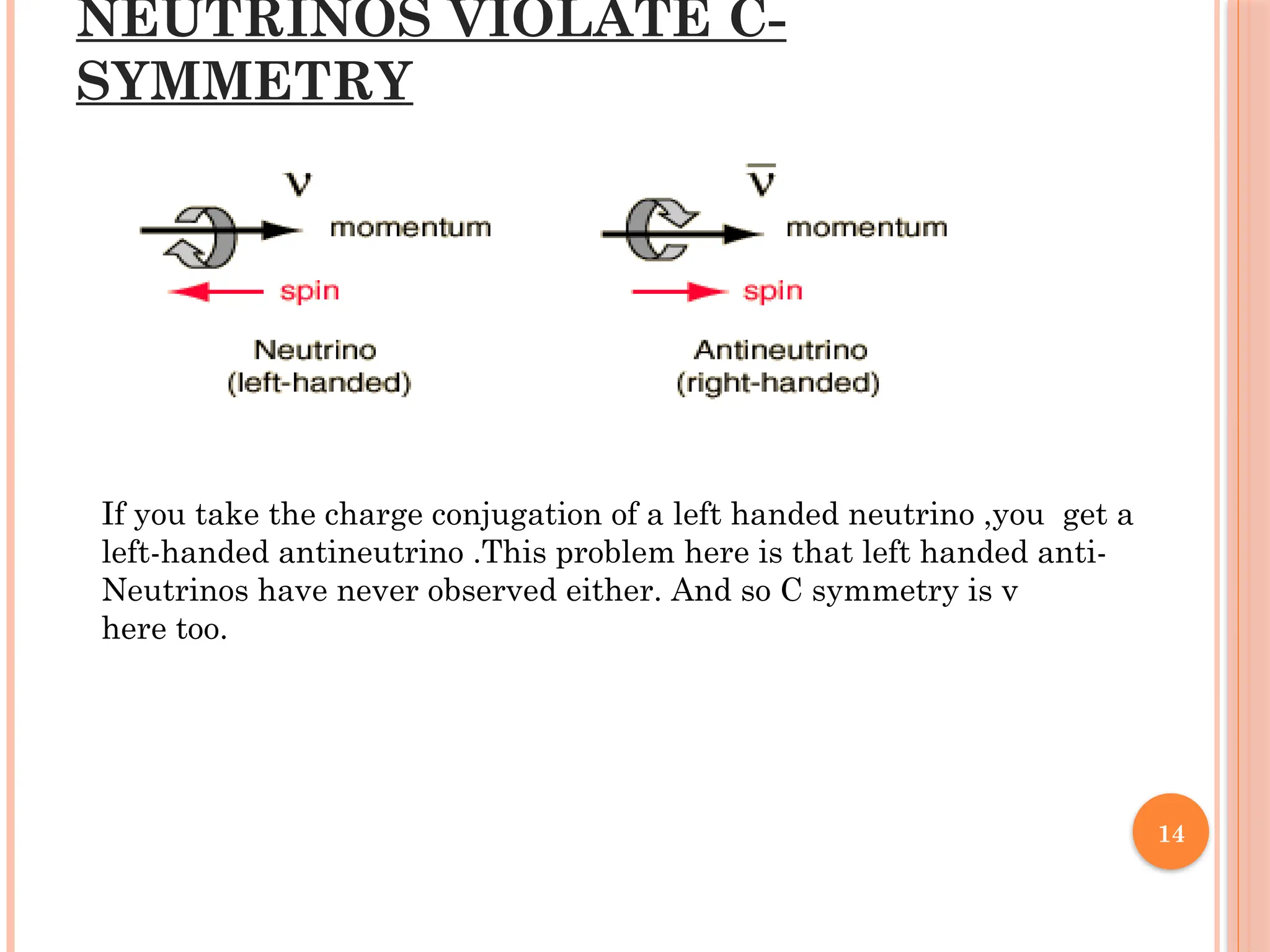
Ifyou take the charge conjugation of a left handed neutrino ,you get a
left-handed antineutrino .This problem here is that left handed anti-
Neutrinos have never observed either. And so C symmetry is v
here too.
15.
15
CONCLUSION
1. Symmetry inphysics is the preservation of some feature under a
transformation.
2. These symmetries help to classify various interactions, and allow
us to describe “patterns” of nature.
3. Symmetries help to apply constraints to physical laws and guide
us to proceed for the new discoveries .
4. Symmetry becomes even more useful due to its associated laws
like conservation laws.
5. Symmetry helps to bring out the elegance to the Physics.