Compiler Construction
Symbol table
SYMBOL TABLE
• A symbol table is a data structure used by a
language translator such as a compiler or
interpreter
• where each identifier in a program's source code is
associated with information relating to its declaration
or appearance in the source, such as its type, scope
level and sometimes its location.
Symbol table
• Symbol table is a major data structure used in a
compiler which associates attributes with identifiers
in a program.
• A symbol table information is used by the analysis
and synthesis phases to verify that used identifiers
have been defined (declared), to verify that
expressions and assignments are semantically
correct (type checking), to generate intermediate or
target code.
Features Of Symbol Table
 This symbol table is used for the following purposes:
 It is used to keep all of the names of all entities in
one place in a structured format.
 It is used to check whether or not a variable has
been declared.
 It is used to identify the scope of a name.
 It is used to implement type checking in source code
by ensuring if assignments and expressions are
semantically accurate or not.
Basic Operations of a Symbol table
The basic operations defined on a symbol table
include:
 allocate – to allocate a new empty symbol table
 free – to remove all entries and free the storage of a
symbol table
 insert – to insert a name in a symbol table and return
a pointer to its entry
 lookup – to search for a name and return a pointer
to its entry
 set_attribute – to associate an attribute with a given
entry
 get_attribute – to get an attribute associated with a
given entry
Cont…
• Other operations can be added depending on
requirement. For example, a delete operation
removes a name previously inserted.
Possible Implementations Techniques:
 Unordered list: for a very small set of variables.
 Ordered linear list: insertion is expensive, but
implementation is relatively easy
 Binary search tree: O(log n) time per operation for n
variables.
 Hash table: most commonly used, and very efficient
provided the memory space is adequately larger
than the number of variables.
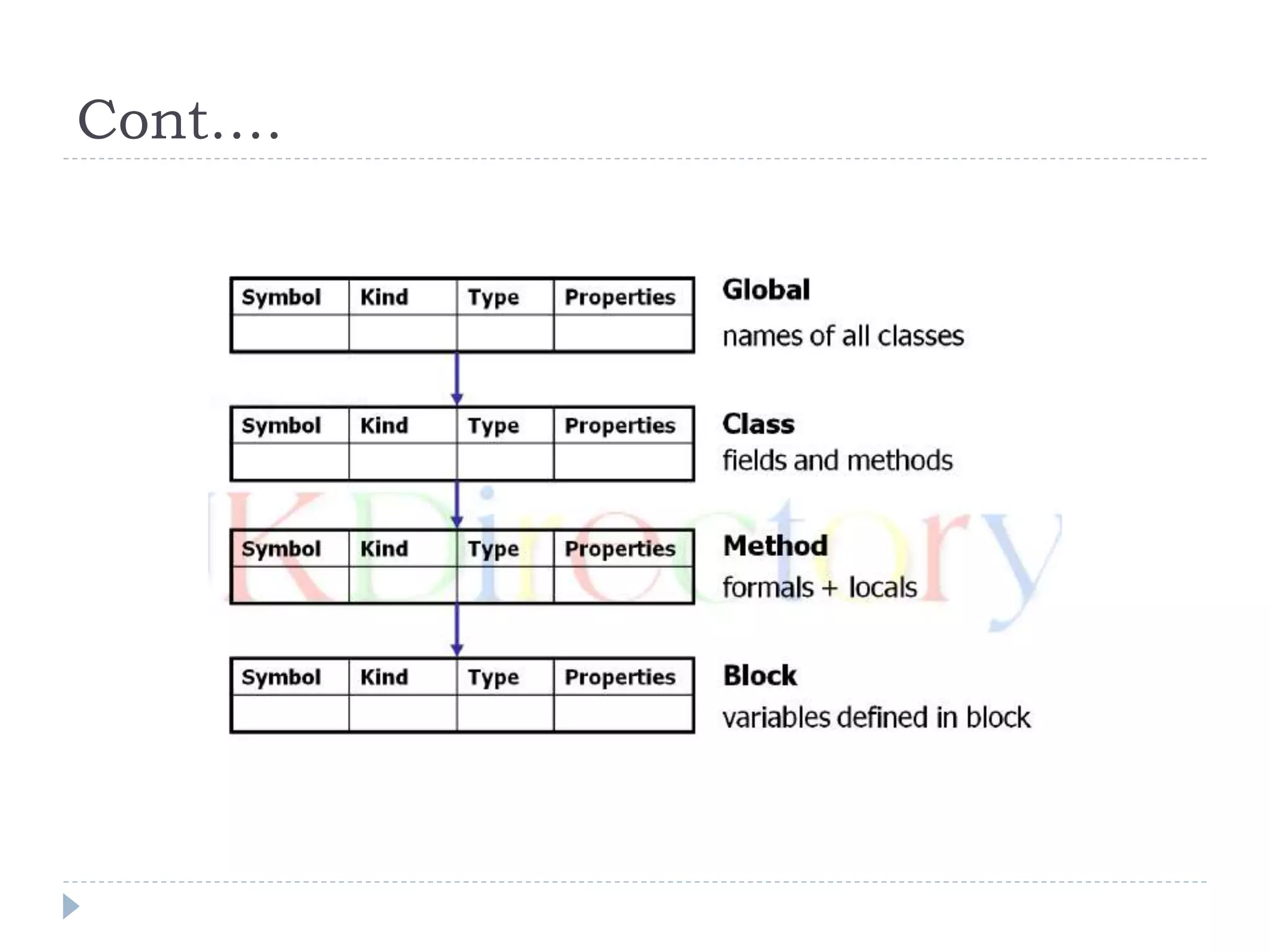
SYMBOL TABLE FORMAT:
 Symbol table is an environment that stores
information about identifiers, a data structure that
captures scope information.
 Each entry in symbol table contains: Name, Kind,
Type and additional properties.
 Symbol table contains the following format:
Cont….
Symbol table example:
Symbol table Example

Symbol Table.pptx

  • 1.
  • 2.
    SYMBOL TABLE • Asymbol table is a data structure used by a language translator such as a compiler or interpreter • where each identifier in a program's source code is associated with information relating to its declaration or appearance in the source, such as its type, scope level and sometimes its location.
  • 3.
    Symbol table • Symboltable is a major data structure used in a compiler which associates attributes with identifiers in a program. • A symbol table information is used by the analysis and synthesis phases to verify that used identifiers have been defined (declared), to verify that expressions and assignments are semantically correct (type checking), to generate intermediate or target code.
  • 4.
    Features Of SymbolTable  This symbol table is used for the following purposes:  It is used to keep all of the names of all entities in one place in a structured format.  It is used to check whether or not a variable has been declared.  It is used to identify the scope of a name.  It is used to implement type checking in source code by ensuring if assignments and expressions are semantically accurate or not.
  • 5.
    Basic Operations ofa Symbol table The basic operations defined on a symbol table include:  allocate – to allocate a new empty symbol table  free – to remove all entries and free the storage of a symbol table  insert – to insert a name in a symbol table and return a pointer to its entry  lookup – to search for a name and return a pointer to its entry  set_attribute – to associate an attribute with a given entry  get_attribute – to get an attribute associated with a given entry
  • 6.
    Cont… • Other operationscan be added depending on requirement. For example, a delete operation removes a name previously inserted.
  • 7.
    Possible Implementations Techniques: Unordered list: for a very small set of variables.  Ordered linear list: insertion is expensive, but implementation is relatively easy  Binary search tree: O(log n) time per operation for n variables.  Hash table: most commonly used, and very efficient provided the memory space is adequately larger than the number of variables.
  • 8.
    SYMBOL TABLE FORMAT: Symbol table is an environment that stores information about identifiers, a data structure that captures scope information.  Each entry in symbol table contains: Name, Kind, Type and additional properties.  Symbol table contains the following format:
  • 9.
  • 10.
  • 11.