Symbol Table
Symbol Table
The data structure that is created and
maintained by the compilers for information
storing regarding the occurrence of various
entities like names of variables, functions,
objects, classes
Symbol table is used by both the analysis
and the synthesis parts of a compiler
Symbol Table
A symbol table may serve the following
purposes depending upon the language in
hand:
To store the names of all entities in a structured
form at one place
To verify if a variable has been declared
To implement type checking, by verifying
assignments and expressions in the source code
are semantically correct
To determine the scope of a name (scope
resolution)
Information Stored in Symbol
Table
The following possible information about
identifiers are stored in symbol table
The name (as a string)
Attribute: Reserved word, Variable name, Type
name, Procedure name, Constant name
The data type
The block level
Its scope (global, local, or parameter)
Its offset from the base pointer (for local variables
and parameters only)
Implementation
Symbol table can be implemented as
Unordered List
Linear (sorted or unsorted) list
Binary Search Tree
Hash table
Among all, symbol tables are mostly
implemented as hash tables, where the
source code symbol itself is treated as a key
for the hash function and the return value is
the information about the symbol.
Entry Format
A symbol table maintains an entry for each
name in the following format:
<symbol name, type, attribute>
For example, if a symbol table has to store
information about the following variable
declaration:
static int interest;
then it should store the entry such as:
<interest, int, static>
Operations
A symbol table, either linear or hash, should
provide the following operations.
insert()
This operation is more frequently used by analysis
phase where tokens are identified and names are
stored in the table.
This operation is used to add information in the
symbol table about unique names occurring in the
source code.
The format or structure in which the names arestored
depends upon the compiler in hand.
Operations
An attribute for a symbol in the source code is the
information associated with that symbol.
This information contains the value, state, scope, and type
about the symbol.
The insert() function takes the symbol and its
attributes as arguments and stores the information in
the symbol table.
For example:
int a;
should be processed by the compileras:
insert(a, int);
Operations
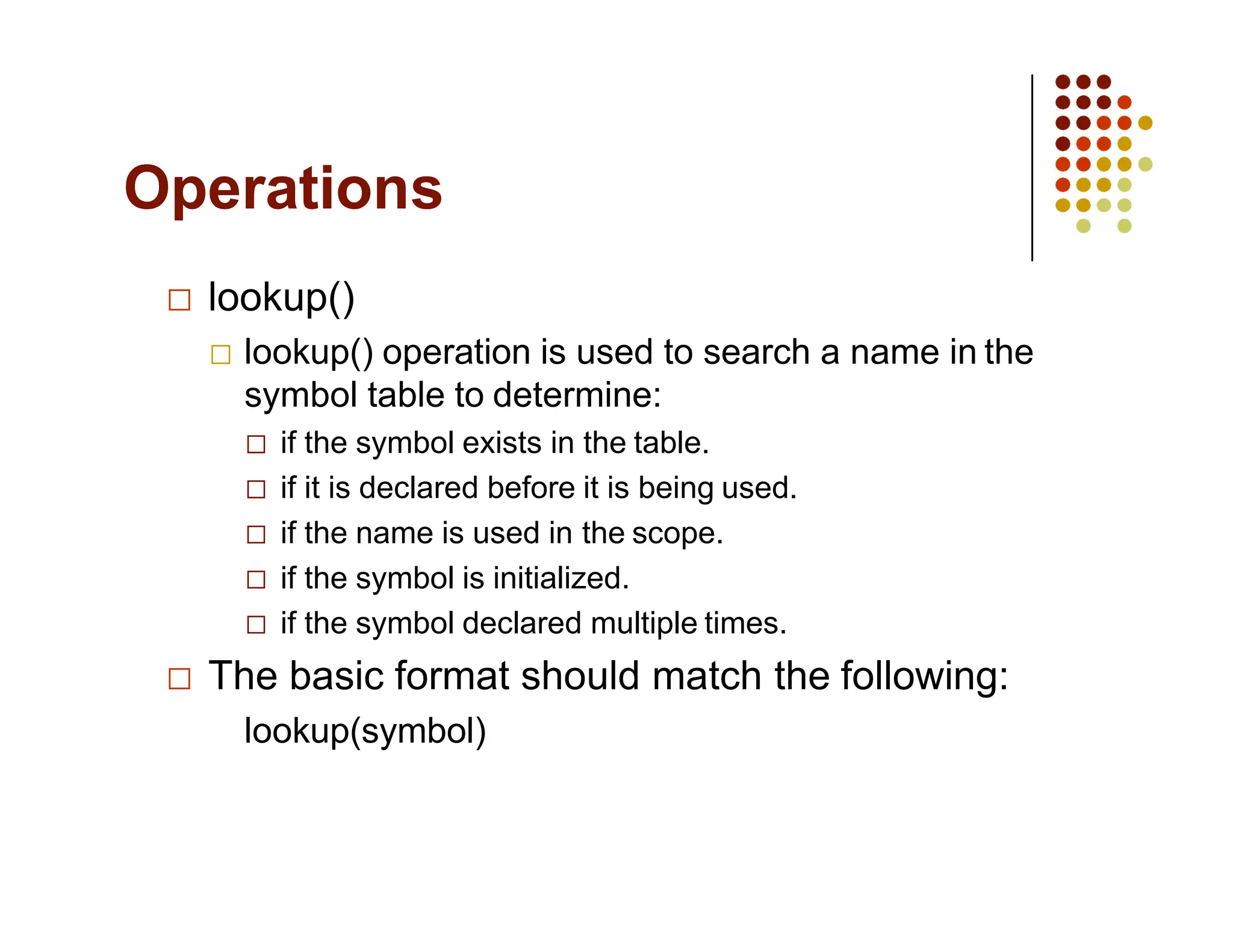
lookup()
lookup() operation is used to search a name in the
symbol table to determine:
if the symbol exists in the table.
if it is declared before it is being used.
if the name is used in the scope.
if the symbol is initialized.
if the symbol declared multiple times.
The basic format should match the following:
lookup(symbol)
Operations
This method returns 0 (zero) if the symbol does not
exist in the symbol table. If the symbol exists in the
symbol table, it returns its attributes stored in the
table.
Scope Management
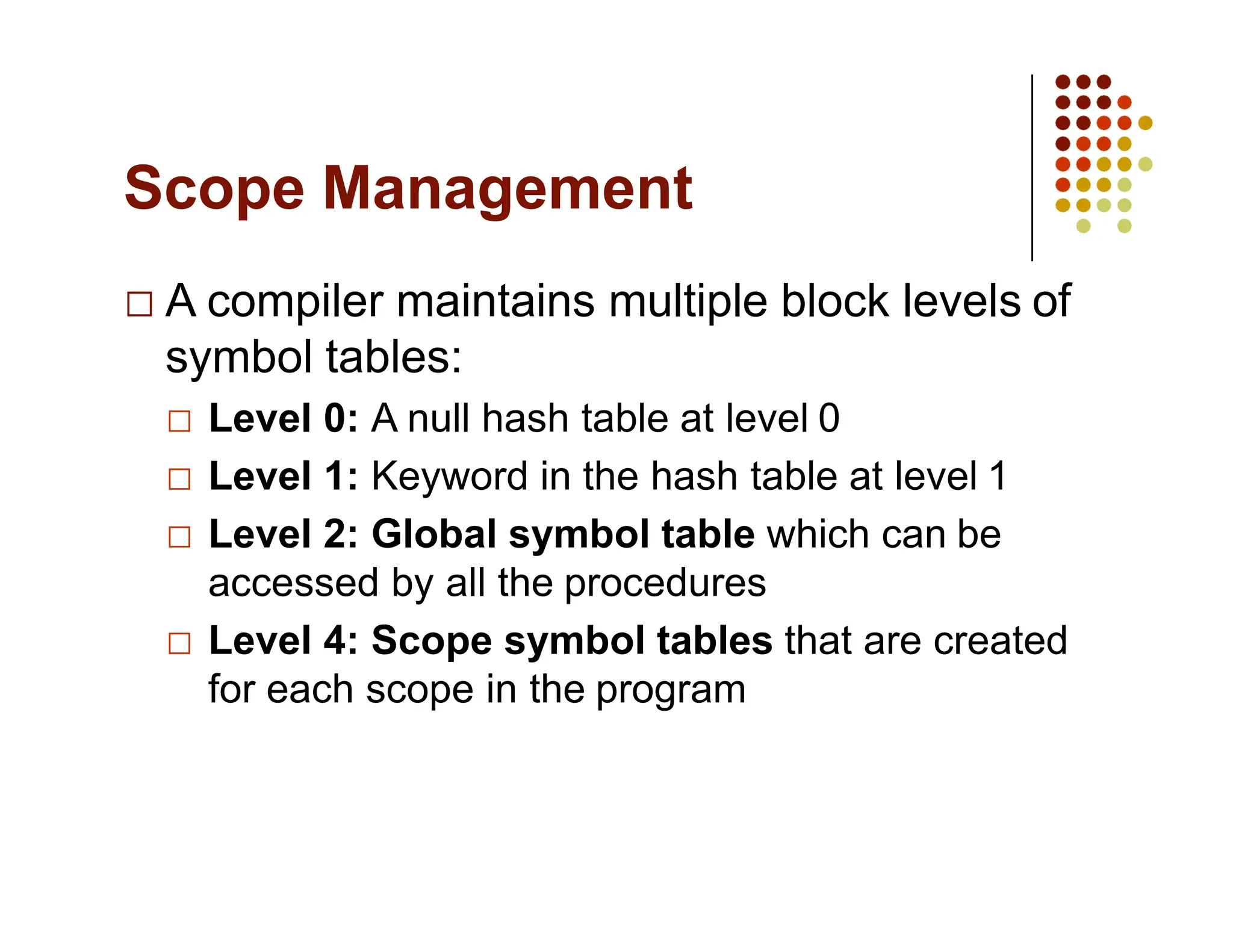
A compiler maintains multiple block levels of
symbol tables:
Level 0: A null hash table at level 0
Level 1: Keyword in the hash table at level 1
Level 2: Global symbol table which can be
accessed by all the procedures
Level 4: Scope symbol tables that are created
for each scope in the program
Scope Management
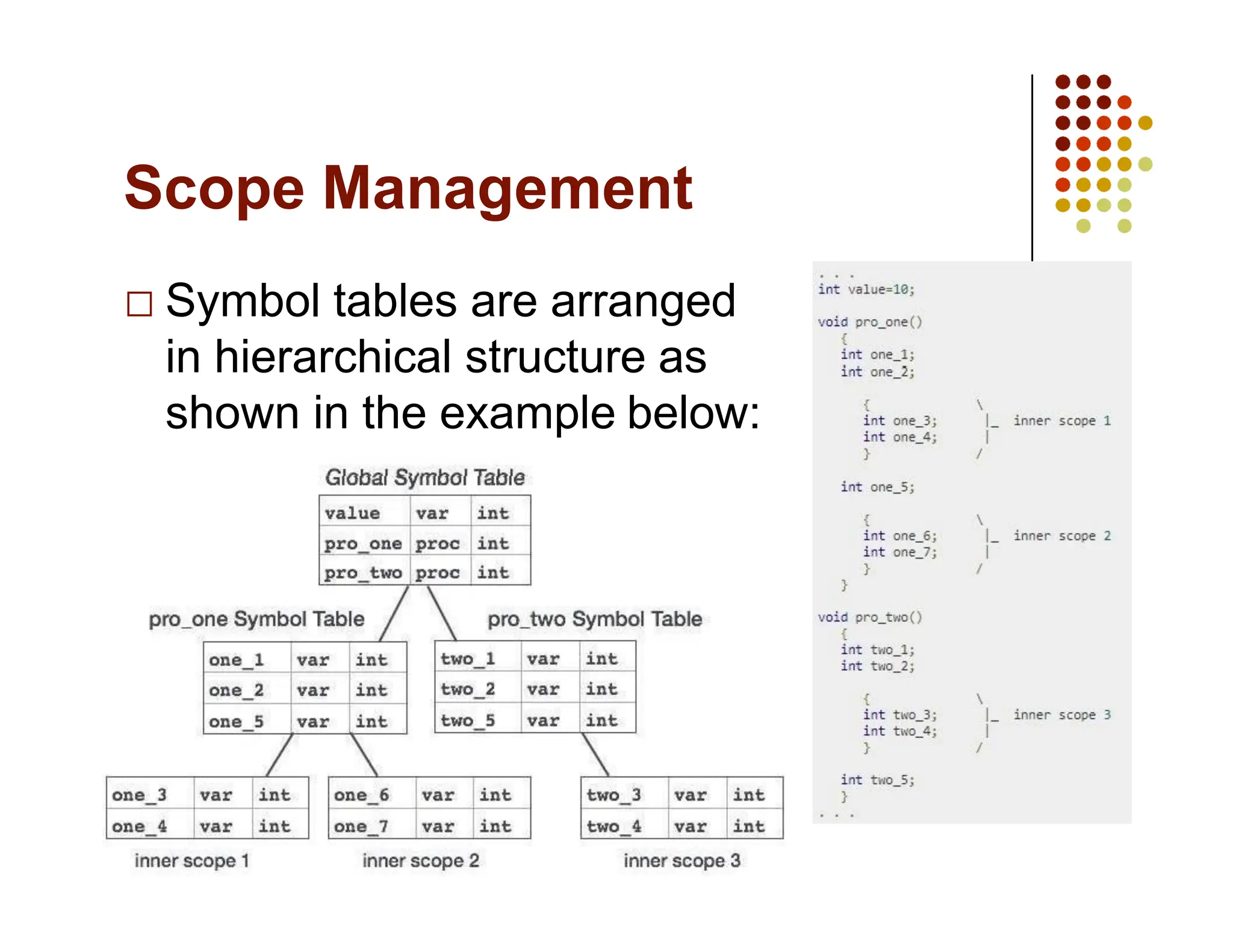
Symbol tables are arranged
in hierarchical structure as
shown in the example below:
Structure of the Symbol Table
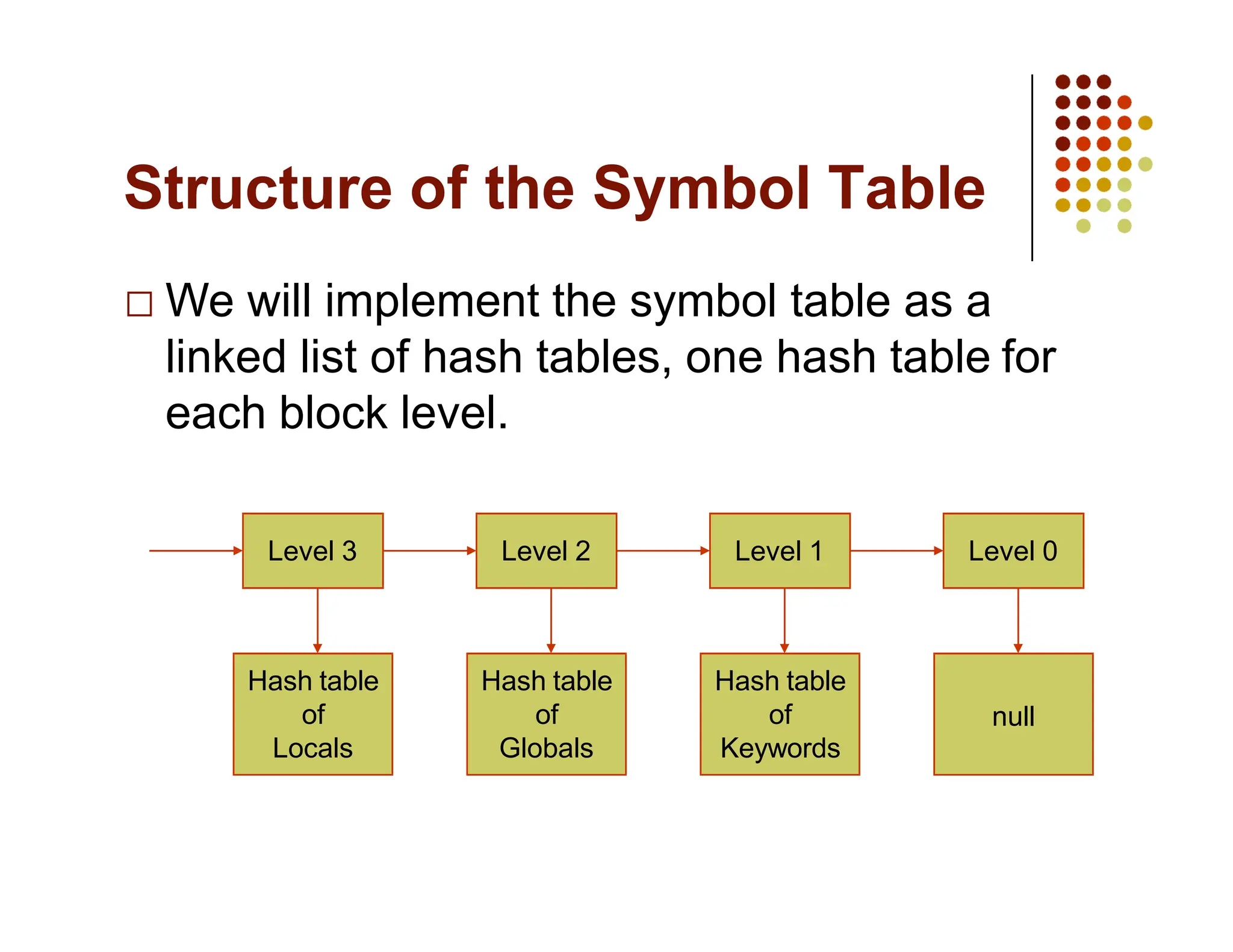
We will implement the symbol table as a
linked list of hash tables, one hash table for
each block level.
Level 3 Level 1
Level 2
Hash table
of
Locals
Hash table
of
Globals
Hash table
of
Keywords
Level 0
null
Structure of the Symbol Table
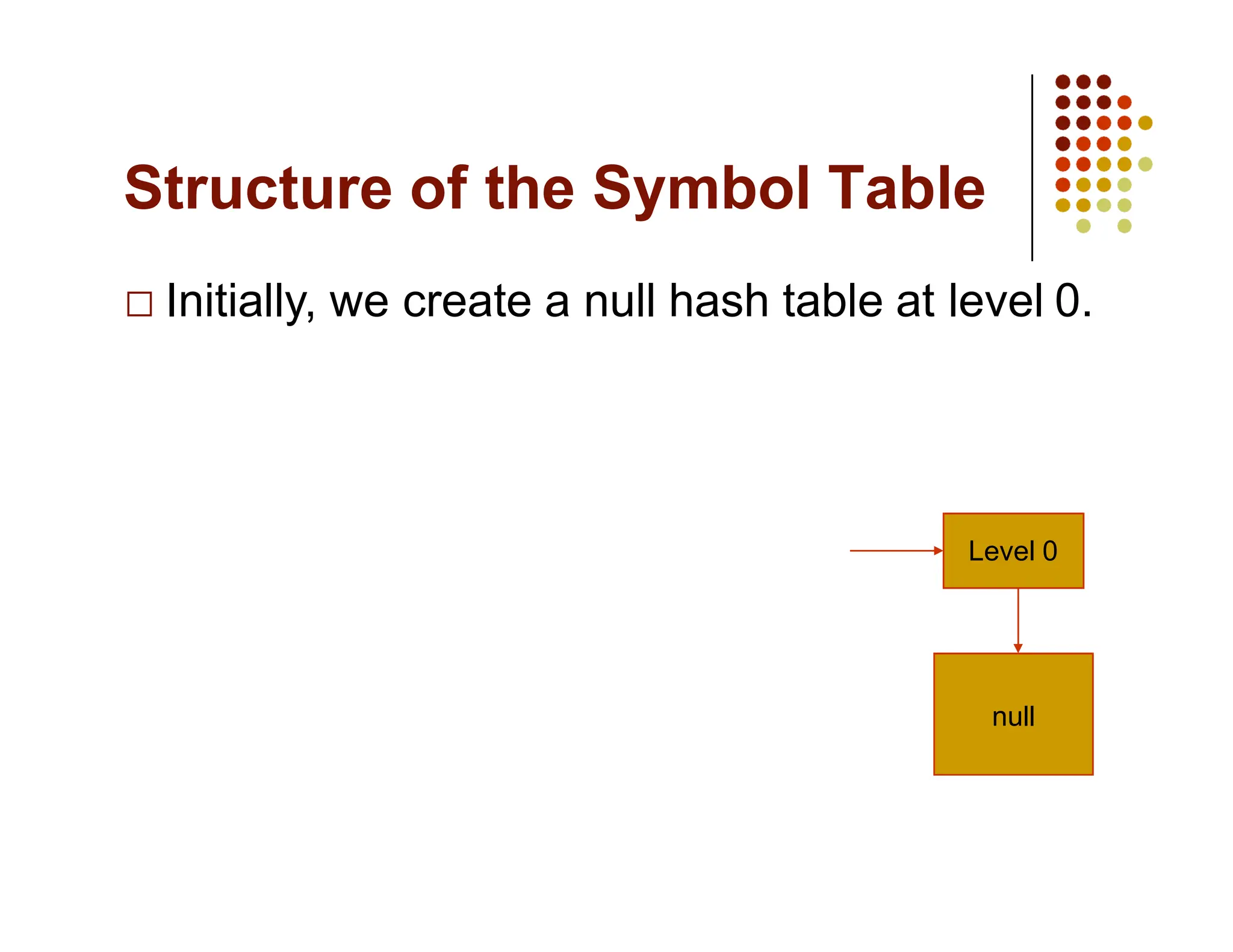
Initially, we create a null hash table at level 0.
Level 0
null
Structure of the Symbol Table
Then we increase the block level and install
the keywords in the symbol table at level 1.
Level 1
Hash table
of
Keywords
Level 0
null
Structure of the Symbol Table
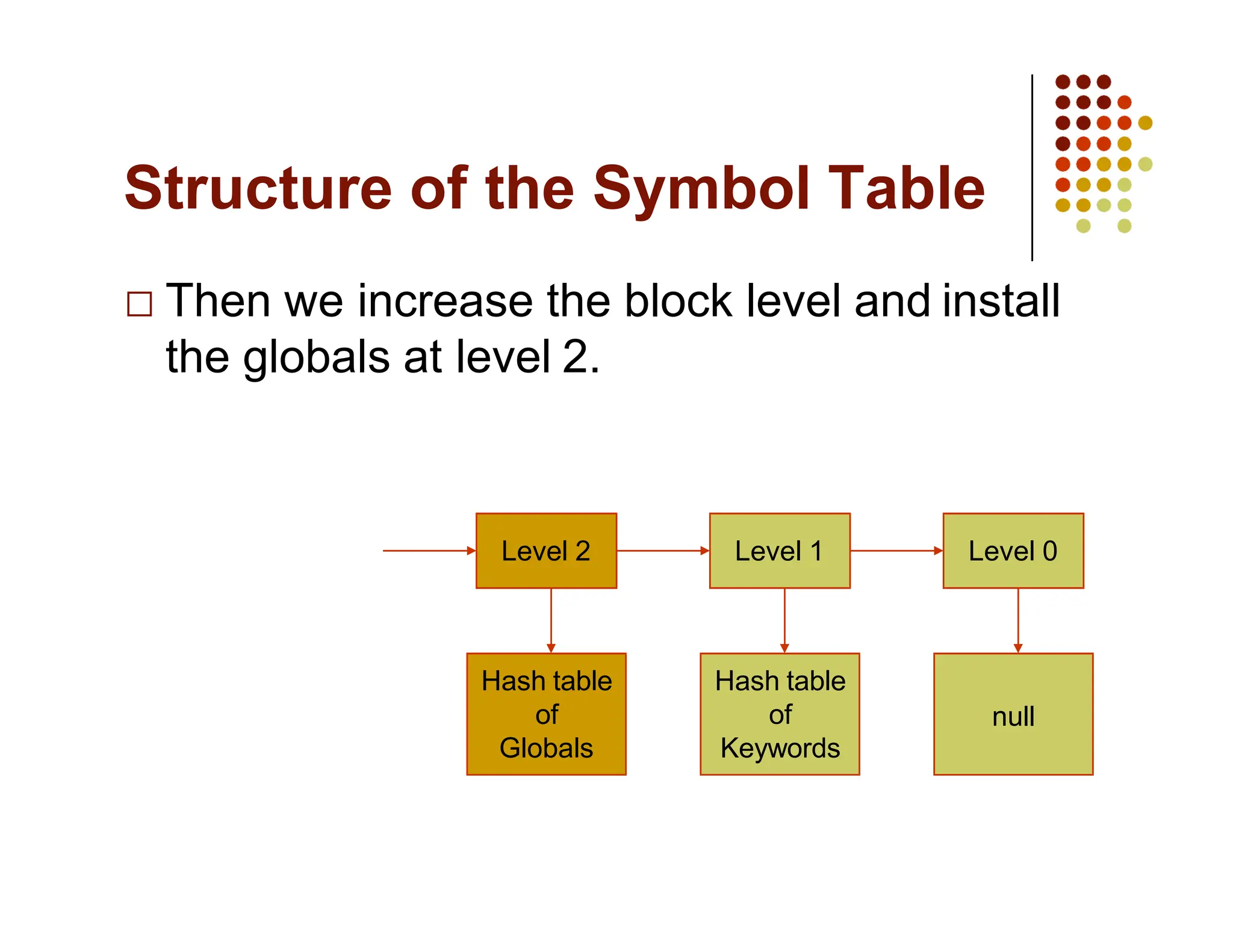
Then we increase the block level and install
the globals at level 2.
Level 1
Level 2
Hash table
of
Globals
Hash table
of
Keywords
Level 0
null
Structure of the Symbol Table
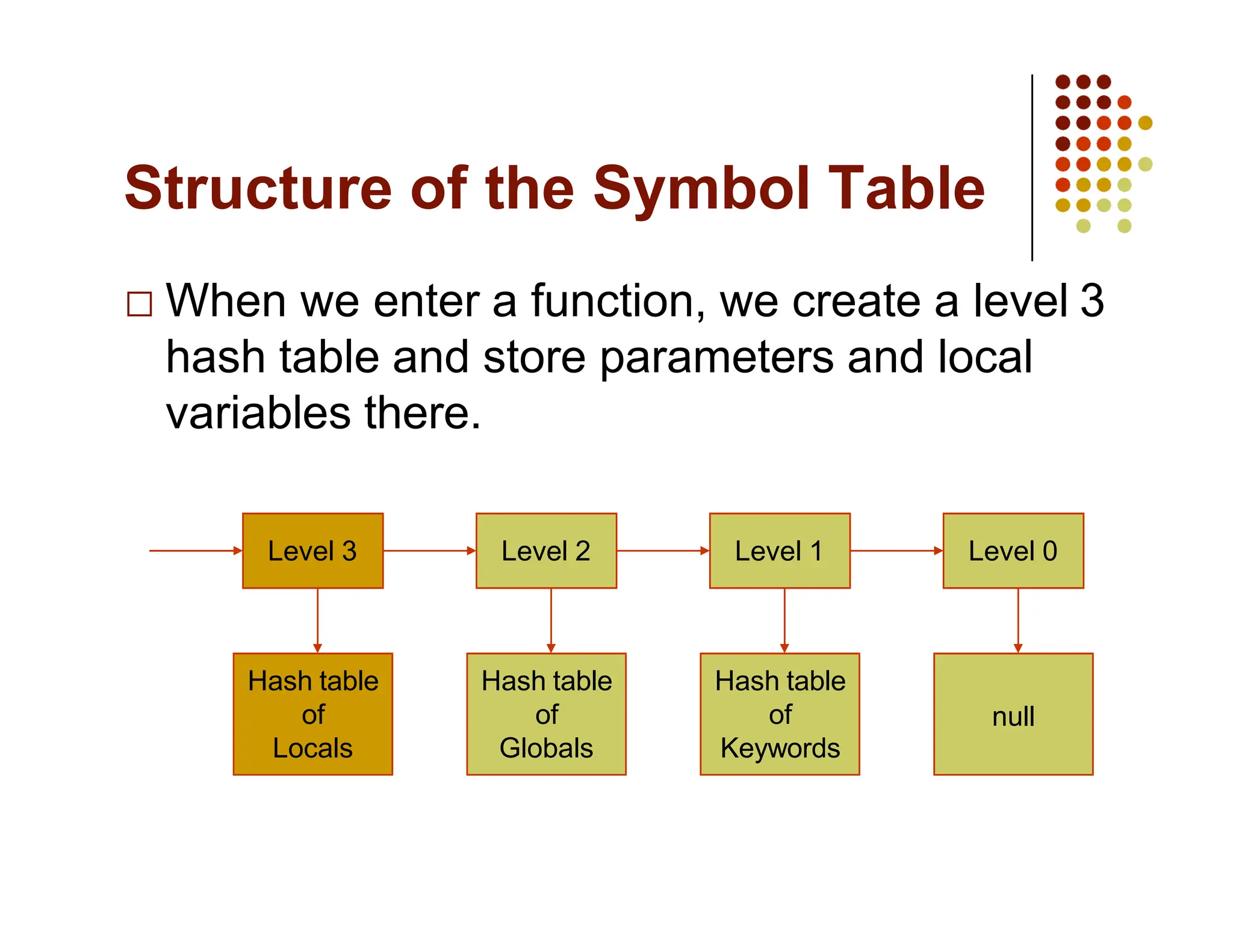
When we enter a function, we create a level 3
hash table and store parameters and local
variables there.
Level 3 Level 1
Level 2
Hash table
of
Locals
Hash table
of
Globals
Hash table
of
Keywords
Level 0
null
Structure of the Symbol Table
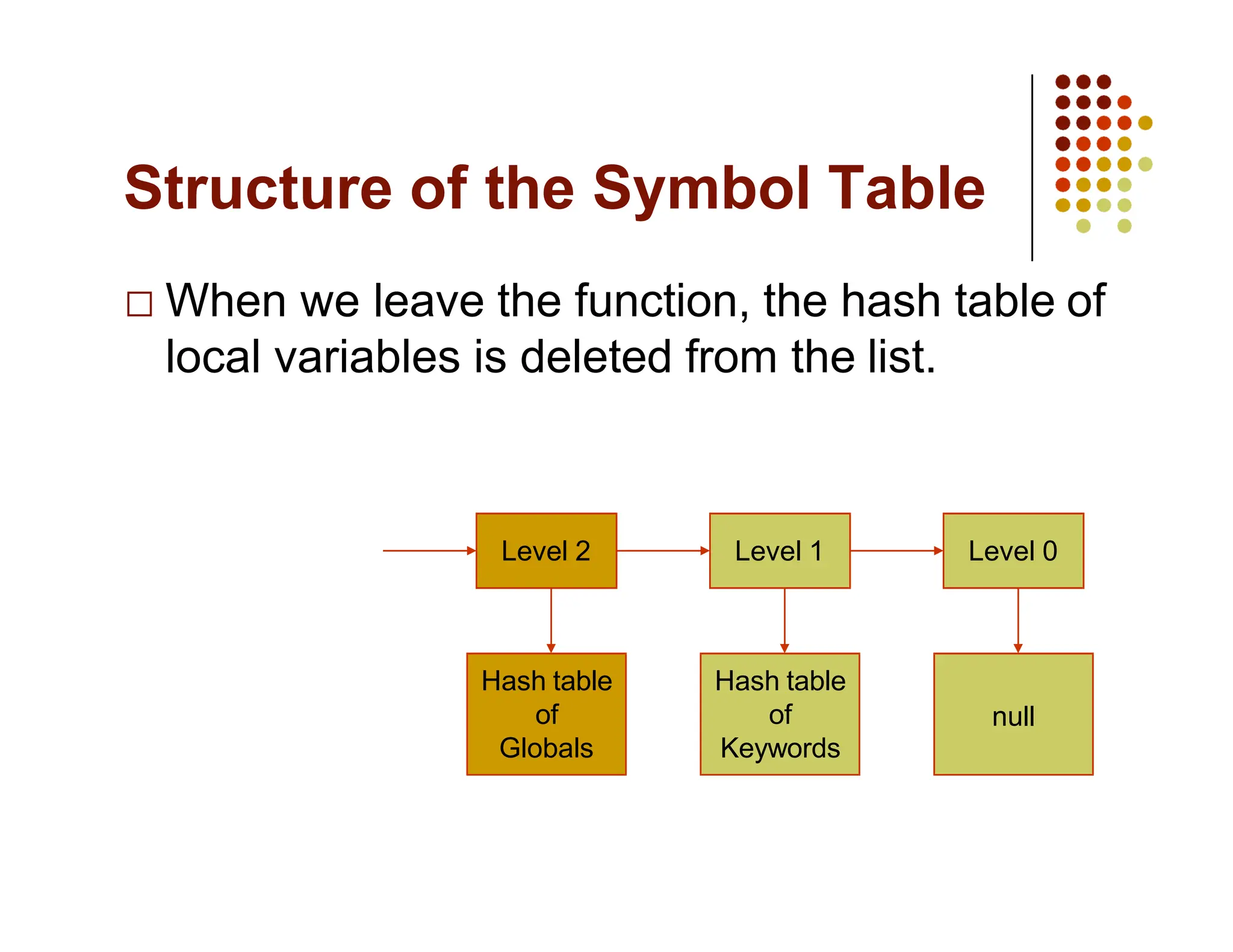
When we leave the function, the hash table of
local variables is deleted from the list.
Level 1
Level 2
Hash table
of
Globals
Hash table
of
Keywords
Level 0
null
Locating a Symbol
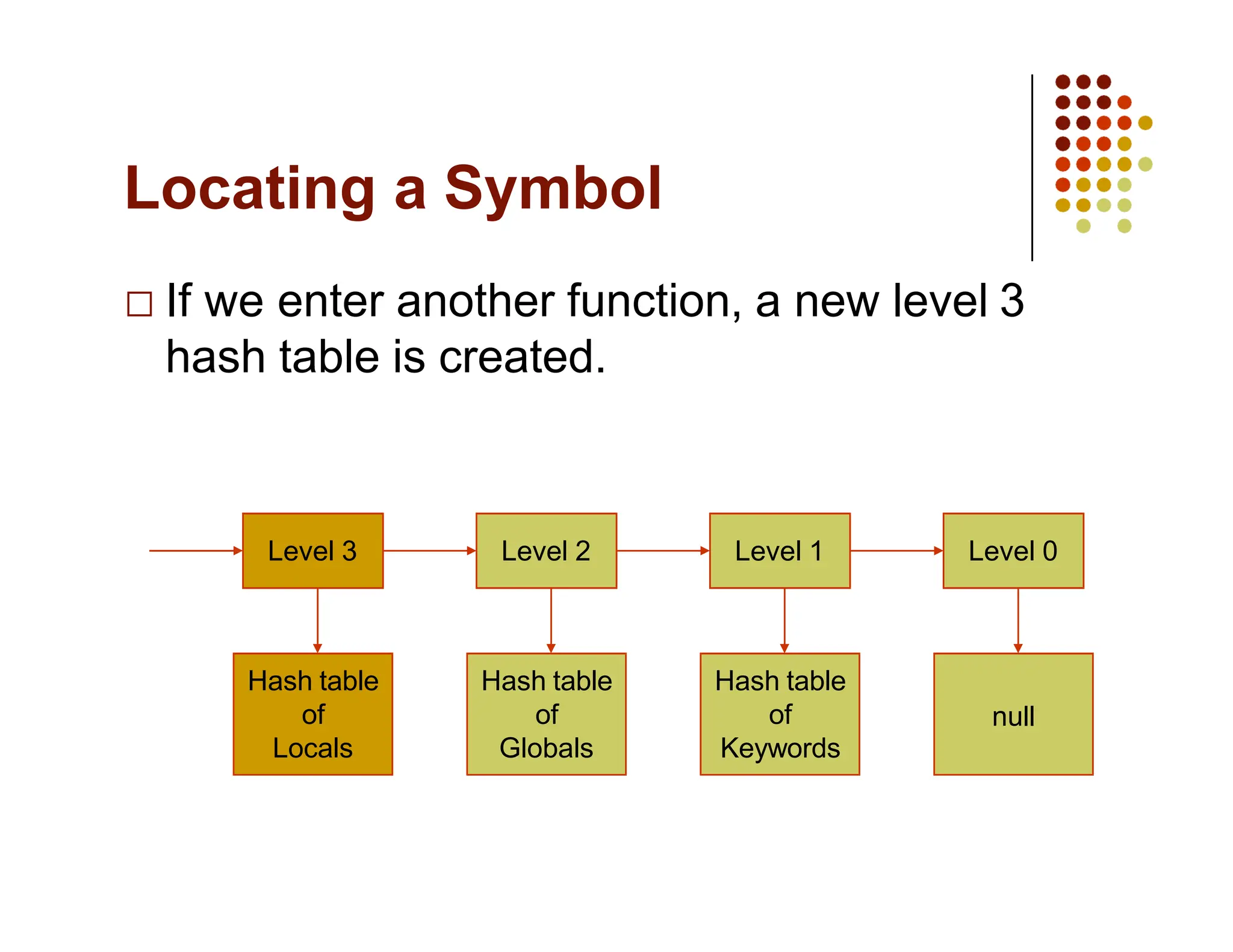
If we enter another function, a new level 3
hash table is created.
Level 3 Level 1
Level 2
Hash table
of
Locals
Hash table
of
Globals
Hash table
of
Keywords
Level 0
null
Locating a Symbol
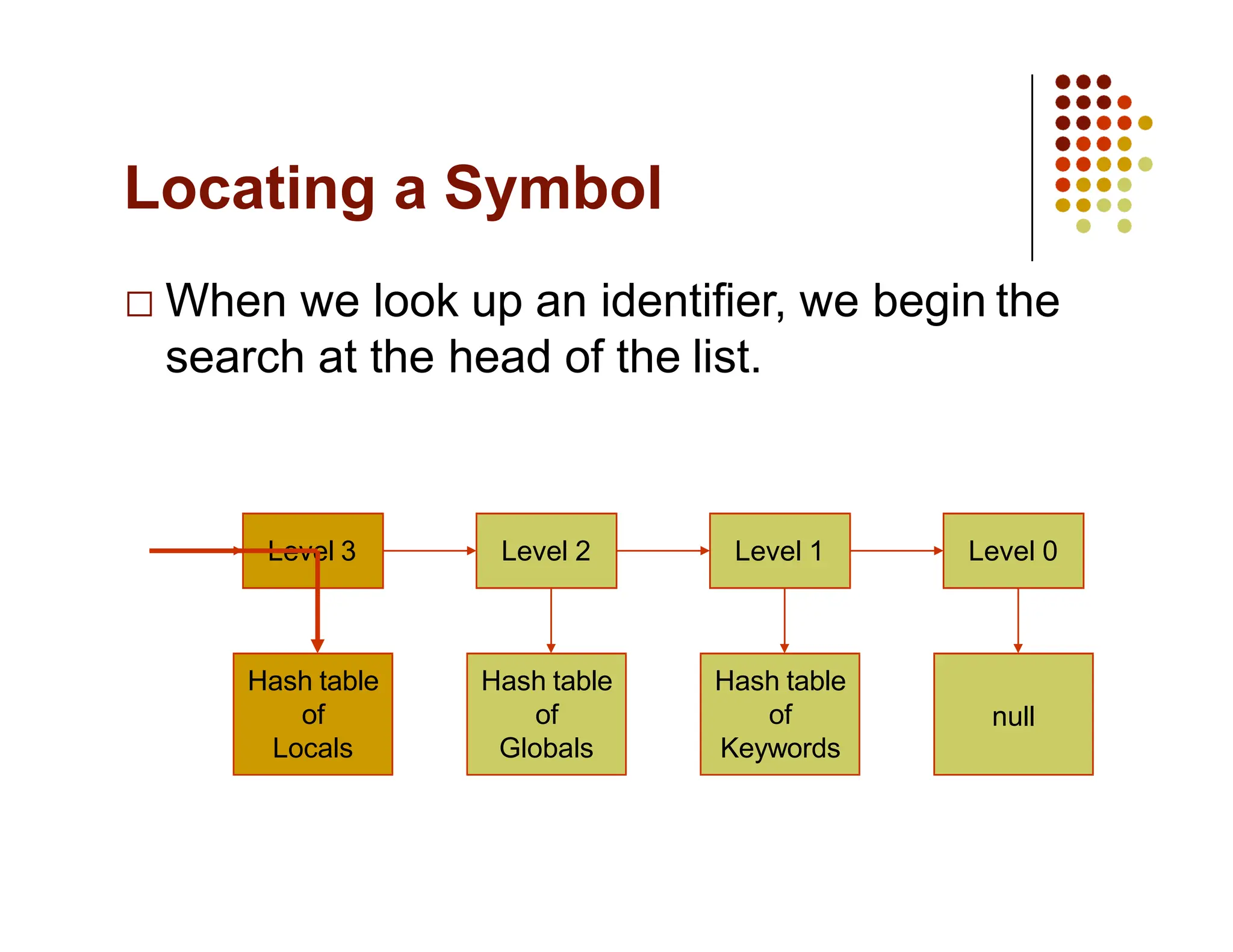
When we look up an identifier, we begin the
search at the head of the list.
Level 3 Level 1
Level 2
Hash table
of
Locals
Hash table
of
Globals
Hash table
of
Keywords
Level 0
null
Locating a Symbol
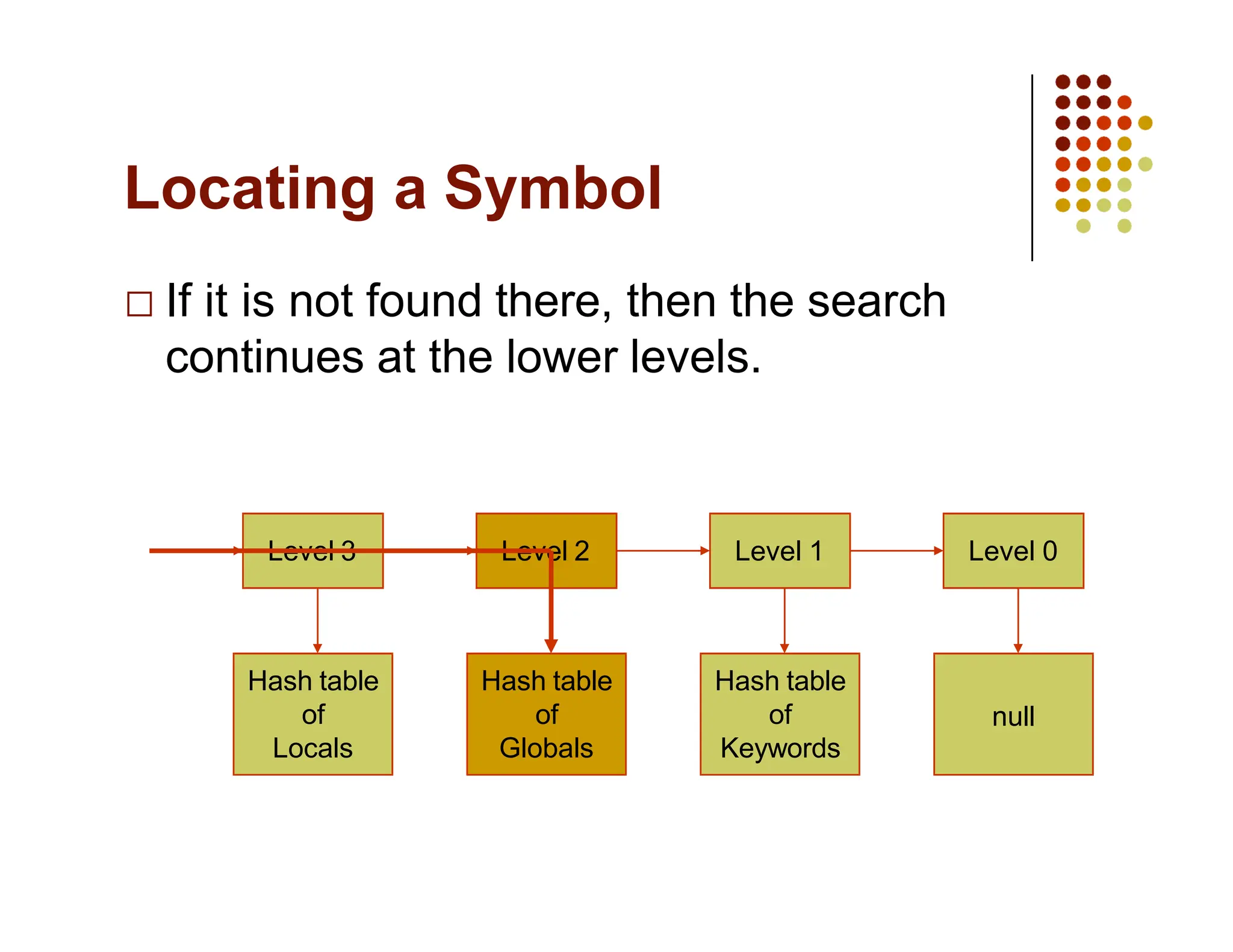
If it is not found there, then the search
continues at the lower levels.
Level 3 Level 1
Level 2
Hash table
of
Locals
Hash table
of
Globals
Hash table
of
Keywords
Level 0
null
Locating a Symbol
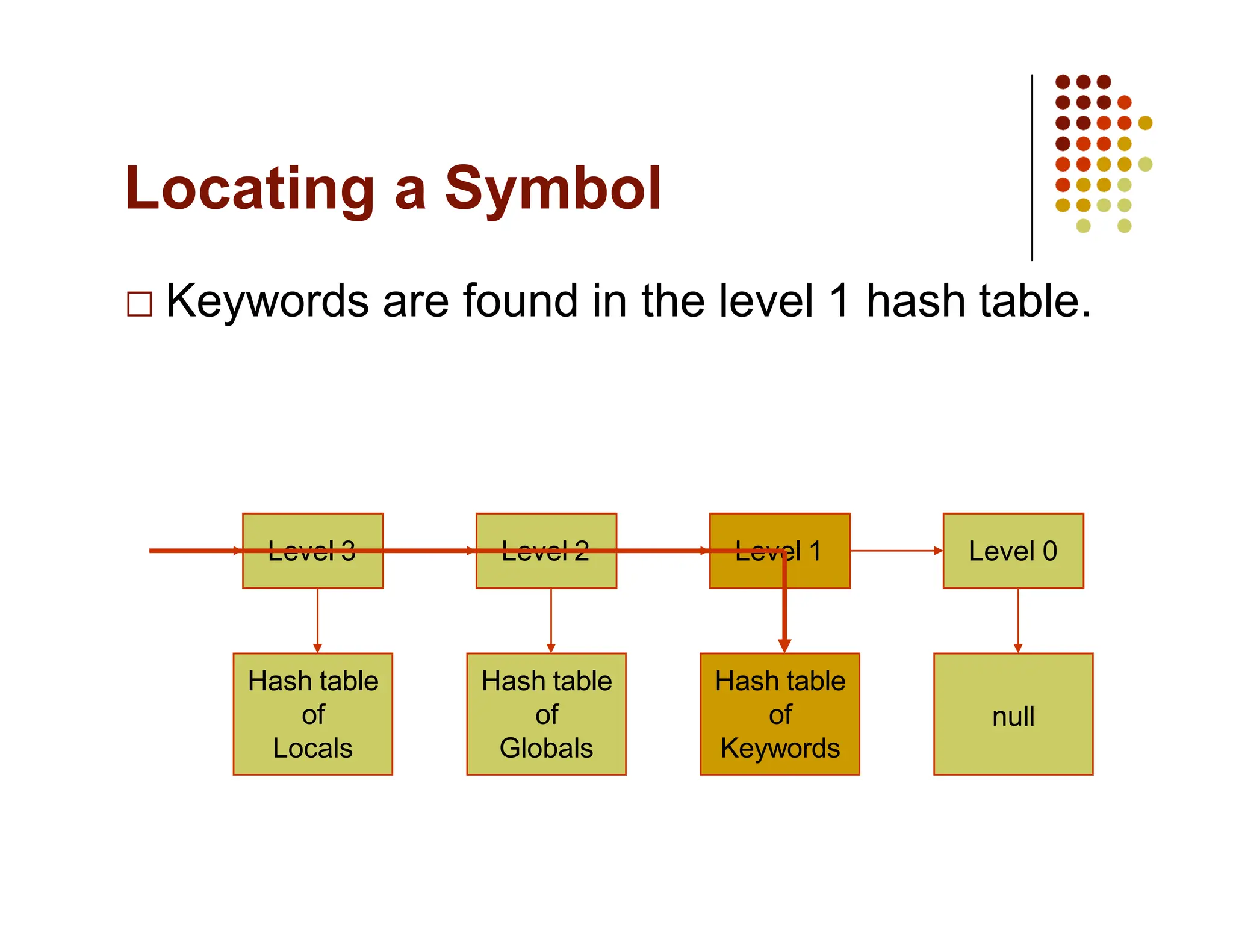
Keywords are found in the level 1 hash table.
Level 3 Level 1
Level 2
Hash table
of
Locals
Hash table
of
Globals
Hash table
of
Keywords
Level 0
null
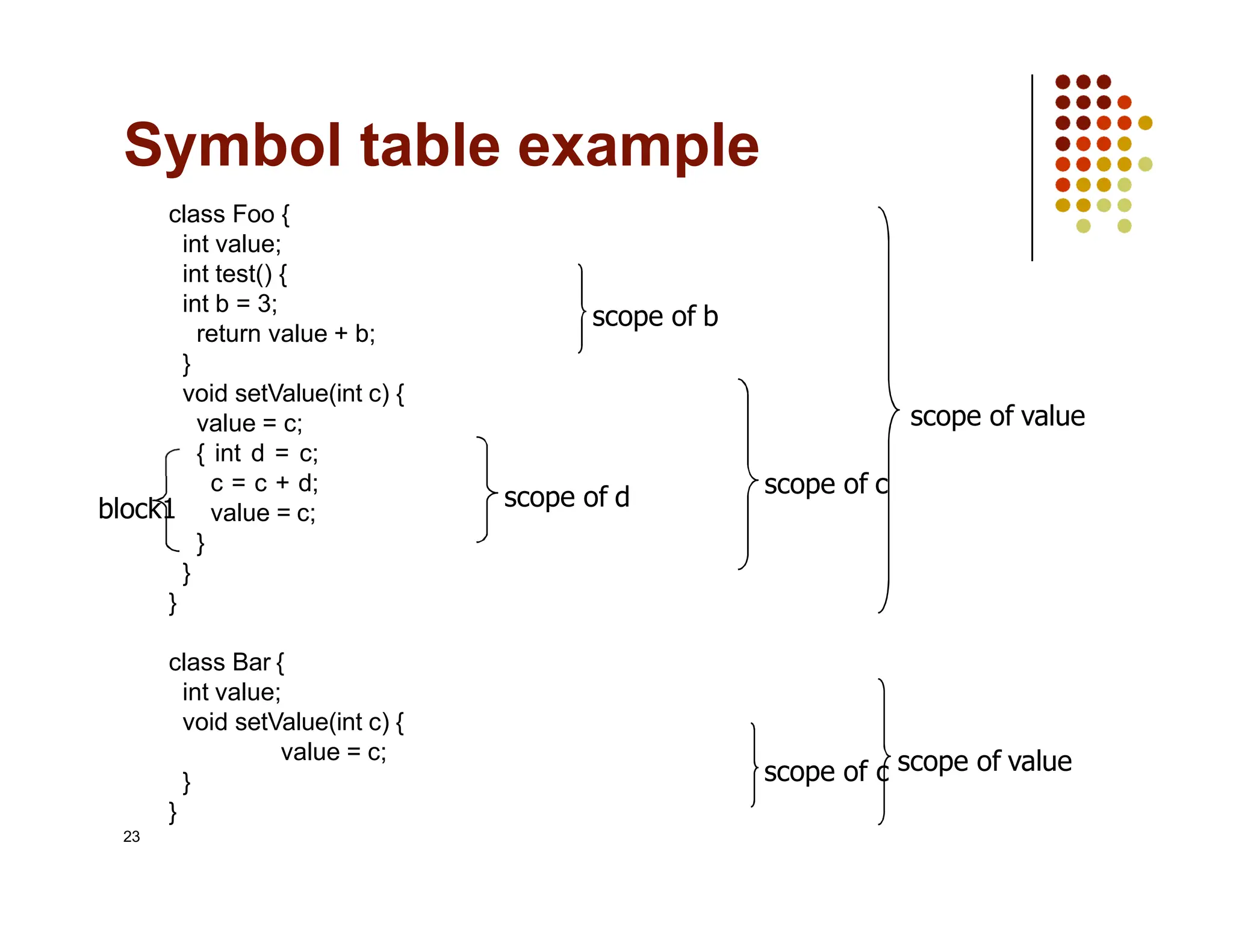
class Foo {
int value;
int test() {
int b = 3;
return value + b;
}
void setValue(int c) {
value = c;
{ int d = c;
c = c + d;
value = c;
}
}
scope of value
scope of b
Symbol table example
23
}
class Bar {
int value;
void setValue(int c) {
value = c;
}
}
scope of c
scope of c scope of value
scope of d
block1
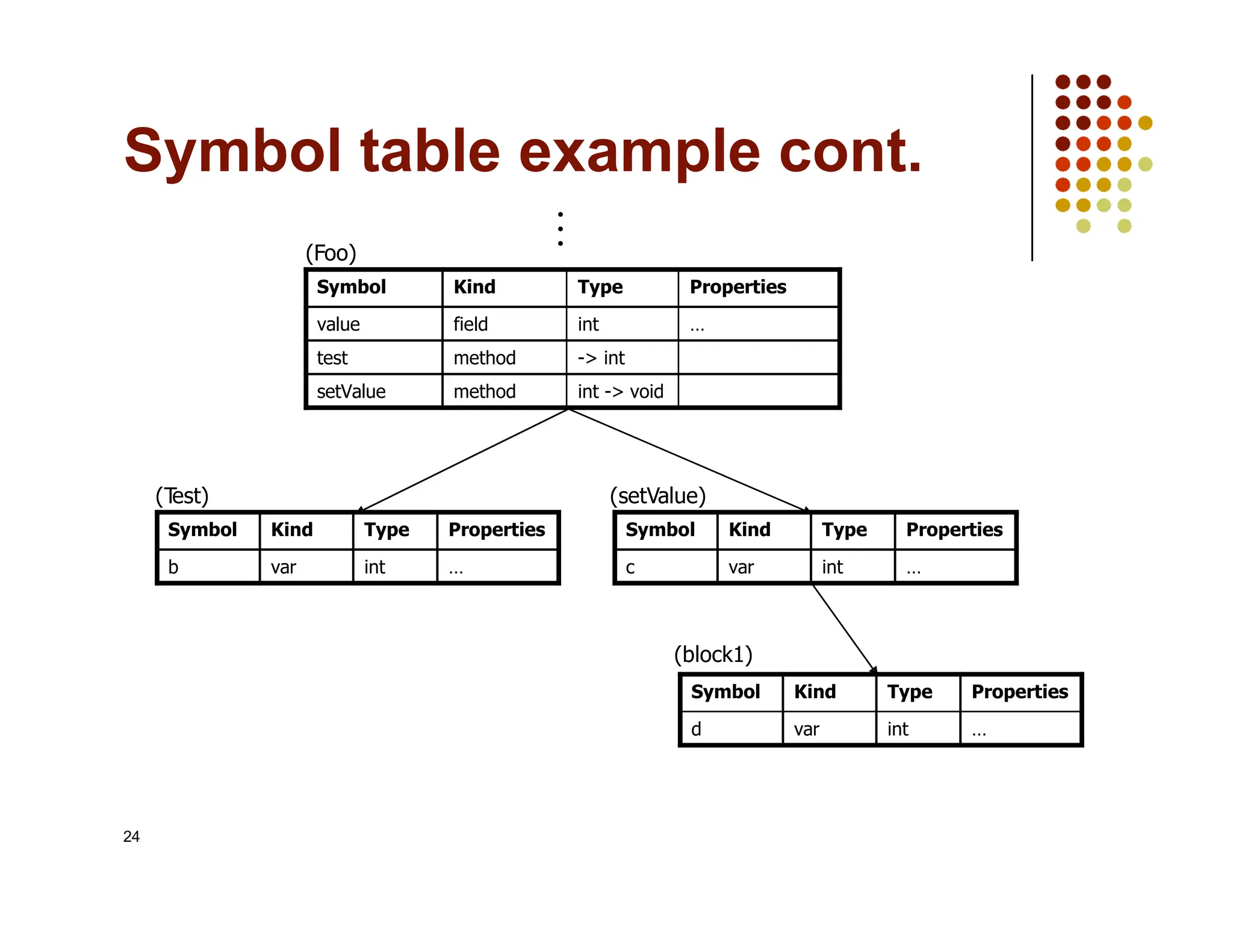
Symbol Kind Type Properties
value field int …
test method -> int
setValue method int -> void
(Foo)
…
Symbol table example cont.
24
Symbol Kind Type Properties
b var int …
Symbol Kind Type Properties
c var int …
Symbol Kind Type Properties
d var int …
(T
est) (setValue)
(block1)
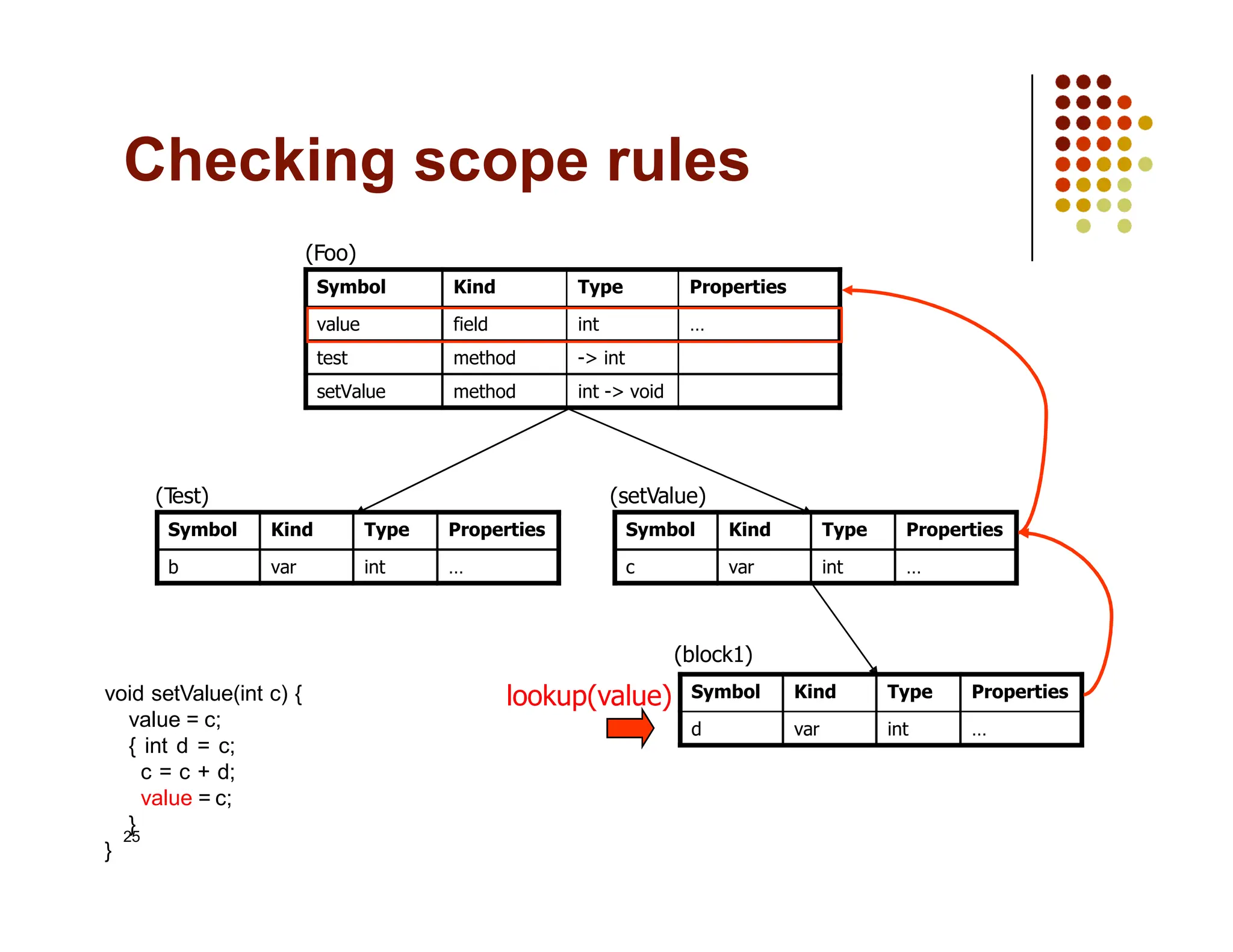
Checking scope rules
Symbol Kind Type Properties
value field int …
test method -> int
setValue method int -> void
(Foo)
25
Symbol Kind Type Properties
b var int …
Symbol Kind Type Properties
c var int …
Symbol Kind Type Properties
d var int …
(T
est) (setValue)
(block1)
void setValue(int c) {
value = c;
{ int d = c;
c = c + d;
value = c;
}
}
lookup(value)
Symbol Kind Type Properties
value field int …
test method -> int
setValue method int -> void
(Foo)
(T
est) (setValue)
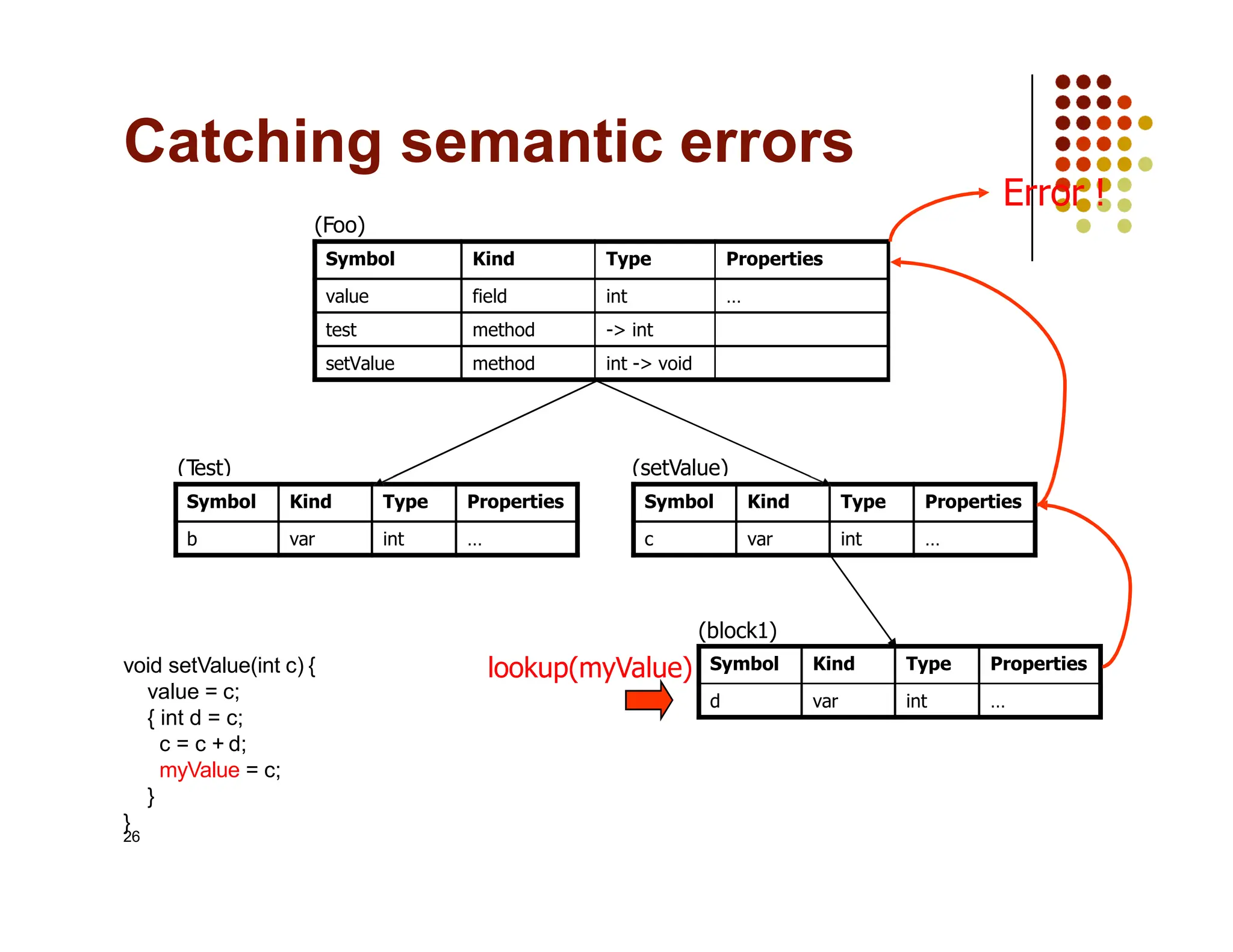
Error !
Catching semantic errors
26
Symbol Kind Type Properties
b var int …
Symbol Kind Type Properties
c var int …
Symbol Kind Type Properties
d var int …
(block1)
void setValue(int c) {
value = c;
{ int d = c;
c = c + d;
myValue = c;
}
}
lookup(myValue)
Hash Tables
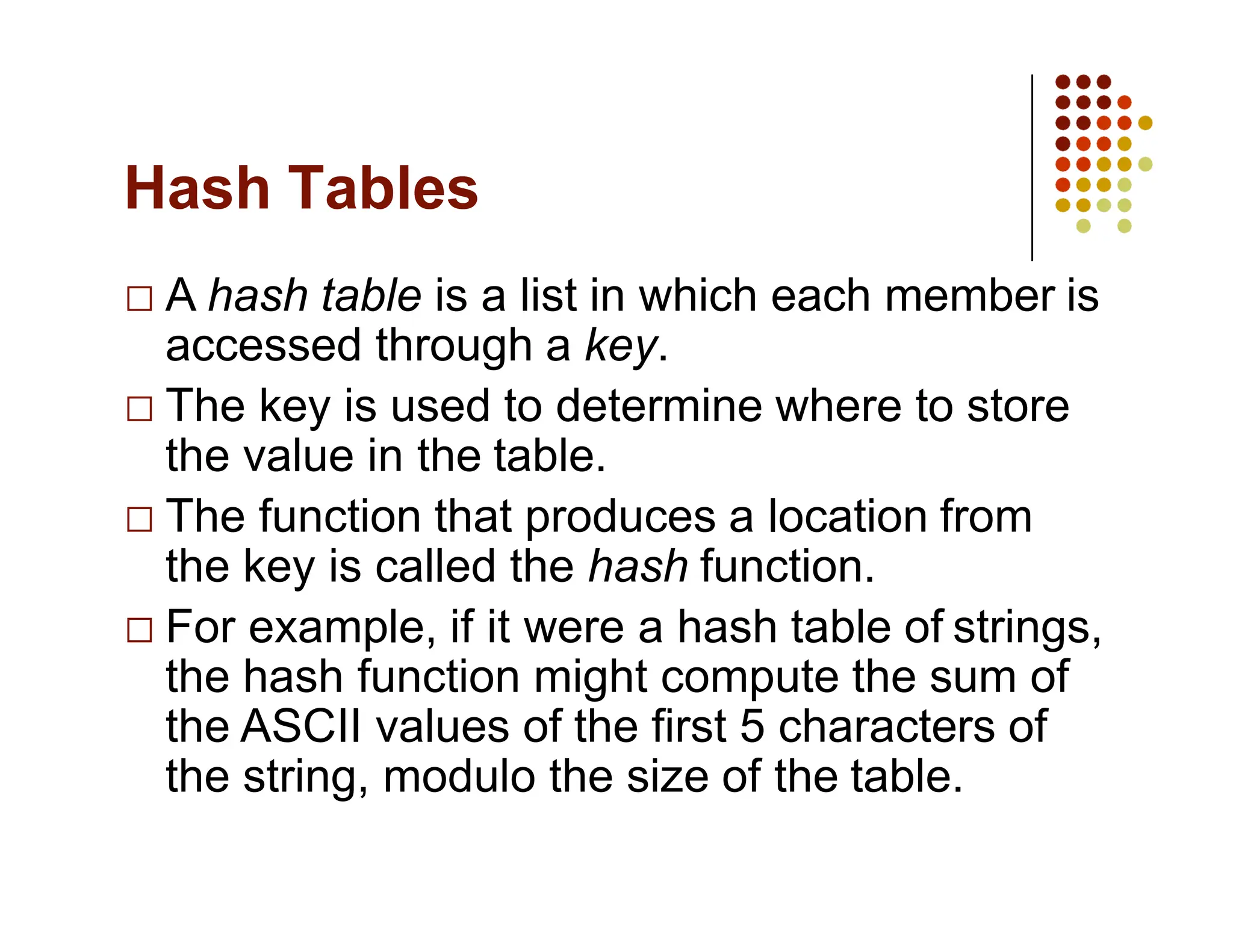
A hash table is a list in which each member is
accessed through a key.
The key is used to determine where to store
the value in the table.
The function that produces a location from
the key is called the hash function.
For example, if it were a hash table of strings,
the hash function might compute the sum of
the ASCII values of the first 5 characters of
the string, modulo the size of the table.
Hash Tables
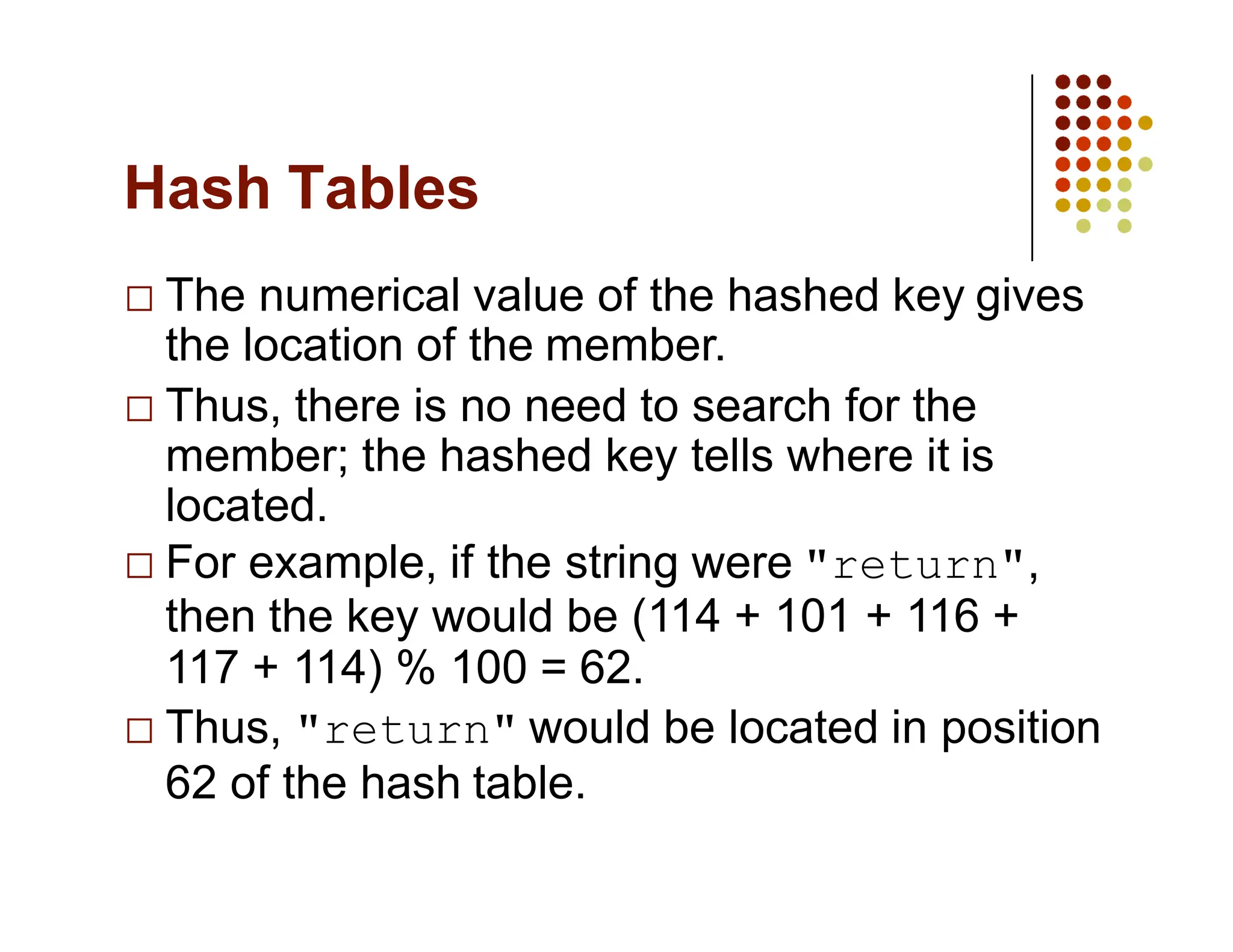
The numerical value of the hashed key gives
the location of the member.
Thus, there is no need to search for the
member; the hashed key tells where it is
located.
For example, if the string were "return",
then the key would be (114 + 101 + 116 +
117 + 114) % 100 = 62.
Thus, "return" would be located in position
62 of the hash table.
Clashes and Buckets
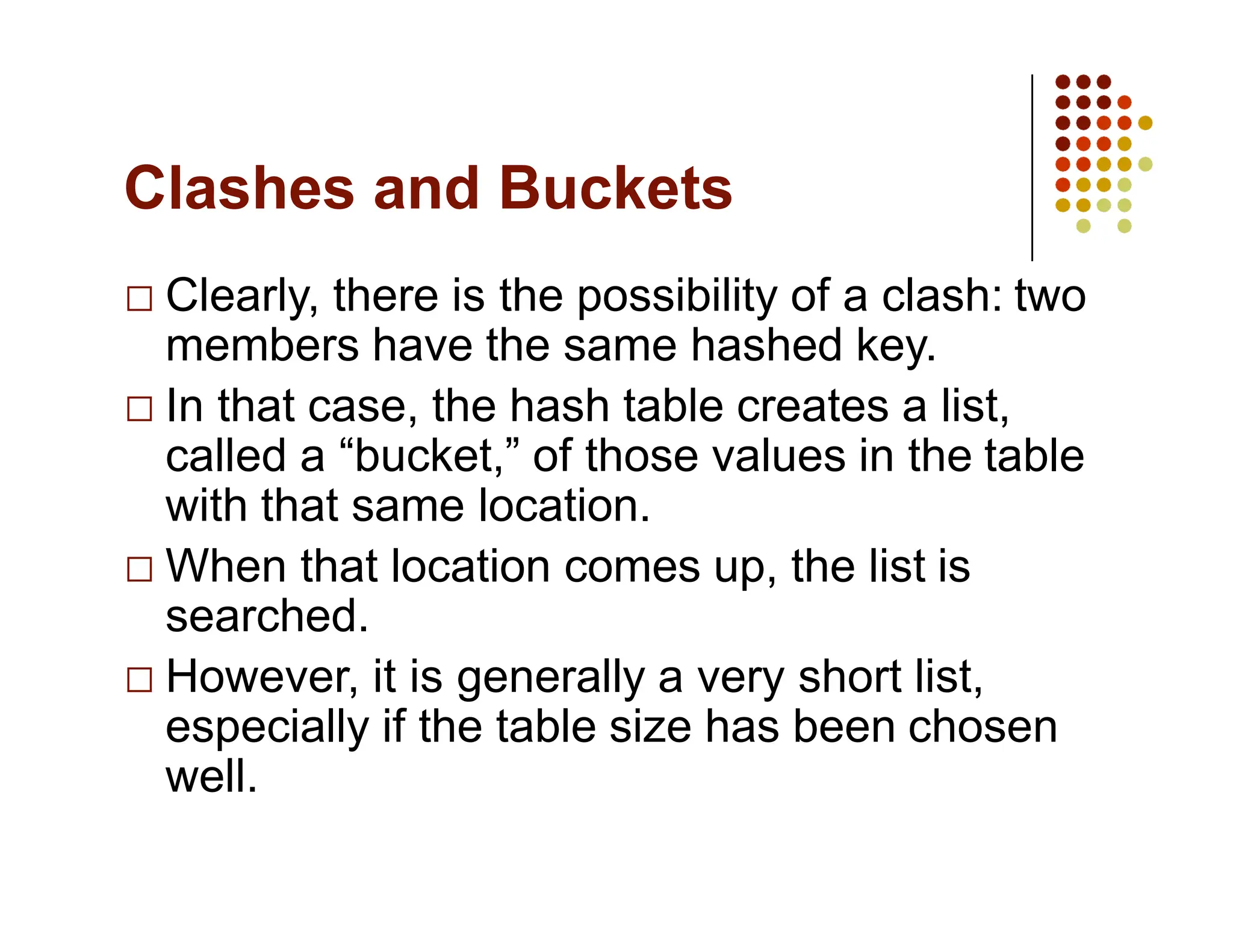
Clearly, there is the possibility of a clash: two
members have the same hashed key.
In that case, the hash table creates a list,
called a “bucket,” of those values in the table
with that same location.
When that location comes up, the list is
searched.
However, it is generally a very short list,
especially if the table size has been chosen
well.
Hash Table Efficiency
The two parameters that determine how
efficiently the hash table performs are
The capacity of the table, i.e., the total amount of
memory allocated.
The number of buckets, or equivalently, the size
of a bucket.
Clearly, the size of a bucket times the
number of buckets equals the capacity of the
table.
Hash Table Efficiency
For a given hash table capacity,
If there are too many buckets, then many buckets
will not be used, leading to space inefficiency.
If there are too few buckets, then there will be
many clashes, causing the searches to
degenerate into predominately sequential
searches, leading to time inefficiency.
End of Chapter # 13

Symbol-Table concept in compiler design pdf for reference

  • 1.
  • 2.
    Symbol Table The datastructure that is created and maintained by the compilers for information storing regarding the occurrence of various entities like names of variables, functions, objects, classes Symbol table is used by both the analysis and the synthesis parts of a compiler
  • 3.
    Symbol Table A symboltable may serve the following purposes depending upon the language in hand: To store the names of all entities in a structured form at one place To verify if a variable has been declared To implement type checking, by verifying assignments and expressions in the source code are semantically correct To determine the scope of a name (scope resolution)
  • 4.
    Information Stored inSymbol Table The following possible information about identifiers are stored in symbol table The name (as a string) Attribute: Reserved word, Variable name, Type name, Procedure name, Constant name The data type The block level Its scope (global, local, or parameter) Its offset from the base pointer (for local variables and parameters only)
  • 5.
    Implementation Symbol table canbe implemented as Unordered List Linear (sorted or unsorted) list Binary Search Tree Hash table Among all, symbol tables are mostly implemented as hash tables, where the source code symbol itself is treated as a key for the hash function and the return value is the information about the symbol.
  • 6.
    Entry Format A symboltable maintains an entry for each name in the following format: <symbol name, type, attribute> For example, if a symbol table has to store information about the following variable declaration: static int interest; then it should store the entry such as: <interest, int, static>
  • 7.
    Operations A symbol table,either linear or hash, should provide the following operations. insert() This operation is more frequently used by analysis phase where tokens are identified and names are stored in the table. This operation is used to add information in the symbol table about unique names occurring in the source code. The format or structure in which the names arestored depends upon the compiler in hand.
  • 8.
    Operations An attribute fora symbol in the source code is the information associated with that symbol. This information contains the value, state, scope, and type about the symbol. The insert() function takes the symbol and its attributes as arguments and stores the information in the symbol table. For example: int a; should be processed by the compileras: insert(a, int);
  • 9.
    Operations lookup() lookup() operation isused to search a name in the symbol table to determine: if the symbol exists in the table. if it is declared before it is being used. if the name is used in the scope. if the symbol is initialized. if the symbol declared multiple times. The basic format should match the following: lookup(symbol)
  • 10.
    Operations This method returns0 (zero) if the symbol does not exist in the symbol table. If the symbol exists in the symbol table, it returns its attributes stored in the table.
  • 11.
    Scope Management A compilermaintains multiple block levels of symbol tables: Level 0: A null hash table at level 0 Level 1: Keyword in the hash table at level 1 Level 2: Global symbol table which can be accessed by all the procedures Level 4: Scope symbol tables that are created for each scope in the program
  • 12.
    Scope Management Symbol tablesare arranged in hierarchical structure as shown in the example below:
  • 13.
    Structure of theSymbol Table We will implement the symbol table as a linked list of hash tables, one hash table for each block level. Level 3 Level 1 Level 2 Hash table of Locals Hash table of Globals Hash table of Keywords Level 0 null
  • 14.
    Structure of theSymbol Table Initially, we create a null hash table at level 0. Level 0 null
  • 15.
    Structure of theSymbol Table Then we increase the block level and install the keywords in the symbol table at level 1. Level 1 Hash table of Keywords Level 0 null
  • 16.
    Structure of theSymbol Table Then we increase the block level and install the globals at level 2. Level 1 Level 2 Hash table of Globals Hash table of Keywords Level 0 null
  • 17.
    Structure of theSymbol Table When we enter a function, we create a level 3 hash table and store parameters and local variables there. Level 3 Level 1 Level 2 Hash table of Locals Hash table of Globals Hash table of Keywords Level 0 null
  • 18.
    Structure of theSymbol Table When we leave the function, the hash table of local variables is deleted from the list. Level 1 Level 2 Hash table of Globals Hash table of Keywords Level 0 null
  • 19.
    Locating a Symbol Ifwe enter another function, a new level 3 hash table is created. Level 3 Level 1 Level 2 Hash table of Locals Hash table of Globals Hash table of Keywords Level 0 null
  • 20.
    Locating a Symbol Whenwe look up an identifier, we begin the search at the head of the list. Level 3 Level 1 Level 2 Hash table of Locals Hash table of Globals Hash table of Keywords Level 0 null
  • 21.
    Locating a Symbol Ifit is not found there, then the search continues at the lower levels. Level 3 Level 1 Level 2 Hash table of Locals Hash table of Globals Hash table of Keywords Level 0 null
  • 22.
    Locating a Symbol Keywordsare found in the level 1 hash table. Level 3 Level 1 Level 2 Hash table of Locals Hash table of Globals Hash table of Keywords Level 0 null
  • 23.
    class Foo { intvalue; int test() { int b = 3; return value + b; } void setValue(int c) { value = c; { int d = c; c = c + d; value = c; } } scope of value scope of b Symbol table example 23 } class Bar { int value; void setValue(int c) { value = c; } } scope of c scope of c scope of value scope of d block1
  • 24.
    Symbol Kind TypeProperties value field int … test method -> int setValue method int -> void (Foo) … Symbol table example cont. 24 Symbol Kind Type Properties b var int … Symbol Kind Type Properties c var int … Symbol Kind Type Properties d var int … (T est) (setValue) (block1)
  • 25.
    Checking scope rules SymbolKind Type Properties value field int … test method -> int setValue method int -> void (Foo) 25 Symbol Kind Type Properties b var int … Symbol Kind Type Properties c var int … Symbol Kind Type Properties d var int … (T est) (setValue) (block1) void setValue(int c) { value = c; { int d = c; c = c + d; value = c; } } lookup(value)
  • 26.
    Symbol Kind TypeProperties value field int … test method -> int setValue method int -> void (Foo) (T est) (setValue) Error ! Catching semantic errors 26 Symbol Kind Type Properties b var int … Symbol Kind Type Properties c var int … Symbol Kind Type Properties d var int … (block1) void setValue(int c) { value = c; { int d = c; c = c + d; myValue = c; } } lookup(myValue)
  • 27.
    Hash Tables A hashtable is a list in which each member is accessed through a key. The key is used to determine where to store the value in the table. The function that produces a location from the key is called the hash function. For example, if it were a hash table of strings, the hash function might compute the sum of the ASCII values of the first 5 characters of the string, modulo the size of the table.
  • 28.
    Hash Tables The numericalvalue of the hashed key gives the location of the member. Thus, there is no need to search for the member; the hashed key tells where it is located. For example, if the string were "return", then the key would be (114 + 101 + 116 + 117 + 114) % 100 = 62. Thus, "return" would be located in position 62 of the hash table.
  • 29.
    Clashes and Buckets Clearly,there is the possibility of a clash: two members have the same hashed key. In that case, the hash table creates a list, called a “bucket,” of those values in the table with that same location. When that location comes up, the list is searched. However, it is generally a very short list, especially if the table size has been chosen well.
  • 30.
    Hash Table Efficiency Thetwo parameters that determine how efficiently the hash table performs are The capacity of the table, i.e., the total amount of memory allocated. The number of buckets, or equivalently, the size of a bucket. Clearly, the size of a bucket times the number of buckets equals the capacity of the table.
  • 31.
    Hash Table Efficiency Fora given hash table capacity, If there are too many buckets, then many buckets will not be used, leading to space inefficiency. If there are too few buckets, then there will be many clashes, causing the searches to degenerate into predominately sequential searches, leading to time inefficiency.
  • 32.