Software Testing Essentials
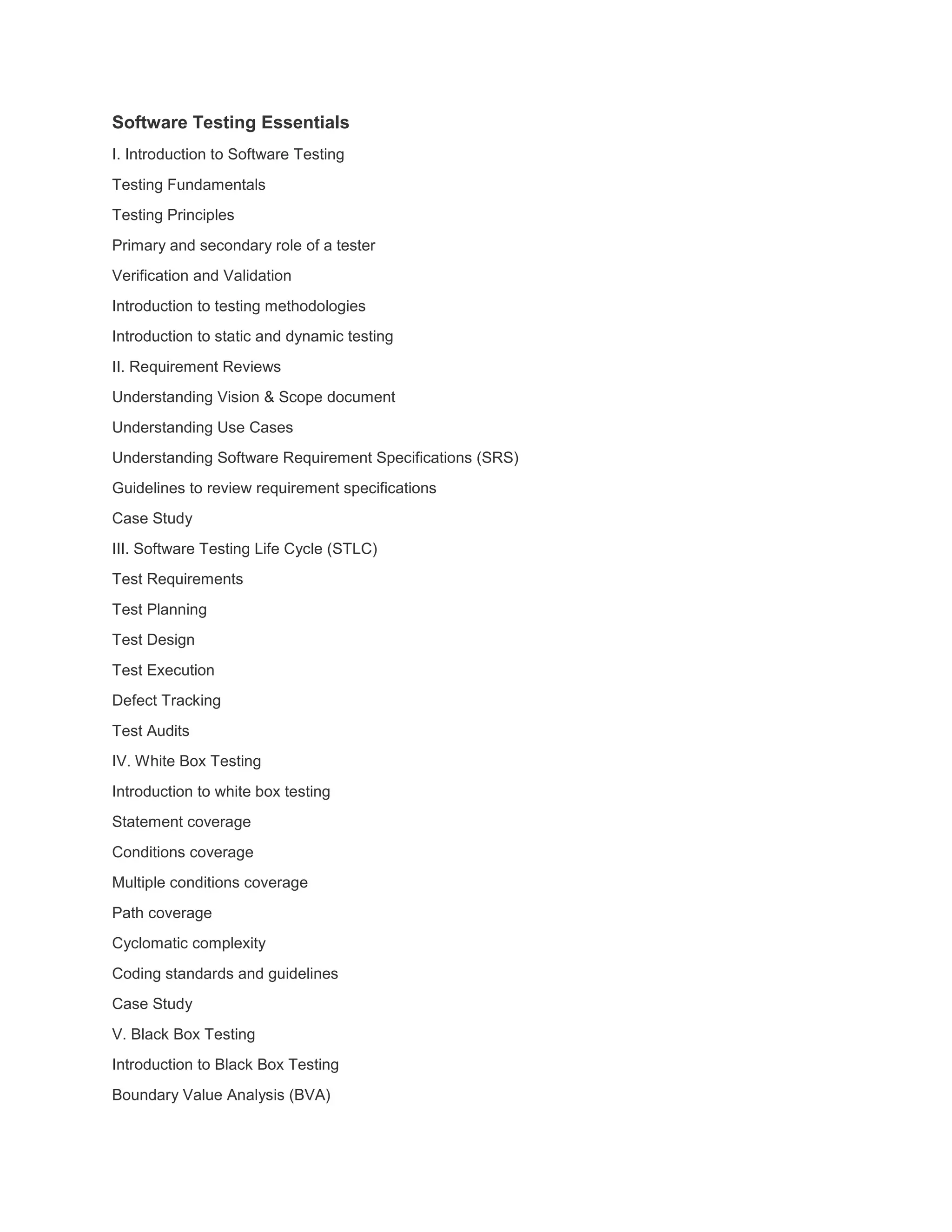
I. Introduction to Software Testing
Testing Fundamentals
Testing Principles
Primary and secondary role of a tester
Verification and Validation
Introduction to testing methodologies
Introduction to static and dynamic testing
II. Requirement Reviews
Understanding Vision & Scope document
Understanding Use Cases
Understanding Software Requirement Specifications (SRS)
Guidelines to review requirement specifications
Case Study
III. Software Testing Life Cycle (STLC)
Test Requirements
Test Planning
Test Design
Test Execution
Defect Tracking
Test Audits
IV. White Box Testing
Introduction to white box testing
Statement coverage
Conditions coverage
Multiple conditions coverage
Path coverage
Cyclomatic complexity
Coding standards and guidelines
Case Study
V. Black Box Testing
Introduction to Black Box Testing
Boundary Value Analysis (BVA)
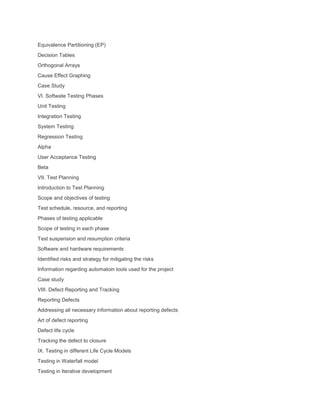
Equivalence Partitioning (EP)
Decision Tables
Orthogonal Arrays
Cause Effect Graphing
Case Study
VI. Softwate Testing Phases
Unit Testing
Integration Testing
System Testing
Regression Testing
Alpha
User Acceptance Testing
Beta
VII. Test Planning
Introduction to Test Planning
Scope and objectives of testing
Test schedule, resource, and reporting
Phases of testing applicable
Scope of testing in each phase
Test suspension and resumption criteria
Software and hardware requirements
Identified risks and strategy for mitigating the risks
Information regarding automatoin tools used for the project
Case study
VIII. Defect Reporting and Tracking
Reporting Defects
Addressing all necessary information about reporting defects
Art of defect reporting
Defect life cycle
Tracking the defect to closure
IX. Testing in different Life Cycle Models
Testing in Waterfall model
Testing in Iterative development
Testing in Agile environment
Testing in RUP

Syllabus ref01

  • 1.
    Software Testing Essentials I.Introduction to Software Testing Testing Fundamentals Testing Principles Primary and secondary role of a tester Verification and Validation Introduction to testing methodologies Introduction to static and dynamic testing II. Requirement Reviews Understanding Vision & Scope document Understanding Use Cases Understanding Software Requirement Specifications (SRS) Guidelines to review requirement specifications Case Study III. Software Testing Life Cycle (STLC) Test Requirements Test Planning Test Design Test Execution Defect Tracking Test Audits IV. White Box Testing Introduction to white box testing Statement coverage Conditions coverage Multiple conditions coverage Path coverage Cyclomatic complexity Coding standards and guidelines Case Study V. Black Box Testing Introduction to Black Box Testing Boundary Value Analysis (BVA)
  • 2.
    Equivalence Partitioning (EP) DecisionTables Orthogonal Arrays Cause Effect Graphing Case Study VI. Softwate Testing Phases Unit Testing Integration Testing System Testing Regression Testing Alpha User Acceptance Testing Beta VII. Test Planning Introduction to Test Planning Scope and objectives of testing Test schedule, resource, and reporting Phases of testing applicable Scope of testing in each phase Test suspension and resumption criteria Software and hardware requirements Identified risks and strategy for mitigating the risks Information regarding automatoin tools used for the project Case study VIII. Defect Reporting and Tracking Reporting Defects Addressing all necessary information about reporting defects Art of defect reporting Defect life cycle Tracking the defect to closure IX. Testing in different Life Cycle Models Testing in Waterfall model Testing in Iterative development
  • 3.
    Testing in Agileenvironment Testing in RUP