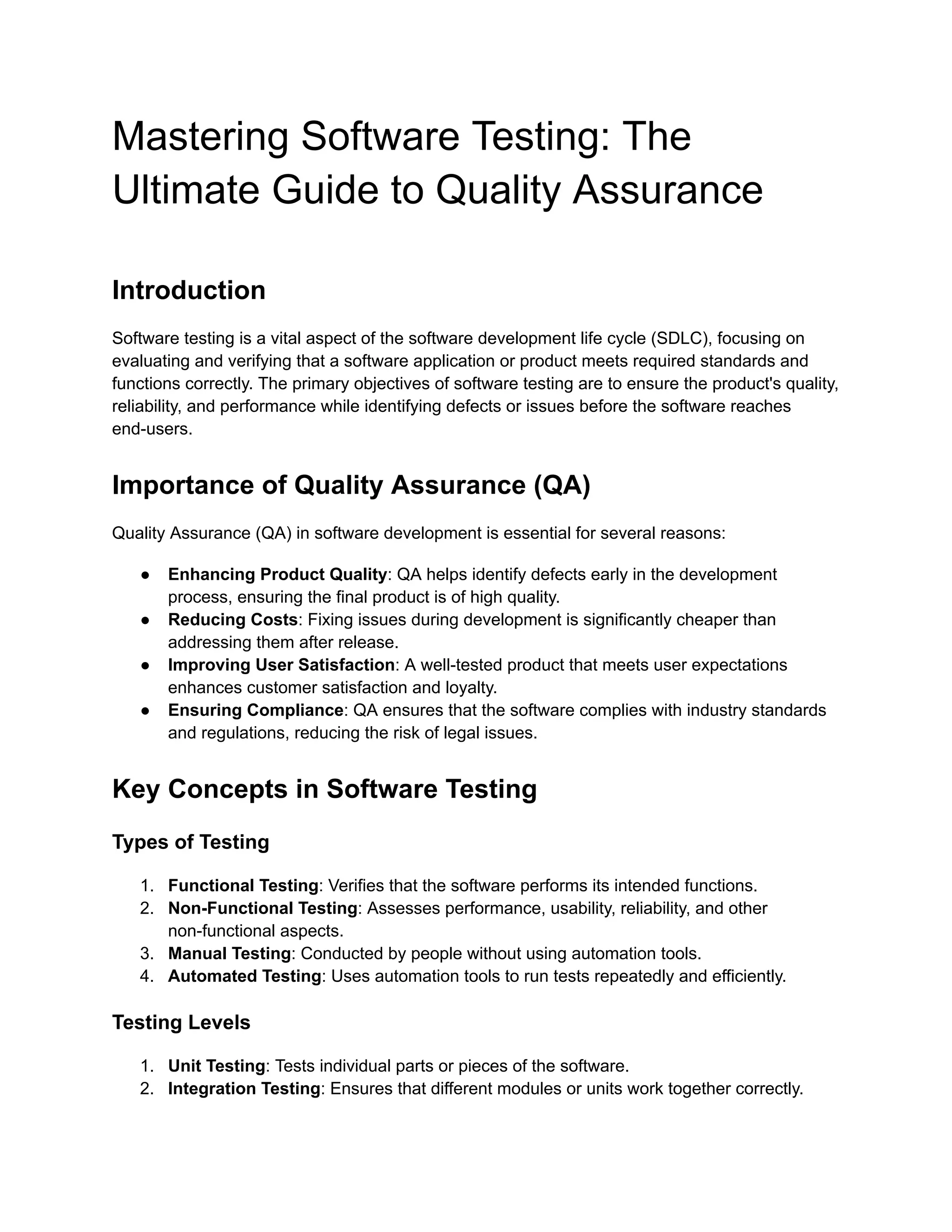
Mastering Software Testing: The
Ultimate Guide to Quality Assurance
Introduction
Software testing is a vital aspect of the software development life cycle (SDLC), focusing on
evaluating and verifying that a software application or product meets required standards and
functions correctly. The primary objectives of software testing are to ensure the product's quality,
reliability, and performance while identifying defects or issues before the software reaches
end-users.
Importance of Quality Assurance (QA)
Quality Assurance (QA) in software development is essential for several reasons:
● Enhancing Product Quality: QA helps identify defects early in the development
process, ensuring the final product is of high quality.
● Reducing Costs: Fixing issues during development is significantly cheaper than
addressing them after release.
● Improving User Satisfaction: A well-tested product that meets user expectations
enhances customer satisfaction and loyalty.
● Ensuring Compliance: QA ensures that the software complies with industry standards
and regulations, reducing the risk of legal issues.
Key Concepts in Software Testing
Types of Testing
1. Functional Testing: Verifies that the software performs its intended functions.
2. Non-Functional Testing: Assesses performance, usability, reliability, and other
non-functional aspects.
3. Manual Testing: Conducted by people without using automation tools.
4. Automated Testing: Uses automation tools to run tests repeatedly and efficiently.
Testing Levels
1. Unit Testing: Tests individual parts or pieces of the software.
2. Integration Testing: Ensures that different modules or units work together correctly.
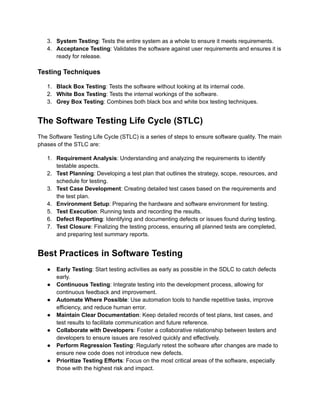
3. System Testing: Tests the entire system as a whole to ensure it meets requirements.
4. Acceptance Testing: Validates the software against user requirements and ensures it is
ready for release.
Testing Techniques
1. Black Box Testing: Tests the software without looking at its internal code.
2. White Box Testing: Tests the internal workings of the software.
3. Grey Box Testing: Combines both black box and white box testing techniques.
The Software Testing Life Cycle (STLC)
The Software Testing Life Cycle (STLC) is a series of steps to ensure software quality. The main
phases of the STLC are:
1. Requirement Analysis: Understanding and analyzing the requirements to identify
testable aspects.
2. Test Planning: Developing a test plan that outlines the strategy, scope, resources, and
schedule for testing.
3. Test Case Development: Creating detailed test cases based on the requirements and
the test plan.
4. Environment Setup: Preparing the hardware and software environment for testing.
5. Test Execution: Running tests and recording the results.
6. Defect Reporting: Identifying and documenting defects or issues found during testing.
7. Test Closure: Finalizing the testing process, ensuring all planned tests are completed,
and preparing test summary reports.
Best Practices in Software Testing
● Early Testing: Start testing activities as early as possible in the SDLC to catch defects
early.
● Continuous Testing: Integrate testing into the development process, allowing for
continuous feedback and improvement.
● Automate Where Possible: Use automation tools to handle repetitive tasks, improve
efficiency, and reduce human error.
● Maintain Clear Documentation: Keep detailed records of test plans, test cases, and
test results to facilitate communication and future reference.
● Collaborate with Developers: Foster a collaborative relationship between testers and
developers to ensure issues are resolved quickly and effectively.
● Perform Regression Testing: Regularly retest the software after changes are made to
ensure new code does not introduce new defects.
● Prioritize Testing Efforts: Focus on the most critical areas of the software, especially
those with the highest risk and impact.
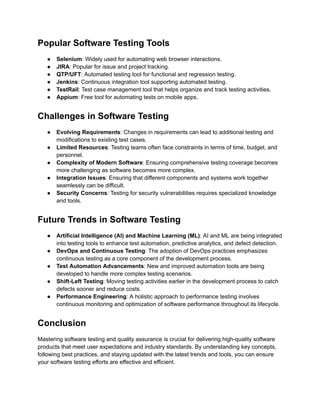
Popular Software Testing Tools
● Selenium: Widely used for automating web browser interactions.
● JIRA: Popular for issue and project tracking.
● QTP/UFT: Automated testing tool for functional and regression testing.
● Jenkins: Continuous integration tool supporting automated testing.
● TestRail: Test case management tool that helps organize and track testing activities.
● Appium: Free tool for automating tests on mobile apps.
Challenges in Software Testing
● Evolving Requirements: Changes in requirements can lead to additional testing and
modifications to existing test cases.
● Limited Resources: Testing teams often face constraints in terms of time, budget, and
personnel.
● Complexity of Modern Software: Ensuring comprehensive testing coverage becomes
more challenging as software becomes more complex.
● Integration Issues: Ensuring that different components and systems work together
seamlessly can be difficult.
● Security Concerns: Testing for security vulnerabilities requires specialized knowledge
and tools.
Future Trends in Software Testing
● Artificial Intelligence (AI) and Machine Learning (ML): AI and ML are being integrated
into testing tools to enhance test automation, predictive analytics, and defect detection.
● DevOps and Continuous Testing: The adoption of DevOps practices emphasizes
continuous testing as a core component of the development process.
● Test Automation Advancements: New and improved automation tools are being
developed to handle more complex testing scenarios.
● Shift-Left Testing: Moving testing activities earlier in the development process to catch
defects sooner and reduce costs.
● Performance Engineering: A holistic approach to performance testing involves
continuous monitoring and optimization of software performance throughout its lifecycle.
Conclusion
Mastering software testing and quality assurance is crucial for delivering high-quality software
products that meet user expectations and industry standards. By understanding key concepts,
following best practices, and staying updated with the latest trends and tools, you can ensure
your software testing efforts are effective and efficient.
Whether you're participating in a software testing course in Delhi, Gurgaon, Faridabad, Noida,
or other cities in India, or engaging in continuous learning through various resources, investing
in comprehensive training will help you achieve excellence in software testing and contribute to
the success of your software projects. Remember, quality assurance is not just a phase in the
development process; it is an ongoing commitment to delivering the best possible software to
your users.
Source
link:https://www.zupyak.com/p/4247827/t/software-testing-mastery-ultimate-guide-to-quality-ass
urance

Mastering Software Testing: The Ultimate Guide to Quality Assurance

  • 1.
    Mastering Software Testing:The Ultimate Guide to Quality Assurance Introduction Software testing is a vital aspect of the software development life cycle (SDLC), focusing on evaluating and verifying that a software application or product meets required standards and functions correctly. The primary objectives of software testing are to ensure the product's quality, reliability, and performance while identifying defects or issues before the software reaches end-users. Importance of Quality Assurance (QA) Quality Assurance (QA) in software development is essential for several reasons: ● Enhancing Product Quality: QA helps identify defects early in the development process, ensuring the final product is of high quality. ● Reducing Costs: Fixing issues during development is significantly cheaper than addressing them after release. ● Improving User Satisfaction: A well-tested product that meets user expectations enhances customer satisfaction and loyalty. ● Ensuring Compliance: QA ensures that the software complies with industry standards and regulations, reducing the risk of legal issues. Key Concepts in Software Testing Types of Testing 1. Functional Testing: Verifies that the software performs its intended functions. 2. Non-Functional Testing: Assesses performance, usability, reliability, and other non-functional aspects. 3. Manual Testing: Conducted by people without using automation tools. 4. Automated Testing: Uses automation tools to run tests repeatedly and efficiently. Testing Levels 1. Unit Testing: Tests individual parts or pieces of the software. 2. Integration Testing: Ensures that different modules or units work together correctly.
  • 2.
    3. System Testing:Tests the entire system as a whole to ensure it meets requirements. 4. Acceptance Testing: Validates the software against user requirements and ensures it is ready for release. Testing Techniques 1. Black Box Testing: Tests the software without looking at its internal code. 2. White Box Testing: Tests the internal workings of the software. 3. Grey Box Testing: Combines both black box and white box testing techniques. The Software Testing Life Cycle (STLC) The Software Testing Life Cycle (STLC) is a series of steps to ensure software quality. The main phases of the STLC are: 1. Requirement Analysis: Understanding and analyzing the requirements to identify testable aspects. 2. Test Planning: Developing a test plan that outlines the strategy, scope, resources, and schedule for testing. 3. Test Case Development: Creating detailed test cases based on the requirements and the test plan. 4. Environment Setup: Preparing the hardware and software environment for testing. 5. Test Execution: Running tests and recording the results. 6. Defect Reporting: Identifying and documenting defects or issues found during testing. 7. Test Closure: Finalizing the testing process, ensuring all planned tests are completed, and preparing test summary reports. Best Practices in Software Testing ● Early Testing: Start testing activities as early as possible in the SDLC to catch defects early. ● Continuous Testing: Integrate testing into the development process, allowing for continuous feedback and improvement. ● Automate Where Possible: Use automation tools to handle repetitive tasks, improve efficiency, and reduce human error. ● Maintain Clear Documentation: Keep detailed records of test plans, test cases, and test results to facilitate communication and future reference. ● Collaborate with Developers: Foster a collaborative relationship between testers and developers to ensure issues are resolved quickly and effectively. ● Perform Regression Testing: Regularly retest the software after changes are made to ensure new code does not introduce new defects. ● Prioritize Testing Efforts: Focus on the most critical areas of the software, especially those with the highest risk and impact.
  • 3.
    Popular Software TestingTools ● Selenium: Widely used for automating web browser interactions. ● JIRA: Popular for issue and project tracking. ● QTP/UFT: Automated testing tool for functional and regression testing. ● Jenkins: Continuous integration tool supporting automated testing. ● TestRail: Test case management tool that helps organize and track testing activities. ● Appium: Free tool for automating tests on mobile apps. Challenges in Software Testing ● Evolving Requirements: Changes in requirements can lead to additional testing and modifications to existing test cases. ● Limited Resources: Testing teams often face constraints in terms of time, budget, and personnel. ● Complexity of Modern Software: Ensuring comprehensive testing coverage becomes more challenging as software becomes more complex. ● Integration Issues: Ensuring that different components and systems work together seamlessly can be difficult. ● Security Concerns: Testing for security vulnerabilities requires specialized knowledge and tools. Future Trends in Software Testing ● Artificial Intelligence (AI) and Machine Learning (ML): AI and ML are being integrated into testing tools to enhance test automation, predictive analytics, and defect detection. ● DevOps and Continuous Testing: The adoption of DevOps practices emphasizes continuous testing as a core component of the development process. ● Test Automation Advancements: New and improved automation tools are being developed to handle more complex testing scenarios. ● Shift-Left Testing: Moving testing activities earlier in the development process to catch defects sooner and reduce costs. ● Performance Engineering: A holistic approach to performance testing involves continuous monitoring and optimization of software performance throughout its lifecycle. Conclusion Mastering software testing and quality assurance is crucial for delivering high-quality software products that meet user expectations and industry standards. By understanding key concepts, following best practices, and staying updated with the latest trends and tools, you can ensure your software testing efforts are effective and efficient.
  • 4.
    Whether you're participatingin a software testing course in Delhi, Gurgaon, Faridabad, Noida, or other cities in India, or engaging in continuous learning through various resources, investing in comprehensive training will help you achieve excellence in software testing and contribute to the success of your software projects. Remember, quality assurance is not just a phase in the development process; it is an ongoing commitment to delivering the best possible software to your users. Source link:https://www.zupyak.com/p/4247827/t/software-testing-mastery-ultimate-guide-to-quality-ass urance