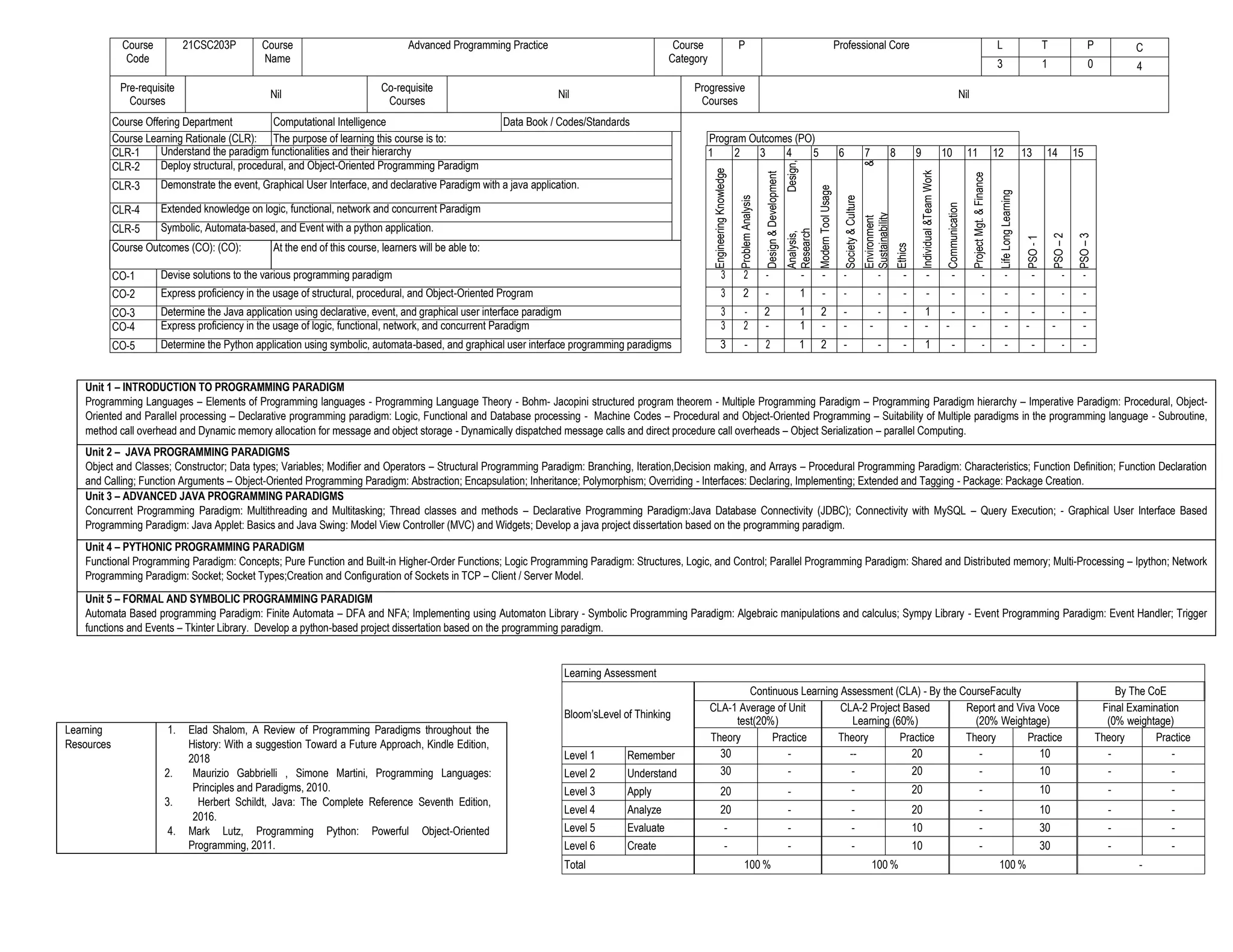
Unit 1 – INTRODUCTION TO PROGRAMMING PARADIGM
Programming Languages – Elements of Programming languages - Programming Language Theory - Bohm- Jacopini structured program theorem - Multiple Programming Paradigm – Programming Paradigm hierarchy – Imperative Paradigm: Procedural, Object-
Oriented and Parallel processing – Declarative programming paradigm: Logic, Functional and Database processing - Machine Codes – Procedural and Object-Oriented Programming – Suitability of Multiple paradigms in the programming language - Subroutine,
method call overhead and Dynamic memory allocation for message and object storage - Dynamically dispatched message calls and direct procedure call overheads – Object Serialization – parallel Computing.
Unit 2 – JAVA PROGRAMMING PARADIGMS
Object and Classes; Constructor; Data types; Variables; Modifier and Operators – Structural Programming Paradigm: Branching, Iteration,Decision making, and Arrays – Procedural Programming Paradigm: Characteristics; Function Definition; Function Declaration
and Calling; Function Arguments – Object-Oriented Programming Paradigm: Abstraction; Encapsulation; Inheritance; Polymorphism; Overriding - Interfaces: Declaring, Implementing; Extended and Tagging - Package: Package Creation.
Unit 3 – ADVANCED JAVA PROGRAMMING PARADIGMS
Concurrent Programming Paradigm: Multithreading and Multitasking; Thread classes and methods – Declarative Programming Paradigm:Java Database Connectivity (JDBC); Connectivity with MySQL – Query Execution; - Graphical User Interface Based
Programming Paradigm: Java Applet: Basics and Java Swing: Model View Controller (MVC) and Widgets; Develop a java project dissertation based on the programming paradigm.
Unit 4 – PYTHONIC PROGRAMMING PARADIGM
Functional Programming Paradigm: Concepts; Pure Function and Built-in Higher-Order Functions; Logic Programming Paradigm: Structures, Logic, and Control; Parallel Programming Paradigm: Shared and Distributed memory; Multi-Processing – Ipython; Network
Programming Paradigm: Socket; Socket Types;Creation and Configuration of Sockets in TCP – Client / Server Model.
Unit 5 – FORMAL AND SYMBOLIC PROGRAMMING PARADIGM
Automata Based programming Paradigm: Finite Automata – DFA and NFA; Implementing using Automaton Library - Symbolic Programming Paradigm: Algebraic manipulations and calculus; Sympy Library - Event Programming Paradigm: Event Handler; Trigger
functions and Events – Tkinter Library. Develop a python-based project dissertation based on the programming paradigm.
Course
Code
21CSC203P Course
Name
Advanced Programming Practice Course
Category
P Professional Core L T P C
3 1 0 4
Pre-requisite
Courses
Nil
Co-requisite
Courses
Nil
Progressive
Courses
Nil
Course Offering Department Computational Intelligence Data Book / Codes/Standards
Course Learning Rationale (CLR): The purpose of learning this course is to: Program Outcomes (PO)
CLR-1 Understand the paradigm functionalities and their hierarchy 1 2 3 4 5 6 7 8 9 10 11 12 13 14 15
CLR-2 Deploy structural, procedural, and Object-Oriented Programming Paradigm
Engineering
Knowledge
Problem
Analysis
Design
&
Development
Analysis,
Design,
Research
Modern
Tool
Usage
Society
&
Culture
Environment
&
Sustainability
Ethics
Individual
&Team
Work
Communication
Project
Mgt.
&
Finance
Life
Long
Learning
PSO
-
1
PSO
–
2
PSO
–
3
CLR-3 Demonstrate the event, Graphical User Interface, and declarative Paradigm with a java application.
CLR-4 Extended knowledge on logic, functional, network and concurrent Paradigm
CLR-5 Symbolic, Automata-based, and Event with a python application.
Course Outcomes (CO): (CO): At the end of this course, learners will be able to:
CO-1 Devise solutions to the various programming paradigm 3 2 - - - - - - - - - - - - -
CO-2 Express proficiency in the usage of structural, procedural, and Object-Oriented Program 3 2 - 1 - - - - - - - - - - -
CO-3 Determine the Java application using declarative, event, and graphical user interface paradigm 3 - 2 1 2 - - - 1 - - - - - -
CO-4 Express proficiency in the usage of logic, functional, network, and concurrent Paradigm 3 2 - 1 - - - - - - - - - - -
CO-5 Determine the Python application using symbolic, automata-based, and graphical user interface programming paradigms 3 - 2 1 2 - - - 1 - - - - - -
Learning
Resources
1. Elad Shalom, A Review of Programming Paradigms throughout the
History: With a suggestion Toward a Future Approach, Kindle Edition,
2018
2. Maurizio Gabbrielli , Simone Martini, Programming Languages:
Principles and Paradigms, 2010.
3. Herbert Schildt, Java: The Complete Reference Seventh Edition,
2016.
4. Mark Lutz, Programming Python: Powerful Object-Oriented
Programming, 2011.
Learning Assessment
Bloom’sLevel of Thinking
Continuous Learning Assessment (CLA) - By the CourseFaculty By The CoE
CLA-1 Average of Unit
test(20%)
CLA-2 Project Based
Learning (60%)
Report and Viva Voce
(20% Weightage)
Final Examination
(0% weightage)
Theory Practice Theory Practice Theory Practice Theory Practice
Level 1 Remember 30 - -- 20 - 10 - -
Level 2 Understand 30 - - 20 - 10 - -
Level 3 Apply 20 - - 20 - 10 - -
Level 4 Analyze 20 - - 20 - 10 - -
Level 5 Evaluate - - - 10 - 30 - -
Level 6 Create - - - 10 - 30 - -
Total 100 % 100 % 100 % -

syllabus app.pdf

  • 1.
    Unit 1 –INTRODUCTION TO PROGRAMMING PARADIGM Programming Languages – Elements of Programming languages - Programming Language Theory - Bohm- Jacopini structured program theorem - Multiple Programming Paradigm – Programming Paradigm hierarchy – Imperative Paradigm: Procedural, Object- Oriented and Parallel processing – Declarative programming paradigm: Logic, Functional and Database processing - Machine Codes – Procedural and Object-Oriented Programming – Suitability of Multiple paradigms in the programming language - Subroutine, method call overhead and Dynamic memory allocation for message and object storage - Dynamically dispatched message calls and direct procedure call overheads – Object Serialization – parallel Computing. Unit 2 – JAVA PROGRAMMING PARADIGMS Object and Classes; Constructor; Data types; Variables; Modifier and Operators – Structural Programming Paradigm: Branching, Iteration,Decision making, and Arrays – Procedural Programming Paradigm: Characteristics; Function Definition; Function Declaration and Calling; Function Arguments – Object-Oriented Programming Paradigm: Abstraction; Encapsulation; Inheritance; Polymorphism; Overriding - Interfaces: Declaring, Implementing; Extended and Tagging - Package: Package Creation. Unit 3 – ADVANCED JAVA PROGRAMMING PARADIGMS Concurrent Programming Paradigm: Multithreading and Multitasking; Thread classes and methods – Declarative Programming Paradigm:Java Database Connectivity (JDBC); Connectivity with MySQL – Query Execution; - Graphical User Interface Based Programming Paradigm: Java Applet: Basics and Java Swing: Model View Controller (MVC) and Widgets; Develop a java project dissertation based on the programming paradigm. Unit 4 – PYTHONIC PROGRAMMING PARADIGM Functional Programming Paradigm: Concepts; Pure Function and Built-in Higher-Order Functions; Logic Programming Paradigm: Structures, Logic, and Control; Parallel Programming Paradigm: Shared and Distributed memory; Multi-Processing – Ipython; Network Programming Paradigm: Socket; Socket Types;Creation and Configuration of Sockets in TCP – Client / Server Model. Unit 5 – FORMAL AND SYMBOLIC PROGRAMMING PARADIGM Automata Based programming Paradigm: Finite Automata – DFA and NFA; Implementing using Automaton Library - Symbolic Programming Paradigm: Algebraic manipulations and calculus; Sympy Library - Event Programming Paradigm: Event Handler; Trigger functions and Events – Tkinter Library. Develop a python-based project dissertation based on the programming paradigm. Course Code 21CSC203P Course Name Advanced Programming Practice Course Category P Professional Core L T P C 3 1 0 4 Pre-requisite Courses Nil Co-requisite Courses Nil Progressive Courses Nil Course Offering Department Computational Intelligence Data Book / Codes/Standards Course Learning Rationale (CLR): The purpose of learning this course is to: Program Outcomes (PO) CLR-1 Understand the paradigm functionalities and their hierarchy 1 2 3 4 5 6 7 8 9 10 11 12 13 14 15 CLR-2 Deploy structural, procedural, and Object-Oriented Programming Paradigm Engineering Knowledge Problem Analysis Design & Development Analysis, Design, Research Modern Tool Usage Society & Culture Environment & Sustainability Ethics Individual &Team Work Communication Project Mgt. & Finance Life Long Learning PSO - 1 PSO – 2 PSO – 3 CLR-3 Demonstrate the event, Graphical User Interface, and declarative Paradigm with a java application. CLR-4 Extended knowledge on logic, functional, network and concurrent Paradigm CLR-5 Symbolic, Automata-based, and Event with a python application. Course Outcomes (CO): (CO): At the end of this course, learners will be able to: CO-1 Devise solutions to the various programming paradigm 3 2 - - - - - - - - - - - - - CO-2 Express proficiency in the usage of structural, procedural, and Object-Oriented Program 3 2 - 1 - - - - - - - - - - - CO-3 Determine the Java application using declarative, event, and graphical user interface paradigm 3 - 2 1 2 - - - 1 - - - - - - CO-4 Express proficiency in the usage of logic, functional, network, and concurrent Paradigm 3 2 - 1 - - - - - - - - - - - CO-5 Determine the Python application using symbolic, automata-based, and graphical user interface programming paradigms 3 - 2 1 2 - - - 1 - - - - - - Learning Resources 1. Elad Shalom, A Review of Programming Paradigms throughout the History: With a suggestion Toward a Future Approach, Kindle Edition, 2018 2. Maurizio Gabbrielli , Simone Martini, Programming Languages: Principles and Paradigms, 2010. 3. Herbert Schildt, Java: The Complete Reference Seventh Edition, 2016. 4. Mark Lutz, Programming Python: Powerful Object-Oriented Programming, 2011. Learning Assessment Bloom’sLevel of Thinking Continuous Learning Assessment (CLA) - By the CourseFaculty By The CoE CLA-1 Average of Unit test(20%) CLA-2 Project Based Learning (60%) Report and Viva Voce (20% Weightage) Final Examination (0% weightage) Theory Practice Theory Practice Theory Practice Theory Practice Level 1 Remember 30 - -- 20 - 10 - - Level 2 Understand 30 - - 20 - 10 - - Level 3 Apply 20 - - 20 - 10 - - Level 4 Analyze 20 - - 20 - 10 - - Level 5 Evaluate - - - 10 - 30 - - Level 6 Create - - - 10 - 30 - - Total 100 % 100 % 100 % -