Syllabication
By Enrique A. Sánchez B.
Master Degree Program
Definition, Principles and Patterns
September, 2020
Multimedia and Online Resource Design for Teaching English
www.oteimavirtual.com
Contents
Definition1
Principles2
Patterns3
Conclusions4
Multimedia and Online Resource Design for Teaching English
www.oteimavirtual.com
Definition
 What is Syllabication or
Syllabification?
 It is the process of braking down words
into syllables, by following some principles
and patterns.
Multimedia and Online Resource Design for Teaching English
www.oteimavirtual.com
Definition
 It is common to use a hyphen to separate
syllables in orthography. And a period
when using IPA.
Syllable
Syl-la-ble [ˈsɪ.lə.bᵊɫ]
Taken from: https://en.wikipedia.org/wiki/Syllabification
Multimedia and Online Resource Design for Teaching English
www.oteimavirtual.com
PRINCIPLES
Six
Principles
The Obligatory Onset PrincipleThe Stress Principle
The Legality Principle
The Irregular Coda Principle
The Resyllabification
The Sonority Cycle
Ahmed M. Hashim (2018), 2018
Multimedia and Online Resource Design for Teaching English
www.oteimavirtual.com
PRINCIPLES
The Obligatory Onset Principle1
It states that all languages have open syllables (with no coda), and
closed syllables (with coda). It says that there is not any language
with only open syllables.
For example: in the pattern vcv, to get the open syllable, we must
split it before the consonant in this way: v.cv
So, VCV becomes V.CV
Taken from: https://www.grin.com/document/451232
Multimedia and Online Resource Design for Teaching English
www.oteimavirtual.com
PRINCIPLES
The Legality Principle2
According to S Bartlett - 2009, “It constrains the segments that can
begin and end syllables to those that appear at the beginning and
end of words”
In other words, a syllable can not begin nor end with a consonant
cluster which does not begin or end a word.
Taken from:https://www.aclweb.org/anthology/N09-1035.pdf
Multimedia and Online Resource Design for Teaching English
www.oteimavirtual.com
PRINCIPLES
The Principle of Irregular coda3
That there is a number of exceptions in the rules of finals than in
the rules of initials Vennemann (1988:70)
Treiman and Zukowski (1990:68) say “if a consonant or consonant
cluster is illegal at the beginning of a word it is also at the beginning
of a syllable.”
Taken from:https://www.grin.com/document/451232
Multimedia and Online Resource Design for Teaching English
www.oteimavirtual.com
PRINCIPLES
The Sonority Cycle Principle4
The SCP is another option to try the “sonority scale” different to the
deep examination of phototactic regularities.
When syllabifying a word, SCP states that sonority should increase
from the first phoneme of the onset to the syllable’s nucleus, and
then fall off to the coda (Selkirk, 1984).
Taken from:https://www.grin.com/document/451232
Multimedia and Online Resource Design for Teaching English
www.oteimavirtual.com
PRINCIPLES
The Resyllabification Principle5
That if a word ends with a closed syllable (C*V C) and the
subsequent word begin with a syllable without an onset (V C*), the
coda of the closed syllable of the first word shifts to the onset
position of the word-initial syllable.
Taken from:https://www.grin.com/document/451232
Multimedia and Online Resource Design for Teaching English
www.oteimavirtual.com
PRINCIPLES
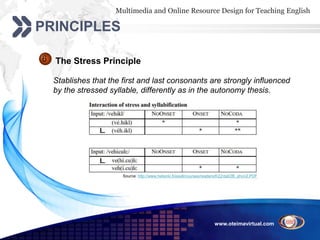
The Stress Principle6
Stablishes that the first and last consonants are strongly influenced
by the stressed syllable, differently as in the autonomy thesis.
Source: http://www.helsinki.fi/esslli/courses/readers/K22/dat/2B_phon2.PDF
Multimedia and Online Resource Design for Teaching English
www.oteimavirtual.com
PATTERNS
DIVISION
PATTERNS
VCV
VCCCV
VC/CV
V/CV
VC/V
VVCCV
CVC
VCCCCV
VV
VC/CCV
VC/CCCV
V/V
input output
See: https://www.wikihow.com/Teach-and-Learn-Syllabication for more information
Multimedia and Online Resource Design for Teaching English
www.oteimavirtual.com
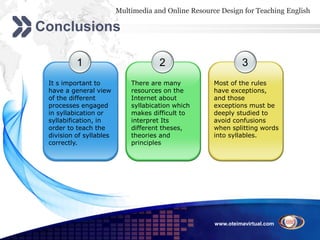
Conclusions
1
It s important to
have a general view
of the different
processes engaged
in syllabication or
syllabification, in
order to teach the
division of syllables
correctly.
2
There are many
resources on the
Internet about
syllabication which
makes difficult to
interpret Its
different theses,
theories and
principles
3
Most of the rules
have exceptions,
and those
exceptions must be
deeply studied to
avoid confusions
when splitting words
into syllables.
Multimedia and Online Resource Design for Teaching English
www.oteimavirtual.com
References
• https://en.wikipedia.org/wiki/Syllabification
• http://niceenglish.weebly.com/second-term.html
• https://www.wikihow.com/Teach-and-Learn-Syllabication
• https://www.aclweb.org/anthology/N09-1035.pdf
• Ahmed M. Hashim (Author), 2018, Syllable Structure and Syllabification in English and Arabic,
Munich, GRIN Verlag, https://www.grin.com/document/451232
Others
Websites
www.oteimavirtual.com

Syllabication

  • 1.
    Syllabication By Enrique A.Sánchez B. Master Degree Program Definition, Principles and Patterns September, 2020
  • 2.
    Multimedia and OnlineResource Design for Teaching English www.oteimavirtual.com Contents Definition1 Principles2 Patterns3 Conclusions4
  • 3.
    Multimedia and OnlineResource Design for Teaching English www.oteimavirtual.com Definition  What is Syllabication or Syllabification?  It is the process of braking down words into syllables, by following some principles and patterns.
  • 4.
    Multimedia and OnlineResource Design for Teaching English www.oteimavirtual.com Definition  It is common to use a hyphen to separate syllables in orthography. And a period when using IPA. Syllable Syl-la-ble [ˈsɪ.lə.bᵊɫ] Taken from: https://en.wikipedia.org/wiki/Syllabification
  • 5.
    Multimedia and OnlineResource Design for Teaching English www.oteimavirtual.com PRINCIPLES Six Principles The Obligatory Onset PrincipleThe Stress Principle The Legality Principle The Irregular Coda Principle The Resyllabification The Sonority Cycle Ahmed M. Hashim (2018), 2018
  • 6.
    Multimedia and OnlineResource Design for Teaching English www.oteimavirtual.com PRINCIPLES The Obligatory Onset Principle1 It states that all languages have open syllables (with no coda), and closed syllables (with coda). It says that there is not any language with only open syllables. For example: in the pattern vcv, to get the open syllable, we must split it before the consonant in this way: v.cv So, VCV becomes V.CV Taken from: https://www.grin.com/document/451232
  • 7.
    Multimedia and OnlineResource Design for Teaching English www.oteimavirtual.com PRINCIPLES The Legality Principle2 According to S Bartlett - 2009, “It constrains the segments that can begin and end syllables to those that appear at the beginning and end of words” In other words, a syllable can not begin nor end with a consonant cluster which does not begin or end a word. Taken from:https://www.aclweb.org/anthology/N09-1035.pdf
  • 8.
    Multimedia and OnlineResource Design for Teaching English www.oteimavirtual.com PRINCIPLES The Principle of Irregular coda3 That there is a number of exceptions in the rules of finals than in the rules of initials Vennemann (1988:70) Treiman and Zukowski (1990:68) say “if a consonant or consonant cluster is illegal at the beginning of a word it is also at the beginning of a syllable.” Taken from:https://www.grin.com/document/451232
  • 9.
    Multimedia and OnlineResource Design for Teaching English www.oteimavirtual.com PRINCIPLES The Sonority Cycle Principle4 The SCP is another option to try the “sonority scale” different to the deep examination of phototactic regularities. When syllabifying a word, SCP states that sonority should increase from the first phoneme of the onset to the syllable’s nucleus, and then fall off to the coda (Selkirk, 1984). Taken from:https://www.grin.com/document/451232
  • 10.
    Multimedia and OnlineResource Design for Teaching English www.oteimavirtual.com PRINCIPLES The Resyllabification Principle5 That if a word ends with a closed syllable (C*V C) and the subsequent word begin with a syllable without an onset (V C*), the coda of the closed syllable of the first word shifts to the onset position of the word-initial syllable. Taken from:https://www.grin.com/document/451232
  • 11.
    Multimedia and OnlineResource Design for Teaching English www.oteimavirtual.com PRINCIPLES The Stress Principle6 Stablishes that the first and last consonants are strongly influenced by the stressed syllable, differently as in the autonomy thesis. Source: http://www.helsinki.fi/esslli/courses/readers/K22/dat/2B_phon2.PDF
  • 12.
    Multimedia and OnlineResource Design for Teaching English www.oteimavirtual.com PATTERNS DIVISION PATTERNS VCV VCCCV VC/CV V/CV VC/V VVCCV CVC VCCCCV VV VC/CCV VC/CCCV V/V input output See: https://www.wikihow.com/Teach-and-Learn-Syllabication for more information
  • 13.
    Multimedia and OnlineResource Design for Teaching English www.oteimavirtual.com Conclusions 1 It s important to have a general view of the different processes engaged in syllabication or syllabification, in order to teach the division of syllables correctly. 2 There are many resources on the Internet about syllabication which makes difficult to interpret Its different theses, theories and principles 3 Most of the rules have exceptions, and those exceptions must be deeply studied to avoid confusions when splitting words into syllables.
  • 14.
    Multimedia and OnlineResource Design for Teaching English www.oteimavirtual.com References • https://en.wikipedia.org/wiki/Syllabification • http://niceenglish.weebly.com/second-term.html • https://www.wikihow.com/Teach-and-Learn-Syllabication • https://www.aclweb.org/anthology/N09-1035.pdf • Ahmed M. Hashim (Author), 2018, Syllable Structure and Syllabification in English and Arabic, Munich, GRIN Verlag, https://www.grin.com/document/451232 Others Websites
  • 15.