












JavaScript Performance MythBusters™
                 (via jsPerf)


SXSW 2012
about:me
Lindsey Simon
elsigh@gmail.com / @elsigh

•   AdWords
•   App Engine
•   i18n
•   Closure library
•   Search
•   Google Translate
•   Google+
about:me
Kyle Simpson
getify@gmail.com / @getify / http://getify.me
 • LABjs
 • HTML5 Cookbook
 • HubAustin Coworking
 • ATX Web Performance Meetup
 • Web Performance Summit (online!)
 • "Always bet on JS & HTML5"
about:me
John-David Dalton
john.david.dalton@gmail.com / @jdalton
 • Benchmark.js
 • jsPerf.com
 • FuseJS
 • All-around JS Fanboy
about:me
Chris Joel
chris@cloudflare.com / @robodynamo
 • Rocket Loader
 • CloudFlareJS
Your Development Test Environment
Your Mobile Test Environment
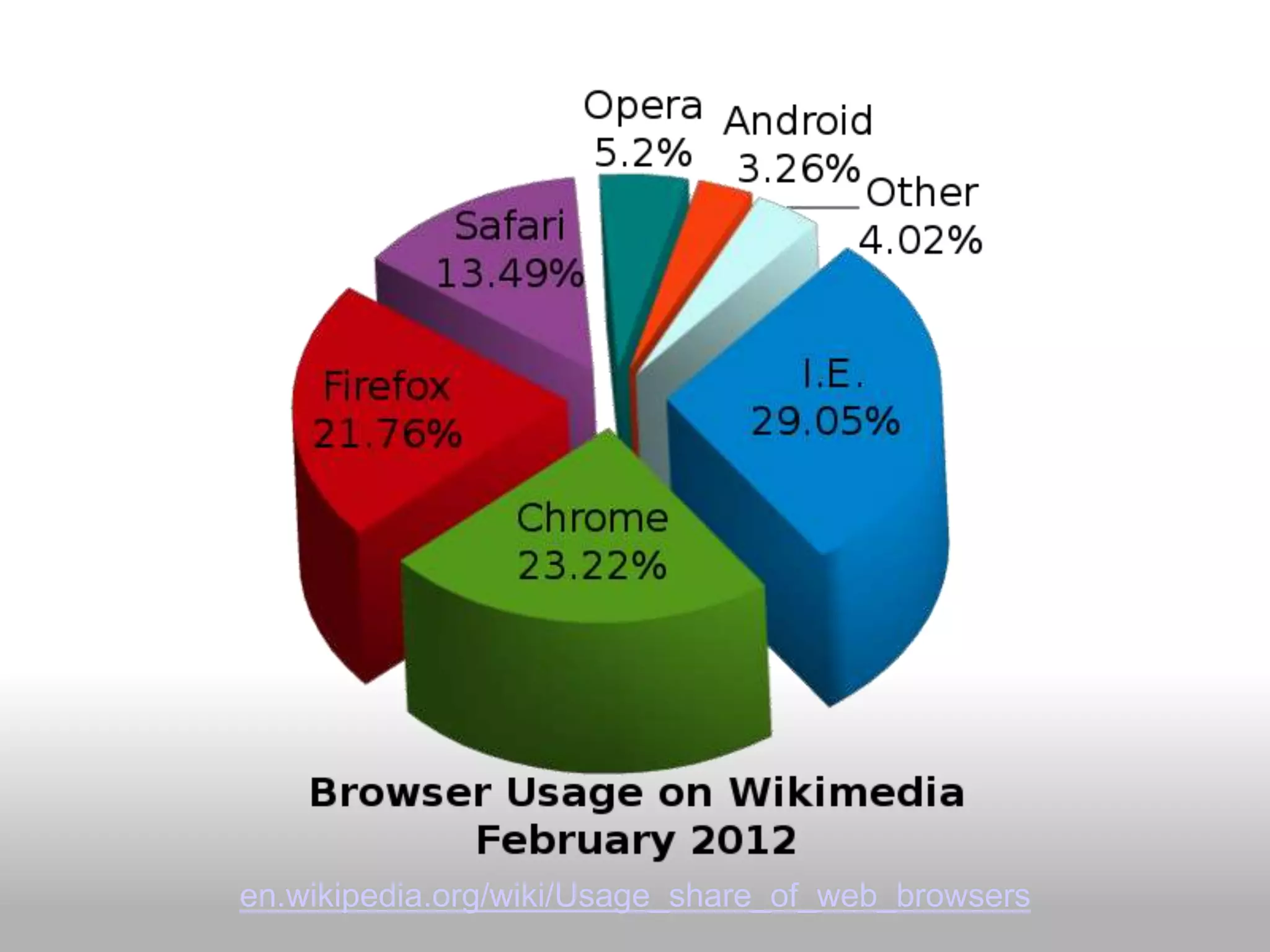
en.wikipedia.org/wiki/Usage_share_of_web_browsers
Browserscope & jsPerf

Open-source, community-driven project for profiling browsers.

Explicit Goals:
• foster innovation by tracking functionality
• push browser innovation, uncover regressions
• historical resource for web developers
crowdsourcing the results
crowdsourcing

• no dedicated test resources
crowdsourcing

• no dedicated test resources
• project runs in perpetuity
crowdsourcing

• no dedicated test resources
• project runs in perpetuity
• real world test conditions
crowdsourcing

•   no dedicated test resources
•   project runs in perpetuity
•   real world test conditions
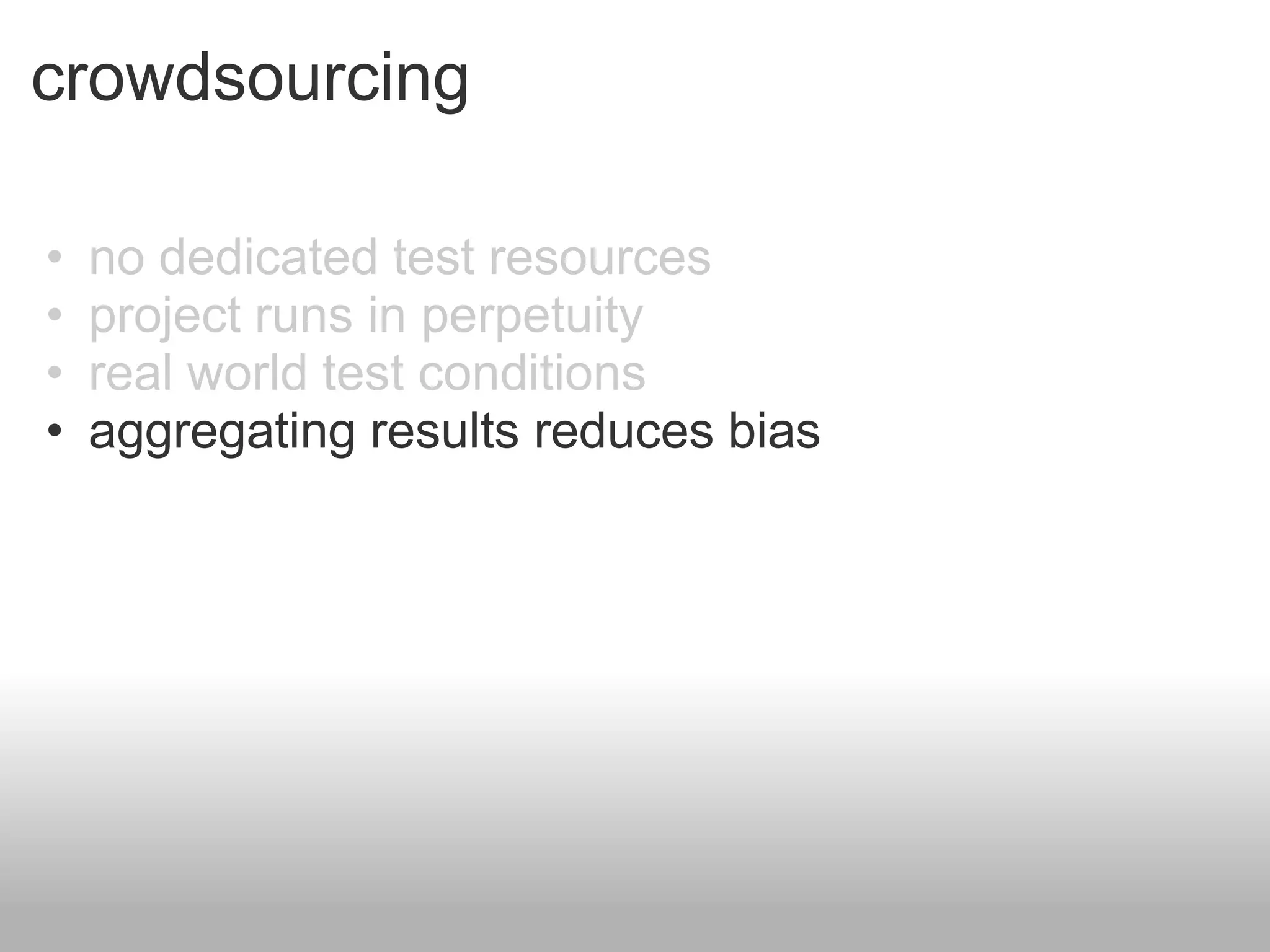
•   aggregating results reduces bias
crowdsourcing

•   no dedicated test resources
•   project runs in perpetuity
•   real world test conditions
•   aggregating results reduces bias
•   new browsers show up immediately
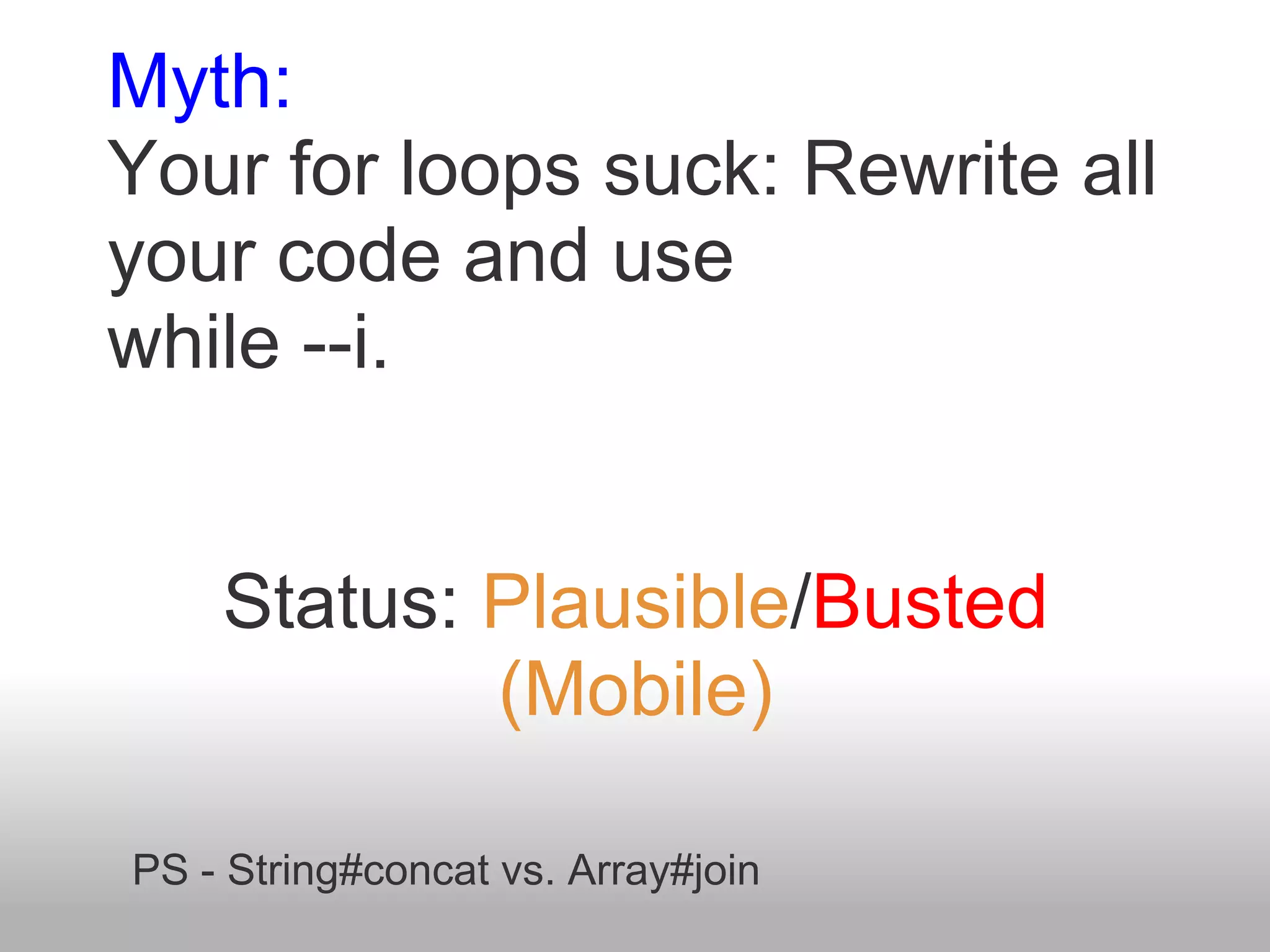
Myth:
Your for loops suck: Rewrite all
your code and use
while --i.


    Status: Plausible/Busted
            (Mobile)

PS - String#concat vs. Array#join
jsperf.com/for-loop-research

jsperf.com/for-loop-caching
Myth:
"Double your localStorage
read performance in Chrome
using indexes ls.getItem[i] not
keys ls.getItem('key')"
See: twitter.com/johnallsopp/status/177964915632513024


            Status: Confirmed
jsperf.com/localstorage-science

      jsbin.com/ifucuc/9
Myth:
The arguments object should
be avoided because accessing
it is slow.


       Status: Busted
jspatterns.com/arguments-considered-harmful/

         jsperf.com/arguments-perf
Myth:
Frameworks/libraries, like
jQuery, are always better at
managing performance than
you are, so just use what they
provide.
         Status: Busted
http://4vk.geti.fi/jsperf/jquery-this
Myth:
Converting a NodeList to an
array is expensive, so you
shouldn't do it.


        Status: Busted
jsperf.com/lists-of-nodes
Myth:
 Script concatenation and/or
<script defer> is all you need
  to load JS performantly.
       (aka "Issue 28")
   github.com/h5bp/html5-boilerplate/issues/28


   Status: (Mostly) Busted
•<script defer>
horribly buggy across browsers
(esp IE<=9!)
github.com/paulirish/lazyweb-requests/issues/42
still would delay the DOM-ready
event (bad!)...and btw, this is also buggy
cross-browser!
<script> or <script defer>


 dynamic script loading
•<script "one-big-file.js">
at some point, "big" is big enough
to overcome HTTP connection
overhead, meaning a second
parallel request for half the file will
be faster.

NOTE: do concat your files
first, then (if size >=100k) chunk
into 2-3 ~equal-sized parts.
•<script "one-big-file.js">
chunking a big file into 2-3 parts,
based on volatility of code (how
often it changes) allows for
different caching headers for each
part (win!).

NOTE: jquery.js is far more stable
than your site's code.
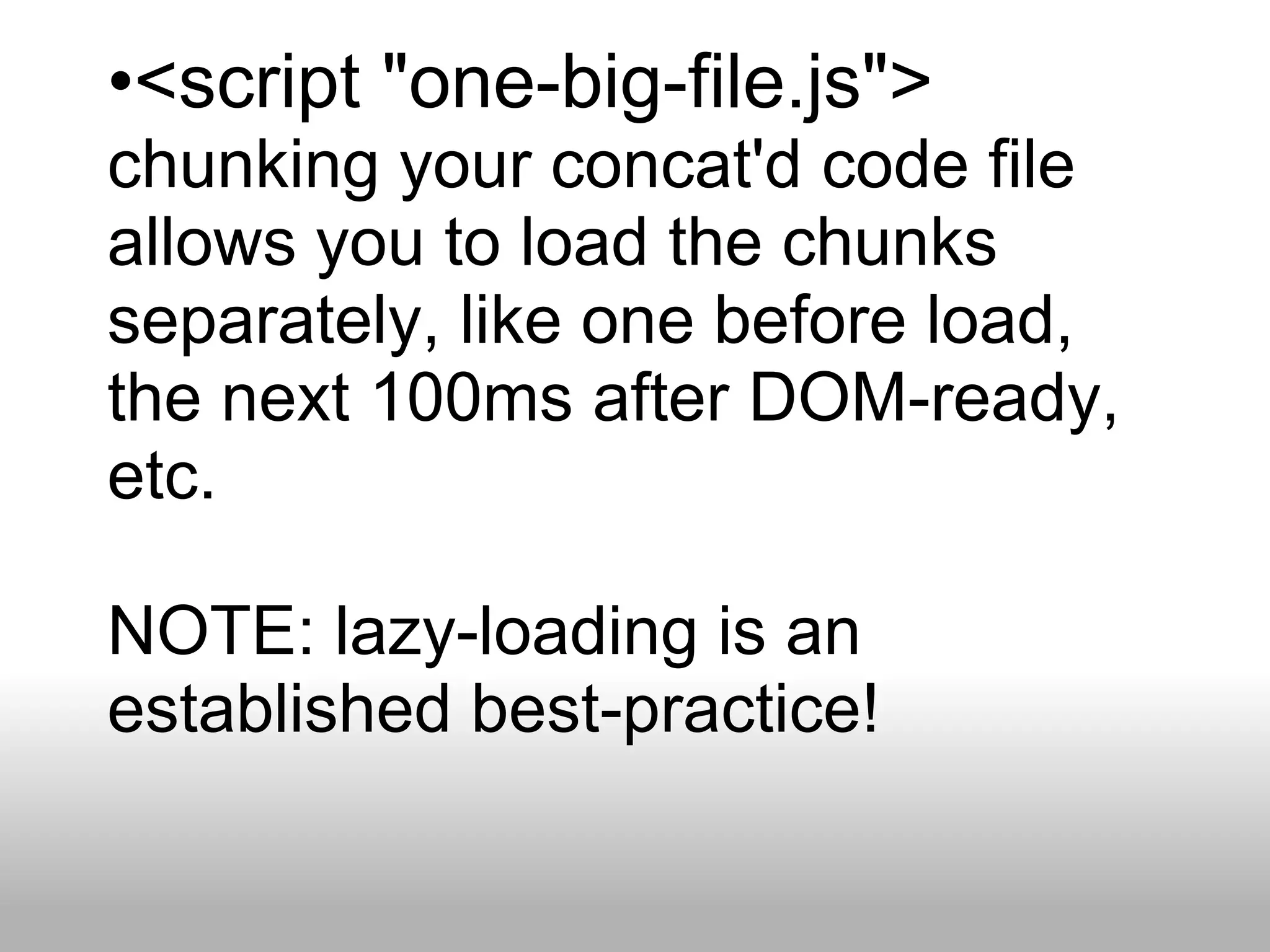
•<script "one-big-file.js">
chunking your concat'd code file
allows you to load the chunks
separately, like one before load,
the next 100ms after DOM-ready,
etc.

NOTE: lazy-loading is an
established best-practice!
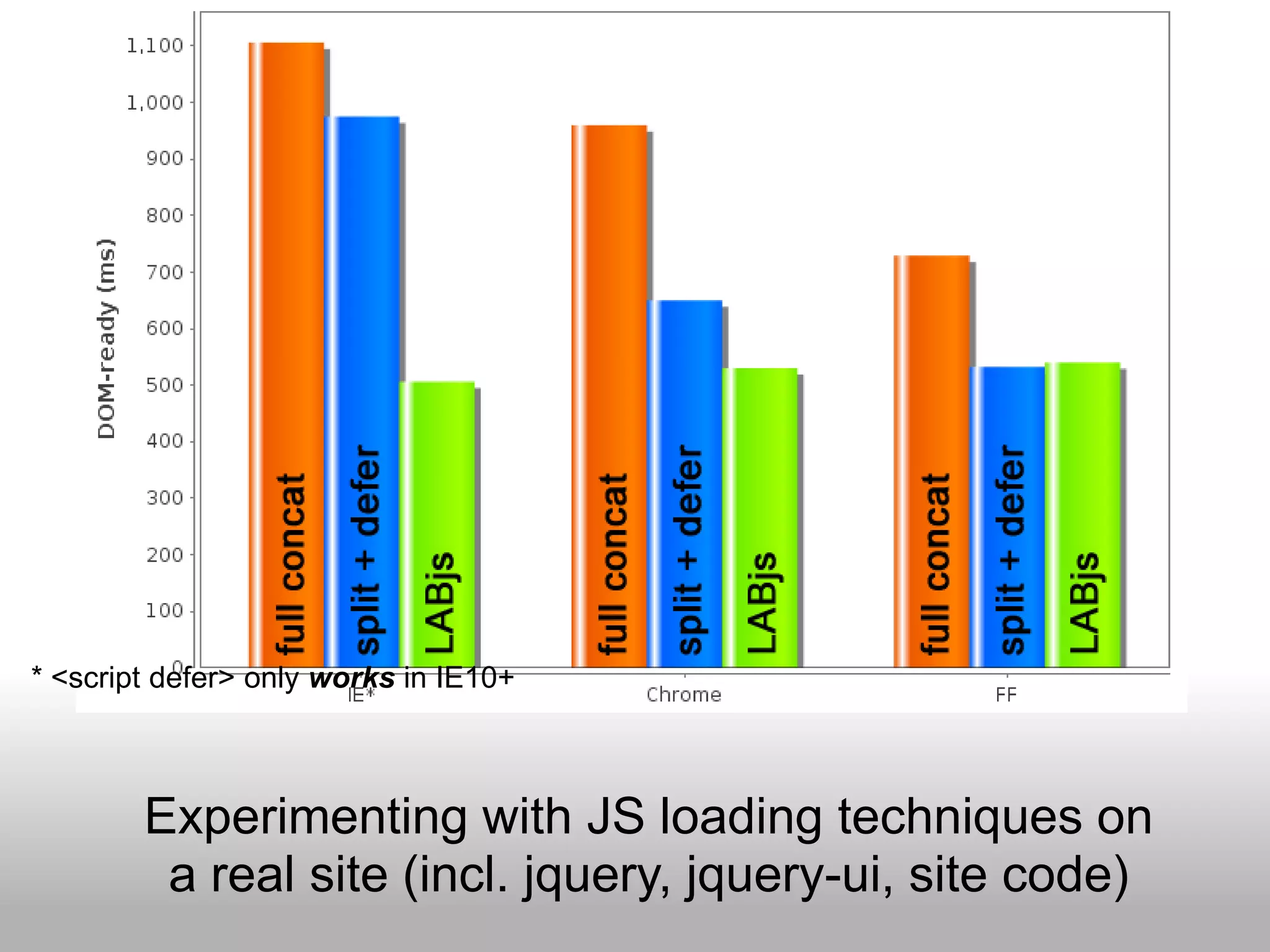
* <script defer> only works in IE10+


        Experimenting with JS loading techniques on
         a real site (incl. jquery, jquery-ui, site code)
Myth:
"eval is evil", or in other words,
eval is too slow and quirky to
be considered useful.


        Status: Plausible
jsperf.com/practical-eval/2

jsperf.com/more-practical-eval/3

       jsperf.com/eval-kills
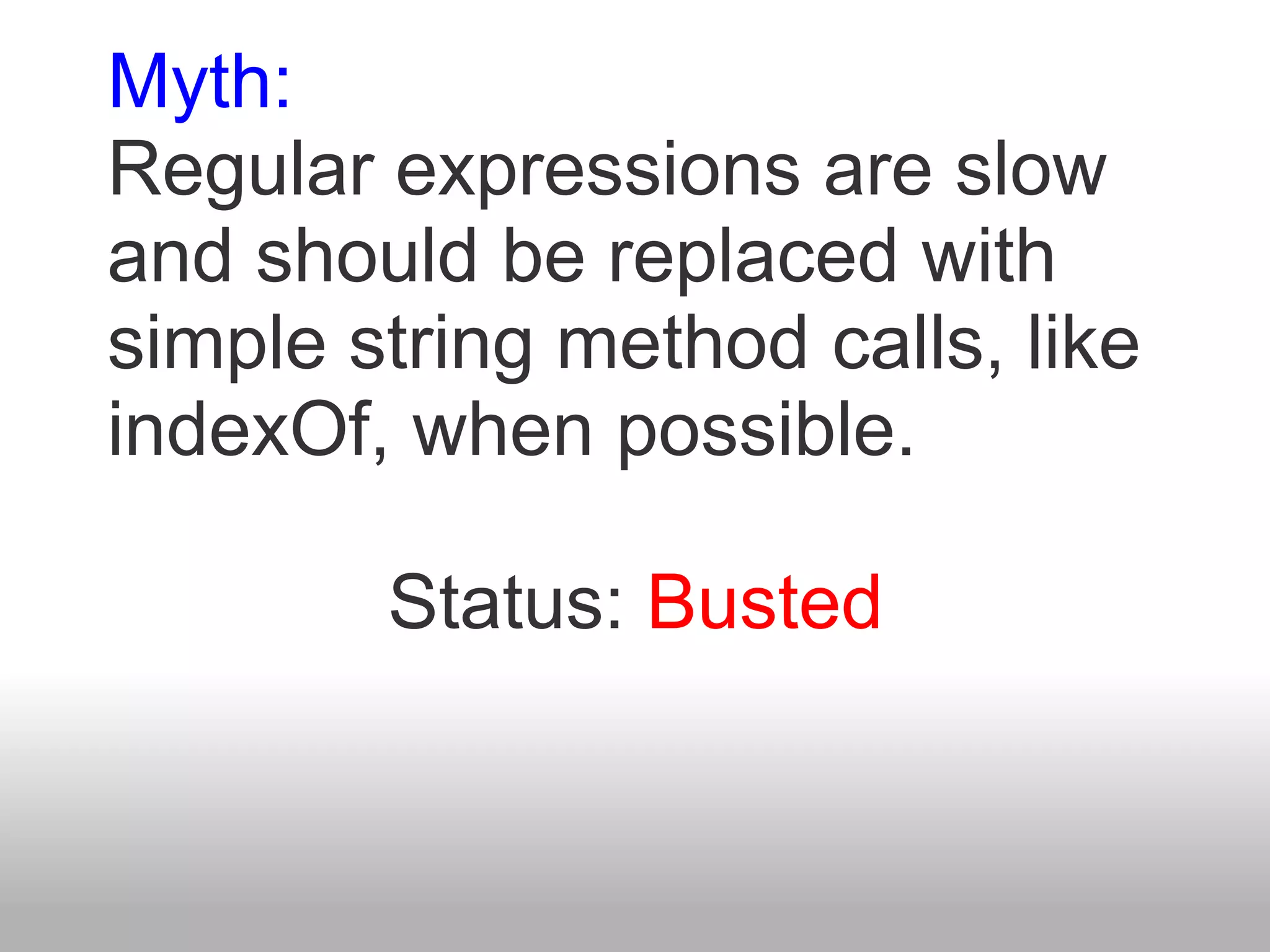
Myth:
Regular expressions are slow
and should be replaced with
simple string method calls, like
indexOf, when possible.

        Status: Busted
es5.github.com/#x7.8.5

jsperf.com/regexp-indexof-perf
Myth:
OO API abstraction means you
never have to worry about the
details (including the
performance).

       Status: Busted
http://nam.geti.fi/jsperf/ooapi
Myth:
Caching "nested property
lookup" or "prototype chain
lookup" helps (or hurts)
performance.

        Status: Busted
http://pc6.geti.fi/jsperf/prototype-chain


http://q3y.geti.fi/jsperf/nested-properties
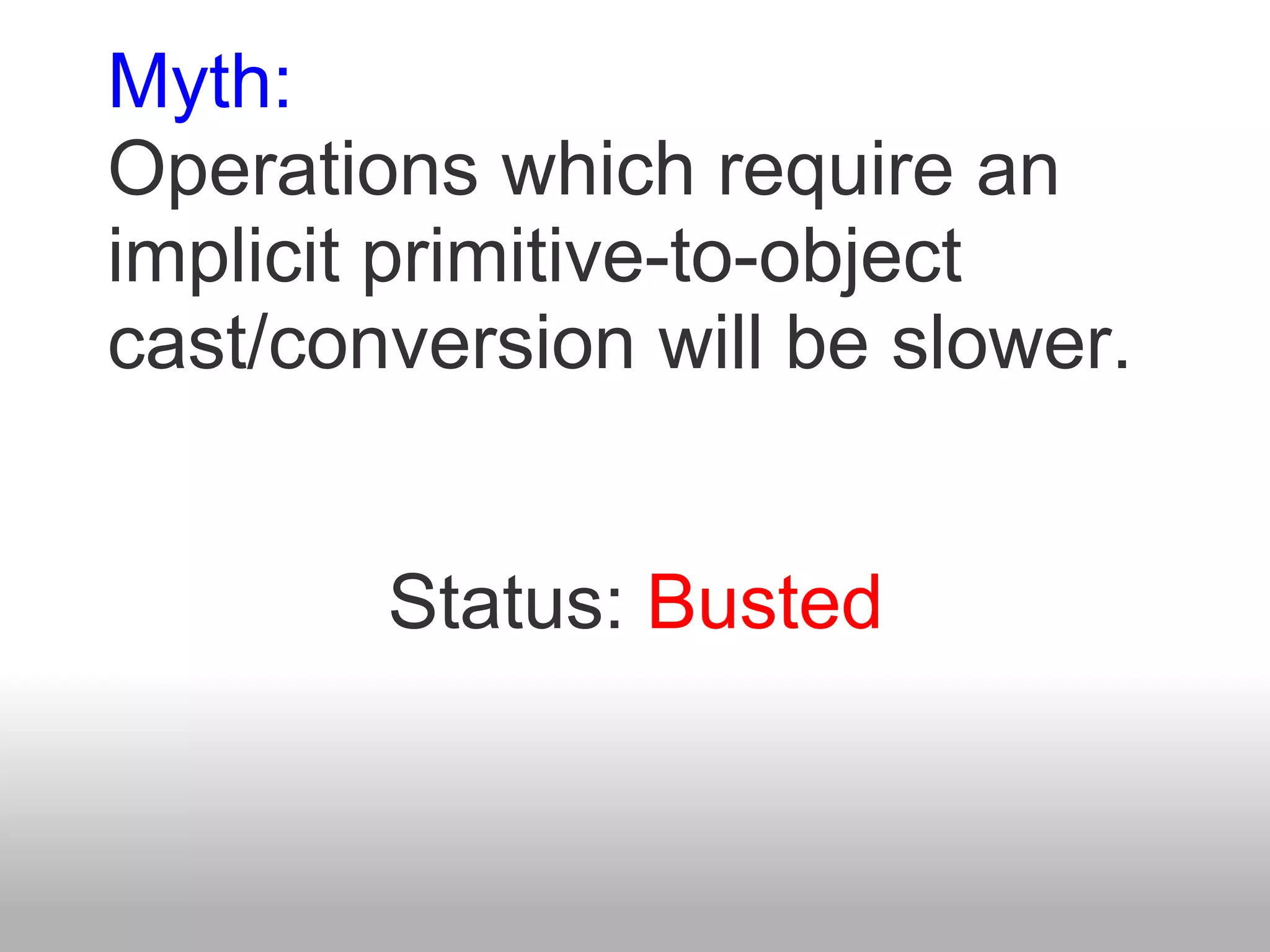
Myth:
Operations which require an
implicit primitive-to-object
cast/conversion will be slower.


        Status: Busted
http://udw.geti.fi/jsperf/object-casting
Myth:
Scope chain lookups are
expensive.


       Status: Busted
jsperf.com/scope-chain-perf
Myth:
Use void 0 instead of
undefined and === instead of
== when concerned about
performance.

       Status: Busted
es5.github.com/#x11.9.3

    es5.github.com/#x11.9.6

 jsperf.com/undefined-void0-perf

jsperf.com/double-vs-triple-equals
Myth:
Use switch statements instead
of if / else if for better
performance.


   Status: Plausible/Busted
       (WebKit Mobile)
jsperf.com/switch-if-else
Myth:
Use native methods for better
performance.


        Status: Busted
es5.github.com/#x15.4.4.18

   jsperf.com/accessor-perf

  jsperf.com/bind-vs-custom

jsperf.com/for-vs-array-foreach

SXSW 2012 JavaScript MythBusters