SWRL2SPIN
Converting SWRL to SPIN
Nick Bassiliades
Intelligent Systems Lab, School of Informatics, Aristotle Univ. of Thessaloniki, Greece
What?
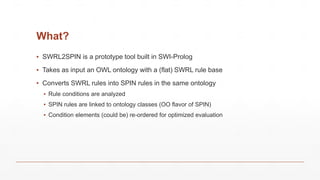
▪ SWRL2SPIN is a prototype tool built in SWI-Prolog
▪ Takes as input an OWL ontology with a (flat) SWRL rule base
▪ Converts SWRL rules into SPIN rules in the same ontology
▪ Rule conditions are analyzed
▪ SPIN rules are linked to ontology classes (OO flavor of SPIN)
▪ Condition elements (could be) re-ordered for optimized evaluation
Why?
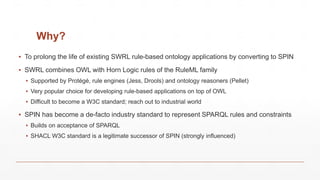
▪ To prolong the life of existing SWRL rule-based ontology applications by converting to SPIN
▪ SWRL combines OWL with Horn Logic rules of the RuleML family
▪ Supported by Protégé, rule engines (Jess, Drools) and ontology reasoners (Pellet)
▪ Very popular choice for developing rule-based applications on top of OWL
▪ Difficult to become a W3C standard; reach out to industrial world
▪ SPIN has become a de-facto industry standard to represent SPARQL rules and constraints
▪ Builds on acceptance of SPARQL
▪ SHACL W3C standard is a legitimate successor of SPIN (strongly influenced)
How?
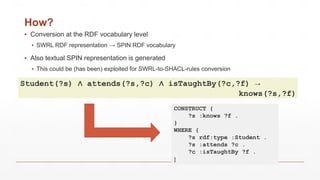
▪ Conversion at the RDF vocabulary level
▪ SWRL RDF representation → SPIN RDF vocabulary
▪ Also textual SPIN representation is generated
▪ This could be (has been) exploited for SWRL-to-SHACL-rules conversion
Student(?s) ∧ attends(?s,?c) ∧ isTaughtBy(?c,?f) →
knows(?s,?f)
CONSTRUCT {
?s :knows ?f .
}
WHERE {
?s rdf:type :Student .
?s :attends ?c .
?c :isTaughtBy ?f .
}
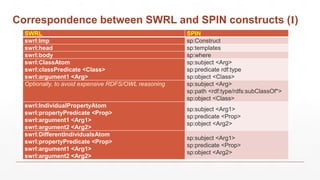
Correspondence between SWRL and SPIN constructs (I)
SWRL SPIN
swrl:Imp sp:Construct
swrl:head sp:templates
swrl:body sp:where
swrl:ClassAtom
swrl:classPredicate <Class>
swrl:argument1 <Arg>
sp:subject <Arg>
sp:predicate rdf:type
sp:object <Class>
Optionally, to avoid expensive RDFS/OWL reasoning sp:subject <Arg>
sp:path <rdf:type/rdfs:subClassOf*>
sp:object <Class>
swrl:IndividualPropertyAtom
swrl:propertyPredicate <Prop>
swrl:argument1 <Arg1>
swrl:argument2 <Arg2>
sp:subject <Arg1>
sp:predicate <Prop>
sp:object <Arg2>
swrl:DifferentIndividualsAtom
swrl:propertyPredicate <Prop>
swrl:argument1 <Arg1>
swrl:argument2 <Arg2>
sp:subject <Arg1>
sp:predicate <Prop>
sp:object <Arg2>
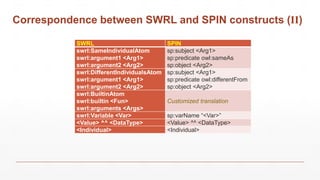
Correspondence between SWRL and SPIN constructs (II)
SWRL SPIN
swrl:SameIndividualAtom
swrl:argument1 <Arg1>
swrl:argument2 <Arg2>
sp:subject <Arg1>
sp:predicate owl:sameAs
sp:object <Arg2>
swrl:DifferentIndividualsAtom
swrl:argument1 <Arg1>
swrl:argument2 <Arg2>
sp:subject <Arg1>
sp:predicate owl:differentFrom
sp:object <Arg2>
swrl:BuiltinAtom
swrl:builtin <Fun>
swrl:arguments <Args>
Customized translation
swrl:Variable <Var> sp:varName “<Var>”
<Value> ^^ <DataType> <Value> ^^ <DataType>
<Individual> <Individual>
Embedding SPIN rules in
Classes
CONSTRUCT {
?x :knows ?z .
}
WHERE {
?x rdf:type :Student .
?x :attends ?y .
?y :isTaughtBy ?z .
}
CONSTRUCT { # @Student
?this :knows ?z .
}
WHERE {
?this :attends ?y .
?y :isTaughtBy ?z .
}
CONSTRUCT { # @Course
?x :knows ?z .
}
WHERE {
?x rdf:type :Student .
?x :attends ?this .
?this :isTaughtBy ?z .
}
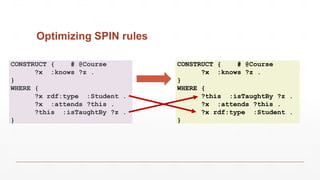
Optimizing SPIN rules
CONSTRUCT { # @Course
?x :knows ?z .
}
WHERE {
?this :isTaughtBy ?z .
?x :attends ?this .
?x rdf:type :Student .
}
CONSTRUCT { # @Course
?x :knows ?z .
}
WHERE {
?x rdf:type :Student .
?x :attends ?this .
?this :isTaughtBy ?z .
}
Implementing SWRL builtins
▪ 41 built-ins supported (out of 78)
▪ Mostly: Comparisons, Mathematics, Strings and Lists
▪ Date, Time and Duration: only swrlb:date
▪ Conversion of builtins falls into 10 categories:
▪ Filter: binary filter, filter function, complex filter
▪ Bind: associative infix assign, binary infix assign, unary assign, assign function, complex
assign
▪ Other: magic property, complex expression
Built-in examples (1/2)
▪ Binary filter
▪ greaterThan(?x,?y) → FILTER (?x > ?y)
▪ Associative infix assign
▪ add(?y,?x1,?x2,…,?xn) → BIND ((((?x1 + ?x2) +…) + ?xn) AS ?y)
▪ Filter function
▪ endsWith(?x,?y) → FILTER STRENDS(?x, ?y)
▪ Assign function
▪ stringLength(?y,?x) → BIND (STRLEN(?x) AS ?y)
Built-in examples (2/2)
▪ Complex assign
▪ integerDivide(?z,?x,?y) → BIND (spif:cast(?x / ?y, xsd:integer) AS ?z)
▪ Complex filter
▪ stringEqualIgnoreCase(?s1,?s2) → FILTER (LCASE(?s1) = LCASE(?s2))
▪ Complex expression
▪ member(?e,?list) → ?list (rdf:rest)*/rdf:first ?e .
▪ Magic property
▪ tokenize(?x,?y,?z) → ?x spif:split ( ?y ?z ) .
Evaluation
Rule translation time scalability
Rule 2:
Student(?x)∧ attends(?x,?y)∧ isTaughtBy(?y,?z) ∧ firstName(?z,?f) ∧
lastName(?z,?l) ∧ swrlb:stringConcat(?fn,?f, " ", ?l) -> knowsName(?x, ?fn)
Rule1:
Student(?s) ∧ attends(?s,?c) ∧ isTaughtBy(?c,?f) → knows(?s,?f)
Evaluation
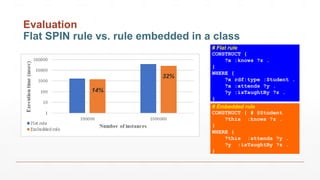
Flat SPIN rule vs. rule embedded in a class
# Flat rule
CONSTRUCT {
?x :knows ?z .
}
WHERE {
?x rdf:type :Student .
?x :attends ?y .
?y :isTaughtBy ?z .
}
# Embedded rule
CONSTRUCT { # @Student
?this :knows ?z .
}
WHERE {
?this :attends ?y .
?y :isTaughtBy ?z .
}
14%
32%
Evaluation
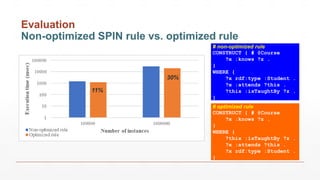
Non-optimized SPIN rule vs. optimized rule
# non-optimized rule
CONSTRUCT { # @Course
?x :knows ?z .
}
WHERE {
?x rdf:type :Student .
?x :attends ?this .
?this :isTaughtBy ?z .
}
# optimized rule
CONSTRUCT { # @Course
?x :knows ?z .
}
WHERE {
?this :isTaughtBy ?z .
?x :attends ?this .
?x rdf:type :Student .
}
11%
30%
Conclusions
▪ SWRL2SPIN: A tool to transform SWRL to SPIN rules
▪ Based on RDF vocabulary translation AND text SPIN syntax
▪ Rules embedded in classes (instead of flat) and optimized (re-ordering atoms in the condition)
▪ Initial evaluation shows promising results
▪ Looking for large SWRL rule bases for proper evaluation
▪ Porting tool to translate SWRL to SHACL SPARQL rules
SWRL2SPIN Code: https://github.com/nbassili/SWRL2SPIN
SWRL2SPIN full Technical Report: https://arxiv.org/abs/1801.09061
Thank you!

SWRL2SPIN: Converting SWRL to SPIN

  • 1.
    SWRL2SPIN Converting SWRL toSPIN Nick Bassiliades Intelligent Systems Lab, School of Informatics, Aristotle Univ. of Thessaloniki, Greece
  • 2.
    What? ▪ SWRL2SPIN isa prototype tool built in SWI-Prolog ▪ Takes as input an OWL ontology with a (flat) SWRL rule base ▪ Converts SWRL rules into SPIN rules in the same ontology ▪ Rule conditions are analyzed ▪ SPIN rules are linked to ontology classes (OO flavor of SPIN) ▪ Condition elements (could be) re-ordered for optimized evaluation
  • 3.
    Why? ▪ To prolongthe life of existing SWRL rule-based ontology applications by converting to SPIN ▪ SWRL combines OWL with Horn Logic rules of the RuleML family ▪ Supported by Protégé, rule engines (Jess, Drools) and ontology reasoners (Pellet) ▪ Very popular choice for developing rule-based applications on top of OWL ▪ Difficult to become a W3C standard; reach out to industrial world ▪ SPIN has become a de-facto industry standard to represent SPARQL rules and constraints ▪ Builds on acceptance of SPARQL ▪ SHACL W3C standard is a legitimate successor of SPIN (strongly influenced)
  • 4.
    How? ▪ Conversion atthe RDF vocabulary level ▪ SWRL RDF representation → SPIN RDF vocabulary ▪ Also textual SPIN representation is generated ▪ This could be (has been) exploited for SWRL-to-SHACL-rules conversion Student(?s) ∧ attends(?s,?c) ∧ isTaughtBy(?c,?f) → knows(?s,?f) CONSTRUCT { ?s :knows ?f . } WHERE { ?s rdf:type :Student . ?s :attends ?c . ?c :isTaughtBy ?f . }
  • 5.
    Correspondence between SWRLand SPIN constructs (I) SWRL SPIN swrl:Imp sp:Construct swrl:head sp:templates swrl:body sp:where swrl:ClassAtom swrl:classPredicate <Class> swrl:argument1 <Arg> sp:subject <Arg> sp:predicate rdf:type sp:object <Class> Optionally, to avoid expensive RDFS/OWL reasoning sp:subject <Arg> sp:path <rdf:type/rdfs:subClassOf*> sp:object <Class> swrl:IndividualPropertyAtom swrl:propertyPredicate <Prop> swrl:argument1 <Arg1> swrl:argument2 <Arg2> sp:subject <Arg1> sp:predicate <Prop> sp:object <Arg2> swrl:DifferentIndividualsAtom swrl:propertyPredicate <Prop> swrl:argument1 <Arg1> swrl:argument2 <Arg2> sp:subject <Arg1> sp:predicate <Prop> sp:object <Arg2>
  • 6.
    Correspondence between SWRLand SPIN constructs (II) SWRL SPIN swrl:SameIndividualAtom swrl:argument1 <Arg1> swrl:argument2 <Arg2> sp:subject <Arg1> sp:predicate owl:sameAs sp:object <Arg2> swrl:DifferentIndividualsAtom swrl:argument1 <Arg1> swrl:argument2 <Arg2> sp:subject <Arg1> sp:predicate owl:differentFrom sp:object <Arg2> swrl:BuiltinAtom swrl:builtin <Fun> swrl:arguments <Args> Customized translation swrl:Variable <Var> sp:varName “<Var>” <Value> ^^ <DataType> <Value> ^^ <DataType> <Individual> <Individual>
  • 7.
    Embedding SPIN rulesin Classes CONSTRUCT { ?x :knows ?z . } WHERE { ?x rdf:type :Student . ?x :attends ?y . ?y :isTaughtBy ?z . } CONSTRUCT { # @Student ?this :knows ?z . } WHERE { ?this :attends ?y . ?y :isTaughtBy ?z . } CONSTRUCT { # @Course ?x :knows ?z . } WHERE { ?x rdf:type :Student . ?x :attends ?this . ?this :isTaughtBy ?z . }
  • 8.
    Optimizing SPIN rules CONSTRUCT{ # @Course ?x :knows ?z . } WHERE { ?this :isTaughtBy ?z . ?x :attends ?this . ?x rdf:type :Student . } CONSTRUCT { # @Course ?x :knows ?z . } WHERE { ?x rdf:type :Student . ?x :attends ?this . ?this :isTaughtBy ?z . }
  • 9.
    Implementing SWRL builtins ▪41 built-ins supported (out of 78) ▪ Mostly: Comparisons, Mathematics, Strings and Lists ▪ Date, Time and Duration: only swrlb:date ▪ Conversion of builtins falls into 10 categories: ▪ Filter: binary filter, filter function, complex filter ▪ Bind: associative infix assign, binary infix assign, unary assign, assign function, complex assign ▪ Other: magic property, complex expression
  • 10.
    Built-in examples (1/2) ▪Binary filter ▪ greaterThan(?x,?y) → FILTER (?x > ?y) ▪ Associative infix assign ▪ add(?y,?x1,?x2,…,?xn) → BIND ((((?x1 + ?x2) +…) + ?xn) AS ?y) ▪ Filter function ▪ endsWith(?x,?y) → FILTER STRENDS(?x, ?y) ▪ Assign function ▪ stringLength(?y,?x) → BIND (STRLEN(?x) AS ?y)
  • 11.
    Built-in examples (2/2) ▪Complex assign ▪ integerDivide(?z,?x,?y) → BIND (spif:cast(?x / ?y, xsd:integer) AS ?z) ▪ Complex filter ▪ stringEqualIgnoreCase(?s1,?s2) → FILTER (LCASE(?s1) = LCASE(?s2)) ▪ Complex expression ▪ member(?e,?list) → ?list (rdf:rest)*/rdf:first ?e . ▪ Magic property ▪ tokenize(?x,?y,?z) → ?x spif:split ( ?y ?z ) .
  • 12.
    Evaluation Rule translation timescalability Rule 2: Student(?x)∧ attends(?x,?y)∧ isTaughtBy(?y,?z) ∧ firstName(?z,?f) ∧ lastName(?z,?l) ∧ swrlb:stringConcat(?fn,?f, " ", ?l) -> knowsName(?x, ?fn) Rule1: Student(?s) ∧ attends(?s,?c) ∧ isTaughtBy(?c,?f) → knows(?s,?f)
  • 13.
    Evaluation Flat SPIN rulevs. rule embedded in a class # Flat rule CONSTRUCT { ?x :knows ?z . } WHERE { ?x rdf:type :Student . ?x :attends ?y . ?y :isTaughtBy ?z . } # Embedded rule CONSTRUCT { # @Student ?this :knows ?z . } WHERE { ?this :attends ?y . ?y :isTaughtBy ?z . } 14% 32%
  • 14.
    Evaluation Non-optimized SPIN rulevs. optimized rule # non-optimized rule CONSTRUCT { # @Course ?x :knows ?z . } WHERE { ?x rdf:type :Student . ?x :attends ?this . ?this :isTaughtBy ?z . } # optimized rule CONSTRUCT { # @Course ?x :knows ?z . } WHERE { ?this :isTaughtBy ?z . ?x :attends ?this . ?x rdf:type :Student . } 11% 30%
  • 15.
    Conclusions ▪ SWRL2SPIN: Atool to transform SWRL to SPIN rules ▪ Based on RDF vocabulary translation AND text SPIN syntax ▪ Rules embedded in classes (instead of flat) and optimized (re-ordering atoms in the condition) ▪ Initial evaluation shows promising results ▪ Looking for large SWRL rule bases for proper evaluation ▪ Porting tool to translate SWRL to SHACL SPARQL rules SWRL2SPIN Code: https://github.com/nbassili/SWRL2SPIN SWRL2SPIN full Technical Report: https://arxiv.org/abs/1801.09061 Thank you!