The importance of switching in communication
• The cost of switching is high
Definition:
• Transfer input sample points to the correct output ports at the
correct time
Terminology
• Switching
• Digital switching (sample points amplitudes are 0's and 1's)
• PABX
• Circuit
• Circuit switching
• Packet switching
Space division
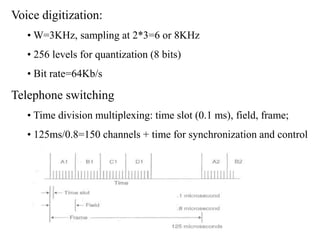
Voice digitization:
• W=3KHz, sampling at 2*3=6 or 8KHz
• 256 levels for quantization (8 bits)
• Bit rate=64Kb/s
Telephone switching
• Time division multiplexing: time slot (0.1 ms), field, frame;
• 125ms/0.8=150 channels + time for synchronization and control
Switch architecture
• Sampling input signals, storing values in memory, placing
values in the proper field and frame of the output sequence
• Need for more channels: hierarchical switching
• Combining time and space switching
General framework for switching
• time, space and frequency (broadband signals) switching
• synchronization (single clock) and buffering (memory)
• set-up time and delay (propagation time)
• "call duration" assignment vs. dynamic assignment
• in-band and out-of-band signaling
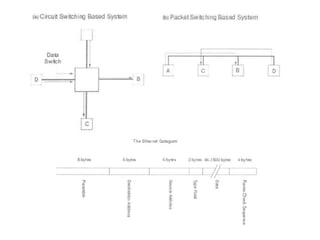
Circuit (synchronous) vs. packet (asynchronous) switching
• control and routing overhead, virtual packet switching
Switching techniques and networking
• Switching is the technology allowing to get a message between
the nodes of a network
• Crossbar switching: mechanical (in the past) or electronic.
• Bus and cable switches: computer buses or cables (switching +
transportation = network)
• Token passing approach (similar to the locks used by
multiprocessors connected by a bus)
• Ethernet approach: cable or ring, packets, conflicts,
resending
• Synchronization and Hub switch: star networks (no conflicts)
Ethernet Cabling
Ethernet Cabling
Cable topologies. (a) Linear, (b) Spine, (c) Tree, (d)
Segmented.
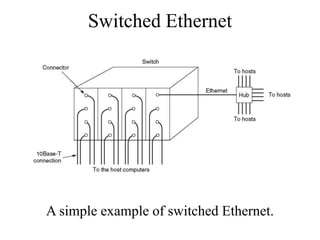
Switched Ethernet
A simple example of switched Ethernet.
switching.ppt

switching.ppt

  • 2.
    The importance ofswitching in communication • The cost of switching is high Definition: • Transfer input sample points to the correct output ports at the correct time Terminology • Switching • Digital switching (sample points amplitudes are 0's and 1's) • PABX • Circuit • Circuit switching • Packet switching
  • 3.
  • 5.
    Voice digitization: • W=3KHz,sampling at 2*3=6 or 8KHz • 256 levels for quantization (8 bits) • Bit rate=64Kb/s Telephone switching • Time division multiplexing: time slot (0.1 ms), field, frame; • 125ms/0.8=150 channels + time for synchronization and control
  • 6.
    Switch architecture • Samplinginput signals, storing values in memory, placing values in the proper field and frame of the output sequence • Need for more channels: hierarchical switching • Combining time and space switching
  • 7.
    General framework forswitching • time, space and frequency (broadband signals) switching • synchronization (single clock) and buffering (memory) • set-up time and delay (propagation time) • "call duration" assignment vs. dynamic assignment • in-band and out-of-band signaling Circuit (synchronous) vs. packet (asynchronous) switching • control and routing overhead, virtual packet switching
  • 8.
    Switching techniques andnetworking • Switching is the technology allowing to get a message between the nodes of a network • Crossbar switching: mechanical (in the past) or electronic. • Bus and cable switches: computer buses or cables (switching + transportation = network) • Token passing approach (similar to the locks used by multiprocessors connected by a bus) • Ethernet approach: cable or ring, packets, conflicts, resending • Synchronization and Hub switch: star networks (no conflicts)
  • 11.
  • 12.
    Ethernet Cabling Cable topologies.(a) Linear, (b) Spine, (c) Tree, (d) Segmented.
  • 13.
    Switched Ethernet A simpleexample of switched Ethernet.