Lecture 12
Instructor
Rida Shifa
Switching Terms
 Switching Nodes:
 Intermediate switching device that moves data
 Not concerned with content of data
 Stations:
 End devices that wish to communicate
 Each station is connected to a switching node
 Communications Network:
 A collection of switching nodes
2
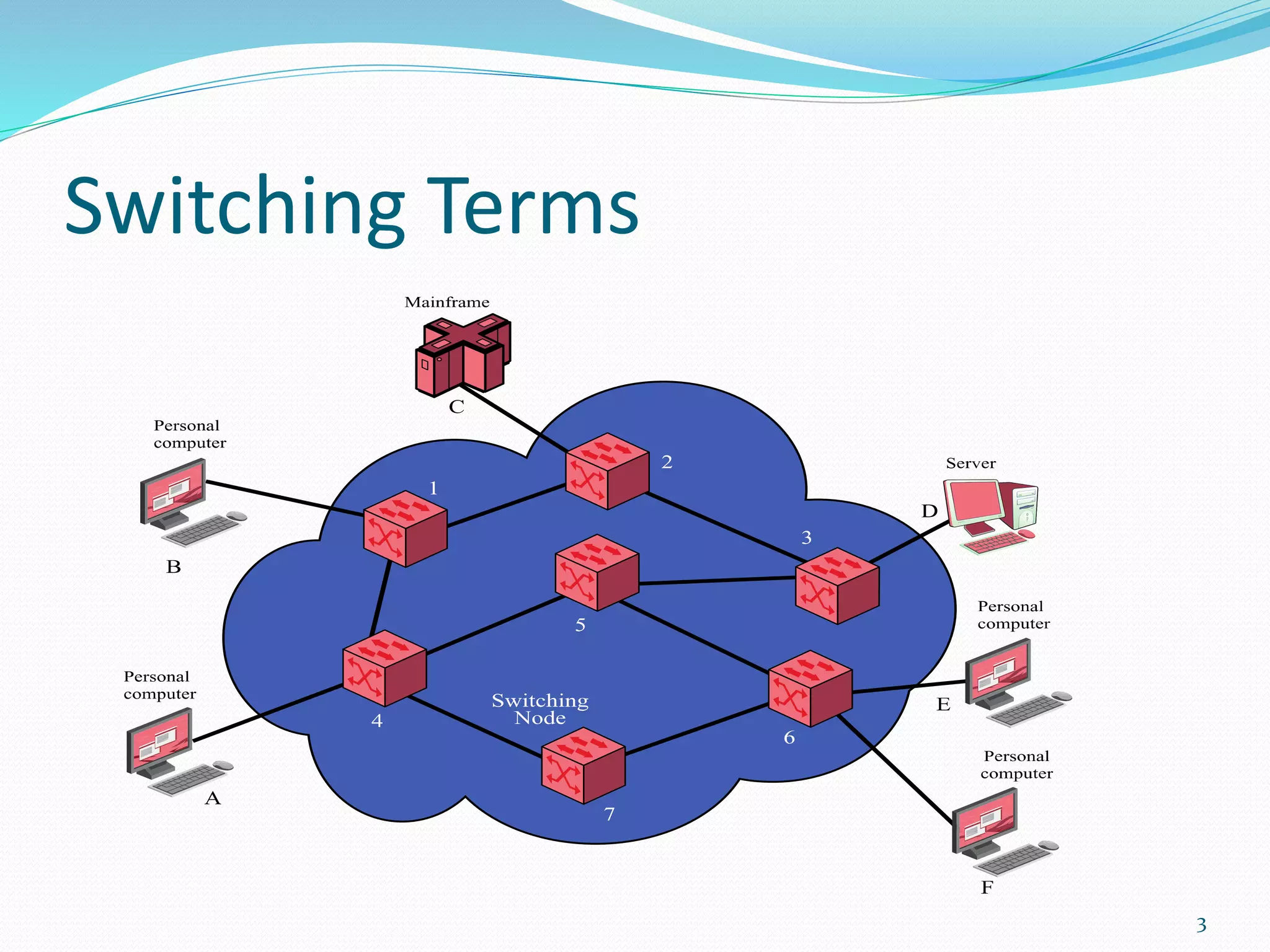
Switching Terms
3
Observations of Figure
 Some nodes connect only to other nodes (e.g., 5
and 7)
 Some nodes connect to one or more stations
 Node-station links usually dedicated point-to-
point links
 Node-node links usually multiplexed links
 Frequency-division multiplexing (FDM)
 Time-division multiplexing (TDM)
 Not a direct link between every node pair
4
Techniques Used in Switched
Networks
 Circuit switching
 Dedicated communications path between two stations
 E.g., public telephone network
 Packet switching
 Message is broken into a series of packets
 Each node determines next leg of transmission for each
packet
5
Phases of Circuit Switching
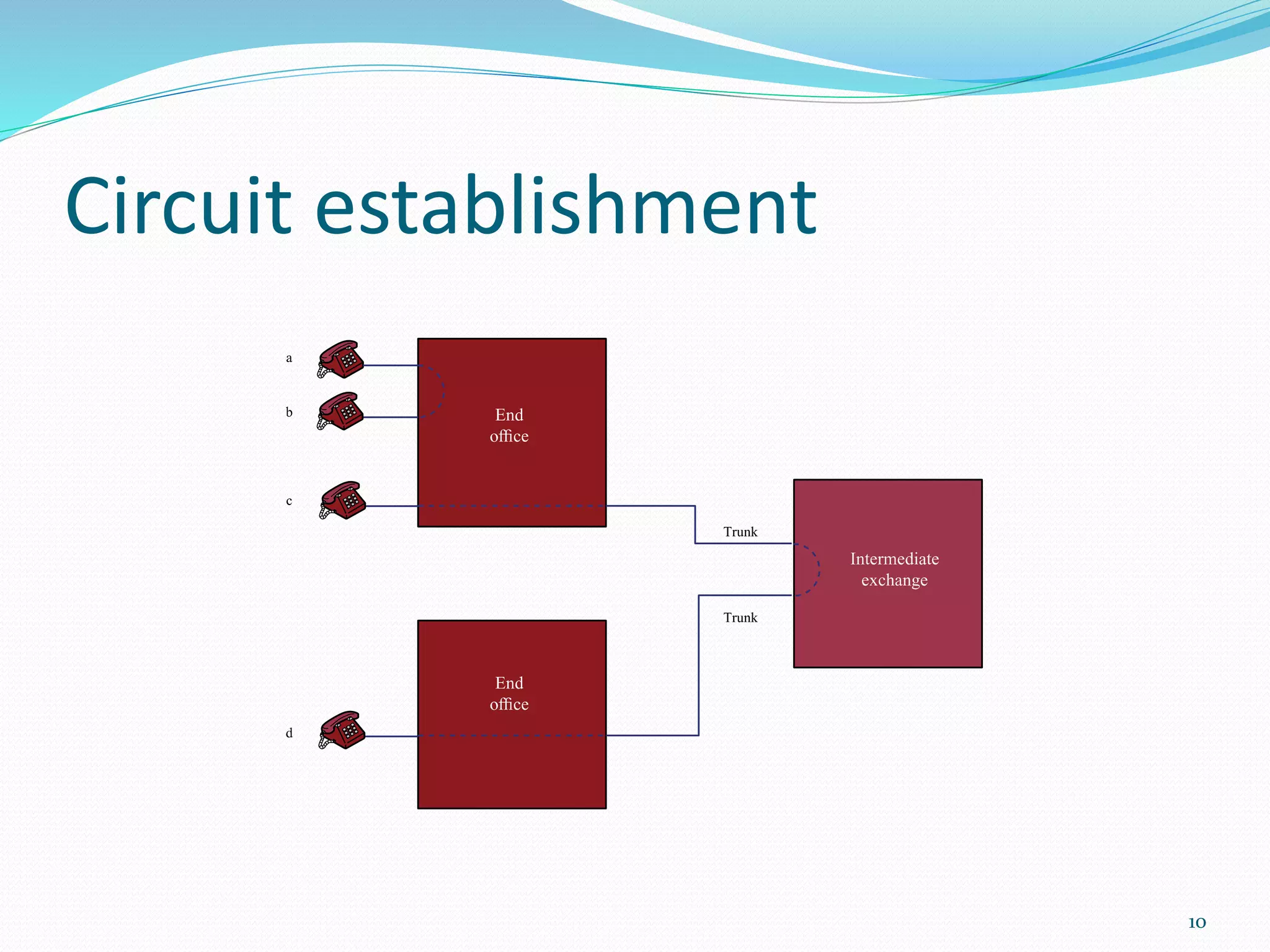
 Circuit establishment
 An end to end circuit is established through switching
nodes
 Information Transfer
 Information transmitted through the network
 Data may be analog voice, digitized voice, or binary data
 Circuit disconnect
 Circuit is terminated
 Each node deallocates dedicated resources
6
Characteristics of Circuit Switching
 Can be inefficient
 Channel capacity dedicated for duration of connection
 Utilization not 100%
 Delay prior to signal transfer for establishment
 Once established, network is transparent to users
 Information transmitted at fixed data rate with
only propagation delay
 Propagation delay = d/s
7
Components of Public
Telecommunications Network
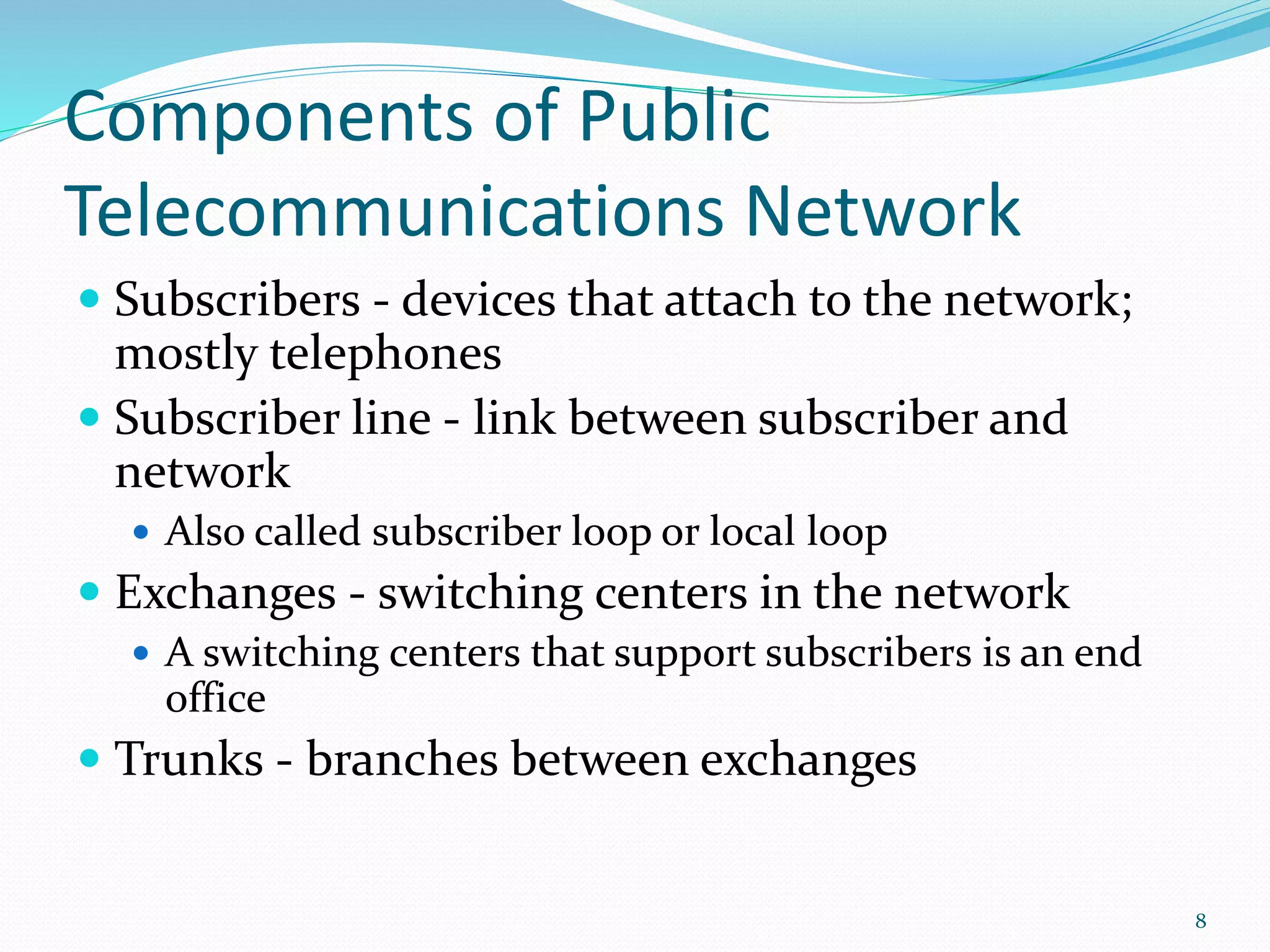
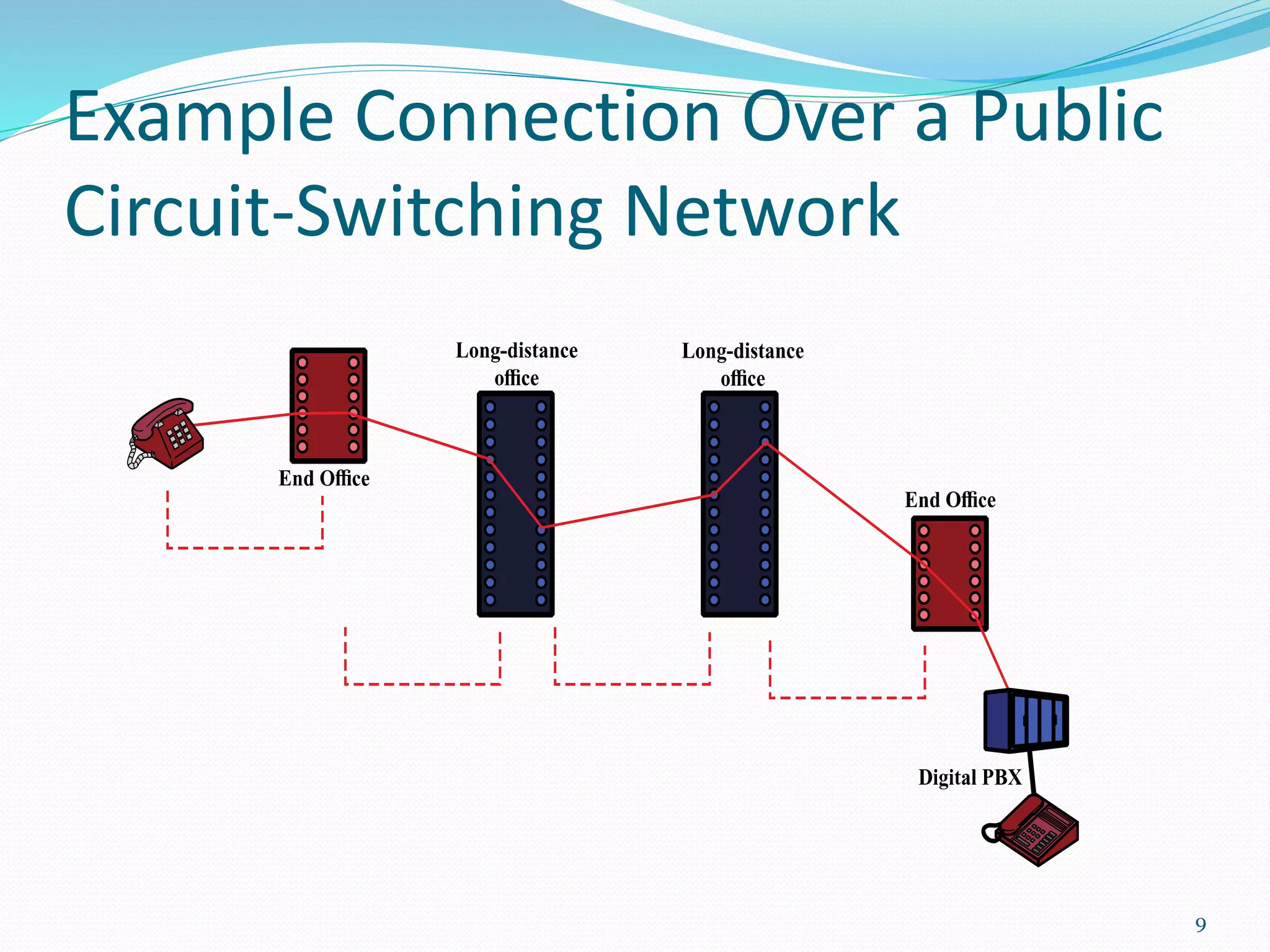
 Subscribers - devices that attach to the network;
mostly telephones
 Subscriber line - link between subscriber and
network
 Also called subscriber loop or local loop
 Exchanges - switching centers in the network
 A switching centers that support subscribers is an end
office
 Trunks - branches between exchanges
8
Example Connection Over a Public
Circuit-Switching Network
9
Circuit establishment
10
How Packet Switching Works
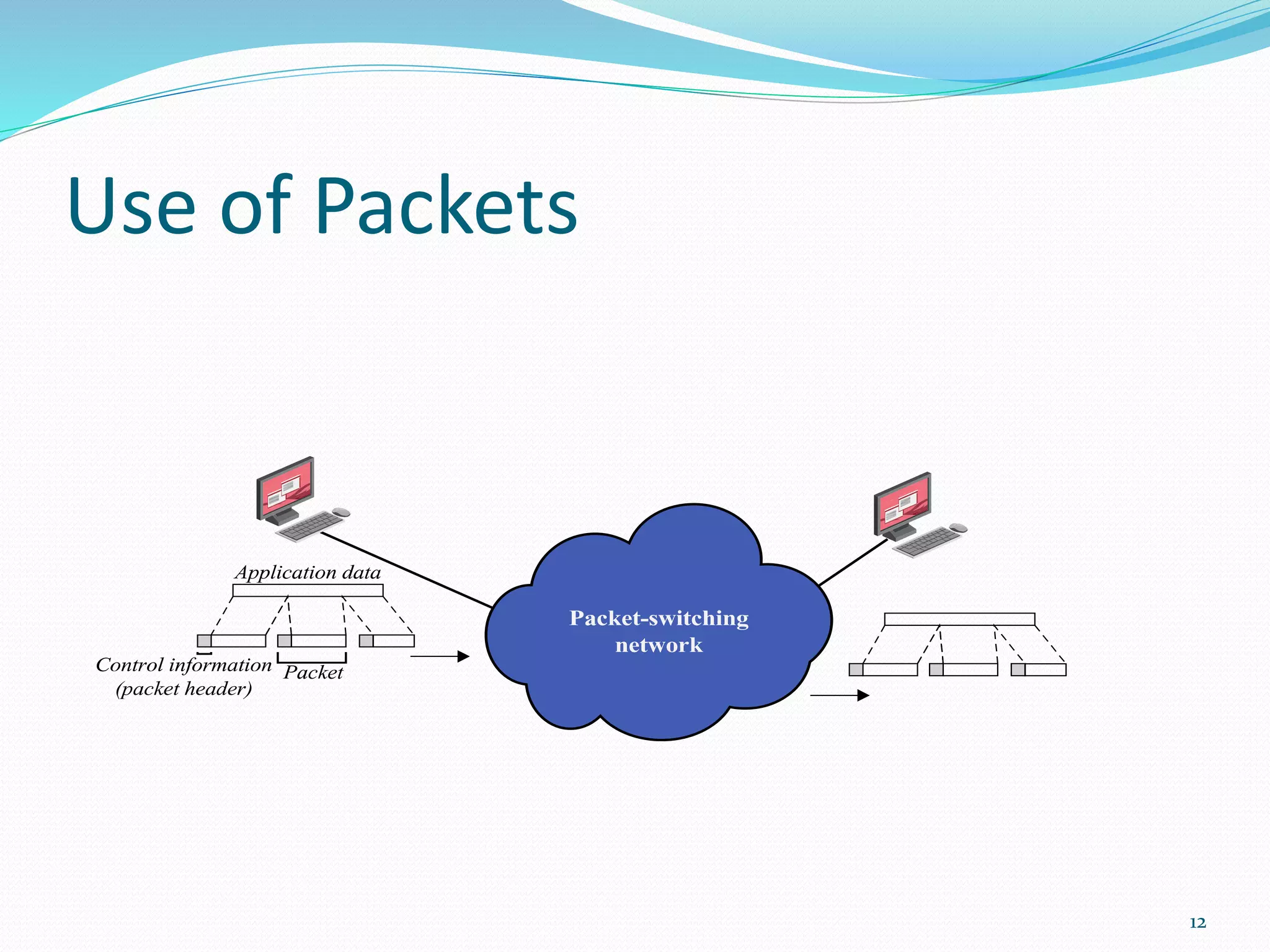
 Data is transmitted in blocks, called packets
 Before sending, the message is broken into a series
of packets
 Typical packet length is 1000 octets (bytes)
 Packets consists of a portion of data plus a packet header
that includes control information
 At each node en route, packet is received, stored
briefly and passed to the next node
11
Use of Packets
12
Packet Switching Advantages
 Line efficiency is greater
 Many packets over time can dynamically share the same
node to node link
 Packet-switching networks can carry out data-rate
conversion
 Two stations with different data rates can exchange
information
 Unlike circuit-switching networks that block calls
when traffic is heavy, packet-switching still accepts
packets, but with increased delivery delay
 Priorities can be used
13
Disadvantages of Packet Switching
 Each packet switching node introduces a delay
 Overall packet delay can vary substantially
 This is referred to as jitter
 Caused by differing packet sizes, routes taken and
varying delay in the switches
 Each packet requires overhead information
 Includes destination and sequencing information
 Reduces communication capacity
 More processing required at each node
14
Packet Switching Networks -
Datagram
 Each packet treated independently, without
reference to previous packets
 Each node chooses next node on packet’s path
 Packets don’t necessarily follow same route and
may arrive out of sequence
 Exit node restores packets to original order
 Responsibility of exit node or destination to detect
loss of packet and how to recover
15
Packet-switching datagram
Approach
16
Packet Switching Networks –
Datagram
 Advantages:
 Call setup phase is avoided
 Because it’s more primitive, it’s more flexible
 Datagram delivery is more reliable
17
Packet Switching Networks –
Virtual Circuit
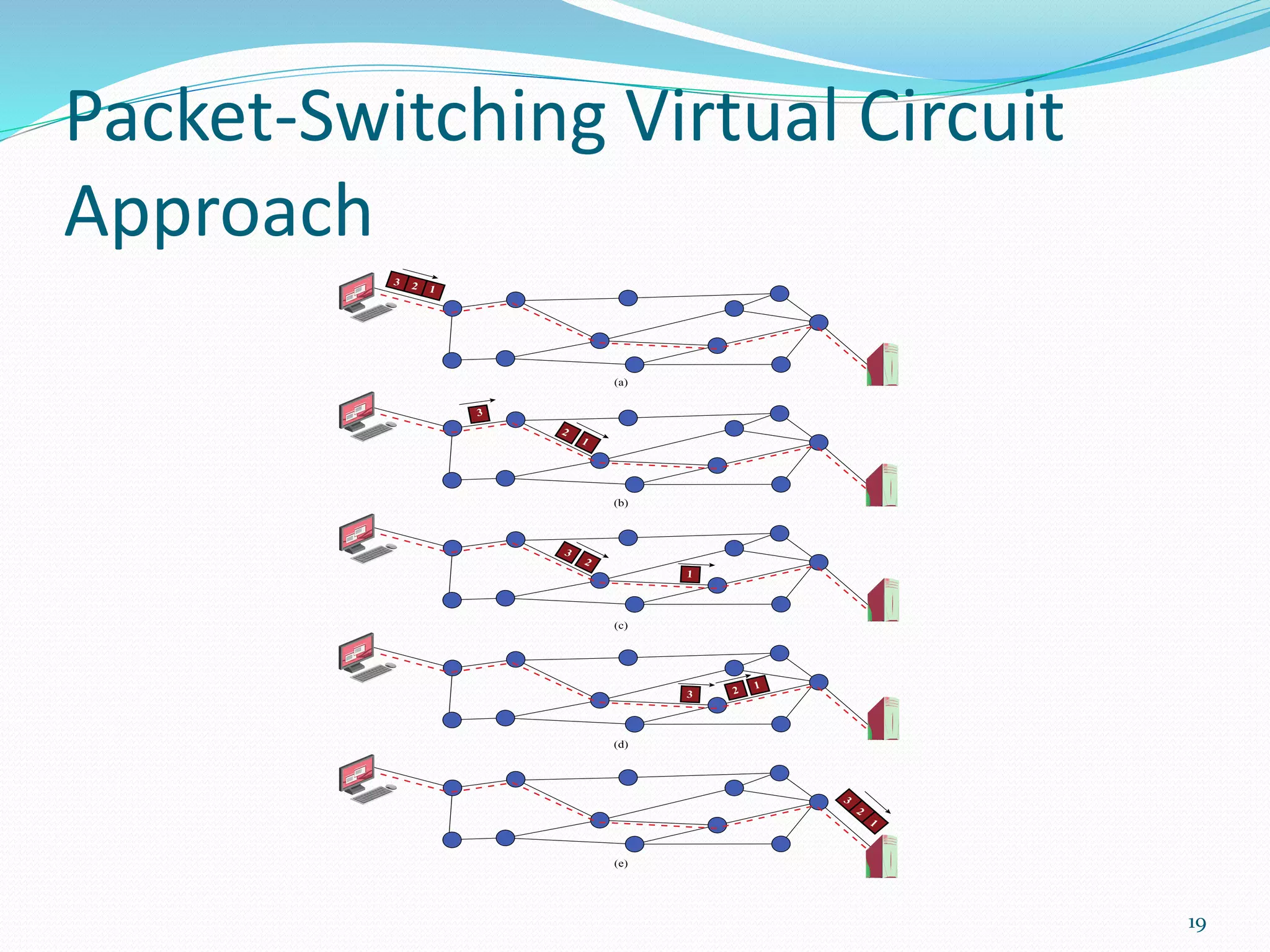
 Preplanned route established before packets sent
 All packets between source and destination follow
this route
 Routing decision not required by nodes for each
packet
 Emulates a circuit in a circuit switching network
but is not a dedicated path
 Packets still buffered at each node and queued for
output over a line
18
Packet-Switching Virtual Circuit
Approach
19
Packet Switching Networks –
Virtual Circuit
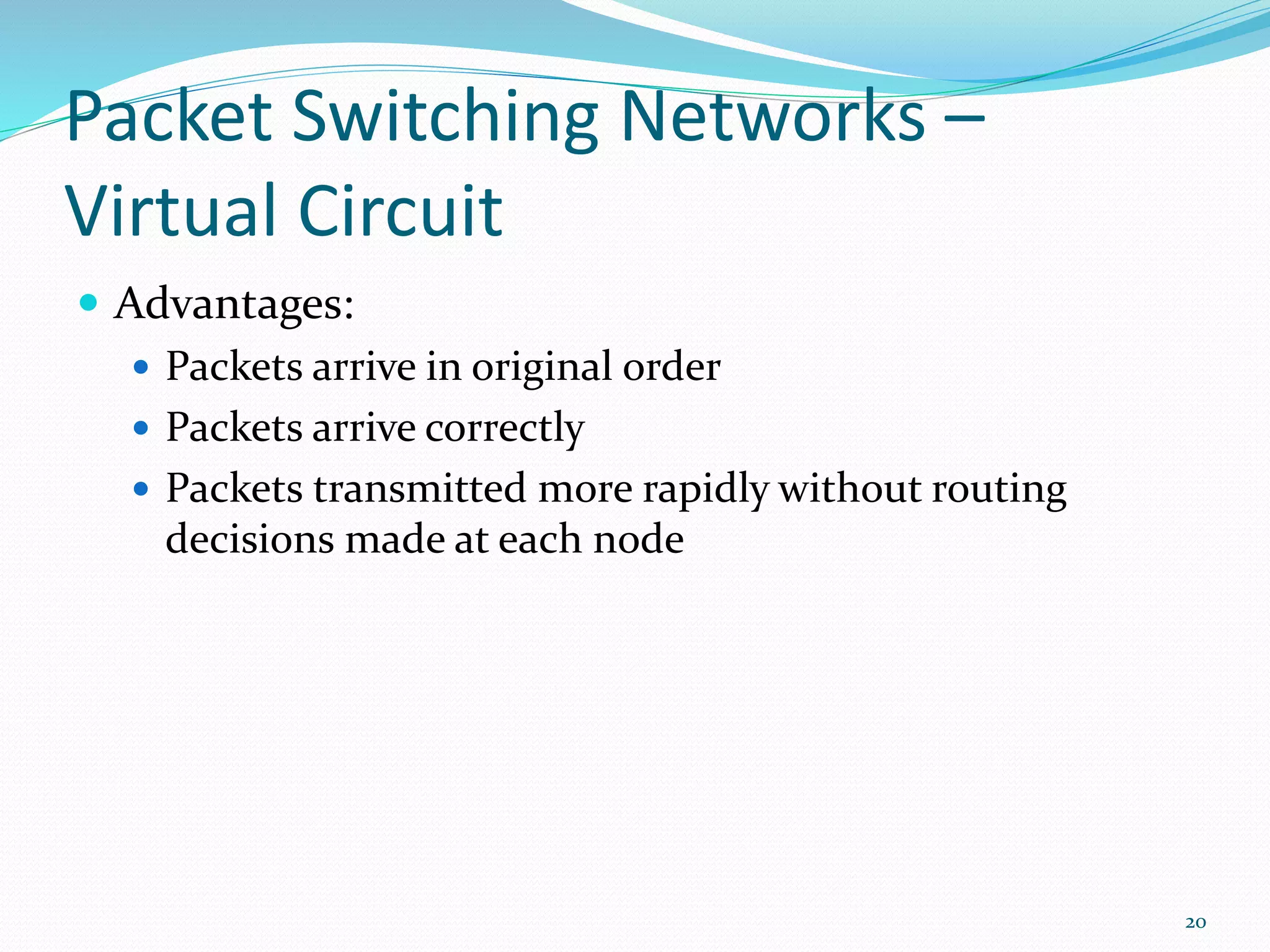
 Advantages:
 Packets arrive in original order
 Packets arrive correctly
 Packets transmitted more rapidly without routing
decisions made at each node
20
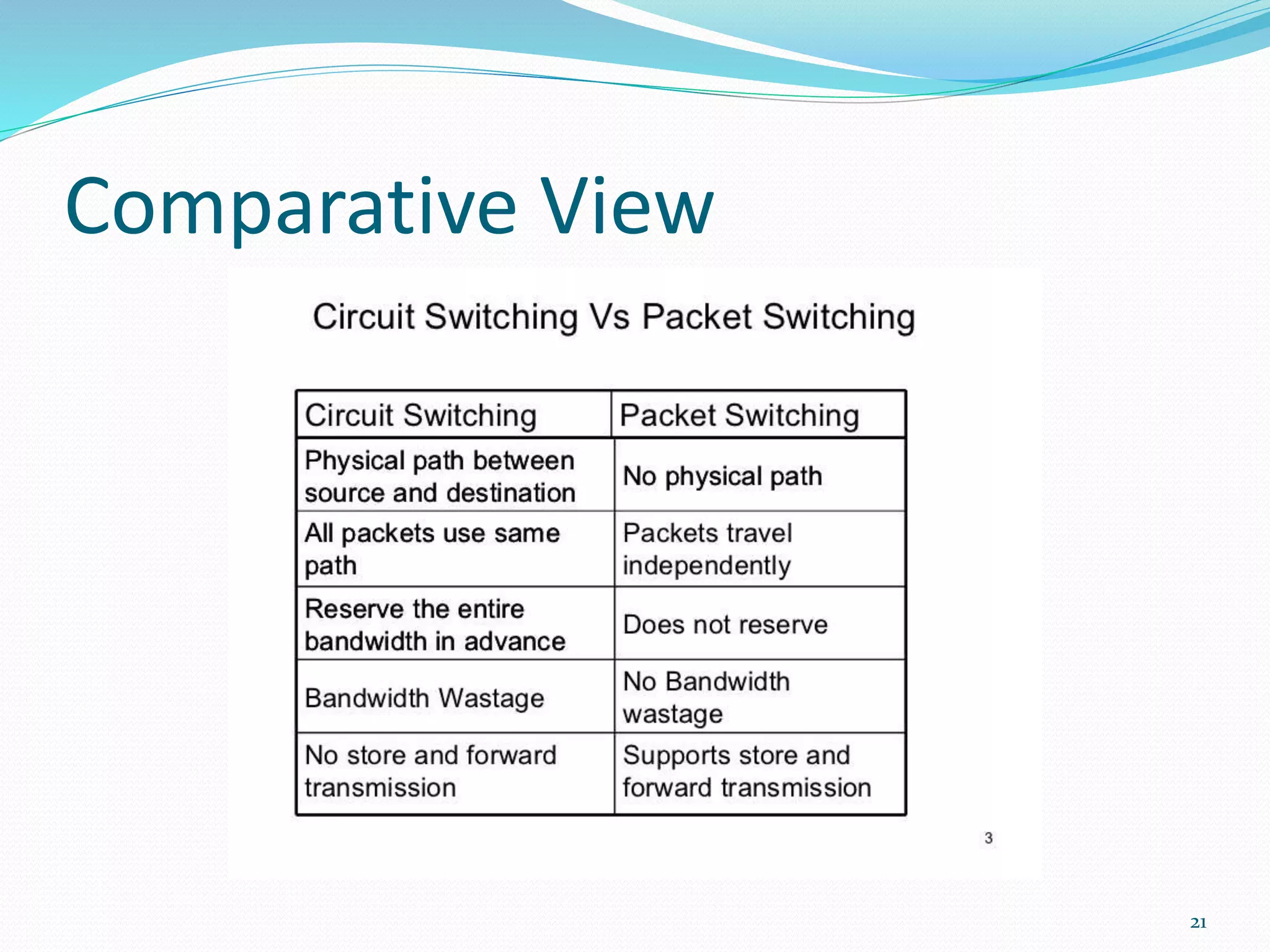
Comparative View
21
Assignment
 In the assignment , you people are going to submit:
Where to use circuit switching?
Where to use Packet switching?
22
23

Switching Techniques Lecture12,wireless

  • 1.
  • 2.
    Switching Terms  SwitchingNodes:  Intermediate switching device that moves data  Not concerned with content of data  Stations:  End devices that wish to communicate  Each station is connected to a switching node  Communications Network:  A collection of switching nodes 2
  • 3.
  • 4.
    Observations of Figure Some nodes connect only to other nodes (e.g., 5 and 7)  Some nodes connect to one or more stations  Node-station links usually dedicated point-to- point links  Node-node links usually multiplexed links  Frequency-division multiplexing (FDM)  Time-division multiplexing (TDM)  Not a direct link between every node pair 4
  • 5.
    Techniques Used inSwitched Networks  Circuit switching  Dedicated communications path between two stations  E.g., public telephone network  Packet switching  Message is broken into a series of packets  Each node determines next leg of transmission for each packet 5
  • 6.
    Phases of CircuitSwitching  Circuit establishment  An end to end circuit is established through switching nodes  Information Transfer  Information transmitted through the network  Data may be analog voice, digitized voice, or binary data  Circuit disconnect  Circuit is terminated  Each node deallocates dedicated resources 6
  • 7.
    Characteristics of CircuitSwitching  Can be inefficient  Channel capacity dedicated for duration of connection  Utilization not 100%  Delay prior to signal transfer for establishment  Once established, network is transparent to users  Information transmitted at fixed data rate with only propagation delay  Propagation delay = d/s 7
  • 8.
    Components of Public TelecommunicationsNetwork  Subscribers - devices that attach to the network; mostly telephones  Subscriber line - link between subscriber and network  Also called subscriber loop or local loop  Exchanges - switching centers in the network  A switching centers that support subscribers is an end office  Trunks - branches between exchanges 8
  • 9.
    Example Connection Overa Public Circuit-Switching Network 9
  • 10.
  • 11.
    How Packet SwitchingWorks  Data is transmitted in blocks, called packets  Before sending, the message is broken into a series of packets  Typical packet length is 1000 octets (bytes)  Packets consists of a portion of data plus a packet header that includes control information  At each node en route, packet is received, stored briefly and passed to the next node 11
  • 12.
  • 13.
    Packet Switching Advantages Line efficiency is greater  Many packets over time can dynamically share the same node to node link  Packet-switching networks can carry out data-rate conversion  Two stations with different data rates can exchange information  Unlike circuit-switching networks that block calls when traffic is heavy, packet-switching still accepts packets, but with increased delivery delay  Priorities can be used 13
  • 14.
    Disadvantages of PacketSwitching  Each packet switching node introduces a delay  Overall packet delay can vary substantially  This is referred to as jitter  Caused by differing packet sizes, routes taken and varying delay in the switches  Each packet requires overhead information  Includes destination and sequencing information  Reduces communication capacity  More processing required at each node 14
  • 15.
    Packet Switching Networks- Datagram  Each packet treated independently, without reference to previous packets  Each node chooses next node on packet’s path  Packets don’t necessarily follow same route and may arrive out of sequence  Exit node restores packets to original order  Responsibility of exit node or destination to detect loss of packet and how to recover 15
  • 16.
  • 17.
    Packet Switching Networks– Datagram  Advantages:  Call setup phase is avoided  Because it’s more primitive, it’s more flexible  Datagram delivery is more reliable 17
  • 18.
    Packet Switching Networks– Virtual Circuit  Preplanned route established before packets sent  All packets between source and destination follow this route  Routing decision not required by nodes for each packet  Emulates a circuit in a circuit switching network but is not a dedicated path  Packets still buffered at each node and queued for output over a line 18
  • 19.
  • 20.
    Packet Switching Networks– Virtual Circuit  Advantages:  Packets arrive in original order  Packets arrive correctly  Packets transmitted more rapidly without routing decisions made at each node 20
  • 21.
  • 22.
    Assignment  In theassignment , you people are going to submit: Where to use circuit switching? Where to use Packet switching? 22
  • 23.

Editor's Notes

  • #8 propagation delay is equal to d / s where d is the distance and s is the wave propagation speed
  • #15 Jitter is any deviation in, or displacement of, the signal pulses in a high-frequency digital signal. overhead is any combination of excess or indirect computation time, memory, bandwidth, or other resources that are required to perform a specific task