Introduction to Data communication
Topic: Introduction To Switching and
Circuit Switching
Lecture #6
Dr Rajiv Srivastava
Director
Sagar Institute of Research & Technology (SIRT)
Sagar Group of Institutions, Bhopal
http://www.sirtbhopal.ac.in
Unit 2
Lecture 6
Course Lecture 23
Introduction To Switching
Circuit Switching
Q. What is a switch?
Q. What is switching?
Q. What is switched network?
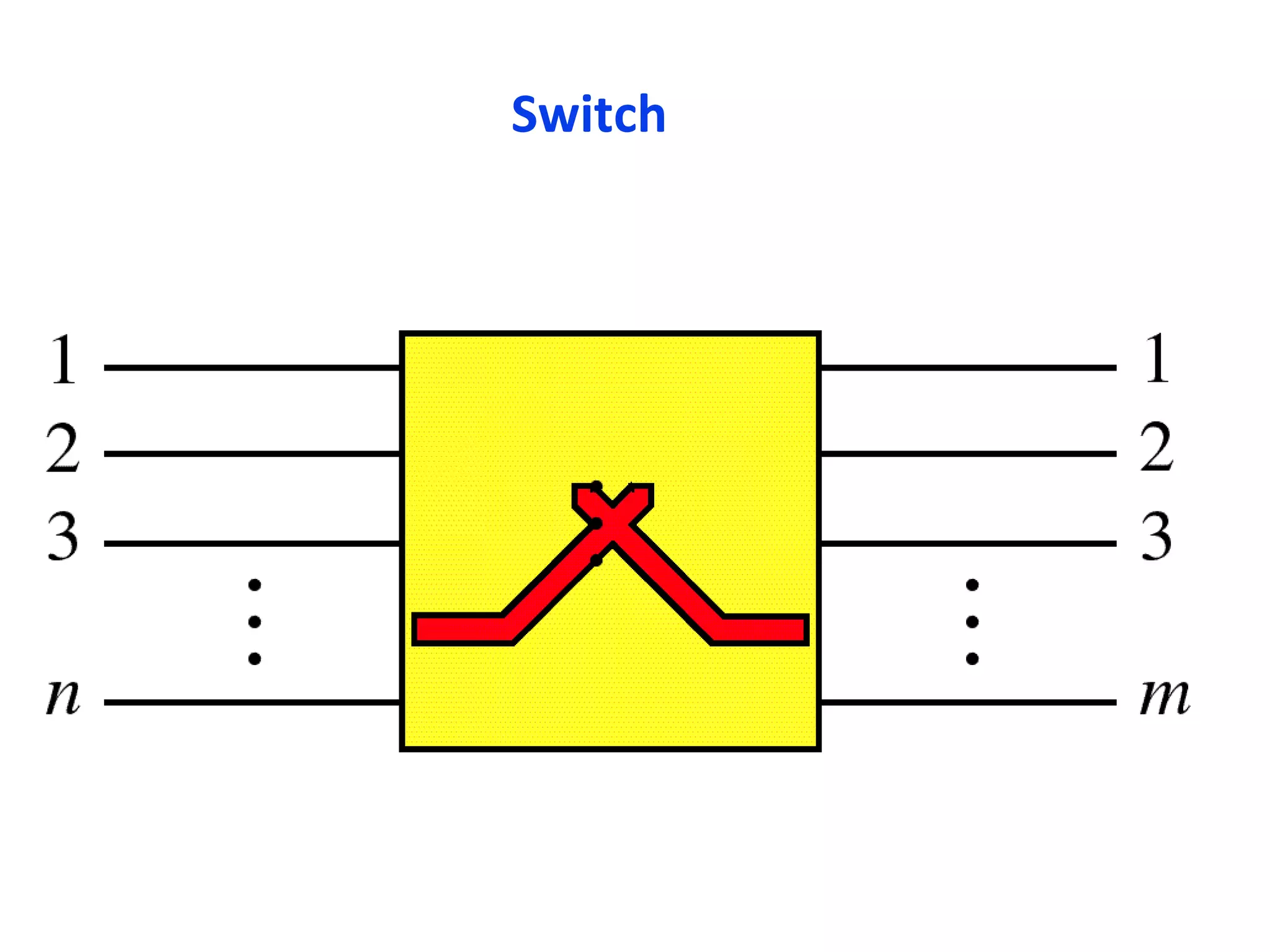
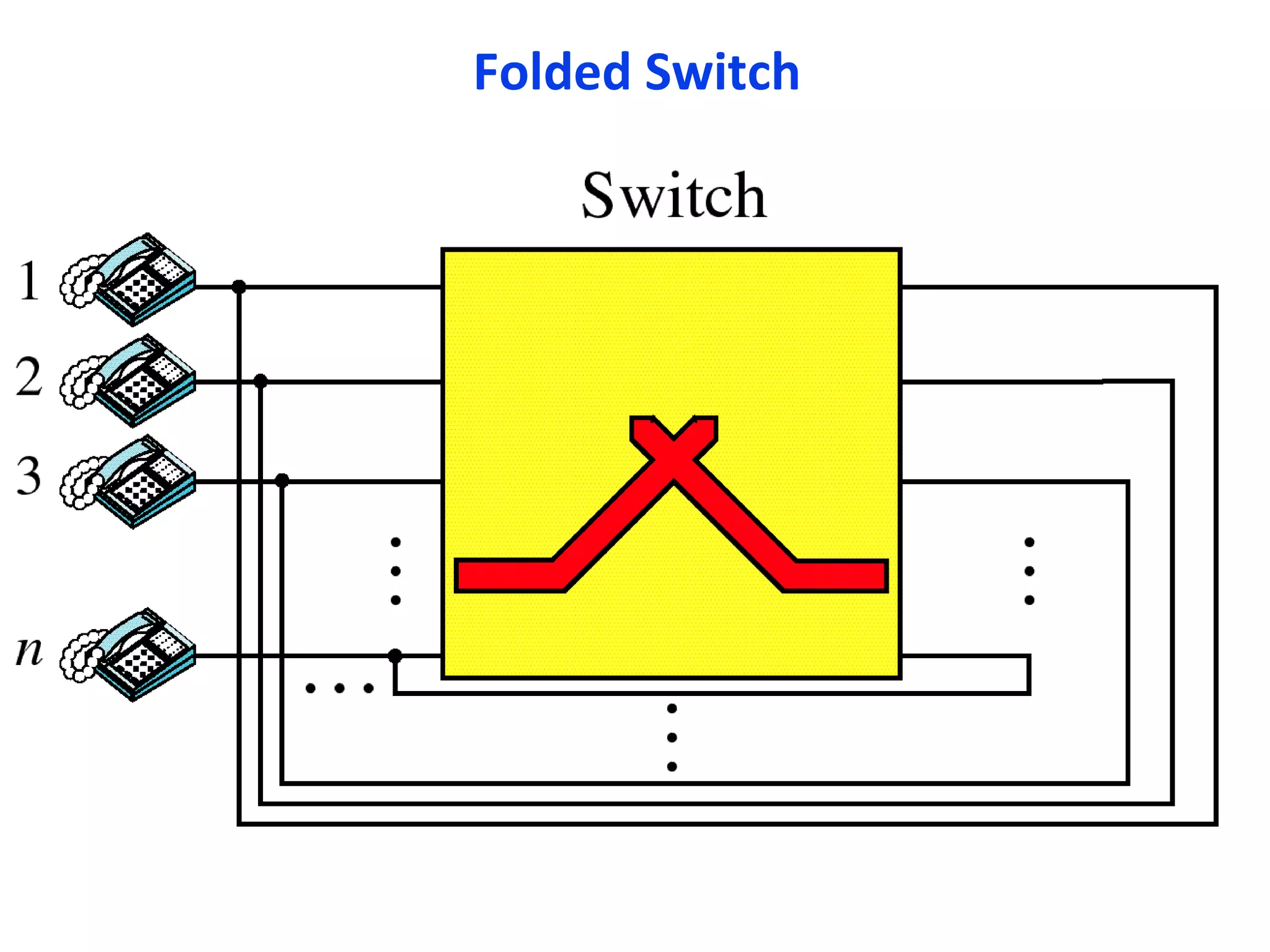
Switch
Switches are the hardware or software
devices capable of creating temporary
connections between two or more devices
linked to the switch but not to each other. It
is a device which connects multiple
communication lines together.
Switch
Folded Switch
Switching
• A network is a set of connected devices.
Whenever we have multiple devices, we have
the problem of how to connect them to make
one-to-one communication possible.
• The solution is switching.
• A switched network consists of a series of
interlinked nodes, called switches.
Switched Network
• A Computer network in which connectivity is
provided by using numbers of switches.
• A fully switched network uses only switches
for connecting all devices used in that
network.
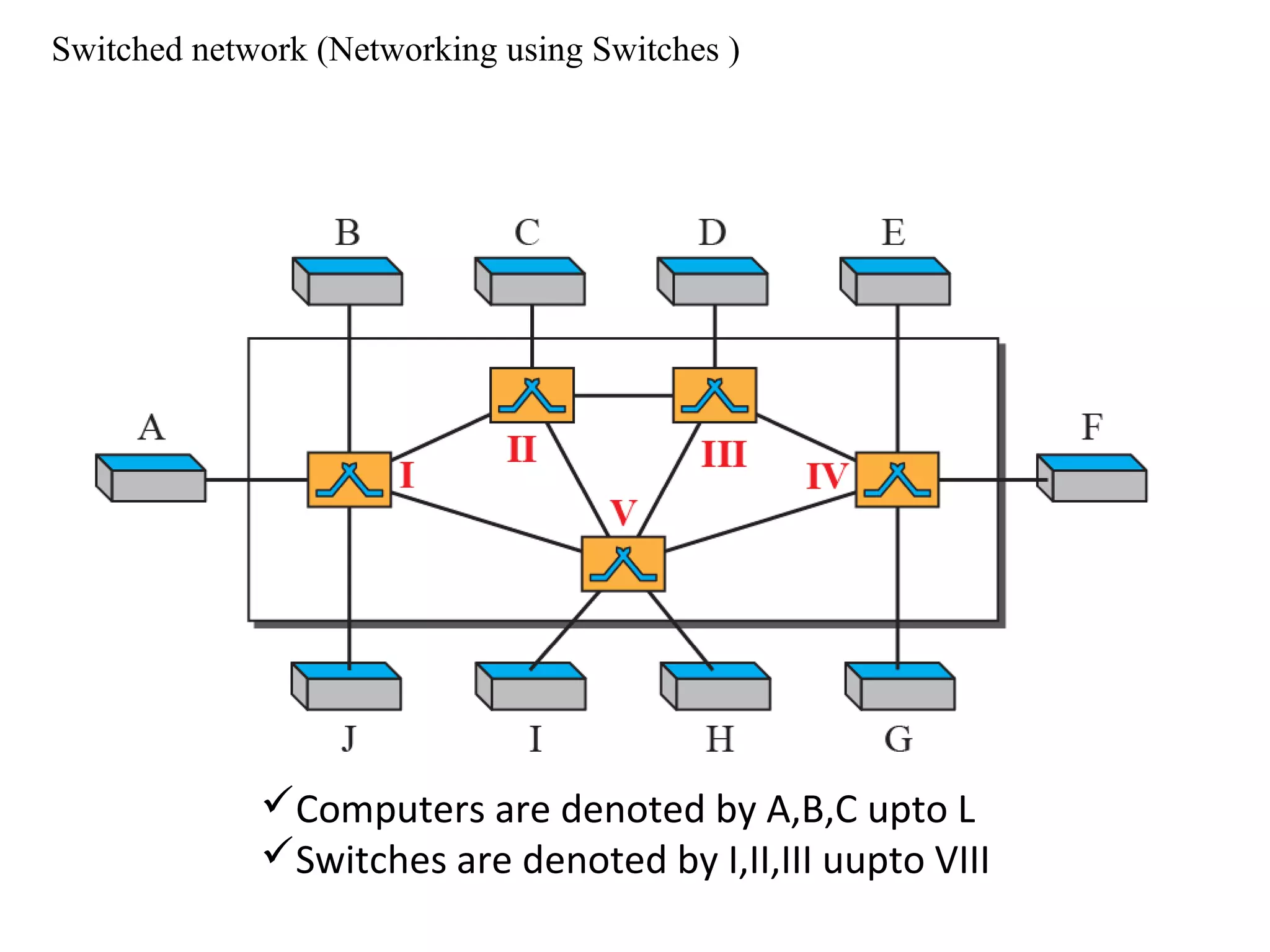
Switched network (Networking using Switches )
Computers are denoted by A,B,C upto L
Switches are denoted by I,II,III uupto VIII
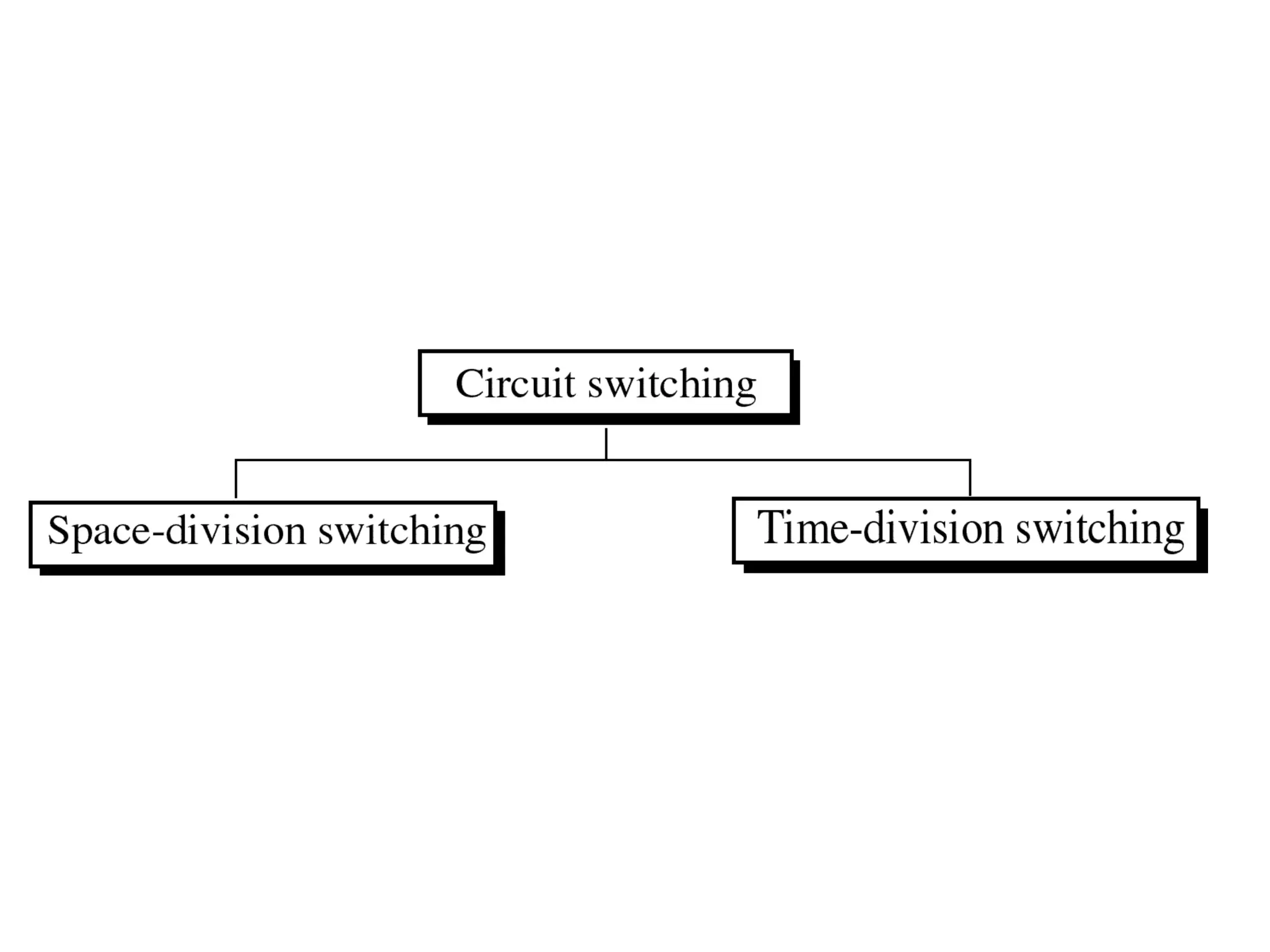
Traditionally, three methods of switching have
been discussed:
1.circuit switching,
2.packet switching
i. Virtual circuit
ii. Data gram
3.message switching.
•The first two are commonly used today.
•The third has been phased out in general
communications but still has applications.
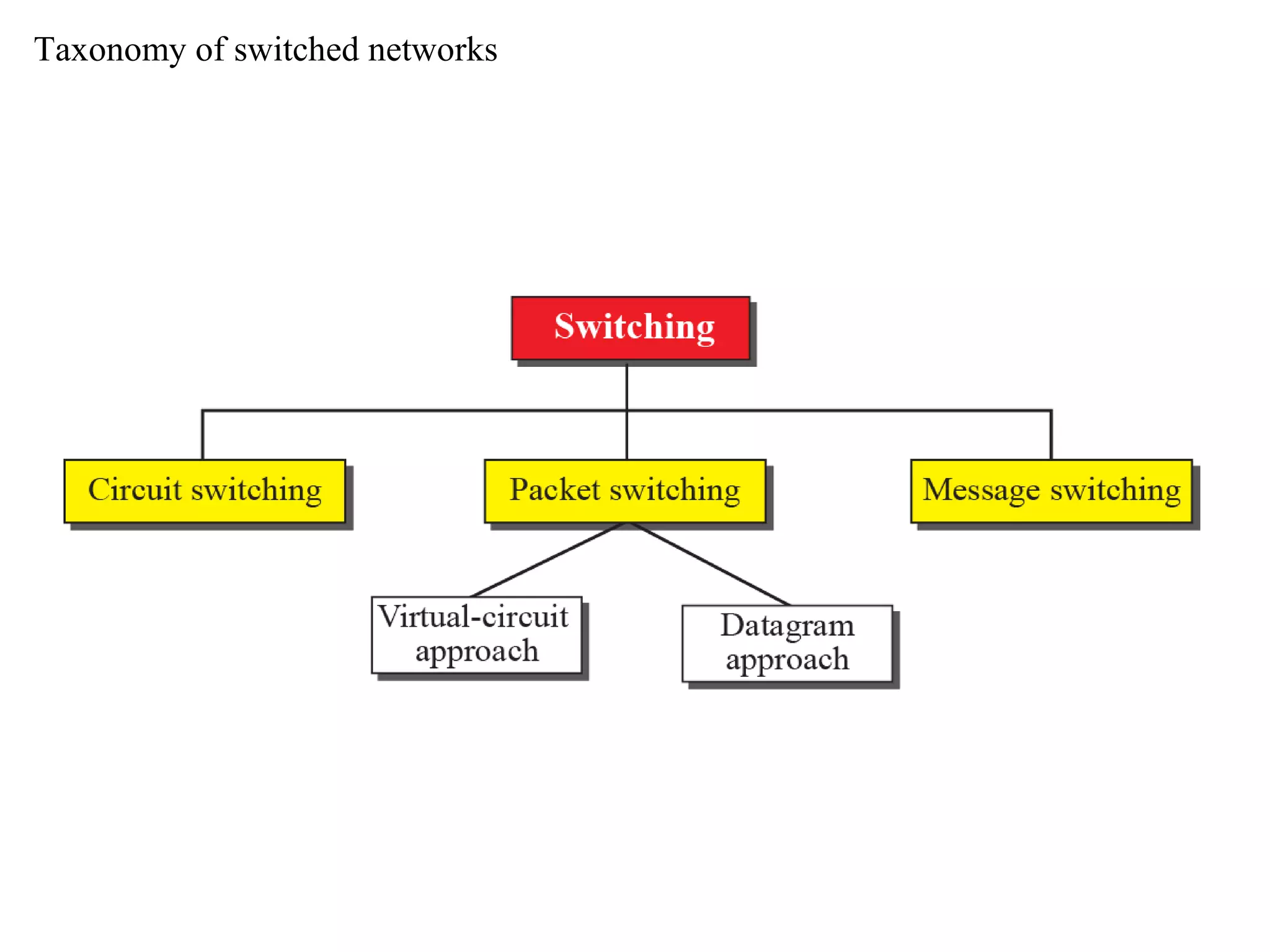
Taxonomy of switched networks
8.11
Switching and TCP/IP LayersSwitching and TCP/IP Layers
Switching takes place at several layers of the TCP/IP
protocol suite:
1.at the physical layer it is circuit switching. There is
no exchange of packets at PL. The switches at PL
allow signals to move in one path or another.
2.at the data-link layer we can have packet switching.
However, the packet can mean frame or cells here.
Packet switching is done normally using Virtual
Circuit Approach.
3.at the network layer we can have packet switching.
Here, either a virtual circuit or datagram approach can
be used. Internet uses datagram approach.
4. Switching at Application Layer : we can have only
message switching at AL. It is done by exchanging
messages like email etc. So such communication can
be called as message switched communication. As
such there is no concept of message switched
Network.
Circuit switching
• Circuit switching is used in public telephone
network but it is used for data transmission
also along with voice communication
• Voice communication is efficient but data
communication is not that efficient
• In this method a dedicated path is
established between two computer using
one or more switch
• The transfer mode of a network involves
setting up a dedicated end to end
connection. This path is maintained till the
end of communication.
• Link is released after communication is over
• Circuit switching takes place at physical
layer
• Data transfer may use FDM or TDM
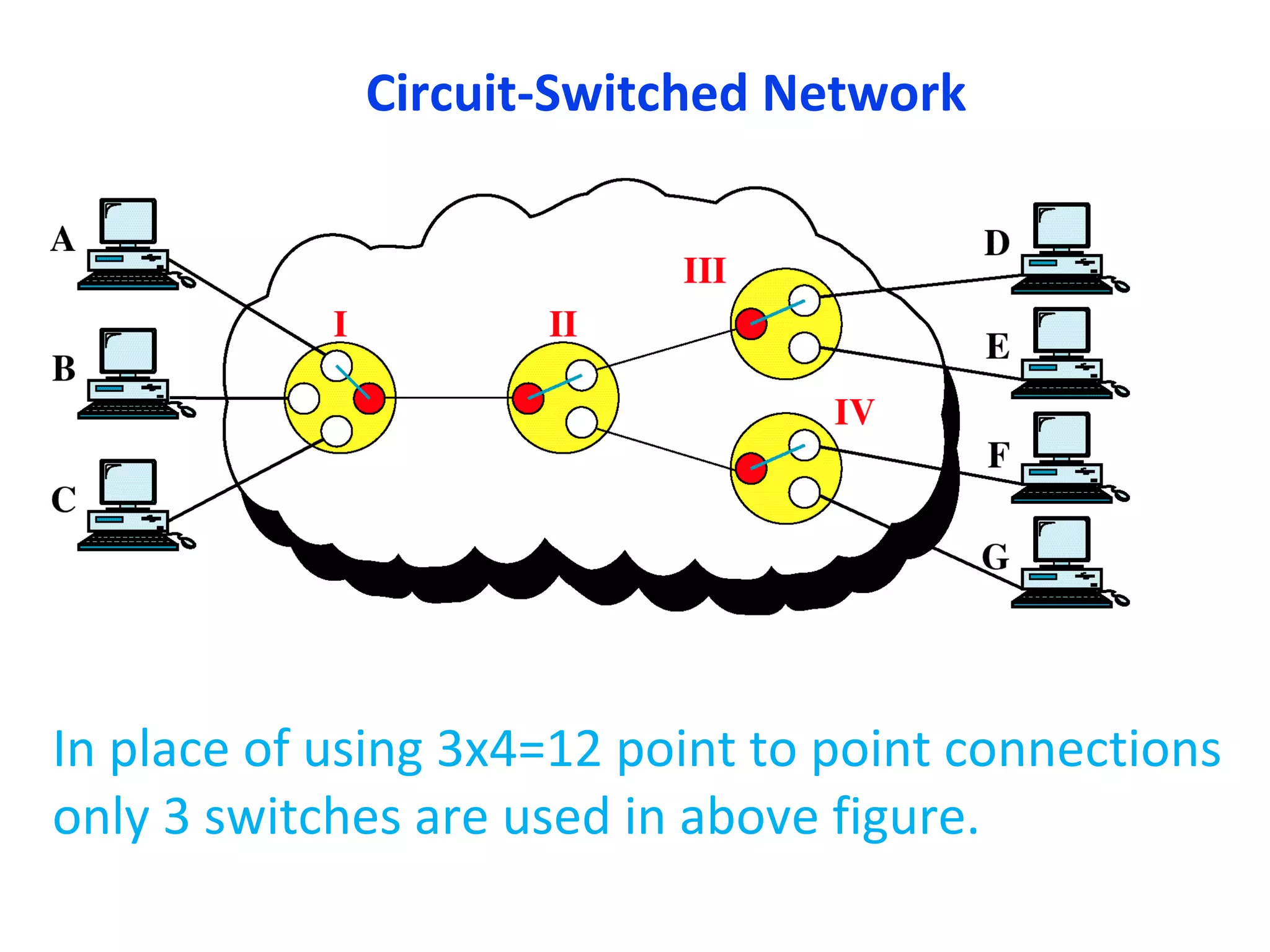
Circuit-Switched Network
In place of using 3x4=12 point to point connections
only 3 switches are used in above figure.
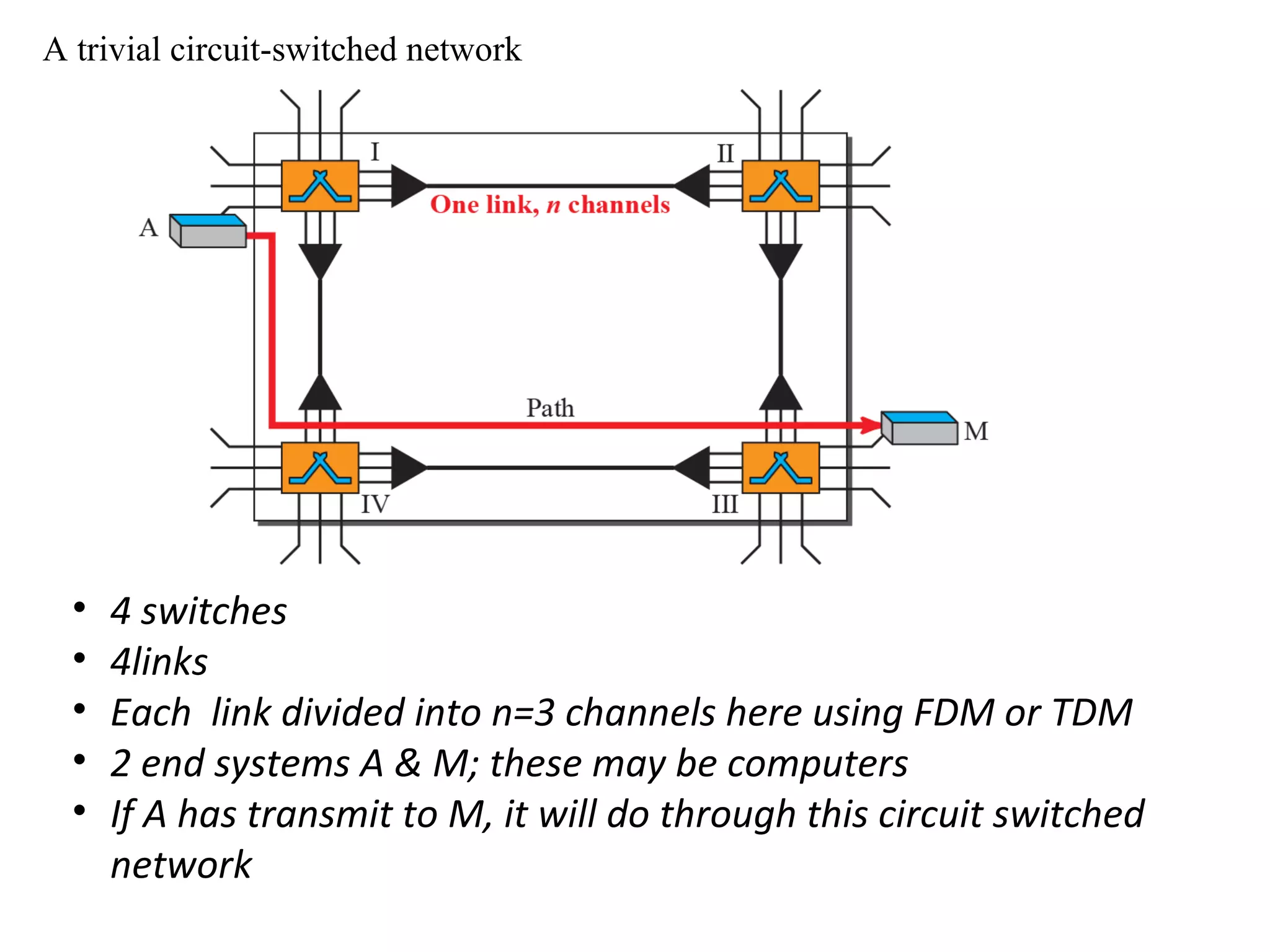
A trivial circuit-switched network
• 4 switches
• 4links
• Each link divided into n=3 channels here using FDM or TDM
• 2 end systems A & M; these may be computers
• If A has transmit to M, it will do through this circuit switched
network
Three Phases of Circuit SwitchingThree Phases of Circuit Switching
The actual communication in a circuit-
switched network requires three phases:
1. connection setup,
2. data transfer, and
3. connection teardown.
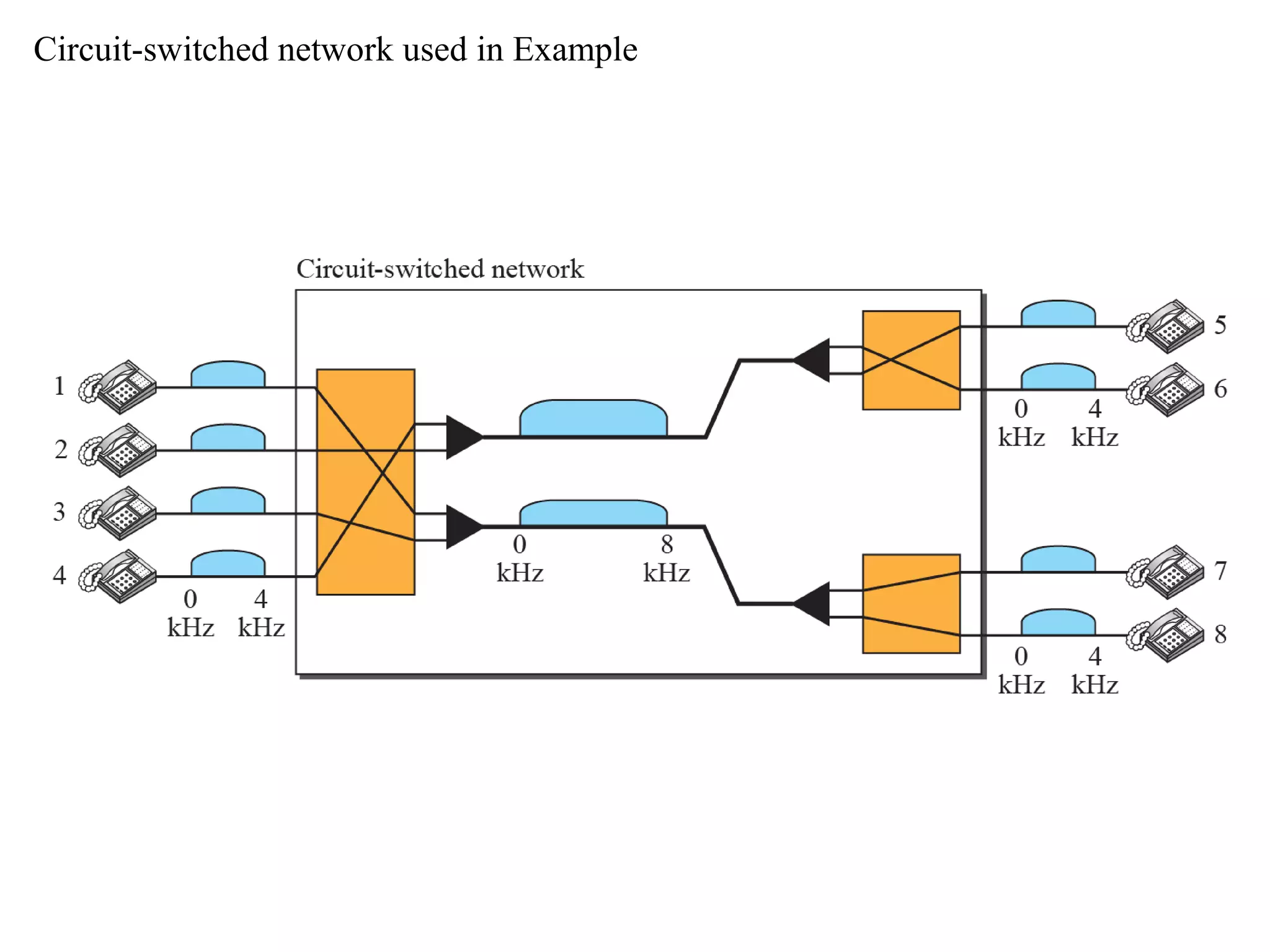
As a trivial example, let us use a circuit-switched network to
connect eight telephones in a small area. Communication is
through 4-kHz voice channels. We assume that each link
uses FDM to connect a maximum of two voice channels.
The bandwidth of each link is then 8 kHz. Figure shows the
situation. Telephone 1 is connected to telephone 7; 2 to 5;
3 to 8; and 4 to 6. Of course the situation may change when
new connections are made. The switch controls the
connections.
Example
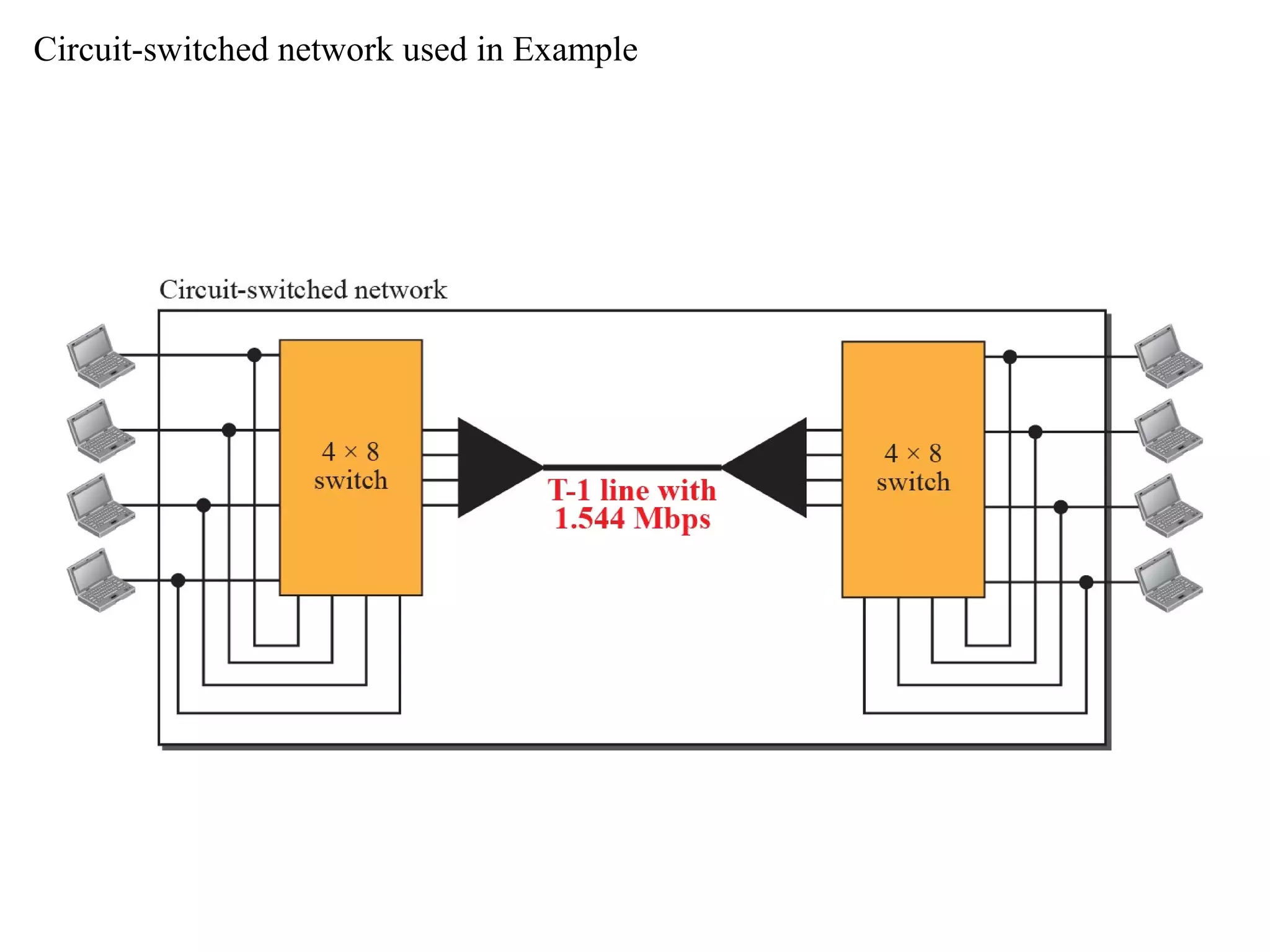
Circuit-switched network used in Example
As another example, consider a circuit-switched network
that connects computers in two remote offices of a private
company. The offices are connected using a T-1 line leased
from a communication service provider. There are two 4 ×
8 (4 inputs and 8 outputs) switches in this network. For
each switch, four output ports are folded into the input
ports to allow communication between computers in the
same office. Four other output ports allow communication
between the two offices. Figure shows the situation.
Example
Circuit-switched network used in Example
Certain issues in circuit switching
• Efficiency – low, because of resources remain
dedicated through out the connection
• Delay – despite low efficiency there is very
low delay in transmission.
– Since connection is dedicate so only time taken in
connection is the only delay in transmission
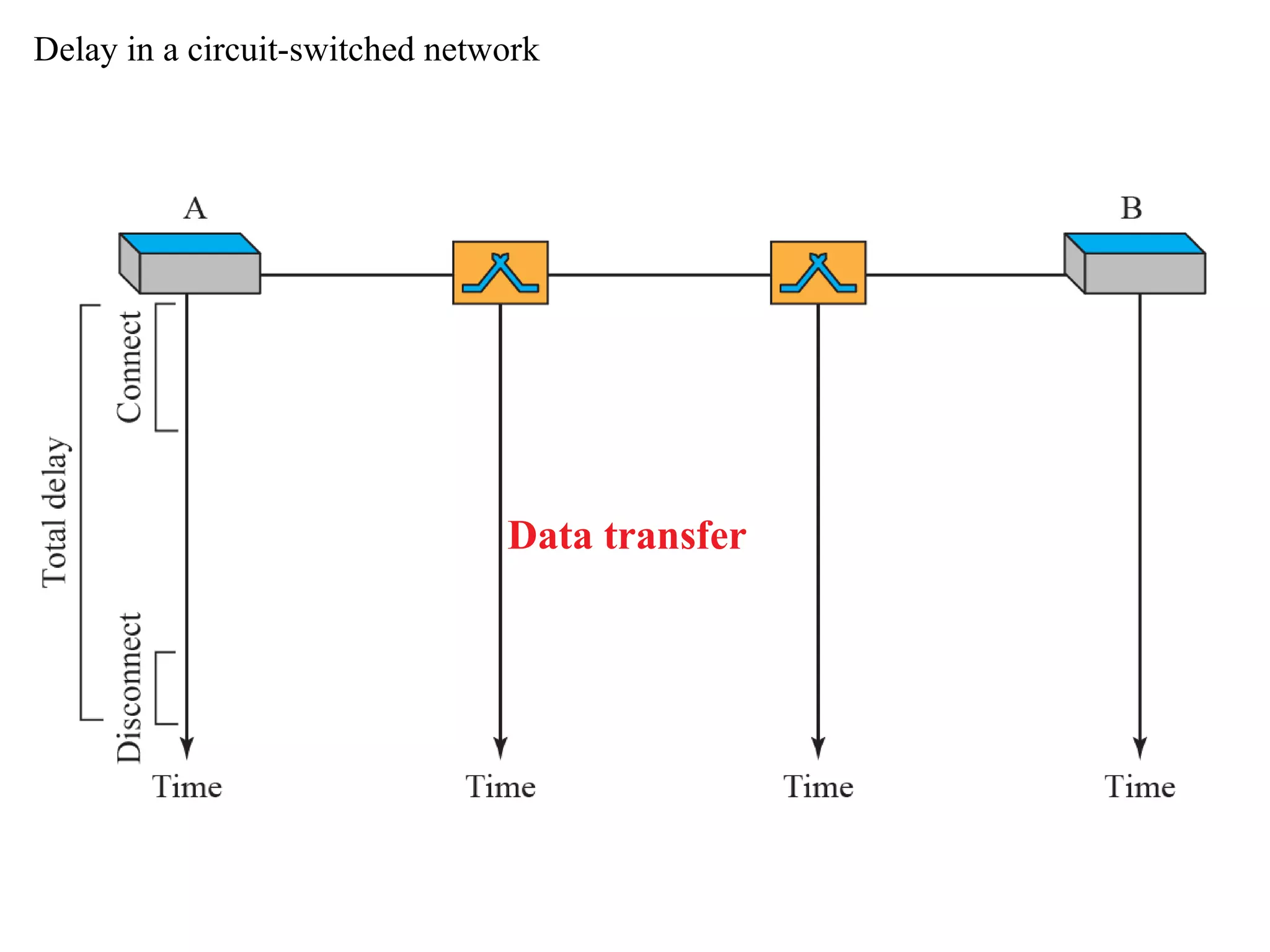
Delay in a circuit-switched network
Data transfer
• Advantages –
– Dedicated transmission
– No delay in transmission
• Disadvantages
– Because of dedicated connection other devices waste
time in waiting
– Dedicated connection will consume all bandwidth
– Sometimes it may take long time to establish a
connection
• Applications – Public Switched Telephone Network
(PSTN)
Space Division Switching
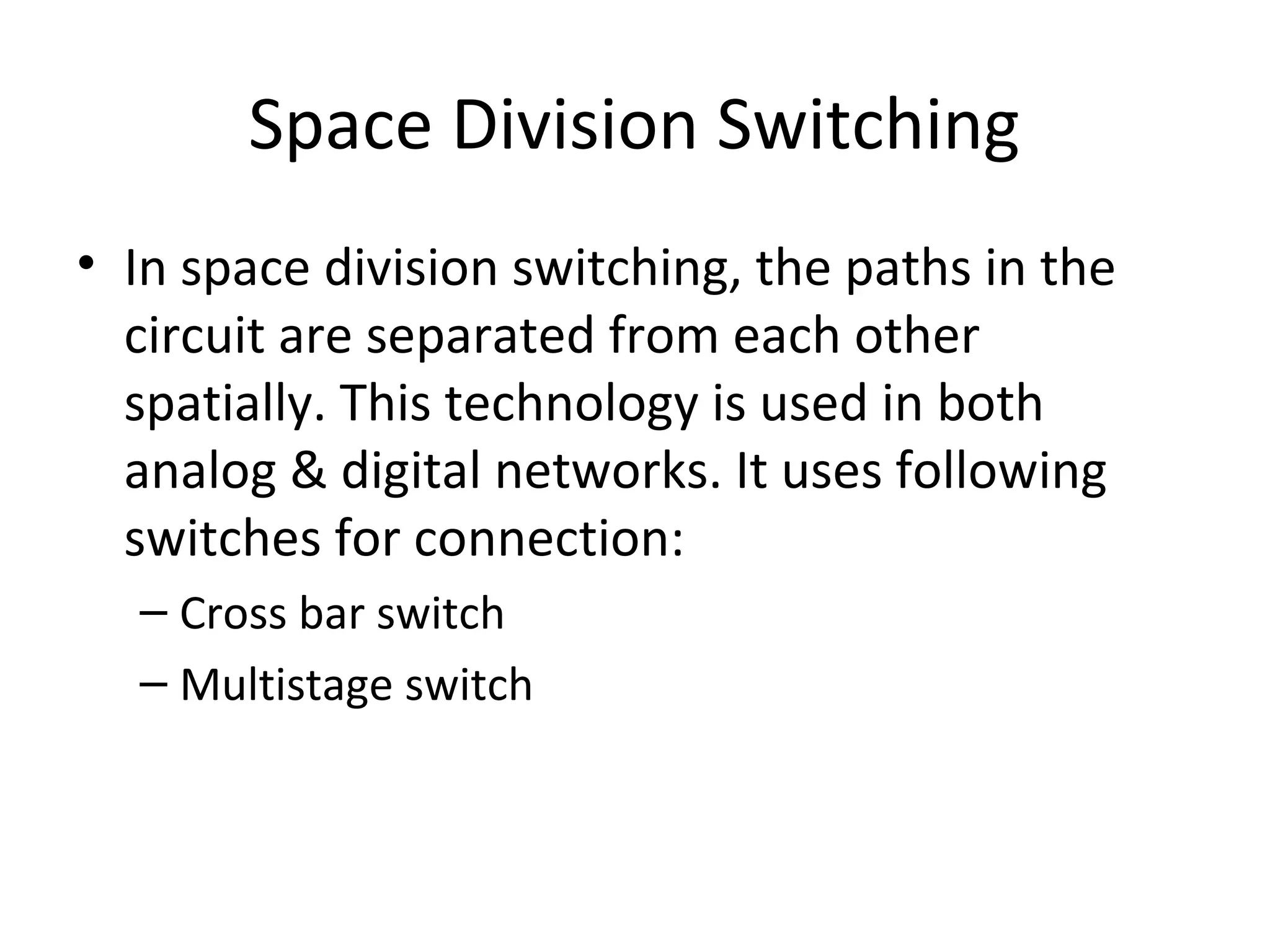
• In space division switching, the paths in the
circuit are separated from each other
spatially. This technology is used in both
analog & digital networks. It uses following
switches for connection:
– Cross bar switch
– Multistage switch
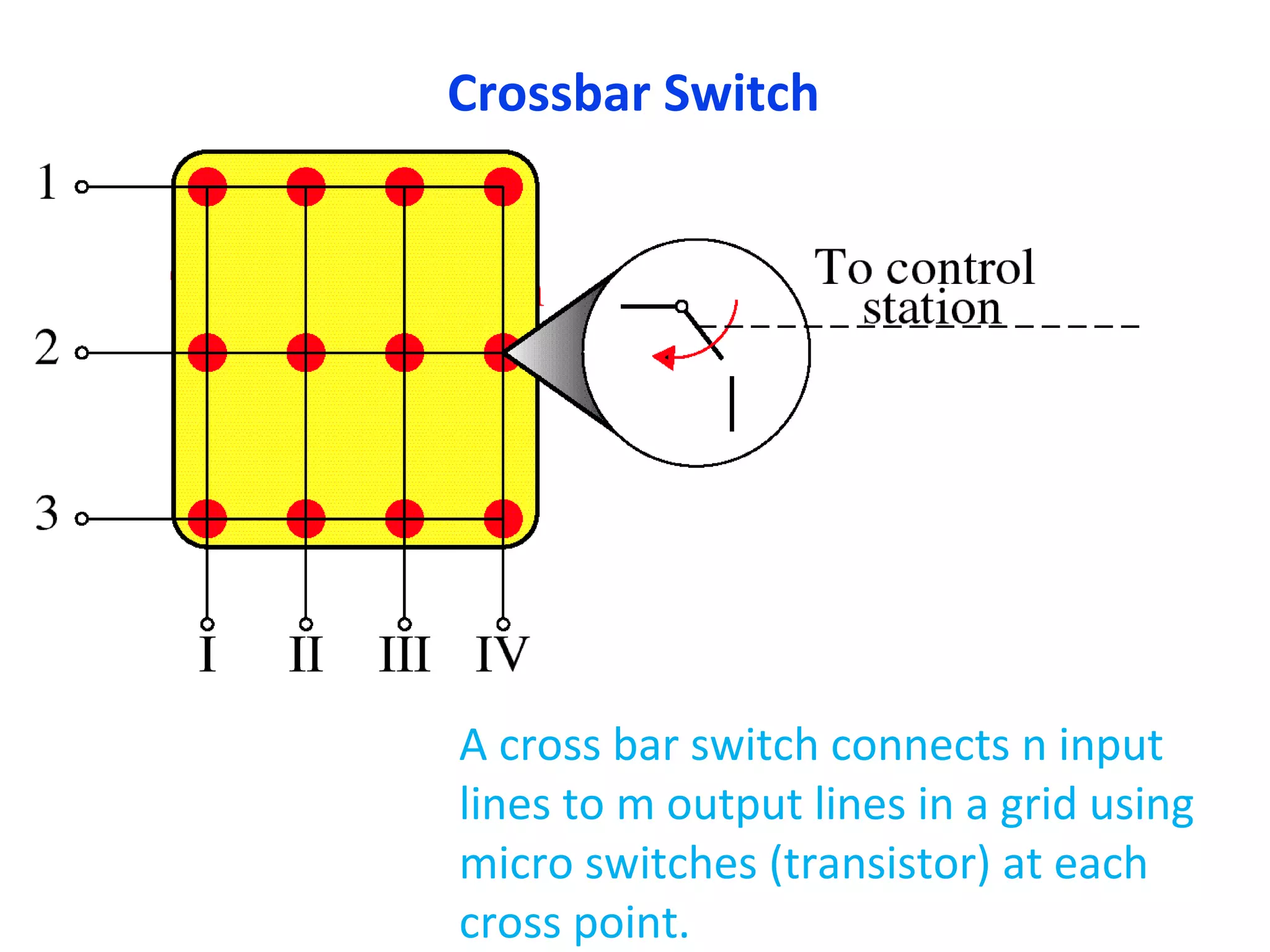
Crossbar Switch
A cross bar switch connects n input
lines to m output lines in a grid using
micro switches (transistor) at each
cross point.
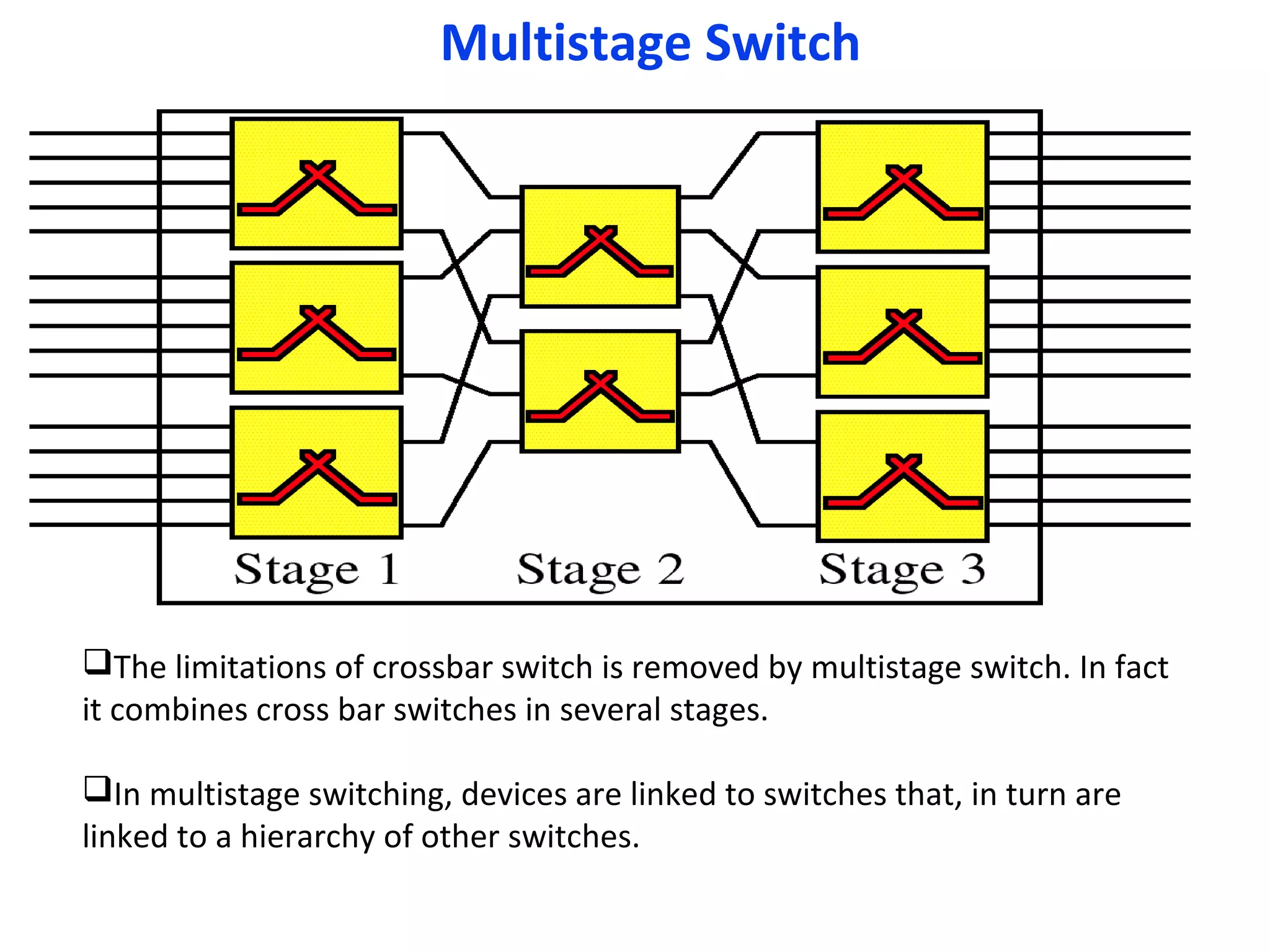
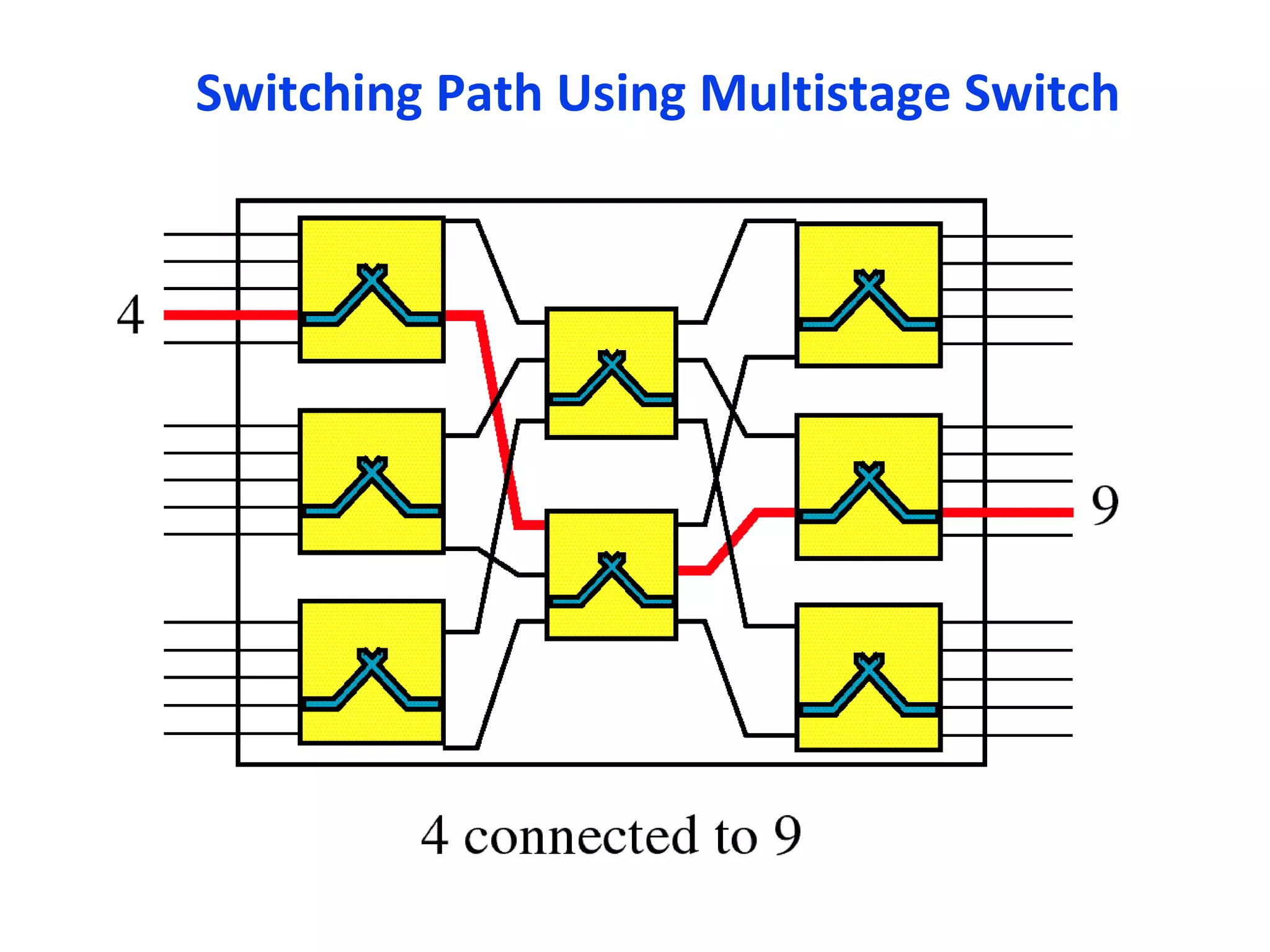
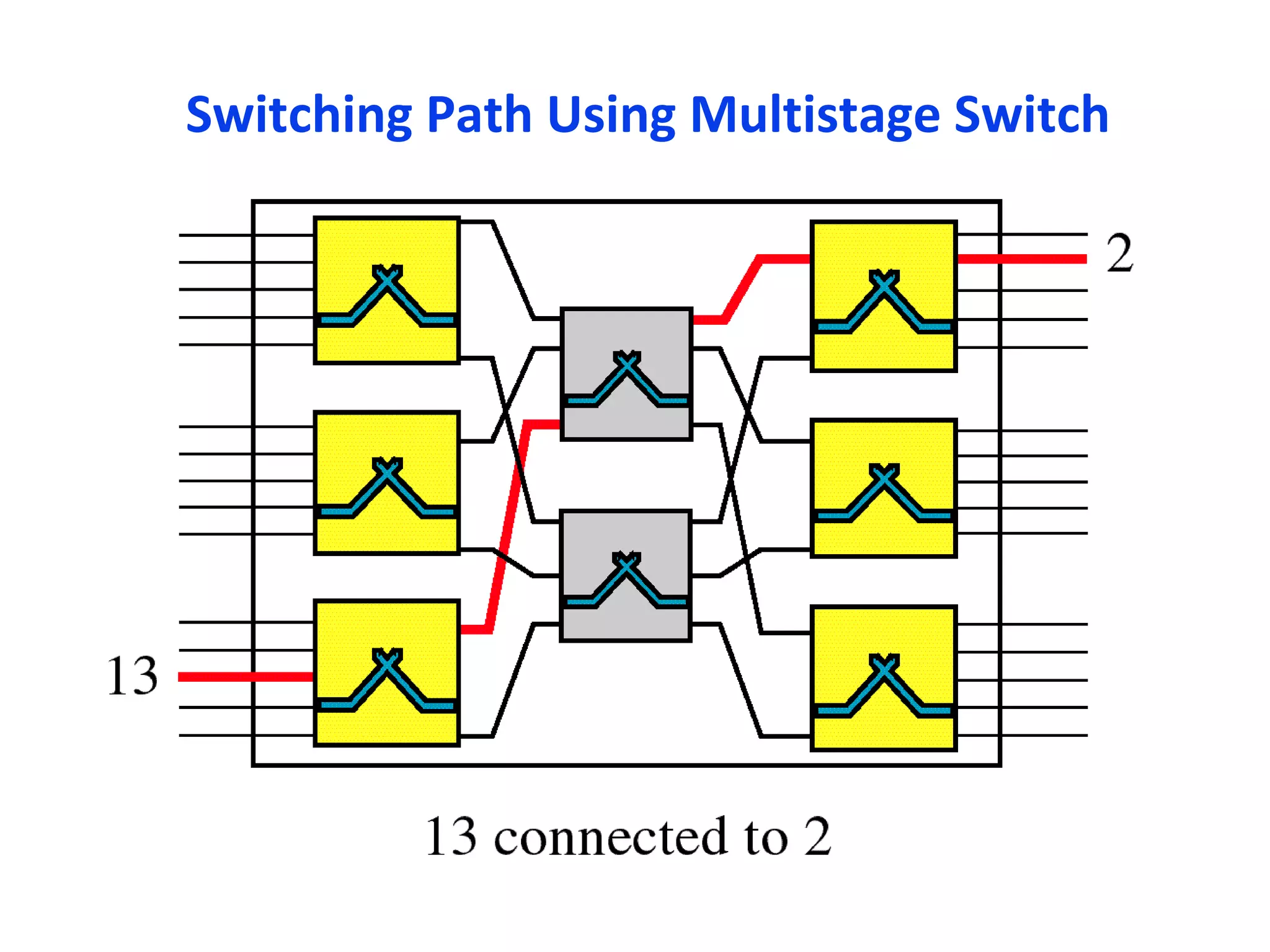
Multistage Switch
The limitations of crossbar switch is removed by multistage switch. In fact
it combines cross bar switches in several stages.
In multistage switching, devices are linked to switches that, in turn are
linked to a hierarchy of other switches.
Switching Path Using Multistage Switch
Time-division multiplexed switch
• Time slot interchange reads bits from incoming slots in
each frame and writes these into a register. Call setup
would have created a permutation table for how the
contents are read out.
• These switches are only used in voice calling.
Examples of Circuit Switched Network
• Public switched telephone network (PSTN)
• ISDN B-channel
• Circuit Switched Data (CSD) and
High-Speed Circuit-Switched Data (HSCSD)
service in cellular systems such as GSM
• Datakit
• X.21 (Used in the German DATEX-L and
Scandinavian DATEX circuit switched data
network)
• Optical mesh network
Thank You
Dr Rajiv Srivastava
Director
Sagar Institute of Research & Technology (SIRT)
Sagar Group of Institutions, Bhopal
http://www.sirtbhopal.ac.in

Introduction to switching & circuit switching

  • 1.
    Introduction to Datacommunication Topic: Introduction To Switching and Circuit Switching Lecture #6 Dr Rajiv Srivastava Director Sagar Institute of Research & Technology (SIRT) Sagar Group of Institutions, Bhopal http://www.sirtbhopal.ac.in
  • 2.
    Unit 2 Lecture 6 CourseLecture 23 Introduction To Switching Circuit Switching
  • 3.
    Q. What isa switch? Q. What is switching? Q. What is switched network? Switch Switches are the hardware or software devices capable of creating temporary connections between two or more devices linked to the switch but not to each other. It is a device which connects multiple communication lines together.
  • 4.
  • 5.
  • 6.
    Switching • A networkis a set of connected devices. Whenever we have multiple devices, we have the problem of how to connect them to make one-to-one communication possible. • The solution is switching. • A switched network consists of a series of interlinked nodes, called switches.
  • 7.
    Switched Network • AComputer network in which connectivity is provided by using numbers of switches. • A fully switched network uses only switches for connecting all devices used in that network.
  • 8.
    Switched network (Networkingusing Switches ) Computers are denoted by A,B,C upto L Switches are denoted by I,II,III uupto VIII
  • 9.
    Traditionally, three methodsof switching have been discussed: 1.circuit switching, 2.packet switching i. Virtual circuit ii. Data gram 3.message switching. •The first two are commonly used today. •The third has been phased out in general communications but still has applications.
  • 10.
  • 11.
    8.11 Switching and TCP/IPLayersSwitching and TCP/IP Layers Switching takes place at several layers of the TCP/IP protocol suite: 1.at the physical layer it is circuit switching. There is no exchange of packets at PL. The switches at PL allow signals to move in one path or another. 2.at the data-link layer we can have packet switching. However, the packet can mean frame or cells here. Packet switching is done normally using Virtual Circuit Approach. 3.at the network layer we can have packet switching. Here, either a virtual circuit or datagram approach can be used. Internet uses datagram approach.
  • 12.
    4. Switching atApplication Layer : we can have only message switching at AL. It is done by exchanging messages like email etc. So such communication can be called as message switched communication. As such there is no concept of message switched Network.
  • 13.
    Circuit switching • Circuitswitching is used in public telephone network but it is used for data transmission also along with voice communication • Voice communication is efficient but data communication is not that efficient • In this method a dedicated path is established between two computer using one or more switch
  • 14.
    • The transfermode of a network involves setting up a dedicated end to end connection. This path is maintained till the end of communication. • Link is released after communication is over • Circuit switching takes place at physical layer • Data transfer may use FDM or TDM
  • 15.
    Circuit-Switched Network In placeof using 3x4=12 point to point connections only 3 switches are used in above figure.
  • 16.
    A trivial circuit-switchednetwork • 4 switches • 4links • Each link divided into n=3 channels here using FDM or TDM • 2 end systems A & M; these may be computers • If A has transmit to M, it will do through this circuit switched network
  • 17.
    Three Phases ofCircuit SwitchingThree Phases of Circuit Switching The actual communication in a circuit- switched network requires three phases: 1. connection setup, 2. data transfer, and 3. connection teardown.
  • 18.
    As a trivialexample, let us use a circuit-switched network to connect eight telephones in a small area. Communication is through 4-kHz voice channels. We assume that each link uses FDM to connect a maximum of two voice channels. The bandwidth of each link is then 8 kHz. Figure shows the situation. Telephone 1 is connected to telephone 7; 2 to 5; 3 to 8; and 4 to 6. Of course the situation may change when new connections are made. The switch controls the connections. Example
  • 19.
  • 20.
    As another example,consider a circuit-switched network that connects computers in two remote offices of a private company. The offices are connected using a T-1 line leased from a communication service provider. There are two 4 × 8 (4 inputs and 8 outputs) switches in this network. For each switch, four output ports are folded into the input ports to allow communication between computers in the same office. Four other output ports allow communication between the two offices. Figure shows the situation. Example
  • 21.
  • 22.
    Certain issues incircuit switching • Efficiency – low, because of resources remain dedicated through out the connection • Delay – despite low efficiency there is very low delay in transmission. – Since connection is dedicate so only time taken in connection is the only delay in transmission
  • 23.
    Delay in acircuit-switched network Data transfer
  • 24.
    • Advantages – –Dedicated transmission – No delay in transmission • Disadvantages – Because of dedicated connection other devices waste time in waiting – Dedicated connection will consume all bandwidth – Sometimes it may take long time to establish a connection • Applications – Public Switched Telephone Network (PSTN)
  • 26.
    Space Division Switching •In space division switching, the paths in the circuit are separated from each other spatially. This technology is used in both analog & digital networks. It uses following switches for connection: – Cross bar switch – Multistage switch
  • 27.
    Crossbar Switch A crossbar switch connects n input lines to m output lines in a grid using micro switches (transistor) at each cross point.
  • 28.
    Multistage Switch The limitationsof crossbar switch is removed by multistage switch. In fact it combines cross bar switches in several stages. In multistage switching, devices are linked to switches that, in turn are linked to a hierarchy of other switches.
  • 29.
    Switching Path UsingMultistage Switch
  • 30.
    Switching Path UsingMultistage Switch
  • 31.
    Time-division multiplexed switch •Time slot interchange reads bits from incoming slots in each frame and writes these into a register. Call setup would have created a permutation table for how the contents are read out. • These switches are only used in voice calling.
  • 32.
    Examples of CircuitSwitched Network • Public switched telephone network (PSTN) • ISDN B-channel • Circuit Switched Data (CSD) and High-Speed Circuit-Switched Data (HSCSD) service in cellular systems such as GSM • Datakit • X.21 (Used in the German DATEX-L and Scandinavian DATEX circuit switched data network) • Optical mesh network
  • 33.
    Thank You Dr RajivSrivastava Director Sagar Institute of Research & Technology (SIRT) Sagar Group of Institutions, Bhopal http://www.sirtbhopal.ac.in