Introduction to Data communication
Topic: Virtual Switching (contd.) & Message
Switching
Lecture #8
Dr Rajiv Srivastava
Director
Sagar Institute of Research & Technology (SIRT)
Sagar Group of Institutions, Bhopal
http://www.sirtbhopal.ac.in
Unit 2
Lecture 8
Course Lecture 23
Virtual Switching (contd.)
&
Message Switching
There are three phases in virtual circuit
network.
1.Data Transfer phase
2.Setup Phase
I. Setup request
II. Acknowledgement
3.Tear down phase
1st
Phase
Data Transfer Phase
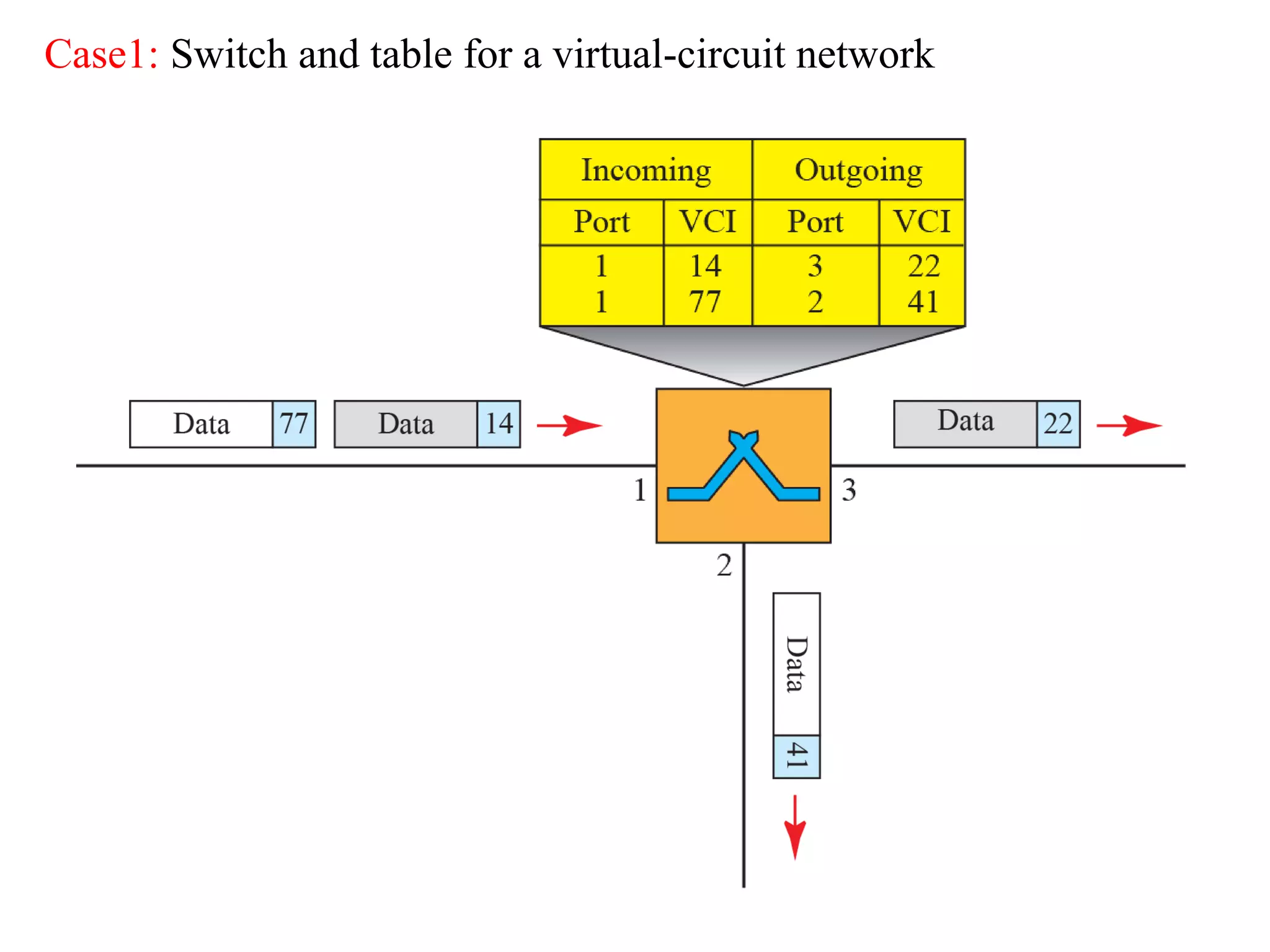
Case1: Switch and table for a virtual-circuit network
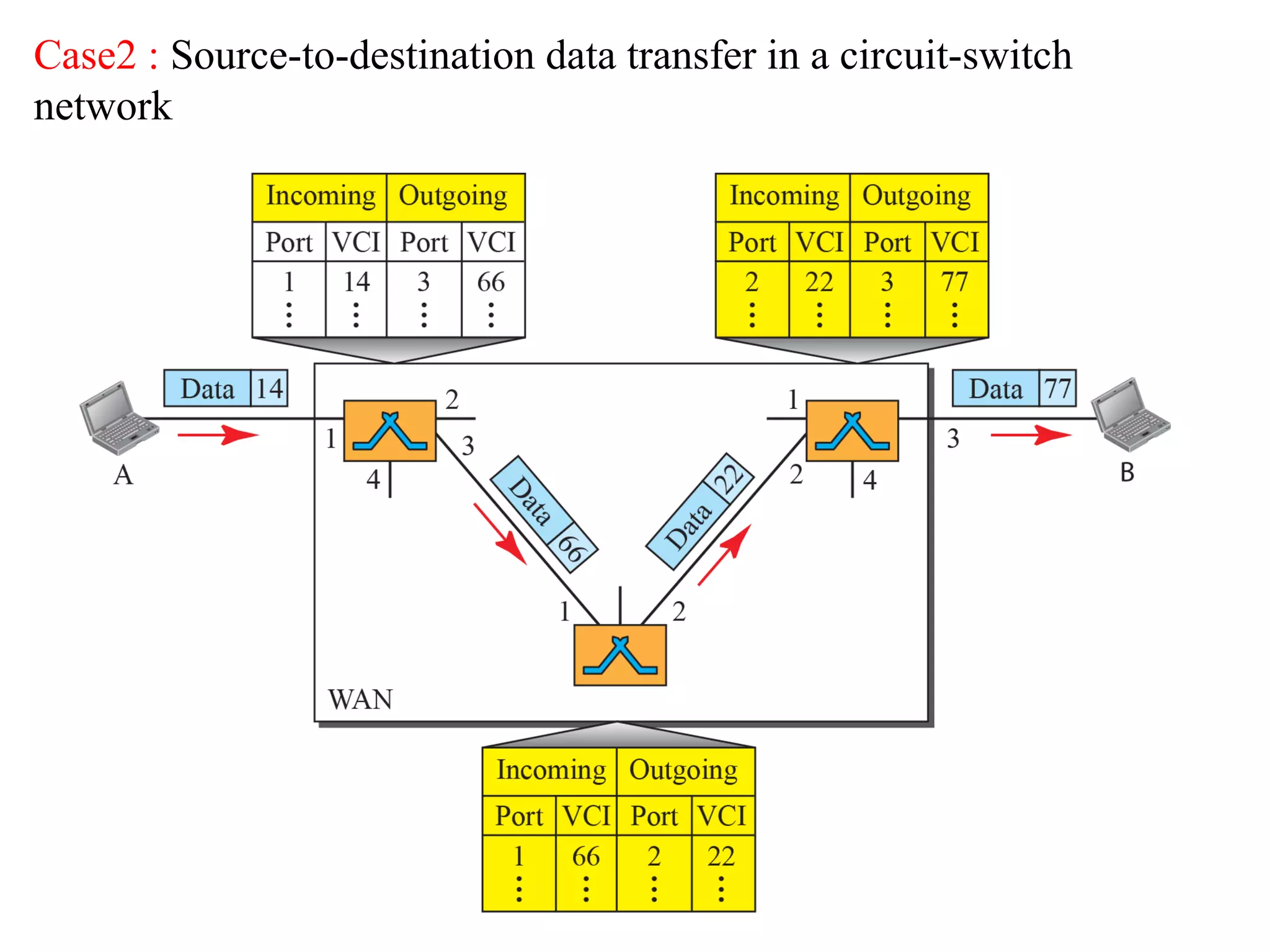
Case2 : Source-to-destination data transfer in a circuit-switch
network
Phase 2
Setup Phase
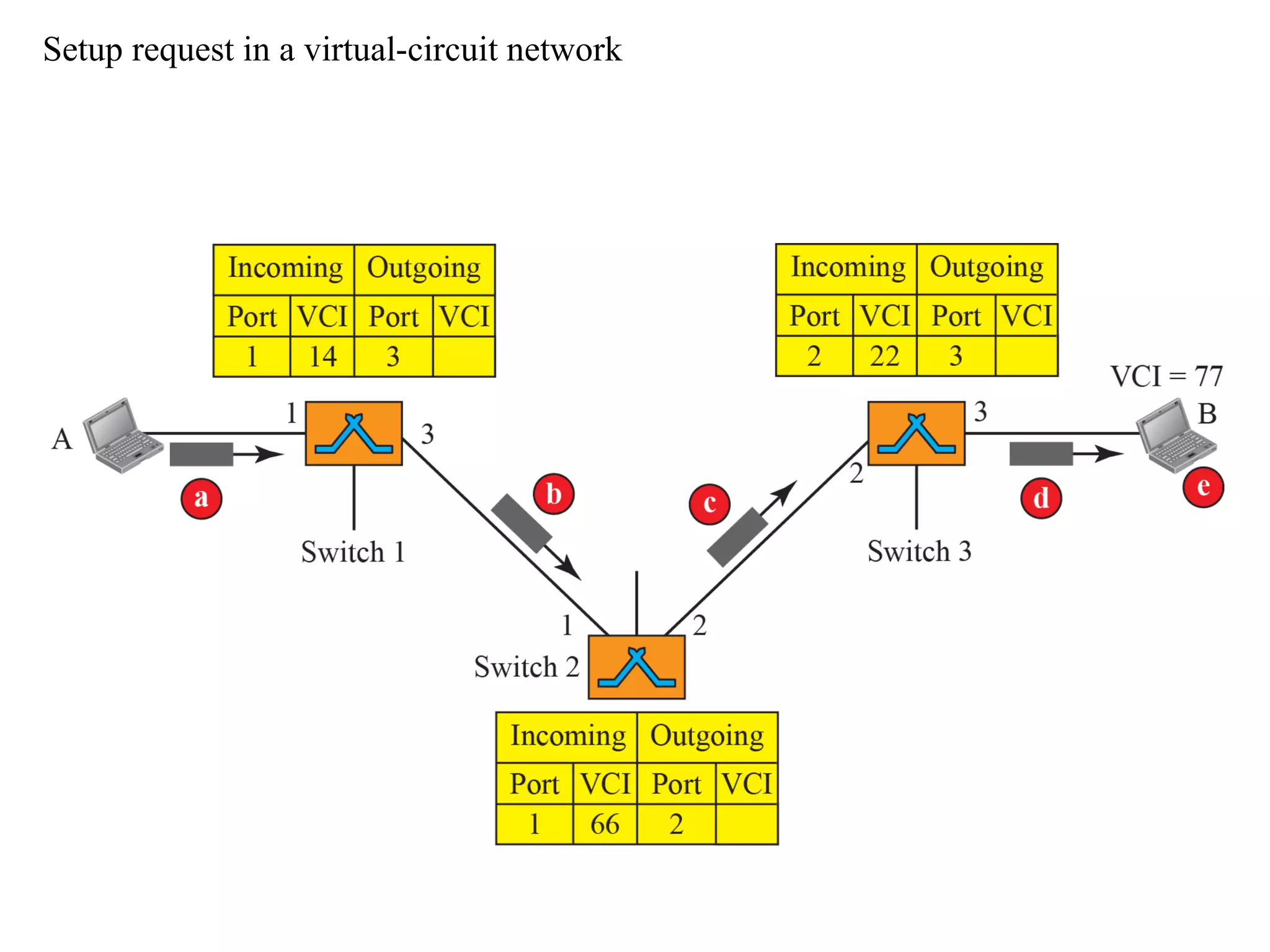
1. Setup request
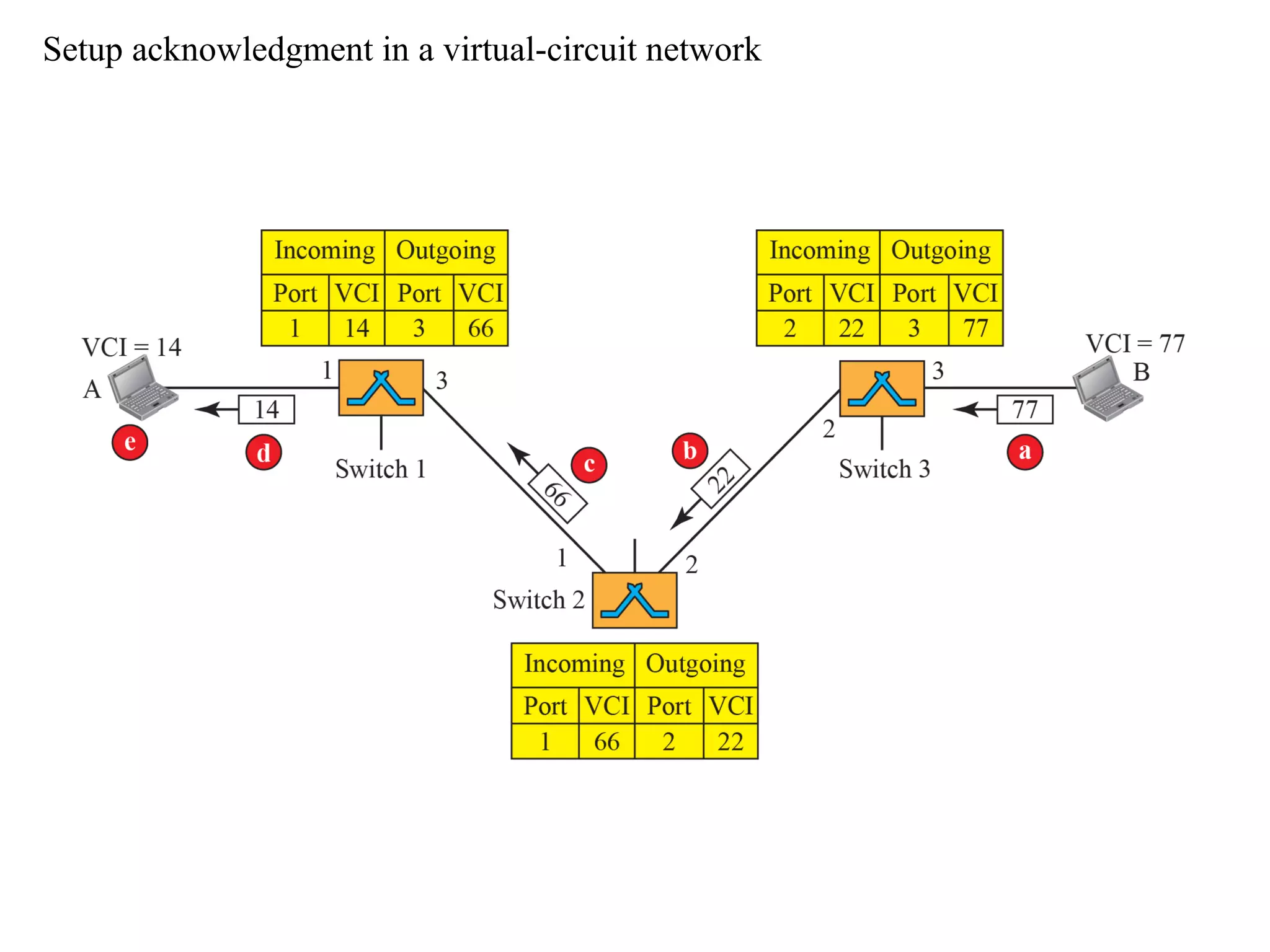
2. Acknowledgment
Setup request in a virtual-circuit network
Setup acknowledgment in a virtual-circuit network
3rd
Phase
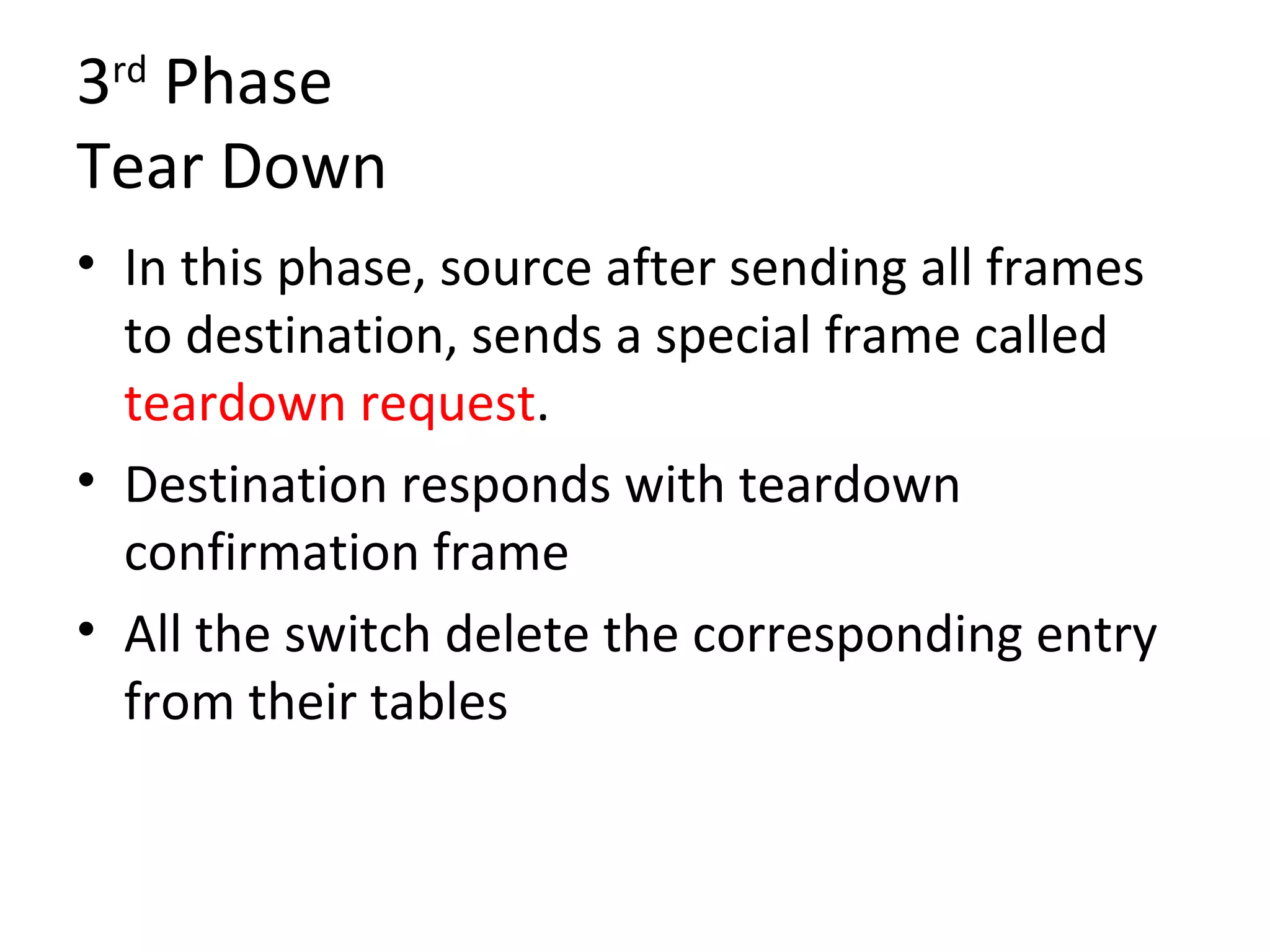
Tear Down
• In this phase, source after sending all frames
to destination, sends a special frame called
teardown request.
• Destination responds with teardown
confirmation frame
• All the switch delete the corresponding entry
from their tables
Efficiency
• In virtual circuit switching, all packets
belonging to the same source & destination
travel the same path, but the packets may
arrive at the destination with different delays
if resource allocation is on demand.
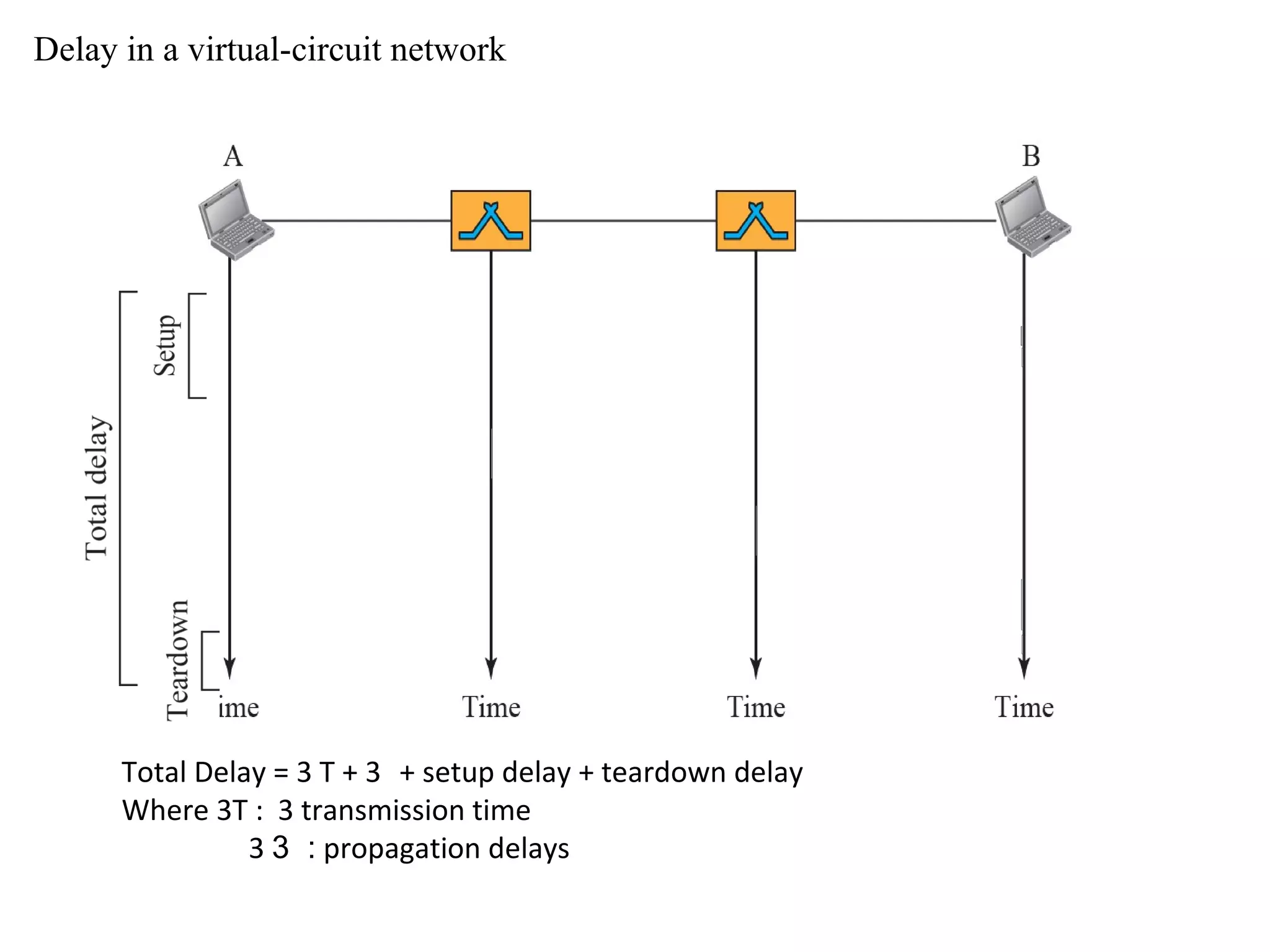
Delay in a virtual-circuit network
Total Delay = 3 T + 3 + setup delay + teardown delay
Where 3T : 3 transmission time
3 :3 propagation delays
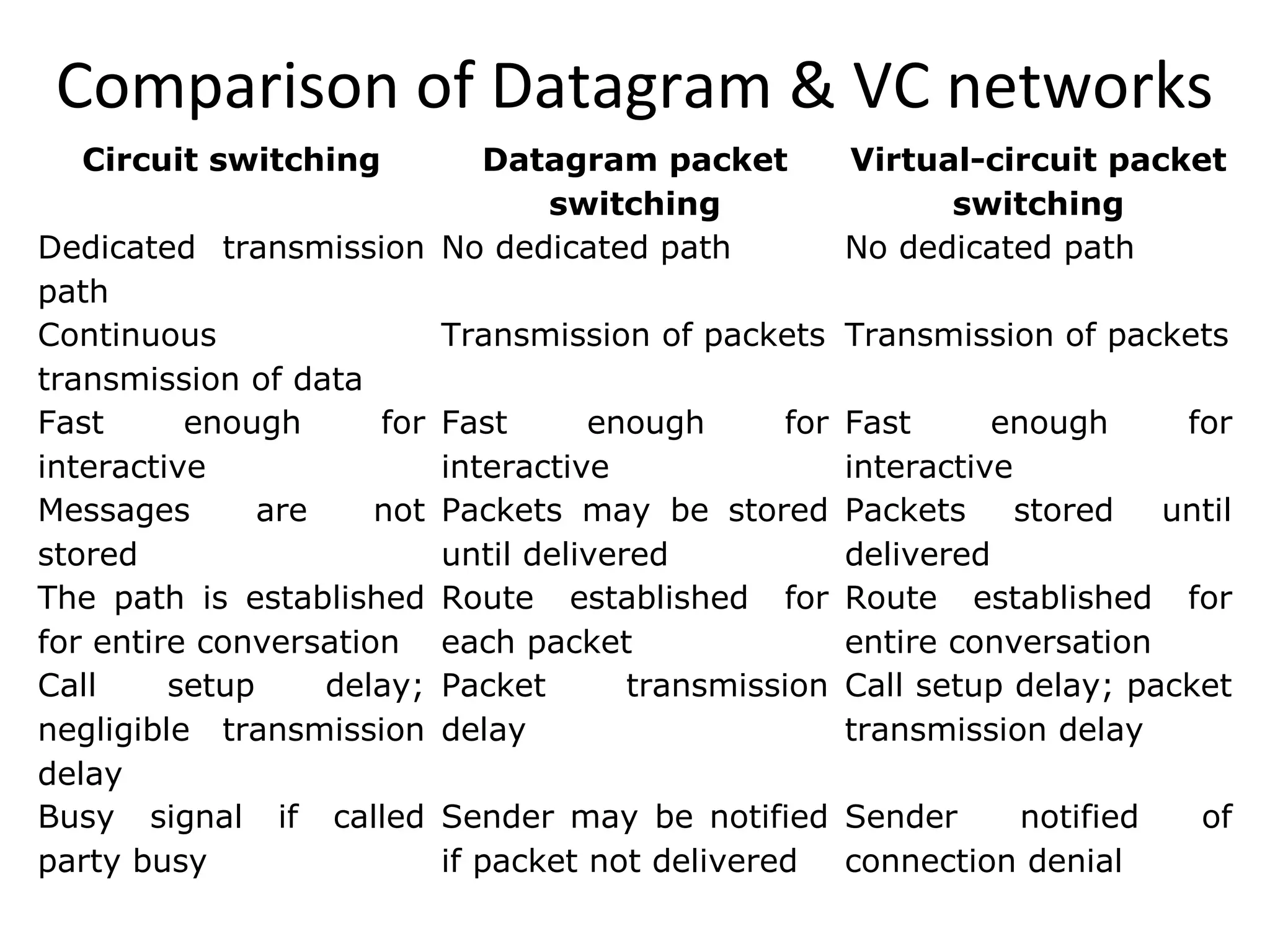
Comparison of Datagram & VC networks
Circuit switching Datagram packet
switching
Virtual-circuit packet
switching
Dedicated transmission
path
No dedicated path No dedicated path
Continuous
transmission of data
Transmission of packets Transmission of packets
Fast enough for
interactive
Fast enough for
interactive
Fast enough for
interactive
Messages are not
stored
Packets may be stored
until delivered
Packets stored until
delivered
The path is established
for entire conversation
Route established for
each packet
Route established for
entire conversation
Call setup delay;
negligible transmission
delay
Packet transmission
delay
Call setup delay; packet
transmission delay
Busy signal if called
party busy
Sender may be notified
if packet not delivered
Sender notified of
connection denial
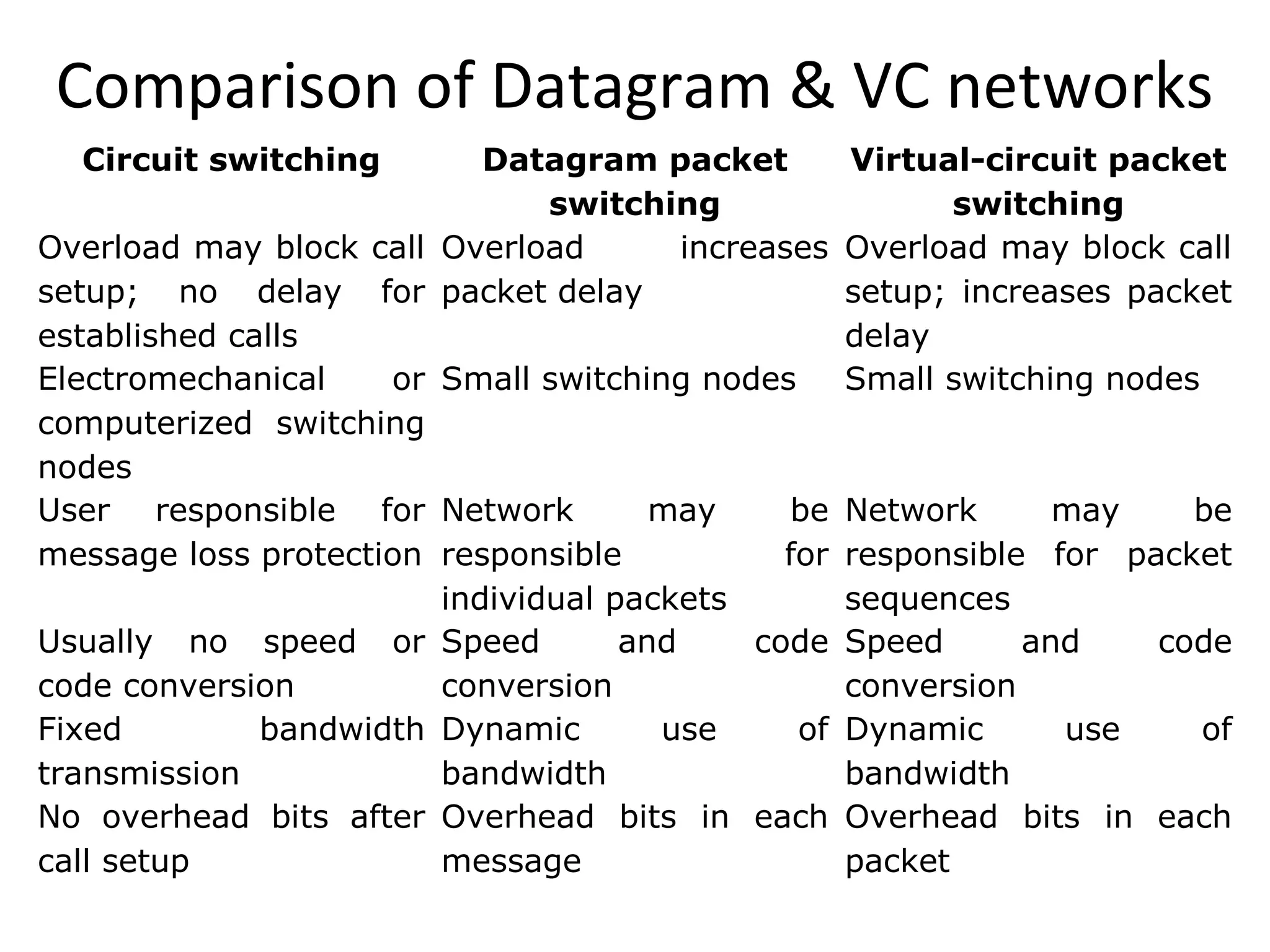
Comparison of Datagram & VC networks
Circuit switching Datagram packet
switching
Virtual-circuit packet
switching
Overload may block call
setup; no delay for
established calls
Overload increases
packet delay
Overload may block call
setup; increases packet
delay
Electromechanical or
computerized switching
nodes
Small switching nodes Small switching nodes
User responsible for
message loss protection
Network may be
responsible for
individual packets
Network may be
responsible for packet
sequences
Usually no speed or
code conversion
Speed and code
conversion
Speed and code
conversion
Fixed bandwidth
transmission
Dynamic use of
bandwidth
Dynamic use of
bandwidth
No overhead bits after
call setup
Overhead bits in each
message
Overhead bits in each
packet
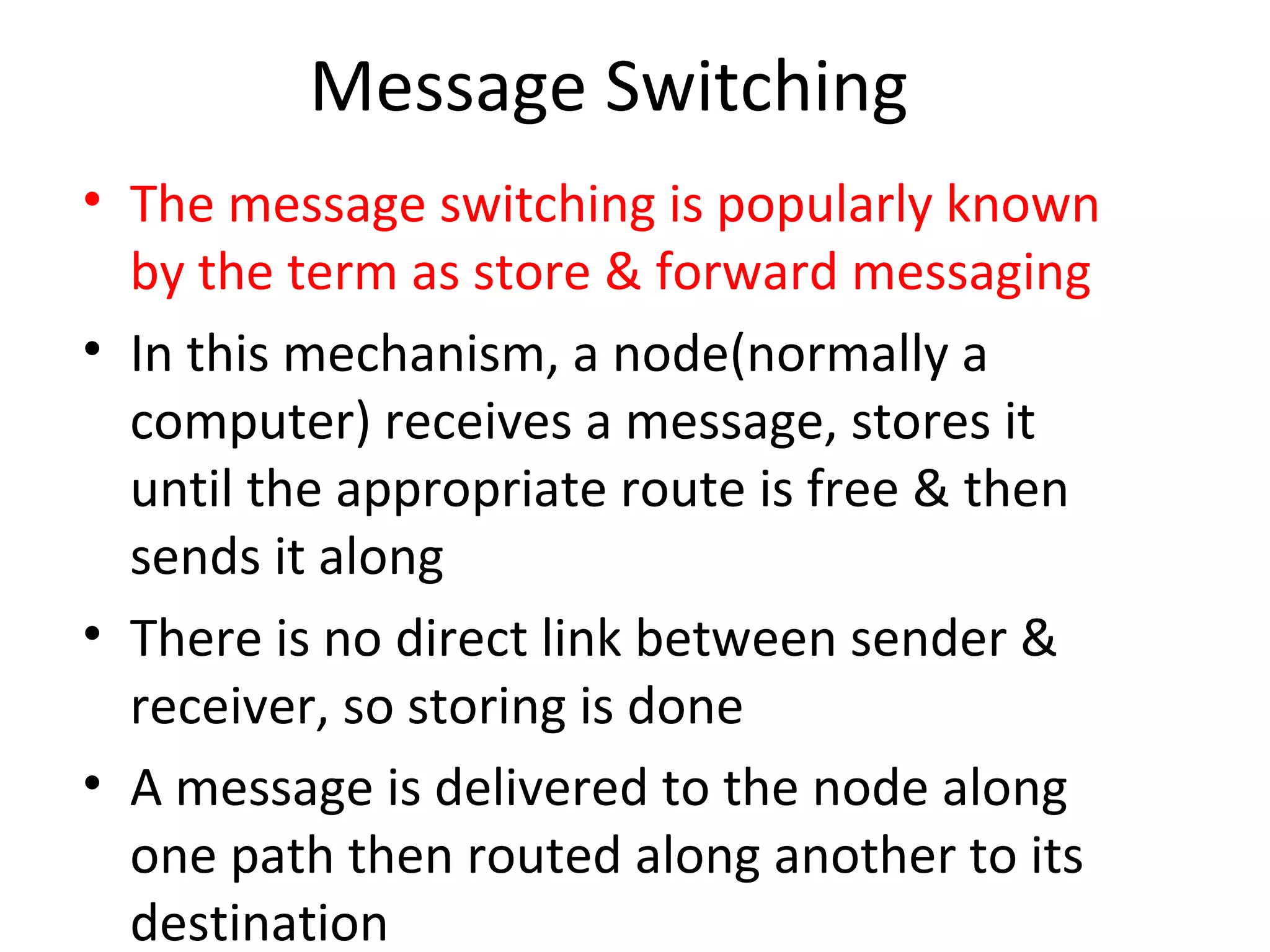
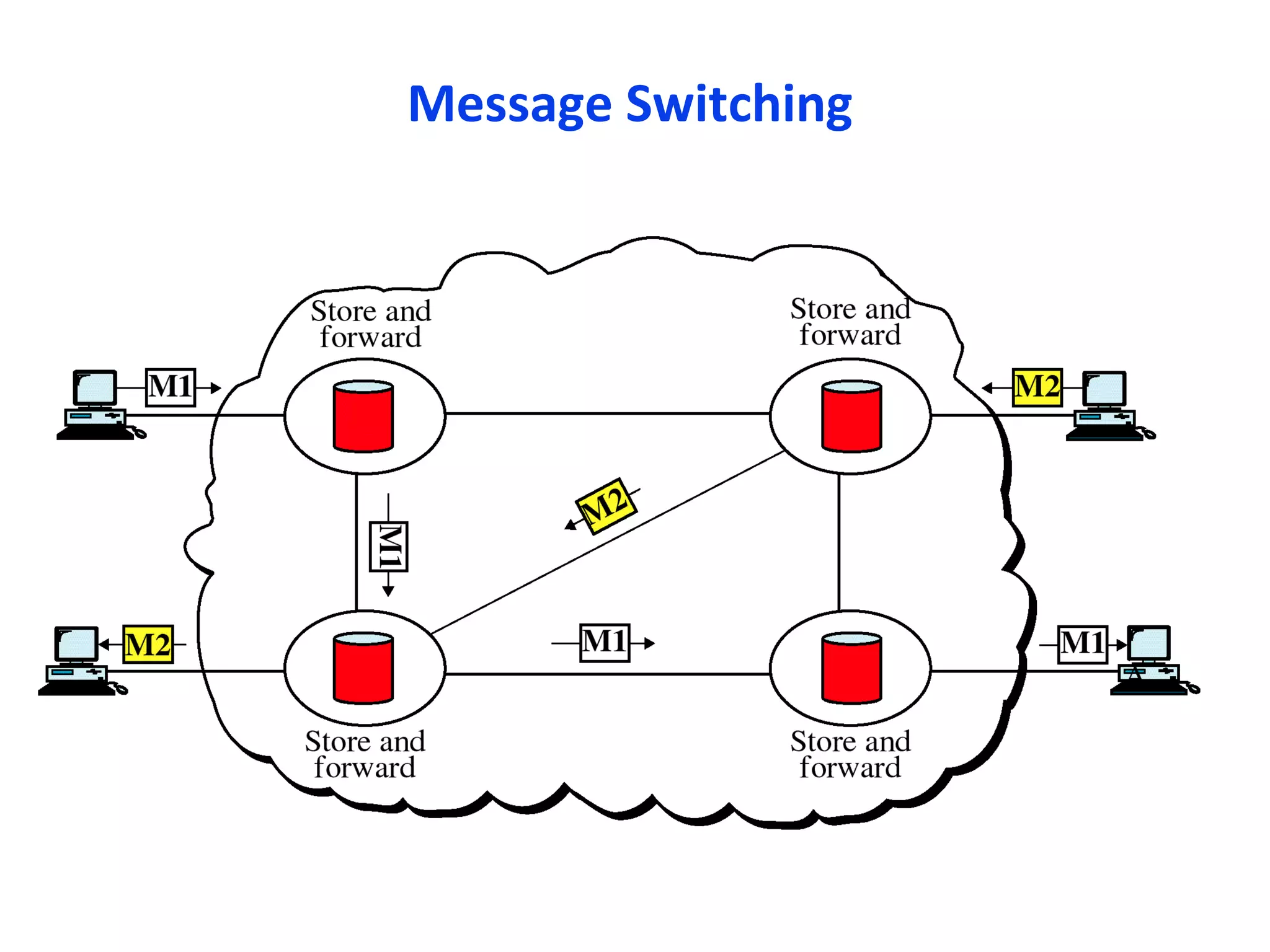
Message Switching
• The message switching is popularly known
by the term as store & forward messaging
• In this mechanism, a node(normally a
computer) receives a message, stores it
until the appropriate route is free & then
sends it along
• There is no direct link between sender &
receiver, so storing is done
• A message is delivered to the node along
one path then routed along another to its
destination
• messages are relayed from secondary storage
in this case whereas in packet switching
messages are forwarded from RAM
• It was a common method in 1960 to 1970
• This method doesn’t work now a days but
implications are still working.
• Just as a application; email can be treated as
good example of message switching
Message Switching
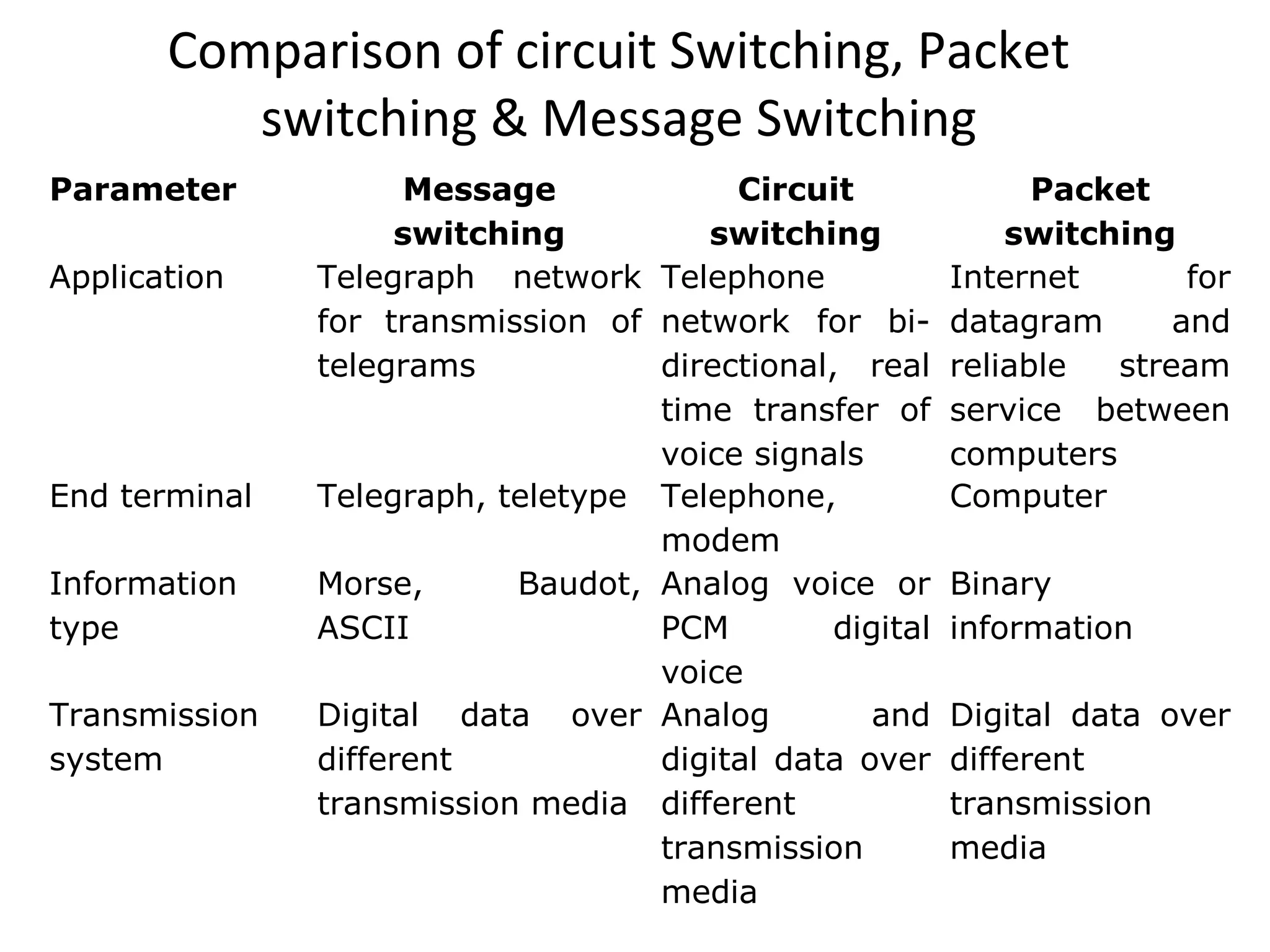
Comparison of circuit Switching, Packet
switching & Message Switching
Parameter Message
switching
Circuit
switching
Packet
switching
Application Telegraph network
for transmission of
telegrams
Telephone
network for bi-
directional, real
time transfer of
voice signals
Internet for
datagram and
reliable stream
service between
computers
End terminal Telegraph, teletype Telephone,
modem
Computer
Information
type
Morse, Baudot,
ASCII
Analog voice or
PCM digital
voice
Binary
information
Transmission
system
Digital data over
different
transmission media
Analog and
digital data over
different
transmission
media
Digital data over
different
transmission
media
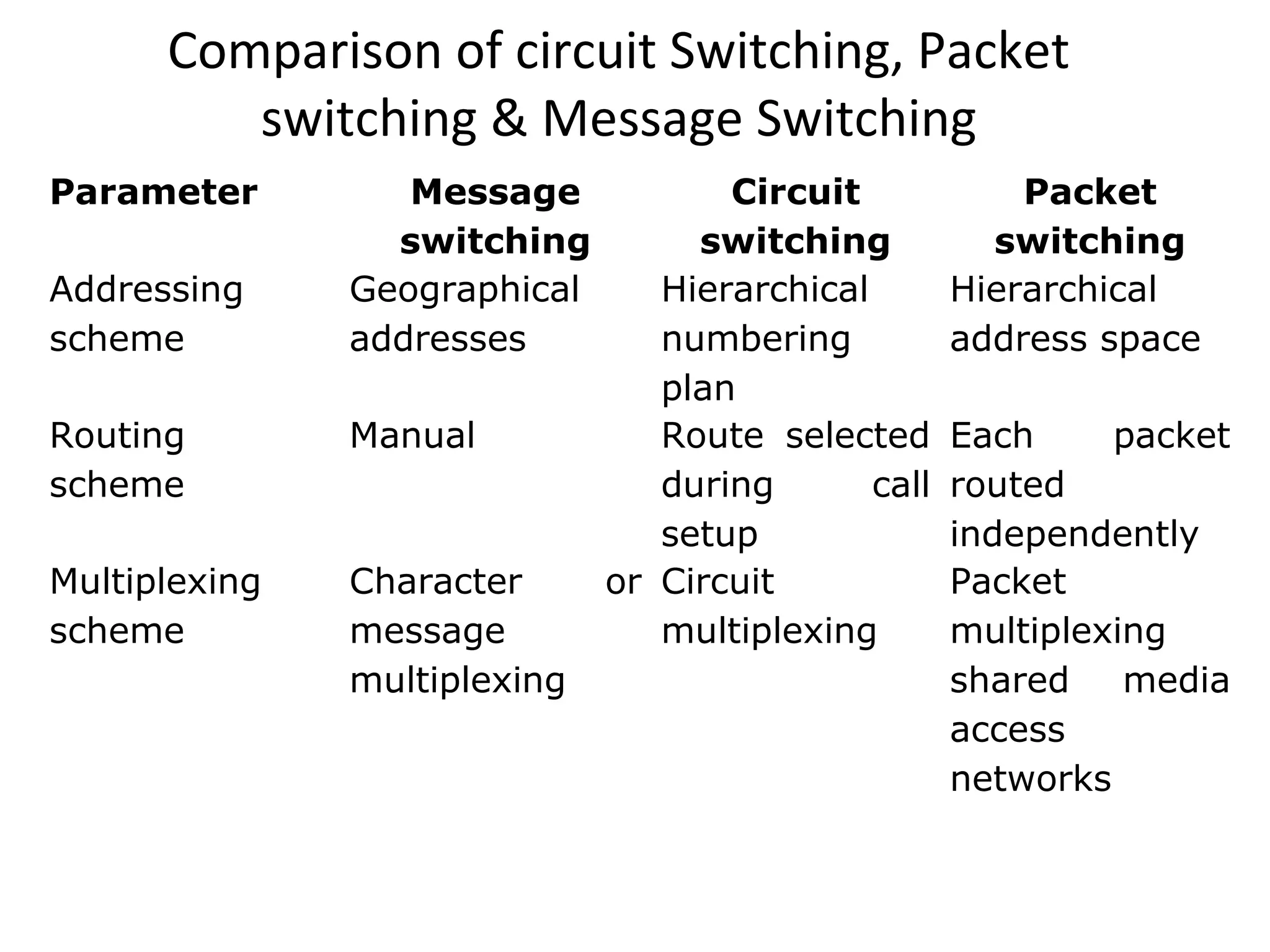
Comparison of circuit Switching, Packet
switching & Message Switching
Parameter Message
switching
Circuit
switching
Packet
switching
Addressing
scheme
Geographical
addresses
Hierarchical
numbering
plan
Hierarchical
address space
Routing
scheme
Manual Route selected
during call
setup
Each packet
routed
independently
Multiplexing
scheme
Character or
message
multiplexing
Circuit
multiplexing
Packet
multiplexing
shared media
access
networks
Thank You
Dr Rajiv Srivastava
Director
Sagar Institute of Research & Technology (SIRT)
Sagar Group of Institutions, Bhopal
http://www.sirtbhopal.ac.in

Topic: Virtual circuit & message switching

  • 1.
    Introduction to Datacommunication Topic: Virtual Switching (contd.) & Message Switching Lecture #8 Dr Rajiv Srivastava Director Sagar Institute of Research & Technology (SIRT) Sagar Group of Institutions, Bhopal http://www.sirtbhopal.ac.in
  • 2.
    Unit 2 Lecture 8 CourseLecture 23 Virtual Switching (contd.) & Message Switching
  • 3.
    There are threephases in virtual circuit network. 1.Data Transfer phase 2.Setup Phase I. Setup request II. Acknowledgement 3.Tear down phase
  • 4.
  • 5.
    Case1: Switch andtable for a virtual-circuit network
  • 6.
    Case2 : Source-to-destinationdata transfer in a circuit-switch network
  • 7.
    Phase 2 Setup Phase 1.Setup request 2. Acknowledgment
  • 8.
    Setup request ina virtual-circuit network
  • 9.
    Setup acknowledgment ina virtual-circuit network
  • 10.
    3rd Phase Tear Down • Inthis phase, source after sending all frames to destination, sends a special frame called teardown request. • Destination responds with teardown confirmation frame • All the switch delete the corresponding entry from their tables
  • 11.
    Efficiency • In virtualcircuit switching, all packets belonging to the same source & destination travel the same path, but the packets may arrive at the destination with different delays if resource allocation is on demand.
  • 12.
    Delay in avirtual-circuit network Total Delay = 3 T + 3 + setup delay + teardown delay Where 3T : 3 transmission time 3 :3 propagation delays
  • 13.
    Comparison of Datagram& VC networks Circuit switching Datagram packet switching Virtual-circuit packet switching Dedicated transmission path No dedicated path No dedicated path Continuous transmission of data Transmission of packets Transmission of packets Fast enough for interactive Fast enough for interactive Fast enough for interactive Messages are not stored Packets may be stored until delivered Packets stored until delivered The path is established for entire conversation Route established for each packet Route established for entire conversation Call setup delay; negligible transmission delay Packet transmission delay Call setup delay; packet transmission delay Busy signal if called party busy Sender may be notified if packet not delivered Sender notified of connection denial
  • 14.
    Comparison of Datagram& VC networks Circuit switching Datagram packet switching Virtual-circuit packet switching Overload may block call setup; no delay for established calls Overload increases packet delay Overload may block call setup; increases packet delay Electromechanical or computerized switching nodes Small switching nodes Small switching nodes User responsible for message loss protection Network may be responsible for individual packets Network may be responsible for packet sequences Usually no speed or code conversion Speed and code conversion Speed and code conversion Fixed bandwidth transmission Dynamic use of bandwidth Dynamic use of bandwidth No overhead bits after call setup Overhead bits in each message Overhead bits in each packet
  • 15.
    Message Switching • Themessage switching is popularly known by the term as store & forward messaging • In this mechanism, a node(normally a computer) receives a message, stores it until the appropriate route is free & then sends it along • There is no direct link between sender & receiver, so storing is done • A message is delivered to the node along one path then routed along another to its destination
  • 16.
    • messages arerelayed from secondary storage in this case whereas in packet switching messages are forwarded from RAM • It was a common method in 1960 to 1970 • This method doesn’t work now a days but implications are still working. • Just as a application; email can be treated as good example of message switching
  • 17.
  • 18.
    Comparison of circuitSwitching, Packet switching & Message Switching Parameter Message switching Circuit switching Packet switching Application Telegraph network for transmission of telegrams Telephone network for bi- directional, real time transfer of voice signals Internet for datagram and reliable stream service between computers End terminal Telegraph, teletype Telephone, modem Computer Information type Morse, Baudot, ASCII Analog voice or PCM digital voice Binary information Transmission system Digital data over different transmission media Analog and digital data over different transmission media Digital data over different transmission media
  • 19.
    Comparison of circuitSwitching, Packet switching & Message Switching Parameter Message switching Circuit switching Packet switching Addressing scheme Geographical addresses Hierarchical numbering plan Hierarchical address space Routing scheme Manual Route selected during call setup Each packet routed independently Multiplexing scheme Character or message multiplexing Circuit multiplexing Packet multiplexing shared media access networks
  • 20.
    Thank You Dr RajivSrivastava Director Sagar Institute of Research & Technology (SIRT) Sagar Group of Institutions, Bhopal http://www.sirtbhopal.ac.in