The H1N1 (Swine Flu) Pandemic-A Serious Issue in Education Today-A Visual Presentation by Scott Walbrun
IntroductionBackground InformationImpactWhat Needs to Be DonePublic Health ActionsConclusionReferencesAgenda
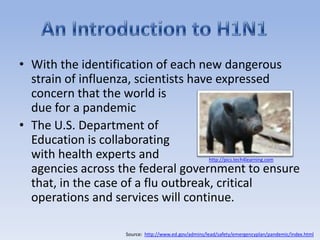
An Introduction to H1N1With the identification of each new dangerous strain of influenza, scientists have expressed concern that the world is due for a pandemicThe U.S. Department of Education is collaborating with health experts and agencies across the federal government to ensure that, in the case of a flu outbreak, critical operations and services will continue. http://pics.tech4learning.comSource:  http://www.ed.gov/admins/lead/safety/emergencyplan/pandemic/index.html
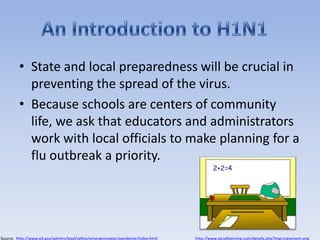
State and local preparedness will be crucial in preventing the spread of the virus. Because schools are centers of community life, we ask that educators and administrators work with local officials to make planning for a flu outbreak a priority.An Introduction to H1N1http://www.pics4learning.com/details.php?img=classroom.pngSource:  http://www.ed.gov/admins/lead/safety/emergencyplan/pandemic/index.html
Novel H1N1 Flu (initially called swine flu) is a new virus currently causing illness in people in all 50 states and in many countries around the worldIt contains a previously unknown combination of genetic material from swine, avian and human influenza virusesBackground Informationhttp://eastern.tennessee.edu/ag/EMERGENCY%20PREPAREDNESS/DOWNLOARD%20-%20EMERGENCY%20PREPAREDNESS/Novel%20H1N1%20Flu%20Fact%20Sheet.pdf
The virus was first detected in April 2009 in persons in the United States, Mexico and CanadaThe virus has spread from person to person through the coughs and sneezes of infected people; similar to how the seasonal flu spreadsBackground Informationhttp://eastern.tennessee.edu/ag/EMERGENCY%20PREPAREDNESS/DOWNLOARD%20-%20EMERGENCY%20PREPAREDNESS/Novel%20H1N1%20Flu%20Fact%20Sheet.pdf
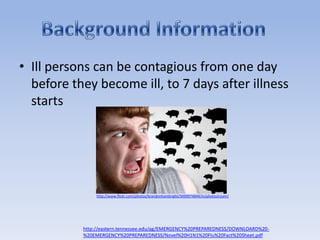
Ill persons can be contagious from one day before they become ill, to 7 days after illness startsBackground Informationhttp://www.flickr.com/photos/brandonhambright/3499974844/in/photostream/http://eastern.tennessee.edu/ag/EMERGENCY%20PREPAREDNESS/DOWNLOARD%20-%20EMERGENCY%20PREPAREDNESS/Novel%20H1N1%20Flu%20Fact%20Sheet.pdf
Each of New York City’s 1,500 public schools will start the year with support from the City’s influenza-prevention campaign, which uses posters and guidance to incorporate proper techniques for covering coughs and washing hands into classroom instruction Restrooms will be stocked with soap and paper towels, and parents will get written reminders to keep their children home when they’re sickImpact on Educationhttp://text.nycenet.edu/Home/Spotlight/swine.htm
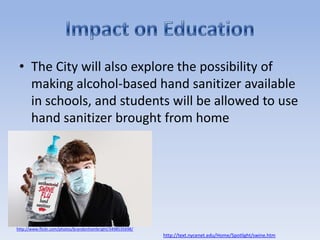
The City will also explore the possibility of making alcohol-based hand sanitizer available in schools, and students will be allowed to use hand sanitizer brought from homeImpact on Educationhttp://www.flickr.com/photos/brandonhambright/3498535698/http://text.nycenet.edu/Home/Spotlight/swine.htm
Schools should evaluate the resources and technology they have available to continue delivering learning services off siteThis would include everything from take-home course packets to online materials, Listservs, and new services, such as social networking through YouTube and TwitterWhat Needs to Be Donehttp://www.ed.gov/admins/lead/safety/emergencyplan/pandemic/guidance/continuity-qa.pdf
What Needs to Be DonePCs, laptops, DVD and MP3 players or other audiovisual recording devices may be used. Conference calls and Internet-based webinar-style classes may be effective ways of delivering class materialSchools should collect or update the relevant contact information for students so that teachers can check in with students and their parents to deliver lessonshttp://www.ed.gov/admins/lead/safety/emergencyplan/pandemic/guidance/continuity-qa.pdf
Some County Health Departments engage in tracking of influenza illness on a routine basis year‐ round.Medical providers in the community report the number of patients that are seen each week with flu‐like illness during flu seasons.Public Health Actionshttp://eastern.tennessee.edu/ag/EMERGENCY%20PREPAREDNESS/DOWNLOARD%20%20EMERGENCY%20PREPAREDNESS/Novel%20H1N1%20Flu%20Fact%20Sheet.pdf
This data is monitored for unusual increases in disease, and for identification of the virus strains that are circulating in the community. In addition, the health department is providing disease prevention information to the community to promote healthy habits that will assist to prevent illness spread within our community.Public Health Actionshttp://eastern.tennessee.edu/ag/EMERGENCY%20PREPAREDNESS/DOWNLOARD%20-%20EMERGENCY%20PREPAREDNESS/Novel%20H1N1%20Flu%20Fact%20Sheet.pdf
The swine flu is a serious problem in education todaySchools are the main institution where the virus is spread from person to personThe pandemic can be stopped as long as the population is educated on the subjectConclusion
Hambri, Brandon. A Real Epidemic. 2009. Flickr.com. 28 Oct 2009 <http://www.flickr.com/photos/brandonhambright/3499974844/in/photostream>Hambri, Brandon. Beware the Swine Flu. 2009. Flickr.com. 28 Oct 2009 <http://www.flickr.com/photos/brandonhambright/3498535698/>Inc., Tech4Learning,. classroom.png. 10/20/09. Pics4Learning. 27 Oct 2009 <http://pics.tech4learning.com>Katie. piggy.jpg. 2007. Pics4Learning. 27 Oct 2009 <http://pics.tech4learning.com>Photo Credits
"Latest Information on H1N1 (Swine) Influenza." NYC Department of Education. Web. 28 Oct. 2009. <http://text.nycenet.edu/Home/Spotlight/swine.htm>. "Lead and Manage My School." Www.ed.gov. U.S. Department of Education, 21 Oct. 2009. Web. 29 Oct. 2009. <http://www.ed.gov/admins/lead/safety/emergencyplan/pandemic/index.html>. "Novel H1N1 Flu Fact Sheet." Hamilton County, Tennessee. Web. 28 Oct. 2009. <http://eastern.tennessee.edu/ag/EMERGENCY%20PREPAREDNESS/DOWNLOARD%20-%20EMERGENCY%20PREPAREDNESS/Novel%20H1N1%20Flu%20Fact%20Sheet.pdf>. "Preparing for the Flu During the 2009-10 School Year." Www.ed.gov. U.S. Department of Education. Web. 28 Oct. 2009. <http://www.ed.gov/admins/lead/safety/emergencyplan/pandemic/guidance/continuity-qa.pdf>. References

Swine Flu And Education

  • 1.
    The H1N1 (SwineFlu) Pandemic-A Serious Issue in Education Today-A Visual Presentation by Scott Walbrun
  • 2.
    IntroductionBackground InformationImpactWhat Needsto Be DonePublic Health ActionsConclusionReferencesAgenda
  • 3.
    An Introduction toH1N1With the identification of each new dangerous strain of influenza, scientists have expressed concern that the world is due for a pandemicThe U.S. Department of Education is collaborating with health experts and agencies across the federal government to ensure that, in the case of a flu outbreak, critical operations and services will continue. http://pics.tech4learning.comSource: http://www.ed.gov/admins/lead/safety/emergencyplan/pandemic/index.html
  • 4.
    State and localpreparedness will be crucial in preventing the spread of the virus. Because schools are centers of community life, we ask that educators and administrators work with local officials to make planning for a flu outbreak a priority.An Introduction to H1N1http://www.pics4learning.com/details.php?img=classroom.pngSource: http://www.ed.gov/admins/lead/safety/emergencyplan/pandemic/index.html
  • 5.
    Novel H1N1 Flu(initially called swine flu) is a new virus currently causing illness in people in all 50 states and in many countries around the worldIt contains a previously unknown combination of genetic material from swine, avian and human influenza virusesBackground Informationhttp://eastern.tennessee.edu/ag/EMERGENCY%20PREPAREDNESS/DOWNLOARD%20-%20EMERGENCY%20PREPAREDNESS/Novel%20H1N1%20Flu%20Fact%20Sheet.pdf
  • 6.
    The virus wasfirst detected in April 2009 in persons in the United States, Mexico and CanadaThe virus has spread from person to person through the coughs and sneezes of infected people; similar to how the seasonal flu spreadsBackground Informationhttp://eastern.tennessee.edu/ag/EMERGENCY%20PREPAREDNESS/DOWNLOARD%20-%20EMERGENCY%20PREPAREDNESS/Novel%20H1N1%20Flu%20Fact%20Sheet.pdf
  • 7.
    Ill persons canbe contagious from one day before they become ill, to 7 days after illness startsBackground Informationhttp://www.flickr.com/photos/brandonhambright/3499974844/in/photostream/http://eastern.tennessee.edu/ag/EMERGENCY%20PREPAREDNESS/DOWNLOARD%20-%20EMERGENCY%20PREPAREDNESS/Novel%20H1N1%20Flu%20Fact%20Sheet.pdf
  • 8.
    Each of NewYork City’s 1,500 public schools will start the year with support from the City’s influenza-prevention campaign, which uses posters and guidance to incorporate proper techniques for covering coughs and washing hands into classroom instruction Restrooms will be stocked with soap and paper towels, and parents will get written reminders to keep their children home when they’re sickImpact on Educationhttp://text.nycenet.edu/Home/Spotlight/swine.htm
  • 9.
    The City willalso explore the possibility of making alcohol-based hand sanitizer available in schools, and students will be allowed to use hand sanitizer brought from homeImpact on Educationhttp://www.flickr.com/photos/brandonhambright/3498535698/http://text.nycenet.edu/Home/Spotlight/swine.htm
  • 10.
    Schools should evaluatethe resources and technology they have available to continue delivering learning services off siteThis would include everything from take-home course packets to online materials, Listservs, and new services, such as social networking through YouTube and TwitterWhat Needs to Be Donehttp://www.ed.gov/admins/lead/safety/emergencyplan/pandemic/guidance/continuity-qa.pdf
  • 11.
    What Needs toBe DonePCs, laptops, DVD and MP3 players or other audiovisual recording devices may be used. Conference calls and Internet-based webinar-style classes may be effective ways of delivering class materialSchools should collect or update the relevant contact information for students so that teachers can check in with students and their parents to deliver lessonshttp://www.ed.gov/admins/lead/safety/emergencyplan/pandemic/guidance/continuity-qa.pdf
  • 12.
    Some County HealthDepartments engage in tracking of influenza illness on a routine basis year‐ round.Medical providers in the community report the number of patients that are seen each week with flu‐like illness during flu seasons.Public Health Actionshttp://eastern.tennessee.edu/ag/EMERGENCY%20PREPAREDNESS/DOWNLOARD%20%20EMERGENCY%20PREPAREDNESS/Novel%20H1N1%20Flu%20Fact%20Sheet.pdf
  • 13.
    This data ismonitored for unusual increases in disease, and for identification of the virus strains that are circulating in the community. In addition, the health department is providing disease prevention information to the community to promote healthy habits that will assist to prevent illness spread within our community.Public Health Actionshttp://eastern.tennessee.edu/ag/EMERGENCY%20PREPAREDNESS/DOWNLOARD%20-%20EMERGENCY%20PREPAREDNESS/Novel%20H1N1%20Flu%20Fact%20Sheet.pdf
  • 14.
    The swine fluis a serious problem in education todaySchools are the main institution where the virus is spread from person to personThe pandemic can be stopped as long as the population is educated on the subjectConclusion
  • 15.
    Hambri, Brandon. AReal Epidemic. 2009. Flickr.com. 28 Oct 2009 <http://www.flickr.com/photos/brandonhambright/3499974844/in/photostream>Hambri, Brandon. Beware the Swine Flu. 2009. Flickr.com. 28 Oct 2009 <http://www.flickr.com/photos/brandonhambright/3498535698/>Inc., Tech4Learning,. classroom.png. 10/20/09. Pics4Learning. 27 Oct 2009 <http://pics.tech4learning.com>Katie. piggy.jpg. 2007. Pics4Learning. 27 Oct 2009 <http://pics.tech4learning.com>Photo Credits
  • 16.
    "Latest Information onH1N1 (Swine) Influenza." NYC Department of Education. Web. 28 Oct. 2009. <http://text.nycenet.edu/Home/Spotlight/swine.htm>. "Lead and Manage My School." Www.ed.gov. U.S. Department of Education, 21 Oct. 2009. Web. 29 Oct. 2009. <http://www.ed.gov/admins/lead/safety/emergencyplan/pandemic/index.html>. "Novel H1N1 Flu Fact Sheet." Hamilton County, Tennessee. Web. 28 Oct. 2009. <http://eastern.tennessee.edu/ag/EMERGENCY%20PREPAREDNESS/DOWNLOARD%20-%20EMERGENCY%20PREPAREDNESS/Novel%20H1N1%20Flu%20Fact%20Sheet.pdf>. "Preparing for the Flu During the 2009-10 School Year." Www.ed.gov. U.S. Department of Education. Web. 28 Oct. 2009. <http://www.ed.gov/admins/lead/safety/emergencyplan/pandemic/guidance/continuity-qa.pdf>. References

Editor's Notes

  • #2 The H1N1, or Swine Flu, Pandemic—A serious issue in education today. A visual presentation by Scott Walbrun.
  • #3 First on our agenda today will be a brief introduction, as well as the background information on the swine flu. Then, we will discuss the impact of of the virus on education and what needs to be done. After that, we will touch on some public health options. Lastly, there is a conclusion and the sources of information and media cited.
  • #4 So, let’s start with an introduction to the H1N1 virus on education. According to the NYC Department of education, it should be noted that with the identification of each new dangerous strain of influenza, scientists have expressed concern that the world is due for a pandemic. In response to this reality, the U.S. Department of Education is collaborating with health experts and agencies across the federal government to ensure that, in the case of a flu outbreak, critical operations and services will continue.
  • #5 Considering this, state and local preparedness will be crucial in preventing the spread of the virus. And since schools are centers of community life, educators and administrators are asked to work with local officials to make a plan for a flu outbreak.
  • #6 Now, let us take a look at the background information on the virus itself. The H1N1 flu is a new virus that is currently causing illness to people all over the world. It contains a previously unknown combination of genetic material from the swine, avian and human influenza viruses.
  • #7 The virus was first detected in April 2009 in persons in the United States, Mexico and Canada.The virus has spread from person to person through the coughs and sneezes of infected people; similar to how the seasonal flu spreads.
  • #8 Ill persons can be contagious from one day before they become ill, to 7 days after illness starts.
  • #9 As much of an impact this virus has had on people all over the country, it may have its biggest impact on the education institution. Each of New York City’s 1,500 public schools will start the year with support from the City’s influenza-prevention campaign, which uses posters and guidance to incorporate proper techniques for covering coughs and washing hands into classroom instruction. So, restrooms will be stocked with soap and paper towels, and parents will get written reminders to keep their children home when they’re sick.
  • #10 The City will also explore the possibility of making alcohol-based hand sanitizer available in schools, and students will be allowed to use hand sanitizer brought from home.
  • #11 What needs to be done about this great impact to the educational institutions all over the country? Well, schools should evaluate the resources and technology they have available to continue delivering learning services off site.This would include everything from take-home course packets to online materials, Listservs, and new services, such as social networking through YouTube and Twitter
  • #12 PCs, laptops, DVD and MP3 players or other audiovisual recording devices may be used. Conference calls and Internet-based webinar-style classes may be effective ways of delivering class material.Schools should also collect or update the relevant contact information for students so that teachers can check in with students and their parents to deliver lessons.
  • #13 There have been several public health actions so far. Some County Health Departments engage in tracking of influenza illness on a routine basis year‐round.Medical providers in the community report the number of patients that are seen each week with flu‐like illness during flu seasons.
  • #14 This data is monitored for unusual increases in disease, and for identification of the virus strains that are circulating in the community. In addition, the health department is providing disease prevention information to the community to promote healthy habits that will assist to prevent illness spread within our community.
  • #15 With all things considered,the swine flu is a serious problem in education today.Schools are the main institution where the virus is spread from person to person.The pandemic can be stopped as long as the population is educated on the subject.
  • #16 Please take a moment to acknowledge the photo sources used in this presentation.
  • #17 And please take a moment to recognize the sources for information used in this presentation.