Influential British Precursor of American Public
Schools Instrumental Classes
Based on the article by
Robin K. Deverich JRME
Carol Swinchoski
History and Philosophy of Music Education

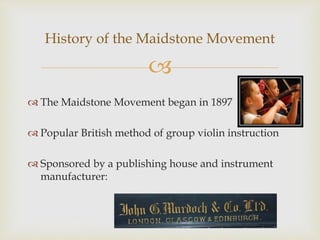
 The Maidstone Movement began in 1897
 Popular British method of group violin instruction
 Sponsored by a publishing house and instrument
manufacturer:
History of the Maidstone Movement

 Mee Pattison, musical advisor for the Murdoch
Company, saw the need for group violin program
for children.
 Created an all-inclusive program to bring to schools
which would include:
 Teachers
 Violins
 Teaching Materials
How it Began

The Maidstone School Orchestra
Association (MSOA)
 Formed by the Murdoch Company
The National Union of School
Orchestras (NUSO)
 Mee Pattison formed this organization to encourage
collaboration in teaching methods and promote joint
concerts.
Two organizations

 All Saints’ National School in?
 Drum roll please …
 the town of Maidstone in Kent, England
The First school to accept?

 Teachers received their salaries directly from the
students.
 Classes were 30-60 minutes
 Lunch time or after school
 12-20 students in a class
 Offered multiple days of the week to accommodate
student interest.
 Performed concerts at times in conjunction with
other MSOA classes in different schools.
Format of School

 OBJECTIVES
 1. To promote the study and practice of instrumental
music among the school children of the Kingdom, by
encouraging the formation of school orchestras, and
to elevate the musical taste of the nation as a whole.
 This encouraged the MSOA to establish classes in Cello,
mandolin, orchestra, brass bands, military bands, drum
& fife bands, bugle bands.
National Union of School
Orchestras (1905)

 2. To obtain the best methods of working from
compared experiences of each school in starting and
working its orchestra.
 3. To provide means of assuring an adequate supply
of teachers.
 4. To establish a periodical (The Young Musician)
with a view to keeping school orchestras in touch
with one another and giving all the experiences of
each together with information of general interest.
Key Objectives

 5. To insure by expert supervision that the teaching
is properly done.
 6.To provide scholarships by which pupils of
exceptional ability may obtain advanced teaching.
 7.To keep in touch with young people after leaving
the Day School by means of Evening Classes and
Orchestral Societies.
 This was to provide opportunities for the students once
they graduated from the Day Schools as a bridge to adult
orchestras.
Key Objectives

 8. To promote combined practices and local concerts and thus
stimulate the pupils, entertain the elders, and possibly help in local
benevolent works.
 Played for orphanages, and charitable institutions
 9. To organize an Annual Music Festival to keep the public in touch
with the work of the Union
 Concerts on a grand scale!
 1905 – 700 Violinists
 1914 – 6,650 Violinists
 Classes would compete for Silver Challenge Shields!
 10. To enlist the help and support of influential men in the musical and
educational world.
Key Objectives

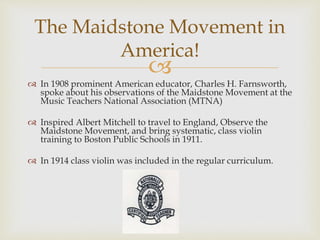
 In 1908 prominent American educator, Charles H. Farnsworth,
spoke about his observations of the Maidstone Movement at the
Music Teachers National Association (MTNA)
 Inspired Albert Mitchell to travel to England, Observe the
Maidstone Movement, and bring systematic, class violin
training to Boston Public Schools in 1911.
 In 1914 class violin was included in the regular curriculum.
The Maidstone Movement in
America!

 First instrumental classes in America used the
Maidstone Movement as a model!
 Introduced to Boston Public Schools by Albert G.
Mitchell.
1911 Boston School District

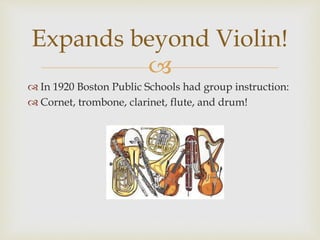
 In 1920 Boston Public Schools had group instruction:
 Cornet, trombone, clarinet, flute, and drum!
Expands beyond Violin!

 Weaknesses in Maidstone Movement
 Despite the objectives of the NUSO
 Teachers varied greatly in experience and quality.
 A uniform curriculum was not realized.
 Challenges of teaching violin in large groupings was
criticized.
 The 1939 evacuation of London left no children to
take lessons or play in the Annual Music Festival.
 In 1943, the Murdoch Company dissolved.
The Maidstone Movement falters

 THE LASTING IMPACT OF THE MAIDSTONE
MOVEMENT:
 Sparked a national interest in instrumental classes!
 Demonstrated an economical way for large numbers
of students to learn to play instruments!
 American music teachers created their own
instrumental programs!
 Instrumental music became a permanent part of
public schools.
Legacy Carries on!
Deverich, Robin K. "The Maidstone Movement -
Influential British Precursor of American Public
School Instrumental." Journal of Research in Music
Education 35 (1987): 39-56. National Association for
Music Education. Web. 5 July 2014.

Swinchoski slideshare

  • 1.
    Influential British Precursorof American Public Schools Instrumental Classes Based on the article by Robin K. Deverich JRME Carol Swinchoski History and Philosophy of Music Education
  • 2.
      The MaidstoneMovement began in 1897  Popular British method of group violin instruction  Sponsored by a publishing house and instrument manufacturer: History of the Maidstone Movement
  • 3.
      Mee Pattison,musical advisor for the Murdoch Company, saw the need for group violin program for children.  Created an all-inclusive program to bring to schools which would include:  Teachers  Violins  Teaching Materials How it Began
  • 4.
     The Maidstone SchoolOrchestra Association (MSOA)  Formed by the Murdoch Company The National Union of School Orchestras (NUSO)  Mee Pattison formed this organization to encourage collaboration in teaching methods and promote joint concerts. Two organizations
  • 5.
      All Saints’National School in?  Drum roll please …  the town of Maidstone in Kent, England The First school to accept?
  • 6.
      Teachers receivedtheir salaries directly from the students.  Classes were 30-60 minutes  Lunch time or after school  12-20 students in a class  Offered multiple days of the week to accommodate student interest.  Performed concerts at times in conjunction with other MSOA classes in different schools. Format of School
  • 7.
      OBJECTIVES  1.To promote the study and practice of instrumental music among the school children of the Kingdom, by encouraging the formation of school orchestras, and to elevate the musical taste of the nation as a whole.  This encouraged the MSOA to establish classes in Cello, mandolin, orchestra, brass bands, military bands, drum & fife bands, bugle bands. National Union of School Orchestras (1905)
  • 8.
      2. Toobtain the best methods of working from compared experiences of each school in starting and working its orchestra.  3. To provide means of assuring an adequate supply of teachers.  4. To establish a periodical (The Young Musician) with a view to keeping school orchestras in touch with one another and giving all the experiences of each together with information of general interest. Key Objectives
  • 9.
      5. Toinsure by expert supervision that the teaching is properly done.  6.To provide scholarships by which pupils of exceptional ability may obtain advanced teaching.  7.To keep in touch with young people after leaving the Day School by means of Evening Classes and Orchestral Societies.  This was to provide opportunities for the students once they graduated from the Day Schools as a bridge to adult orchestras. Key Objectives
  • 10.
      8. Topromote combined practices and local concerts and thus stimulate the pupils, entertain the elders, and possibly help in local benevolent works.  Played for orphanages, and charitable institutions  9. To organize an Annual Music Festival to keep the public in touch with the work of the Union  Concerts on a grand scale!  1905 – 700 Violinists  1914 – 6,650 Violinists  Classes would compete for Silver Challenge Shields!  10. To enlist the help and support of influential men in the musical and educational world. Key Objectives
  • 11.
      In 1908prominent American educator, Charles H. Farnsworth, spoke about his observations of the Maidstone Movement at the Music Teachers National Association (MTNA)  Inspired Albert Mitchell to travel to England, Observe the Maidstone Movement, and bring systematic, class violin training to Boston Public Schools in 1911.  In 1914 class violin was included in the regular curriculum. The Maidstone Movement in America!
  • 12.
      First instrumentalclasses in America used the Maidstone Movement as a model!  Introduced to Boston Public Schools by Albert G. Mitchell. 1911 Boston School District
  • 13.
      In 1920Boston Public Schools had group instruction:  Cornet, trombone, clarinet, flute, and drum! Expands beyond Violin!
  • 14.
      Weaknesses inMaidstone Movement  Despite the objectives of the NUSO  Teachers varied greatly in experience and quality.  A uniform curriculum was not realized.  Challenges of teaching violin in large groupings was criticized.  The 1939 evacuation of London left no children to take lessons or play in the Annual Music Festival.  In 1943, the Murdoch Company dissolved. The Maidstone Movement falters
  • 15.
      THE LASTINGIMPACT OF THE MAIDSTONE MOVEMENT:  Sparked a national interest in instrumental classes!  Demonstrated an economical way for large numbers of students to learn to play instruments!  American music teachers created their own instrumental programs!  Instrumental music became a permanent part of public schools. Legacy Carries on!
  • 16.
    Deverich, Robin K."The Maidstone Movement - Influential British Precursor of American Public School Instrumental." Journal of Research in Music Education 35 (1987): 39-56. National Association for Music Education. Web. 5 July 2014.