glass pool fencing brisbaneglass pool fencing brisbane
automatic gates brisbaneautomatic gates brisbane aluminiumaluminium
privacy screens brisbaneprivacy screens brisbane
XI. Swimming Pools & BathingXI. Swimming Pools & Bathing
BeachesBeaches
A. Regulations &A. Regulations &
B. Design and safetyB. Design and safety
Cdfabrication.com.au
Objectives:Objectives:
List and describe regulationsList and describe regulations
affecting water quality in pools andaffecting water quality in pools and
bathing beaches.bathing beaches.
Discuss design and safety consider-Discuss design and safety consider-
ations for pools and bathing beachesations for pools and bathing beaches
Regulation of water quality inRegulation of water quality in
pools, beaches:pools, beaches:
Sanitary quality of swimmingSanitary quality of swimming
water is determined by microbial,water is determined by microbial,
chemical, and physical tests describedchemical, and physical tests described
inin Standard Methods for the ExaminationStandard Methods for the Examination
of Water and Wastewaterof Water and Wastewater, performed by, performed by
competent laboratory personnel.competent laboratory personnel.
APHA Joint Committee onAPHA Joint Committee on
Swimming Pools and BathingSwimming Pools and Bathing
Places Recommendations:Places Recommendations:
Microbial parametersMicrobial parameters
(pools):(pools):
– Plate count - < 200 CFU/ml.Plate count - < 200 CFU/ml.
– Coliforms - < 1.0/50 ml.Coliforms - < 1.0/50 ml.
– Staphylococci - < 50/100 ml.Staphylococci - < 50/100 ml.
Joint CommitteeJoint Committee
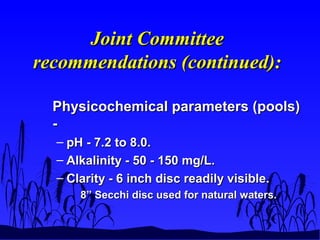
recommendations (continued):recommendations (continued):
Physicochemical parameters (pools)Physicochemical parameters (pools)
--
– pH - 7.2 to 8.0.pH - 7.2 to 8.0.
– Alkalinity - 50 - 150 mg/L.Alkalinity - 50 - 150 mg/L.
– Clarity - 6 inch disc readily visible.Clarity - 6 inch disc readily visible.
8” Secchi disc used for natural waters.8” Secchi disc used for natural waters.
Standards for bathing beaches:Standards for bathing beaches:
Microbiological standards -Microbiological standards -
– Total coliforms - < 500/100 ml.Total coliforms - < 500/100 ml.
– Fecal coliforms - < 100/100 ml.Fecal coliforms - < 100/100 ml.
– FecalFecal StreptococciStreptococci - < 100/100 ml.- < 100/100 ml.
– SalmonellaSalmonella, enteroviruses - 0/100 ml., enteroviruses - 0/100 ml.
Standards for bathing beachesStandards for bathing beaches
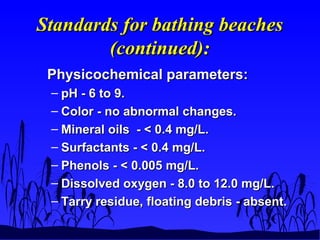
(continued):(continued):
Physicochemical parameters:Physicochemical parameters:
– pH - 6 to 9.pH - 6 to 9.
– Color - no abnormal changes.Color - no abnormal changes.
– Mineral oils - < 0.4 mg/L.Mineral oils - < 0.4 mg/L.
– Surfactants - < 0.4 mg/L.Surfactants - < 0.4 mg/L.
– Phenols - < 0.005 mg/L.Phenols - < 0.005 mg/L.
– Dissolved oxygen - 8.0 to 12.0 mg/L.Dissolved oxygen - 8.0 to 12.0 mg/L.
– Tarry residue, floating debris - absent.Tarry residue, floating debris - absent.
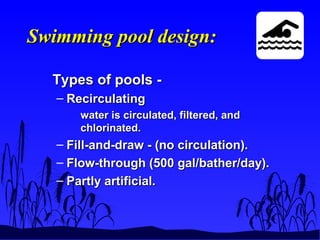
Swimming pool design:Swimming pool design:
Types of pools -Types of pools -
– RecirculatingRecirculating
water is circulated, filtered, andwater is circulated, filtered, and
chlorinated.chlorinated.
– Fill-and-draw - (no circulation).Fill-and-draw - (no circulation).
– Flow-through (500 gal/bather/day).Flow-through (500 gal/bather/day).
– Partly artificial.Partly artificial.
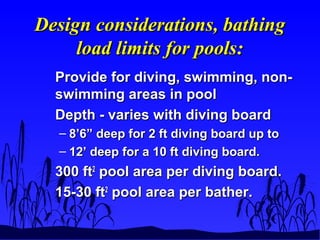
Design considerations, bathingDesign considerations, bathing
load limits for pools:load limits for pools:
Provide for diving, swimming, non-Provide for diving, swimming, non-
swimming areas in poolswimming areas in pool
Depth - varies with diving boardDepth - varies with diving board
– 8’6” deep for 2 ft diving board up to8’6” deep for 2 ft diving board up to
– 12’ deep for a 10 ft diving board.12’ deep for a 10 ft diving board.
300 ft300 ft22
pool area per diving board.pool area per diving board.
15-30 ft15-30 ft22
pool area per bather.pool area per bather.
Safety considerations for pools:Safety considerations for pools:
Diving injuries (head strikes) is theDiving injuries (head strikes) is the
primary injury in pools.primary injury in pools.
– Diving boards should be eliminated inDiving boards should be eliminated in
unsupervised areas.unsupervised areas.
Nonslip pool bottoms & run out areasNonslip pool bottoms & run out areas
help prevent slips due to wet surfaces.help prevent slips due to wet surfaces.
Water slides should terminate in atWater slides should terminate in at
least 3 feet of waterleast 3 feet of water
Safety considerations forSafety considerations for
bathing beaches:bathing beaches:
Standards for evaluation must beStandards for evaluation must be
interpreted based on several factors:interpreted based on several factors:
– Sanitary survey of the area (pollution).Sanitary survey of the area (pollution).
– Microbiological, chemical, physicalMicrobiological, chemical, physical
water quality.water quality.
– Epidemiological data indicating relatedEpidemiological data indicating related
illness.illness.
– Economic, social, psychological impact.Economic, social, psychological impact.
Other associated bathing areas:Other associated bathing areas:
Whirlpools, spas, and hot tubs mayWhirlpools, spas, and hot tubs may
be associated with pools.be associated with pools.
– Infections withInfections with P. aeruginosaP. aeruginosa have beenhave been
associated with several hot tubs.associated with several hot tubs.
– L. pneumophilaL. pneumophila has also been isolatedhas also been isolated
from hot tubs.from hot tubs.
– 3.0 mg/L free chlorine recommended to3.0 mg/L free chlorine recommended to
prevent infections.prevent infections.
– Temp. of 100-102Temp. of 100-102
00
F recommended.F recommended.
SummarySummary:
Standards and recommendations forStandards and recommendations for
pool quality include potentialpool quality include potential
microbial, chemical, and physicalmicrobial, chemical, and physical
contaminants affecting aesthetic andcontaminants affecting aesthetic and
health concerns.health concerns.
Pool design and maintenance canPool design and maintenance can
contribute to both safety andcontribute to both safety and
environmental health concerns.environmental health concerns.
Swimming Pools,Swimming Pools,
Bathing BeachesBathing Beaches
Treatment, sampling, testing ofTreatment, sampling, testing of
water qualitywater quality
Objectives - students should:Objectives - students should:
Distinguish among different methodsDistinguish among different methods
used to treat water for pools andused to treat water for pools and
bathing beaches.bathing beaches.
List, describe, and discuss samplingList, describe, and discuss sampling
and testing techniques for pool andand testing techniques for pool and
bathing beach water.bathing beach water.
Pool water treatment:Pool water treatment:
Disinfection - Chlorine, bromine,Disinfection - Chlorine, bromine,
iodine, and UV radiation.iodine, and UV radiation.
– Chlorine and bromine are the chemicalChlorine and bromine are the chemical
treatments of choice.treatments of choice.
– UV radiation plus hydrogen peroxide isUV radiation plus hydrogen peroxide is
also effective for swimming pools.also effective for swimming pools.
– 0.6 mg/L free available residual chlorine0.6 mg/L free available residual chlorine
recommended.recommended.
Pool water treatmentPool water treatment
(continued):(continued):
Control of pH, corrosion, scale.Control of pH, corrosion, scale.
– pH should be adjusted to above 7.4.pH should be adjusted to above 7.4.
(Eye irritation occurs below pH 7.4).(Eye irritation occurs below pH 7.4).
– Addition of soda ash (sodium carbonate)Addition of soda ash (sodium carbonate)
raises pH (lowered by chlorine).raises pH (lowered by chlorine).
– High pH promotes scale formation andHigh pH promotes scale formation and
can be lowered by addition of fresh watercan be lowered by addition of fresh water
or acids (HCl, Hor acids (HCl, H22SOSO44, sodium bisulfiate)., sodium bisulfiate).
Treatment of bathing beaches:Treatment of bathing beaches:
If turnover rates are unsatisfactoryIf turnover rates are unsatisfactory
for natural waters, disinfection mayfor natural waters, disinfection may
be necessary.be necessary.
– Chlorine or other disinfectant can beChlorine or other disinfectant can be
added in dry or liquid form.added in dry or liquid form.
– Natural waters can also be recirculated,Natural waters can also be recirculated,
filtered and chlorinated similarly tofiltered and chlorinated similarly to
human-made pools.human-made pools.
Control of bathing beaches:Control of bathing beaches:
Control of algaeControl of algae
– Copper sulfate doses of 5 lb/mg every 2-4Copper sulfate doses of 5 lb/mg every 2-4
weeks usually controls algal growth.weeks usually controls algal growth.
Control of aquatic weeds.Control of aquatic weeds.
– Lowering of water levels during winterLowering of water levels during winter
will kill plants.will kill plants.
Elimination of pathogenic protozoa.Elimination of pathogenic protozoa.
– CuSOCuSO44 and elimination of plants will help.and elimination of plants will help.
Sampling of pool,Sampling of pool,
bathing beach waterbathing beach water
Water samples should be collected byWater samples should be collected by
plunging collection bottle downward andplunging collection bottle downward and
forward till filled.forward till filled.
Sampling points should be near bathingSampling points should be near bathing
beach area or pool outlet(s).beach area or pool outlet(s).
One sample per 300 ft of beach in about 2One sample per 300 ft of beach in about 2
ft depth of water recommended.ft depth of water recommended.
Sodium thiosulfate is used to eliminateSodium thiosulfate is used to eliminate
free chlorine in chlorinated pool samples.free chlorine in chlorinated pool samples.
Summary:Summary:
Treatments for disinfection of poolsTreatments for disinfection of pools
(and other bathing areas) include(and other bathing areas) include
chlorinaton, bromination, iodination,chlorinaton, bromination, iodination,
and UV radiation.and UV radiation.
Control of pH as well as algae andControl of pH as well as algae and
weeds may be necessary in someweeds may be necessary in some
circumstances.circumstances.
Periodic sampling ensures safe levels.Periodic sampling ensures safe levels.

Swimming pool and bathing beaches

  • 1.
    glass pool fencingbrisbaneglass pool fencing brisbane automatic gates brisbaneautomatic gates brisbane aluminiumaluminium privacy screens brisbaneprivacy screens brisbane XI. Swimming Pools & BathingXI. Swimming Pools & Bathing BeachesBeaches A. Regulations &A. Regulations & B. Design and safetyB. Design and safety Cdfabrication.com.au
  • 2.
    Objectives:Objectives: List and describeregulationsList and describe regulations affecting water quality in pools andaffecting water quality in pools and bathing beaches.bathing beaches. Discuss design and safety consider-Discuss design and safety consider- ations for pools and bathing beachesations for pools and bathing beaches
  • 3.
    Regulation of waterquality inRegulation of water quality in pools, beaches:pools, beaches: Sanitary quality of swimmingSanitary quality of swimming water is determined by microbial,water is determined by microbial, chemical, and physical tests describedchemical, and physical tests described inin Standard Methods for the ExaminationStandard Methods for the Examination of Water and Wastewaterof Water and Wastewater, performed by, performed by competent laboratory personnel.competent laboratory personnel.
  • 4.
    APHA Joint CommitteeonAPHA Joint Committee on Swimming Pools and BathingSwimming Pools and Bathing Places Recommendations:Places Recommendations: Microbial parametersMicrobial parameters (pools):(pools): – Plate count - < 200 CFU/ml.Plate count - < 200 CFU/ml. – Coliforms - < 1.0/50 ml.Coliforms - < 1.0/50 ml. – Staphylococci - < 50/100 ml.Staphylococci - < 50/100 ml.
  • 5.
    Joint CommitteeJoint Committee recommendations(continued):recommendations (continued): Physicochemical parameters (pools)Physicochemical parameters (pools) -- – pH - 7.2 to 8.0.pH - 7.2 to 8.0. – Alkalinity - 50 - 150 mg/L.Alkalinity - 50 - 150 mg/L. – Clarity - 6 inch disc readily visible.Clarity - 6 inch disc readily visible. 8” Secchi disc used for natural waters.8” Secchi disc used for natural waters.
  • 6.
    Standards for bathingbeaches:Standards for bathing beaches: Microbiological standards -Microbiological standards - – Total coliforms - < 500/100 ml.Total coliforms - < 500/100 ml. – Fecal coliforms - < 100/100 ml.Fecal coliforms - < 100/100 ml. – FecalFecal StreptococciStreptococci - < 100/100 ml.- < 100/100 ml. – SalmonellaSalmonella, enteroviruses - 0/100 ml., enteroviruses - 0/100 ml.
  • 7.
    Standards for bathingbeachesStandards for bathing beaches (continued):(continued): Physicochemical parameters:Physicochemical parameters: – pH - 6 to 9.pH - 6 to 9. – Color - no abnormal changes.Color - no abnormal changes. – Mineral oils - < 0.4 mg/L.Mineral oils - < 0.4 mg/L. – Surfactants - < 0.4 mg/L.Surfactants - < 0.4 mg/L. – Phenols - < 0.005 mg/L.Phenols - < 0.005 mg/L. – Dissolved oxygen - 8.0 to 12.0 mg/L.Dissolved oxygen - 8.0 to 12.0 mg/L. – Tarry residue, floating debris - absent.Tarry residue, floating debris - absent.
  • 8.
    Swimming pool design:Swimmingpool design: Types of pools -Types of pools - – RecirculatingRecirculating water is circulated, filtered, andwater is circulated, filtered, and chlorinated.chlorinated. – Fill-and-draw - (no circulation).Fill-and-draw - (no circulation). – Flow-through (500 gal/bather/day).Flow-through (500 gal/bather/day). – Partly artificial.Partly artificial.
  • 9.
    Design considerations, bathingDesignconsiderations, bathing load limits for pools:load limits for pools: Provide for diving, swimming, non-Provide for diving, swimming, non- swimming areas in poolswimming areas in pool Depth - varies with diving boardDepth - varies with diving board – 8’6” deep for 2 ft diving board up to8’6” deep for 2 ft diving board up to – 12’ deep for a 10 ft diving board.12’ deep for a 10 ft diving board. 300 ft300 ft22 pool area per diving board.pool area per diving board. 15-30 ft15-30 ft22 pool area per bather.pool area per bather.
  • 10.
    Safety considerations forpools:Safety considerations for pools: Diving injuries (head strikes) is theDiving injuries (head strikes) is the primary injury in pools.primary injury in pools. – Diving boards should be eliminated inDiving boards should be eliminated in unsupervised areas.unsupervised areas. Nonslip pool bottoms & run out areasNonslip pool bottoms & run out areas help prevent slips due to wet surfaces.help prevent slips due to wet surfaces. Water slides should terminate in atWater slides should terminate in at least 3 feet of waterleast 3 feet of water
  • 11.
    Safety considerations forSafetyconsiderations for bathing beaches:bathing beaches: Standards for evaluation must beStandards for evaluation must be interpreted based on several factors:interpreted based on several factors: – Sanitary survey of the area (pollution).Sanitary survey of the area (pollution). – Microbiological, chemical, physicalMicrobiological, chemical, physical water quality.water quality. – Epidemiological data indicating relatedEpidemiological data indicating related illness.illness. – Economic, social, psychological impact.Economic, social, psychological impact.
  • 12.
    Other associated bathingareas:Other associated bathing areas: Whirlpools, spas, and hot tubs mayWhirlpools, spas, and hot tubs may be associated with pools.be associated with pools. – Infections withInfections with P. aeruginosaP. aeruginosa have beenhave been associated with several hot tubs.associated with several hot tubs. – L. pneumophilaL. pneumophila has also been isolatedhas also been isolated from hot tubs.from hot tubs. – 3.0 mg/L free chlorine recommended to3.0 mg/L free chlorine recommended to prevent infections.prevent infections. – Temp. of 100-102Temp. of 100-102 00 F recommended.F recommended.
  • 13.
    SummarySummary: Standards and recommendationsforStandards and recommendations for pool quality include potentialpool quality include potential microbial, chemical, and physicalmicrobial, chemical, and physical contaminants affecting aesthetic andcontaminants affecting aesthetic and health concerns.health concerns. Pool design and maintenance canPool design and maintenance can contribute to both safety andcontribute to both safety and environmental health concerns.environmental health concerns.
  • 14.
    Swimming Pools,Swimming Pools, BathingBeachesBathing Beaches Treatment, sampling, testing ofTreatment, sampling, testing of water qualitywater quality
  • 15.
    Objectives - studentsshould:Objectives - students should: Distinguish among different methodsDistinguish among different methods used to treat water for pools andused to treat water for pools and bathing beaches.bathing beaches. List, describe, and discuss samplingList, describe, and discuss sampling and testing techniques for pool andand testing techniques for pool and bathing beach water.bathing beach water.
  • 16.
    Pool water treatment:Poolwater treatment: Disinfection - Chlorine, bromine,Disinfection - Chlorine, bromine, iodine, and UV radiation.iodine, and UV radiation. – Chlorine and bromine are the chemicalChlorine and bromine are the chemical treatments of choice.treatments of choice. – UV radiation plus hydrogen peroxide isUV radiation plus hydrogen peroxide is also effective for swimming pools.also effective for swimming pools. – 0.6 mg/L free available residual chlorine0.6 mg/L free available residual chlorine recommended.recommended.
  • 17.
    Pool water treatmentPoolwater treatment (continued):(continued): Control of pH, corrosion, scale.Control of pH, corrosion, scale. – pH should be adjusted to above 7.4.pH should be adjusted to above 7.4. (Eye irritation occurs below pH 7.4).(Eye irritation occurs below pH 7.4). – Addition of soda ash (sodium carbonate)Addition of soda ash (sodium carbonate) raises pH (lowered by chlorine).raises pH (lowered by chlorine). – High pH promotes scale formation andHigh pH promotes scale formation and can be lowered by addition of fresh watercan be lowered by addition of fresh water or acids (HCl, Hor acids (HCl, H22SOSO44, sodium bisulfiate)., sodium bisulfiate).
  • 18.
    Treatment of bathingbeaches:Treatment of bathing beaches: If turnover rates are unsatisfactoryIf turnover rates are unsatisfactory for natural waters, disinfection mayfor natural waters, disinfection may be necessary.be necessary. – Chlorine or other disinfectant can beChlorine or other disinfectant can be added in dry or liquid form.added in dry or liquid form. – Natural waters can also be recirculated,Natural waters can also be recirculated, filtered and chlorinated similarly tofiltered and chlorinated similarly to human-made pools.human-made pools.
  • 19.
    Control of bathingbeaches:Control of bathing beaches: Control of algaeControl of algae – Copper sulfate doses of 5 lb/mg every 2-4Copper sulfate doses of 5 lb/mg every 2-4 weeks usually controls algal growth.weeks usually controls algal growth. Control of aquatic weeds.Control of aquatic weeds. – Lowering of water levels during winterLowering of water levels during winter will kill plants.will kill plants. Elimination of pathogenic protozoa.Elimination of pathogenic protozoa. – CuSOCuSO44 and elimination of plants will help.and elimination of plants will help.
  • 20.
    Sampling of pool,Samplingof pool, bathing beach waterbathing beach water Water samples should be collected byWater samples should be collected by plunging collection bottle downward andplunging collection bottle downward and forward till filled.forward till filled. Sampling points should be near bathingSampling points should be near bathing beach area or pool outlet(s).beach area or pool outlet(s). One sample per 300 ft of beach in about 2One sample per 300 ft of beach in about 2 ft depth of water recommended.ft depth of water recommended. Sodium thiosulfate is used to eliminateSodium thiosulfate is used to eliminate free chlorine in chlorinated pool samples.free chlorine in chlorinated pool samples.
  • 21.
    Summary:Summary: Treatments for disinfectionof poolsTreatments for disinfection of pools (and other bathing areas) include(and other bathing areas) include chlorinaton, bromination, iodination,chlorinaton, bromination, iodination, and UV radiation.and UV radiation. Control of pH as well as algae andControl of pH as well as algae and weeds may be necessary in someweeds may be necessary in some circumstances.circumstances. Periodic sampling ensures safe levels.Periodic sampling ensures safe levels.