Sweetcoins
Token engineering presentation by Micha Roon
Benefits
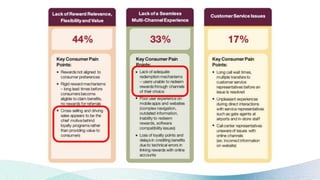
Solving the most common pain points related to loyalty programs:
● Lack of Reward Relevance
● Flexibility
● Value
● Lack of a Seamless Multi-Channel Experience
● Customer Service Issues
[Source: Capgemini Consulting Analysis, Social Media Scan conducted in December 2014
https://www.capgemini.com/consulting/wp-content/uploads/sites/30/2017/07/reinventing_loyalty_programs.pdf]
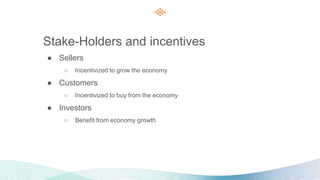
● Sellers
○ Incentivized to grow the economy
● Customers
○ Incentivized to buy from the economy
● Investors
○ Benefit from economy growth
Stake-Holders and incentives
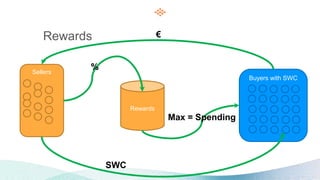
Rewards
Rewards
Sellers
Buyers with SWC
%
Max = Spending
€
SWC
Rewards
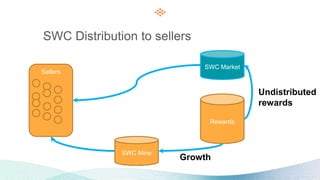
Sellers
SWC Mine
Undistributed
rewards
Growth
SWC Market
SWC Distribution to sellers
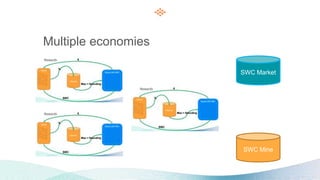
Multiple economies
SWC Mine
SWC Market
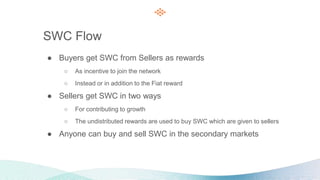
SWC Flow
● Buyers get SWC from Sellers as rewards
○ As incentive to join the network
○ Instead or in addition to the Fiat reward
● Sellers get SWC in two ways
○ For contributing to growth
○ The undistributed rewards are used to buy SWC which are given to sellers
● Anyone can buy and sell SWC in the secondary markets
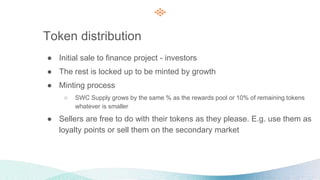
● Initial sale to finance project - investors
● The rest is locked up to be minted by growth
● Minting process
○ SWC Supply grows by the same % as the rewards pool or 10% of remaining tokens
whatever is smaller
● Sellers are free to do with their tokens as they please. E.g. use them as
loyalty points or sell them on the secondary market
Token distribution
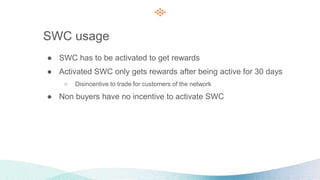
SWC usage
● SWC has to be activated to get rewards
● Activated SWC only gets rewards after being active for 30 days
○ Disincentive to trade for customers of the network
● Non buyers have no incentive to activate SWC
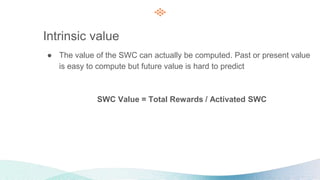
Intrinsic value
● The value of the SWC can actually be computed. Past or present value
is easy to compute but future value is hard to predict
SWC Value = Total Rewards / Activated SWC
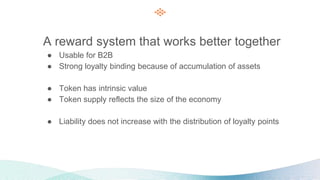
● Usable for B2B
● Strong loyalty binding because of accumulation of assets
● Token has intrinsic value
● Token supply reflects the size of the economy
● Liability does not increase with the distribution of loyalty points
A reward system that works better together
Sweetbridge Token Design & Discount Token

Sweetbridge Token Design & Discount Token

  • 1.
  • 2.
    Benefits Solving the mostcommon pain points related to loyalty programs: ● Lack of Reward Relevance ● Flexibility ● Value ● Lack of a Seamless Multi-Channel Experience ● Customer Service Issues [Source: Capgemini Consulting Analysis, Social Media Scan conducted in December 2014 https://www.capgemini.com/consulting/wp-content/uploads/sites/30/2017/07/reinventing_loyalty_programs.pdf]
  • 4.
    ● Sellers ○ Incentivizedto grow the economy ● Customers ○ Incentivized to buy from the economy ● Investors ○ Benefit from economy growth Stake-Holders and incentives
  • 5.
  • 6.
  • 7.
  • 8.
    SWC Flow ● Buyersget SWC from Sellers as rewards ○ As incentive to join the network ○ Instead or in addition to the Fiat reward ● Sellers get SWC in two ways ○ For contributing to growth ○ The undistributed rewards are used to buy SWC which are given to sellers ● Anyone can buy and sell SWC in the secondary markets
  • 9.
    ● Initial saleto finance project - investors ● The rest is locked up to be minted by growth ● Minting process ○ SWC Supply grows by the same % as the rewards pool or 10% of remaining tokens whatever is smaller ● Sellers are free to do with their tokens as they please. E.g. use them as loyalty points or sell them on the secondary market Token distribution
  • 10.
    SWC usage ● SWChas to be activated to get rewards ● Activated SWC only gets rewards after being active for 30 days ○ Disincentive to trade for customers of the network ● Non buyers have no incentive to activate SWC
  • 11.
    Intrinsic value ● Thevalue of the SWC can actually be computed. Past or present value is easy to compute but future value is hard to predict SWC Value = Total Rewards / Activated SWC
  • 12.
    ● Usable forB2B ● Strong loyalty binding because of accumulation of assets ● Token has intrinsic value ● Token supply reflects the size of the economy ● Liability does not increase with the distribution of loyalty points A reward system that works better together

Editor's Notes

  • #2 Who is sweetbrige Who am I My background My role within sweetbridge Thank you for listening to my talk about reward tokens
  • #3 Too many loyalty programs to remember. Average household participates in 21 programs Why should the customers care about the loyalty points? Value is the main contention point: exchanging loyalty points for services is not available over all channels
  • #4 The main goal of SWC is to provide increasing value to its holders The cashback from SWC ownership is seamless The owner of SWC is free to sell them on the secondary markets
  • #5 Sellers get rewarded for contributing to growth Customers get cashbacks when they spend in the network Investors benefit from the raising value without impacting the cashback
  • #6 Stakeholders are Sellers and buyers Sellers incentivize buyers to join by giving them SWC. This is not a mandatory step Buyers spend money at sellers in exchange for products and services Participant sellers contribute a fixed percentage of revenue to the rewards pool Tokens have to be locked in order to get rewards An arbitrary locking period of 30 days has been defined The value of each token locked up for at least 30 days is computed as follows Total Reward Pool / Sum(Activated Tokens) = Individual token reward The reward is capped at the owner’s spending The rewards pool is distributed according to the formula SWC Value * SWC held In addition to the rewards pool, sellers are free to distribute other rewards like the SWC they have earned from mining Giving SWC is a good idea as the more SWC customers have, the more likely they are to remain loyal Lack of Reward Relevance Flexibility Value Lack of a Seamless Multi-Channel Experience
  • #7 There are 3 ways to get SWC Buyback from undistributed rewards Mining by growing the economy Purchase from secondary markets As the rewards are capped to the spending of the buyers there might be overflow. This is used to buy SWC on the market The purchased SWC are then distributed to the Sellers in proportion to their contribution to the rewards pool Growth is. Computed on an absolute basis. The rewards pool must pass its last peak for growth to be registered The number of SWC grows by the same percentage as the rewards pool or 10% of the remaining SWC to be mined whatever is smaller
  • #8 At the beginning there will be only one economy but as the system grows, there is no reason to limit that Even if there are multiple economies there will be a single mining pool and probably only a handful of exchanges
  • #11 The activation requirement means that you can get cashback from only one network for any SWC you own. Activating SWC without buying has the effect of gifting SWC to all the sellers
  • #13 As the token increases in value, everyone wins so getting more companies on board is beneficial The token represents the size of the economy. The bigger it is the more valuable it becomes When you distribute an appreciating token to your customers they are more likely to stick around A token with intrinsic value allows nice features like alerting users when they can purchase an item with over X% discount As the cashback value is dependent on buyer spending and active SWC it varies all the time Normally each loyalty token is a liability, in the SWC system it is the rewards pool contribution which represents the liability. This means that the liability is the same (10% of revenue say) independent of the loyalty program or customer behaviour