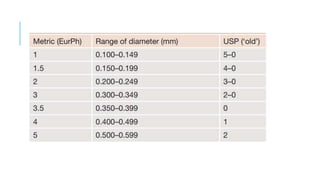
SUTURE MATERIALS
INTRODUCTION
Sutures are the medical devices used to co apt
tissue following trauma or surgery.
Sutures are crucial in surgical repair of wounds
, a proper understanding of their properties ,
interactions with body tissues, principle of use
and complications are necessary to ensure good
wound healing and safety.
SUTURE CHARACTERISTICS
Physical structure: monoflament or
multiflament.
● Monoflament sutures are smooth and tend to
slide through tissues easily, but are more
difficult to knot effectively. Tend to fracture
easily.
● Multiflament or braided sutures are much
easier to knot but have a surface area of several
thousand times that of monoflament sutures
and thus have a capillaryaction and interstices
where bacteria may lodge and be responsible
Strength:
The strength of a suture depends upon its
constituent material, thickness and its response to
various tissues and circumstances.
The tensile strength of a suture can be expressed as
the force required to break it when pulling the two
ends apart.
 Absorbable sutures show decay of this strength with
time,its tensile strength cannot be relied on in vivo for
this entire period.
even non-absorbable sutures do not necessarily
maintain their strength indefnitely. For example non-
absorbable materials of biological origin, such as silk,
will fragment with time and lose their strength.
Tensile behaviour: suture materials behave diferently
depending upon their deformability and fexibility.
Some may be ‘elastic’, in which case the material will
return to its original length once any tension is
released, while others may be ‘plastic’, in which case
this phenomenon does not occur.
Many synthetic materials demonstrate ‘memory’,
which means they keep curling up in the shape that
they adopted within the packaging. but the more
memory a suture material has, the less is the knot
security.
Absorbability: suture materials may be non-absorbable or
absorbable
Biological behaviour:
The biological behaviour of suture materials within the tissues
depends upon the constituent raw material. Biological or natural
sutures, such as catgut, are proteolysed, but this involves a process
that is not entirely predictable and can cause local irritation.
Man-made synthetic polymers are hydrolysed and their
disappearance in the tissues is more predictable.
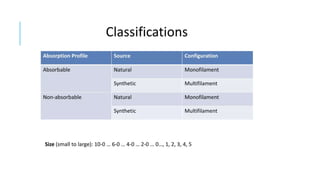
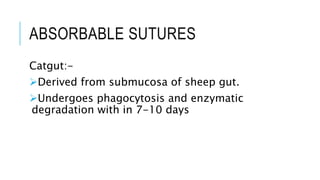
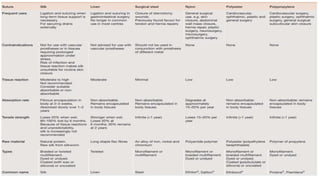
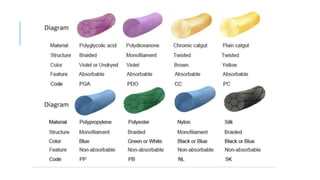
ABSORBABLE SUTURES
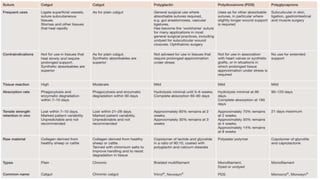
Catgut:-
Derived from submucosa of sheep gut.
Undergoes phagocytosis and enzymatic
degradation with in 7-10 days
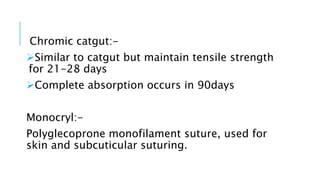
Chromic catgut:-
Similar to catgut but maintain tensile strength
for 21-28 days
Complete absorption occurs in 90days
Monocryl:-
Polyglecoprone monofilament suture, used for
skin and subcuticular suturing.
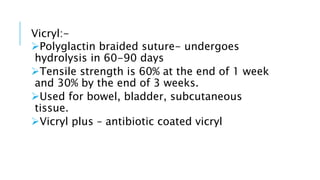
Vicryl:-
Polyglactin braided suture- undergoes
hydrolysis in 60-90 days
Tensile strength is 60% at the end of 1 week
and 30% by the end of 3 weeks.
Used for bowel, bladder, subcutaneous
tissue.
Vicryl plus – antibiotic coated vicryl
Polydiaxone (PDS):-
Monofilament suture- dissolves in 180 days
More expensive
Used for tracheobronchial repairs
Silk:-
Derived from silk worm
Used for fixing drains, skin , bowel
anastomosis.
NON ABSORBABLE
Prolene:-
Monofilament suture- used in hernia mesh
repair, rectus sheath closure, vascular
anastomosis.
Nylon:-
Monofilament suture- used for nerve repair,
tendon repair, skin closure.
Polybutester:-
Used in plastic surgery
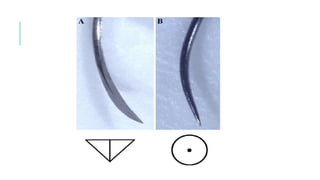
NEEDLE
Round Body:-
Cross section needle is round, relatively
atraumatic.
Cutting/reverse cutting:-
Cross section is triangular and can cause
trauma.
THANKYOU

SUTURES materials in general surgery .pptx

  • 1.
  • 2.
    INTRODUCTION Sutures are themedical devices used to co apt tissue following trauma or surgery. Sutures are crucial in surgical repair of wounds , a proper understanding of their properties , interactions with body tissues, principle of use and complications are necessary to ensure good wound healing and safety.
  • 4.
    SUTURE CHARACTERISTICS Physical structure:monoflament or multiflament. ● Monoflament sutures are smooth and tend to slide through tissues easily, but are more difficult to knot effectively. Tend to fracture easily. ● Multiflament or braided sutures are much easier to knot but have a surface area of several thousand times that of monoflament sutures and thus have a capillaryaction and interstices where bacteria may lodge and be responsible
  • 5.
    Strength: The strength ofa suture depends upon its constituent material, thickness and its response to various tissues and circumstances. The tensile strength of a suture can be expressed as the force required to break it when pulling the two ends apart.  Absorbable sutures show decay of this strength with time,its tensile strength cannot be relied on in vivo for this entire period. even non-absorbable sutures do not necessarily maintain their strength indefnitely. For example non- absorbable materials of biological origin, such as silk, will fragment with time and lose their strength.
  • 6.
    Tensile behaviour: suturematerials behave diferently depending upon their deformability and fexibility. Some may be ‘elastic’, in which case the material will return to its original length once any tension is released, while others may be ‘plastic’, in which case this phenomenon does not occur. Many synthetic materials demonstrate ‘memory’, which means they keep curling up in the shape that they adopted within the packaging. but the more memory a suture material has, the less is the knot security.
  • 7.
    Absorbability: suture materialsmay be non-absorbable or absorbable Biological behaviour: The biological behaviour of suture materials within the tissues depends upon the constituent raw material. Biological or natural sutures, such as catgut, are proteolysed, but this involves a process that is not entirely predictable and can cause local irritation. Man-made synthetic polymers are hydrolysed and their disappearance in the tissues is more predictable.
  • 10.
    ABSORBABLE SUTURES Catgut:- Derived fromsubmucosa of sheep gut. Undergoes phagocytosis and enzymatic degradation with in 7-10 days
  • 11.
    Chromic catgut:- Similar tocatgut but maintain tensile strength for 21-28 days Complete absorption occurs in 90days Monocryl:- Polyglecoprone monofilament suture, used for skin and subcuticular suturing.
  • 12.
    Vicryl:- Polyglactin braided suture-undergoes hydrolysis in 60-90 days Tensile strength is 60% at the end of 1 week and 30% by the end of 3 weeks. Used for bowel, bladder, subcutaneous tissue. Vicryl plus – antibiotic coated vicryl
  • 13.
    Polydiaxone (PDS):- Monofilament suture-dissolves in 180 days More expensive Used for tracheobronchial repairs
  • 14.
    Silk:- Derived from silkworm Used for fixing drains, skin , bowel anastomosis.
  • 15.
    NON ABSORBABLE Prolene:- Monofilament suture-used in hernia mesh repair, rectus sheath closure, vascular anastomosis. Nylon:- Monofilament suture- used for nerve repair, tendon repair, skin closure. Polybutester:- Used in plastic surgery
  • 19.
    NEEDLE Round Body:- Cross sectionneedle is round, relatively atraumatic. Cutting/reverse cutting:- Cross section is triangular and can cause trauma.
  • 22.