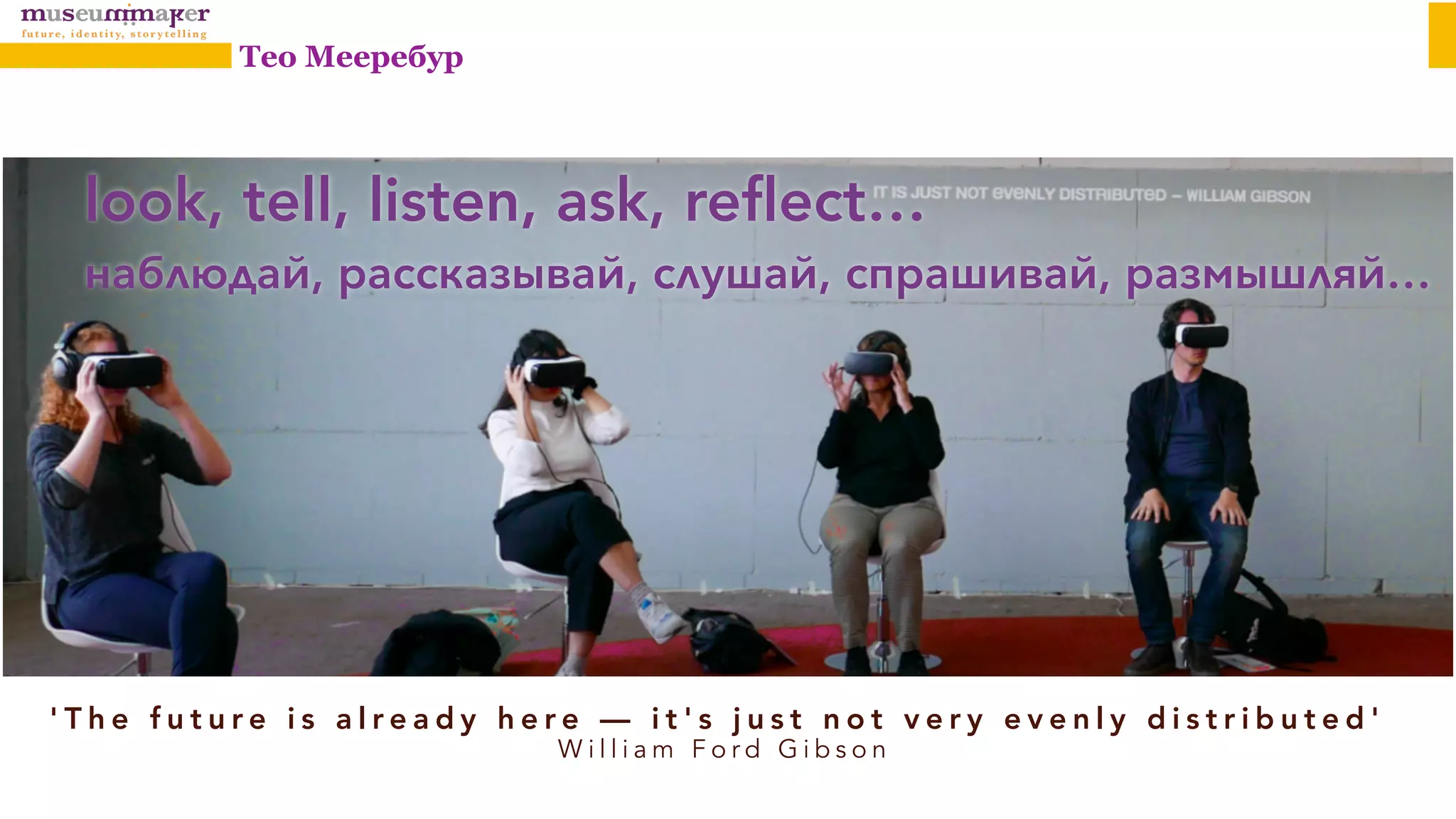
look, tell, listen, ask, reflect…

наблюдай, рассказывай, слушай, спрашивай, размышляй…
' T h e f u t u r e i s a l r e a d y h e r e — i t ' s j u s t n o t v e r y e v e n l y d i s t r i b u t e d ' 

W i l l i a m F o r d G i b s o n
Тео Мееребур
0. THE 21st CENTURY PARADIGM

our reaction to an era of dramatic changes
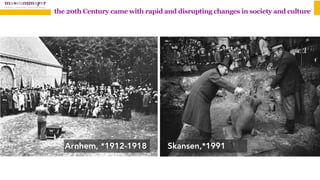
the 20th Century came with rapid and disrupting changes in society and culture
Arnhem, *1912-1918 Skansen,*1991
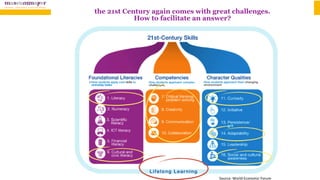
the 21st Century again comes with great challenges.
How to facilitate an answer?
How students approach complex
challenges
How students apply core skills to
everyday tasks
How students approach their changing
environment
`
` `
`
http://newleaf-llc.com/2013/07/defining-
sustainability-triple-bottom-line/
http://www.ibrc.indiana.edu/
ibr/2011/spring/article2.html
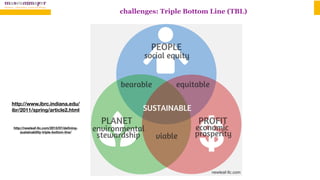
challenges: Triple Bottom Line (TBL)
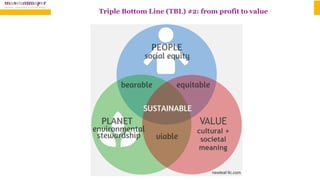
VALUE
cultural +
societal
meaning
Triple Bottom Line (TBL) #2: from profit to value
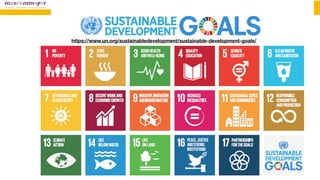
https://www.un.org/sustainabledevelopment/sustainable-development-goals/
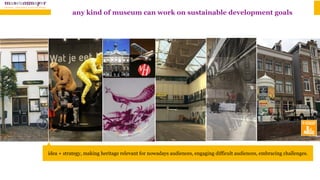
idea + strategy, making heritage relevant for nowadays audiences, engaging difficult audiences, embracing challenges.
any kind of museum can work on sustainable development goals
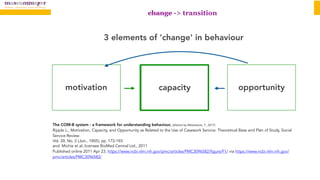
motivation opportunitycapability
3 elements of 'change' in behaviour
The COM-B system - a framework for understanding behaviour, (altered by Meereboer, T., 2017)
Ripple L., Motivation, Capacity, and Opportunity as Related to the Use of Casework Service: Theoretical Base and Plan of Study, Social
Service Review
Vol. 29, No. 2 (Jun., 1955), pp. 172-193
and: Michie et al; licensee BioMed Central Ltd., 2011
Published online 2011 Apr 23, https://www.ncbi.nlm.nih.gov/pmc/articles/PMC3096582/figure/F1/ via https://www.ncbi.nlm.nih.gov/
pmc/articles/PMC3096582/
capacity
change -> transition
1. THE MUSEUMS OF NOWADAYS FUTURE

dynamic heritage as a proces of transition & identity
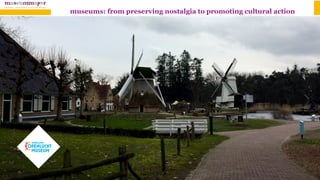
museums: from preserving nostalgia to promoting cultural action
Ivoss: MoluksebarakNederlandsOpenluchtmuseum.JPG
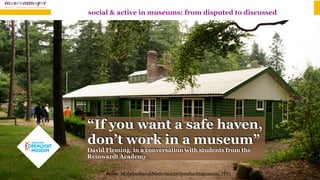
“If you want a safe haven,
don’t work in a museum”
David Fleming, in a conversation with students from the
Reinwardt Academy
social & active in museums: from disputed to discussed
value: everlasting issues for heritage institutions
• budget : which means value, in terms of financial support, income,
business model, but also mental support, relations, interest (also:
source community, support, etc.)
• knowledge: research, knowledge building, knowledge storage,
knowledge transfer, professionalism of volunteers, preventing a
braindrain, etc.
• relevancy: what is the museum about, why should you care, what
does it mean to you at this very moment, why should we care, how
can we support, co-create?
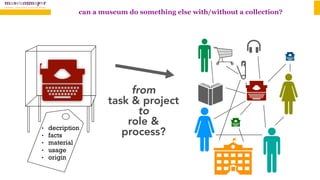
from
task & project
to
role &
process?• decription
• facts
• material
• usage
• origin
can a museum do something else with/without a collection?
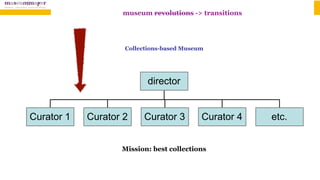
Curator 1 Curator 2 Curator 3 Curator 4 etc.
director
Collections-based Museum
Mission: best collections
museum revolutions -> transitions
Functions-based Museum
Conservation
Preservation Research
Collections
Exhibitions Education
Communication
director
Outreach Special needs
Documentation online
Mission: best functions
museum revolutions -> transitions
Mission: best purpose
board
sponsorspartners
director
collection
education programming presentation
communication relations development
special needs
social programs
training
wellbeing
co-creation
co-production
sustainability
prototyping
Values-based Museum
museum revolutions -> transitions
Transmissie:

- lineair (hoogstens plus feedback)

- er is een boodschap!
- zender/ontvanger
- ‘kennis’ is objectief
- de zender is wijs en alwetend
- de ontvanger is leeg + dom

- ‘deficit model’
museum revolutions -> transitions
Transmissie:

- lineair (hoogstens plus feedback)

- er is een boodschap!
- zender/ontvanger
- ‘kennis’ is objectief
- de zender is wijs en alwetend
- de ontvanger is leeg + dom

- ‘deficit model’
PARTICIPATORY
PEOPLE
+ PARTICIPATORY
PARTNERS
museum revolutions -> transitions
How about climate & culture?
https://sustainablemuseums.net/
"gradually the concept of socially responsible museum (Janes 2007:
141) is replaced by the concept of socially purposeful museum
(Leicester School of Museum Studies 2012): "a dynamic, vital
institution, that has rich relationships with diverse audiences that
nurtures participatory and co-creative practice and is part of people's
everyday lives; that seeks to foster progressive social values and, at
the same time, is widely recognised as a site for dialogue and debate
[…]"
(van Mensch and Meijer van Mensch 2015)
new museology and social activism
"Only a decade ago, the notion that museums, galleries and heritage
organisations might engage in activist practice, with explicit intent to
act upon inequalities, injustices and environmental crises, was met
with scepticism and often derision. Seeking to purposefully bring
about social change was viewed by many within and beyond the
museum community as inappropriately political and antithetical to
fundamental professional values. Today, although the idea remains
controversial, the way we think about the roles and responsibilities of
museums as knowledge based, social institutions is
changing. Museum Activism examines the increasing significance of
this activist trend in thinking and practice. […] wide-ranging
examination of new and divergent expressions of the inherent power
of museums as forces for good, and as activists in civil society, aims to
encourage further experimentation and enrich the debate in this
nascent and uncertain field of museum practice[…]" 

(Edited by Robert R. Janes, Richard Sandell, 2019) 

https://www.routledge.com/Museum-Activism/Janes-Sandell/p/book/9780815369974?fbclid=IwAR1rk-
eiAW6uXqJXDYscc1xwjj4rsld5XmCGIBAG4JZ19O3aHxvdTKq1Zv4
new museology and social activism
https://www.nytimes.com/2015/10/04/books/review/jonathan-franzen-reviews-sherry-turkle-reclaiming-conversation.html
https://www.inexhibit.com/case-studies/virtual-museums-part-2-today-and-beyond/
from virtuality (back) to real life conversations; human relations as a value?
foto via Dyonna Bennett
emotions & interaction in museums: from prejudice to perspectives &
interest; multi-perspectivity
perspectives on dynamic heritage
"The definition of heritage is dynamic, changing both over time and as the
public’s appreciation changes. As a result, frameworks and methods of
evaluation cannot remain static."

Cultural Heritage Agency / Ministry of Education, Culture and Science of the Netherlands
“At a time when the international community is discussing future development
goals, numerous efforts are focused on putting culture at the heart of the
global development agenda. Culture, in its manifold expressions ranging from
cultural heritage to cultural and creative industries and cultural tourism, is both
an enabler and a driver of the economic, social and environmental dimensions
of sustainable development.”
UNESCO
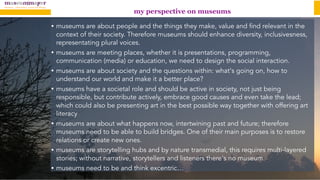
my perspective on museums
• museums are about people and the things they make, value and find relevant in the
context of their society. Therefore museums should enhance diversity, inclusivesness,
representating plural voices.
• museums are meeting places, whether it is presentations, programming,
communication (media) or education, we need to design the social interaction.
• museums are about society and the questions within: what's going on, how to
understand our world and make it a better place?
• museums have a societal role and should be active in society, not just being
responsible, but contribute actively, embrace good causes and even take the lead;
which could also be presenting art in the best possible way together with offering art
literacy
• museums are about what happens now, intertwining past and future; therefore
museums need to be able to build bridges. One of their main purposes is to restore
relations or create new ones.
• museums are storytelling hubs and by nature transmedial, this requires multi-layered
stories; without narrative, storytellers and listeners there's no museum.
• museums need to be and think excentric…
questions?
?
I have a question for you:
what are we going to earn?
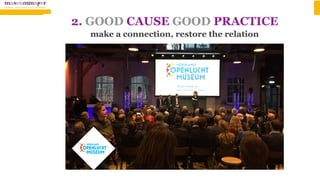
2. GOOD CAUSE GOOD PRACTICE

make a connection, restore the relation
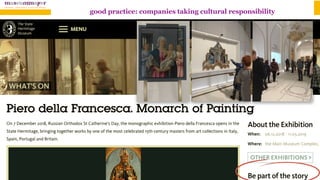
good practice: companies taking cultural responsibility
good practice: big companies taking responsibility
if companies show the
way and take
responsibility (and they
know their audiences),
museums should care as
well, and do the same.
Together they can build
trust, 'earn' respect,
attention, restore
relations, instill moral
values and make things
happen for the better.
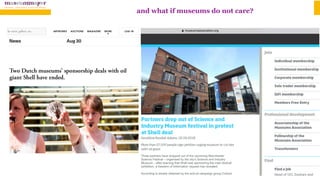
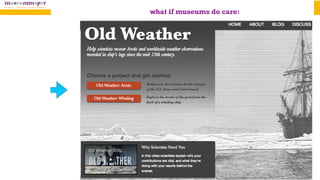
and what if museums do not care?
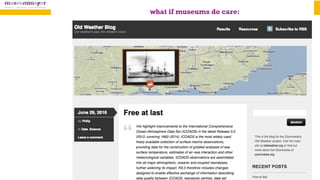
what if museums do care:
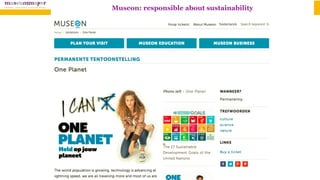
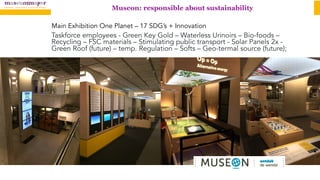
Museon: responsible about sustainability
Main Exhibition One Planet – 17 SDG’s + Innovation
Taskforce employees - Green Key Gold – Waterless Urinoirs – Bio-foods –
Recycling – FSC materials – Stimulating public transport - Solar Panels 2x -
Green Roof (future) – temp. Regulation – Softs – Geo-termal source (future);
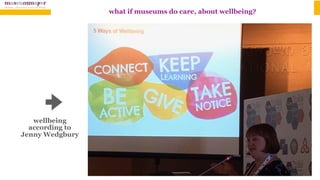
what if museums do care, about wellbeing?
wellbeing
according to
Jenny Wedgbury
what if heritage can bring peace, instead of exclusion?
what if heritage can build bridges, instead of separating cultures?
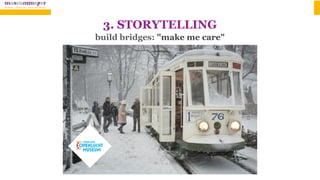
3. STORYTELLING

build bridges: "make me care"
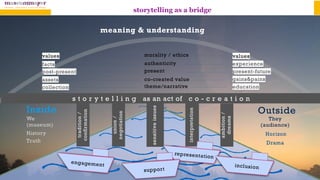
s t o r y t e l l i n g as an act of c o - c r e a t i o n
Inside Outside
tradition/
confirmation
meaning & understanding
union/
negotiation
sensitiveissues
interpretation
ambition/
dreams
collection theme/narrative education
engagement
We
(museum)
They
(audience)
assets co-created value gains&pains
post-present present present-future
History Horizon
Truth Drama
facts authenticity experience
representation
inclusion
support
storytelling as a bridge
values valuesmorality / ethics
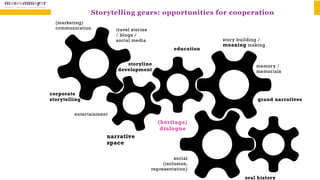
Storytelling gears: opportunities for cooperation
(heritage)
dialogue
oral history
(marketing)
communication
grand narratives
storyline
development
education
corporate
storytelling
story building /
meaning making
memory /
memorials
entertainment
social
(inclusion,
representation)
travel stories
/ blogs /
social media
narrative
space
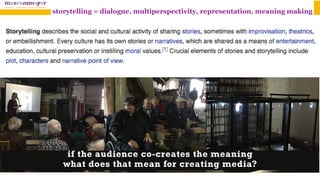
storytelling = dialogue, multiperspectivity, representation, meaning making
if the audience co-creates the meaning

what does that mean for creating media?
https://www.britanniaminemuseum.ca/Blog/museums-can-encourage-social-interaction
it is easy: storytelling = social interaction
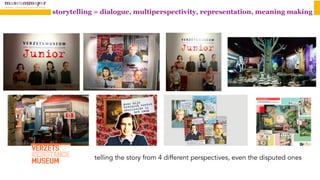
storytelling = dialogue, multiperspectivity, representation, meaning making
telling the story from 4 different perspectives, even the disputed ones
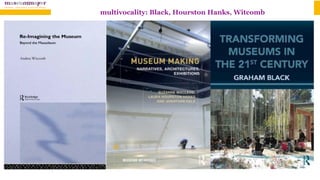
multivocality: Black, Hourston Hanks, Witcomb
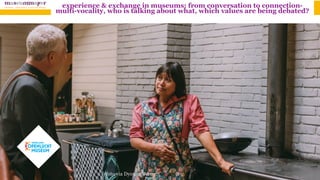
experience & exchange in museums: from conversation to connection-
multi-vocality, who is talking about what, which values are being debated?
foto via Dyonna Bennettfoto via Dyonna Bennett
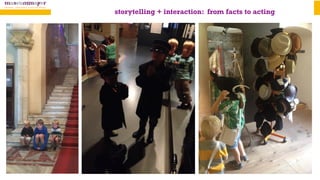
storytelling + interaction: from facts to acting
Experience Design 1.1 (2009) A Manifesto for the Design of Experiences By Nathan Shedroff
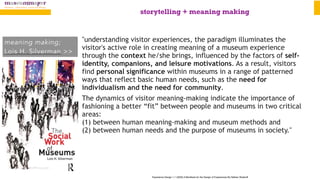
meaning making;
Lois H. Silverman >>
"understanding visitor experiences, the paradigm illuminates the
visitor's active role in creating meaning of a museum experience
through the context he/she brings, influenced by the factors of self-
identity, companions, and leisure motivations. As a result, visitors
find personal significance within museums in a range of patterned
ways that reflect basic human needs, such as the need for
individualism and the need for community.
The dynamics of visitor meaning-making indicate the importance of
fashioning a better “fit” between people and museums in two critical
areas: 

(1) between human meaning-making and museum methods and 

(2) between human needs and the purpose of museums in society."
storytelling + meaning making
LINDA KRONMAN |
ANDREAS ZINGERLE,
OPENING MUSEUMS; NEW
INTERACTION METHODS
FOR FUTURE MUSEUM
EXPERIENCES
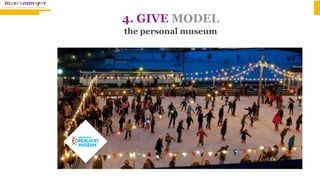
4. GIVE MODEL

the personal museum
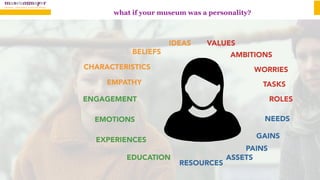
what if your museum was a personality?
ENGAGEMENT
EMOTIONS
IDEAS VALUES
AMBITIONS
TASKS
ROLES
BELIEFS
CHARACTERISTICS WORRIES
EMPATHY
NEEDS
GAINS
PAINS
ASSETS
RESOURCES
EXPERIENCES
EDUCATION
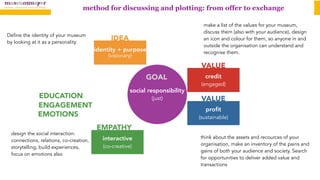
identity + purpose
(visionary)
IDEA
credit

(engaged)
VALUE
profit
(sustainable)
VALUE
interactive
(co-creative)
EDUCATION
social responsibility
(just)
GOAL
ENGAGEMENT
EMPATHY
EMOTIONS
method for discussing and plotting: from offer to exchange
make a list of the values for your museum,
discuss them (also with your audience), design
an icon and colour for them, so anyone in and
outside the organisation can understand and
recognise them.
think about the assets and recources of your
organisation, make an inventory of the pains and
gains of both your audience and society. Search
for opportunities to deliver added value and
transactions
Define the identity of your museum
by looking at it as a personality
design the social interaction:
connections, relations, co-creation,
storytelling, build experiences,
focus on emotions also
method for discussing and plotting: from goal to engagement
EMPATHIEEMPATHY
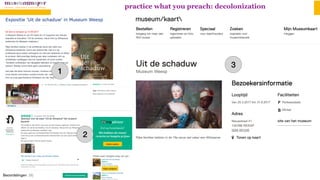
practice what you preach: decolonization
1
2
3
social & sustainable in museums: from responsible to purposeful
social & sustainable in my museum: plotting the SDG and values
Add:
• identity
• values
• themes
• storylines
• interactions
museums and sites are about taking care, for each other
Gatchina Palace
last question: what are you going to do tomorrow, to make the world a
better place?
FEEL FREE TO MAIL / FOLLOW ME:
tcmeereboer @ gmail . com
t.meereboer @ openluchtmuseum . nl
+31 6 48 777 421
…/in/theomeereboer
@theomeereboer
facebook.com/theomeereboer
THANK YOU FOR YOUR ATTENTION!

Sustainable Development Goals and Values for Museum

  • 1.
    look, tell, listen,ask, reflect…
 наблюдай, рассказывай, слушай, спрашивай, размышляй… ' T h e f u t u r e i s a l r e a d y h e r e — i t ' s j u s t n o t v e r y e v e n l y d i s t r i b u t e d ' 
 W i l l i a m F o r d G i b s o n Тео Мееребур
  • 2.
    0. THE 21stCENTURY PARADIGM
 our reaction to an era of dramatic changes
  • 3.
    the 20th Centurycame with rapid and disrupting changes in society and culture Arnhem, *1912-1918 Skansen,*1991
  • 4.
    the 21st Centuryagain comes with great challenges. How to facilitate an answer? How students approach complex challenges How students apply core skills to everyday tasks How students approach their changing environment ` ` ` `
  • 5.
  • 6.
    VALUE cultural + societal meaning Triple BottomLine (TBL) #2: from profit to value
  • 7.
  • 8.
    idea + strategy,making heritage relevant for nowadays audiences, engaging difficult audiences, embracing challenges. any kind of museum can work on sustainable development goals
  • 9.
    motivation opportunitycapability 3 elementsof 'change' in behaviour The COM-B system - a framework for understanding behaviour, (altered by Meereboer, T., 2017) Ripple L., Motivation, Capacity, and Opportunity as Related to the Use of Casework Service: Theoretical Base and Plan of Study, Social Service Review Vol. 29, No. 2 (Jun., 1955), pp. 172-193 and: Michie et al; licensee BioMed Central Ltd., 2011 Published online 2011 Apr 23, https://www.ncbi.nlm.nih.gov/pmc/articles/PMC3096582/figure/F1/ via https://www.ncbi.nlm.nih.gov/ pmc/articles/PMC3096582/ capacity change -> transition
  • 10.
    1. THE MUSEUMSOF NOWADAYS FUTURE
 dynamic heritage as a proces of transition & identity
  • 11.
    museums: from preservingnostalgia to promoting cultural action
  • 12.
    Ivoss: MoluksebarakNederlandsOpenluchtmuseum.JPG “If youwant a safe haven, don’t work in a museum” David Fleming, in a conversation with students from the Reinwardt Academy social & active in museums: from disputed to discussed
  • 13.
    value: everlasting issuesfor heritage institutions • budget : which means value, in terms of financial support, income, business model, but also mental support, relations, interest (also: source community, support, etc.) • knowledge: research, knowledge building, knowledge storage, knowledge transfer, professionalism of volunteers, preventing a braindrain, etc. • relevancy: what is the museum about, why should you care, what does it mean to you at this very moment, why should we care, how can we support, co-create?
  • 14.
    from task & project to role& process?• decription • facts • material • usage • origin can a museum do something else with/without a collection?
  • 15.
    Curator 1 Curator2 Curator 3 Curator 4 etc. director Collections-based Museum Mission: best collections museum revolutions -> transitions
  • 16.
    Functions-based Museum Conservation Preservation Research Collections ExhibitionsEducation Communication director Outreach Special needs Documentation online Mission: best functions museum revolutions -> transitions
  • 17.
    Mission: best purpose board sponsorspartners director collection educationprogramming presentation communication relations development special needs social programs training wellbeing co-creation co-production sustainability prototyping Values-based Museum museum revolutions -> transitions
  • 18.
    Transmissie:
 - lineair (hoogstensplus feedback)
 - er is een boodschap! - zender/ontvanger - ‘kennis’ is objectief - de zender is wijs en alwetend - de ontvanger is leeg + dom
 - ‘deficit model’ museum revolutions -> transitions
  • 19.
    Transmissie:
 - lineair (hoogstensplus feedback)
 - er is een boodschap! - zender/ontvanger - ‘kennis’ is objectief - de zender is wijs en alwetend - de ontvanger is leeg + dom
 - ‘deficit model’ PARTICIPATORY PEOPLE + PARTICIPATORY PARTNERS museum revolutions -> transitions
  • 20.
    How about climate& culture? https://sustainablemuseums.net/
  • 21.
    "gradually the conceptof socially responsible museum (Janes 2007: 141) is replaced by the concept of socially purposeful museum (Leicester School of Museum Studies 2012): "a dynamic, vital institution, that has rich relationships with diverse audiences that nurtures participatory and co-creative practice and is part of people's everyday lives; that seeks to foster progressive social values and, at the same time, is widely recognised as a site for dialogue and debate […]" (van Mensch and Meijer van Mensch 2015) new museology and social activism
  • 22.
    "Only a decadeago, the notion that museums, galleries and heritage organisations might engage in activist practice, with explicit intent to act upon inequalities, injustices and environmental crises, was met with scepticism and often derision. Seeking to purposefully bring about social change was viewed by many within and beyond the museum community as inappropriately political and antithetical to fundamental professional values. Today, although the idea remains controversial, the way we think about the roles and responsibilities of museums as knowledge based, social institutions is changing. Museum Activism examines the increasing significance of this activist trend in thinking and practice. […] wide-ranging examination of new and divergent expressions of the inherent power of museums as forces for good, and as activists in civil society, aims to encourage further experimentation and enrich the debate in this nascent and uncertain field of museum practice[…]" 
 (Edited by Robert R. Janes, Richard Sandell, 2019) 
 https://www.routledge.com/Museum-Activism/Janes-Sandell/p/book/9780815369974?fbclid=IwAR1rk- eiAW6uXqJXDYscc1xwjj4rsld5XmCGIBAG4JZ19O3aHxvdTKq1Zv4 new museology and social activism
  • 23.
  • 24.
    foto via DyonnaBennett emotions & interaction in museums: from prejudice to perspectives & interest; multi-perspectivity
  • 25.
    perspectives on dynamicheritage "The definition of heritage is dynamic, changing both over time and as the public’s appreciation changes. As a result, frameworks and methods of evaluation cannot remain static."
 Cultural Heritage Agency / Ministry of Education, Culture and Science of the Netherlands “At a time when the international community is discussing future development goals, numerous efforts are focused on putting culture at the heart of the global development agenda. Culture, in its manifold expressions ranging from cultural heritage to cultural and creative industries and cultural tourism, is both an enabler and a driver of the economic, social and environmental dimensions of sustainable development.” UNESCO
  • 26.
    my perspective onmuseums • museums are about people and the things they make, value and find relevant in the context of their society. Therefore museums should enhance diversity, inclusivesness, representating plural voices. • museums are meeting places, whether it is presentations, programming, communication (media) or education, we need to design the social interaction. • museums are about society and the questions within: what's going on, how to understand our world and make it a better place? • museums have a societal role and should be active in society, not just being responsible, but contribute actively, embrace good causes and even take the lead; which could also be presenting art in the best possible way together with offering art literacy • museums are about what happens now, intertwining past and future; therefore museums need to be able to build bridges. One of their main purposes is to restore relations or create new ones. • museums are storytelling hubs and by nature transmedial, this requires multi-layered stories; without narrative, storytellers and listeners there's no museum. • museums need to be and think excentric…
  • 27.
  • 28.
    I have aquestion for you: what are we going to earn?
  • 29.
    2. GOOD CAUSEGOOD PRACTICE
 make a connection, restore the relation
  • 30.
    good practice: companiestaking cultural responsibility
  • 31.
    good practice: bigcompanies taking responsibility if companies show the way and take responsibility (and they know their audiences), museums should care as well, and do the same. Together they can build trust, 'earn' respect, attention, restore relations, instill moral values and make things happen for the better.
  • 32.
    and what ifmuseums do not care?
  • 33.
  • 34.
  • 35.
  • 36.
    Museon: responsible aboutsustainability Main Exhibition One Planet – 17 SDG’s + Innovation Taskforce employees - Green Key Gold – Waterless Urinoirs – Bio-foods – Recycling – FSC materials – Stimulating public transport - Solar Panels 2x - Green Roof (future) – temp. Regulation – Softs – Geo-termal source (future);
  • 37.
    what if museumsdo care, about wellbeing? wellbeing according to Jenny Wedgbury
  • 38.
    what if heritagecan bring peace, instead of exclusion?
  • 39.
    what if heritagecan build bridges, instead of separating cultures?
  • 40.
  • 41.
    s t or y t e l l i n g as an act of c o - c r e a t i o n Inside Outside tradition/ confirmation meaning & understanding union/ negotiation sensitiveissues interpretation ambition/ dreams collection theme/narrative education engagement We (museum) They (audience) assets co-created value gains&pains post-present present present-future History Horizon Truth Drama facts authenticity experience representation inclusion support storytelling as a bridge values valuesmorality / ethics
  • 42.
    Storytelling gears: opportunitiesfor cooperation (heritage) dialogue oral history (marketing) communication grand narratives storyline development education corporate storytelling story building / meaning making memory / memorials entertainment social (inclusion, representation) travel stories / blogs / social media narrative space
  • 43.
    storytelling = dialogue,multiperspectivity, representation, meaning making if the audience co-creates the meaning
 what does that mean for creating media?
  • 44.
  • 45.
    storytelling = dialogue,multiperspectivity, representation, meaning making telling the story from 4 different perspectives, even the disputed ones
  • 46.
  • 47.
    experience & exchangein museums: from conversation to connection- multi-vocality, who is talking about what, which values are being debated? foto via Dyonna Bennettfoto via Dyonna Bennett
  • 48.
    storytelling + interaction:from facts to acting
  • 49.
    Experience Design 1.1(2009) A Manifesto for the Design of Experiences By Nathan Shedroff meaning making; Lois H. Silverman >> "understanding visitor experiences, the paradigm illuminates the visitor's active role in creating meaning of a museum experience through the context he/she brings, influenced by the factors of self- identity, companions, and leisure motivations. As a result, visitors find personal significance within museums in a range of patterned ways that reflect basic human needs, such as the need for individualism and the need for community. The dynamics of visitor meaning-making indicate the importance of fashioning a better “fit” between people and museums in two critical areas: 
 (1) between human meaning-making and museum methods and 
 (2) between human needs and the purpose of museums in society." storytelling + meaning making
  • 50.
    LINDA KRONMAN | ANDREASZINGERLE, OPENING MUSEUMS; NEW INTERACTION METHODS FOR FUTURE MUSEUM EXPERIENCES
  • 51.
    4. GIVE MODEL
 thepersonal museum
  • 52.
    what if yourmuseum was a personality? ENGAGEMENT EMOTIONS IDEAS VALUES AMBITIONS TASKS ROLES BELIEFS CHARACTERISTICS WORRIES EMPATHY NEEDS GAINS PAINS ASSETS RESOURCES EXPERIENCES EDUCATION
  • 53.
    identity + purpose (visionary) IDEA credit
 (engaged) VALUE profit (sustainable) VALUE interactive (co-creative) EDUCATION socialresponsibility (just) GOAL ENGAGEMENT EMPATHY EMOTIONS method for discussing and plotting: from offer to exchange make a list of the values for your museum, discuss them (also with your audience), design an icon and colour for them, so anyone in and outside the organisation can understand and recognise them. think about the assets and recources of your organisation, make an inventory of the pains and gains of both your audience and society. Search for opportunities to deliver added value and transactions Define the identity of your museum by looking at it as a personality design the social interaction: connections, relations, co-creation, storytelling, build experiences, focus on emotions also
  • 54.
    method for discussingand plotting: from goal to engagement EMPATHIEEMPATHY
  • 55.
    practice what youpreach: decolonization 1 2 3
  • 56.
    social & sustainablein museums: from responsible to purposeful
  • 57.
    social & sustainablein my museum: plotting the SDG and values Add: • identity • values • themes • storylines • interactions
  • 58.
    museums and sitesare about taking care, for each other Gatchina Palace
  • 59.
    last question: whatare you going to do tomorrow, to make the world a better place?
  • 60.
    FEEL FREE TOMAIL / FOLLOW ME: tcmeereboer @ gmail . com t.meereboer @ openluchtmuseum . nl +31 6 48 777 421 …/in/theomeereboer @theomeereboer facebook.com/theomeereboer THANK YOU FOR YOUR ATTENTION!