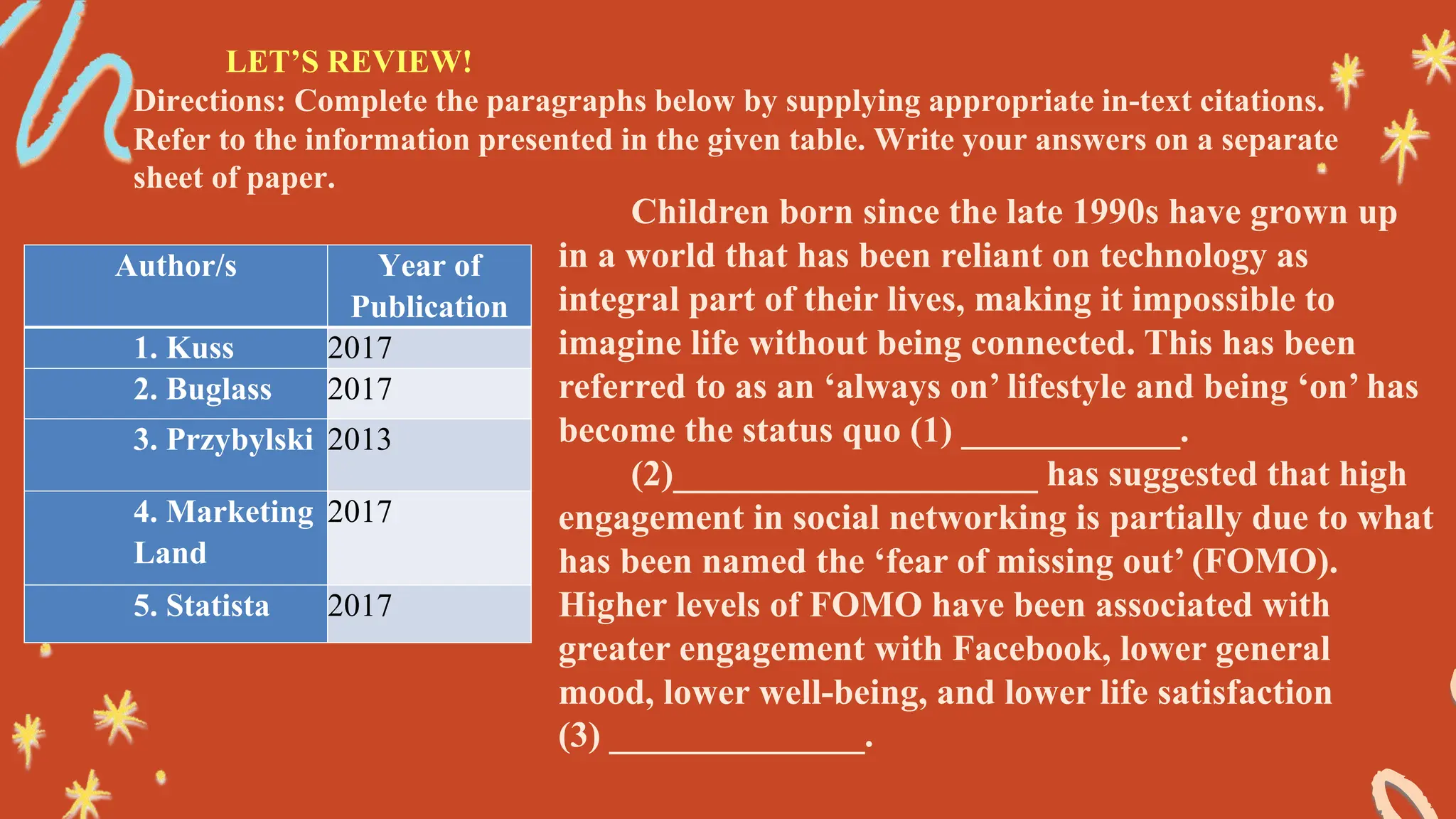
LET’S REVIEW!
Directions: Complete the paragraphs below by supplying appropriate in-text citations.
Refer to the information presented in the given table. Write your answers on a separate
sheet of paper.
Author/s Year of
Publication
1. Kuss 2017
2. Buglass 2017
3. Przybylski 2013
4. Marketing
Land
2017
5. Statista 2017
Children born since the late 1990s have grown up
in a world that has been reliant on technology as
integral part of their lives, making it impossible to
imagine life without being connected. This has been
referred to as an ‘always on’ lifestyle and being ‘on’ has
become the status quo (1) ____________.
(2)____________________ has suggested that high
engagement in social networking is partially due to what
has been named the ‘fear of missing out’ (FOMO).
Higher levels of FOMO have been associated with
greater engagement with Facebook, lower general
mood, lower well-being, and lower life satisfaction
(3) ______________.
LET’S REVIEW!
Directions: Complete the paragraphs below by supplying appropriate in-text citations.
Refer to the information presented in the given table. Write your answers on a separate
sheet of paper.
Author/s Year of
Publication
1. Kuss 2017
2. Buglass 2017
3. Przybylski 2013
4. Marketing
Land
2017
5. Statista 2017
Using social networking sites is a
particularly popular activity on smartphones,
with around 80% of social media used via
mobile technologies (4) __________________.
(5) _________________ found out that
approximately 75% of Facebook users access
Social Networking Sites (SNS) via their
mobile phones.
LET’S REVIEW!
Directions: Complete the paragraphs below by supplying appropriate in-text citations.
Refer to the information presented in the given table. Write your answers on a separate
sheet of paper.
Author/s Year of
Publication
1. Kuss 2017
2. Buglass 2017
3. Przybylski 2013
4. Marketing
Land
2017
5. Statista 2017
Children born since the late 1990s have grown up
in a world that has been reliant on technology as
integral part of their lives, making it impossible to
imagine life without being connected. This has been
referred to as an ‘always on’ lifestyle and being ‘on’ has
become the status quo (1) ____________.
(2)____________________ has suggested that high
engagement in social networking is partially due to what
has been named the ‘fear of missing out’ (FOMO).
Higher levels of FOMO have been associated with
greater engagement with Facebook, lower general
mood, lower well-being, and lower life satisfaction
(3) ________________.
(Kuss, 2017)
Buglass (2017)
(Przybylski, 2013)
LET’S REVIEW!
Directions: Complete the paragraphs below by supplying appropriate in-text citations.
Refer to the information presented in the given table. Write your answers on a separate
sheet of paper.
Author/s Year of
Publication
1. Kuss 2017
2. Buglass 2017
3. Przybylski 2013
4. Marketing
Land
2017
5. Statista 2017
Using social networking sites is a
particularly popular activity on smartphones,
with around 80% of social media used via
mobile technologies (4) __________________.
(5) _________________ found out that
approximately 75% of Facebook users access
Social Networking Sites (SNS) via their
mobile phones.
(Marketing Land, 2017)
Statista (2017)
What is your
name?
How old are
you?
What is your
gender?
a. SINGLE
b.MARRIED
c.WIDOWED
d.SEPARATED
What is your
relationship status?
a. Excellent
b.Somewhatgood
c.Average
d.SomewhatPoor
Overall, how would you
rate your mental health?
e. Poor
f. Notsure
a. YES
b. NO
c.NOTSURE
During the past 4 weeks, have you had any
problems with your work or daily life due to
any emotional problems, such as feeling
depressed, sad or anxious?
a. VeryOften
b.SomewhatOften
c.Notsooften
d.Notatall
Have you felt particularly low
or down for more than 2
weeks in a row?
a. Never
b.Onceinawhile
c.Abouthalfthetime
d.Mostofthetime
How often do you
experience being calm and
peaceful?
e. Always
a. Never
b.Onceinawhile
c.Abouthalfthetime
d.Mostofthetime
How often do you
experience being
energetic?
e. Always
a. Never
b.Onceinawhile
c.Abouthalfthetime
d.Mostofthetime
How often do you
experience being gloomy?
e. Always
a. Never
b.Onceinawhile
c.Abouthalfthetime
d.Mostofthetime
How often do you
experience being angry?
e. Always
a. Fewdaysago
b.Fewweeksago
c.Fewmonthsago
d.Fewyearsago
When was the last time
you were really happy?
e.Idon’tremember
a. Fewdaysago
b.Fewweeksago
c.Fewmonthsago
d.Fewyearsago
When was the last time you
felt good about yourself?
e.Idon’tremember
a. Never
b.Onceinawhile
c.Abouthalfthetime
d.Mostofthetime
How often do you feel
positive about your life?
e. Always
a. YES
b. NO
Are you going through a tough
emotional situation?
Directions: Rearranged the letters and write the word that you have formed in the blanks
in the following statements. Write your answers on a clean sheet of paper.
1. Focus on asking ____________questions.
L C S O E – N E E D D
2. Don’t ask for _______ things at once.
W O T
3. Make sure your questions do not ______.
V E O R P A L
4. Keep your survey questions ________.
E N T U A L R
5. Keep a _______ set of answers/choices.
A L B N A E D C
Directions: Rearranged the letters and write the word that you have formed in the blanks
in the following statements. Write your answers on a clean sheet of paper.
1. Focus on asking ________________ questions.
L C S O E – N E E D D
2. Don’t ask for _______ things at once.
W O T
3. Make sure your questions do not ___________.
V E O R P A L
4. Keep your survey questions ____________.
E N T U A L R
5. Keep a _____________ set of answers/choices.
A L B N A E D C
close-ended
two
overlap
neutral
balanced
Here are the tips in
constructing a survey:
Focus on asking close-ended questions.
Don’t ask for two things at once.
Make sure your questions do not overlap.
Keep your survey questions neutral.
Keep a balanced set of answers/choices.
Formulating questions for a
quantitative research is different from
a qualitative one. If you remember,
quantitative research involves
collecting and analyzing numerical
data while qualitative research
collects and analyzes non-numerical
data.
For example:
How does New Normal Education affects your time management now
that you are learning from the convenience of your home?
Qualitative Research
The commonly used data collection
method is INTERVIEW (personally
asking people questions in one-on-
one conversations).
You may also gather qualitative data
through a ‘survey’ but your questions
should be open-ended.
This question is an open-
ended one. If you notice, it
does not provide the
respondents a pre-
determined set of answer
choices, instead allowing
them to provide responses
in their own words. Their
answers will serve as your
qualitative data.
Translate your research
questions to survey
ones.
F
o
r
ex
a
m
p
l
e
:
Research Question: What are the common factors that affect
students’ time management?
Survey Question: Which of the following factors commonly
affect your time management?
_____ Distraction
_____ Motivation
_____ Priorities
_____ Procrastination
_____ Stress
Others, please specify: _________
Directions: Identify which of the following statements are the tips in constructing a
survey. Write TIPS if it is one of the tips and LEAVE IT BLANK if it is not.
Write your answers on a clean sheet of paper.
__________1. Focus on asking close-ended questions.
__________2. Don’t ask for two things at once.
__________3. Make sure your questions do not overlap.
__________4. It should address directly or indirectly some
real problems in the world.
__________5. Keep your survey questions neutral.
__________6. Without specific areas of focus, it will be hard to
even know where to begin.
__________7. Keep a balanced set of answers/choices.
Directions: Identify which of the following statements are the tips in constructing a
survey. Write TIPS if it is one of the tips and LEAVE IT BLANK if it is not.
Write your answers on a clean sheet of paper.
__________1. Focus on asking close-ended questions.
__________2. Don’t ask for two things at once.
__________3. Make sure your questions do not overlap.
__________4. It should address directly or indirectly some
real problems in the world.
__________5. Keep your survey questions neutral.
__________6. Without specific areas of focus, it will be hard to
even know where to begin.
__________7. Keep a balanced set of answers/choices.
TIPS
TIPS
TIPS
TIPS
TIPS
Directions: Based on the research questions of your own research
topic, formulate your survey questions and come up with a
survey questionnaire. Do this on a separate sheet of paper.
Research Question 1:
_________________________________________________.
Survey Question 1:
__________________________________________________.
Research Question 2:
__________________________________________________.
Survey Question 2:
__________________________________________________.
ASSIGNMENT:
Construct your own survey questions
based on the given research questions.
1. What are the advantages and disadvantages of
Facebook?
Survey Question: _____________________________
2. What effect does the daily use of YouTube have on the
attention span of children aged under 16?
Survey Question: _____________________________
3. How do students at our school spend their weekends?
Survey Question: __________________________
PRESENTED BY: ELEANOR FITZGERALD
YOUR
TOPIC HERE
#1 HEADLINE
#2 HEADLINE
#3 HEADLINE
#4 HEADLINE
#5 HEADLINE
TOPIC OUTLINE
Today's Discussion
INTRODUCTION
HEADLINE
Your catchy opening statem
ent here.
Jumpstart your presentation by introducing the concepts
and topics for the day.Then,ask questions to interact
with your students. You can duplicate this slide as much
as you want to customize your presentation. You can
also add other related visuals to capture the attention of
your audience.
HEADLI
NE
HER
E
Your catchy opening statem
ent here.
Jumpstart your presentation by introducing the concepts
and topics for the day.Then,ask questions to interact
with your students. You can duplicate this slide as much
as you want to customize your presentation. You can
also add other related visuals to capture the attention of
your audience.
HEADLINE
HEADLINE HERE
HEADLINE
Y
our catchy opening statement here.
Ask questions to interact with your students. You can
duplicate this slide as much as you want to customize
your presentation. You can also add other related visuals
to capture the attention of your audience.
HEADLINE
HE
RE
HEADLINE
Y
our catchy opening statement here.
Ask questions to interact with your students. You can
duplicate this slide as much as you want to customize
your presentation. You can also add other related visuals
to capture the attention of your audience.
HEADLINE
HERE
HEADLINE HERE
HEADLINE
Y
our catchy opening statement here.
Ask questions to interact with your students. You can
duplicate this slide as much as you want to customize
your presentation. You can also add other related visuals
to capture the attention of your audience.
HEADLINE
HERE
HEADLINE
HE
RE
HEADLINE
Y
our catchy opening statement here.
Ask questions to interact with your students. You can
duplicate this slide as much as you want to customize
your presentation. You can also add other related visuals
to capture the attention of your audience.
HEADLINE
HERE
THE S
K
I
N
HEADLINE
Y
our catchy opening statement here.
Ask questions to interact with your students. You can
duplicate this slide as much as you want to customize
your presentation. You can also add other related visuals
to capture the attention of your audience.
REVIEW
Review #2
That’s a salad wrap!Finally,you
can fill this section to summarize
your presentation.
Review #
1
That’s a salad wrap!Finally,you
can fill this section to summarize
your presentation.
Review #4
That’s a salad wrap!Finally,you
can fill this section to summarize
your presentation.
Review #3
That’s a salad wrap!Finally,you
can fill this section to summarize
your presentation.
SUMMARY
Y
our catchy opening statement here.
Ask questions to interact with your students. You can
duplicate this slide as much as you want to customize
your presentation. You can also add other related visuals
to capture the attention of your audience.
You can also add other related visuals to capture
the attention of your audience.
THANK
YOU FOR
LISTENING
FREE
RESOURCE
PAGE
You can use these
gorgeous elements to
customize the slides.
FREE
RESOURCE
PAGE
You can use these
gorgeous elements to
customize the slides.
FREE
RESOURCE
PAGE
You can use these
gorgeous elements to
customize the slides.
A. Directions: Think of a topic for a research paper. Then, using the spider
map, put the topic inside the body of the spider and the terms that are related to
your main topic in the smaller circles. Remember, these terms should be related to
your topic and will help you complete your research paper. Use a separate sheet of
paper to do this.
B. Directions: Make an operational definition of terms for your
research paper. Use a separate sheet of paper to do this.
(Operational Definition of Terms)
Topic: ___________________________________
TERM DEFINITION
1.
2.
3.
4.
5.
6.
7.
8.

SURVEY-QUESTIONS.pptx

  • 1.
    LET’S REVIEW! Directions: Completethe paragraphs below by supplying appropriate in-text citations. Refer to the information presented in the given table. Write your answers on a separate sheet of paper. Author/s Year of Publication 1. Kuss 2017 2. Buglass 2017 3. Przybylski 2013 4. Marketing Land 2017 5. Statista 2017 Children born since the late 1990s have grown up in a world that has been reliant on technology as integral part of their lives, making it impossible to imagine life without being connected. This has been referred to as an ‘always on’ lifestyle and being ‘on’ has become the status quo (1) ____________. (2)____________________ has suggested that high engagement in social networking is partially due to what has been named the ‘fear of missing out’ (FOMO). Higher levels of FOMO have been associated with greater engagement with Facebook, lower general mood, lower well-being, and lower life satisfaction (3) ______________.
  • 2.
    LET’S REVIEW! Directions: Completethe paragraphs below by supplying appropriate in-text citations. Refer to the information presented in the given table. Write your answers on a separate sheet of paper. Author/s Year of Publication 1. Kuss 2017 2. Buglass 2017 3. Przybylski 2013 4. Marketing Land 2017 5. Statista 2017 Using social networking sites is a particularly popular activity on smartphones, with around 80% of social media used via mobile technologies (4) __________________. (5) _________________ found out that approximately 75% of Facebook users access Social Networking Sites (SNS) via their mobile phones.
  • 3.
    LET’S REVIEW! Directions: Completethe paragraphs below by supplying appropriate in-text citations. Refer to the information presented in the given table. Write your answers on a separate sheet of paper. Author/s Year of Publication 1. Kuss 2017 2. Buglass 2017 3. Przybylski 2013 4. Marketing Land 2017 5. Statista 2017 Children born since the late 1990s have grown up in a world that has been reliant on technology as integral part of their lives, making it impossible to imagine life without being connected. This has been referred to as an ‘always on’ lifestyle and being ‘on’ has become the status quo (1) ____________. (2)____________________ has suggested that high engagement in social networking is partially due to what has been named the ‘fear of missing out’ (FOMO). Higher levels of FOMO have been associated with greater engagement with Facebook, lower general mood, lower well-being, and lower life satisfaction (3) ________________. (Kuss, 2017) Buglass (2017) (Przybylski, 2013)
  • 4.
    LET’S REVIEW! Directions: Completethe paragraphs below by supplying appropriate in-text citations. Refer to the information presented in the given table. Write your answers on a separate sheet of paper. Author/s Year of Publication 1. Kuss 2017 2. Buglass 2017 3. Przybylski 2013 4. Marketing Land 2017 5. Statista 2017 Using social networking sites is a particularly popular activity on smartphones, with around 80% of social media used via mobile technologies (4) __________________. (5) _________________ found out that approximately 75% of Facebook users access Social Networking Sites (SNS) via their mobile phones. (Marketing Land, 2017) Statista (2017)
  • 5.
  • 6.
  • 7.
  • 8.
  • 9.
    a. Excellent b.Somewhatgood c.Average d.SomewhatPoor Overall, howwould you rate your mental health? e. Poor f. Notsure
  • 10.
    a. YES b. NO c.NOTSURE Duringthe past 4 weeks, have you had any problems with your work or daily life due to any emotional problems, such as feeling depressed, sad or anxious?
  • 11.
    a. VeryOften b.SomewhatOften c.Notsooften d.Notatall Have youfelt particularly low or down for more than 2 weeks in a row?
  • 12.
    a. Never b.Onceinawhile c.Abouthalfthetime d.Mostofthetime How oftendo you experience being calm and peaceful? e. Always
  • 13.
  • 14.
  • 15.
  • 16.
    a. Fewdaysago b.Fewweeksago c.Fewmonthsago d.Fewyearsago When wasthe last time you were really happy? e.Idon’tremember
  • 17.
    a. Fewdaysago b.Fewweeksago c.Fewmonthsago d.Fewyearsago When wasthe last time you felt good about yourself? e.Idon’tremember
  • 18.
    a. Never b.Onceinawhile c.Abouthalfthetime d.Mostofthetime How oftendo you feel positive about your life? e. Always
  • 19.
    a. YES b. NO Areyou going through a tough emotional situation?
  • 20.
    Directions: Rearranged theletters and write the word that you have formed in the blanks in the following statements. Write your answers on a clean sheet of paper. 1. Focus on asking ____________questions. L C S O E – N E E D D 2. Don’t ask for _______ things at once. W O T 3. Make sure your questions do not ______. V E O R P A L 4. Keep your survey questions ________. E N T U A L R 5. Keep a _______ set of answers/choices. A L B N A E D C
  • 21.
    Directions: Rearranged theletters and write the word that you have formed in the blanks in the following statements. Write your answers on a clean sheet of paper. 1. Focus on asking ________________ questions. L C S O E – N E E D D 2. Don’t ask for _______ things at once. W O T 3. Make sure your questions do not ___________. V E O R P A L 4. Keep your survey questions ____________. E N T U A L R 5. Keep a _____________ set of answers/choices. A L B N A E D C close-ended two overlap neutral balanced
  • 22.
    Here are thetips in constructing a survey: Focus on asking close-ended questions. Don’t ask for two things at once. Make sure your questions do not overlap. Keep your survey questions neutral. Keep a balanced set of answers/choices.
  • 23.
    Formulating questions fora quantitative research is different from a qualitative one. If you remember, quantitative research involves collecting and analyzing numerical data while qualitative research collects and analyzes non-numerical data.
  • 24.
    For example: How doesNew Normal Education affects your time management now that you are learning from the convenience of your home? Qualitative Research The commonly used data collection method is INTERVIEW (personally asking people questions in one-on- one conversations). You may also gather qualitative data through a ‘survey’ but your questions should be open-ended. This question is an open- ended one. If you notice, it does not provide the respondents a pre- determined set of answer choices, instead allowing them to provide responses in their own words. Their answers will serve as your qualitative data.
  • 25.
    Translate your research questionsto survey ones. F o r ex a m p l e : Research Question: What are the common factors that affect students’ time management? Survey Question: Which of the following factors commonly affect your time management? _____ Distraction _____ Motivation _____ Priorities _____ Procrastination _____ Stress Others, please specify: _________
  • 26.
    Directions: Identify whichof the following statements are the tips in constructing a survey. Write TIPS if it is one of the tips and LEAVE IT BLANK if it is not. Write your answers on a clean sheet of paper. __________1. Focus on asking close-ended questions. __________2. Don’t ask for two things at once. __________3. Make sure your questions do not overlap. __________4. It should address directly or indirectly some real problems in the world. __________5. Keep your survey questions neutral. __________6. Without specific areas of focus, it will be hard to even know where to begin. __________7. Keep a balanced set of answers/choices.
  • 27.
    Directions: Identify whichof the following statements are the tips in constructing a survey. Write TIPS if it is one of the tips and LEAVE IT BLANK if it is not. Write your answers on a clean sheet of paper. __________1. Focus on asking close-ended questions. __________2. Don’t ask for two things at once. __________3. Make sure your questions do not overlap. __________4. It should address directly or indirectly some real problems in the world. __________5. Keep your survey questions neutral. __________6. Without specific areas of focus, it will be hard to even know where to begin. __________7. Keep a balanced set of answers/choices. TIPS TIPS TIPS TIPS TIPS
  • 28.
    Directions: Based onthe research questions of your own research topic, formulate your survey questions and come up with a survey questionnaire. Do this on a separate sheet of paper. Research Question 1: _________________________________________________. Survey Question 1: __________________________________________________. Research Question 2: __________________________________________________. Survey Question 2: __________________________________________________.
  • 29.
    ASSIGNMENT: Construct your ownsurvey questions based on the given research questions. 1. What are the advantages and disadvantages of Facebook? Survey Question: _____________________________ 2. What effect does the daily use of YouTube have on the attention span of children aged under 16? Survey Question: _____________________________ 3. How do students at our school spend their weekends? Survey Question: __________________________
  • 30.
    PRESENTED BY: ELEANORFITZGERALD YOUR TOPIC HERE
  • 31.
    #1 HEADLINE #2 HEADLINE #3HEADLINE #4 HEADLINE #5 HEADLINE TOPIC OUTLINE Today's Discussion
  • 32.
    INTRODUCTION HEADLINE Your catchy openingstatem ent here. Jumpstart your presentation by introducing the concepts and topics for the day.Then,ask questions to interact with your students. You can duplicate this slide as much as you want to customize your presentation. You can also add other related visuals to capture the attention of your audience.
  • 33.
    HEADLI NE HER E Your catchy openingstatem ent here. Jumpstart your presentation by introducing the concepts and topics for the day.Then,ask questions to interact with your students. You can duplicate this slide as much as you want to customize your presentation. You can also add other related visuals to capture the attention of your audience.
  • 34.
  • 35.
    HEADLINE HERE HEADLINE Y our catchyopening statement here. Ask questions to interact with your students. You can duplicate this slide as much as you want to customize your presentation. You can also add other related visuals to capture the attention of your audience.
  • 36.
    HEADLINE HE RE HEADLINE Y our catchy openingstatement here. Ask questions to interact with your students. You can duplicate this slide as much as you want to customize your presentation. You can also add other related visuals to capture the attention of your audience.
  • 37.
  • 38.
    HEADLINE HERE HEADLINE Y our catchyopening statement here. Ask questions to interact with your students. You can duplicate this slide as much as you want to customize your presentation. You can also add other related visuals to capture the attention of your audience.
  • 39.
  • 40.
    HEADLINE HE RE HEADLINE Y our catchy openingstatement here. Ask questions to interact with your students. You can duplicate this slide as much as you want to customize your presentation. You can also add other related visuals to capture the attention of your audience.
  • 41.
  • 42.
    THE S K I N HEADLINE Y our catchyopening statement here. Ask questions to interact with your students. You can duplicate this slide as much as you want to customize your presentation. You can also add other related visuals to capture the attention of your audience.
  • 43.
    REVIEW Review #2 That’s asalad wrap!Finally,you can fill this section to summarize your presentation. Review # 1 That’s a salad wrap!Finally,you can fill this section to summarize your presentation. Review #4 That’s a salad wrap!Finally,you can fill this section to summarize your presentation. Review #3 That’s a salad wrap!Finally,you can fill this section to summarize your presentation.
  • 44.
    SUMMARY Y our catchy openingstatement here. Ask questions to interact with your students. You can duplicate this slide as much as you want to customize your presentation. You can also add other related visuals to capture the attention of your audience.
  • 45.
    You can alsoadd other related visuals to capture the attention of your audience. THANK YOU FOR LISTENING
  • 46.
    FREE RESOURCE PAGE You can usethese gorgeous elements to customize the slides.
  • 47.
    FREE RESOURCE PAGE You can usethese gorgeous elements to customize the slides.
  • 48.
    FREE RESOURCE PAGE You can usethese gorgeous elements to customize the slides.
  • 49.
    A. Directions: Thinkof a topic for a research paper. Then, using the spider map, put the topic inside the body of the spider and the terms that are related to your main topic in the smaller circles. Remember, these terms should be related to your topic and will help you complete your research paper. Use a separate sheet of paper to do this.
  • 50.
    B. Directions: Makean operational definition of terms for your research paper. Use a separate sheet of paper to do this. (Operational Definition of Terms) Topic: ___________________________________ TERM DEFINITION 1. 2. 3. 4. 5. 6. 7. 8.