Chapter 5
Attorneys
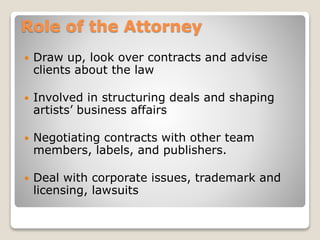
Role of the Attorney
 Draw up, look over contracts and advise
clients about the law
 Involved in structuring deals and shaping
artists’ business affairs
 Negotiating contracts with other team
members, labels, and publishers.
 Deal with corporate issues, trademark and
licensing, lawsuits
Choosing a Lawyer
 Lawyers are one of the most powerful groups
in the music industry. Why?
 Lawyers are involved in all areas of the music
industry, can have more clients than
managers, and business managers only deal
in limited financial areas.
 They see more deals, know more about
what’s going on in town; can influence which
manager and business manager get a client.
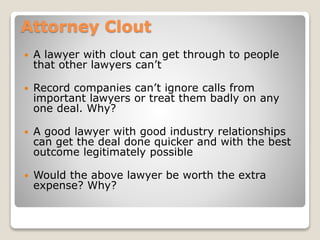
Attorney Clout
 A lawyer with clout can get through to people
that other lawyers can’t
 Record companies can’t ignore calls from
important lawyers or treat them badly on any
one deal. Why?
 A good lawyer with good industry relationships
can get the deal done quicker and with the best
outcome legitimately possible
 Would the above lawyer be worth the extra
expense? Why?
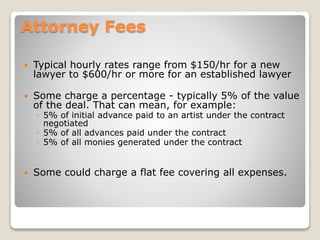
Attorney Fees
 Typical hourly rates range from $150/hr for a new
lawyer to $600/hr or more for an established lawyer
 Some charge a percentage - typically 5% of the value
of the deal. That can mean, for example:
◦ 5% of initial advance paid to an artist under the contract
negotiated
◦ 5% of all advances paid under the contract
◦ 5% of all monies generated under the contract
 Some could charge a flat fee covering all expenses.
Attorney Fees
 Retainer: set monthly fee paid to attorney
to retain their services.
◦ Can be credited toward final bill or cover all
services.
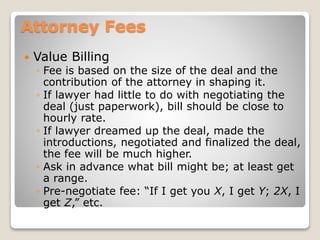
Attorney Fees
 Value Billing
◦ Fee is based on the size of the deal and the
contribution of the attorney in shaping it.
◦ If lawyer had little to do with negotiating the
deal (just paperwork), bill should be close to
hourly rate.
◦ If lawyer dreamed up the deal, made the
introductions, negotiated and finalized the deal,
the fee will be much higher.
◦ Ask in advance what bill might be; at least get
a range.
◦ Pre-negotiate fee: “If I get you X, I get Y; 2X, I
get Z,” etc.
Conflict of Interest
◦ Conflict of interest occurs when attorney has
two clients that have opposing interests.
◦ Can happen when clients either sue each other
or want to make a deal with each other.
◦ In a relatively small industry like the music
business, this happens quite often.
◦ How do you resolve conflict of interest?
Conflict of Interest
Ways to avoid conflicts of interest:
◦ Both clients agree to ignore the conflict of
interest (waive the conflict) and continue
using the same attorney.
◦ Both clients get a new attorney (rare, unless
it’s serious!).
◦ One of the clients gets a new attorney (much
more common).
◦ Clients work out the deal with each other and
attorney just draws up the paperwork.
Conflict of Interest
Conflicts of interest aren’t limited to attorneys!
For example:
Business managers have a conflict when they
represent both manager and artist.
Managers can have a conflict when they are also
the artist’s publisher, producer, or both.
Why?
Attorney Checklist
 Do they have expertise in the music biz?
 What are their fees?
 Do they have a written agreement stating their fees?
 Do they object to independent review of agreement by
another lawyer, your manager, business manager, etc.?
 Get references from artists at your level and check them.
 Do they return phone calls? Get deals done in reasonable
amount of time?
 Do they foresee any conflicts of interest?
◦ Do they also represent your label, manager, etc.
Questions?

Survey passman chap_5_fa13

  • 1.
  • 2.
    Role of theAttorney  Draw up, look over contracts and advise clients about the law  Involved in structuring deals and shaping artists’ business affairs  Negotiating contracts with other team members, labels, and publishers.  Deal with corporate issues, trademark and licensing, lawsuits
  • 3.
    Choosing a Lawyer Lawyers are one of the most powerful groups in the music industry. Why?  Lawyers are involved in all areas of the music industry, can have more clients than managers, and business managers only deal in limited financial areas.  They see more deals, know more about what’s going on in town; can influence which manager and business manager get a client.
  • 4.
    Attorney Clout  Alawyer with clout can get through to people that other lawyers can’t  Record companies can’t ignore calls from important lawyers or treat them badly on any one deal. Why?  A good lawyer with good industry relationships can get the deal done quicker and with the best outcome legitimately possible  Would the above lawyer be worth the extra expense? Why?
  • 5.
    Attorney Fees  Typicalhourly rates range from $150/hr for a new lawyer to $600/hr or more for an established lawyer  Some charge a percentage - typically 5% of the value of the deal. That can mean, for example: ◦ 5% of initial advance paid to an artist under the contract negotiated ◦ 5% of all advances paid under the contract ◦ 5% of all monies generated under the contract  Some could charge a flat fee covering all expenses.
  • 6.
    Attorney Fees  Retainer:set monthly fee paid to attorney to retain their services. ◦ Can be credited toward final bill or cover all services.
  • 7.
    Attorney Fees  ValueBilling ◦ Fee is based on the size of the deal and the contribution of the attorney in shaping it. ◦ If lawyer had little to do with negotiating the deal (just paperwork), bill should be close to hourly rate. ◦ If lawyer dreamed up the deal, made the introductions, negotiated and finalized the deal, the fee will be much higher. ◦ Ask in advance what bill might be; at least get a range. ◦ Pre-negotiate fee: “If I get you X, I get Y; 2X, I get Z,” etc.
  • 8.
    Conflict of Interest ◦Conflict of interest occurs when attorney has two clients that have opposing interests. ◦ Can happen when clients either sue each other or want to make a deal with each other. ◦ In a relatively small industry like the music business, this happens quite often. ◦ How do you resolve conflict of interest?
  • 9.
    Conflict of Interest Waysto avoid conflicts of interest: ◦ Both clients agree to ignore the conflict of interest (waive the conflict) and continue using the same attorney. ◦ Both clients get a new attorney (rare, unless it’s serious!). ◦ One of the clients gets a new attorney (much more common). ◦ Clients work out the deal with each other and attorney just draws up the paperwork.
  • 10.
    Conflict of Interest Conflictsof interest aren’t limited to attorneys! For example: Business managers have a conflict when they represent both manager and artist. Managers can have a conflict when they are also the artist’s publisher, producer, or both. Why?
  • 11.
    Attorney Checklist  Dothey have expertise in the music biz?  What are their fees?  Do they have a written agreement stating their fees?  Do they object to independent review of agreement by another lawyer, your manager, business manager, etc.?  Get references from artists at your level and check them.  Do they return phone calls? Get deals done in reasonable amount of time?  Do they foresee any conflicts of interest? ◦ Do they also represent your label, manager, etc.
  • 12.