Premier Conference David N. Sundwall, M.D. Vice Chair, MACPAC (Medicaid and CHIP Payment and Access Commission) Winning Under Reform Nashville, TN June 15, 2011   Medicaid Under Fire: Partnering Under Reform
Presentation Outline I.  Overview II.  MACPAC III.  MACPAC Reports to Congress March 2011 June 2011 IV.  Future Directions  Managed Care ACOs (Accountable Care Organization)   Other innovations?
I.  Overview  Medicaid in the spotlight: Increased costs Increased enrollment due to recession       (“counter cyclical”) Expansions of Medicaid under PPACA Politics a.  Democrats - Part of the solution to address the problems of the uninsured is to expand Medicaid b.  Republicans - Part of the problem is with unsustainable government spending and “hyper-regulation ”
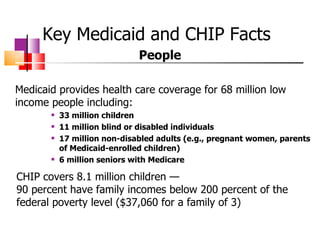
Key Medicaid and CHIP Facts People Medicaid provides health care coverage for 68 million low income people including: 33 million children 11 million blind or disabled individuals 17 million non-disabled adults (e.g., pregnant women, parents of Medicaid-enrolled children) 6 million seniors with Medicare CHIP covers 8.1 million children —  90 percent have family incomes below 200 percent of the federal poverty level ($37,060 for a family of 3)
Key Medicaid and CHIP Facts –  cont. Expenditures Medicaid federal and state expenditures were over $400 billion in FY 2010 and account for: 8.1 percent of total federal outlays 33 percent of all nursing home expenditures 36 percent of all home health care expenditures 25 percent of all mental health and substance abuse treatment spending CHIP federal and state expenditures in FY 2010 were  $11 billion
 
MACPAC –  the Medicaid and CHIP Payment and Access Commission (www.macpac.org) Legislative History Established in February 2009 (Children’s Health Insurance Program Reauthorization Act) Expanded and funded in March 2010 (Patient Protection and Affordable Care Act) Commission Appointed by the Comptroller General of the United States to 3-year terms 17 Commissioners represent broad spectrum of interests and expertise on Medicaid and CHIP
MACPAC - continued Goals Serve as a federal non-partisan and analytic resource on Medicaid and CHIP policy for the Congress Review federal and state Medicaid and CHIP policies and data sources
MACPAC Duties Review Medicaid and CHIP policy issues: Payment policies Access to care issues  Eligibility  Quality of care  Interactions between Medicaid and Medicare  Data policy analysis and program accountability   Create early-warning system to identify provider shortage areas and other factors that adversely affect appropriate access.
MACPAC Duties -  continued Review and comment on Secretarial reports and regulations that relate to policies under Medicaid and CHIP Review federal and state Medicaid and CHIP policies and data sources
III. MACPAC Report to Congress Overview of MACPAC’s March 2011  Report to the Congress Chapters 1-3:  Background and overview of Medicaid and  CHIP Chapters 4-6:  Foundation for MACPAC’s initial approach to  addressing payment, access and data - Evolving  framework  for Commission to examine  access to care - Initial approach for examining Medicaid provider  fee-for-service payment policy across states and  providers -  Outlines federal data sources, issues and potential  areas for improvement for policy and  accountability
III. MACPAC Report to Congress -   continued Medicaid and CHIP Program Statistics (MACStats):  original MACPAC data analysis … perhaps the most useful and valuable contribution of the MACPAC  to date.
Enrollees Enrollee characteristics and health needs Eligibility requirements Access Appropriateness of services and settings Efficiency, economy, and quality of care Health outcomes Chapter 4:  Examining Access to Care in Medicaid and CHIP Framework for monitoring access to care  Will evolve over time to address changing health care practice patterns Challenges in Current Political Climate:   just one example . . .
Preview of the June 2011 Report   Current, baseline information on Medicaid managed care: Medicaid managed care in the context of the U.S. health care system Populations enrolled in Medicaid managed care Managed care models  Payment policies Access and quality Program accountability, integrity and data  Future issues facing Medicaid managed care MACStats tables and figures include:   Trends in Medicaid enrollment and spending Current health characteristics, enrollment, and benefit spending among Medicaid populations Medicaid managed care enrollment
IV. Future Directions . . . Context:  “ Taming the Medicaid Monster”….  (headline on the front page of the Salt Lake  Tribune, November 2010)
IV. Future Directions . . .  States activities – “WAIVERS”  ( from lots of requirements or proposed policies under the PPACA) 1) Movement to more  “managed care”  (risk-based) for all categories of eligible beneficiaries,  e.g. Utah’s waiver   for an “HMO-like ACO”,  +:  allow state to provide a “premium subsidy to purchase private insurance on the Health Insurance Exchange, in lieu of Medicaid for those who qualify ;  and   set a cap on state spending for Medicaid (can’t grow faster than the state budget)   2)  Create alternative delivery systems and/or payment policies , e.g., “Accountable Care Organizations” (ACOs), and “medical homes,” to better coordinate care and hopefully reduce expenditures.
IV. Future Directions . . .  Continued – Federal activities 1)  BUDGET ? 2)  Amendments to PPACA - Amend the PPACA  to repeal the “Maintenance of Effort”  (MOE) requirement of states, i.e. allow  flexibility to limit eligibility (S.868) 3)  Block grant ? ( see Kaiser Family Foundation analysis) 4)  Status of PPACA due to litigation/Supreme  Court consideration in 2012 - ?

Sundwall medicaid

  • 1.
    Premier Conference DavidN. Sundwall, M.D. Vice Chair, MACPAC (Medicaid and CHIP Payment and Access Commission) Winning Under Reform Nashville, TN June 15, 2011 Medicaid Under Fire: Partnering Under Reform
  • 2.
    Presentation Outline I. Overview II. MACPAC III. MACPAC Reports to Congress March 2011 June 2011 IV. Future Directions Managed Care ACOs (Accountable Care Organization) Other innovations?
  • 3.
    I. Overview Medicaid in the spotlight: Increased costs Increased enrollment due to recession (“counter cyclical”) Expansions of Medicaid under PPACA Politics a. Democrats - Part of the solution to address the problems of the uninsured is to expand Medicaid b. Republicans - Part of the problem is with unsustainable government spending and “hyper-regulation ”
  • 4.
    Key Medicaid andCHIP Facts People Medicaid provides health care coverage for 68 million low income people including: 33 million children 11 million blind or disabled individuals 17 million non-disabled adults (e.g., pregnant women, parents of Medicaid-enrolled children) 6 million seniors with Medicare CHIP covers 8.1 million children — 90 percent have family incomes below 200 percent of the federal poverty level ($37,060 for a family of 3)
  • 5.
    Key Medicaid andCHIP Facts – cont. Expenditures Medicaid federal and state expenditures were over $400 billion in FY 2010 and account for: 8.1 percent of total federal outlays 33 percent of all nursing home expenditures 36 percent of all home health care expenditures 25 percent of all mental health and substance abuse treatment spending CHIP federal and state expenditures in FY 2010 were $11 billion
  • 6.
  • 7.
    MACPAC – the Medicaid and CHIP Payment and Access Commission (www.macpac.org) Legislative History Established in February 2009 (Children’s Health Insurance Program Reauthorization Act) Expanded and funded in March 2010 (Patient Protection and Affordable Care Act) Commission Appointed by the Comptroller General of the United States to 3-year terms 17 Commissioners represent broad spectrum of interests and expertise on Medicaid and CHIP
  • 8.
    MACPAC - continuedGoals Serve as a federal non-partisan and analytic resource on Medicaid and CHIP policy for the Congress Review federal and state Medicaid and CHIP policies and data sources
  • 9.
    MACPAC Duties ReviewMedicaid and CHIP policy issues: Payment policies Access to care issues Eligibility Quality of care Interactions between Medicaid and Medicare Data policy analysis and program accountability Create early-warning system to identify provider shortage areas and other factors that adversely affect appropriate access.
  • 10.
    MACPAC Duties - continued Review and comment on Secretarial reports and regulations that relate to policies under Medicaid and CHIP Review federal and state Medicaid and CHIP policies and data sources
  • 11.
    III. MACPAC Reportto Congress Overview of MACPAC’s March 2011 Report to the Congress Chapters 1-3: Background and overview of Medicaid and CHIP Chapters 4-6: Foundation for MACPAC’s initial approach to addressing payment, access and data - Evolving framework for Commission to examine access to care - Initial approach for examining Medicaid provider fee-for-service payment policy across states and providers - Outlines federal data sources, issues and potential areas for improvement for policy and accountability
  • 12.
    III. MACPAC Reportto Congress - continued Medicaid and CHIP Program Statistics (MACStats): original MACPAC data analysis … perhaps the most useful and valuable contribution of the MACPAC to date.
  • 13.
    Enrollees Enrollee characteristicsand health needs Eligibility requirements Access Appropriateness of services and settings Efficiency, economy, and quality of care Health outcomes Chapter 4: Examining Access to Care in Medicaid and CHIP Framework for monitoring access to care Will evolve over time to address changing health care practice patterns Challenges in Current Political Climate: just one example . . .
  • 14.
    Preview of theJune 2011 Report Current, baseline information on Medicaid managed care: Medicaid managed care in the context of the U.S. health care system Populations enrolled in Medicaid managed care Managed care models Payment policies Access and quality Program accountability, integrity and data Future issues facing Medicaid managed care MACStats tables and figures include: Trends in Medicaid enrollment and spending Current health characteristics, enrollment, and benefit spending among Medicaid populations Medicaid managed care enrollment
  • 15.
    IV. Future Directions. . . Context: “ Taming the Medicaid Monster”…. (headline on the front page of the Salt Lake Tribune, November 2010)
  • 16.
    IV. Future Directions. . . States activities – “WAIVERS” ( from lots of requirements or proposed policies under the PPACA) 1) Movement to more “managed care” (risk-based) for all categories of eligible beneficiaries, e.g. Utah’s waiver for an “HMO-like ACO”, +: allow state to provide a “premium subsidy to purchase private insurance on the Health Insurance Exchange, in lieu of Medicaid for those who qualify ; and set a cap on state spending for Medicaid (can’t grow faster than the state budget) 2) Create alternative delivery systems and/or payment policies , e.g., “Accountable Care Organizations” (ACOs), and “medical homes,” to better coordinate care and hopefully reduce expenditures.
  • 17.
    IV. Future Directions. . . Continued – Federal activities 1) BUDGET ? 2) Amendments to PPACA - Amend the PPACA to repeal the “Maintenance of Effort” (MOE) requirement of states, i.e. allow flexibility to limit eligibility (S.868) 3) Block grant ? ( see Kaiser Family Foundation analysis) 4) Status of PPACA due to litigation/Supreme Court consideration in 2012 - ?