A
Summer Training Project Report
on
A Study of Working Capital of ITC LTD
at
ITC ltd ( Saharanpur)
• Submitted To:
Head & Dean(FMS)
Dr. Vishnu Nath (Guide)
• Submitted By:
Shivansh Goyal
roll no: 31
MANAGEMENT OF WORKING CAPITAL
Management of working capital is concerned with the
problem that arises in attempting to manage the
current assets, current liabilities. The basic goal of
working capital management is to manage the current
assets and current liabilities of a firm in such a way that
a satisfactory level of working capital is maintained, i.e.
it is neither adequate nor excessive as both the
situations are bad for any firm. There should be no
shortage of funds and also no working capital should
be ideal. WORKING CAPITAL MANAGEMENT POLICES of
a firm has a great on its probability, liquidity and
structural health of the organization. working capital
management is three dimensional in nature as
Working capital management has three
dimensional in nature as
1. It concerned with the formulation of
policies with regard to profitability, liquidity
and risk.
2. It is concerned with the decision about
the composition and level of current assets.
3. It is concerned with the decision about
the composition and level of current liabilities.
WORKING CAPITAL ANALYSIS
As we know working capital is the life blood and the
centre of a business. Adequate amount of working
capital is very much essential for the smooth running
of the business. And the most important part is the
efficient management of working capital in right time.
The liquidity position of the firm is totally effected by
the management of working capital. So, a study of
changes in the uses and sources of working capital is
necessary to evaluate the efficiency with which the
working capital is employed in a business. This involves
the need of working capital analysis
The analysis of working capital can be conducted
through a number of devices, such as:
1. Ratio analysis.
2. Fund flow analysis.
3. Budgeting.
METHODS OF WORKING CAPITAL
ANALYSIS
There are so many methods for analysis of financial
statements but ITC LTD. used the following
techniques:-
• Comparative size statements
• Trend analysis
• Cash flow statement
• Ratio analysis
A detail description of these methods
is as follows:-
• COMPARATIVE SIZE STATEMENTS:-
When two or more than two years figures are
compared to each other than we called
comparative size statements in order to estimate
the future progress of the business, it is
necessary to look the past performance of the
company. These statements show the absolute
figures and also show the change from one year
to another
• TREND ANALYSIS:-
To analyze many years financial statements ITC
LTD. uses this method. This indicates the
direction on movement over the long time
and help in the financial statements.
Procedure for calculating trends:-
Previous year is taken as a base year.
Figures of the base year are taken 100.
Trend % are calculated in relation to year
CASH FLOW STATEMENT:-
Cash flow statements are the statements of changes in
the financial position prepared on the basis of funds
defined in cash or cash equivalents. In short cash flow
statement summaries the cash inflows and outflows of
the firm during a particular period of time.
Benefits for the ITC LTD.:-
To prepare the cash budget.
To compare the cash budgets .
To show the position of the cash and
cash equivalents
• RATIO ANALYSIS:-
Ratio analysis is the process of the determining and
presenting the relationship of the items and group of items
in the statements.
Benefits of ratio analysis to ITC LTD.:-
• Helpful in analysis of financial statements.
• Helpful in comparative study.
• Helpful in locating the weak spots of the ITC LTD.
• Helpful in forecasting.
• Estimate about the trend of the business.
• Fixation of ideal standards.
• Effective control.
• Study of financial soundness.
Data analysis & interpretation:
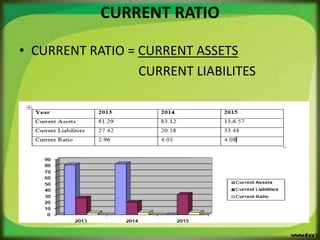
CURRENT RATIO
• CURRENT RATIO = CURRENT ASSETS
CURRENT LIABILITES
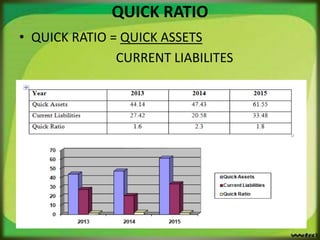
QUICK RATIO
• QUICK RATIO = QUICK ASSETS
CURRENT LIABILITES
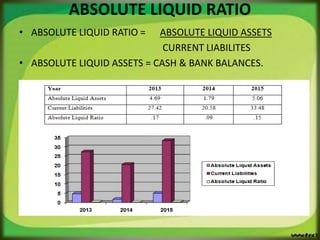
ABSOLUTE LIQUID RATIO
• ABSOLUTE LIQUID RATIO = ABSOLUTE LIQUID ASSETS
CURRENT LIABILITES
• ABSOLUTE LIQUID ASSETS = CASH & BANK BALANCES.
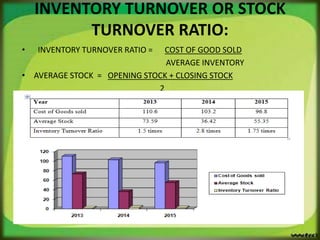
INVENTORY TURNOVER OR STOCK
TURNOVER RATIO:
• INVENTORY TURNOVER RATIO = COST OF GOOD SOLD
AVERAGE INVENTORY
• AVERAGE STOCK = OPENING STOCK + CLOSING STOCK
2
COMPANY PROFILE
• ITC is one of India's foremost private sector
companies with a market capitalisation of over
US $ 22 billion and a turnover of over US $ 5
billion.* ITC is rated among the World's Best Big
Companies, Asia's 'Fab 50' and the World's Most
Reputable Companies by Forbes magazine,
among India's Most Respected Companies by
Business World and among India's Most Valuable
Companies by Business Today. ITC ranks among
India's `10 Most Valuable (Company) Brands', in a
study conducted by Brand Finance and published
by the Economic Times. ITC also ranks among
Asia's 50 best performing companies compiled by
Business Week.
• ITC has a diversified presence in Cigarettes, Hotels,
Paperboards & Specialty Papers, Packaging, Agri-Business,
Packaged Foods & Confectionery, Information Technology,
Branded Apparel, Personal Care, Stationery, Safety Matches
and other FMCG products.
• Chairman Y C Deveshwar calls this source of inspiration "a
commitment beyond the market". In his own words: "ITC
believes that its aspiration to create enduring value for the
nation provides the motive force to sustain growing
shareholder value. ITC practices this philosophy by not only
driving each of its businesses towards international
competitiveness but by also consciously contributing to
enhancing the competitiveness of the larger value chain of
which it is a part."
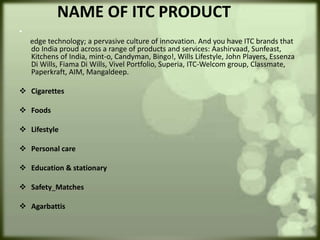
NAME OF ITC PRODUCT
•
edge technology; a pervasive culture of innovation. And you have ITC brands that
do India proud across a range of products and services: Aashirvaad, Sunfeast,
Kitchens of India, mint-o, Candyman, Bingo!, Wills Lifestyle, John Players, Essenza
Di Wills, Fiama Di Wills, Vivel Portfolio, Superia, ITC-Welcom group, Classmate,
Paperkraft, AIM, Mangaldeep.
 Cigarettes
 Foods
 Lifestyle
 Personal care
 Education & stationary
 Safety Matches
 Agarbattis
CONCLUSION
• In the present study I have analyzed the working
management of ITC Limited.
• I found that inventory is increasing which shows that
company has sufficient stocks to meet up out production of
the company.
• Inventory Turnover Ratio measures the velocity of
conversion of stock into sales. Usually, a high inventory
turnover indicates efficient management of inventory
because more frequently the stocks are sold, the lesser
amount of money is required to finance the inventory. The
Inventory Turnover Ratio is decreasing which is not a good
sign for the company.
• So the company’s performance outlook
continues to be positive and optimistic. The
company remains confident of delivering of
strong operating and financial performance.
Efficient stock velocity indicates efficient
management of inventory of the firm and no
slow movement of the stock due to damaged
goods.
Thank You

Summer training report of itc

  • 1.
    A Summer Training ProjectReport on A Study of Working Capital of ITC LTD at ITC ltd ( Saharanpur)
  • 2.
    • Submitted To: Head& Dean(FMS) Dr. Vishnu Nath (Guide) • Submitted By: Shivansh Goyal roll no: 31
  • 3.
    MANAGEMENT OF WORKINGCAPITAL Management of working capital is concerned with the problem that arises in attempting to manage the current assets, current liabilities. The basic goal of working capital management is to manage the current assets and current liabilities of a firm in such a way that a satisfactory level of working capital is maintained, i.e. it is neither adequate nor excessive as both the situations are bad for any firm. There should be no shortage of funds and also no working capital should be ideal. WORKING CAPITAL MANAGEMENT POLICES of a firm has a great on its probability, liquidity and structural health of the organization. working capital management is three dimensional in nature as
  • 4.
    Working capital managementhas three dimensional in nature as 1. It concerned with the formulation of policies with regard to profitability, liquidity and risk. 2. It is concerned with the decision about the composition and level of current assets. 3. It is concerned with the decision about the composition and level of current liabilities.
  • 5.
    WORKING CAPITAL ANALYSIS Aswe know working capital is the life blood and the centre of a business. Adequate amount of working capital is very much essential for the smooth running of the business. And the most important part is the efficient management of working capital in right time. The liquidity position of the firm is totally effected by the management of working capital. So, a study of changes in the uses and sources of working capital is necessary to evaluate the efficiency with which the working capital is employed in a business. This involves the need of working capital analysis
  • 6.
    The analysis ofworking capital can be conducted through a number of devices, such as: 1. Ratio analysis. 2. Fund flow analysis. 3. Budgeting.
  • 7.
    METHODS OF WORKINGCAPITAL ANALYSIS There are so many methods for analysis of financial statements but ITC LTD. used the following techniques:- • Comparative size statements • Trend analysis • Cash flow statement • Ratio analysis
  • 8.
    A detail descriptionof these methods is as follows:- • COMPARATIVE SIZE STATEMENTS:- When two or more than two years figures are compared to each other than we called comparative size statements in order to estimate the future progress of the business, it is necessary to look the past performance of the company. These statements show the absolute figures and also show the change from one year to another
  • 9.
    • TREND ANALYSIS:- Toanalyze many years financial statements ITC LTD. uses this method. This indicates the direction on movement over the long time and help in the financial statements. Procedure for calculating trends:- Previous year is taken as a base year. Figures of the base year are taken 100. Trend % are calculated in relation to year
  • 10.
    CASH FLOW STATEMENT:- Cashflow statements are the statements of changes in the financial position prepared on the basis of funds defined in cash or cash equivalents. In short cash flow statement summaries the cash inflows and outflows of the firm during a particular period of time. Benefits for the ITC LTD.:- To prepare the cash budget. To compare the cash budgets . To show the position of the cash and cash equivalents
  • 11.
    • RATIO ANALYSIS:- Ratioanalysis is the process of the determining and presenting the relationship of the items and group of items in the statements. Benefits of ratio analysis to ITC LTD.:- • Helpful in analysis of financial statements. • Helpful in comparative study. • Helpful in locating the weak spots of the ITC LTD. • Helpful in forecasting. • Estimate about the trend of the business. • Fixation of ideal standards. • Effective control. • Study of financial soundness.
  • 12.
    Data analysis &interpretation:
  • 13.
    CURRENT RATIO • CURRENTRATIO = CURRENT ASSETS CURRENT LIABILITES
  • 14.
    QUICK RATIO • QUICKRATIO = QUICK ASSETS CURRENT LIABILITES
  • 15.
    ABSOLUTE LIQUID RATIO •ABSOLUTE LIQUID RATIO = ABSOLUTE LIQUID ASSETS CURRENT LIABILITES • ABSOLUTE LIQUID ASSETS = CASH & BANK BALANCES.
  • 16.
    INVENTORY TURNOVER ORSTOCK TURNOVER RATIO: • INVENTORY TURNOVER RATIO = COST OF GOOD SOLD AVERAGE INVENTORY • AVERAGE STOCK = OPENING STOCK + CLOSING STOCK 2
  • 17.
  • 18.
    • ITC isone of India's foremost private sector companies with a market capitalisation of over US $ 22 billion and a turnover of over US $ 5 billion.* ITC is rated among the World's Best Big Companies, Asia's 'Fab 50' and the World's Most Reputable Companies by Forbes magazine, among India's Most Respected Companies by Business World and among India's Most Valuable Companies by Business Today. ITC ranks among India's `10 Most Valuable (Company) Brands', in a study conducted by Brand Finance and published by the Economic Times. ITC also ranks among Asia's 50 best performing companies compiled by Business Week.
  • 19.
    • ITC hasa diversified presence in Cigarettes, Hotels, Paperboards & Specialty Papers, Packaging, Agri-Business, Packaged Foods & Confectionery, Information Technology, Branded Apparel, Personal Care, Stationery, Safety Matches and other FMCG products. • Chairman Y C Deveshwar calls this source of inspiration "a commitment beyond the market". In his own words: "ITC believes that its aspiration to create enduring value for the nation provides the motive force to sustain growing shareholder value. ITC practices this philosophy by not only driving each of its businesses towards international competitiveness but by also consciously contributing to enhancing the competitiveness of the larger value chain of which it is a part."
  • 22.
    NAME OF ITCPRODUCT • edge technology; a pervasive culture of innovation. And you have ITC brands that do India proud across a range of products and services: Aashirvaad, Sunfeast, Kitchens of India, mint-o, Candyman, Bingo!, Wills Lifestyle, John Players, Essenza Di Wills, Fiama Di Wills, Vivel Portfolio, Superia, ITC-Welcom group, Classmate, Paperkraft, AIM, Mangaldeep.  Cigarettes  Foods  Lifestyle  Personal care  Education & stationary  Safety Matches  Agarbattis
  • 23.
    CONCLUSION • In thepresent study I have analyzed the working management of ITC Limited. • I found that inventory is increasing which shows that company has sufficient stocks to meet up out production of the company. • Inventory Turnover Ratio measures the velocity of conversion of stock into sales. Usually, a high inventory turnover indicates efficient management of inventory because more frequently the stocks are sold, the lesser amount of money is required to finance the inventory. The Inventory Turnover Ratio is decreasing which is not a good sign for the company.
  • 24.
    • So thecompany’s performance outlook continues to be positive and optimistic. The company remains confident of delivering of strong operating and financial performance. Efficient stock velocity indicates efficient management of inventory of the firm and no slow movement of the stock due to damaged goods.
  • 25.