Marriner S. Eccles’s view
on the Great Depression
In comparison with Keynes and Samuelson’s views
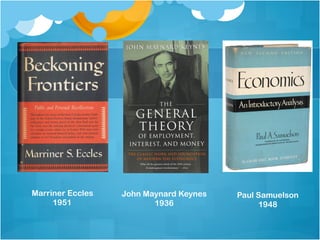
Marriner Eccles
1951
John Maynard Keynes
1936
Paul Samuelson
1948
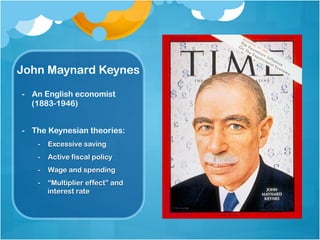
John Maynard Keynes
-  An English economist
(1883-1946)
-  The Keynesian theories:
-  Excessive saving
-  Active fiscal policy
-  Wage and spending
-  “Multiplier effect” and
interest rate
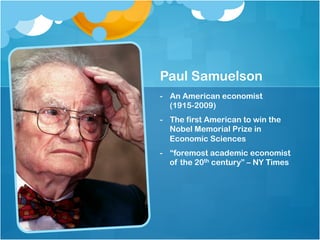
Paul Samuelson
-  An American economist
(1915-2009)
-  The first American to win the
Nobel Memorial Prize in
Economic Sciences
-  “foremost academic economist
of the 20th century” – NY Times
Marriner Eccles
(1890 – 1977)
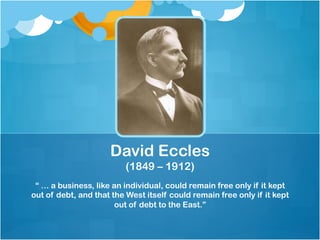
“ … a business, like an individual, could remain free only if it kept
out of debt, and that the West itself could remain free only if it kept
out of debt to the East.”
David Eccles
(1849 – 1912)
The Roaring
Twenties •  1920-1929
The Great Crash •  1929
Eccles stopped a
bank run •  1931
Franklin
Roosevelt was
elected as the
President
•  1933
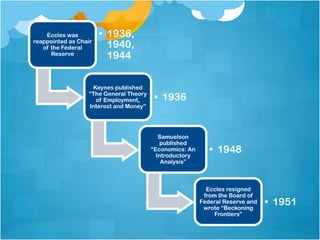
Eccles was
appointed as the
Chairman of the
Federal Reserve
•  1934
Eccles was
reappointed as Chair
of the Federal
Reserve
•  1936,
1940,
1944
Keynes published
“The General Theory
of Employment,
Interest and Money”
•  1936
Samuelson
published
“Economics: An
Introductory
Analysis”
•  1948
Eccles resigned
from the Board of
Federal Reserve and
wrote “Beckoning
Frontiers”
•  1951
The Great
Depression
-  What most people thought ><
What Eccles’s idea
-  Excessive saving can be
detrimental during a
recession
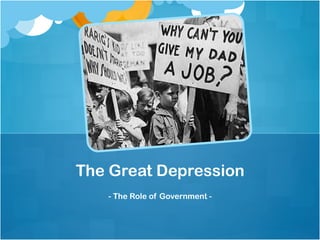
- The Role of Government -
The Great Depression
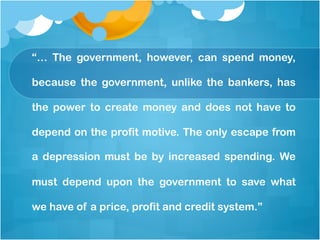
“… The government, however, can spend money,
because the government, unlike the bankers, has
the power to create money and does not have to
depend on the profit motive. The only escape from
a depression must be by increased spending. We
must depend upon the government to save what
we have of a price, profit and credit system.”
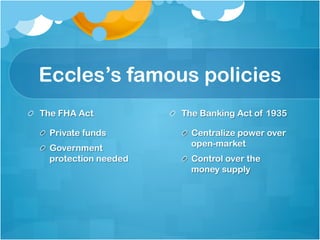
Eccles’s famous policies
  The FHA Act
  Private funds
  Government
protection needed
  The Banking Act of 1935
  Centralize power over
open-market
  Control over the
money supply
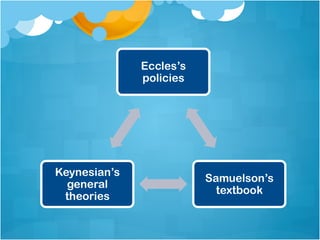
Eccles’s
policies
Samuelson’s
textbook
Keynesian’s
general
theories
Summer Research Presentation

Summer Research Presentation

  • 1.
    Marriner S. Eccles’sview on the Great Depression In comparison with Keynes and Samuelson’s views
  • 2.
    Marriner Eccles 1951 John MaynardKeynes 1936 Paul Samuelson 1948
  • 3.
    John Maynard Keynes - An English economist (1883-1946) -  The Keynesian theories: -  Excessive saving -  Active fiscal policy -  Wage and spending -  “Multiplier effect” and interest rate
  • 4.
    Paul Samuelson -  AnAmerican economist (1915-2009) -  The first American to win the Nobel Memorial Prize in Economic Sciences -  “foremost academic economist of the 20th century” – NY Times
  • 5.
  • 6.
    “ … abusiness, like an individual, could remain free only if it kept out of debt, and that the West itself could remain free only if it kept out of debt to the East.” David Eccles (1849 – 1912)
  • 7.
    The Roaring Twenties • 1920-1929 The Great Crash •  1929 Eccles stopped a bank run •  1931 Franklin Roosevelt was elected as the President •  1933 Eccles was appointed as the Chairman of the Federal Reserve •  1934
  • 8.
    Eccles was reappointed asChair of the Federal Reserve •  1936, 1940, 1944 Keynes published “The General Theory of Employment, Interest and Money” •  1936 Samuelson published “Economics: An Introductory Analysis” •  1948 Eccles resigned from the Board of Federal Reserve and wrote “Beckoning Frontiers” •  1951
  • 9.
    The Great Depression -  Whatmost people thought >< What Eccles’s idea -  Excessive saving can be detrimental during a recession
  • 10.
    - The Roleof Government - The Great Depression
  • 11.
    “… The government,however, can spend money, because the government, unlike the bankers, has the power to create money and does not have to depend on the profit motive. The only escape from a depression must be by increased spending. We must depend upon the government to save what we have of a price, profit and credit system.”
  • 12.
    Eccles’s famous policies  The FHA Act   Private funds   Government protection needed   The Banking Act of 1935   Centralize power over open-market   Control over the money supply
  • 13.